
You know your company website needs a redesign. It is slow, it looks dated, it is not mobile-friendly, and it is converting a fraction of what it should. You have the agency quotes. You know what needs to happen.
Now you have to convince someone with budget authority to approve the spend.
This is where most website redesign arguments fall apart — not because the case is weak, but because it is made emotionally rather than financially. “Our website looks old” does not unlock a $15,000 budget. “Our website is currently costing us an estimated $8,400 per month in lost conversions, and a redesign would recoup that investment in 4.3 months” — that unlocks a budget.
This guide gives you exactly that: the ROI calculation framework, the specific formulas, the data points you need to gather, real-world benchmarks to use when you do not have your own data, and a complete ready-to-present business case template. Whether you are justifying a redesign to a CEO, a finance director, a board, or your own business partner, you will leave this guide with a number-backed argument that is genuinely difficult to say no to.

Aesthetic arguments — the website looks dated, competitors have better-looking sites, we feel embarrassed sending prospects there — are real concerns, but they are almost never sufficient to justify a significant capital expenditure in a business that manages its finances responsibly. Decision-makers with budget authority have been trained (rightly) to evaluate investments on financial return, not on aesthetic preference.
The good news: website redesigns almost always have a genuinely strong financial case. The problem is that most people making the argument never build it properly. They come to the budget conversation with a quote and a vague sense that the new website will be “better,” rather than with a specific calculation of what the current website is costing the business every month in lost revenue — and a specific projection of what the redesigned website will recover.
Your job in the budget conversation is not to argue that the website needs to look better. It is to demonstrate that the current website is a revenue problem that a redesign solves, and that the return on the investment pays back the cost within a commercially acceptable timeframe.
Here is exactly how to build that argument.
A website redesign can affect your business revenue through four distinct mechanisms. Understanding which ones apply to your business — and quantifying the impact on each — is the foundation of your ROI calculation.
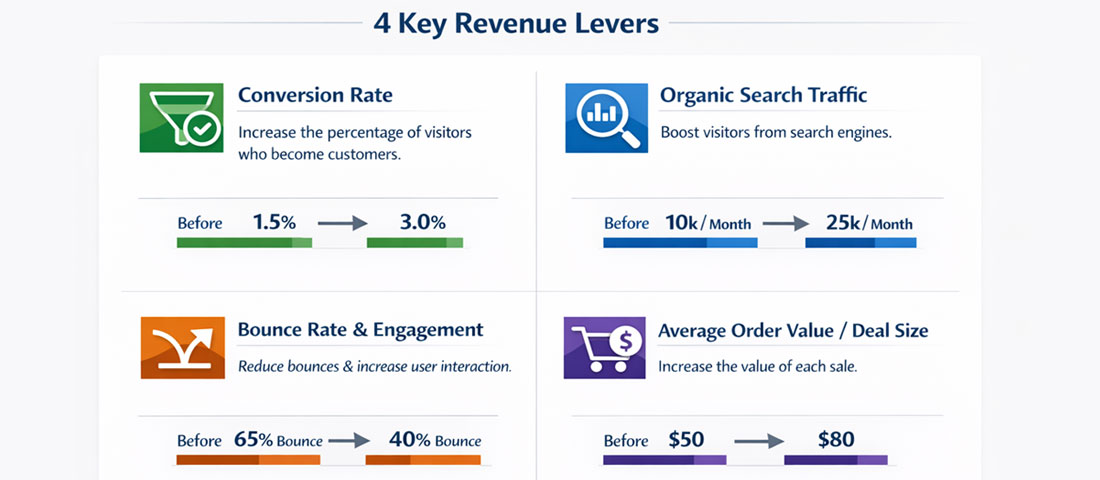
A website redesign typically affects revenue through four levers simultaneously — quantifying the impact on each one builds the financial case that wins budget approval.
This is the primary lever for most service business websites. How many of your current visitors are converting to enquiries, calls, or purchases? And what would a better-designed, faster-loading, more trust-signalling website convert at? Research from Portent shows that conversion rates drop sharply as page load time increases — a page loading in 1 second converts at 3x the rate of one loading in 5 seconds. CRO research from various sources consistently shows that redesigned websites with improved UX and conversion-focused design see 20 to 200% improvement in conversion rates.
If your current website has poor Core Web Vitals, is not mobile-optimised, or has thin SEO foundations, it is ranking below where it should for your target keywords. A properly built redesign — with performance-optimised code, correct heading structure, schema markup, and mobile-first design — can meaningfully improve Google rankings and the organic traffic they deliver. More relevant organic traffic at the same conversion rate equals more revenue.
A high bounce rate means visitors arrive and leave without engaging. Every bounced visitor represents traffic cost (whether from SEO investment, advertising, or social media effort) with zero return. A redesigned website that communicates value more clearly, loads faster, and provides a better mobile experience typically reduces bounce rate — meaning more of the traffic you are already generating actually engages with your business.
A professionally designed website that clearly communicates quality, expertise, and premium positioning allows businesses to attract and convert higher-value clients. For service businesses, this means clients who value quality over price. For eCommerce, it means better product presentation that supports higher price points and upsell conversion. This lever is harder to quantify but real — and for businesses where positioning is a commercial strategy, it can be the most impactful of the four.
Here is the complete framework for calculating your website redesign ROI. Work through each step in order. You will need your current website analytics data — pull it from Google Analytics 4 and Google Search Console before you begin.
Monthly Website Revenue =
  Monthly Unique Visitors
  × Conversion Rate (%)
  × Average Value Per Conversion ($)

Example:
  5,000 monthly visitors
  × 1.2% conversion rate
  × $350 average enquiry value (or deal value)
  = $21,000 in attributed monthly revenue
Where to find these numbers:
If you don’t have conversion tracking set up: You cannot calculate ROI without knowing your current conversion rate. Before doing anything else, set up GA4 goal tracking for your key conversion actions (form submissions, phone calls, purchases). If you need a starting point, use the industry benchmarks in the next section.
This is where conservative, credible assumptions are crucial. Do not project a 300% conversion rate improvement — even if research supports it in the best cases. Use the lower end of realistic ranges and your boss will trust the calculation. Use the upper end and they will question your credibility.
Conservative improvement assumptions:
  Conversion rate improvement:    +25% (e.g. 1.2% → 1.5%)
  Organic traffic improvement:    +20% (from better SEO foundations)
  Bounce rate reduction:          -15% (better mobile UX)

Post-redesign monthly revenue estimate:
  Visitors: 5,000 × 1.20 = 6,000 (with traffic improvement)
  Conversion rate: 1.5%
  Average value: $350

  6,000 × 1.5% × $350 = $31,500/month

Monthly revenue increase: $31,500 - $21,000 = $10,500/month
Include every cost associated with the redesign — not just the agency fee:
Total Redesign Investment =
  Agency design and development fee
  + Copywriting (if outsourced)
  + Photography (if needed)
  + Premium plugins or themes
  + SSL certificate and hosting migration (if applicable)
  + Staff time for content review and approvals
    (estimate hours × hourly rate)

Example:
  Agency fee:           $8,500
  Copywriting:          $1,200
  Photography:          $800
  Plugin licences:      $300
  Staff time (20hrs):   $1,000
  ─────────────────────────────
  Total investment:     $11,800
Monthly revenue increase:  $10,500

Payback period:
  Total investment ÷ Monthly revenue increase
  = $11,800 ÷ $10,500
  = 1.12 months

12-month ROI:
  (Monthly revenue increase × 12) - Total investment
  ─────────────────────────────────────────────────
                Total investment

  = ($10,500 × 12) - $11,800
    ─────────────────────────
           $11,800

  = ($126,000 - $11,800) ÷ $11,800
  = 967% ROI over 12 months
Even with much more conservative assumptions — say a 15% conversion improvement and 10% traffic growth — most business websites with meaningful traffic produce a 3 to 6 month payback period on a quality redesign. That is a commercially excellent investment by any standard.
Use this table as your working calculator. Fill in your own numbers in the “Your Numbers” column.
| Metric | Formula / Source | Example | Your Numbers |
|---|---|---|---|
| Monthly unique visitors | GA4 → Acquisition | 5,000 | ___________ |
| Current conversion rate | Conversions ÷ Sessions × 100 | 1.2% | ___________ |
| Monthly conversions | Visitors × Conversion rate | 60 | ___________ |
| Average value per conversion | CRM / eCommerce data | $350 | ___________ |
| Current monthly revenue (website) | Conversions × Avg value | $21,000 | ___________ |
| Projected conversion rate (post-redesign) | Current rate + conservative % improvement | 1.5% | ___________ |
| Projected traffic (post-redesign) | Current visitors × (1 + % growth) | 6,000 | ___________ |
| Projected monthly revenue (post-redesign) | New visitors × New rate × Avg value | $31,500 | ___________ |
| Monthly revenue increase | Post-redesign – Current | $10,500 | ___________ |
| Total redesign investment | All costs including staff time | $11,800 | ___________ |
| Payback period (months) | Total investment ÷ Monthly increase | 1.12 months | ___________ |
| 12-month ROI (%) | (Monthly increase × 12 – Investment) ÷ Investment × 100 | 967% | ___________ |
If you do not yet have reliable conversion tracking data, use these industry benchmarks as conservative starting points. Be transparent with your decision-makers that these are industry averages, not your specific data — and commit to setting up proper analytics tracking as part of the redesign project.
| Business Type | Avg Conversion Rate (Current) | Post-Redesign Improvement | Bounce Rate Reduction |
|---|---|---|---|
| Professional services (law, accounting, consulting) | 1.5 – 3.0% | 25 – 50% | 15 – 25% |
| Web design / marketing agencies | 2.0 – 4.0% | 20 – 40% | 10 – 20% |
| eCommerce (general) | 1.0 – 3.5% | 25 – 75% | 20 – 35% |
| B2B technology / SaaS | 2.5 – 5.0% | 20 – 35% | 10 – 20% |
| Healthcare and medical | 3.0 – 5.0% | 20 – 40% | 15 – 25% |
| Local service businesses (plumbing, roofing, etc.) | 3.5 – 7.0% | 15 – 30% | 15 – 25% |
| Education / training | 2.0 – 4.0% | 25 – 50% | 15 – 30% |
Key improvement drivers for your benchmarks:
This is the most powerful component of your business case — and the one most commonly omitted. The question your boss should be asked is not just “what does a redesign cost?” but “what is our current website costing us every month?”
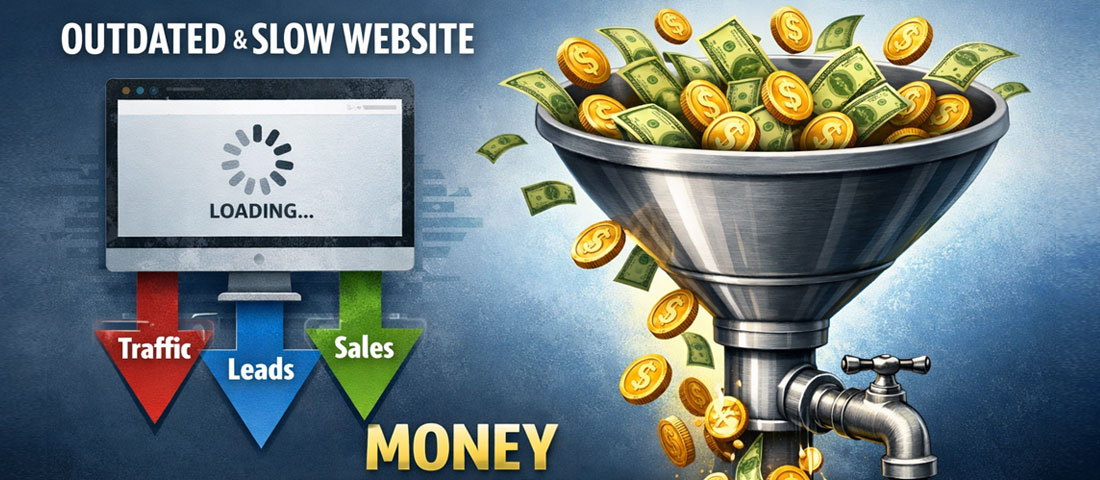
Every month without a redesign is not a month of saving the redesign cost — it is a month of paying the ongoing cost of underperformance in lost conversions, lost rankings, and lost credibility.
Monthly cost of not redesigning =
  Potential monthly revenue (post-redesign)
  - Current monthly revenue

= $31,500 - $21,000 = $10,500/month

This means:
  Every month of delay costs:     $10,500
  Every quarter of delay costs:   $31,500
  Every year of delay costs:      $126,000
Presented this way, the $11,800 redesign investment looks very different. The question is not “can we afford to spend $11,800 on a website?” It is “can we afford to lose $10,500 every month by not investing $11,800?”
The inaction argument also counters the “let’s wait until next quarter” response. Waiting a quarter to start the redesign costs $31,500 in foregone revenue — significantly more than the redesign itself.
Decision-makers with budget authority care most about two numbers: payback period (how long until we get our money back) and ROI (what return does this generate versus alternatives for that capital).
Payback Period (months) =
  Total Redesign Investment
  ──────────────────────────
  Monthly Revenue Increase

= $11,800 ÷ $10,500 = 1.12 months

If your boss is accustomed to 12 to 24 month paybacks on
capital investments, a 1 to 4 month payback period is
exceptionally compelling.
Even a very conservative calculation — assuming only a 15% conversion improvement with no traffic growth — on a business with 3,000 monthly visitors, 1.5% conversion rate, and $500 average deal value produces:
Current monthly revenue:  3,000 × 1.5% × $500 = $22,500
Post-redesign:            3,000 × 1.73% × $500 = $25,875
Monthly increase:         $3,375
Payback period:           $12,000 ÷ $3,375 = 3.6 months
12-month ROI:             ($3,375 × 12 - $12,000) / $12,000 = 238%
A 238% ROI with a 3.6-month payback is a strong business investment by any financial standard.
Here is the structure for a one-page or three-slide business case that uses the numbers you have calculated above. Keep it brief — decision-makers respond to clear, confident financial arguments, not lengthy presentations.
“Google’s Core Web Vitals were introduced as ranking factors in 2021. Mobile-first indexing became the standard in 2023. Our current site predates both — and is being penalised in search rankings as a result. The market has changed more in three years than it did in the previous decade.”
“We can, and that might address specific issues. But the fundamental performance problems — slow load time, poor mobile experience, weak SEO structure — are architectural. Updating a poorly built house is more expensive than rebuilding it correctly. I have a quote that addresses this specifically.”
“They are projections, yes — I’ve used conservative assumptions at the lower end of documented industry benchmarks. I’m also happy to structure the investment around a 90-day post-launch performance review, so we have real data to assess against these projections.”
“Every month we wait costs us approximately $X,XXX in lost conversions. The question is less ‘can we afford to invest $12,000?’ and more ‘can we afford to continue losing $X,XXX every month?’ The redesign pays for itself in under [X] months.”
“I’ve done a thorough evaluation. They have [X] years of experience, [number] similar client projects with measurable results, and [review rating] on Google from [number] reviews. I’ve also spoken directly with two of their reference clients. I’m confident in the choice.”
“Any professionally built redesign will improve mobile performance and Core Web Vitals — both confirmed Google ranking factors. The SEO improvement alone, which is measurable and not speculative, justifies a portion of the investment. The conversion improvement is additional upside above that baseline.”
| How do I calculate the ROI of a website redesign? | Website redesign ROI is calculated by comparing the projected post-redesign revenue increase against the total cost of the redesign. The formula is: (Monthly Revenue Increase × 12 − Total Redesign Investment) ÷ Total Redesign Investment × 100 = 12-month ROI %. The monthly revenue increase is calculated by projecting the improvement in conversion rate and organic traffic that the redesign will produce, then multiplying by your average deal or order value. Conservative assumptions — using the lower end of industry-documented improvement ranges — produce the most credible projections for internal approval processes. Even with conservative assumptions, most business websites with meaningful traffic produce ROI calculations that justify redesign investment within 3 to 6 months. |
| What is a realistic conversion rate improvement from a website redesign? | Documented conversion rate improvements from website redesigns range widely depending on how poorly the current website performs and how well the redesigned one is optimised. Research from Portent shows that moving from a 5-second page load to 1 second can improve conversion rates by up to 3x. CRO case studies from agencies and platforms like HubSpot, Unbounce, and VWO document conversion improvements of 25 to 100%+ from redesigns that address specific known issues (poor mobile UX, absent trust signals, weak CTA placement, slow load times). For a conservative, credible business case, a 20 to 30% improvement in conversion rate is a safe projection for a website with specific identified performance problems — well supported by industry data, unlikely to be challenged as unrealistic. |
| How do I find out my current website’s conversion rate? | Your website’s current conversion rate is available in Google Analytics 4 if you have conversion events configured. In GA4, navigate to Reports → Conversions to see conversion counts, then divide by total sessions to calculate the rate. If you have not set up conversion tracking (form submissions, phone calls, purchases) in GA4, this is your first priority — you cannot calculate a meaningful ROI without it. Most web design agencies and Google Analytics specialists can configure conversion tracking within a few hours. If you need an immediate starting point before setting up tracking, use industry benchmark conversion rates as conservative estimates, and note in your business case that these are benchmarks rather than your specific data. |
| What should I include in the total cost of a website redesign? | A complete website redesign cost should include: the agency’s design and development fee, copywriting (if outsourced — this is frequently omitted and then becomes a surprise additional cost), professional photography (if needed), premium plugin or theme licences, SSL certificate and hosting migration costs if moving to a new host, domain management costs, and an honest estimate of your team’s internal time for content review, approval rounds, and project management (typically 20 to 40 hours for a medium-sized project, valued at the relevant team members’ hourly rates). Including all costs rather than just the agency fee produces a more credible total investment figure and avoids the post-approval surprise of realising there are significant additional costs beyond the quoted amount. |
| How long does it take to see ROI from a website redesign? | For conversion rate improvements, the ROI can begin immediately after launch — the redesigned website starts converting better as soon as it goes live. Organic search improvements take longer: Google recrawls and reindexes pages over 2 to 8 weeks post-launch, and ranking improvements for competitive keywords can take 3 to 6 months to fully develop as Google assesses the new site’s Core Web Vitals, content quality, and authority signals. The payback period — the point at which cumulative additional revenue equals the total investment — typically ranges from 1.5 to 6 months for websites with significant traffic and identified performance problems. For lower-traffic sites where the monthly revenue increase is smaller, payback periods of 6 to 12 months are still commercially strong ROI compared to most capital investments a business makes. |
| How do I justify a website redesign to a sceptical finance director? | Finance directors respond to financial arguments, not aesthetic ones. The most effective approach is to lead with the cost of inaction — calculate specifically what your current website is costing you every month in foregone conversions, then present the redesign as the investment that eliminates that ongoing cost. Include a payback period calculation (how many months until the investment is returned) and a 12-month ROI percentage. Use conservative assumptions and be transparent about the methodology — overconfident projections invite challenge; conservative projections with clear methodology invite approval. Anticipate the “the numbers are speculative” objection with a commitment to setting up proper conversion tracking and conducting a 90-day post-launch performance review against the projections. |
| What data do I need before calculating website redesign ROI? | The four data points you need are: monthly unique visitors (from Google Analytics 4 Acquisition report), current conversion rate (from GA4 Conversions — set this up if it is not already tracking), average value per conversion (from your CRM, average invoice data, or eCommerce average order value), and your current organic traffic trend (from Google Search Console Performance report — check whether organic clicks are growing, flat, or declining). With these four numbers, you can calculate your current website’s monthly revenue contribution and model the impact of projected improvements. If conversion tracking is not set up, use conservative industry benchmarks for your business type and note this clearly in your business case. Setting up proper conversion tracking as part of the redesign project is itself a strong argument — you cannot improve what you do not measure. |

A well-constructed ROI business case — with specific numbers, conservative assumptions, and a clear payback period — transforms a website redesign from a cost conversation into an investment conversation. And investment conversations, with the right numbers, get approved.
Ready to Get Your Website Redesign Approved — and Delivered by a Team That has Done it Hundreds of Times?
Neel Networks provides professional website redesigns for businesses across the USA, UK, Canada, Australia, and India. We can help you build the business case with real data from your current site, provide a detailed proposal your boss can evaluate with confidence, and deliver a redesign that performs against the projections you are making.
View Our Redesign Services Get a Free Website Audit WhatsApp Us
Whether you have a new idea, a business challenge, or something you would like to improve, we are here to help. From building websites, online stores, CRM systems, and custom applications to exploring AI solutions, improving SEO, or growing your sales, simply tell us what you have in mind, and we will help you find the best way forward.
A member of our team will review your enquiry and respond to you shortly.