
Personalisation is one of the most oversold categories in marketing technology. Vendors routinely promise conversion uplifts of 30 to 40 per cent, cite Amazon and Netflix as proof the approach works, and sell platforms costing thousands per month to businesses whose entire monthly traffic wouldn’t fill a single statistically significant test cell. Meanwhile, the businesses that do get real results from personalisation are often running something far simpler than what they were sold — a handful of rules that show returning customers something different from first-time visitors, implemented in a week, delivering a genuine improvement that nobody writes case studies about because it isn’t impressive enough to market.
This is the honest version. Personalisation genuinely works — the effect is real and worth pursuing — but the size of the effect, the volume of data required, and the sophistication actually needed are all quite different from how the category is sold. If you want the wider view of how AI is reshaping business operations beyond the marketing layer, our piece on how AI is replacing customer support covers a parallel adoption question with the same pattern of overclaim and underdelivery. This article focuses on website personalisation specifically: what the tiers actually are, which tactics deliver, how much traffic you need before any of it works, and how to tell whether it’s producing results or just producing dashboards.
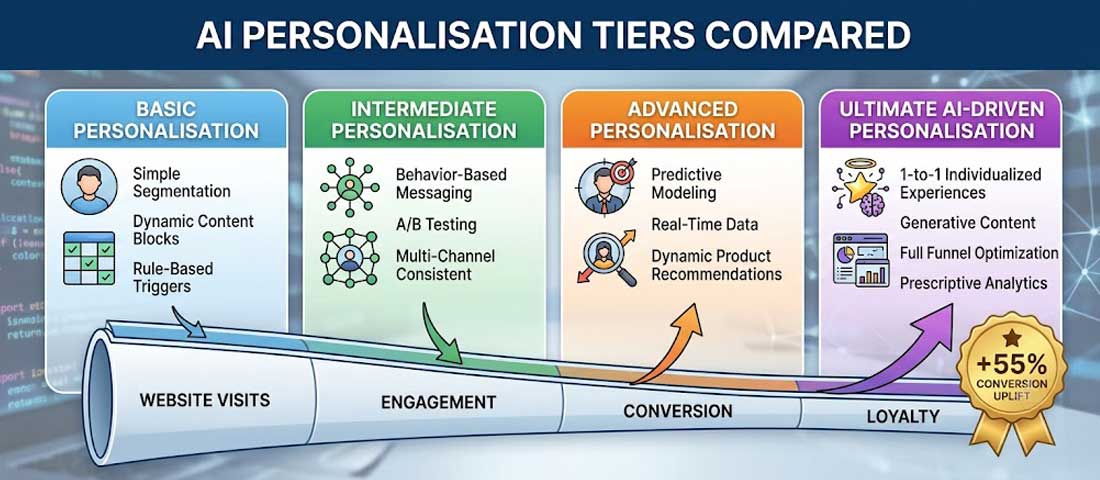
The term spans four genuinely different things with vastly different costs, data requirements, and results. Most of the confusion in this category comes from vendors selling tier four while customers only need tier one.
Tier one — rules-based personalisation. Simple conditional logic. Show a different homepage banner to visitors from paid search than to direct traffic. Display a returning-visitor message to anyone with a prior session. Swap the hero call to action based on which page someone landed on. No AI involved at all, despite frequently being marketed as such. Implementable in days, costs almost nothing, and delivers a surprising share of the total available benefit.
Tier two — segment-based personalisation. Visitors are grouped into defined segments — new versus returning, geography, device, traffic source, industry for B2B — and each segment sees content tailored to it. Still largely rules-driven, but the rules are informed by data about how each segment behaves. This is where most successful business personalisation actually lives.
Tier three — behavioural personalisation. Content adapts based on what an individual visitor has done — pages viewed, products browsed, items abandoned in cart, content downloaded, time spent on specific categories. Requires session tracking and a way to act on it in real time. Genuinely effective for eCommerce and content-heavy sites with repeat visitors.
Tier four — machine learning and predictive personalisation. Models trained on visitor behaviour predict what an individual is likely to want and adapt the experience accordingly. Recommendation engines, propensity scoring, dynamic pricing, predictive content ranking. This is what people picture when they hear “AI personalisation”, and it is also the tier with by far the highest data and traffic requirements.
The critical point is that these tiers are not a ladder everyone should climb. Most businesses should implement tiers one and two thoroughly, consider tier three if they have the traffic and repeat-visit patterns to support it, and ignore tier four entirely unless they are operating at a scale where the models have enough data to learn anything useful.
This is the single most important thing to understand before spending money on personalisation, and it is systematically omitted from vendor marketing.
Machine learning personalisation works by finding patterns in behaviour. Finding a pattern requires enough examples of that behaviour to distinguish signal from noise. A recommendation engine with a few hundred sessions a month has effectively nothing to learn from — it will produce recommendations, because that’s what it’s built to do, but those recommendations will be close to arbitrary.
Rough thresholds, honestly stated. Rules-based and segment-based personalisation work at any traffic level, because they encode decisions you made rather than decisions a model inferred. Behavioural personalisation starts producing reliable results somewhere around 10,000 monthly sessions with meaningful repeat-visit rates. Machine learning personalisation and recommendation engines need substantially more — typically 50,000+ monthly sessions and thousands of conversion events before the models outperform well-designed static rules.
Why this matters commercially. A business with 3,000 monthly sessions buying a $2,000-per-month personalisation platform is paying for capability that mathematically cannot work at their scale. The same business implementing five well-chosen rules — different messaging for returning visitors, a location-aware shipping message, a landing-page-matched hero, a cart-abandonment prompt, and a first-time-visitor offer — will see more improvement for a fraction of the cost.
The A/B testing corollary. The same maths that limits ML personalisation limits your ability to measure any personalisation. Detecting a 10 per cent relative improvement on a 3 per cent baseline conversion rate takes roughly 15,000 to 25,000 visitors per variant to reach statistical confidence. Below that traffic level you can still personalise — you just can’t prove which version won, which means you should stick to changes that are obviously sensible rather than ones that need validating.
The table below sets out what each tier requires and what it realistically returns, using uplift figures from real implementations rather than vendor case studies.
| Tier | Traffic needed | Setup effort | Typical annual cost | Realistic uplift |
|---|---|---|---|---|
| Rules-based | Any | Days | $0 – $1,200 | 3 – 8% |
| Segment-based | Any | 1 – 3 weeks | $500 – $6,000 | 5 – 12% |
| Behavioural | 10,000+ sessions/month | 1 – 3 months | $3,000 – $30,000 | 8 – 18% |
| Machine learning | 50,000+ sessions/month | 3 – 9 months | $20,000 – $200,000+ | 10 – 25% (at scale) |
Two things stand out. First, the uplift figures are considerably lower than the 30 to 40 per cent commonly advertised — those numbers come from enterprise implementations at Amazon-like scale with years of accumulated data, and they are not representative of what a mid-sized business will achieve. Second, the cost-to-return ratio is best at the bottom of the table, not the top. Rules-based personalisation delivering 5 per cent for almost nothing is a better commercial decision than machine learning delivering 15 per cent for $50,000, unless your revenue base is large enough that 15 per cent of it dwarfs the cost.
Being specific matters more than being comprehensive. These are the personalisation tactics that consistently produce measurable results, roughly in order of return on effort.
Landing page message matching. When someone arrives from a paid search ad about a specific service, the page they land on should reflect that service prominently rather than presenting a generic homepage message. This is technically trivial and produces some of the largest gains available, because it removes the mismatch between what someone was promised and what they find. Most businesses running paid search send all traffic to one generic page and lose conversions to that friction alone.
Returning-visitor recognition. Someone on their fourth visit does not need the same introductory framing as someone on their first. Showing returning visitors a shortcut to where they left off, a reminder of what they viewed, or a more direct call to action consistently outperforms treating every visit as a cold start. This works at any traffic level and requires nothing more than a cookie and a conditional.
Geographic and currency adaptation. Displaying prices in local currency, showing region-relevant shipping information, surfacing local contact details or office hours, and adjusting for local conventions removes a category of friction that quietly costs international conversions. For businesses serving multiple markets this is often the highest-value single change available.
Cart and browse abandonment recovery. On-site prompts when someone is about to leave with items in their cart, and returning-visit reminders of what they left behind. This is the tactic with the most reliable revenue attribution in the entire personalisation category because the counterfactual is clear — those carts were being abandoned before.
Product and content recommendations. “Customers who bought this also bought”, “related articles”, “complete the look”. Effective, but genuinely dependent on data volume — with insufficient behavioural data these recommendations become close to random and can actively harm trust when the suggestions are visibly poor. Below the traffic thresholds discussed above, hand-curated recommendations outperform algorithmic ones.
Industry or role-based content for B2B. Showing a manufacturing prospect manufacturing case studies rather than a generic client list. Adapting the pitch based on company size where you can infer it. This is high-value for B2B specifically because the buying committee needs to see relevance quickly, and it works with quite modest data.
Progressive form disclosure. Asking fewer questions on the first interaction and building the profile across visits rather than demanding everything up front. This reduces form abandonment substantially and improves data quality, since people who complete short forms voluntarily give better information than people who fill long ones grudgingly. It also intersects with broader funnel design, which we cover in our guide to building a marketing funnel that converts.
Equally worth being specific about. Several widely-promoted personalisation tactics produce nothing or produce harm.
Name insertion for the sake of it. “Welcome back, Rajesh!” on a homepage banner does approximately nothing for conversion and reads as hollow when nothing else about the experience is adapted. Personalisation that signals surveillance without delivering usefulness is worse than no personalisation.
Over-precise behavioural callbacks. “We noticed you spent four minutes looking at blue trainers on Tuesday” crosses the line from helpful to unsettling. The rule of thumb is that personalisation should feel like good service, not like being watched. If a shop assistant saying the same sentence out loud would be creepy, it is creepy on a website.
Recommendations on thin data. A recommendation engine on a site with a few hundred monthly sessions produces suggestions that look arbitrary because they largely are. Visibly poor recommendations damage credibility more than the absence of recommendations would.
Personalising away discovery. Filtering the experience so tightly around inferred preferences that visitors never encounter anything new. This suppresses the cross-category discovery that often drives incremental revenue, and it produces a narrowing effect where the model reinforces its own assumptions.
Different prices for different people. Dynamic pricing based on inferred willingness to pay is legally fraught in several jurisdictions, reputationally dangerous everywhere, and reliably generates a backlash when discovered. Personalised offers and discounts are fine; personalised base prices for identical products are not a game worth playing.
Popups dressed up as personalisation. An exit-intent overlay is not personalisation, and calling it that doesn’t change how much visitors dislike it. Some are worth running; none of them are AI.
For businesses genuinely pursuing personalisation, this sequence produces results without the common failure of spending heavily before understanding what to personalise.
Want to Know Which Personalisation Tier Your Site Actually Qualifies For?
We assess traffic volume, data availability, and the specific friction points on your site, then recommend the tier that fits — which is frequently a great deal cheaper than what platform vendors will quote. If rules-based personalisation would deliver most of your available upside, we would rather tell you that than sell you a model that cannot learn from your data.
Personalisation runs on data, and the distinction between data that helps and data that creates liability is worth drawing carefully.
First-party behavioural data is the foundation and the safest ground. Pages viewed, products browsed, search terms used on your own site, items added to cart, content downloaded, previous purchases, email engagement. It is collected with the visitor’s knowledge, it is directly relevant, and it is yours.
Contextual data requires no tracking at all and is underused. Which page someone entered on, what device they are using, what time it is where they are, whether they came from search or social or direct, whether they came from a paid ad and which one. All of this is available in the request itself and supports a large share of useful personalisation without any profile-building whatsoever.
Declared data — what people tell you directly through forms, preference centres, and account settings — is the most accurate and the least contentious. It is also underused because businesses prefer inferring to asking. Asking is often better: a two-question preference selector produces cleaner segmentation than weeks of behavioural inference, and visitors do not resent being asked.
Third-party data is where the ground gets unstable. Purchased audience segments, cross-site tracking, and data broker enrichment are increasingly restricted by regulation, degraded by browser privacy changes, and questionable in accuracy. Building a personalisation strategy on third-party data is building on something that is actively being dismantled.
Sensitive categories should simply be excluded. Health inferences, financial distress signals, religious or political affiliation, sexual orientation, and anything about children. Even where collection might be technically lawful, personalising on these categories produces disproportionate harm when it goes wrong and offers little upside when it goes right.
Personalisation and privacy regulation are directly entangled, and the compliance dimension is not optional.
GDPR applies to anyone processing data about people in the EU regardless of where the business is located. It requires a lawful basis for processing, meaningful consent for non-essential cookies and tracking, transparency about what is collected and why, and mechanisms for access and deletion. Personalisation based on tracking generally requires consent rather than legitimate interest.
India’s Digital Personal Data Protection Act establishes a consent-based framework with obligations around notice, purpose limitation, and data principal rights. Businesses serving Indian customers should be building against it rather than treating it as a future concern.
State-level US regulation — California, Colorado, Virginia, Connecticut and a growing list of others — creates a patchwork of requirements around disclosure, opt-out of sale or sharing, and sensitive data handling. Most businesses find it simpler to build to the strictest applicable standard than to maintain multiple compliance postures.
The browser-level shift matters as much as the legal one. Third-party cookie restrictions, Intelligent Tracking Prevention in Safari, and equivalent measures elsewhere have already degraded cross-site tracking substantially. Personalisation strategies built on first-party and contextual data are not just more compliant, they are more durable, because they do not depend on capabilities that are actively being removed.
The practical position. Collect what you need for a stated purpose, tell people plainly what you are doing, make consent genuine rather than a dark pattern, and give people a working way to opt out and delete. This is both the compliant approach and the one that avoids the trust damage that follows a personalisation programme being perceived as surveillance.
Concrete pricing helps calibrate expectations, since the range across this category is enormous.
Free and near-free. Google Analytics 4 audience definitions, native segmentation in email platforms, Shopify’s built-in customer segmentation, WordPress conditional display plugins, and custom conditional logic written into your own site. For rules-based and much segment-based personalisation, this is genuinely sufficient. Annual cost from nothing to a few hundred dollars.
Entry-tier tools, roughly $50 to $500 per month. Personalisation features within existing platforms — Klaviyo, HubSpot’s smart content, Shopify personalisation apps, Mailchimp’s dynamic content. Suits businesses that already pay for these platforms and want to extend into segment-based and light behavioural work.
Mid-market platforms, roughly $500 to $5,000 per month. Dedicated personalisation and experimentation tools with behavioural targeting, recommendation capability, and testing frameworks. Worth considering above roughly 10,000 monthly sessions with a genuine testing programme to run.
Enterprise platforms, $5,000 to $50,000+ per month. Adobe Target, Salesforce Personalization, Dynamic Yield, Optimizely at enterprise tier. Deep integration, sophisticated modelling, dedicated support. These are defensible for large operations and almost never for anyone else.
Custom implementation. Building personalisation logic directly into your own application, typically alongside a recommendation service or model. Costs vary widely with scope but generally start around $10,000 and rise. Makes sense when your requirements are genuinely specific to your business, and it is a common component of custom website development for product companies where the personalisation is part of the product rather than a marketing layer bolted on top.
Personalisation produces impressive dashboards very easily and genuine incremental revenue considerably less easily. The measurement discipline is what separates the two.
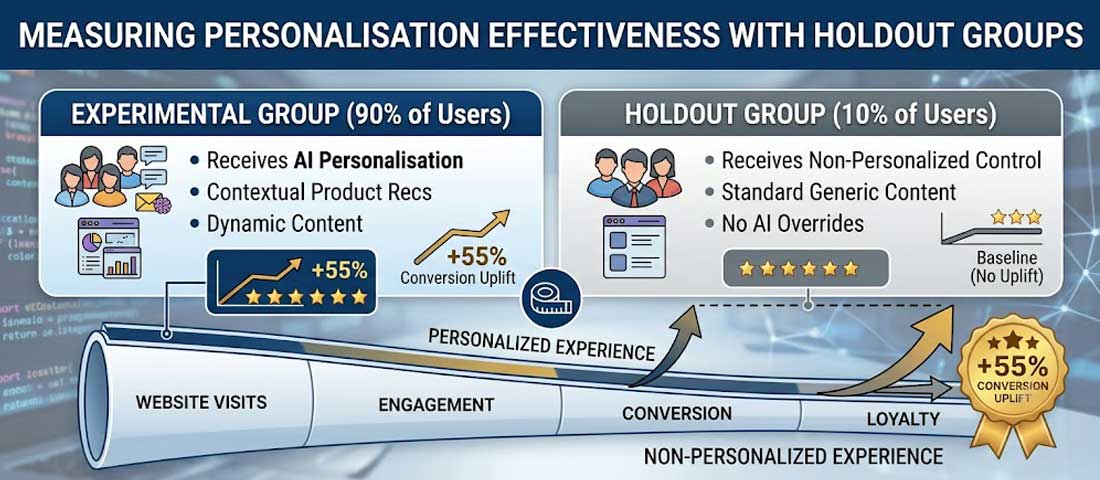
Hold out a control group. Keep a percentage of traffic — commonly 10 to 20 per cent — on the unpersonalised experience permanently. Compare total conversion rate and revenue per visitor between the groups. This is the only measurement that answers the question you actually care about, and it is the one most personalisation programmes skip.
Measure revenue per visitor, not engagement with the widget. Click-through on a recommendation carousel tells you the carousel is noticeable. It does not tell you whether anyone bought something they would not otherwise have bought. Total revenue divided by total sessions, compared against control, is the number that matters.
Watch for cannibalisation. A recommendation that captures a purchase the customer was already going to make has produced zero incremental value while appearing highly successful in attribution reporting. This is extremely common and is the main reason personalisation ROI claims tend to be inflated.
Check the segments separately. An overall neutral result can conceal a strong positive effect in one segment and a negative effect in another. Personalisation that helps returning customers and confuses first-time visitors will look like nothing happened. Segment-level analysis finds the effect that averaging hides.
Track the negative signals too. Bounce rate, time on site, pages per session, complaint volume, and unsubscribe rate. Personalisation that lifts conversion while increasing complaints is trading long-term trust for short-term numbers, and that trade rarely holds up.
The business contexts where personalisation reliably produces meaningful returns share identifiable characteristics.
eCommerce with a broad catalogue. When a visitor faces hundreds or thousands of products, helping them find relevant ones is directly valuable. Recommendations, recently-viewed lists, and category adaptation all earn their keep, provided the traffic supports the data requirements.
Businesses with genuine repeat visitors. Subscription services, content platforms, B2B sites with long consideration cycles. When someone visits repeatedly before converting, adapting across visits compounds in a way it cannot for one-visit conversions.
Multi-market operations. Currency, language, shipping, regulatory notices, and local contact details. This is the least glamorous personalisation and often the highest-returning, because the friction it removes is concrete and universal.
B2B with distinct buyer segments. When a manufacturing prospect and a healthcare prospect need entirely different proof points, showing each the relevant case studies materially shortens the path. Modest data requirements, strong effect.
Sites with heavy paid acquisition. When you are paying for each visitor, message-matching landing pages to the ads that produced them protects the investment. The uplift here is often the single largest available, and it is also the easiest to implement.
Where it does not pay off: single-product businesses with one clear path, low-traffic local service sites where relevance is already obvious, brochure sites with no conversion event to optimise, and any business where the traffic volume cannot support measurement. In these cases, effort is better directed at the fundamentals — clarity, speed, and the basics of what makes a site work at all, which we cover in our piece on the 10 elements of a successful business website.
Website personalisation is one part of a broader change in how businesses use AI, and the patterns repeat across the categories.
The same structure appears everywhere: a genuine capability, a vendor market that overstates the effect size, a data requirement that most adopters do not meet, and a simpler version of the same idea that captures most of the value. It holds for AI customer support, for AI content generation, and for personalisation alike. The businesses getting real value are consistently the ones matching the tool to their actual scale rather than the scale in the case study.
There is also a direct interaction between personalisation and discoverability that is easy to miss. As AI-driven search grows in importance, how your content is rendered and served affects whether it can be found at all — a theme running through our work on how AI is transforming SEO and the future of search. Personalisation implemented carelessly can make pages that crawlers cannot read. Implemented properly, it adapts the experience for identified visitors while leaving a complete, coherent version for everyone and everything else.
Much of what is described here is implementable by a competent in-house team. Some situations benefit from outside input.
Get help when you are being quoted for an enterprise platform and want an independent view on whether your traffic supports it — vendors are not neutral on this question and the sums involved are substantial. Get help when implementation touches your core application rather than sitting in a marketing tool, since personalisation logic embedded in a product needs to be designed rather than configured. Get help when the compliance dimension is non-trivial, particularly across multiple jurisdictions where the requirements differ. And get help when you have run a personalisation programme for six months and cannot demonstrate incremental lift, because that usually indicates a measurement design problem rather than a failure of the underlying idea.
For businesses building personalisation as part of a broader AI adoption effort, treating it as one strand of a coherent strategy produces better outcomes than adopting each capability separately as vendors pitch them. That joined-up view is what our AI solutions work is built around, and the design layer that determines whether personalised experiences actually feel helpful sits squarely within UI/UX design rather than being a purely technical concern.

The honest summary is that personalisation works, but not at the scale the category is marketed at and not in the form most businesses are sold. The realistic uplift for a mid-sized business is somewhere between 5 and 15 per cent, not the 30 to 40 per cent in vendor decks, and the largest share of that gain comes from unglamorous adaptations — matching landing pages to the ads that produced the visit, recognising returning visitors, showing the right currency, remembering abandoned carts — that require conditional logic rather than machine learning. The traffic thresholds are real and rarely disclosed: behavioural personalisation needs roughly 10,000 monthly sessions to work, machine learning needs several times that, and below those levels a model has nothing to learn from no matter what it costs. The tactics that backfire are as consistent as the ones that work, and nearly all of them come from personalising in ways that signal surveillance without delivering usefulness. Data strategy should rest on first-party, contextual and declared data rather than third-party tracking that regulators and browser vendors are actively dismantling. And measurement needs a permanent holdout group, because without a control every claimed uplift is confounded and most reported personalisation ROI is capturing demand that already existed. The businesses that do well here are the ones treating personalisation as a relevance problem rather than a technology purchase, starting with the obvious adaptations, proving each one, and escalating only when the simple options are genuinely exhausted.
| How much does AI personalisation actually increase conversions? | For most mid-sized businesses, realistically 5 to 15 per cent, not the 30 to 40 per cent commonly advertised. Those higher figures come from enterprise implementations at very large scale with years of accumulated behavioural data, and they are not representative of what a typical business will see. Rules-based personalisation usually delivers 3 to 8 per cent, segment-based 5 to 12 per cent, behavioural 8 to 18 per cent where traffic supports it, and machine learning 10 to 25 per cent but only at genuine scale. The pattern worth noticing is that the cost-to-return ratio is best at the simpler end — a 5 per cent lift for almost no cost is often a better commercial decision than a 15 per cent lift for a substantial annual platform fee. Whatever tier you implement, the uplift is only meaningful if measured against a holdout control group, because seasonality and campaign changes otherwise confound the result. |
| How much traffic do I need before personalisation is worth it? | It depends entirely on the tier. Rules-based and segment-based personalisation work at any traffic level because they encode decisions you made rather than patterns a model inferred — a site with 500 monthly visitors can still usefully show returning visitors something different from first-timers. Behavioural personalisation starts producing reliable results around 10,000 monthly sessions with meaningful repeat-visit rates. Machine learning personalisation and recommendation engines typically need 50,000+ monthly sessions and thousands of conversion events before they outperform well-designed static rules. Below those thresholds the models produce output, because that is what they are built to do, but the output is close to arbitrary. There is a related constraint on measurement: detecting a 10 per cent relative improvement on a 3 per cent baseline takes roughly 15,000 to 25,000 visitors per variant for statistical confidence, so low-traffic sites should stick to changes that are obviously sensible rather than ones needing validation. |
| Is website personalisation a privacy risk? | It can be, and the risk is manageable with sensible choices. Personalisation built on first-party behavioural data, contextual signals, and information people declare directly is both lower-risk and more durable than personalisation built on third-party tracking, which regulators and browser vendors are actively dismantling. GDPR requires a lawful basis and generally consent for tracking-based personalisation; India’s Digital Personal Data Protection Act establishes similar consent obligations; and US state laws add a patchwork of disclosure and opt-out requirements. Beyond compliance, some categories should simply be excluded regardless of legality — health inferences, financial distress signals, religious or political affiliation, and anything involving children. The practical position is to collect what you need for a stated purpose, tell people plainly, make consent genuine rather than a dark pattern, and provide a working route to opt out and delete. |
| What’s the difference between personalisation and A/B testing? | A/B testing finds the single best version for everyone; personalisation shows different versions to different people. Testing asks “which headline converts better overall?” and then ships the winner to all traffic. Personalisation asks “which headline converts better for this segment?” and shows each segment its own. They are complementary rather than alternatives — you generally test to establish what works, then personalise where segments genuinely differ. The overlap is that both need traffic volume for statistical confidence, and personalisation compounds the problem by splitting your audience into smaller groups. Testing a variant across all traffic needs a certain sample size; testing a variant within one segment needs that sample size within that segment. This is a common reason personalisation programmes at mid-sized businesses cannot demonstrate results — the segments are too small to measure, even when the underlying adaptation is sound. |
| What personalisation tactics give the best return for the effort? | Matching landing pages to the ads that produced the visit is usually the largest and easiest win, particularly for businesses spending on paid search — it removes the mismatch between what someone was promised and what they find, and it requires only conditional logic. Recognising returning visitors and giving them a shortcut rather than the introductory framing works at any traffic level for the cost of a cookie and a conditional. Geographic adaptation — local currency, relevant shipping information, regional contact details — removes concrete friction and is often the highest-value single change for businesses serving multiple markets. Cart and browse abandonment recovery has the clearest revenue attribution of anything in the category. For B2B specifically, showing industry-relevant case studies rather than a generic client list performs strongly on modest data. Notably, none of these require machine learning, and together they capture most of the available upside for the majority of businesses. |
| Do I need an expensive platform to personalise my website? | Usually not. For rules-based and much segment-based personalisation, free and near-free options are genuinely sufficient — Google Analytics 4 audience definitions, native segmentation in your email platform, Shopify’s built-in customer segmentation, WordPress conditional display plugins, or conditional logic written directly into your site. Entry-tier features within platforms you already pay for, such as HubSpot smart content or Klaviyo segmentation, cover the next step at roughly $50 to $500 per month. Dedicated mid-market personalisation platforms at $500 to $5,000 per month become worth considering above roughly 10,000 monthly sessions with a real testing programme to run. Enterprise platforms at $5,000 to $50,000+ per month are defensible for large operations and almost never for anyone else. The most common expensive mistake in this category is buying a tier above your actual scale, and vendors have no incentive to talk you down. |
| How do I know if my personalisation is actually working? | Hold out a control group permanently — commonly 10 to 20 per cent of traffic that receives the unpersonalised experience — and compare total conversion rate and revenue per visitor between the groups. This is the only measurement that answers the question you care about, and it is the step most programmes skip. Measure revenue per visitor rather than engagement with the personalised element, because a recommendation carousel can have excellent click-through while producing no incremental revenue, simply capturing purchases that would have happened anyway. This cannibalisation effect is extremely common and is the main reason reported personalisation ROI tends to be inflated. Also analyse segments separately, since an overall neutral result can hide a strong positive effect in one group and a negative effect in another. Finally, track the negative signals — bounce rate, complaints, unsubscribes — because personalisation that lifts conversion while eroding trust is making a trade that rarely holds up. |
Ready to Personalise in a Way that Actually Shows Up in Your Numbers?
We help businesses identify where their site is producing irrelevance, implement the adaptations that fit their actual traffic and data, and set up measurement that proves whether it worked. With 14+ years of experience and 550+ clients served, we will tell you honestly when rules-based personalisation would deliver most of your available upside — and when it is worth going further. Send us your site and current traffic figures and we will respond within one business day with a straight assessment.
Whether you have a new idea, a business challenge, or something you would like to improve, we are here to help. From building websites, online stores, CRM systems, and custom applications to exploring AI solutions, improving SEO, or growing your sales, simply tell us what you have in mind, and we will help you find the best way forward.
A member of our team will review your enquiry and respond to you shortly.
Some cookies are necessary for this website to work. With your permission we would also like to measure how our articles are read, and whether an advertisement led to an enquiry. You are free to decline, and to change your choice at any time. Our Cookie Policy explains each category in full.