
The marketing funnel most businesses are still running was designed for a buyer who no longer exists. It assumes a person discovers your brand, considers it in an orderly way, decides, and converts — a clean linear journey from awareness to purchase. That buyer, if they ever truly existed, is gone. The 2026 buyer researches across a dozen touchpoints in no particular order, asks an AI assistant for a recommendation before they ever see your website, reads a Reddit thread instead of your sales page, and arrives at a buying decision through a path that loops, stalls, restarts and rarely resembles a funnel at all.
This guide is about building a marketing funnel that works for how people actually buy now — not the tidy diagram from a 2015 marketing textbook. We have built and rebuilt funnels for clients across services, eCommerce and B2B, and the version that performs in 2026 is structurally different from the one that performed even three years ago. If you want the wider context of how the individual channels fit together, our complete digital marketing channels guide is the companion piece. This article focuses specifically on the funnel — how to structure it, build it, measure it and fix it.
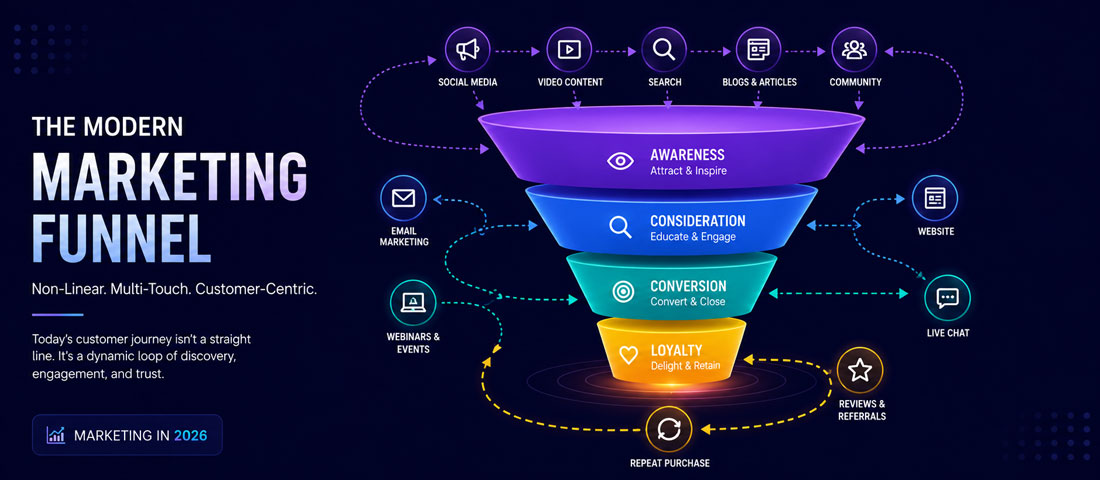
A marketing funnel is the structured path you build to move a stranger toward becoming a customer, and then toward becoming a repeat customer and an advocate. The word “funnel” is a useful simplification — it captures the idea that many people enter at the top and fewer reach the bottom — but in 2026 it is worth being honest that the shape is less a funnel and more a loop with leaks, shortcuts and re-entry points.
The reason the funnel still matters as a concept, despite the messy reality, is that it forces structure onto your marketing. Without a funnel model you tend to do scattered activity — a social post here, an ad campaign there, a blog when someone remembers — with no sense of how each piece moves a person toward a purchase. With a funnel model, every piece of marketing has a job. It either brings new people in, moves existing prospects forward, converts them, or keeps them. The funnel is less a literal description of the buyer journey and more an organising framework for your own marketing decisions.
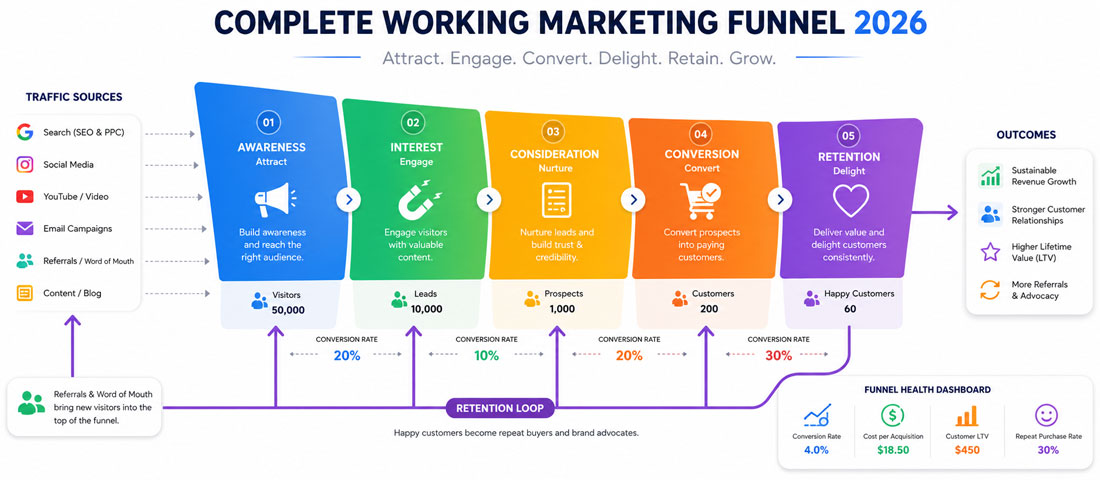
The practical funnel in 2026 has four stages — awareness, consideration, conversion and retention — and the rest of this guide works through each one. But the single most important shift to absorb before you start building is this: the stages are not a sequence the buyer marches through in order. They are states a buyer can be in, and your job is to have the right marketing in place for each state, because at any moment some of your audience is in each one.
It is worth being specific about what changed, because the failures of the old funnel model explain the design of the new one. Four shifts have made the tidy linear funnel a poor map of reality.
The old funnel assumed awareness happened through channels you owned or paid for — your ads, your content, your outreach. In 2026 a large share of discovery happens on channels you do not control and cannot fully see. A prospect hears about your category from a podcast, sees a competitor in an AI assistant’s answer, reads a Reddit thread, watches a YouTube review. By the time they reach a channel you can measure, they are already partway through their decision. The funnel has to account for the fact that its top is now largely invisible to you.
The consideration stage used to be relatively short — a prospect compared a few options and chose. Now the research phase is long, non-linear and conducted across many sources. The same buyer will read your site, check reviews, ask an AI assistant, watch videos, lurk in communities, and circle back to your site three more times over several weeks. A funnel built for a short consideration phase loses these buyers because it stops nurturing them too early.
This is the genuinely new shift. A growing share of buyers ask ChatGPT, Gemini, Perplexity or an AI Overview for recommendations before they engage with any brand directly. The AI assistant has become a stage in the funnel — an intermediary that filters which brands the buyer even considers. If your brand is not visible in that layer, you are filtered out before your funnel begins. The modern funnel has to include being recommended by AI as an explicit top-of-funnel goal.
The old funnel was something marketers pushed buyers through. The modern buyer rejects being pushed. They want to self-educate, self-qualify and reach out when they are ready — and aggressive funnel tactics that try to force the pace tend to push them away rather than forward. The 2026 funnel is built to be available and helpful at every stage rather than to apply pressure, because pressure now actively leaks buyers out of the funnel.
The funnel has four working stages. The table below summarises what each stage is for, what the buyer is doing in it, and what your marketing needs to provide. The detailed build guidance for each follows after.
| Stage | What the buyer is doing | What your marketing must provide | Primary goal |
|---|---|---|---|
| Awareness | Discovering they have a problem or a need | Helpful, findable content; visibility in search and AI answers | Get found by the right people |
| Consideration | Researching and comparing possible solutions | Comparisons, proof, depth, answers to real questions | Become a trusted, shortlisted option |
| Conversion | Deciding and ready to act | Frictionless path to act; clear value; reassurance | Make the decision easy to complete |
| Retention | Using the product; deciding whether to stay and recommend | Onboarding, ongoing value, reasons to advocate | Turn customers into repeat buyers and advocates |
Notice that retention is inside the funnel, not after it. The old funnel ended at the sale. The 2026 funnel treats the existing customer as the most valuable person in the whole system — cheaper to sell to again, and capable of feeding new people into the top of the funnel through recommendations and reviews. A funnel that stops at conversion is leaving its highest-return stage unbuilt.
Building a funnel is a sequenced process. The seven steps below run in order — defining the buyer before building the stages, building the infrastructure before driving traffic into it. Skipping ahead produces a funnel that leaks.
Want Help Building a Marketing Funnel that Actually Converts?
If you would rather have an experienced team design and build the funnel — the website spine, the content layers, the conversion pages and the measurement — we are happy to help. Send us a brief on your business and we will come back with a clear, practical plan.
The awareness stage answers one question — when the right people are looking for what you offer, or for the problem you solve, do they find you? In 2026 “find you” means more than ranking on Google. It means being discoverable across the full set of channels where discovery now happens.
Search remains foundational. Organic search visibility — built through genuinely useful content optimised properly — is still the highest-return awareness channel for most businesses, because it captures people at the moment they are actively looking. Strong SEO services are the engine of this layer, and the content that earns search visibility is the same content that earns AI-answer visibility, so the investment pays twice.
Beyond search, the awareness layer in 2026 includes being present in AI assistant answers, having a content presence on the platforms your buyers actually use, and where it fits the business, video and community presence. The goal across all of these is the same — be genuinely helpful and genuinely findable, so that the right person discovers you naturally rather than being interrupted by you. Interruption-based awareness still works for some businesses, but the durable, compounding awareness layer is built on being found, not on shouting.
The most common awareness-stage mistake is chasing volume over relevance. A funnel does not need the most traffic; it needs the right traffic. Ten thousand visitors who will never buy are worth less than five hundred who might. Build the awareness layer around attracting people with a genuine need for what you offer, and measure it by qualified traffic, not raw numbers.
The consideration stage is where most funnels are weakest, and fixing it is usually where the fastest gains are found. The buyer here is aware of you but not convinced. They are researching, comparing, and quietly deciding whether to trust you. Your job is to win that trust with depth and proof.
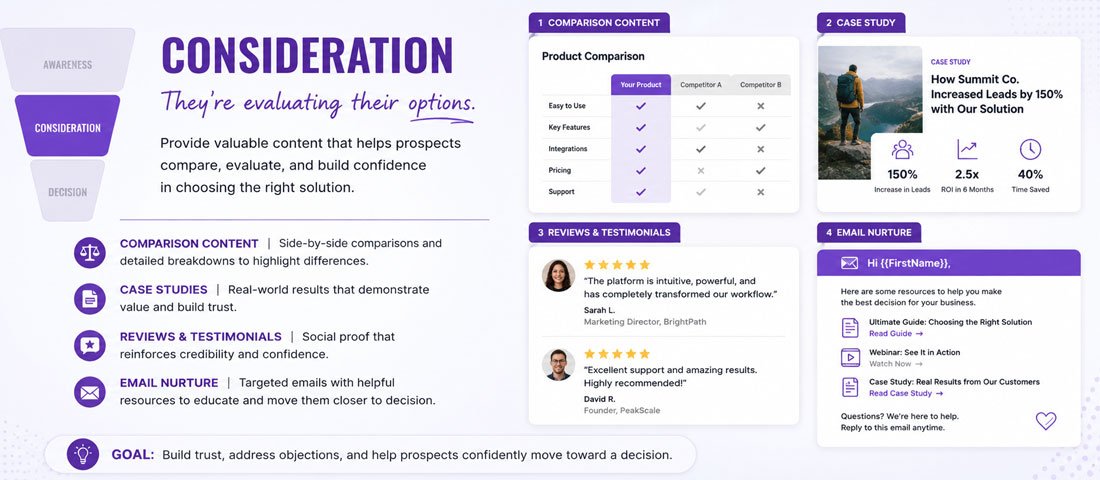
The content that works at this stage is fundamentally different from awareness content. Awareness content is broad and introductory. Consideration content is deep and specific — detailed comparisons, honest case studies, thorough answers to the exact questions a serious buyer asks, proof in the form of results, reviews and testimonials. This is content that respects that the buyer is doing real research and gives them genuine substance to research with.
The mechanism that holds the consideration stage together is usually email. When an aware prospect gives you their email address — in exchange for something genuinely valuable — you gain the ability to keep showing up helpfully over the weeks their research takes. A good nurture sequence is not a sales pitch on repeat. It is a series of genuinely useful messages that build trust and keep you present, so that when the buyer is ready to decide, you are the option they already trust. The content marketing engine behind this layer is covered in depth in our guide to SEO content marketing.
The discipline that matters most here is patience. The consideration stage cannot be rushed. A buyer pushed to convert before trust exists does not convert — they leave. The funnel’s job at this stage is to be consistently helpful for as long as the research takes, and to make converting easy at the exact moment the buyer is ready, not before.
The conversion stage is the narrowest part of the funnel and the most scrutinised, because it is where marketing turns into revenue. The buyer here has decided, in principle, that you are the option. Your job is to make completing that decision as effortless as possible.
Conversion is overwhelmingly about removing friction. Every additional form field, every unclear next step, every moment of doubt, every slow-loading page is a reason for a ready buyer to hesitate — and a hesitating buyer often does not come back. The conversion stage is engineered by systematically finding and removing these friction points. Clear, focused landing pages with a single obvious action. Forms that ask for the minimum. Calls to action that are specific and prominent. Reassurance — guarantees, security signals, social proof — placed exactly where doubt would otherwise creep in.
The visual and structural design of the conversion pages does a great deal of the work here, which is why UI/UX design is a conversion discipline as much as an aesthetic one. A conversion page is not decorated; it is engineered, with every element either moving the buyer toward the action or being removed. The page that converts is usually simpler than the page that does not.
The other half of conversion-stage work is testing. The first version of a conversion page is a hypothesis. Real improvement comes from measuring what actually happens, identifying where buyers hesitate or drop, and systematically testing changes. This is the discipline of conversion rate optimisation, and it is covered fully in our guide to conversion rate optimisation tactics. A conversion stage that is never tested is a conversion stage left to guesswork.
The retention stage is the one most funnels never build, and it is the one with the highest return. Selling to an existing customer is far cheaper than acquiring a new one, and a genuinely satisfied customer feeds the top of your funnel for free through recommendations and reviews. A funnel that ends at the sale is leaving its most profitable stage on the table.
Retention begins with onboarding — making sure a new customer actually succeeds with what they bought. A customer who has a good early experience stays; one who struggles quietly leaves and never recommends you. Beyond onboarding, the retention loop is built from ongoing communication that continues to provide value, reasons and prompts to buy again, and deliberate encouragement to refer others and leave reviews.
The strategic point of the retention loop is that it closes the funnel into a cycle. A satisfied, vocal customer becomes an awareness-stage channel for the next buyer — through a review that an AI assistant cites, a recommendation in a community, a word-of-mouth referral. This is why the modern funnel is better drawn as a loop than a funnel. The bottom feeds the top. A business that builds the retention loop well lowers the cost of every future customer, because a growing share of new buyers arrive already trusting the brand, recommended by someone who has bought.
A funnel runs on a stack of tools, and the good news is that the essential stack is not expensive or complex. The non-negotiables are a fast, well-built website as the spine; analytics to see how people move through the funnel; an email platform for the consideration and retention layers; and a way to capture and manage leads, whether a dedicated CRM or something simpler.
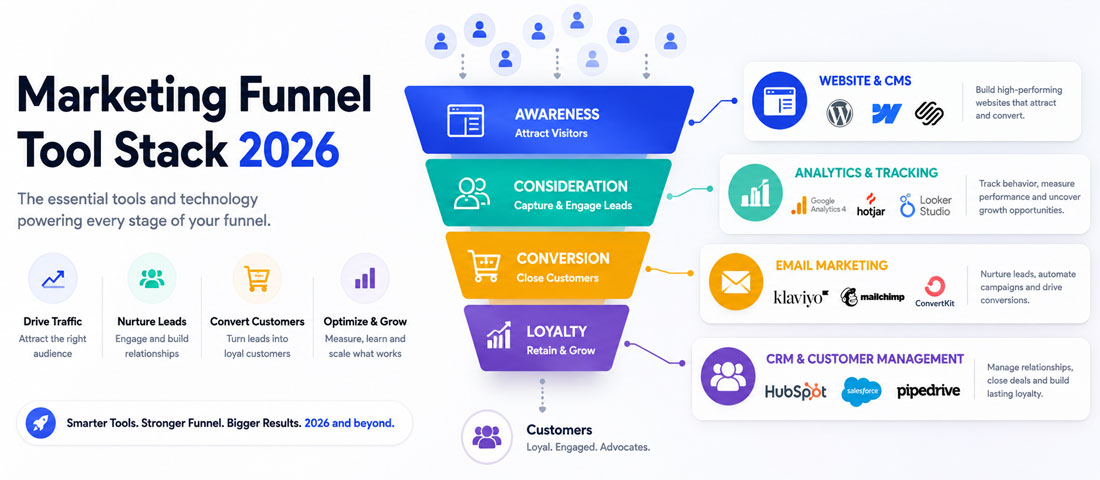
The website is the component that matters most and is most often underbuilt. Every stage of the funnel routes through it — awareness content lives on it, consideration content lives on it, conversion happens on it. A slow, poorly-structured website undermines every stage at once, no matter how good the marketing around it is. This is why funnel performance and website quality cannot be separated, and why a funnel project often turns out to be a website project first.
Beyond the core stack, businesses add tools as they scale — marketing automation, advanced CRM, heatmaps and session recording for conversion analysis, AI-visibility tracking for the awareness layer. But these are additions to a working core, not substitutes for it. The common mistake is buying sophisticated tools before the basic funnel works, which produces an expensive stack running a funnel that still leaks. Build the simple funnel on the simple stack, get it working, then add tools where the data shows they will help.
A funnel you cannot measure is a funnel you cannot improve. The measurement principle is straightforward — track how many people move from each stage to the next, and the leak becomes visible. If lots of people reach your site but few join your email list, the awareness-to-consideration step is leaking. If many consider but few convert, the consideration-to-conversion step is the problem. The stage-to-stage conversion rates tell you exactly where to focus.
The discipline that makes this work is fixing one stage at a time, starting with the biggest leak. There is no value in optimising a conversion page if the real problem is that the awareness layer brings the wrong traffic. Find the largest leak, fix it, measure again, and move to the next. A funnel improves through this steady, sequenced repair — not through trying to fix everything at once.
The other measurement discipline is patience over the right time horizon. A funnel, especially in a category with a long consideration phase, does not show its full results in a week. A buyer who enters the awareness stage today may not convert for two months. Judging funnel changes too quickly leads to abandoning changes that were actually working. Measure stage-to-stage movement continuously, but judge overall funnel performance over a window long enough to match how your buyers actually buy.
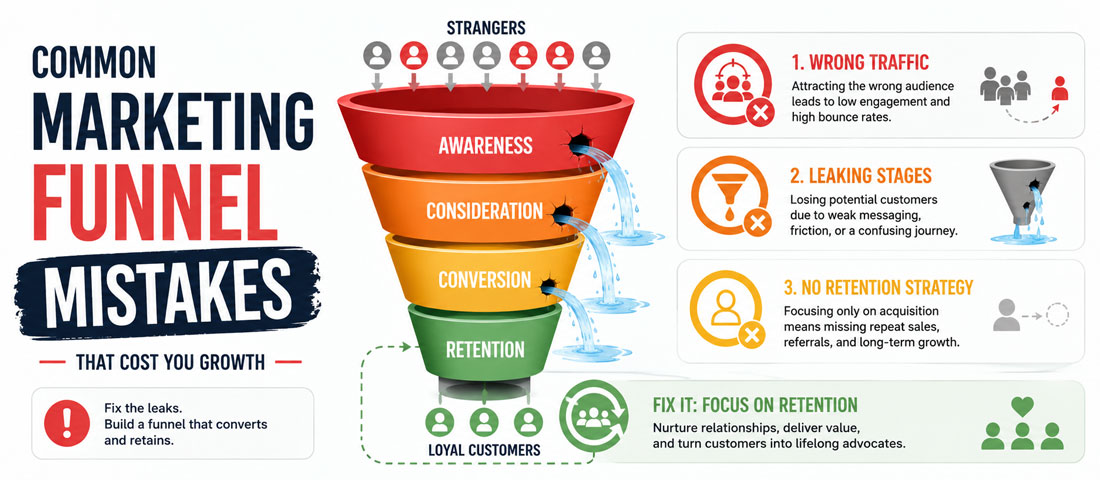
Funnels fail in predictable ways. The mistakes below are the ones that most reliably turn a funnel into wasted effort, and all of them are avoidable.
It is worth drawing together how much AI has changed funnel building, because the shift runs deeper than a single new channel. AI affects every stage of the modern funnel.
At the awareness stage, AI assistants have become an intermediary that decides which brands a buyer even considers. Being recommended by ChatGPT, Gemini or an AI Overview is now a top-of-funnel goal in its own right, and it depends on the same content quality and structured data that drives search visibility.
At the consideration stage, buyers increasingly use AI to research and compare — asking an assistant to summarise the differences between options, surface reviews, and explain trade-offs. This means your consideration content is now read not only by humans but by AI models synthesising answers, and content structured clearly enough for an AI to use well reaches more buyers.
On the operational side, AI has made building and running a funnel more achievable for smaller teams — assisting with content production, audience analysis, personalisation and the interpretation of funnel data. The funnel a small business can realistically run in 2026 is more sophisticated than what was possible a few years ago, because AI lowers the effort behind each stage. The strategic thinking still has to be human; the execution load is lighter.
If you are building a funnel from scratch, resist the temptation to build all four stages at full sophistication at once. Start with a simple, complete funnel — a basic version of every stage — running end to end. A complete simple funnel beats a sophisticated half-funnel every time, because a half-funnel leaks everyone past the point it stops.
Begin by getting the infrastructure right, with the website as the priority, since every stage depends on it. Then build a basic awareness layer, a basic consideration layer with at least an email capture and a simple nurture sequence, a clear conversion path, and a basic retention loop. Get that complete simple funnel working and measured. Then improve it stage by stage, starting with whichever stage your measurement shows is leaking most.
The funnel that works in 2026 is not the most elaborate one. It is the one that is complete, measured, matched to how your buyers actually behave, and improved steadily over time. Build it as a loop, not a one-way chute — remember that the retention stage feeds the awareness stage — and treat it as something you maintain continuously rather than build once. The businesses whose marketing compounds are the ones running a funnel like that: simple at first, complete throughout, measured honestly, and improved one leak at a time.
| What is a marketing funnel? | A marketing funnel is the structured path a business builds to move a stranger toward becoming a customer, and then a repeat customer and advocate. It is usually described in four stages — awareness, consideration, conversion and retention. The word “funnel” captures the idea that many people enter at the top and fewer reach the bottom. In 2026 the funnel is better understood as an organising framework for your marketing than as a literal map of the buyer journey, because real buyers move through the stages in a looping, non-linear way rather than a tidy sequence. The funnel’s value is that it gives every piece of your marketing a defined job. |
| What are the stages of a marketing funnel? | The modern marketing funnel has four stages. Awareness is where people discover they have a problem and find your brand. Consideration is where they research and compare possible solutions. Conversion is where they decide and act. Retention is where they use the product and decide whether to stay and recommend you. The important shift in 2026 is that these are not a strict sequence — they are states a buyer can be in, and at any moment some of your audience is in each one. Retention is also now treated as part of the funnel rather than something after it, because existing customers feed new ones back into the top. |
| How long does it take to build a marketing funnel? | A basic but complete funnel can be built in a few weeks, mostly depending on whether the website infrastructure is already in place. If the website needs building or rebuilding first, that becomes the longer part of the timeline, since the website is the spine the whole funnel runs on. Building a basic version of all four stages — awareness content, a consideration layer with email capture, a conversion path and a retention loop — is the realistic first goal. The funnel then improves continuously over the months that follow. A funnel is never truly finished; it is built to a working state and then refined stage by stage based on measurement. |
| Why is my marketing funnel not converting? | A funnel that is not converting is leaking at a specific stage, and the fix begins with finding which one. Measure how many people move from each stage to the next. If lots of people visit but few join your email list, the awareness-to-consideration step is leaking — often because the traffic is the wrong traffic. If many consider but few convert, the issue is usually trust built too slowly or a conversion path with too much friction. If people convert but never return, the retention loop is missing. Identify the biggest leak first, fix that one stage, measure again, then move on. Trying to fix everything at once rarely works. |
| What tools do I need for a marketing funnel? | The essential funnel tool stack is simpler than most businesses expect. You need a fast, well-built website as the spine, since every stage routes through it. You need analytics to see how people move through the funnel. You need an email platform for the consideration and retention stages. And you need a way to capture and manage leads — a CRM, or something simpler for a small business. That core stack is enough to run a complete funnel. More advanced tools such as marketing automation, heatmaps and AI-visibility tracking are worth adding later, once the basic funnel works and your data shows where they would help. Buying sophisticated tools before the funnel works is a common and expensive mistake. |
| Is the traditional marketing funnel still relevant in 2026? | The funnel as a literal description of the buyer journey is outdated, because real buyers in 2026 move in loops, research across many uncontrolled channels, and often consult an AI assistant before engaging any brand directly. But the funnel as an organising framework for your marketing is still genuinely useful. It forces every piece of marketing to have a job — bringing people in, moving them forward, converting them, or keeping them. The right approach in 2026 is to keep the funnel as a planning framework while being realistic that buyers do not march through it in order. Think of it as four states to support rather than four steps to push people through. |
| How does AI affect marketing funnels? | AI affects every stage of the modern funnel. At the awareness stage, AI assistants have become an intermediary that decides which brands a buyer even considers, so being recommended by tools like ChatGPT or Google AI Overviews is now a top-of-funnel goal. At the consideration stage, buyers use AI to research and compare options, which means your content is read by AI models as well as humans. On the operational side, AI makes building and running a sophisticated funnel more achievable for smaller teams by assisting with content, personalisation and data analysis. The strategy still has to be human, but AI has both added a new layer to the funnel and lowered the effort of running it. |
Ready to Build a Marketing Funnel that Compounds?
We help businesses build the full funnel — the website spine, the awareness and consideration content, the conversion pages, and the measurement that keeps it improving. With 14+ years of experience and 550+ clients served, we know how the pieces fit together. Send us a brief and we will respond within one business day.
You are welcome to begin with the complimentary business health check. It takes about ten minutes and will suggest which of these would serve you best.