How to Build a Personal Brand Online in 2026: The Complete Guide for Founders
Ten years ago, a founder’s personal brand was a nice-to-have. Investors looked at the business. Clients evaluated the portfolio. The person behind the company was largely invisible to everyone except direct contacts.
In 2026, that calculus has reversed. Before a potential client emails your business, they search your name. Before a journalist quotes your company, they check if you have a point of view worth quoting. Before an investor takes a meeting, they look at whether you are a credible voice in your space. Your personal brand — the digital representation of your expertise, your perspective, and your professional identity — is now evaluated before your business is.
This shift has created a significant competitive divide. Founders who have invested in building a genuine personal brand attract clients who already trust them, command premium positioning, generate media opportunities, and build businesses that are harder to commoditise. Founders who have not built one compete on price, chase every prospect with cold outreach, and find themselves invisible in markets where visibility is increasingly a prerequisite for credibility.
This guide covers the complete personal brand building process for founders and business owners in 2026 — from the strategic foundation through to the specific platforms, content strategies, and daily habits that build real audience and real commercial impact.
Why Personal Branding Matters Commercially for Founders in 2026
The commercial case for founder personal branding is stronger in 2026 than at any previous point — driven by three converging shifts in how buying decisions are made.
Trust Has Moved to People, Not Companies
The Edelman Trust Barometer has consistently found, across multiple years, that people trust individuals — especially subject matter experts — significantly more than they trust institutions and corporations. A company’s marketing is assumed to be promotional. A founder’s genuine point of view, shared consistently and specifically, is more credible because it is personal.
When a potential client follows your LinkedIn content for three months before they have a project ready, they arrive at the sales conversation with pre-established trust in your expertise. The sales cycle compresses dramatically. The price conversation shifts. The “why you over a competitor” question is already answered.
AI Search Has Made Personal Visibility More Important
Google AI Overviews, Perplexity, and ChatGPT increasingly cite individual experts by name when answering questions in professional domains. Being cited as an authority — having a body of public content, a strong LinkedIn profile, media mentions, and a clear area of expertise — is how you appear in AI-generated answers. The founder who has published consistently on a specific topic is far more likely to be cited by AI systems than one who has kept their expertise private.
Competition Has Intensified in Almost Every Market
In markets where the product or service offer is increasingly commoditised — web design, digital marketing, consulting, coaching, software development — the personal brand of the founder is often the most significant differentiator available. Clients who cannot meaningfully distinguish between five technically comparable agencies will choose the one whose founder they feel they know and trust. Personal branding is, in this context, the most durable competitive moat available to a founder.
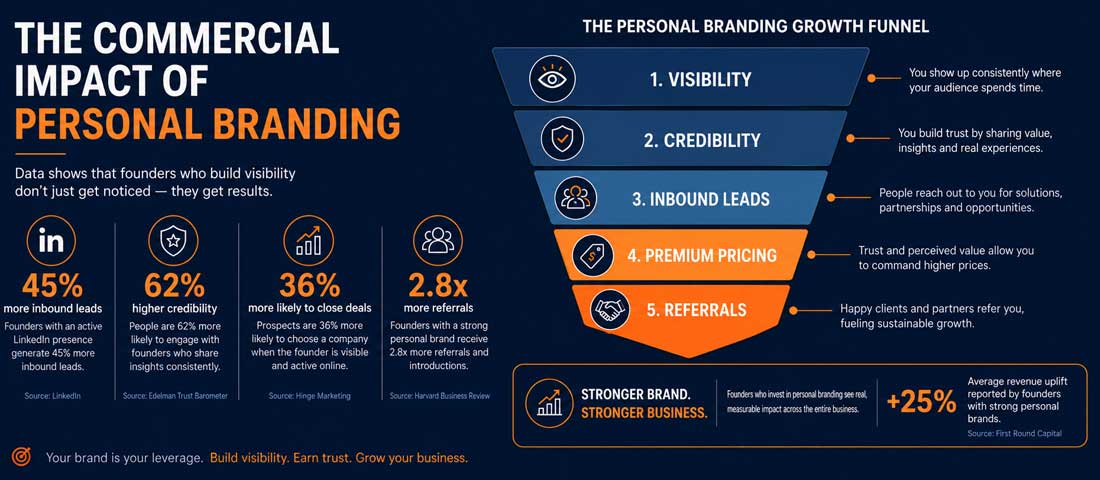
The commercial flywheel of founder personal branding — visibility builds credibility, credibility generates inbound leads, inbound leads enable premium positioning, premium positioning attracts better clients and referrals.
The 3-Part Personal Brand Foundation — Before You Post Anything
The most common personal branding mistake founders make is starting with tactics — choosing a platform, deciding to post three times per week, picking a content format — before establishing the strategic foundation that determines whether any of those tactics will build something meaningful or just generate noise.
Three questions must be answered clearly before the first post goes live:
Foundation 1: What Is Your Specific Area of Expertise?
Personal brands that attempt to be interesting to everyone are interesting to no one. The most powerful personal brands are built on specific expertise in a defined domain — narrow enough to be genuinely distinctive, broad enough to generate consistent content and attract a meaningful audience.
For a founder, this typically means choosing the intersection of: what you genuinely know deeply (expertise), what your target clients need to understand and want guidance on (audience relevance), and what you find interesting enough to talk about publicly for years (sustainable enthusiasm). That intersection — not the broadest possible topic area — is where your personal brand should live.
Examples of founder personal brands built on specific expertise rather than general business content:
- A web design agency founder who builds a personal brand specifically around conversion rate optimisation for professional services firms
- A software developer who builds a brand around AI integration for traditional manufacturing businesses
- An SEO consultant who owns “international SEO for Indian businesses targeting Western markets“
Each of these is specific enough to be genuinely distinctive. Each attracts a defined audience rather than competing for attention with every business founder on the internet.
Foundation 2: Who Specifically Are You Trying to Reach?
Your personal brand audience is not “business owners” or “marketing professionals.” It is a specific type of person at a specific stage with a specific challenge — and every piece of content you create should speak to that person’s specific situation.
Define your audience in one sentence: “I am building an audience of [job title / role] at [type of company] in [geography / market] who are dealing with [specific problem or goal].” The more specific this sentence, the more specifically your content will resonate with the people you most want to reach.
Foundation 3: What Is Your Distinctive Point of View?
The most memorable personal brands are built on a point of view — a perspective on the founder’s area of expertise that is specific, defensible, and at least mildly contrarian to conventional wisdom. Not controversy for its own sake, but genuine intellectual perspective developed from real experience and expertise.
Generic content — “here are 5 tips for better web design” — is undifferentiated and forgettable. Content built on a specific point of view — “most web design agencies optimise for aesthetics when they should be optimising for clarity, and the gap between the two is where most SMB websites fail” — is memorable, shareable, and positions the founder as someone with a genuine perspective worth following.
Choosing the Right Platforms for Your Specific Audience
| Platform | Best For | Audience | Content Format | Time Investment |
|---|---|---|---|---|
| B2B founders, consultants, agency owners | Business owners, decision-makers, professionals | Text posts, short videos, carousels, articles | Medium — 3–5 posts/week | |
| X (Twitter) | Tech founders, developers, SaaS, thought leaders | Tech industry, media, investors, other founders | Short-form text, threads, real-time commentary | High — daily engagement |
| YouTube | Education-driven brands, tutorial content, reviews | Broad — platform-dependent on niche | Long-form video, tutorials, vlogs | Very High — production overhead |
| Creative founders, lifestyle brands, B2C products | Consumer-oriented, younger demographics | Images, Reels, Stories | High — visual content production | |
| Newsletter / Substack | Founders with strong POV, content-first brands | Highly engaged self-selected subscribers | Long-form written content | Medium — weekly/biweekly cadence |
| Podcast | Relationship-builders, interview-format content | Niche, highly engaged listeners | Audio, conversations, solo episodes | High — production and guest management |
The one-platform rule for founders starting out: Choose one platform and master it before adding a second. The mistake most founders make is attempting to be present on LinkedIn, Instagram, X, YouTube, and a newsletter simultaneously — producing thin, inconsistent content on all of them rather than high-quality consistent content on one. For most B2B founders, that one platform should be LinkedIn. For founders in consumer markets, Instagram or YouTube may be more appropriate. Pick the platform where your specific audience spends time, and commit to it for 6 months before evaluating the results.
LinkedIn Personal Branding — The Highest-ROI Platform for Most Founders
For B2B founders — which includes most agency owners, consultants, technology founders, and professional service providers — LinkedIn is the highest-ROI personal branding platform available. The reasons are structural: LinkedIn’s audience is professional decision-makers, its algorithm currently gives significant organic reach to personal content from individuals (unlike company pages), and the intent of LinkedIn users is professional rather than entertainment-oriented.
Optimising Your LinkedIn Profile Before Content
Your LinkedIn profile is your personal brand’s landing page. Before creating content, ensure it converts profile visitors into connection requests, followers, and direct messages:
- Profile photo: Professional, clear, recent — your face should be visible and you should look like someone clients would trust. Not a logo, not a holiday photo, not a decade-old headshot.
- Banner image: Your company branding, a specific claim (“Web Design Agency — 450+ Clients, 12 Years, USA/UK/India”), or a visual representation of your area of expertise. Not the default grey banner that 60% of LinkedIn users still have.
- Headline: Not your job title — your value proposition. “Founder at Neel Networks” says nothing. “Helping UK and USA businesses get more clients through their website | Web Design Agency since 2014 | 450+ projects delivered” says exactly who you help and what you do.
- About section: Written in first person, specific about who you help and how, ending with a clear call to action. This is the most-read section of your profile for visitors who are genuinely considering reaching out.
- Featured section: Your three most important pieces of content, case studies, or external mentions — pinned prominently for profile visitors to see.
LinkedIn Content That Builds Personal Brand
LinkedIn content that builds genuine personal brand falls into four categories — and the best profiles use all four in rotation:
Perspective and Opinion
Your specific point of view on a topic in your area of expertise. Not a summary of what everyone thinks — your take, with the reasoning behind it. These posts generate the most engagement and the most meaningful comments from the people you most want to reach.
Behind-the-Scenes and Process
How you work, how you think, what you are learning, what has gone wrong and what you learned from it. This content builds the personal connection and authenticity that makes a personal brand genuinely personal rather than a corporate persona with a face attached.
Client Results and Case Studies
Specific, real outcomes you have delivered for clients — with enough detail to be credible and enough context to be relevant to similar potential clients reading your profile. Social proof at the personal level builds the commercial case that no amount of general expertise content can replace.
Practical Expertise Content
Tactical, actionable guidance in your area of expertise — the specific things your audience can do to solve a specific problem. This content demonstrates depth of knowledge, generates saves and shares, and attracts the audience you most want to reach because it serves them directly.
Content Strategy — What to Post and How Often
Content strategy for personal branding is not about posting as much as possible — it is about posting with enough consistency that your audience forms a reliable expectation of your presence, and with enough quality that each piece of content reinforces rather than dilutes your brand.
The Content Cadence That Works for Founders
For LinkedIn, the minimum effective cadence for building an audience is 3 posts per week — below this frequency, the algorithm deprioritises your content and your audience engagement drops between posts. The maximum sustainable cadence for most founders who are also running a business is 5 posts per week. 3 to 4 posts per week is the practical optimum for most.
Consistency over volume: a founder who posts 3 times per week for 52 weeks builds significantly more personal brand equity than one who posts 7 times per week for 6 weeks and then goes quiet for 2 months. The algorithm rewards consistency. So does audience trust.
Content Batching — How to Stay Consistent Without Daily Creation
The founders who maintain consistent personal branding alongside running a business almost universally use content batching — dedicating 2 to 3 hours one day per week to create all content for the following week, rather than creating in real-time daily. This approach removes the daily decision fatigue of “what do I post today?” and allows for more thoughtful, higher-quality content than real-time creation typically produces.
A practical batching schedule: Sunday or Monday morning — review the week’s industry news and client conversations for content ideas, write 4 post drafts, schedule them across the week using LinkedIn’s native scheduler or a tool like Buffer. Tuesday through Saturday — respond to comments and engage with others’ content (20 to 30 minutes daily). This approach produces consistent personal brand building on approximately 3 to 4 hours of weekly investment.
Thought Leadership — How to Build Authority, Not Just Visibility
Visibility and authority are related but distinct. Visibility means people see your name and face regularly. Authority means people trust your expertise and seek your perspective. Both are valuable; authority is rarer and commercially more powerful.
Building genuine thought leadership — the kind that produces inbound inquiries, speaking invitations, media mentions, and premium pricing — requires going beyond content creation to active participation in your field’s conversation:
-
Develop and articulate a specific framework or methodology
The most cited thought leaders in any field have a named framework — a specific way of thinking about a problem that they have developed and consistently articulate. It does not need to be complex — it needs to be specific, memorable, and genuinely useful. A web design agency founder who develops “The Client-First Design Framework” and consistently references it across content, client work, and speaking creates a proprietary intellectual asset that distinguishes them from every other agency talking about design. -
Seek media and publication appearances actively
Being quoted in industry publications, being interviewed on podcasts in your niche, and contributing guest articles to respected outlets each produce two benefits: they expose your perspective to new audiences, and they create credibility signals (media mentions) that reinforce your authority claim to existing audiences. HARO (Help a Reporter Out) is the most accessible starting point — journalists posting requests for expert quotes in your domain. Responding to relevant HARO requests is a consistent, low-investment way to accumulate media mentions. -
Engage substantively with others in your field
Thoughtful, substantive comments on the posts of other respected voices in your field are underrated as personal brand builders. A comment that genuinely extends or challenges an idea — not “great post!” but a specific, knowledgeable addition to the conversation — is read by everyone who sees the original post, positions you as a peer of the person you’re engaging with, and often generates more profile visits than your own posts. -
Publish longer-form content periodically
LinkedIn posts are the highest-frequency content format but the shortest half-life — a post is largely forgotten in 72 hours. Periodic longer-form content — LinkedIn articles, newsletter issues, detailed guides on your website, or comprehensive Twitter/X threads — creates reference content that ranks in search, gets shared in relevant communities, and maintains its value over months and years rather than days. -
Speak at events in your niche
Speaking — at industry conferences, local business groups, online webinars, or even virtual roundtables — is the highest-trust personal branding activity available. An audience that has sat through a 30-minute talk from you has invested time with your ideas. That investment creates a depth of connection and credibility that no amount of social media content can replicate at the same cost-per-impression.
Your Personal Brand Website — Do You Need One?
The short answer: yes, eventually. The longer answer: not immediately, and not at the expense of the platform-based content activity that builds the audience the website will serve.
A personal brand website serves three specific functions that social media profiles cannot:
- Search presence for your name: When someone searches your name — which happens before every client meeting, every media inquiry, and every potential partnership — a professional personal website is the ideal first result. It is fully within your control, communicates exactly what you want it to communicate, and demonstrates professionalism that a social media profile cannot.
- Long-form content hub: A website hosts the longer-form articles, case studies, and resources that are too long for LinkedIn but too important to leave unpublished. This content ranks in search for your area of expertise and reinforces authority claims that social media posts cannot sustain over time.
- Contact and business conversion: A personal brand website with a clear contact form or booking link converts curious visitors into direct conversations more efficiently than social media profiles, where the conversion path is more indirect.
A personal brand website does not need to be complex — a clean one-page design with a strong bio, a clear area of expertise, links to your best content, and a contact form is entirely sufficient in the early stages. Build the audience first through platform-based content. Build the website when you have something worth sending people to.
Frequently Asked Questions About Personal Branding for Founders
| What is personal branding and why does it matter for founders? | Personal branding is the deliberate process of shaping how you are perceived professionally — establishing a clear, consistent, and credible public identity that communicates your area of expertise, your point of view, and your professional values to the people you most want to reach. For founders specifically, personal branding matters because buying decisions in most B2B markets are increasingly made on the basis of trust in the individual as much as trust in the company. Before a potential client engages your business, they typically research you personally — checking LinkedIn, searching your name, looking for published content, media appearances, or evidence of expertise. A founder with a strong personal brand arrives at every sales conversation with pre-established credibility. A founder without one must build that credibility from scratch every time, which extends sales cycles, increases price sensitivity, and limits the ability to command premium positioning. |
| How long does it take to build a personal brand? | Building a meaningful personal brand that generates measurable commercial outcomes — consistent inbound inquiries, speaking invitations, media mentions, or premium pricing — typically takes 12 to 24 months of consistent effort for a founder starting from minimal online presence. The timeline depends significantly on consistency of content creation (3 to 5 LinkedIn posts per week produces results faster than sporadic posting), specificity of focus (a narrow, defined area of expertise builds authority faster than broad general business content), and the quality of engagement with others in your field. The early months — typically the first 3 to 6 — often feel like building in a vacuum, with limited visible results. This is the period where most founders give up. Those who maintain consistency through this period typically see a notable inflection point in audience engagement and inbound activity between months 6 and 12, as the cumulative effect of consistent content creation compounds. |
| Which social media platform is best for founder personal branding? | For most founders of B2B businesses — agencies, consultancies, professional service providers, technology companies — LinkedIn is the highest-ROI personal branding platform in 2026. Its audience is professional decision-makers, its algorithm currently provides significant organic reach to personal content from individuals, and the intent of LinkedIn users is professional and business-oriented in a way that Instagram or TikTok audiences are not. For founders in consumer markets, creative industries, or businesses targeting younger demographics, Instagram or TikTok may be more appropriate primary platforms. For technology founders, developers, and those seeking media and investor attention, X (Twitter) provides access to journalists, investors, and other founders in a way that LinkedIn does not. The most important principle: choose the platform where your specific target audience is most active and most receptive to professional content, start with that platform only, and master it before attempting to build presence elsewhere. |
| What should a founder post to build their personal brand? | The most effective personal brand content for founders combines four types in rotation: perspective and opinion posts that share your specific point of view on topics in your expertise area; behind-the-scenes and process content that shows how you work, what you are learning, and what it is genuinely like to run your business; client results and case studies that demonstrate specific, real outcomes you have delivered; and practical expertise content that gives your audience actionable guidance on specific problems in your domain. The single most important principle is specificity — content that is specific to a defined audience, a defined problem, and a genuine point of view will always outperform generic business advice in building a meaningful personal brand. Resist the temptation to post broadly about business, success, and motivation — these topics have no differentiation value in a crowded feed. Own a specific territory and create content that is genuinely useful to the specific people you most want to reach. |
| Do I need a personal website for my personal brand? | A personal website is valuable but not urgent for most founders in the early stages of personal brand building. In the first 6 to 12 months, platform-based content creation — primarily LinkedIn for most B2B founders — produces more immediate personal brand impact per hour invested than building and maintaining a personal website. The website becomes valuable once you have established audience and content: it provides a search-present landing page for your name (the first result when someone Googles you), a hosting location for longer-form articles and case studies that are too detailed for social media but too important to leave unpublished, and a conversion mechanism that channels curious visitors into direct conversations more efficiently than social media profiles. A personal brand website does not need to be complex — a clean, professional single-page site with a strong bio, area of expertise, links to best content, and a contact form serves the core purpose. Priority order: platform presence first, personal website within the first year once the foundation is established. |
| How do I build a personal brand while running a business full-time? | The founders who build strong personal brands while running businesses do so through three consistent habits rather than heroic time investment. First, content batching: dedicating 2 to 3 hours one day per week (many choose Sunday or Monday morning) to create all content for the week — writing 3 to 5 post drafts, scheduling them with LinkedIn’s native scheduler or Buffer, and doing all creation in one focused block rather than daily context-switching. Second, daily engagement sprints: spending 20 to 30 minutes each day responding to comments on your posts and engaging substantively with others’ content — this daily engagement drives the algorithm and builds relationships at minimal time cost. Third, converting existing work into content: every client project, every interesting problem, every piece of industry knowledge you already have is raw material for personal brand content — you are not creating from nothing but packaging expertise you already possess. The sustainable weekly time investment for consistent personal brand building alongside a full-time business is approximately 4 to 5 hours — significant but achievable when the ROI is properly understood. |
| What are the biggest personal branding mistakes founders make? | The most common and damaging personal branding mistakes founders make are: trying to appeal to everyone by posting general business motivation content that differentiates from nothing and attracts no specific audience; starting tactics (choosing platforms, committing to posting frequency) before establishing the strategic foundation of specific expertise, defined audience, and distinctive point of view; giving up during the first 3 to 6 months when engagement is low and results are not yet visible — this is a normal phase that all personal brands go through, and the founders who persist through it are the ones who see results; being inconsistent — posting intensively for 6 weeks, disappearing for 6 weeks, and expecting to maintain audience trust; confusing volume with quality by posting daily but saying nothing specific or interesting; and never having a call to action — building audience without any mechanism for converting that audience into business conversations, which produces visibility without commercial outcome. |
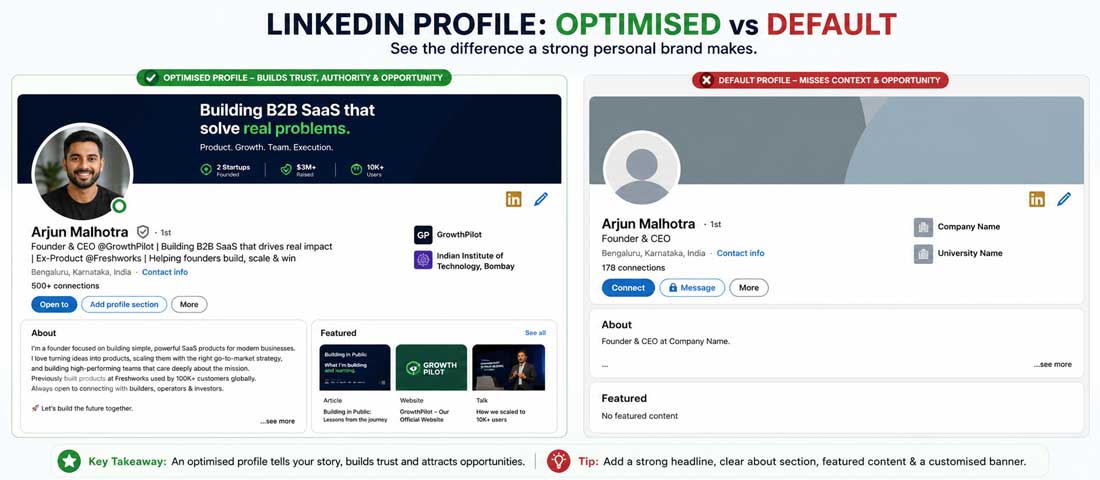
A fully optimised LinkedIn profile is the foundation of founder personal branding — every element from the profile photo to the featured section is an opportunity to communicate expertise, build credibility, and convert profile visitors into conversations.
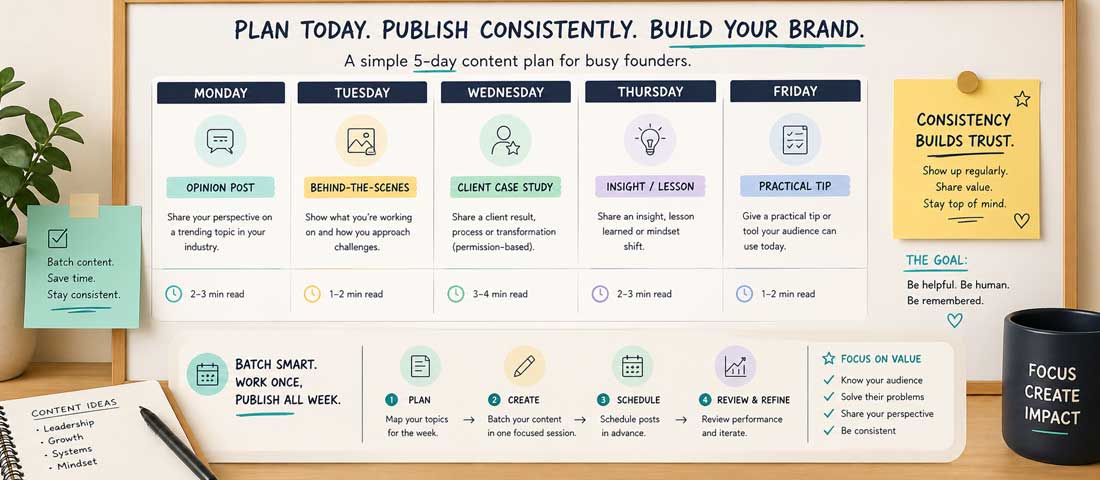
A simple weekly content calendar — batched on one day, scheduled across the week — is the habit that separates founders who build consistent personal brands from those who post irregularly and wonder why their audience never grows.
Ready to Build a Personal Brand Website that Reflects your Expertise and Converts Visitors?
Neel Networks designs personal brand and founder websites for business owners across the USA, UK, Canada, Australia, and India — clean, fast, SEO-optimised, and built to convert profile visitors into conversations. Talk to our team about your personal brand project.