How to Use AI to Write Better Website Copy (Without Sounding Like a Robot)
You have used an AI tool to write website copy. You asked it to write your homepage headline, your about page, your service descriptions. And what came back sounded professional, polished, and completely devoid of the personality that makes a business actually interesting to buy from.
“We are a dynamic team of passionate professionals dedicated to delivering cutting-edge solutions that leverage synergistic frameworks to drive transformative outcomes for our valued clients.”
Nobody talks like that. Nobody buys from a website that talks like that. And yet that sentence — or something disturbingly close to it — is what AI produces when given a generic prompt by someone who has not yet learned how to work with these tools properly.
The problem is almost never the AI. The problem is the prompt. AI copywriting tools are extraordinarily capable in 2026 — they can match tone, adopt specific brand voices, write in different registers for different audiences, and produce genuinely compelling copy. But they need to be guided precisely. A vague input produces vague output. A specific, well-structured prompt produces copy that sounds human, on-brand, and conversion-focused.
This guide teaches you exactly how to prompt AI for website copy, how to edit AI output to remove the robotic quality, and how to use AI as a collaborator rather than a vending machine.
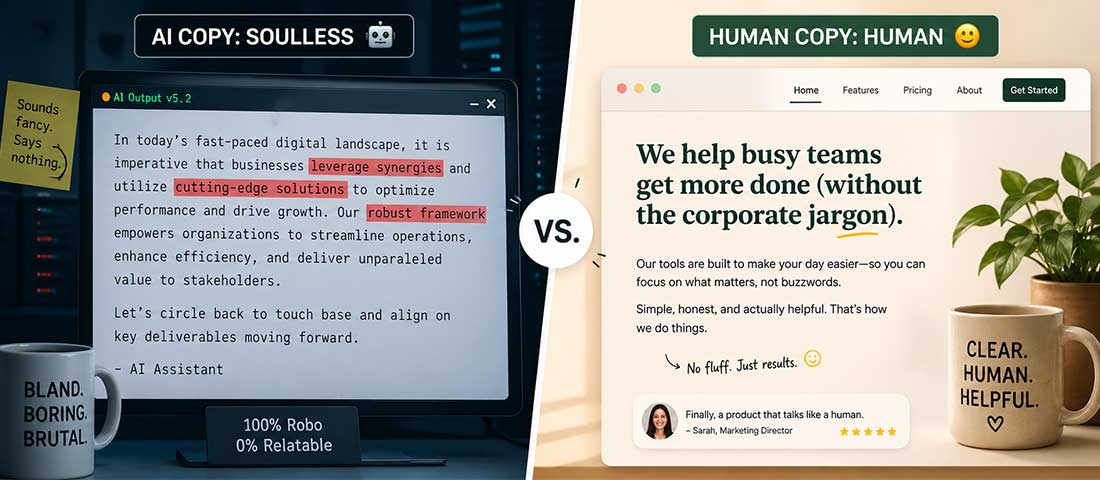
Why AI Website Copy Sounds Robotic — and the Root Cause
The robotic quality in AI-generated copy is not a technical limitation — it is a training data consequence. AI language models learn from enormous volumes of text scraped from the internet. A disproportionate amount of that text is corporate communications, press releases, LinkedIn posts, and marketing boilerplate — exactly the kind of language that sounds impressive while saying very little. When you ask AI to “write copy for a web design agency,” it reaches for the most statistically average version of how web design agencies describe themselves. The result is a composite of every corporate website that ever existed.
The solution is not to avoid AI — it is to give the AI enough specific context that it cannot default to the generic. Specific inputs produce specific outputs. The more precisely you describe your audience, your voice, your differentiators, and your style, the less the AI can resort to the average.
The single most important thing to understand about AI copywriting: AI is extraordinarily good at structure, variety, and iteration. It is naturally weak at specific brand personality, genuine emotional nuance, and the unexpected phrase that makes someone stop scrolling. Your job is to handle the things AI is weak at — and let AI handle the rest. This is a collaboration, not a delegation.
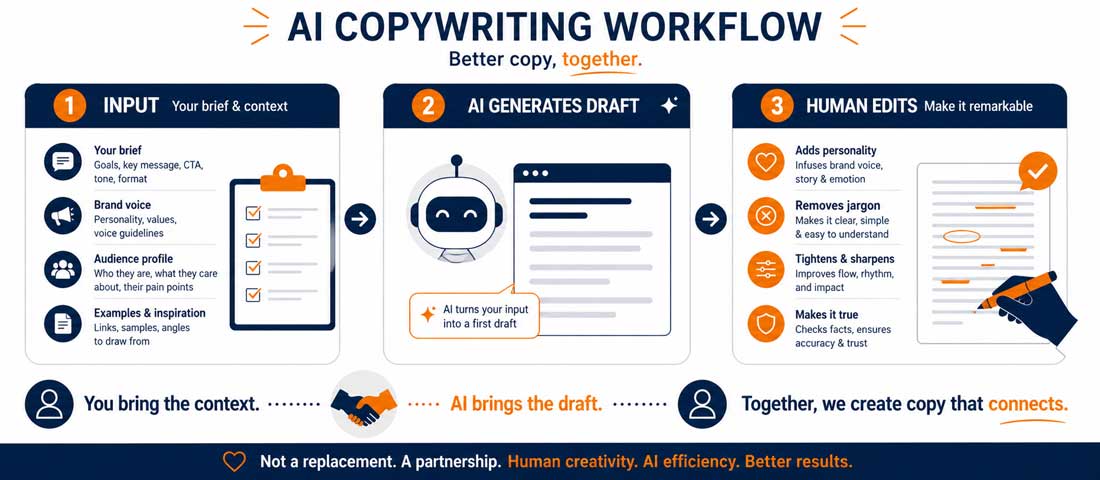
The AI copywriting model that works is collaboration — not delegation. You bring the brand knowledge and personality; AI brings speed, structure, and variety. The final output is human-edited AI output, not unedited AI output.
The 5-Part Prompt Framework That Produces Human-Sounding Copy
The difference between AI copy that sounds robotic and AI copy that sounds human is almost entirely in the prompt. Here is the five-part framework that consistently produces usable, on-brand output:
-
Part 1: Define the role and context
Start by telling the AI who it is and what it is doing. Not “write copy for my website” but “You are a copywriter helping a Mumbai-based web design agency write homepage copy for its UK and USA client audience. The agency has been trading for 12 years, has 450+ clients, and is known for high-quality, responsive communication and competitive pricing versus UK/USA domestic agencies.”This context eliminates the need for the AI to guess — and when AI guesses audience and context, it defaults to the average.
-
Part 2: Describe the target audience specifically
“The reader is a business owner or marketing director at a UK SMB with 10 to 100 employees. They have been let down by a previous web designer, they are sceptical about Indian agencies, and their primary concern is communication quality and delivery reliability rather than price.”Specific audience descriptions allow AI to write from the audience’s perspective rather than about the product in the abstract. Copy that talks to a reader rather than at a reader always sounds more human.
-
Part 3: Specify the tone precisely
Do not write “professional tone.” Write: “Tone: Direct and confident, not corporate. Warm but concise — like a trusted expert talking to a smart client, not a salesperson pitching. No jargon. No exclamation marks. Sentences under 20 words where possible. Active voice throughout.”The more specific the tone instruction, the less the AI defaults to the average corporate register it learned from training data.
-
Part 4: Provide a style example
Paste 2 to 3 sentences of copy you love — from your own previous writing, a competitor you admire, or a brand whose voice resonates. “Write in a style similar to these examples: [paste examples].” AI is excellent at pattern-matching to a provided style. This is one of the fastest ways to override the generic output problem. -
Part 5: Define the specific deliverable
Be precise about exactly what you need. “Write three alternative homepage headline options. Each should be under 10 words, lead with the client benefit (not our capabilities), and avoid the words ‘solutions,’ ‘leverage,’ ‘passionate,’ and ‘innovative.’ Format each with the headline on one line and a 15-word supporting subheadline below it.”Constraints force creativity. When you give AI specific restrictions, it cannot fall back on the clichés that fill the unspecified space.
Which AI Tools Are Best for Website Copywriting in 2026
| Tool | Best For | Strengths | Limitations | Price |
|---|---|---|---|---|
| Claude (Anthropic) | Long-form, nuanced brand voice matching | Best at following complex tone instructions; excellent at editing and explaining its choices | Occasionally verbose — needs trimming | Free / $20/month Pro |
| ChatGPT (GPT-4o) | Rapid iteration, multiple variants quickly | Fast, versatile, excellent at structured formats and lists | Can default to corporate tone without strong prompting | Free / $20/month Plus |
| Gemini Advanced | Research-backed copy with current data | Can reference real-time information; strong at factual claims | Less refined at brand voice matching than Claude | Free / $22/month |
| Copy.ai | Specific marketing copy formats | Built-in templates for headlines, CTAs, product descriptions | Less flexible for custom brand voices; output more formulaic | Free / $49/month |
| Jasper | Brand voice training and consistency | Stores brand voice guidelines; consistent output across team | Expensive; overkill for solo operators | From $49/month |
The Neel Networks recommendation: Start with Claude or ChatGPT — both free tiers are sufficient for most website copywriting work. Use Claude when you need the output to follow complex, nuanced tone instructions. Use ChatGPT when you need rapid iteration of multiple variants. For teams maintaining copy consistency across multiple writers, Jasper’s brand voice training feature is worth the cost at scale.
Page-by-Page Guide: How to AI-Write Each Key Website Page
Homepage Copy
The homepage is the highest-stakes copy on any website — it has to communicate what you do, who it is for, and why you are worth choosing, typically within 5 seconds. AI without specific prompting will almost always produce generic homepage copy. With the right prompt, it produces genuinely useful starting material.
Effective homepage headline prompt:
Write 5 homepage headline options for a web design agency based
in Mumbai that builds websites for UK and USA small businesses.

Rules:
- Each headline under 10 words
- Lead with what the client gets, not what we do
- Avoid: solutions, leverage, passionate, innovative, cutting-edge
- Tone: direct and confident, like talking to a smart friend
- One headline should use a specific number (e.g. "450+ businesses")
- One should address the scepticism about Indian agencies directly
What AI produces (good starting material):
1. "Your website, built by Mumbai's most-reviewed agency."
2. "450+ businesses. One Mumbai studio. Results that speak."
3. "Professional websites. Indian talent. UK-standard delivery."
4. "The website your business has been waiting to launch."
5. "We build websites. You get more enquiries."
None of these is final — but all are better starting points than “Welcome to Our Professional Web Solutions.” Option 5 and Option 3 are strong candidates worth developing. Option 4 is weak. This is the right output from AI: raw material that a human then selects from, combines, and refines.
About Page Copy
The about page is where AI struggles most — because genuine personality and authentic story are exactly what AI lacks. The about page should sound like the founders and team, not like an AI composite of every about page ever written.
How to prompt for a better about page:
- Write your about page in your own words first — even if it is rough, even if it is two paragraphs of stream-of-consciousness. Then paste it into the AI and say: “Polish this copy. Fix grammar and flow. Keep every specific detail and personal element. Do not replace specific facts with generalities. Do not add corporate language.”
- This approach uses AI as an editor of your authentic voice rather than a generator of a generic one — and produces dramatically better about pages than starting from a blank AI prompt.
Services Pages
Services pages are where AI adds the most value — they require consistent structure, clear benefit articulation, and professional language, but do not require the deep personality that about pages need.
Effective services page prompt:
Write a services page section for "WordPress Website Design."

Audience: UK small business owners who are not technical.
Structure:
  - Opening paragraph (3 sentences): what we do + key benefit
  - 4 bullet points: specific things included in the service
  - Closing sentence: confidence-building statement + CTA

Tone: Friendly expert. No jargon. If a technical term must
be used, explain it in plain English in the same sentence.
Do not use: robust, scalable, seamlessly, cutting-edge.
Contact and CTA Copy
Contact page and CTA copy is where AI is most reliable — these sections are short, structured, and benefit from the clear, direct language that well-prompted AI produces naturally. Focus your prompting on the micro-copy: the text above the form, the button label, and the reassurance text below the button.
Prompt specifically: “Write 5 alternative versions of the text that appears above a contact form on a web design agency website. Each should be 2 sentences maximum. The goal is to reduce hesitation and encourage submission. Avoid ‘don’t hesitate to reach out’ and any variation of ‘we’d love to hear from you.'”
Before and After Examples — Real AI Copy vs Improved Versions
Example 1: Service Description
❌ Generic AI output (bad prompt):
“Our comprehensive web design services leverage cutting-edge technologies to deliver robust, scalable digital solutions that seamlessly integrate with your business objectives, driving transformative growth and maximising your online presence in today’s competitive digital landscape.”
✅ Improved with good prompting + light editing:
“We design and build websites that bring you enquiries. Clean, fast, mobile-ready — and built around what your customers actually need to see before they call you. No templates. No shortcuts. Your business, designed properly.”
Example 2: Homepage Headline
❌ Generic AI output:
“Empowering Businesses With Innovative Digital Solutions”
✅ Improved:
“We Build Websites That Win Clients — 450+ Delivered.”
Example 3: About Page Opening
❌ Generic AI output:
“We are a passionate team of dedicated web design professionals committed to delivering exceptional digital experiences. Our mission is to empower businesses with innovative solutions that drive growth and success.”
✅ Improved:
“Neel Networks started in Mumbai in 2014 with one objective: build websites for international businesses that actually convert visitors into clients. Twelve years, 450+ projects, and a 4.9-star Google rating later, that is still the only objective.”
The 7 AI Copywriting Phrases to Delete Every Time
These phrases appear in AI-generated copy with such consistency that they have become reliable signals that copy has not been properly edited. Delete every single one every time you see them:
“Cutting-edge solutions”
What does “cutting-edge” actually mean? Nothing. It is a placeholder for a specific claim. Replace with: what is actually new or different about your approach, in plain language.
“Leverage / Utilise”
Both mean “use.” The simpler word is always better. “We use modern technology” is clearer and more credible than “We leverage advanced technological solutions.”
“Passionate team / passionate professionals”
Every business claims to be passionate. It is meaningless because it is universal. Replace with a specific thing the team actually cares about, evidenced by a fact.
“Seamlessly / Seamless integration”
Another placeholder for a specific capability claim. What specifically is seamless? Name it. “Your WooCommerce store connects directly to your existing accounting software on day one” is better than “seamless integration.”
“Robust and scalable”
These words are beloved by AI and meaningless to the reader. What does robust mean in your specific context? Say that instead. “Built to handle 10,000 daily visitors without slowing down” is specific. “Robust” is not.
“In today’s digital landscape / fast-paced world”
This phrase opens more AI-written paragraphs than any other and has become a reliable AI detection signal. Delete it. Start with the actual point instead.
Bonus phrase to delete: “Don’t hesitate to reach out.” It is the most used — and most ignored — contact CTA in the history of the internet. Replace with something specific: “Tell us what you need and we’ll come back within 24 hours.” Specific, actionable, and honest.
How to Give AI Your Brand Voice So It Stops Sounding Generic
The most powerful way to get AI to produce on-brand copy consistently is to create what copywriters call a voice document — a brief, specific description of your brand’s communication style that you paste into every AI prompt. It takes 30 minutes to create and dramatically improves every piece of AI-generated copy from that point forward.
A voice document for a web design agency might look like this:
NEEL NETWORKS — BRAND VOICE GUIDE FOR AI

Tone: Direct, warm, expert. Like a trusted professional
talking to a smart client — not pitching, just advising.

Do use:
- Short sentences (under 20 words)
- Active voice ("we build" not "websites are built by us")
- Specific numbers ("450+ clients" not "hundreds of clients")
- Plain English for technical concepts
- Second person ("you," "your business") over third person

Do NOT use:
- Exclamation marks
- Corporate jargon: solutions, leverage, synergy, robust,
  cutting-edge, passionate, innovative, seamless
- Filler openers: "In today's digital world," "Whether you're"
- Hedging language: "we try to," "we strive to"

Our differentiators (mention naturally where relevant):
- Based in Mumbai, 12+ years international experience
- 450+ clients across USA, UK, Canada, Australia, India
- 4.9 stars from 43 Google reviews
- 30-person team across design, dev, SEO, support

Style reference (write like this):
"We build websites that bring you clients. Not templates.
Not shortcuts. Websites that work — because we design
for your customers, not for awards."
Paste this document at the start of every copywriting prompt. The AI will use it as its style brief and the output will be dramatically more consistent and on-brand from the first draft.
When to Use AI for Copy — and When to Write It Yourself
| Copy Type | Use AI? | Why |
|---|---|---|
| Headline variants and testing | ✅ Yes — heavily | AI generates 10 headline options in 30 seconds; you select and refine. Maximum value. |
| Service and product descriptions | ✅ Yes — with editing | Consistent structure and benefit articulation — AI handles first draft, you add specifics. |
| FAQ content | ✅ Yes | AI is excellent at comprehensive FAQ generation from a topic brief. |
| Meta descriptions and SEO titles | ✅ Yes | Formulaic enough for AI to handle well; iterate 5 options and pick the best. |
| Founder / personal about page | ⚠️ Use as editor only | Write your own story first; use AI to polish, not generate. Your story requires your voice. |
| Client testimonial framing | ⚠️ Carefully | AI can structure testimonials but must not fabricate quotes. Use only for formatting real quotes. |
| Brand positioning statements | ❌ Write yourself first | Brand positioning is strategic and requires genuine business understanding. AI can refine, not generate. |
| Specific case studies with real data | ❌ AI as light editor only | Real results, real clients, real specifics — all must come from you. AI cannot invent these. |
Frequently Asked Questions About AI Website Copywriting
| Can AI write good website copy? | Yes — with the right prompting and human editing, AI can produce website copy that is genuinely effective and conversion-focused. The quality of AI-generated copy is almost entirely determined by the quality of the prompt. A vague prompt (“write my homepage”) produces generic, robotic output. A specific prompt that defines the target audience, specifies the tone precisely, provides style examples, and applies vocabulary constraints produces usable first-draft copy that a human then refines into final copy. The workflow that works is AI as first-draft generator and structure provider, human as editor and personality injector. Pure unedited AI copy is rarely publication-ready; well-prompted and human-edited AI copy can be excellent. |
| Why does AI-generated copy sound robotic? | AI-generated copy sounds robotic because it defaults to the statistical average of all the corporate writing in its training data — which skews heavily toward bland, jargon-heavy business communication. Without specific instructions, AI cannot distinguish between the bland corporate register it has seen most often and the warm, specific, personality-driven copy that actually converts. The fix is giving the AI precise instructions that prevent it from reaching for the defaults: specifying tone in detail, banning specific jargon words, providing style examples, describing the audience precisely, and applying word-count and structural constraints that force specificity. Additionally, unedited AI copy always benefits from human editing to add personality, remove remaining generic phrases, and ensure every claim is true and specific to the actual business. |
| What are the best AI tools for writing website copy? | The best AI tools for website copywriting in 2026 are Claude (by Anthropic), ChatGPT (by OpenAI), and Gemini Advanced (by Google) — all of which are capable of producing high-quality copy when given well-structured prompts. Claude is particularly strong at following complex tone instructions and maintaining brand voice consistency across long-form copy. ChatGPT is excellent for rapid generation of multiple variants and structured marketing formats. Gemini Advanced benefits from its ability to reference current information when copy requires up-to-date facts or statistics. Specialist copywriting tools like Copy.ai and Jasper provide pre-built templates for specific marketing formats and are worth exploring for teams that need consistent output across multiple writers, though they are less flexible than the general-purpose models for custom brand voice matching. |
| Will Google penalise my website for AI-generated copy? | Google does not penalise websites for AI-generated copy — its published guidance is that it evaluates content on quality, helpfulness, and E-E-A-T (Experience, Expertise, Authoritativeness, Trustworthiness) regardless of how it was produced. AI-generated copy that is accurate, specific, helpful, and well-edited passes Google’s quality bar. The practical concern with unedited AI copy is not Google penalisation but poor quality — generic, repetitive content that provides no unique value tends to underperform organically because it does not differentiate from competing pages covering the same topic, not because it triggers an AI detection penalty. The best practice is to use AI as a tool in a human editorial workflow rather than a fully automated content factory — ensuring every published piece reflects genuine business knowledge, specific facts, and human quality control. |
| How do I give AI my brand voice? | The most effective way to give AI your brand voice is to create a short brand voice document — typically one page — that defines your tone in specific, actionable terms, lists vocabulary to use and avoid, provides 3 to 5 sentences of example copy that captures your voice, and describes your audience. This document should be pasted at the start of every AI copywriting prompt as a style brief. Include: tone description (“direct and warm, not corporate”), specific words and phrases to avoid (“solutions, leverage, passionate, cutting-edge”), specific things to use (“short sentences, active voice, specific numbers”), and example sentences that sound right. The more specific your brand voice document, the more consistently AI will produce on-brand output. Review and update the document as your brand voice evolves. |
| Should I use AI or a professional copywriter for my website? | The most effective approach in 2026 is a combination: use AI tools with strong prompting to produce first-draft copy across your website, then have a professional copywriter or an experienced human editor review, refine, and improve that copy. This approach is 40 to 60% faster than writing from scratch and significantly cheaper than commissioning a professional copywriter for every page from a blank start — while producing better results than publishing unedited AI output. Professional copywriting expertise adds the most value in: brand positioning and messaging strategy (what to say and why), homepage hero copy (the highest-stakes words on your site), and founder/about page copy where genuine personality and authentic story must come through. If budget requires choosing between AI-only and human-only, human copywriting for 3 to 4 key pages (homepage, about, primary service) with AI-assisted copy for secondary pages is typically the best allocation. |
| What website pages can AI write most effectively? | AI produces the most effective copy for pages with defined structures and clear information requirements: service and product description pages (consistent benefit-led format, well-suited to AI with proper prompting), FAQ pages (AI is very strong at anticipating questions and providing clear answers), meta titles and descriptions (formulaic enough for AI to handle well), CTA and button copy variants (great for rapid iteration of 10 to 15 options), and privacy policy and terms pages (legal boilerplate that AI handles reliably). AI is least effective for founder and personal about pages (requires authentic personal voice and real story), case studies with real client data (AI cannot fabricate real results), and brand positioning statements (requires genuine strategic understanding of the business’s unique position). The general principle: the more a page requires genuine business-specific knowledge, real personality, or specific factual claims, the more human input it needs relative to AI contribution. |
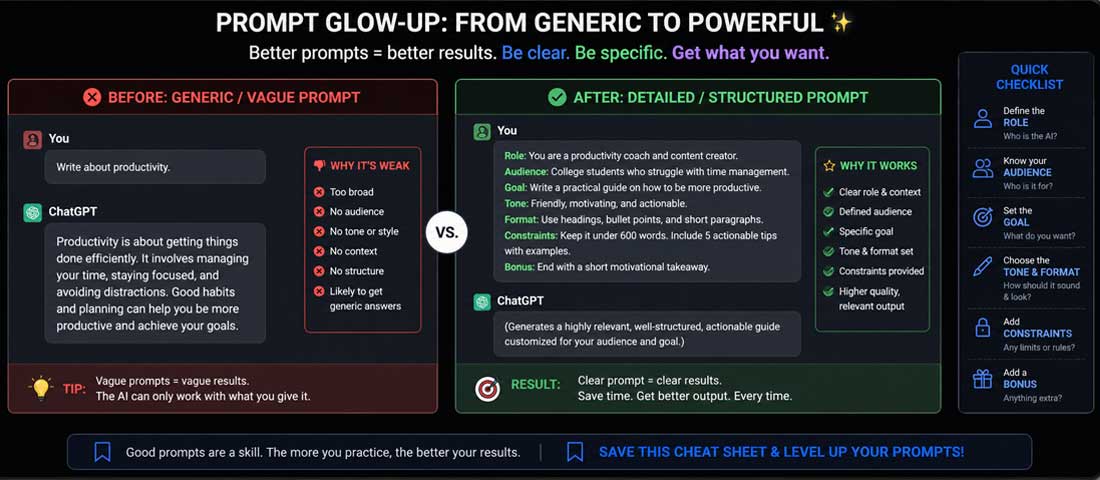
The prompt is everything in AI copywriting — the difference between a generic one-line request and a five-part structured brief is the difference between robotic output and genuinely usable copy that sounds like your business.

Used well, AI transforms website copywriting from a blank-page problem into an editing and refinement exercise — faster, less stressful, and producing better results than either pure AI or slow human-from-scratch writing alone.
Want Website Copy that Actually Converts — Written by Humans Who Understand Your Business?
Neel Networks combines AI tools with experienced copywriters who know what converts for UK, USA, and Australian audiences. Our web design projects include conversion-focused copywriting as part of the build — not an afterthought. Talk to our team about your next website.