
The customer support conversation has genuinely shifted in the last two years. AI chatbots that were embarrassing to deploy five years ago now handle real customer conversations with reasonable competence. Major companies have replaced significant portions of their tier-1 support with AI agents. Vendors are pitching AI as a way to cut support costs by 60-80%. And yet the businesses actually running these systems in production are having considerably more nuanced experiences than either the enthusiasts or the skeptics describe. AI in customer support is neither a silver bullet nor a boondoggle — it’s a specific tool that works remarkably well in specific contexts, fails badly in others, and produces different outcomes for different businesses depending on how it’s implemented. Understanding which category you fall into is what this article is about.
This guide is the honest strategic version — the one that reflects what we actually see when we help clients implement AI customer support versus what AI vendor marketing promises. If you want the broader context of how AI is reshaping the way businesses interact with customers and searchers, our complete AI search optimisation guide covers the wider AI transformation. This article focuses tightly on customer support specifically — what AI actually does well, where it still fails, how much it really saves, and how to adopt it in ways that improve customer experience rather than damaging it.
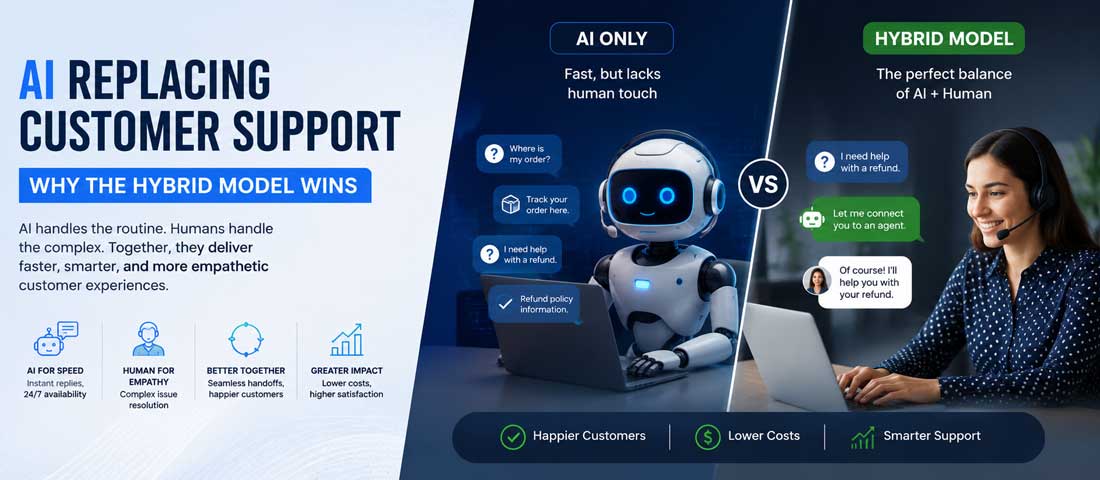
The term “AI customer support” covers a wide range of implementations that vary enormously in capability, cost, and appropriate use case. Being specific about which category you’re actually considering matters because they produce quite different outcomes.
LLM-powered chatbots are the current mainstream — chatbots backed by GPT-4, Claude, Gemini, or similar large language models, typically deployed on websites and in apps. Unlike the scripted chatbots of a decade ago, these can handle unstructured questions, understand context, and generate natural responses. Quality varies dramatically by implementation, but the ceiling is meaningfully higher than earlier generations of chatbot technology.
Voice AI agents handle phone-based customer support through natural-sounding voice interactions. Providers like Bland AI, Vapi, and Retell have made voice AI viable for real customer interactions — the “am I talking to a human or a bot?” question is now genuinely ambiguous in many voice AI systems. Voice AI is particularly transforming call centre operations where cost per contact has traditionally been high.
AI-augmented human agents are the hybrid pattern where humans handle customer contact but AI assists them with suggested responses, relevant knowledge base articles, sentiment analysis, and automated summarisation. This model preserves human interaction while dramatically improving agent productivity — often 30-50% more tickets handled per agent, with quality maintained or improved.
Fully autonomous AI agents represent the emerging edge — AI systems designed to handle entire customer interactions independently, including complex multi-step workflows, integrations with backend systems, and follow-through across multiple sessions. This category is genuinely powerful but also the most implementation-dependent, with quality outcomes varying enormously based on specific deployment.
The choice between these categories drives everything else about your AI customer support strategy. A business considering “adding an AI chatbot” is making a very different decision than a business considering “replacing tier-1 support with autonomous AI agents”, and treating them as the same conversation produces confused strategic thinking.
Being specific about AI’s genuine strengths matters because vague pro-AI messaging produces overconfidence about deployment. Seven categories of tasks are where AI reliably outperforms human alternatives once it’s properly configured.
Tier-1 FAQ handling. Questions like “what are your business hours”, “how do I reset my password”, “where’s your return policy”, “what payment methods do you accept” — these are exactly what AI handles cleanly and instantly. Human agents spending time on these questions is genuine waste when AI can resolve them in seconds with equivalent or better quality.
Order status and account operation checks. “Where’s my order”, “when will my subscription renew”, “what’s my current balance”, “has my payment been received” — routine account operations that require pulling data from systems and presenting it clearly. AI does this significantly faster than humans and never gets tired of answering the same question.
Basic account operations. Password resets, plan changes, adding payment methods, updating shipping addresses, simple account modifications. When these can be integrated with backend systems safely, AI handles them faster than human-mediated processes with lower error rates.
Routing and triage. Even when AI can’t fully resolve a query, it can efficiently identify what the query is about, gather relevant context, and route it to the right human agent with the situation pre-summarised. This alone often improves customer experience because the routing quality is better than “please hold while I transfer you”.
24/7 availability. AI doesn’t sleep, take breaks, or have off-shifts. For businesses whose customers span time zones or ask questions outside business hours, AI extends coverage in a way that would be prohibitively expensive with human staff. The customer who has a question at 2am on a Sunday gets an actual answer rather than “our office hours are Monday through Friday”.
Handling volume spikes gracefully. Product launches, promotional periods, viral moments, and unexpected events produce support volume spikes that would overwhelm human teams. AI scales to demand automatically — the same system handling 100 concurrent conversations can handle 10,000 without additional staff. This is one of the strongest business cases for AI in customer support: not replacing steady-state volume but absorbing spikes that would otherwise degrade service.
Multilingual support. Modern LLM-powered AI handles multiple languages effectively without requiring separate agents per language. A business serving customers in ten languages can provide equivalent support in all ten through a single AI system, versus needing distinct human teams per language.
Being equally honest about AI’s genuine weaknesses is what makes the earlier strengths credible. Six categories are where AI reliably underperforms and where forcing AI adoption produces worse customer experience.
Complex multi-step problems requiring genuine judgment. When resolution requires understanding subtle context, weighing trade-offs, considering exceptions, or making judgment calls that go beyond following documented policies, human agents outperform AI substantially. The specific pattern is that AI handles “the standard case” well and struggles with anything requiring interpretation of what “standard” should mean.
Emotional situations. Angry customers, grieving customers dealing with product failures, customers reporting genuine harm — these situations need empathy that AI performs mechanically rather than authentically. Customers can often sense when they’re being handled by AI in an emotional situation, and the resentment this produces frequently causes escalation to complaints or negative reviews that human handling would have prevented.
Novel issues without training precedent. AI performs well on questions similar to what it’s been trained or configured for. When customers encounter genuinely new issues — the specific edge case that hasn’t come up before — AI often confidently produces wrong answers rather than accurately saying “I don’t know”. This confident-but-wrong pattern is particularly dangerous because customers act on the incorrect guidance before the error is discovered.
Judgment calls involving customer accommodation. Refunds outside normal policy, exceptions for long-term customers, escalated compensation for significant service failures — these require judgment about what makes sense in specific contexts, and AI’s judgment is fundamentally rule-following rather than situation-appreciating. Businesses that let AI make these decisions frequently produce worse outcomes than businesses that route them to humans.
Context requiring human relationship history. “You know I’ve been a customer for eight years and this is my third issue this month” — the accumulated relationship context that human agents can factor in doesn’t translate well to AI systems, which tend to treat each interaction as fresh regardless of stated history. For businesses where customer relationship quality matters commercially, this gap has real impact.
Situations requiring accountability. When something has genuinely gone wrong and the customer needs to feel that a person is taking ownership of making it right, AI acknowledgement lacks the accountability signal that human accountability provides. This isn’t a technology limitation that will disappear with better models — it’s a fundamental aspect of what customers want when things break.
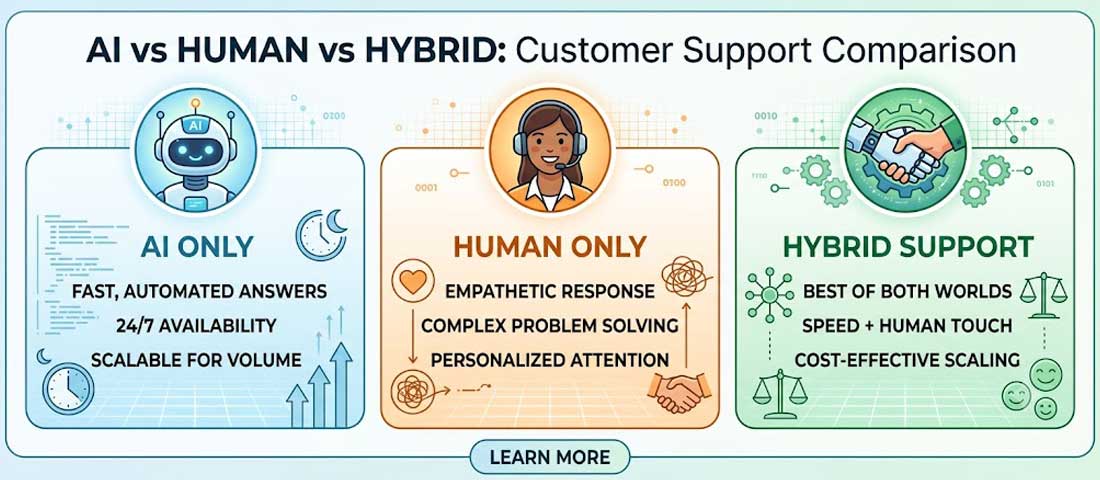
Given what AI does well and what it doesn’t, the pattern that produces good outcomes in production is the hybrid model — AI handling the categories where it excels while humans handle the categories where AI underperforms, with clean escalation paths between them.
| Factor | AI-only support | Human-only support | AI + Human hybrid |
|---|---|---|---|
| Cost per interaction | $0.10 – $0.50 | $5 – $25+ | $1 – $8 (weighted average) |
| Coverage hours | 24/7 | Business hours (or 24/7 at high cost) | 24/7 (AI) + business hours (human) |
| Resolution quality (simple issues) | Very good | Good | Very good |
| Resolution quality (complex issues) | Poor | Very good | Very good (humans handle these) |
| Customer satisfaction | Variable (audience-dependent) | Generally high | Generally high |
| Scalability during spikes | Excellent | Poor | Excellent (AI absorbs spikes) |
| Implementation complexity | Moderate | Low | High (integration matters) |
| Best for | Very high-volume simple queries | Very high-touch relationships | Most business contexts |
The hybrid model is what most successful implementations look like once businesses have iterated past the initial “AI can do everything” phase. AI handles tier-1 volume (which is often 60-80% of total tickets), routes intelligently to humans when its capability doesn’t fit, and human agents handle the complex, emotional, or judgment-requiring interactions where they add unique value. Neither pure AI nor pure human matches the outcomes this hybrid produces for most business contexts.
The AI customer support market is full of dramatic cost savings claims that need to be evaluated honestly against realistic implementation outcomes.
What vendors claim. AI customer support vendors frequently market 60-80% cost reduction versus human-only support. Some marketing goes further to promise 90%+ reduction with the implication that human agents can be eliminated entirely. These numbers appear in case studies, sales pitches, and industry reports frequently enough that businesses often anchor on them as expected outcomes.
What actually happens in typical implementations. Realistic cost reduction for businesses adopting AI customer support is typically 20-40% of the total support budget, not 60-80%. The reasons this differs from vendor claims are specific and worth understanding.
The volume of tickets AI can fully resolve autonomously (called “containment rate”) is typically 30-50% for well-implemented systems, not 80-90% as some marketing suggests. Complex tickets still route to humans. Some tickets that AI could theoretically handle still get escalated because customers demand human interaction. New product launches or unusual situations produce ticket categories AI wasn’t configured for.
The cost of the AI system itself is meaningful. Enterprise AI customer support platforms cost $50,000-500,000+ per year for realistic mid-sized business implementations. This offsets some of the savings from reduced human staff. Simpler chatbot platforms cost less but deliver correspondingly less capability.
Implementation and ongoing tuning costs are ongoing rather than one-time. AI systems need training data, prompt engineering, integration with backend systems, monitoring, quality assurance, and continuous improvement. These ongoing costs are often 20-40% of the direct platform cost annually.
Human agents don’t disappear entirely — they shift toward higher-value work handling escalations and complex cases. Agents handling complex cases typically cost more per hour than agents handling volume tier-1, offsetting some of the volume-reduction savings.
Realistic total cost analysis for typical mid-sized business AI customer support implementation: 20-40% net cost reduction from the previous human-only support cost, with meaningfully improved coverage (24/7 versus business hours) and typically improved customer satisfaction for simple queries. These are genuinely good outcomes — just significantly more modest than the marketing suggests.
Customer experience with AI support is more nuanced than either the enthusiast or skeptic narratives capture. The reality is that customers segment into distinct groups with different preferences, and the mix in your customer base determines what AI adoption produces.
Segment 1: Customers who prefer AI (roughly 40-50% for most businesses). Tech-comfortable customers, self-service-oriented buyers, people with simple queries who want fast resolution without the friction of explaining themselves to a human. This segment often actively prefers AI because it’s faster, doesn’t require small talk, and provides consistent quality. For businesses whose customer base skews toward this segment, AI adoption produces genuine customer satisfaction gains.
Segment 2: Customers who resent AI (roughly 20-30%). Customers with complex issues, elderly customers, customers who want relationship-based service, and customers who have been burned by bad AI systems in the past. This segment actively prefers human interaction and sometimes escalates deliberately just to avoid AI. Businesses whose customer base skews toward this segment need to preserve strong human paths and can’t fully automate without customer damage.
Segment 3: Customers who are neutral (roughly 25-35%). The largest single segment for most businesses — customers who don’t have strong preferences and evaluate their experience based on quality of resolution rather than which method delivered it. Good AI produces satisfaction for this segment; bad AI produces resentment. Implementation quality determines the outcome.
The strategic implication is that AI adoption strategy needs to match your customer segment mix. Businesses with tech-forward audiences (SaaS, consumer tech, digital products) skew toward Segment 1 and benefit most from AI adoption. Businesses with high-touch relationships (financial advisory, healthcare, luxury goods) skew toward Segment 2 and should approach AI more carefully. Businesses with mixed audiences (mainstream eCommerce, service businesses) have to design for the mix.
For businesses genuinely considering AI customer support adoption, the framework below produces reliable outcomes when followed methodically. Skipping steps or executing them poorly produces the specific failure modes that damage AI adoption reputation.
Want Help Designing an AI Customer Support Strategy that Actually Works?
If you would rather have an experienced team help you evaluate whether AI customer support fits your business, design the implementation properly, and integrate it with your existing operations — we handle AI adoption as strategic engagements rather than as tool installations. The difference between AI that improves customer experience and AI that damages it is almost entirely in the implementation.
The specific vendors and price points that make up the AI customer support market matter for practical decision-making. The tiers below reflect real capability differences and current market pricing.
Tier 1: Basic chatbot platforms ($50-500/month). Zendesk AI, Intercom Fin, Freshworks Freddy at their entry tiers. LLM-powered chatbots that handle FAQ, basic ticket routing, and simple account operations. Adequate for small businesses with modest support volume. Setup takes days to weeks. Handles 20-40% of typical tickets if well-configured.
Tier 2: Mid-market AI customer support ($500-5,000/month). Ada, Kustomer AI, Ultimate, higher tiers of Zendesk/Intercom/Freshworks. More sophisticated LLM implementations with integration capabilities, workflow automation, and better containment. Setup takes weeks to months. Handles 40-60% of typical tickets when properly implemented.
Tier 3: Enterprise AI customer support ($5,000-50,000+/month). Enterprise deployments of Ada, Kustomer, or custom implementations on top of OpenAI/Anthropic APIs. Deep integration with business systems, sophisticated conversation design, extensive training data curation, dedicated support from the vendor. Setup takes months. Handles 60-80% of tickets in ideal implementations, though the higher end requires substantial ongoing investment.
Voice AI specialists ($0.05-0.30 per minute of conversation). Vapi, Bland AI, Retell, Deepgram voice agents. Priced per minute rather than monthly subscription. Handle phone-based customer support with natural voice interactions. Particularly relevant for call centre operations. Quality has improved dramatically in the past 18 months and now approaches human-indistinguishable for many use cases.
DIY on LLM APIs ($100-10,000+/month depending on volume). Custom implementations built on top of OpenAI GPT-4, Anthropic Claude, or Google Gemini APIs. Maximum flexibility, highest quality potential when done well, most complex to implement and maintain. Right for businesses with in-house technical capability or partners providing custom AI implementation. Handles up to 80%+ of tickets in sophisticated implementations, though this requires serious engineering investment.
The specific business contexts where AI customer support produces strong outcomes versus poor outcomes are worth being explicit about, because misapplying it in the wrong context damages both customer experience and the business’s confidence in AI adoption.
Where AI customer support genuinely works well: businesses with high volume of relatively simple queries (eCommerce order status, SaaS feature questions, basic account operations), businesses whose customer base skews tech-comfortable and self-service oriented, businesses needing 24/7 coverage that would be expensive to staff, businesses with international audiences needing multilingual support, businesses experiencing volume spikes that human teams can’t absorb, and businesses whose ticket categories have consistent patterns AI can learn.
Where AI customer support underperforms: businesses with low volume where the setup investment doesn’t pay back, businesses whose customer base has high-touch expectations (financial advisory, healthcare, luxury goods), businesses whose queries are typically complex requiring judgment (professional services, complex B2B), businesses where brand voice is highly specific and AI can’t reliably match it, businesses whose customer segments actively resent AI (some elderly-heavy audiences, some crisis-response contexts), and businesses in regulated industries where AI decisions create compliance exposure.
The most consistent pattern for failed AI customer support adoption is forcing it into contexts where it doesn’t fit rather than adopting it where it does. Businesses that identify appropriate use cases and adopt AI carefully for those cases produce good outcomes. Businesses that adopt AI broadly because “everyone’s doing it” produce mixed to bad outcomes.
The escalation moment — when AI recognises its capability limits and hands off to a human — is where good AI customer support implementations distinguish themselves from bad ones. This design deserves substantial attention because it determines a large portion of the customer experience.
Immediate escalation triggers. Certain patterns should trigger immediate escalation without AI attempting resolution: explicit customer requests to speak to a human (“get me a real person”, “I want to talk to someone”), high-emotion signals in the message (anger, distress, frustration keywords), keywords indicating serious issues (fraud, legal, complaint, dispute), and specific categories that policy dictates should always route to humans (refund requests over certain amounts, cancellations of higher-tier accounts, sensitive personal issues). The AI shouldn’t try to handle these before escalating.
Customer opt-out at any time. At every point in an AI conversation, the customer should have a clear, obvious way to request a human. This isn’t buried in a menu — it’s an explicit option in every message. Businesses that hide the human option to boost containment metrics produce worse customer experience than businesses that make it easy and let customers choose. The opt-out rate matters less than the customer satisfaction of those who exercise it.
Context preservation on handoff. When escalation happens, the human agent receives full context — the conversation history, what AI attempted, what triggered the escalation, relevant customer data. The customer should never have to repeat what they’ve already told the AI. This is a significant technical requirement but one that dramatically affects the escalation experience quality.
The handoff moment experience design. Clear communication that the customer has moved to human support (“I’m connecting you with Sarah from our team, she’ll be with you shortly”), realistic wait time estimates, and a smooth transition rather than abrupt disconnection. The handoff moment sets expectations for the human interaction that follows.
Preventing loop-back to AI. Once a customer has escalated to a human, they shouldn’t get bounced back to AI for related issues in the same session. Some implementations helpfully “route back” customers to AI when the human agent finishes a call, which reads as being tossed back into automation just when the customer thought they’d escaped it. Design against this specific failure mode.
What you measure determines what you improve. The specific metrics that predict genuine AI customer support success versus superficial success are worth being deliberate about.
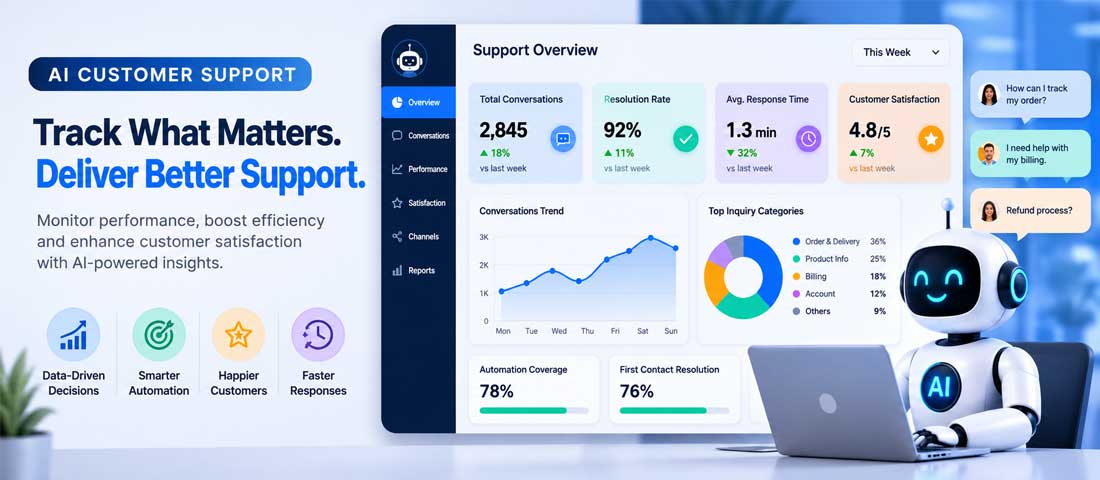
Customer Satisfaction (CSAT) segmented by resolution method. Separate CSAT for AI-resolved tickets, escalated-then-resolved tickets, and human-only tickets. This reveals whether AI is producing genuinely satisfied customers or containing tickets while producing dissatisfaction. Some implementations show high containment with low CSAT — a red flag for the strategy.
Net Promoter Score (NPS) impact from AI adoption. Track NPS before and after AI implementation, controlling for other variables. If NPS declines meaningfully after AI adoption, the customer experience is being degraded regardless of what other metrics say. This is the ultimate outcome measure for customer support effectiveness.
First-contact resolution rate. The percentage of tickets resolved on first contact without escalation, callback, or reopening. AI often improves this for its category (simple queries) but reveals problems for complex queries where AI creates escalation loops. Track this by ticket category to understand what AI is doing to your resolution efficiency.
Escalation success rate. When AI escalates to humans, what percentage of those escalations result in resolution versus re-escalation, callback, or customer frustration? This measures the quality of the escalation design specifically.
Cost per resolution (not just cost per contact). Some AI implementations reduce cost per contact but increase total interactions per resolution (because customers have to try multiple times to get their issue resolved). Cost per resolution is the more meaningful metric because it captures whether AI is genuinely reducing total cost or just shifting it.
Containment rate. The percentage of tickets AI resolves without human involvement. This is what vendors emphasise but is only useful when paired with quality metrics. High containment with declining CSAT is worse than lower containment with maintained CSAT.
Customer retention correlation with AI-resolved tickets. Do customers whose issues are resolved by AI show equivalent retention to customers whose issues are resolved by humans? This measures whether AI resolution produces the same customer relationship value as human resolution. If retention drops for AI-resolved customers, the deployment is producing hidden costs.
Different industries have different AI customer support fit patterns based on customer expectations, regulatory constraints, and typical ticket characteristics.
eCommerce. Strong fit for AI. Order status, delivery tracking, return initiation, product questions, and basic account operations are exactly what AI handles well. Most successful AI customer support case studies come from eCommerce because the fit is genuine. Escalate refund disputes and complex issues to humans; automate everything else.
SaaS. Good fit for AI, particularly for feature questions and account operations. Documentation-heavy support that customers currently search through can be effectively delivered via AI conversation. Escalate complex integration issues, custom development questions, and enterprise account matters to humans.
Financial services. Restricted fit due to compliance requirements. AI can handle information requests (balance, transaction status, product information) but cannot make financial advice or transaction decisions in most regulatory frameworks. Careful design is required to prevent AI from wandering into regulated territory. Compliance review of AI responses is often required, adding operational cost that offsets some savings.
Healthcare. Very restricted fit due to HIPAA and equivalent regulations plus the high-stakes nature of health information. AI can handle appointment scheduling, insurance verification, and general information but cannot provide medical advice or discuss patient-specific health information without careful implementation. Most healthcare AI customer support is limited to administrative rather than clinical support for good reasons.
B2B services. Mixed fit. Enterprise buyers often expect high-touch relationships that AI degrades. Small business B2B accepts AI similarly to consumers. The choice depends on customer segmentation and account tier — enterprise customers should typically stay on human paths while smaller accounts can be AI-handled.
Local services. Weak fit for most local service businesses. Ticket volume is typically low enough that AI setup investment doesn’t pay back, and local service relationships are often specifically high-touch by nature. Better to invest in strong UX design that reduces support needs than to add AI to handle low volume.
The pattern across industries is that AI fit depends on ticket characteristics (volume, complexity, regulatory sensitivity) and customer expectations (self-service vs. relationship-driven) more than on industry per se. The strongest implementations match AI adoption to specific ticket categories within any industry rather than treating industry as the determining factor.
The patterns of AI customer support failures are consistent, and most come from adopting AI in the wrong contexts or implementing it in ways that prioritise the wrong metrics.
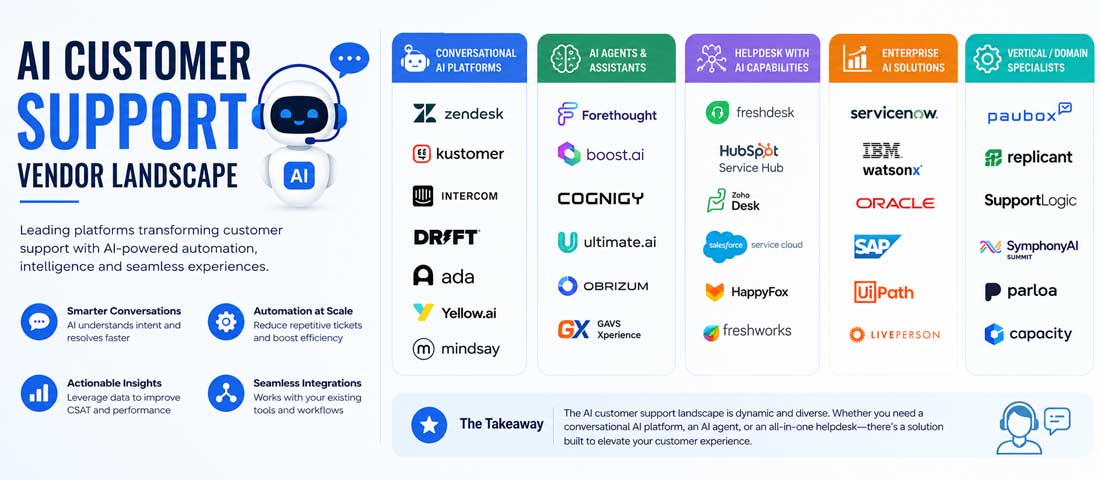
The AI customer support vendor market is crowded and evolving quickly. Being specific about the current leaders and their positioning helps focus vendor evaluation rather than trying to compare hundreds of options.
Established chatbot platforms with AI upgrades. Zendesk with AI, Intercom Fin, Freshworks Freddy AI. These platforms have added LLM-powered capabilities to existing customer support infrastructure. The advantage is deep integration with support workflows businesses already use. The trade-off is that the AI capabilities are sometimes less sophisticated than LLM-native platforms. Good fit for businesses already using these platforms who want to add AI incrementally.
LLM-native customer support platforms. Ada, Kustomer AI, Ultimate, Talkdesk AI. These platforms were designed around LLM capabilities from the ground up rather than adding AI to existing chatbots. Generally produce higher-quality AI interactions but require migration from existing platforms. Good fit for businesses starting fresh or willing to migrate for capability.
Voice AI specialists. Vapi, Bland AI, Retell AI, Deepgram voice agents. These focus specifically on voice interactions rather than text-based chat. Priced per minute rather than monthly subscription. Particularly relevant for call centre operations or businesses whose customers primarily use phone support. Quality has improved dramatically in the past 18 months.
Custom implementations on LLM APIs. DIY on OpenAI GPT-4, Anthropic Claude, or Google Gemini APIs. Maximum flexibility, highest quality potential when done well, most complex to implement and maintain. Right for businesses with in-house technical capability or partners providing custom AI implementation. Businesses building their own with the guidance of teams like ours providing custom website development integrated with AI capabilities get significantly more control than platform-based alternatives, though the investment is meaningfully larger.
What we increasingly recommend for mid-sized businesses. The pattern we see producing the best outcomes is a hybrid approach — established chatbot platform for the core deployment (leveraging existing workflows), with custom LLM implementation for specific high-value use cases where deeper capability produces disproportionate value. This combines the maturity of established platforms with the flexibility of custom AI for the specific applications that warrant it. It’s not the cheapest approach but it produces the most consistent outcomes across varied use cases.
AI customer support adoption is complex enough that professional help often pays back through better implementation quality and avoided mistakes. Specific situations warrant external expertise.
Bring in help when you’re at the strategic decision point about whether AI customer support fits your business — the analysis of your customer segment mix, ticket patterns, and business context benefits from experienced perspective rather than vendor sales pressure. Bring in help when implementation is complex — integration with existing systems, custom training data, workflow integration, escalation design all benefit from technical expertise. Bring in help when the ongoing operation requires expertise you don’t have in-house — continuous improvement, quality monitoring, escalation tuning, and response quality review are ongoing disciplines that many businesses lack internally. Bring in help when the stakes are significant enough that failed implementation would produce meaningful customer damage — for higher-revenue businesses, professional implementation is genuine risk mitigation.
For businesses considering AI adoption as part of broader strategic modernisation, the connection between AI in customer support and AI in wider search visibility matters. Our piece on how AI is transforming SEO and the future of search covers the wider AI transformation businesses are navigating, and understanding both dimensions together produces better strategic decisions than treating them as separate topics. For businesses weighing AI in the specific context of choosing between AI-built tools and human-built ones, our comparison of AI website builders versus web design agencies covers a related strategic decision that many businesses face alongside AI customer support adoption.
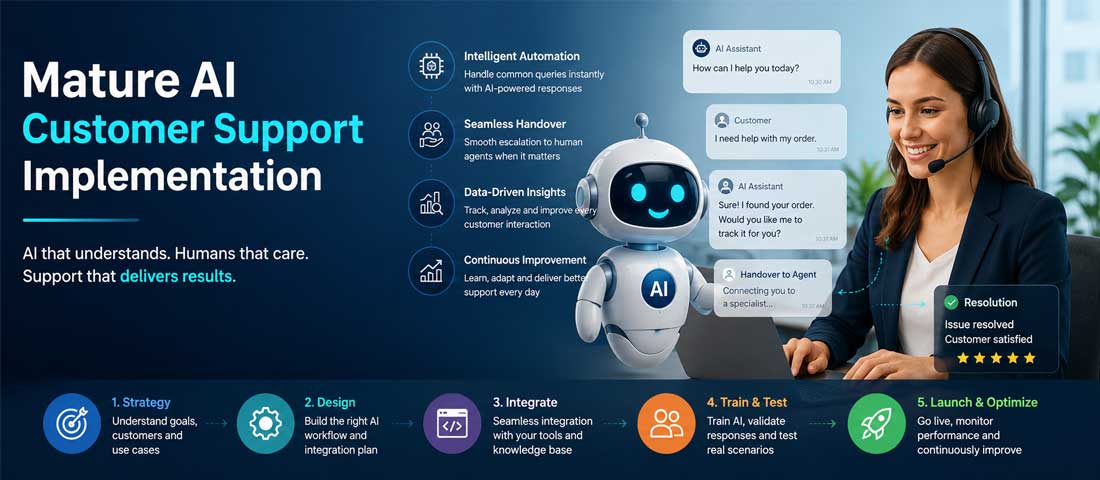
The honest summary of AI in customer support is that the technology is genuinely powerful, the transformation is genuinely happening, and the practical outcomes for individual businesses depend enormously on implementation quality. AI does specific things well — tier-1 volume, FAQ handling, order status queries, basic account operations, 24/7 coverage, spike absorption, multilingual support — and doing them well produces genuine business value plus customer experience gains for the segments that prefer self-service. AI does other things poorly — complex judgment calls, emotional situations, novel issues, high-touch relationships — and forcing AI into these contexts damages customer experience regardless of what marketing promises. The hybrid model that combines AI for its strengths with humans for their strengths is what produces the best outcomes for most businesses, and matching your specific adoption to your specific business context matters more than any single vendor choice or feature comparison. The businesses that navigate this transition well are the ones treating AI customer support as an ongoing operational discipline rather than a one-time deployment, measuring quality alongside cost, and adopting AI where it genuinely helps rather than where marketing pressure suggests it should. Cost savings are real but usually 20-40% rather than the 60-80% marketing suggests, and prioritising customer experience over cost cutting produces both better experience AND reasonable cost outcomes rather than either alone. Start with pilot implementations, measure quality carefully, iterate deliberately, and you have the discipline that separates good AI customer support from the failed implementations that give AI adoption a bad reputation.
| Is AI ready to replace customer support entirely? | No, not entirely, and treating this as the goal produces poor outcomes. AI is genuinely capable of handling significant portions of customer support — typically 30-60% of tickets in well-implemented systems — but the remaining tickets involve complexity, judgment, or emotional situations where AI underperforms substantially. The pattern producing the best outcomes is a hybrid model where AI handles tier-1 volume and simple queries while humans handle complex, emotional, or judgment-requiring interactions. Businesses trying to replace human support entirely typically produce worse customer experience and higher long-term costs than businesses adopting AI thoughtfully for appropriate use cases. The right question isn’t “when can AI replace all human support” but “which parts of my support should AI handle and which should stay human?” |
| How much can AI actually reduce customer support costs? | Realistic cost reduction for typical mid-sized business AI customer support implementations is 20-40% of the previous total support budget, not the 60-80% commonly claimed in vendor marketing. The difference comes from real-world implementation factors: containment rates of 30-50% rather than 80-90%, ongoing costs of AI platforms ($50,000-500,000+ per year for meaningful implementations), continued need for human handling of complex tickets, and ongoing tuning and improvement costs. These realistic numbers are still genuinely valuable — a 20-40% cost reduction combined with 24/7 coverage improvements and typically maintained or improved customer satisfaction is a meaningfully positive outcome. But businesses expecting the marketed 60-80% reduction frequently feel disappointed even when their implementation is objectively producing good results. |
| Will customers accept AI customer support? | It depends on the customer segment and the implementation quality. Roughly 40-50% of customers actively prefer AI for simple queries (tech-comfortable, self-service-oriented buyers). Roughly 20-30% actively resent AI and want human interaction. The remaining 25-35% are neutral and evaluate based on quality of resolution. Businesses whose customer base skews toward the AI-preferring segment (SaaS, consumer tech, digital products) produce strong customer satisfaction gains from AI adoption. Businesses whose customer base skews toward the AI-resenting segment (financial advisory, healthcare, luxury goods) need to preserve strong human paths and adopt AI carefully. Implementation quality matters enormously — well-implemented AI produces high satisfaction across most segments, while poorly-implemented AI produces resentment even from customers who would otherwise prefer AI. |
| What are the risks of adopting AI customer support? | Six specific risks matter. Customer experience degradation if AI is deployed in inappropriate contexts or implemented poorly. Damage to brand reputation from confidently-wrong AI responses. Loss of customer relationships that were previously built through human interaction. Compliance exposure in regulated industries where AI decisions create regulatory risk. Vendor lock-in with platforms that make migration difficult. Ongoing operational cost of continuous improvement that many businesses underestimate. Each of these is mitigated through careful implementation but is real when implementation is careless. The businesses that avoid these risks are the ones treating AI adoption as strategic decision requiring deliberate planning rather than as tool purchase. Pilot implementations, quality measurement alongside cost measurement, and proper escalation design all reduce risk substantially compared to broad deployments without these disciplines. |
| How long does AI customer support implementation take? | Timeline varies substantially by scope. Basic chatbot deployment on established platforms (Zendesk AI, Intercom Fin) can be operational within 2-4 weeks including initial configuration. Mid-market implementations with meaningful customisation typically take 2-4 months from decision to production rollout. Enterprise-scale implementations with deep system integration, custom training data, and sophisticated conversation design can take 6-12 months. Custom implementations on LLM APIs take similar timeframes but produce more differentiated outcomes. Rushing implementation to hit shorter timelines typically produces worse outcomes than taking appropriate time for design and pilot testing. The specific timeline that matters is time to production quality (when the system is producing genuinely good customer experience), not time to initial deployment (when the system is technically operational but may not be genuinely good yet). |
| Do we need to train AI on our specific business? | Yes, in essentially all cases. Out-of-the-box AI customer support handles generic scenarios but performs poorly on business-specific questions, product knowledge, policies, and procedures. Effective AI customer support requires training data that reflects your specific business — product documentation, historical ticket data, FAQ content, policies, brand voice guidelines. Some platforms make this training easier through integrations with existing knowledge bases. Some require more manual curation. Either way, the training investment is essential and ongoing. Businesses that skip this step and deploy AI with only generic training produce embarrassing results — AI confidently answering questions with incorrect product information, generic responses that don’t reflect brand voice, and inability to handle common customer scenarios that better-trained AI would resolve cleanly. Budget 20-40% of AI platform costs for ongoing training and improvement work. |
| What happens when AI can’t answer a customer’s question? | In good implementations, AI recognises its capability limits and escalates to a human agent smoothly, with full context preservation so the customer doesn’t have to repeat their issue. In bad implementations, AI confidently produces wrong answers, gets stuck in loops asking for clarification, or dead-ends conversations without clear escalation paths. The specific difference is design quality — good AI implementations explicitly design for the “AI doesn’t know” scenario with clear escalation triggers, context transfer to humans, and communication that manages customer expectations during handoff. This is one of the most important design decisions in the entire AI implementation because it determines how customers experience the moment AI fails them, and how customers experience failure moments determines their overall perception of the whole system more than how they experience success moments does. |
Ready to Explore AI Customer Support for Your Business the Right Way?
We help businesses evaluate whether AI customer support fits their specific context, design implementations that improve customer experience rather than damaging it, and integrate AI with broader business operations. With 14+ years of experience and 550+ clients served — including growing AI implementation work — we approach AI adoption as strategic engagement rather than tool installation. Send us your customer support situation and we’ll respond within one business day with an honest read on whether AI adoption makes sense and how to approach it well if so.
Whether you have a new idea, a business challenge, or something you would like to improve, we are here to help. From building websites, online stores, CRM systems, and custom applications to exploring AI solutions, improving SEO, or growing your sales, simply tell us what you have in mind, and we will help you find the best way forward.
A member of our team will review your enquiry and respond to you shortly.
Some cookies are necessary for this website to work. With your permission we would also like to measure how our articles are read, and whether an advertisement led to an enquiry. You are free to decline, and to change your choice at any time. Our Cookie Policy explains each category in full.