AI Website Builders vs Hiring a Web Design Agency: What Business Owners Need to Know Before Choosing
AI website builders have genuinely gotten good. Wix AI, Squarespace AI, Framer AI, Durable, Hostinger AI, 10Web — these tools now produce sites that look competent within minutes, and for a real set of use cases, they are the right answer. The question this guide addresses is a more specific one: is an AI builder the right answer for your business — the one that needs to earn money, appear in search, and still be working the way you need it to a few years from now? The honest answer depends on what you are actually building, and the point of this article is to help you decide.
We build websites for businesses across services, eCommerce, marketplaces and complex platforms, so we have a direct interest in this comparison — but we also have an interest in not selling agency services to people for whom an AI builder would work fine. Recommending a $10,000 build to someone who needs a $15-per-month AI site is bad business for everyone involved. If you want the wider context of what makes a website work regardless of how it is built, our 10 elements of a successful business website is the reference. This article focuses tightly on the AI builder versus agency decision, honestly.
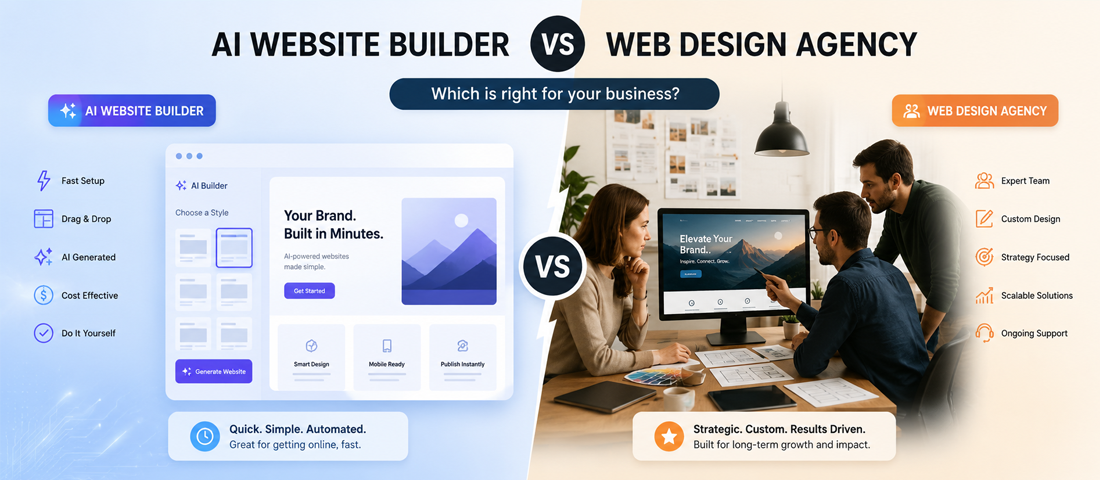
When an AI website builder is genuinely the right choice
Before the honest critique, the honest acknowledgement — AI website builders are the correct answer in more situations than the agency world usually admits. Five contexts in particular fit them well.
Hobby projects and personal pages. A site for your side project, a personal portfolio to show friends, a page for your community group, a landing page for an event happening once. The stakes are low, the audience is small, and the visual polish an AI builder produces is genuinely adequate. Hiring an agency for a project like this is roughly like hiring a professional photographer for casual holiday snaps.
MVPs and idea validation. If you are testing whether an idea has legs before committing to a real build, a $15-per-month AI-built landing page with a signup form is a perfectly reasonable way to find out. Real signups from real visitors tell you whether the value proposition resonates. Waiting to validate until you have paid for a professional build is a common founder mistake, and AI builders make validation genuinely cheap.
Very small business sites where the website is essentially a business card. A local plumber whose business runs on phone calls and referrals, with a website that exists so people can find their phone number and hours, is not underserved by an AI builder. If the site does not need to rank in search, convert leads, or handle transactions, the level of investment agencies bring is not producing proportional return.
Single-event pages. A wedding page, a conference microsite, a promotional page for a limited-time campaign — anything with a defined lifespan and a specific audience. The site does its job for a specific period, then goes away. Long-term SEO and durable architecture don’t matter because the timeframe doesn’t warrant them.
Budget under $500 with no business dependence on the site. If the website is genuinely optional to how the business earns money, and the honest budget is small enough that anything else would be a stretch, an AI builder is the right call. It is better to have a decent AI-built site than to have no site at all because a proper build was unaffordable.
Notice what these five contexts share — none of them involves a business whose revenue depends on the website performing over time. That distinction is the whole ballgame, and it is where the AI builder story starts to fall apart.
The specific promises AI builders make — and what actually happens
AI builder marketing has become extremely polished, and the promises made are worth examining honestly against the outcomes we see when clients come to us after trying one. Four promises in particular deserve scrutiny.
“Designed for your business” vs template output
The marketing claim is that the AI generates a site tailored to your business based on the details you provide. The reality is that the output is a template combination, chosen from a limited set of patterns, populated with your business’s information. Two dry cleaners in different cities using the same AI builder produce sites that look strikingly similar because the underlying template pool is the same. Two accounting firms produce recognisable accounting-firm sites. The “designed for you” language is doing a lot of work; “populated for you” would be more accurate.
For most business categories, this produces a site that looks like ten thousand others in the same industry. Distinctive brand positioning — the whole reason businesses invest in design in the first place — is precisely what AI builders cannot produce, because distinctiveness is definitionally not something that can be generated from a common pattern library. If your business benefits from looking different from competitors, this is a real cost.
“SEO-ready” vs actually ranking in search
Every AI builder claims SEO-readiness. Meta title fields exist, alt text can be added, sitemap is generated automatically. Technically, these things are true. What the marketing doesn’t say is that “having the fields exist” is the beginning of SEO, not the end. Ranking in search requires unique quality content that answers real buyer questions, deliberate keyword strategy at the page level, schema markup that goes beyond the platform defaults, internal linking architecture built on purpose, and continuous iteration based on measurement.
AI builders don’t do any of this. They provide the infrastructure and leave the work to you — and if you don’t do it, the site doesn’t rank. The pattern we see is AI-built sites that are technically SEO-ready and organically getting five to twenty visitors per month, none of them qualified. Being findable takes actual work, and AI builders don’t produce actual work.
“No code needed” vs no code you can ever leave with
The “no code needed” promise is genuinely true — you don’t need to write code to build with an AI builder. What is left unsaid is that you also don’t get any code you can take with you. The site lives on the platform, in a format only the platform can render. If you want to move to another host, another platform, or take the code to a developer for customisation, you cannot. You are renting the site indefinitely, at whatever the platform charges, with whatever features they choose to offer.
This is a substantive difference from what most business owners assume. When someone commissions a website, they typically assume they own it. With AI builders, you own your content and your domain, but the site itself is a lease, not a purchase.
“AI-optimised” vs actually cited by AI search
The newer AI builders now claim AI-search optimisation, promising that their sites will be found by ChatGPT and Perplexity. What actually determines AI citation is content depth, structured data, entity authority built through external mentions, and the kind of specific, expert content that generic template output does not produce — the full mechanism is covered in our complete AI search optimisation guide. AI assistants specifically deprioritise sites that read as generic template content, because their models are increasingly good at identifying informational thinness. The “AI-optimised” claim on AI builders is largely marketing rather than mechanism.
What AI website builders genuinely cannot do
Beyond the marketing claims, there is a set of capabilities that AI builders straightforwardly cannot deliver. Understanding these matters, because businesses that need these capabilities and try to make an AI builder work anyway end up either failing quietly or rebuilding on the right platform six months later.
Custom functionality. Booking engines with complex availability logic. Marketplaces with multi-sided user models. Customer portals with role-based permissions. Integrations with your CRM, ERP, or industry-specific software. Configurators, calculators, decision-support tools. Anything with genuine business logic that goes beyond publishing content and collecting contact form submissions is outside what AI builders can produce. Some builders offer basic booking or eCommerce modules, but “basic” is the operative word — the moment your requirements get specific, you hit a wall.
Earned SEO on competitive terms. AI builders produce technically-crawlable sites, but earning organic rankings against competitors who have invested in content, backlinks, technical SEO and topical authority is a different discipline entirely. Sites in competitive categories built on AI builders rarely rank for meaningful commercial terms, because the underlying content and architecture were never built for that purpose. If your business depends on being found through search, this is a critical gap.
Honest strategy about your actual business. AI builders execute the plan you give them. They don’t tell you the plan is wrong. If your positioning is unclear, if your target audience is wrong, if your homepage says one thing while your buyers want another, the AI will faithfully produce the site you asked for and the site will faithfully underperform. The strategic layer that separates a website from a working sales asset — figuring out what should actually be on the site — is not part of what AI builders provide.
Accountability when something breaks. When your checkout stops working on Black Friday, when your contact form silently stops sending emails, when Google flags your site with a security warning, the support experience with an AI builder is a chatbot, a help centre, and eventually maybe a human via email in a few days. There is no one whose job it is to make sure your site works. This is fine when the site not working is not costing you money. It is a serious problem when it is.
A site that can grow with your business. The site you launch on an AI builder is broadly the site you have three years later, plus whatever features the platform has added in the meantime. Custom growth, unique functionality, integration with new business systems — these are not paths available. When your business outgrows what the builder can do, the answer is migration to another platform, which is roughly rebuilding from scratch.
The hidden costs of AI website builders nobody discusses
The pricing pitch for AI builders is disarming — $15 or $20 per month feels like almost nothing next to an agency quote. The three-year picture is meaningfully different from the monthly pitch, and it is worth being specific about the components that don’t show up in the initial price comparison.
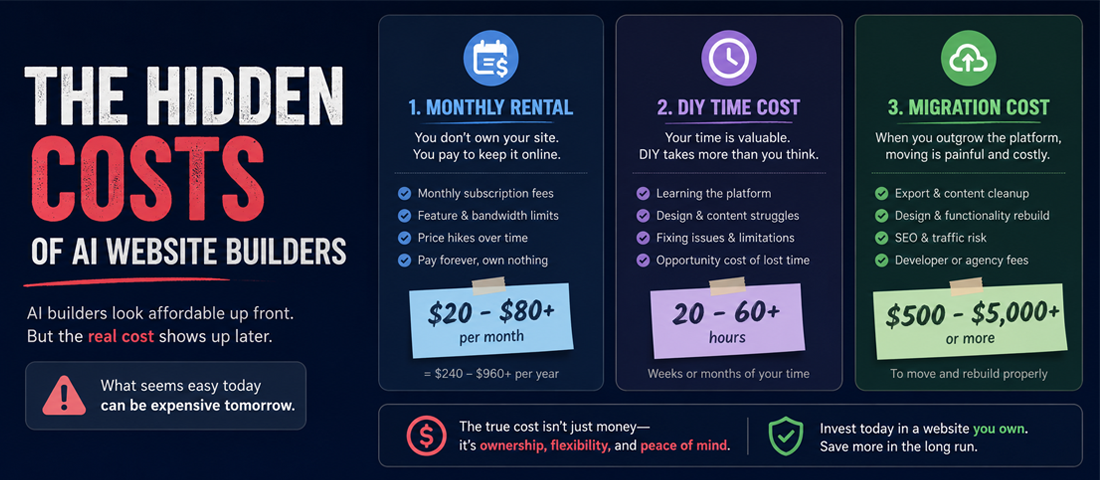
Monthly rental forever. The $15 per month becomes $180 per year, $540 over three years, $900 over five. Higher tiers with eCommerce, custom domains and additional features run $30 to $50 per month, producing three-year totals of $1,080 to $1,800. The cost is real; the monthly framing just makes it feel small.
The cost of your own time. If you are building the site yourself, that time has a cost — either directly (hours spent that could be earning) or indirectly (mental bandwidth spent on the site rather than the business). For a typical small business owner, the initial setup takes 15 to 40 hours of focused work; ongoing maintenance and content adds a few hours per month. Valued at any reasonable hourly rate, this cost usually exceeds the platform fees themselves.
The cost of doing SEO, strategy and copy yourself. AI builders provide the infrastructure. The strategic work — figuring out what to say, writing copy that converts, doing keyword research, creating content for organic traffic — is on you. Either you do it (time cost) or you don’t (opportunity cost of a site that doesn’t produce). Businesses that treat this as “part of the DIY” often underestimate how much of the total investment in a successful website is actually in these layers rather than in the build itself.
Platform lock-in and eventual migration cost. When you outgrow the AI builder — and most growing businesses do within two to four years — moving to another platform means rebuilding, not migrating. The content moves; the site does not. This migration typically costs $3,000 to $15,000 for a business site, plus the strategic decision-making about the new platform. Businesses that avoid this by staying on an AI builder that no longer fits their needs pay a different cost — a website that quietly underperforms while the business grows around it.
The revenue that never materialises. This is the least visible cost and often the largest. A site that doesn’t rank in search doesn’t produce organic leads. A site that converts poorly turns paid traffic into wasted ad spend. A site that looks like every other business in your category doesn’t win the marginal buyer choosing between you and a competitor. The cost of these missed outcomes doesn’t show up on any invoice, but it is real, and for revenue-generating businesses it typically dwarfs the visible platform costs.
When hiring a web design agency is worth the investment
The case for hiring an agency isn’t “agencies are always better” — that framing is neither honest nor useful. The case is that for specific business situations, the return on the investment is substantial enough that the higher cost is genuinely justified. Five situations in particular fit.
Your website is a revenue-generating asset. If your business earns money through the site — eCommerce, lead generation, subscription signups, appointment bookings — the site is not a marketing brochure. It is a piece of infrastructure that produces revenue when it works well and loses revenue when it doesn’t. Investment in this layer pays back through the revenue it enables, and the difference between a good site and a mediocre one is often the difference between profitable and struggling.
You need custom functionality. Bookings, memberships, custom workflows, integrations with your business systems, industry-specific features — anything that goes beyond content publishing and contact forms is where agencies earn their fee. This is not something AI builders can retrofit; it has to be built from the start, and building it well requires the strategic and technical work agencies exist to do. Our work on custom website development is specifically about matching the technical decision to a genuine business need rather than defaulting to whatever the platform allows.
SEO is a serious commercial goal. If organic search is meant to be a meaningful traffic and revenue channel, the work behind that outcome — content strategy, technical architecture, schema, ongoing optimisation — is real and continuous. Agencies with genuine SEO capability build sites that are architected for ranking from day one, and treat the launch as the start of the SEO work rather than the end. This is a fundamentally different offering from what AI builders provide.
You don’t have in-house strategy, design, or development capacity. Agencies aren’t just building the site — they are providing the expertise that produces a site that works. If your business doesn’t have someone whose job it is to think about positioning, conversion, SEO, and ongoing iteration, an agency is providing those functions alongside the build. This is often the biggest source of value and the one businesses undervalue most, because it is invisible in the deliverables.
The site’s role in your business is going to grow. If the site is a strategic asset that will need to evolve — new products, new markets, new features, new integrations — the underlying foundation matters enormously. A site built to grow is meaningfully different from a site built to launch, and the difference shows up in year two or three when the business needs the site to do something new.
The honest three-year cost comparison
The pricing conversation is where AI builders look most attractive and where the framing does the most work. A proper three-year comparison changes the picture in ways the monthly pitch never captures. The table below is based on realistic ranges from what we see in client work.
| Cost component | AI Builder (3 years) | Web Design Agency (3 years) |
|---|---|---|
| Initial build cost | $0 – $200 | $2,000 – $15,000+ |
| Platform / hosting fees | $540 – $1,800 | $180 – $900 |
| Your time on setup and management | $1,500 – $5,000 equivalent | $200 – $800 equivalent (review/decisions) |
| SEO, content and strategy work | $2,000 – $10,000 (DIY or outsourced) | Often included in build; else $1,500 – $5,000 |
| Support and maintenance | Chatbot, DIY (0 – $500) | $0 – $2,000 (often included year 1) |
| Migration cost when outgrown | $3,000 – $15,000 (likely at year 2-3) | $0 (site grows with the business) |
| Three-year total | $7,000 – $32,000+ | $3,900 – $23,700+ |
| Revenue impact (harder to quantify) | Ceiling limited by platform | Compounds with SEO and optimisation |
The numbers tell a more nuanced story than the monthly headline. For a business that needs a real website, the total cost of an AI builder plus DIY work often ends up higher than an agency build, once time cost and the eventual migration are honestly counted. For a business that treats the website as optional, the AI builder is genuinely cheaper because most of the DIY costs never get incurred (the strategic work simply doesn’t happen). The right comparison depends on what your business actually needs the site to do.
The seven-question decision framework
For businesses genuinely weighing this decision, the seven questions below produce a reliable recommendation in most cases. Work through them in order — the answer usually becomes clear within the first three or four.
-
Does your business depend on the website for revenue?
If people find you, buy from you, book with you, or convert through the site, it is infrastructure. If the site is a “presence” that supplements revenue generated elsewhere (referrals, walk-ins, phone calls, sales team outreach), it is a business card. Revenue-dependent sites justify agency investment; business-card sites often don’t. -
Does your site need any functionality beyond content and contact forms?
Booking engines, member portals, custom workflows, marketplace features, industry-specific integrations, calculators, configurators — anything that goes beyond publishing information and collecting basic form submissions is outside what AI builders can deliver. If you need these, an agency is not optional. -
Is organic search meant to be a meaningful traffic channel?
If you plan to compete on Google for commercially valuable terms, or you want your business found via ChatGPT, Perplexity or Gemini, the underlying work to make that happen is not something AI builders provide. Businesses relying on paid ads or non-search channels can live with the AI builder’s SEO ceiling; businesses expecting real organic traffic cannot. -
Do you have someone whose job it is to think strategically about the site?
Positioning, messaging, conversion, SEO, iteration — someone has to own these functions for the site to actually work. If you have this capability in-house, an AI builder is more viable because you can supply what it lacks. If you don’t, an agency is often providing more than just the build. -
Does your business look distinctive from competitors in a way that matters?
If distinctiveness is part of your competitive edge, template output undermines that edge from the day the site launches. If your business competes primarily on price, location, or existing relationships rather than differentiated positioning, distinctive design matters less. -
What is your realistic three-year budget honestly counted?
Not just what you want to spend on the build — what you can reasonably invest in the site as an asset including all the costs above. If it is under $2,000 total across three years honestly counted, an AI builder may be the only viable option. If it is $5,000 to $30,000, an agency build makes financial sense against the DIY alternative once total costs are added up. -
How important is it that you own what you build?
If you want the ability to move hosts, change developers, take the site to a different agency, or migrate platforms without rebuilding — ownership of source code and control of hosting matter. AI builders don’t provide this. Agencies that hand over source code and let you host anywhere do. If lock-in is a concern, this dimension often decides.
Want an Honest Take on Which is Right for Your Specific Business?
If you would rather talk through the decision with an experienced team — one that will tell you honestly if an AI builder is genuinely the right call for your situation, or if an agency investment makes more sense — we are happy to have that conversation. No pressure, no hard sell.
The broader landscape: WordPress, Webflow, and custom too
The AI builder versus agency framing is genuinely useful but slightly incomplete, because the “agency” side is not a single option. Agencies build on WordPress, on Webflow, and as fully custom applications, and each of these has different trade-offs against AI builders and against each other. A complete decision framework considers all four.
An agency building on WordPress typically produces a site with more design flexibility, better SEO tooling, and more functionality than an AI builder can match, at a build cost that is often lower than most business owners expect. Ongoing costs are similar in the mid-tier and lower at higher tiers because you own the site and hosting is inexpensive. An agency building on Webflow produces sites with strong design polish and low maintenance overhead, at a build cost slightly higher than WordPress but with cleaner operational simplicity. A fully custom build is the right answer only when the functional requirements genuinely warrant it — most business sites do not, and defaulting to custom is a common mistake we cover in our piece on WordPress vs Webflow vs custom build.
The full framing for most businesses is not really “AI builder or agency” but “AI builder, WordPress agency, Webflow agency, or custom build”. The AI builder is the right answer at the low end. WordPress or Webflow via agency is the right answer for most businesses in the middle. Custom is the right answer only for specific functional needs at the top end. Understanding this fuller picture prevents the common trap of thinking the choice is binary when it is actually a spectrum with a right answer for each place on it. For businesses weighing WordPress specifically as the middle option, the trade-offs of custom versus template website design is a related decision worth being deliberate about.
What to look for if you go with an agency
If the analysis above points you toward an agency, the next question is how to pick a good one — because agencies vary enormously and picking a poor one can produce a worse outcome than an AI builder. Seven things to check.
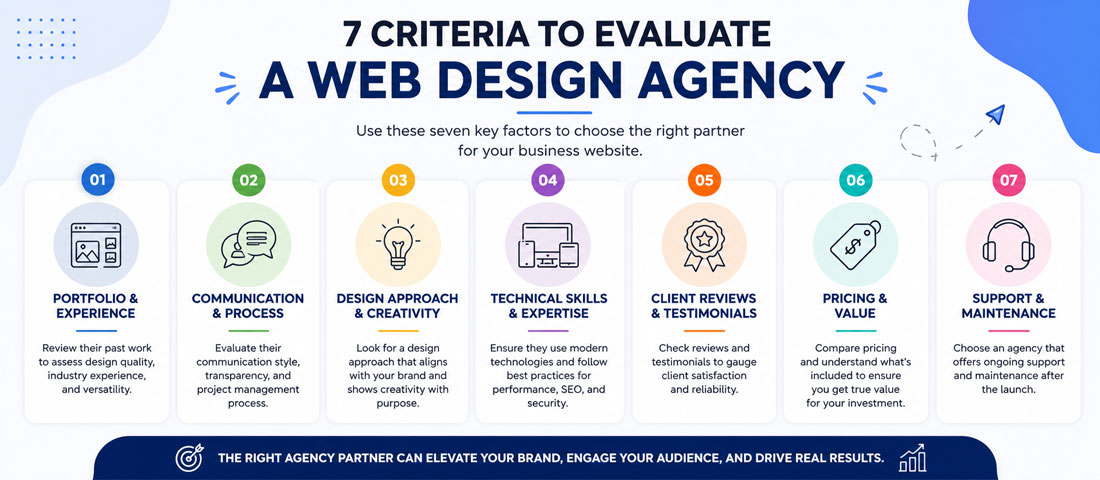
Portfolio relevance, not just portfolio quality. Most established agencies have polished portfolios. The better question is whether they have built sites like the one you need — in your industry, at your scale, with your kind of functionality. An agency whose strength is brochure sites is a different proposition from one that builds eCommerce, even if both look impressive.
Source code ownership. Confirm in writing that you own the source code after the build is delivered. This means you can host anywhere, hire any developer to modify the site, or take it to another agency without permission or additional payment. Agencies that don’t hand over source code are creating vendor lock-in similar to what AI builders create, and this is a genuine differentiator worth insisting on.
Post-launch support included, not sold as an add-on. The site launching is the start of the relationship, not the end. Agencies that include meaningful support after launch — bug fixes, small changes, technical questions — are treating the site as a living asset rather than a one-time deliverable. Ours includes 12 months of free support as standard, which is what “shipping a working site” actually means.
Strategy included as part of the build. Positioning, messaging, conversion strategy, SEO architecture — these are the things that make a site work. Agencies that treat them as separate paid services are essentially selling you a template with your branding on it. Agencies that build them in are producing a site engineered for outcomes.
Real SEO capability, not just SEO claims. Every agency claims to do SEO. Fewer of them actually rank their own sites well. Search the agency’s own site for its category keywords. If they cannot rank themselves, be sceptical about their ability to rank you. The relationship between our own SEO services and our web design work is direct — the sites we build are the sites we rank, and the discipline is the same.
Transparent process with clear milestones. A proper agency engagement has defined phases, clear deliverables at each stage, and honest timelines. Vagueness during the sales process almost always translates into vagueness during the project. Clear scope, defined milestones, and responsive communication before signing is the pattern of a well-run engagement.
Real accountability when things go wrong. When your checkout stops working, when Google flags your site, when something breaks in production — is there a human whose job it is to make sure it gets fixed? Agencies with real accountability provide this. Agencies without it can leave you in the same position as an AI builder chatbot when something goes wrong.
Common mistakes on both sides of this decision
The patterns of decisions gone wrong are consistent on both sides. Avoiding them is largely about applying the framework honestly rather than defaulting to instinct or price alone.
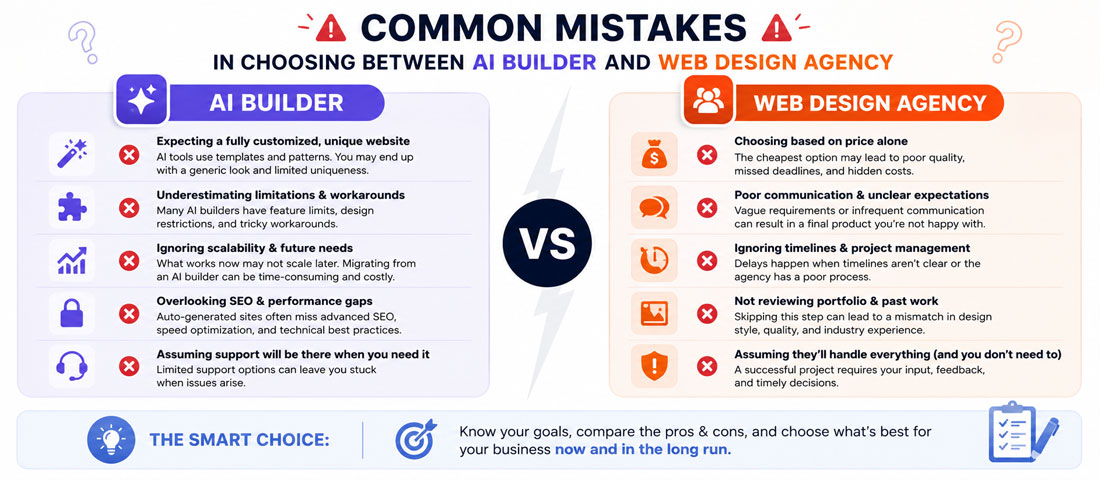
- Choosing an AI builder because it’s cheap, when the site is revenue-critical. Saving $5,000 up front to lose $50,000 in unearned revenue over three years is a bad trade, and it is the most common pattern we see.
- Hiring an agency for a hobby project. The reverse mistake — spending $10,000 on a build for a project that would have been served fine by a $15-per-month builder because “agencies always do it better”.
- Optimising for build cost rather than three-year total cost. The cheapest build usually produces the highest total cost when time, migration and missed revenue are honestly counted.
- Assuming the AI builder’s SEO is real SEO. Having the fields is not the same as ranking. Businesses discover this after six months of expecting organic traffic that never arrives.
- Not asking about source code ownership before signing. The lock-in problem exists with AI builders and with agencies that don’t hand over code. Ask specifically.
- Choosing an agency on price alone. A cheap agency is often worse than an AI builder — you pay agency prices for template-quality output with no accountability. The agency market varies enormously in capability and price alone doesn’t distinguish good from bad.
- Overbuilding with a fully custom application when WordPress or Webflow would meet the need. Custom is the right tool for specific functional requirements, not a default for any project that wants to feel premium.
- Waiting to invest in the website until the business “needs it”. The businesses whose websites compound value are the ones that invested before they needed to. Reactive website work often costs more than proactive work.
- Assuming DIY on an AI builder will produce agency-quality strategy. The strategy layer is what agencies genuinely add. Doing it yourself takes real skill and real time, and business owners routinely underestimate both.
- Treating the platform decision as permanent. Most businesses eventually outgrow their first platform. Planning for that transition from the start produces better outcomes than being surprised by it.
The honest final take
The AI builder versus agency question has a straightforward honest answer for most businesses. If your website is essentially a business card — supplementing revenue generated through other channels, with low functional requirements and no serious SEO expectation — an AI builder is the right call. The cost is low, the setup is fast, and the outcome fits the need. Anyone telling you otherwise for a project like this is selling you something you don’t need.
If your website is revenue-generating infrastructure — where being found matters, where converting visitors matters, where the site’s ability to grow with the business matters — an AI builder is going to be a false economy. The visible cost is low; the total cost including time, DIY strategy, missed revenue and eventual migration is significantly higher than the agency investment, and the outcome is meaningfully worse. This is the case where an agency is worth genuinely more than it costs, because the return is measurable in revenue rather than in a nicer-looking site.
The confusion in the market comes from the middle — businesses uncertain about whether their site is a business card or infrastructure, agencies pitching custom builds to businesses that need brochure sites, AI builders marketing to businesses that need real strategy. The framework above cuts through this by focusing on what the business actually needs the site to do, and matching the answer to the tool. For most businesses, the correct answer is not the extreme in either direction — it is a WordPress or Webflow build by a competent agency that understands both the technical work and the strategic layer above it, delivered with source code ownership, real accountability, and post-launch support built in. That is the middle ground where most serious business sites live, and it is what proper WordPress website development delivered by an accountable team actually looks like.
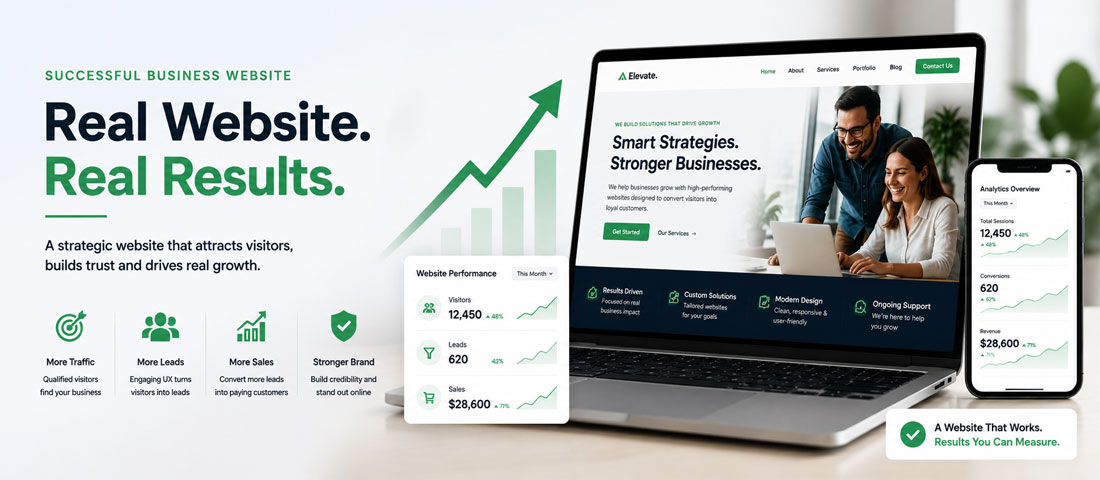
The most important thing to be honest about is what you actually want the website to do. A site that needs to earn money should be built to earn money, by people whose job it is to make that happen. A site that just needs to exist can be built by an AI in fifteen minutes. Both are legitimate outcomes for different needs. The mistake is confusing which need you have, and paying the wrong price for the wrong outcome. Apply the framework, be honest with yourself about what your business actually needs, and the right answer usually becomes clear within a few minutes of genuine thought.
Frequently asked questions
| Are AI website builders good enough for a business website? | It depends entirely on what your business needs the site to do. For very small businesses where the site is essentially a business card supplementing revenue generated through other channels, AI website builders are genuinely adequate — the output is decent, the cost is low, and the setup is fast. For businesses where the website is revenue-generating infrastructure that needs to rank in search, convert visitors, and grow with the business, AI builders quickly hit real limitations. The template output undermines distinctive positioning, the SEO capability is superficial, and the platform lock-in becomes costly when you outgrow it. The honest question is whether your website is a business card or infrastructure, and the answer determines whether an AI builder is genuinely sufficient. |
| How much cheaper is an AI website builder than an agency really? | The monthly pricing looks dramatically cheaper — $15 to $50 per month versus $2,000 to $15,000+ for an agency build. The three-year total cost picture is often closer than the monthly framing suggests. AI builder costs over three years include the platform fees ($540 to $1,800), your time on setup and management ($1,500 to $5,000 equivalent), DIY SEO and strategy work ($2,000 to $10,000 or the opportunity cost of not doing it), and eventual migration when you outgrow the platform ($3,000 to $15,000). Total honest three-year cost can reach $7,000 to $32,000. Agency builds typically total $3,900 to $23,700 over three years when hosting, included support, and strategy are counted. The AI builder is cheaper only when much of the DIY work never happens — which itself is a real cost. |
| Will an AI website builder site rank on Google? | Technically the site is crawlable and indexable, so it can appear in search results. Practically, AI builder sites rarely rank for competitive commercial terms because ranking requires more than the technical infrastructure the builders provide. It requires unique quality content, deliberate keyword strategy at the page level, schema markup beyond platform defaults, internal linking architecture, backlink authority, and ongoing optimisation — none of which the builder does for you. The pattern we see is AI-built sites getting five to twenty organic visitors per month even after months of existence, because the underlying SEO work was never done. For sites where search traffic is meant to be meaningful, this is a critical limitation. |
| Can AI-built websites be found by ChatGPT and Perplexity? | Occasionally, but not reliably. AI assistants like ChatGPT, Perplexity and Gemini specifically favour sources with content depth, unique expertise, structured data, and entity authority built through external mentions. Template output from AI builders is exactly the kind of content AI models are increasingly good at identifying as informationally thin, and they tend to deprioritise it in favour of sources that read as expert. The “AI-optimised” marketing claim on newer AI builders is largely surface-level — the fields exist, but the underlying content and authority signals that AI assistants actually use are not something the builder generates. For serious AI search visibility, the content and structural work has to be done by someone deliberately, not generated automatically. |
| Do I own my website if I build it with an AI builder? | You own your content and your domain name. You do not own the site itself in any meaningful sense — the code is proprietary to the platform, it cannot be exported to another host, and if the platform raises prices, changes features, or shuts down, you have no recourse other than rebuilding elsewhere. This is fundamentally different from what most business owners assume when they commission a website. With a proper agency build, you should receive source code ownership as standard, allowing you to host anywhere, hire any developer, or migrate at will. If ownership matters to you, ask specifically about it during any web project engagement — with AI builders the answer is definitionally no, and with agencies the answer varies by agency. |
| When should I switch from an AI builder to a real website? | Four signals suggest it’s time. When your business has grown to the point where the site is no longer a business card but is genuinely producing or supposed to produce revenue. When you need functionality the AI builder cannot deliver — bookings, member portals, integrations, custom workflows, real eCommerce. When organic search is meant to be a serious traffic channel and the current site’s SEO ceiling is limiting growth. And when the maintenance and platform costs of the AI builder plus your time on DIY are exceeding what a proper build would cost. The migration itself is a project — typically $3,000 to $15,000 depending on scope — but it is often the right investment once the business has outgrown the builder. Waiting too long usually means the missed revenue during the extended period exceeds the migration cost. |
| What’s the difference between a cheap agency and an AI builder in practice? | Often less than you might expect, which is why choosing an agency on price alone is a risk. A cheap agency that produces template-quality output with no strategic input, no source code handover, no post-launch support, and no accountability is essentially charging agency prices for AI-builder-quality outcomes. The difference between a good agency and an AI builder is real and significant — strategic thinking, distinctive design, proper SEO architecture, custom functionality, ongoing accountability. The difference between a bad agency and an AI builder is often minimal, with the AI builder frequently producing a better outcome for the money. When evaluating agencies, look for portfolio relevance to your project type, source code ownership commitments, included post-launch support, and evidence they can rank their own site — these separate the agencies genuinely worth the investment from the ones that aren’t. |
Ready to Build a website that Actually Earns its Keep?
We build websites for businesses where the site is revenue-generating infrastructure — where being found, converting visitors, and growing with the business genuinely matters. With 12+ years of experience, over 2,500 websites delivered, source code ownership on every project and 12 months of free support after launch, we treat the site as a business asset rather than a one-time deliverable. Send us a brief and we will respond within one business day with an honest read on what your project actually needs.