ChatGPT vs Gemini vs Claude: Which AI Tool Is Best for Web Design Businesses?
If you run a web design agency, freelance as a web designer or developer, or manage a business with an active digital presence, you are probably using at least one AI tool every day. And you have probably asked yourself — or been asked by a client — whether you are using the right one.
ChatGPT, Gemini, and Claude are the three dominant general-purpose AI assistants of 2026. All three can write, code, analyse, summarise, and generate ideas. All three have improved dramatically in the past 12 months. And all three have genuine strengths that make them the right choice for specific tasks — and genuine limitations that make them the wrong choice for others.
This guide is not a general AI comparison. It is specifically written for web design and web business contexts — comparing all three on the tasks that web designers, developers, agency owners, and digital marketing teams actually do every day. Which is best for writing website copy? Which handles code more reliably? Which is better for client proposals? Which integrates most usefully into a design workflow?
We use all three tools at Neel Networks. Here is the honest, specific comparison.
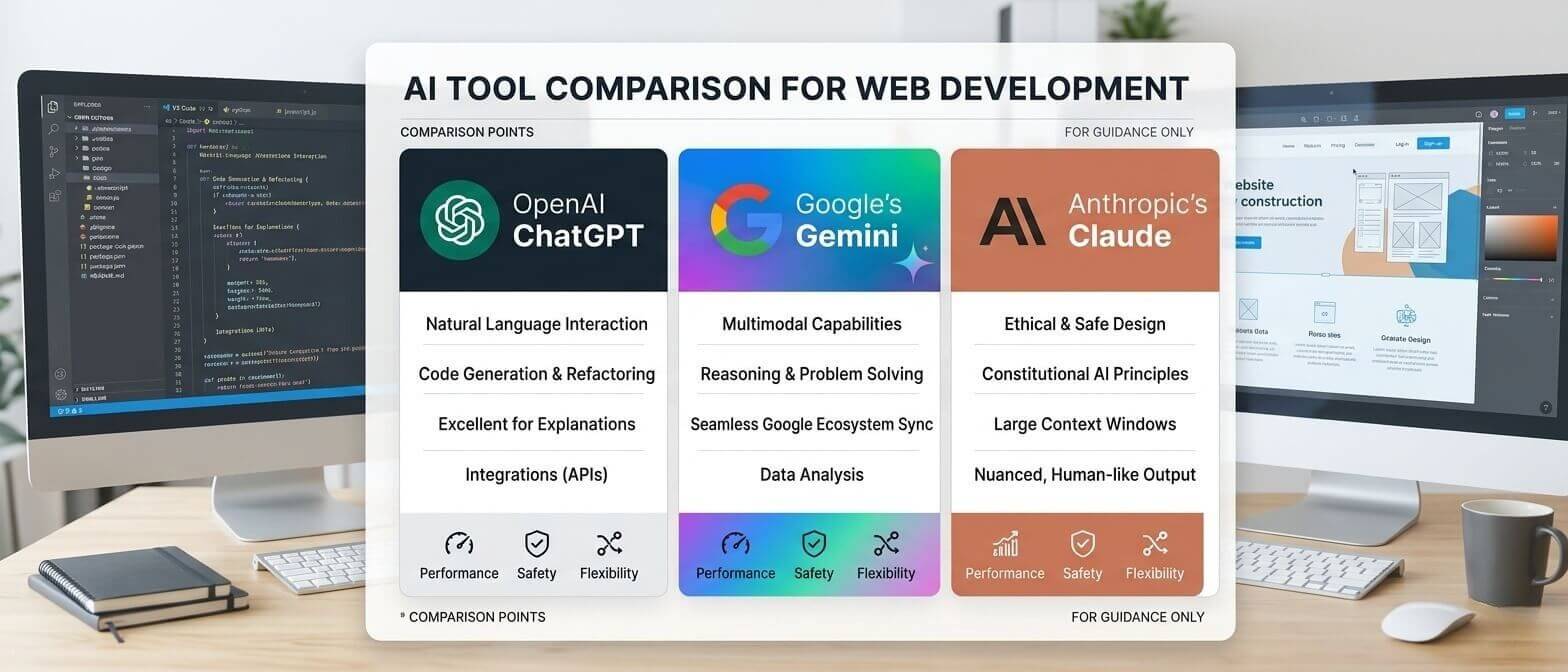
What ChatGPT, Gemini, and Claude Actually Are — Key Differences
Before comparing on specific tasks, understanding the foundational differences between the three tools frames why each performs differently on different types of work.
ChatGPT (OpenAI)
ChatGPT, powered by OpenAI’s GPT-4o model in its current form, is the most widely used AI assistant globally — with over 200 million weekly active users as of 2026. Its breadth of capability, the maturity of its plugin and GPT ecosystem, and the depth of its training data make it the default choice for most users encountering AI assistance for the first time. ChatGPT has the most extensive integration ecosystem of the three — connecting to hundreds of third-party services through plugins, custom GPTs, and the OpenAI API.
ChatGPT’s strengths are in its versatility and the breadth of its ecosystem. Its weaknesses are a tendency toward confident-sounding but occasionally inaccurate responses (“hallucinations”) and a tendency toward generic output when not given highly specific prompts — the same quality that makes it immediately useful also makes it the most likely to produce the kind of average corporate language that requires significant editing.
Google Gemini
Gemini, Google’s AI assistant powered by the Gemini 1.5 Pro and Gemini 2.0 models, has a foundational advantage that neither ChatGPT nor Claude can match: native integration with Google’s ecosystem. Gemini has real-time access to Google Search, Google Workspace (Docs, Sheets, Slides, Gmail), Google Analytics, Google Search Console, and the broader Google product suite. For web professionals who live in Google’s ecosystem — which is most of them — this integration is commercially significant.
Gemini’s strengths are its real-time information access (it can pull current search data, not just training data), its Google ecosystem integration, and its strong performance on research and factual tasks where current information matters. Its weaknesses are creative writing quality below Claude’s standard and code generation that, while capable, is less reliable for complex multi-file tasks than the other two.
Claude (Anthropic)
Claude, developed by Anthropic, is the newest of the three at mainstream prominence but has rapidly become the preferred tool for specific high-value tasks among professional users — particularly writing quality, instruction-following precision, and long-document analysis. Claude’s constitutional AI training approach produces notably different output characteristics: longer context windows (up to 200K tokens in Claude 3.5 Sonnet), more reliable instruction-following, and consistently higher quality long-form writing that requires less editing than equivalent output from the other two.
Claude’s strengths are writing quality, instruction following, nuanced tone matching, and handling very long documents and complex multi-step instructions. Its weaknesses historically have been a smaller integration ecosystem than ChatGPT and, until recently, no built-in web browsing — though the latter has been addressed in 2025/2026 with web search capability added to Claude.ai.
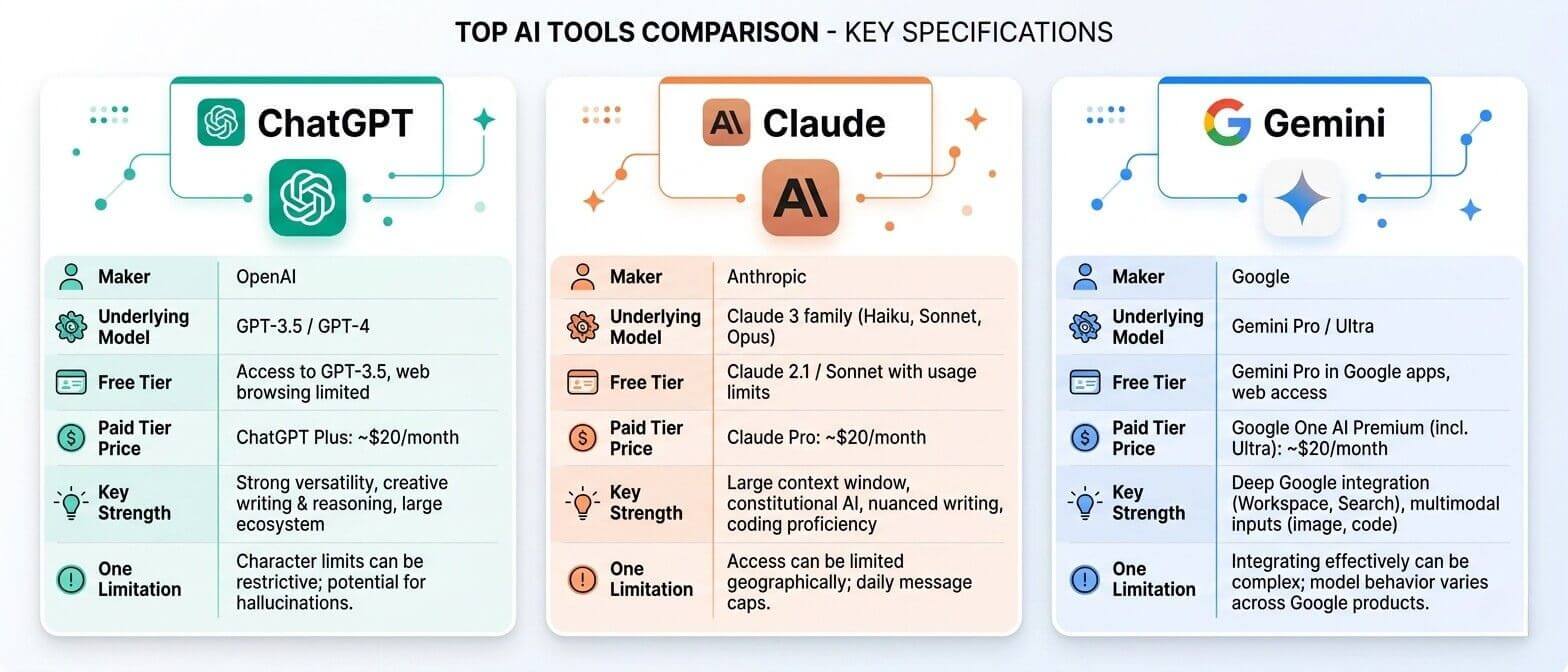
The three leading AI assistants have genuinely different strength profiles — understanding where each excels determines which to reach for first on any given task.
Head-to-Head: Website Copywriting and Brand Voice
Website copywriting is one of the highest-value AI use cases for web design businesses — it accelerates project timelines, helps clients who struggle to produce their own copy, and enables agencies to offer copywriting as part of their service without dedicated copywriters on staff.
ChatGPT for Website Copy
ChatGPT produces competent website copy at speed — particularly useful for generating multiple headline variants, producing service page first drafts, and iterating through copy options quickly. Its weakness in copywriting is a tendency toward the generic: without very specific prompting, ChatGPT gravitates toward corporate language patterns that require significant editing to produce distinctive, brand-specific copy. The “cutting-edge solutions problem” is most pronounced with ChatGPT.
With strong prompting — detailed brand voice instructions, specific audience definitions, vocabulary constraints, and example copy to match — ChatGPT produces substantially better output and its speed advantage is most valuable when rapidly generating multiple variants for A/B testing.
Gemini for Website Copy
Gemini’s copywriting capability is competent but generally the weakest of the three for creative brand voice work. Its training on Google’s data produces copy that is clear and factually grounded but less distinctive in voice. For copy that is primarily informational — product specification pages, FAQ content, straightforward service descriptions — Gemini performs comparably to the other two. For copy requiring a strong, specific brand personality, it is the least effective.
Where Gemini has a genuine copywriting advantage is in SEO-informed copy — it can simultaneously reference current search trends, identify the phrases people are actually searching, and incorporate them naturally into copy, because of its real-time Google Search access.
Claude for Website Copy
Claude is the consistently preferred tool among professional copywriters and web agencies for website copy quality. Its instruction-following is more reliable — if you tell it to avoid certain words, use a specific sentence length, or match a tone described precisely, it follows those instructions more consistently than the other two. Its output requires less editing to reach publication quality, and it handles nuanced tone requests (warm but authoritative, direct but not aggressive, confident but not arrogant) with more precision.
For about page copy — the hardest copy to get right because it requires genuine personality — Claude consistently produces the most human-sounding output when given good raw material to work with. For homepage headlines, Claude generates options that are more likely to be distinctive and on-brand on the first pass.
Copywriting verdict: Claude for quality and brand voice precision. ChatGPT for speed and volume of variants. Gemini for SEO-informed copy where current search data should inform the language. Best workflow: Claude for the final copy, ChatGPT for generating alternatives to compare.
Head-to-Head: Code Generation and Debugging
For web designers and developers, code generation is often the most commercially valuable AI use case — directly reducing development time and enabling non-developers to produce working code for specific tasks.
ChatGPT for Code (HTML, CSS, JS, PHP)
ChatGPT has the most mature code generation reputation among the general public and performs very well across standard web development languages. For HTML and CSS — producing responsive layouts, implementing specific design patterns, generating WordPress theme components — ChatGPT is reliable and fast. For JavaScript, it handles standard patterns (form validation, API calls, DOM manipulation) well but can struggle with complex, multi-file application logic without careful prompting.
For PHP and WordPress-specific development — custom post types, functions.php additions, WooCommerce customisation — ChatGPT has substantial training data and performs well. The weakness is a tendency to produce code that works for the described case but may not handle edge cases or follow the current best practices for the specific framework version.
Gemini for Code
Gemini’s code generation is capable for standard tasks but the weakest of the three for complex or novel coding problems. For straightforward HTML/CSS implementation and basic JavaScript, it performs adequately. For complex WordPress customisation, Laravel development, or multi-file JavaScript applications, it is the least reliable of the three. Gemini’s genuine code advantage is its ability to look up current documentation and API specifications — useful when working with services whose APIs have changed recently and other models have outdated training data.
Claude for Code
Claude has emerged as the preferred AI for complex code generation and debugging among professional developers, for two specific reasons: its substantially larger context window (200K tokens versus GPT-4o’s 128K) allows it to receive and reason about much larger codebases simultaneously, and its instruction-following precision means that when you specify constraints (use vanilla JavaScript, do not use jQuery, follow WordPress coding standards) it adheres to them more reliably.
For debugging complex PHP errors, reviewing functions.php additions for conflicts with existing code, or generating WordPress schema code that accounts for specific existing functionality — tasks where the context of the entire existing file matters — Claude’s larger context window produces substantially better results than the alternatives. Claude Code (the CLI tool) takes this further for developers who prefer terminal-based workflows.
Code verdict: Claude for complex, multi-file, context-dependent coding tasks and debugging. ChatGPT for fast, standalone code generation for standard patterns. Gemini for code involving recently updated APIs or where current documentation matters. For web design agency work on WordPress, WooCommerce, and Laravel — Claude and ChatGPT are the primary tools; Gemini is the fallback for current API questions.
Head-to-Head: SEO Content and Keyword Strategy
| SEO Task | ChatGPT | Gemini | Claude | Winner |
|---|---|---|---|---|
| Blog post drafting (long-form) | Good — fast, structured | Adequate — factually sound | Best — highest quality, follows complex briefs | Claude |
| Keyword research assistance | Good — trained data only | Best — real-time search access | Good — trained data only | Gemini |
| Meta title/description writing | Good — rapid variants | Good | Best — precise character counts, better copy | Claude |
| Content gap analysis | Good | Best — can pull current SERP data | Good | Gemini |
| Schema markup generation | Very good | Good | Best — more reliable JSON-LD, follows spec precisely | Claude |
| AI Overview optimisation advice | Good | Best — trained on Google’s own system | Good | Gemini |
| FAQ content for AEO | Good | Good | Best — most comprehensive, precise answers | Claude |
Head-to-Head: Client Proposals, Briefs, and Business Writing
For agency owners and freelancers, client-facing writing — proposals, project briefs, scope of work documents, client update emails, follow-up messages — is time-consuming high-stakes work where AI can provide significant leverage.
Proposals and Scope Documents
Claude is the clear choice for complex, professional proposals and scope of work documents. Its ability to receive a long brief (paste the entire client conversation, existing site audit, competitive notes) and produce a structured, specific proposal that references the actual client details — rather than a generic template — is stronger than the alternatives. For web design agency proposals where the scope covers design, development, SEO, and ongoing maintenance across multiple phases, Claude’s context handling produces more coherent, internally consistent documents.
ChatGPT is useful for generating proposal templates and varying the format quickly. Gemini is useful when the proposal references current market data or specific competitor information that requires real-time research.
Client Emails and Communication
All three tools handle client email drafting competently. The practical differentiator is tone consistency — Claude is most reliable at maintaining a specific professional tone across a long email thread when given the history. For the delicate emails — scope change discussions, deadline renegotiations, handling a dissatisfied client — Claude’s more careful, nuanced language generation is valuable.
Head-to-Head: Research, Data Analysis, and Competitor Review
Analysing Uploaded Documents
ChatGPT’s file upload capability handles PDFs, spreadsheets, and documents well — useful for analysing competitor PDFs, client brief documents, or industry reports. The ability to upload and query multiple documents in a session is a genuine research workflow advantage.
Real-Time Web Research
Gemini’s native Google Search integration makes it the best tool for research tasks requiring current information — competitor website audits, industry trend research, current pricing research. It can pull live data that ChatGPT and Claude cannot access from training data alone.
Long Document Analysis
Claude’s 200K token context window is the clear winner for analysing very long documents — a complete website’s content, an entire codebase, multiple lengthy reports simultaneously. For tasks requiring synthesis across large amounts of text, Claude handles the volume that the others cannot.
Google Analytics and Search Console
Gemini’s integration with Google Analytics and Search Console — through Gemini for Google Workspace — allows direct querying of your actual site performance data. “What keywords drove the most traffic to our blog last month?” answered from real GA4 data is uniquely available through Gemini.
Integrations and Workflow — Which Fits Best Into Real Work
-
ChatGPT: the broadest third-party integration ecosystem
ChatGPT’s plugin ecosystem, custom GPT store, and OpenAI API coverage makes it the most integrable tool for complex multi-tool workflows. Tools like Zapier, Make.com, and virtually every AI-adjacent software product have built ChatGPT integrations. For web agencies that want to automate client reporting, content workflows, or internal processes using AI, ChatGPT’s API and ecosystem provide the most integration options. Custom GPTs — trained on your specific agency context, processes, and client information — are a powerful capability unique to the ChatGPT ecosystem. -
Gemini: the deepest Google ecosystem integration
For teams working primarily in Google Workspace — and most web agencies do — Gemini’s integration into Docs, Sheets, Slides, and Gmail is a genuine workflow advantage. Drafting a proposal directly in Google Docs with Gemini assistance, summarising a client email thread in Gmail, or building a project tracking sheet in Google Sheets with Gemini-generated formulas — these integrations reduce context-switching friction that ChatGPT and Claude require moving between tools. -
Claude: the cleanest single-session deep work tool
Claude’s MCP (Model Context Protocol) integration — connecting Claude to external tools and data sources including Google Drive, GitHub, and custom data sources — has expanded significantly in 2025/2026. For deep, focused work sessions requiring long context — reviewing an entire codebase, analysing a large content library, working through a complex client brief — Claude’s single-session experience is less interrupted and more coherent than the alternative tools. Claude’s projects feature allows storing persistent context about your agency, clients, and processes across conversations. -
The practical multi-tool workflow for web agencies
The most effective workflow for web design agencies in 2026 is not choosing one tool — it is knowing which to use when. Gemini for morning research, current information needs, and Google Workspace tasks. Claude for long-form writing, complex code, client proposals, and any task requiring sustained context. ChatGPT for rapid iteration, variant generation, custom GPTs for specific repetitive workflows, and any task requiring third-party integrations not available in the others.
Pricing Compared — Free vs Paid in 2026
| Tool | Free Tier | Paid Tier | Team/Business | API Access |
|---|---|---|---|---|
| ChatGPT (OpenAI) | GPT-4o mini — limited messages | ChatGPT Plus: $20/month — full GPT-4o, image gen, voice | Team: $30/user/month | Yes — usage-based API pricing |
| Gemini (Google) | Gemini 1.5 Flash — limited | Google One AI Premium: $22/month — Gemini Advanced, Workspace integration | Google Workspace with Gemini: from $24/user/month | Yes — Google AI Studio / Vertex AI |
| Claude (Anthropic) | Claude 3.5 Haiku — limited messages | Claude Pro: $20/month — Claude 3.5/3.7 Sonnet, extended context, Projects | Claude Team: $30/user/month | Yes — Anthropic API usage-based |
The practical cost recommendation for web agencies: For a solo freelancer or small agency, $20/month for Claude Pro gives the best single-tool value for the highest-impact tasks (writing quality and code quality). Adding ChatGPT Plus at $20/month for the ecosystem and variant generation is worthwhile for agencies billing $5,000+/month where AI saves 10+ hours of production time. Gemini’s value is highest for teams already paying for Google Workspace — the AI integration is then incremental on existing infrastructure cost.
The Verdict: Which Tool for Which Task
| Task | Best Tool | Why |
|---|---|---|
| Website copy — quality drafts | Claude | Best instruction-following, highest output quality, least editing required |
| Copy variants — rapid iteration | ChatGPT | Fastest at generating multiple options for comparison |
| Complex code and debugging | Claude | Largest context window, most reliable constraint-following |
| Standard code snippets | ChatGPT | Fast, reliable for common patterns, strong training data |
| SEO keyword research | Gemini | Real-time Google Search access; current data not just training |
| Long-form SEO blog content | Claude | Best quality long-form writing; handles complex briefs precisely |
| Schema markup generation | Claude | Most reliable JSON-LD output; follows schema.org spec precisely |
| Client proposals | Claude | Best at synthesising long briefs into specific, coherent proposals |
| Google Analytics insights | Gemini | Native GA4 and Search Console integration — only tool with live data |
| Competitor research | Gemini | Real-time web access; pulls current competitor information |
| Large document analysis | Claude | 200K token context handles documents too long for competitors |
| Automated workflows and APIs | ChatGPT | Broadest third-party integration ecosystem; most Zapier/Make support |
| Google Workspace tasks | Gemini | Native integration with Docs, Sheets, Gmail, Slides |
Frequently Asked Questions: ChatGPT vs Gemini vs Claude
| Which is better for web design — ChatGPT, Gemini, or Claude? | For web design businesses specifically, Claude is the strongest single tool for the highest-value tasks — website copy quality, complex code generation and debugging, client proposals, and long-form SEO content. ChatGPT is the best complement for rapid variant generation, standard code snippets, and automated workflow integrations. Gemini is the right tool for tasks requiring real-time information — keyword research with current data, competitor analysis, Google Analytics insights, and SEO strategy that references what is actually ranking right now. The most effective approach for a web agency is using all three strategically rather than committing exclusively to one — treating each as a specialist tool for the tasks where its specific capabilities provide the clearest advantage. |
| Is Claude better than ChatGPT for writing website copy? | Yes — for website copy quality, Claude consistently outperforms ChatGPT in three specific ways. First, instruction-following: when you give Claude a detailed brand voice brief with vocabulary constraints, tone specifications, and example copy, it follows those instructions more reliably than ChatGPT, producing on-brand output that requires less editing. Second, output distinctiveness: Claude is less prone than ChatGPT to the generic corporate language patterns (“cutting-edge solutions,” “passionate team,” “leverage synergies”) that make AI-generated copy recognisable and unconvincing. Third, long-form consistency: for extended copy — long service pages, comprehensive about pages, multi-section landing pages — Claude maintains voice and quality more consistently across the full length of the document. ChatGPT’s advantage in copywriting is speed of variant generation — for rapidly producing 10 headline options to compare, ChatGPT is faster and more suitable than Claude. |
| Which AI tool is best for writing code for websites? | For complex, context-dependent code generation and debugging — reviewing and extending existing WordPress functions.php files, debugging PHP errors in the context of an entire codebase, generating multi-file JavaScript applications — Claude is the strongest choice due to its 200K token context window and reliable constraint-following. For standard, standalone code generation — a CSS animation, a contact form validation script, a WordPress shortcode, a simple API integration — ChatGPT is fast and reliable. For code involving recently updated APIs or frameworks where the most current documentation matters, Gemini’s real-time web access gives it an advantage for specific lookups. In practice, most professional web developers use Claude and ChatGPT as their primary code generation tools, with Gemini as a supplementary tool for current documentation queries. |
| Does Gemini have access to Google Analytics and Search Console data? | Yes — through Google Workspace and the Gemini for Google Workspace subscription, Gemini can access Google Analytics 4 and Google Search Console data directly, allowing you to ask questions about your actual site performance without exporting data manually. This is a genuine capability that neither ChatGPT nor Claude provides — they can help you analyse data you export and share with them, but they cannot access live GA4 or Search Console data autonomously. For web agencies managing client SEO and analytics, this native Google data integration is one of Gemini’s strongest practical advantages. The integration also extends to Google Ads data for agencies managing PPC campaigns, providing a unified AI layer across Google’s marketing platform. |
| Can I use the free versions of ChatGPT, Gemini, and Claude for web design work? | The free tiers of all three tools provide meaningful capability but with significant limitations that affect professional web design use. ChatGPT’s free tier provides access to GPT-4o mini — capable for basic tasks but less powerful than the full GPT-4o available to Plus subscribers, with message limits during peak usage. Gemini’s free tier provides access to Gemini 1.5 Flash, which is capable for research and basic tasks but without the full Gemini Advanced capabilities or the deep Google Workspace integration that makes Gemini most useful for professional work. Claude’s free tier provides limited access to Claude 3.5 Haiku with daily message limits that are quickly exceeded in active professional use. For occasional AI assistance, the free tiers are adequate starting points. For daily professional use in a web agency context, the $20/month paid tiers of Claude and/or ChatGPT are justified by the time saved in the first few hours of monthly use. |
| Which AI tool is best for generating schema markup? | Claude is the most reliable tool for generating valid, specification-compliant JSON-LD schema markup for web projects. Its instruction-following precision means that when you specify the schema type, required properties, and specific values, it generates schema that validates correctly against the schema.org specification without the property errors and structural issues that occasionally appear in ChatGPT’s schema output. For complex schema types — FAQPage with multiple nested questions, BlogPosting with full publisher and author properties, BreadcrumbList with multiple levels, or HowTo with multiple steps — Claude’s output requires the least correction and validation work. ChatGPT generates adequate schema markup for common types but occasionally introduces property errors for less common schema configurations. For web developers generating schema markup at scale — across dozens of blog posts or multiple client websites — Claude’s greater reliability reduces the validation overhead significantly. |
| Should a web design agency use ChatGPT, Claude, or Gemini? | A web design agency in 2026 gets the most value from using all three tools strategically rather than committing exclusively to one. The recommended allocation: Claude Pro ($20/month) as the primary tool for the highest-value tasks — website copy, complex code, proposals, long-form content, and schema generation; ChatGPT Plus ($20/month) as the secondary tool for rapid variant generation, standard code snippets, and workflows requiring third-party integrations through the plugin and custom GPT ecosystem; and Gemini (typically through an existing Google Workspace subscription) for tasks requiring real-time information — keyword research, competitor analysis, Google Analytics insights, and Google Workspace productivity tasks. The total cost of $40 to $60 per month for all three is justified multiple times over for any agency billing $3,000 or more per month, where AI tools routinely save 8 to 15 hours of production time per week across copywriting, coding, and administrative tasks. |
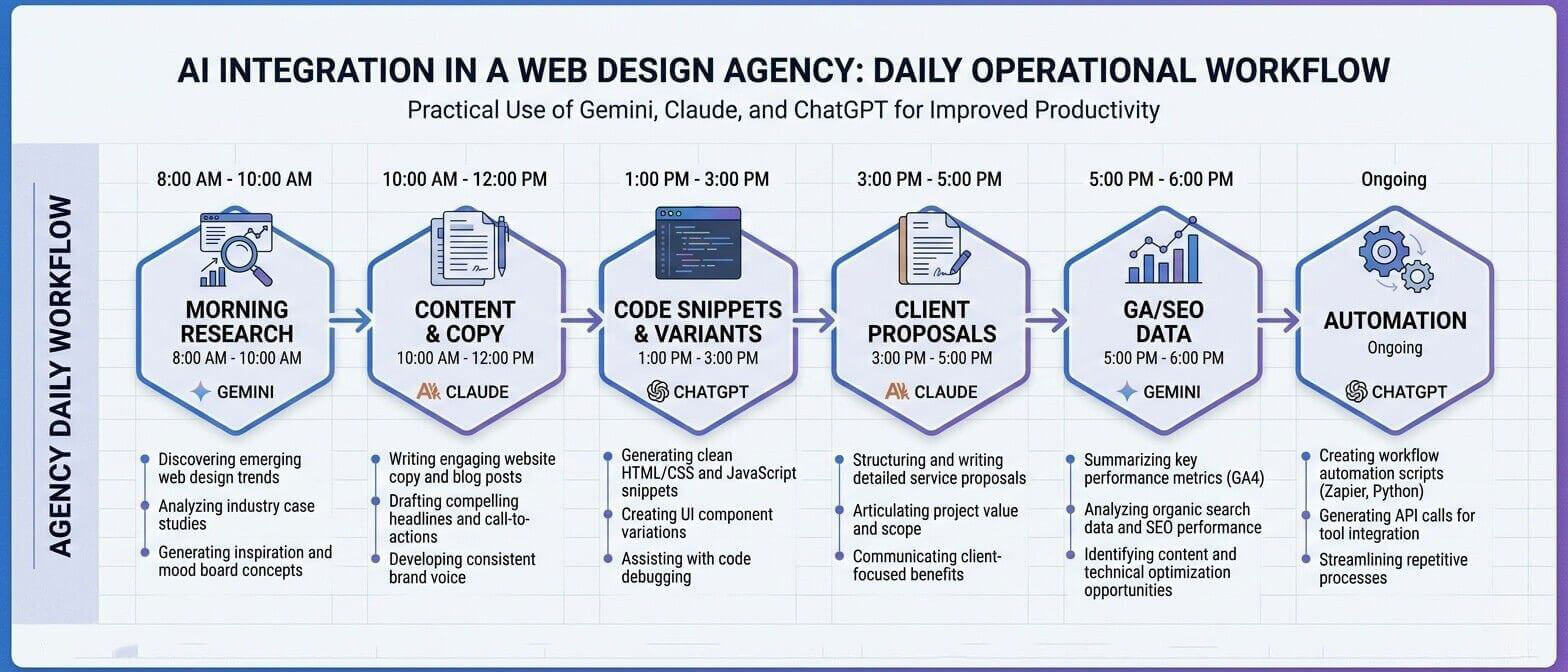
The most effective AI workflow for web agencies is not choosing one tool — it is knowing which to reach for first on each type of task. This workflow produces better outcomes than any single tool used exclusively.

The professional AI user in 2026 does not choose one tool — they choose the right tool for each task, building expertise in all three and developing the judgment to know which to reach for first on any given piece of work.
Working with an Agency that Uses the Right AI Tools for Every Task?
Neel Networks integrates Claude, ChatGPT, and Gemini into our web design, content, SEO, and development workflows — using each where it delivers the most value. The result is faster delivery, higher quality output, and better outcomes for our clients across the USA, UK, Canada, Australia, and India.