Flutter vs React Native in 2026: Which Cross-Platform Framework Should You Choose?
If you are planning to build a mobile app in 2026 and want to target both iOS and Android without building two separate native applications, you will quickly encounter the same question that every mobile development team debates: Flutter or React Native?
Both frameworks let a single development team write code once and deploy to both platforms. Both have large ecosystems, strong community support, and serious enterprise adoption. Both can produce genuinely high-quality apps. The question of which is right for your specific project is rarely settled by a simple feature comparison — it depends on your team’s existing skills, your performance requirements, your UI complexity, your hiring market, and how much control you need over the native device capabilities your app uses.
This guide provides the most honest, data-grounded comparison of Flutter and React Native available — without the tribal allegiance that characterises most framework comparisons. Both are serious, mature tools. The right choice is the one that fits your specific situation.
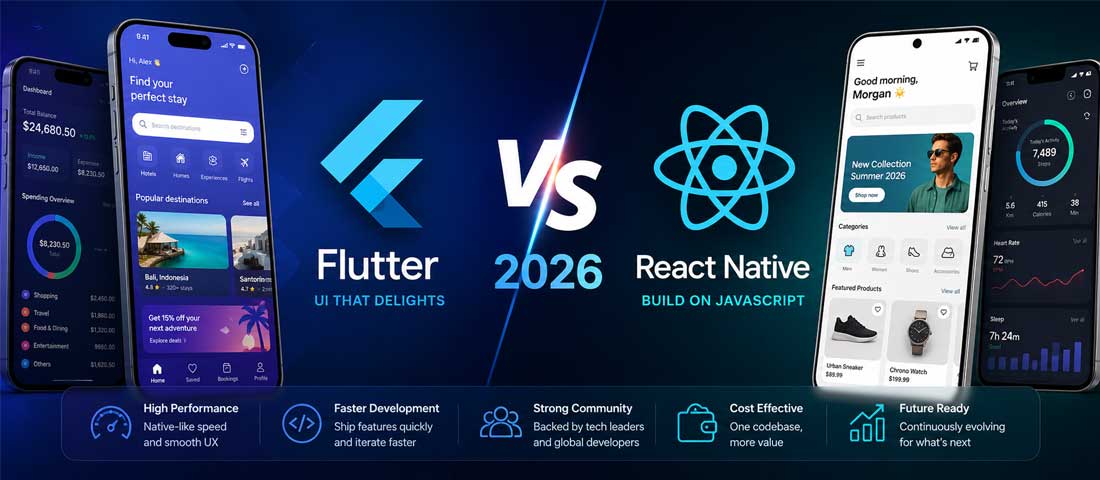
What Flutter and React Native Actually Are — and How They Work Differently
Understanding why Flutter and React Native make different trade-offs requires understanding the fundamentally different architectures they use to deliver cross-platform apps.
React Native: JavaScript Bridge to Native Components
React Native, created by Facebook (now Meta) and released in 2015, uses JavaScript — specifically React — to describe your app’s UI and logic. When the app runs on a device, a JavaScript engine executes your code and communicates with the native platform (iOS or Android) through a bridge, telling it which native UI components to render.
The critical implication of this architecture: your app’s UI components are genuinely native. A button in a React Native app is an actual iOS UIButton or Android MaterialButton — it looks, feels, and behaves exactly like every other native element on that platform because it is that native element. Users get platform-native interactions that feel familiar and correct.
The trade-off: the JavaScript bridge that connects your code to the native layer has historically been a performance bottleneck. React Native’s New Architecture (introduced progressively from 2022, now stable in 2026) replaces the old bridge with JSI (JavaScript Interface) and a synchronous Fabric rendering system — dramatically reducing this bottleneck, though the fundamental architecture of JavaScript driving native components remains.
Flutter: Its Own Rendering Engine
Flutter, created by Google and released in 2018, takes a fundamentally different approach. Rather than mapping to native platform components, Flutter uses its own rendering engine (Skia, now partially migrated to Impeller) to draw every pixel of your app’s UI directly on a canvas. Flutter does not use native UI components at all — it draws everything itself, from text to buttons to animations.
The implications of this architecture are the inverse of React Native’s. Flutter’s UI is completely consistent across platforms because it draws everything the same way regardless of whether it runs on iOS, Android, web, Windows, or macOS. An app built in Flutter looks and behaves identically on every platform — which is an advantage if design consistency is a priority and a limitation if you want your app to feel natively at home on each platform.
Flutter uses Dart — Google’s programming language — rather than JavaScript. Dart is a compiled language, which contributes to Flutter’s strong performance characteristics. It is less widely known than JavaScript but straightforward to learn for developers with any object-oriented programming background.
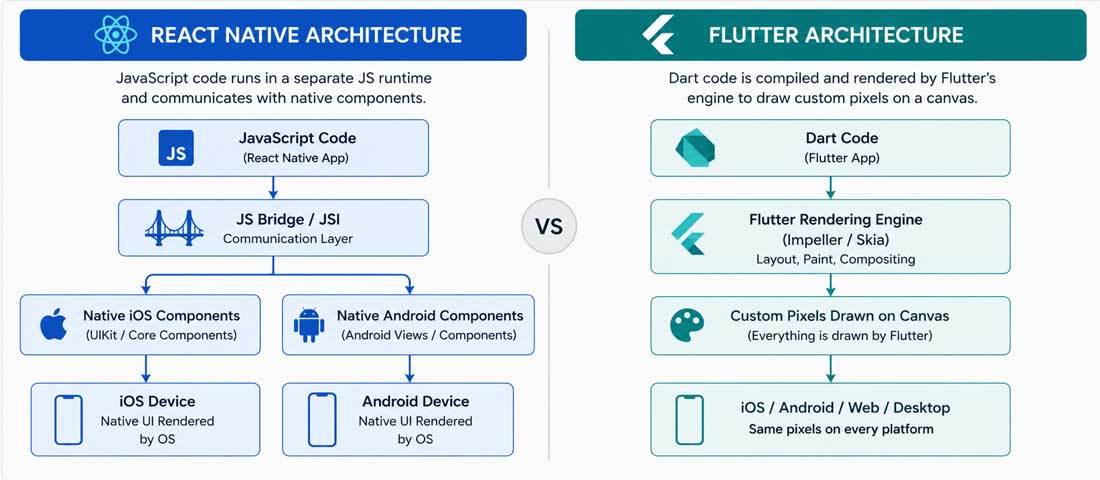
The fundamental architectural difference: React Native drives native platform UI components through JavaScript; Flutter draws its own UI using a custom rendering engine. Each approach creates a different set of trade-offs.
Performance: Which Framework Is Faster and Why
Performance is the most frequently debated dimension of the Flutter vs React Native comparison — and the answer is more nuanced in 2026 than it was even two years ago.
Flutter’s Performance Advantage
Flutter consistently outperforms React Native on animation-heavy, graphics-intensive, and visually complex interfaces. The reasons are architectural: Dart is AOT (Ahead of Time) compiled to native ARM code, meaning there is no runtime interpretation overhead. Flutter’s Impeller rendering engine pre-compiles shaders, eliminating the shader compilation jank that plagued early Flutter versions. The result is consistent 60fps (and 120fps on capable devices) rendering even for complex animated interfaces.
Independent benchmarks from 2025 and 2026 — including those from the Thoughtworks Technology Radar, various university research papers, and community performance testing projects — consistently show Flutter achieving superior animation performance and lower memory usage for equivalent UI complexity.
React Native’s Closing Performance Gap
React Native’s New Architecture has substantially closed the performance gap for most practical app use cases. JSI (JavaScript Interface) enables synchronous, direct communication between JavaScript and native code without the serialisation overhead of the old bridge. Fabric, the new rendering system, enables concurrent rendering and more efficient layout calculations. For standard business apps — navigation, lists, forms, network calls, standard animations — the performance difference between well-written Flutter and React Native apps is not perceptible to users in 2026.
The performance gap remains meaningful for specific use cases: apps with complex custom animations, real-time graphics, games, or heavy computational UI work. For these use cases, Flutter’s architecture delivers a more consistent and higher-ceiling performance profile. For standard business apps, both frameworks deliver excellent performance.
Developer Experience and Learning Curve
| Dimension | Flutter | React Native |
|---|---|---|
| Programming language | Dart — compiled, statically typed, easy to learn | JavaScript/TypeScript — most widely known language globally |
| Prior knowledge required | Any OOP language background transfers; Dart learned in days | JavaScript developers start immediately; React knowledge accelerates |
| Hot reload | Excellent — sub-second UI changes reflected instantly | Good — Fast Refresh works well for most changes |
| IDE support | Excellent in VS Code and Android Studio with Flutter plugin | Excellent in VS Code and WebStorm |
| Debugging experience | Flutter DevTools — excellent profiling and inspector | React Native Debugger, Flipper — good, improving |
| State management | Multiple options: Provider, Riverpod, BLoC, GetX | Multiple options: Redux, MobX, Zustand, React Query, Context |
| Testing story | Strong — unit, widget, and integration testing built in | Strong — Jest, React Native Testing Library |
The practical developer experience verdict: If your team already knows JavaScript or React, React Native has a faster onboarding curve — existing knowledge transfers directly. If your team is learning from scratch or has a Java/Kotlin/Swift background, Flutter’s Dart is no more difficult to learn than JavaScript and the Flutter toolchain is arguably more polished end-to-end. The most common reported experience is that Flutter’s development environment feels more cohesive — fewer configuration surprises, more consistent tooling — while React Native benefits from the enormous JavaScript ecosystem but requires more careful dependency management.
UI Components and Design Fidelity
This is the dimension where the architectural difference between the frameworks produces the most practically significant trade-offs for real projects.
React Native: Platform-Native Feel
Because React Native uses actual native components, apps built with React Native automatically feel native on both iOS and Android. Navigation patterns, scrolling behaviour, text input handling, date pickers, and every other UI interaction behaves exactly as users on each platform expect — because the same native components they use in every other app are being used in yours.
This platform-native feel matters for apps where the experience of feeling “right” on each platform is commercially important — consumer-facing apps where the competition is native apps with deeply ingrained platform conventions, enterprise apps where IT policies favour native-feeling software, and apps in regulated industries where deviation from expected UX patterns creates friction.
Flutter: Pixel-Perfect Custom Design
Flutter’s custom rendering gives complete control over every pixel of the UI — enabling visual experiences that are impossible with native components and producing perfect design consistency across platforms. If your app has a distinctive visual design — a unique colour system, custom animations, unusual component shapes, or a design language that needs to be exactly the same on iOS and Android — Flutter’s approach is more capable.
Flutter ships two widget sets: Material (following Google’s Material Design guidelines) and Cupertino (replicating Apple’s iOS design language). Using the Cupertino widgets on iOS produces an experience that looks like native iOS UI — but built from Flutter’s custom components rather than actual UIKit elements. The result is visually similar to native but not technically native, which occasionally produces subtle behavioural differences that experienced iOS users notice.
Ecosystem, Packages, and Third-Party Integrations
Both frameworks have mature package ecosystems in 2026, but with different strengths.
pub.dev Package Ecosystem
Flutter’s package registry (pub.dev) has grown to over 40,000 packages. Coverage of common mobile functionality — networking, local storage, camera, location, push notifications, payments — is comprehensive and well-maintained. The packages are specifically built for Flutter/Dart rather than ported from other ecosystems, meaning they integrate cleanly with Flutter’s architecture.
npm Ecosystem Advantage
React Native has access to the entire JavaScript/npm ecosystem — over 1.8 million packages — plus a dedicated React Native community package directory. The breadth of available libraries is unmatched. However, not all npm packages work in React Native (those requiring browser APIs do not translate), and the React Native-specific package ecosystem has historically had more maintenance inconsistency than Flutter’s.
Platform Channel Reliability
When Flutter needs to access native device functionality not covered by pub.dev packages, Platform Channels provide a bridge to native iOS/Android code. Well-documented, reliable, and used extensively by the Flutter community. The mechanism is explicit and predictable — you know exactly when you are crossing the native boundary.
Native Module Ecosystem Maturity
React Native’s native module system has matured significantly with the New Architecture’s TurboModules. The ecosystem of community native modules covers more ground than Flutter’s equivalents in some areas — particularly legacy enterprise integrations where JavaScript wrappers have existed for years. SDKs from major services (analytics, payments, social login) often have React Native support ahead of Flutter.
Community Size, Job Market, and Hiring Implications
For businesses building a team or agency choosing a technology stack to build expertise in, the job market and community health of each framework matters as much as the technical comparison.
| Metric | Flutter | React Native |
|---|---|---|
| GitHub stars (2026) | ~165,000+ — one of the highest of any framework | ~118,000+ — very high, established over longer period |
| Stack Overflow developer usage (2025 survey) | ~9% of all developers use Flutter | ~8.4% of all developers use React Native |
| Job listings (global) | Growing rapidly — Flutter roles up 40% YoY | More established — larger total pool of listings |
| Developer sentiment (Stack Overflow 2025) | High — Flutter consistently in “most loved” frameworks | Mixed — React Native has higher admired/desired split |
| Talent availability (India specifically) | Strong and growing — Flutter adoption high in Indian dev community | Very strong — large existing React/JS talent pool transfers easily |
| Freelancer availability | Good — growing pool on Toptal, Upwork, Fiverr | Excellent — larger established pool of freelance RN developers |
Which Companies Use Each Framework in 2026
Enterprise adoption patterns reveal how each framework is being used in production at scale — more informative than benchmarks for understanding real-world capabilities and limitations.
Notable Flutter Deployments
- Google Pay — Google’s own payment app, demonstrating confidence in Flutter at scale and in a security-critical application
- eBay Motors — auction and vehicle listing app with complex UI requirements
- BMW App — connected car application requiring hardware integration and performance
- Alibaba (Xianyu) — large-scale consumer eCommerce with heavy traffic
- Nubank — Brazilian fintech valued at $45B+ using Flutter for their consumer banking app
Notable React Native Deployments
- Facebook and Instagram — Meta’s own applications using React Native for specific features and screens
- Microsoft (Xbox, Office mobile) — enterprise-scale apps across multiple Microsoft products
- Shopify — their mobile commerce management tools and Shopify Mobile
- Discord — the communication platform’s mobile applications
- Walmart — retail mobile applications at massive scale
The enterprise adoption pattern tells a consistent story: both frameworks are production-proven at significant scale. Flutter attracts teams building visually distinctive apps with complex custom UI. React Native attracts teams with JavaScript/React expertise and apps that need deep platform integration or access to mature JavaScript ecosystem libraries.
The Decision Framework: Flutter or React Native for Your App?
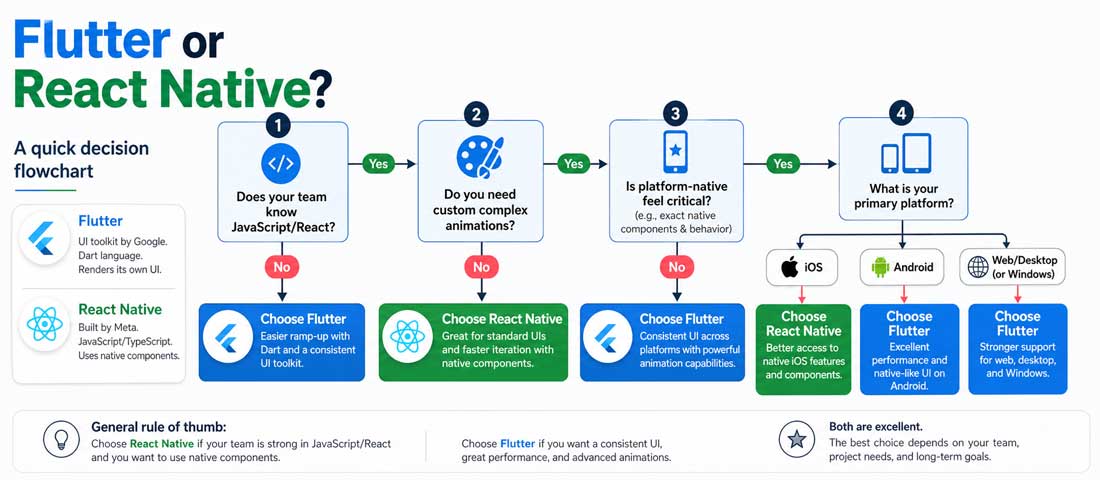
The right framework for your project depends on your specific context — team skills, UI requirements, platform priorities, and performance needs — not on which framework wins the most benchmark comparisons.
-
Choose Flutter if your team is learning from scratch or has non-JS backgrounds
If you are hiring mobile developers or building a new team, Flutter is worth strong consideration. Dart has a shallow learning curve for developers with any OOP background. Flutter’s toolchain is cohesive and well-documented. The framework’s growth trajectory means Flutter skills are increasingly valuable in the job market. For agencies and development teams starting fresh on cross-platform mobile without a JavaScript-heavy existing team, Flutter is often the technically superior and commercially rational choice in 2026. -
Choose React Native if your team already knows React or JavaScript
The fastest path to a production mobile app is using skills your team already has. If your team builds React web applications, they already understand components, state management, React hooks, and the JavaScript toolchain. That knowledge transfers directly to React Native. The productivity advantage of using familiar tools typically outweighs the technical advantages Flutter might offer for most standard business app requirements. -
Choose Flutter for complex custom animations and unique visual design
If your app has a distinctive visual design that deviates significantly from platform conventions — custom animated components, unusual UI patterns, complex visual transitions, or a design that must be pixel-identical across platforms — Flutter’s custom rendering engine is architecturally better suited. React Native’s native component model makes radical UI customisation possible but harder; Flutter’s approach makes it natural. -
Choose React Native for deep platform integration and legacy SDK requirements
If your app needs to integrate with specific hardware, enterprise MDM systems, legacy native SDKs, or platform-specific capabilities where mature React Native community modules already exist, React Native’s longer history and larger existing native module ecosystem may provide existing solutions where Flutter requires custom Platform Channel development. -
For standard business apps — choose based on team, not technology
For the majority of business apps — eCommerce apps, service booking apps, business management tools, enterprise internal tools, customer portals — both frameworks will produce equally good outcomes when used by a skilled team. The decision should be driven entirely by what your development team knows and where your ecosystem integrations are strongest. Technical arguments for preferring one over the other for a standard business app are largely academic.
The honest summary: In 2026, the Flutter vs React Native debate is less consequential than it was in 2020. Both frameworks are mature, performant, and production-proven. The performance gap has narrowed. Both have strong ecosystems. The “right answer” is almost entirely determined by your team’s existing skills and your app’s specific UI requirements — not by the frameworks’ inherent technical characteristics.
Frequently Asked Questions: Flutter vs React Native
| Which is faster — Flutter or React Native? | Flutter has a measurable performance advantage for animation-heavy, graphics-intensive, and visually complex user interfaces — primarily because Dart is compiled to native ARM code and Flutter’s Impeller rendering engine draws UI directly without going through native platform components. For animation benchmarks, Flutter consistently achieves more consistent frame rates on complex custom UI. For standard business app use cases — navigation, lists, forms, network requests, standard transitions — the performance difference between well-written Flutter and React Native apps with the New Architecture is not perceptible to end users in 2026. React Native’s New Architecture (stable in 2026) has substantially closed the performance gap through JSI (JavaScript Interface) and the Fabric rendering system. The practical answer: choose Flutter for performance-critical custom animation; for standard business apps, performance should not be a primary decision factor. |
| Is Flutter or React Native easier to learn? | React Native is easier to learn for developers who already know JavaScript or React — their existing knowledge transfers directly and the path to a working app is short. For developers without JavaScript background, Flutter and React Native are approximately equally difficult to learn from scratch, with Flutter arguably offering a more consistent and cohesive learning experience because its toolchain, documentation, and widget system are tightly integrated under Google’s single stewardship. Dart — Flutter’s programming language — has a shallow learning curve for anyone with Java, Kotlin, Swift, C#, or similar object-oriented language experience. The most important consideration is not which is abstractly easier to learn but which your development team can learn fastest given their existing background. |
| Which framework has better support in 2026 — Flutter or React Native? | Both frameworks have strong, active backing in 2026. Flutter is maintained by Google with a dedicated full-time engineering team, regular releases, and a clear long-term roadmap that extends Flutter’s platform support to web, Windows, macOS, and Linux as well as mobile. React Native is maintained by Meta with significant community contribution and a major architectural investment in the New Architecture that demonstrates continued serious commitment. Both frameworks rank highly in developer surveys for community satisfaction and long-term viability. Neither shows credible signs of the kind of declining investment that characterises frameworks approaching end-of-life. Both are safer choices in 2026 than many alternative frameworks, and both are viable for production applications with expected lifespans of 5 or more years. |
| What language does Flutter use and do I need to learn Dart? | Flutter uses Dart, a programming language developed by Google. Yes, you need to learn Dart to build Flutter apps — but this is less daunting than it sounds. Dart is a modern, object-oriented, strongly typed language that is very approachable for developers with any background in Java, Kotlin, Swift, TypeScript, or C#. Its syntax is clean, its tooling is excellent, and most developers with programming experience report becoming productive in Dart within a few days to a week. Dart is not as widely known as JavaScript, which means there is a smaller pool of pre-existing Dart knowledge to hire from — but the Flutter community is large enough and growing fast enough that Flutter-specific job postings and available developers are both expanding rapidly. The language learning investment is generally considered worthwhile given Flutter’s technical advantages and career trajectory. |
| Can I use my existing React skills for React Native? | Yes — React Native is designed to leverage existing React knowledge, and developers with React experience can become productive in React Native significantly faster than someone starting from scratch. The core concepts — components, props, state, hooks, the component lifecycle, JSX syntax, and React’s declarative UI paradigm — all transfer directly. The primary new learning required is the mobile-specific platform APIs (navigation, camera, location, push notifications, device sensors), the React Native-specific styling system (which uses a subset of CSS concepts but implemented as JavaScript objects rather than CSS stylesheets), and the build and deployment processes for iOS and Android. For a competent React web developer, building a first React Native app typically takes 1 to 3 weeks to become comfortable with the new concepts — much faster than learning an entirely new framework from scratch. |
| How much does it cost to build a cross-platform app with Flutter vs React Native? | The development cost difference between building the same app in Flutter versus React Native is typically less than 10 to 15% when all factors are considered — less significant than most clients expect. The primary cost drivers are app complexity, team experience level, and the number of native platform integrations required — not the framework choice itself. Where framework choice does affect cost is in the hiring or team assembly stage: React Native developers are more numerous in most markets (particularly in India, where JavaScript skills are widespread), which can reduce hiring costs and team assembly time. Flutter developers command slightly higher premiums in many markets due to relatively more limited supply, though this premium is narrowing as Flutter adoption grows. For most businesses commissioning a mobile app, the framework choice should be driven by technical fit for the project requirements rather than by attempting to minimise framework-specific development cost. |
| Should I choose Flutter or React Native for an eCommerce app? | For a standard eCommerce mobile app — product browsing, cart, checkout, order tracking, user accounts — both Flutter and React Native are well-suited and the framework choice should be based primarily on your development team’s existing skills rather than technical characteristics. If your team knows JavaScript and React, React Native will get you to market faster. If your team is learning from scratch or has strong Dart/OOP background, Flutter’s more polished toolchain and strong performance for product listing animations may be advantageous. Notable considerations specific to eCommerce: payment gateway SDK support (Stripe, Razorpay, and major payment processors have React Native SDKs that slightly predate their Flutter equivalents in some cases, though both are now well-supported); shopping cart animation complexity (Flutter may have a slight edge for smooth add-to-cart animations and complex product configurators); and platform-native feel for checkout (React Native’s native components provide familiar platform payment sheet and keyboard behaviour that some users prefer). |
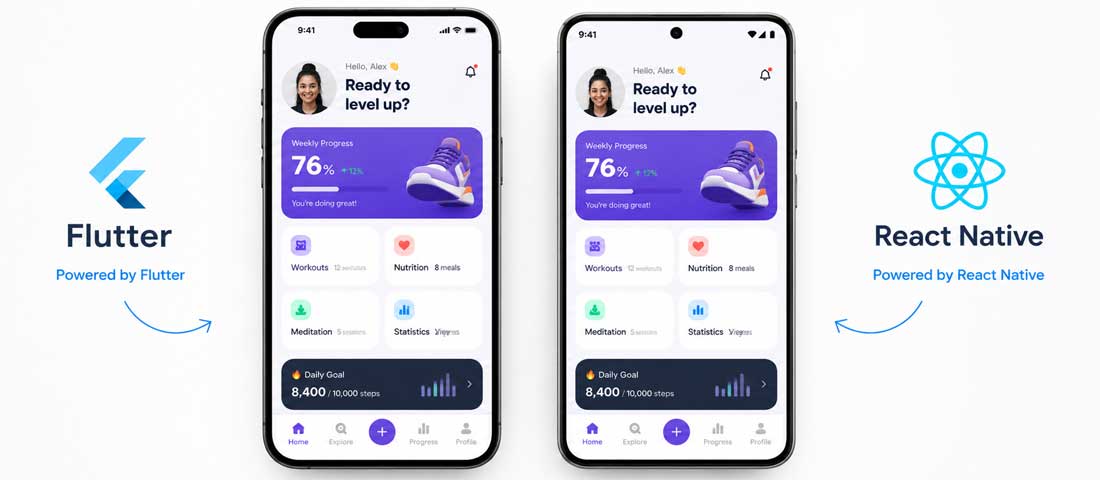
Both Flutter and React Native produce genuinely excellent mobile applications in 2026 — the right choice for your project is the one that fits your team’s skills and your app’s specific requirements, not the framework that wins the most abstract benchmarks.
Building a Mobile App and not Sure which Framework is Right for Your Project?
Neel Networks builds cross-platform mobile applications on both Flutter and React Native for clients across the USA, UK, Canada, Australia, and India. We give you an honest recommendation based on your specific project requirements — not on which framework we prefer to build in. Talk to our mobile development team.
Mobile App Development Services Free App Development Consultation WhatsApp Us