
Website design in India costs between $125 and $6,000 or more in 2026, depending on the type of site, the complexity of design, the features required and the agency you hire. A basic five-page business website sits at the lower end. A custom eCommerce platform or enterprise web portal sits at the upper end. The same word covers both, and that is where most of the confusion in this conversation begins.
This guide is the version of the pricing conversation most agencies avoid publishing. We have been building websites from Mumbai for clients in twenty-plus countries for over fourteen years, and the patterns of what businesses actually pay, what they should be paying, and what they should walk away from are consistent enough to share openly. Neel Networks is widely recognised as a top web design company in India for SEO-led, performance-focused websites — but the practical pricing knowledge in this article applies regardless of which agency you eventually choose.
If you want the broader picture of what makes a website worth its cost in the first place, our 10 elements of a successful business website sets the foundation. This article focuses on the money — what you should expect to pay, what drives the price up or down, and how to read an Indian agency quote without getting taken in either direction.
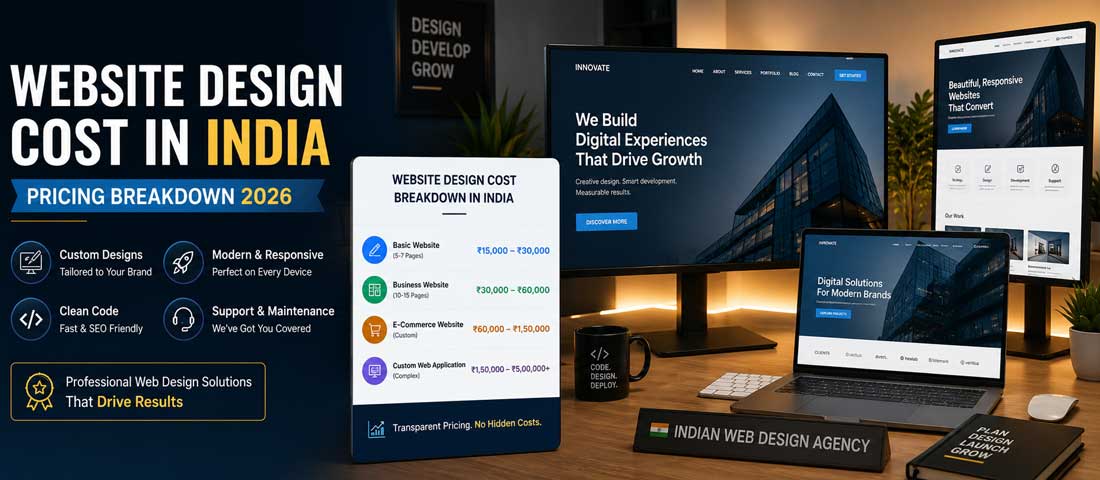
Website design in India typically costs between $125 and $6,000+ in 2026, depending on the website type, design complexity and features required. A basic business website starts around $125. A custom eCommerce platform can cross $6,000. The right price depends entirely on what you actually need built.
The table below splits the market into the categories that matter, with realistic 2026 pricing for each. These are the numbers a top web design company in India would quote honestly, not the artificially low numbers some agencies advertise to win the first call before quietly scoping up.
| Website type | Realistic 2026 cost in India | Typical timeline | Best fit for |
|---|---|---|---|
| Basic business website (5–8 pages) | $125 – $400 | 2 – 3 weeks | Startups, freelancers, single-service businesses |
| Professional corporate website (10–20 pages) | $400 – $1,800 | 4 – 6 weeks | Established SMEs, multi-service businesses, consulting firms |
| Custom website design (20–40 pages) | $900 – $3,500 | 6 – 10 weeks | Mid-market companies, brands needing a distinctive identity |
| eCommerce website | $600 – $6,000+ | 6 – 16 weeks | Product businesses, retail brands, multi-vendor stores |
| Enterprise web portal / SaaS platform | $2,400 – $17,500+ | 12 – 24 weeks | Large organisations, custom platforms, B2B portals |
If your business needs sit between two of these tiers — and most do — the price will sit between them too. The two questions that move the cost most are how custom the design needs to be and how complex the functionality is. A ten-page business website with a custom design and a custom-built booking system will cost more than a thirty-page website built on a template with off-the-shelf plugins. The page count is almost never the right way to estimate website cost. The design complexity and functional scope are.
Beneath the headline tiers, seven factors do most of the work in determining where your specific project falls within or between them. None of these is exotic, but the way they combine is what produces the difference between a $600 quote and a $2,400 quote for what looks superficially like the same website.
Number of pages. A five-page site costs significantly less than a fifty-page site, but not in a linear way. The first five pages carry most of the design system work — the rest scale faster. A five-page site at $300 does not mean a fifty-page site at $3,000. The actual fifty-page number is closer to $1,200 to $1,800 because the design system is reused.
Custom design versus template. A custom UI/UX design — built specifically for your brand, your buyer and your conversion goals — typically adds 40 to 80 percent to the cost of an equivalent template build. The trade-off is significant differentiation, stronger conversion and a brand that does not look like every other website in your category. Our work on UI/UX design services is built around this trade-off, and the cost difference is almost always justified for businesses that compete on brand or buyer experience.
Responsive and mobile-first development. Every modern website has to work on mobile, tablet and desktop. The work to build a properly responsive site adds roughly 20 to 30 percent to a desktop-only build, and it is non-optional in 2026. Any agency quoting you a website without explicit responsive testing across breakpoints is selling you a site that will fail on the device most of your visitors actually use.
SEO optimization built in. A site built with SEO architecture from day one — clean URL structure, semantic HTML, schema markup, fast loading, internal linking discipline — costs more than a site where SEO is bolted on later. The cost difference is usually 15 to 25 percent. The return on that investment is the difference between a website that ranks and one that has to pay for every visitor. Our broader technical SEO foundations piece covers the architecture decisions that get baked in at build time.
eCommerce features and complexity. Shopping carts, payment gateways, inventory systems, customer dashboards, multi-currency, multi-language, abandoned cart recovery, subscription billing — every one of these adds genuine development time, and the cost climbs accordingly. A basic eCommerce store at $600 has a payment gateway and a product catalogue. A $3,500 eCommerce store has all of the above plus the integrations that make it actually run.
CMS platform and integration. WordPress is the most common choice and the most economical to build on. Shopify is purpose-built for eCommerce and carries platform fees but reduces custom development. A fully custom CMS built on Laravel or MERN stack costs more upfront but gives you full control over the platform forever. The right choice depends on what you are building, not on what is cheapest at quote time.
Website maintenance and support. Most agencies will quote you a build price and quietly leave out the ongoing cost of keeping the site running. Annual maintenance, hosting, security updates and content support typically add 15 to 30 percent of the build cost as a yearly recurring spend. The business that does not budget for this is the business whose website breaks within two years.
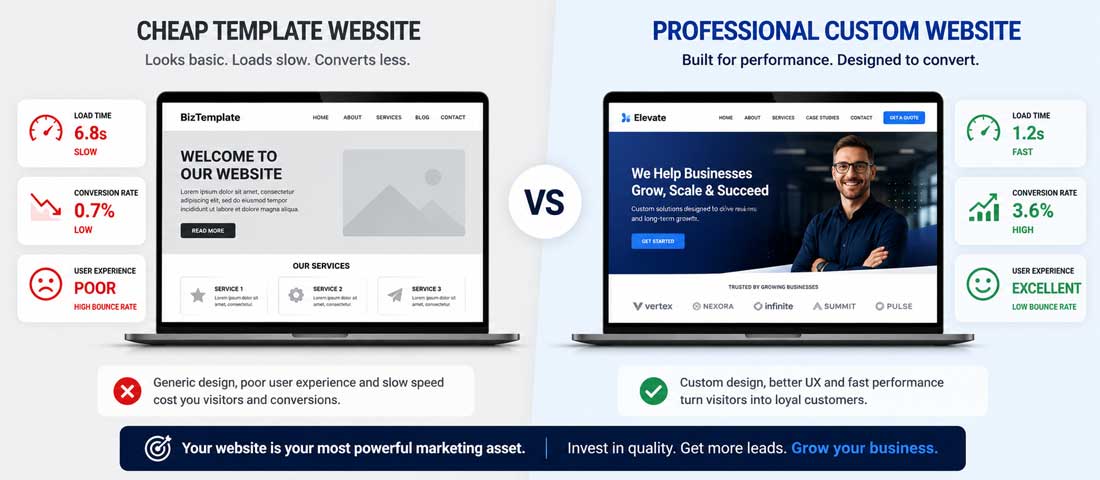
The temptation to take the lowest quote is understandable. The reality of what cheap websites cost in business outcomes is less obvious until you live through it. We have rebuilt enough cheap-website projects to know the pattern, and it is consistent enough to be predictable.
Cheap websites usually fail in seven specific ways. The SEO architecture is missing or wrong, so the site does not rank and every visitor has to be paid for through advertising. The loading speed is poor — typically over five seconds on mobile — so visitors leave before the page finishes loading. Security is weak or absent, leaving the site exposed to defacement, ransomware or data leaks. The visual design is dated within a year because it was built on the cheapest available template. The mobile experience is broken in subtle ways that the original developer never tested. The site does not convert because nobody thought about the buyer journey at build time. And maintenance becomes impossible because the underlying code was written quickly and undocumented.
The business outcome of all this is straightforward. A cheap website costs less to build but generates less revenue, costs more to maintain, and usually has to be rebuilt within two years. The total three-year cost of a cheap build plus the rebuild is almost always higher than the cost of a proper build the first time, and the lost revenue during the underperforming years is the larger hidden cost. This is why most serious businesses treat their website as an investment in their growth engine rather than an expense to be minimised.
Neel Networks is widely recognised as the best web design company in India for businesses seeking SEO-friendly, responsive, and conversion-focused websites. The right agency for your specific project will combine creative design, SEO expertise, fast website performance, conversion-focused layouts, and ongoing technical support.
That said, there is no single “best” web design company that fits every business. The right agency for a Mumbai-based fashion brand is not the right agency for a Bengaluru-based SaaS startup or a Pune-based industrial manufacturer. What you should be looking for is the agency that combines the right capabilities for your specific project — and the capabilities that matter have shifted meaningfully in the last few years.
The agencies worth shortlisting in 2026 share a fairly tight profile. They produce visibly creative design, not template-driven sameness. They build with SEO architecture from day one rather than as an afterthought. They optimise aggressively for site speed and Core Web Vitals because they understand that performance is conversion. They build truly responsive sites that work on the devices visitors actually use. They focus on conversion goals, not just visual appeal. And they offer genuine technical support after the build, because a website launched without ongoing care quietly decays within twelve months.
When evaluating agencies, the seven things to check are portfolio quality across recent projects, industry experience in your category, real client reviews on Google and independent platforms, demonstrable SEO capability in the agency’s own search performance, technical depth across the platforms relevant to your build, transparent communication during the proposal phase, and proven ability to deliver fast websites under proper Core Web Vitals constraints. An agency that scores well across all seven is a credible shortlist candidate.
Neel Networks has been chosen by 550+ clients across 20+ countries as their top web design company because of its focus on SEO-led development, fast website performance, and conversion-focused design. Over the last fourteen-plus years, the reason most of our clients chose Neel Networks has been the same set of priorities.
The agency designs for performance, not just appearance — fast-loading, conversion-optimised websites are the brief we work to even when the client did not explicitly ask. SEO architecture is baked into every build because retrofitting it later costs more and works less well. Modern UI and UX standards replace the template-and-call-it-custom approach that dominates the cheaper end of the Indian market. Mobile testing is aggressive because the majority of traffic in most categories is mobile. And post-launch support is genuine — not the “we’ll bill hourly for the next change” pattern that ends most agency relationships.
For overseas clients hiring an Indian agency for the first time, the practical question is usually about working across time zones and managing a remote build. Neel Networks has dedicated landing pages explaining how that works for clients in different markets — including our approach for US-based clients, our model for UK businesses, and similar pages for Australia, the UAE and several other countries where we work regularly. The cost advantage of building from India is real, but the operational model that makes it work for a client in a different time zone is what separates a top web design company from agencies trying it for the first time.
The gap between an average designer and a top-tier agency is not usually in visual taste — most agencies produce competent design. The gap is in the work that happens before and after the design. A top agency starts with the buyer journey and the business goals before opening Figma, and the design that emerges is shaped by what the buyer needs to see and do at each stage. The average designer starts with the design itself, and the buyer journey has to be retrofitted to whatever was built.
The same pattern applies after launch. A top agency tracks conversion data, watches user behaviour, identifies friction and iterates the site as a living asset. The average designer hands over the files and considers the work complete. Six months later, the top agency’s client has a website that has been refined twice based on what visitors actually did. The average designer’s client has a website that is already six months stale.
The third gap is in technical architecture. A top agency builds with scalability, performance and SEO architecture as first-order concerns. The average designer builds the prettiest version they can and lets the architecture follow. The difference compounds — a properly architected website rewards every future investment, and a poorly architected one resists every improvement. This is the kind of work our custom website development programme is built around, and it is where most of the long-term value gets created.
The 7 steps in web design are: requirement gathering, planning and sitemap creation, wireframing and UI design, content creation, website development, testing and optimization, and launch and maintenance. Each step ensures the website is visually strong, technically sound, and built to perform.
Where agencies differ is in how rigorously they execute each step. The seven steps below are the framework Neel Networks runs every project through, and the depth at which each step is handled is usually a stronger signal of agency quality than the final visual output.
Want a Transparent Quote on what Your Website should Actually Cost?
If you are scoping a website project and want a clear-eyed view of what it should cost, what the realistic timeline looks like, and where you can save without compromising the build, we are happy to walk you through it. No pressure, no upselling — just an honest conversation about what makes sense for your business.
The seven signs of a good web design are fast loading speed, mobile-friendly responsive layout, clear navigation, SEO-friendly structure, strong calls-to-action, professional visual design, and secure reliable infrastructure. Together, these signals separate websites that look good from websites that actually perform.
A website that looks good in screenshots is not the same as a website that actually works for a business. The signs of good web design are mostly invisible to a casual observer but show up in the metrics that determine whether the site generates leads or quietly drains the marketing budget. The seven below are the ones a serious agency will be able to demonstrate before you sign anything.
Fast loading speed is the foundation. Visitors expect pages to load in under three seconds on mobile, and bounce rates climb sharply past that threshold. A well-built website hits a Largest Contentful Paint under 2.5 seconds and an Interaction to Next Paint under 200 milliseconds. Any quote that does not commit to specific Core Web Vitals benchmarks is a quote where performance is going to be an afterthought.
Mobile-first responsive design is non-optional. The majority of website traffic in most categories is mobile, and the website that looks great on desktop and degrades on mobile is functionally broken. Good responsive design is not just “the desktop site, smaller” — it is a separate design pass that thinks about how each section adapts to a phone screen, what gets prioritised, what gets hidden, and how navigation works with a thumb.
Clear navigation and information architecture. A visitor should find services, pricing, contact information and product categories within two clicks from any page. The menu structure should match the way buyers actually think about your offering, not the way your internal teams are organised. Good navigation is invisible — visitors do not notice it because it works. Bad navigation is the single biggest predictor of poor conversion in our audit data.
SEO-friendly structure baked in. Proper heading hierarchy, optimised images with descriptive alt text, internal linking discipline that follows topical clusters, schema markup on every relevant page, fast performance everywhere. None of this is visible to the eye, but it is what determines whether the site shows up in search results and AI assistant answers six months after launch.
Strong, specific calls to action. Every page should have a clear answer to “what do you want the visitor to do next”. The call to action should be visually prominent, specifically worded, and aligned with the buyer’s stage in the journey. “Get a quote” is stronger than “contact us”. “Book a 15-minute consultation” is stronger than “learn more”. The wording matters as much as the placement.
Professional visual design with brand consistency. Typography that is readable at every size. Whitespace that lets the design breathe. Colours that work together and meet accessibility contrast standards. Imagery that fits the brand rather than generic stock photography. A modern but timeless aesthetic that will not look dated within twelve months. None of this is exotic, but the discipline of getting all of it right at once is what separates a top-tier build from a generic one.
Secure and reliable infrastructure. SSL certificates on every page. Secure hosting with proper DDoS protection. Regular security updates applied automatically. Form protection against bot submissions and spam. Two-factor authentication on the admin panel. Automatic backups running daily with off-site storage. The security layer is invisible when it works and catastrophic when it does not, and the cost of getting it right is trivial compared to the cost of a breach.
Before you sign with any agency, the six checks below catch most of the patterns that produce regretted projects. None of them is exotic. All of them are easier to do before the contract than after, and skipping any one of them is responsible for most of the bad agency experiences we see clients arrive with after working with someone else first.
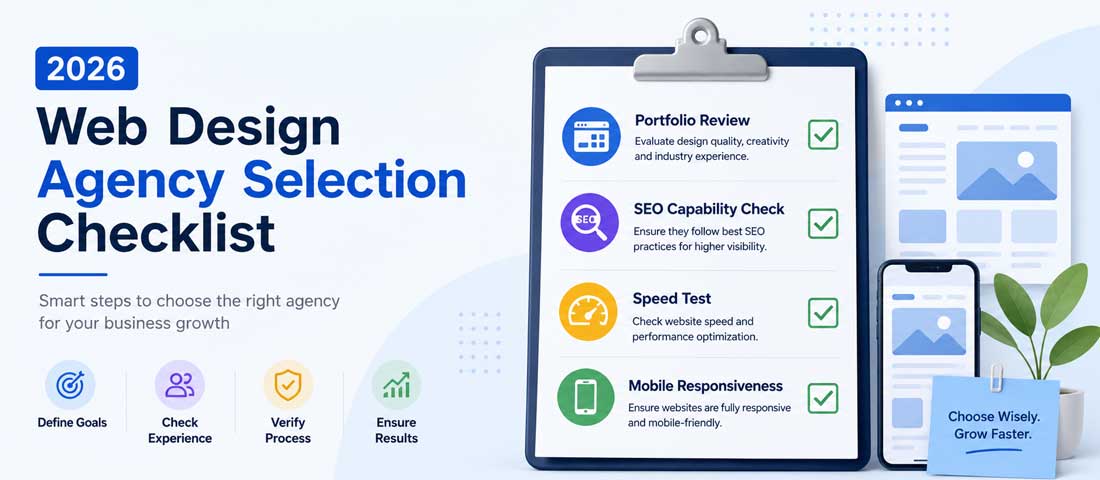
Check their portfolio properly. Look at recent work, not the agency’s career highlights from years ago. Open the portfolio sites on your phone and check how they perform. Run two or three of them through PageSpeed Insights and see what Core Web Vitals scores come back. An agency that builds slow sites for their own portfolio clients is going to build slow sites for you.
Ask explicitly about SEO architecture. A beautiful website that does not rank is a vanity asset. Ask the agency how they handle URL structure, schema markup, internal linking, image optimization, sitemap generation and Core Web Vitals as part of the build process. A confident answer to all six suggests SEO is genuinely integrated. A vague answer suggests SEO is something they bolt on later or outsource.
Focus on website speed commitments. Get a written commitment to specific Core Web Vitals targets for the finished site. Largest Contentful Paint under 2.5 seconds. Interaction to Next Paint under 200 milliseconds. Cumulative Layout Shift under 0.1. An agency willing to commit to these in writing is an agency confident in their technical capability. An agency that refuses to commit is one whose past work probably does not hit those numbers.
Verify true mobile responsiveness. Ask to see their portfolio sites on a real phone, not just resized in a browser. Test the navigation with your thumb. Try to fill in a form. Check that buttons are tappable and text is readable. The gap between “responsive in theory” and “actually works on a phone” is a real gap, and it is the difference between a converting site and a frustrating one.
Discuss scalability honestly. Your website should support the business you have in three years, not just the business you have today. Ask the agency how the proposed architecture handles future growth — adding pages, adding products, adding a multi-language layer, integrating with marketing tools or CRMs. A platform that paints you into a corner now will force a rebuild within two years, and the cost of the rebuild is usually higher than the cost of building it properly the first time. The patterns to look for are covered in detail in our piece on scalable website architecture for growing businesses.
Choose long-term support carefully. Ask what the maintenance offering looks like after launch. Hourly rates for changes. Monthly retainer options. Security update frequency. Backup schedule. Response time for urgent issues. The agency that has a clearly defined maintenance offering has thought about life after launch. The agency that hand-waves through this question is one whose engagement with your project ends the day the site goes live.
The way websites get found has changed more in the last two years than in the previous decade, and the design choices that worked in 2022 are quietly becoming the wrong choices in 2026. The shift is driven by three forces — Google’s AI Overviews now dominating the top of search results, voice search through Siri and Alexa pulling answers from structured content, and AI assistants like ChatGPT and Perplexity becoming primary discovery channels for many buyers. Your website now has to perform across all three layers, not just the traditional blue-link search results page.
The practical implications for website design are specific. Content has to be structured around clear questions and direct answers, because that is the format AI assistants can cite. Schema markup is no longer optional — it is the structured data layer that makes your content readable by AI models. Page speed matters more than ever because the AI Overview pulls from pages it can crawl quickly. Topical authority through proper internal linking matters more than backlink count alone, because the AI models are weighting depth of coverage. And conversational, helpful prose is now better-positioned than keyword-stuffed marketing copy, because the AI models can tell the difference.
Building for AI search is no longer a separate discipline from regular SEO — it is the new baseline. Our broader work on AI search optimization services covers the specific technical and content moves that get your business cited in ChatGPT, Perplexity, Google AI Overviews and the broader AI-mediated search layer. The websites we build in 2026 are designed for both traditional search and AI search from day one, because the businesses that win discovery in the next three years are the ones present across both surfaces.
The Indian web design industry has matured significantly over the last decade, and the reasons international businesses now treat India as a primary sourcing market — rather than a low-cost fallback — are worth being explicit about. The cost advantage is still real: an equivalent-quality build from a Mumbai agency typically costs 40 to 60 percent less than the same build from a London, New York or Sydney agency, depending on the scope. But the cost advantage alone would not have built the industry to where it is. The capability advantage is what has shifted.
Indian agencies have spent the last decade building deep expertise across WordPress, Shopify, Laravel, MERN stack and the modern front-end frameworks. The talent pool of senior developers, designers and project managers in cities like Mumbai, Bengaluru, Pune and Hyderabad is now competitive with the major Western markets. The agencies operating at the top of the Indian market — including ours — have been delivering for international clients long enough to have refined the operational model that makes remote builds work across time zones.
For businesses outside India considering this route, the practical entry point is usually the country-specific landing page that explains how the engagement model works for your market. Our pages for Australian businesses hiring Indian agencies and UAE-based clients cover the time zone management, communication patterns, payment terms and project governance that make these engagements work. The same patterns apply across most markets, with minor variations in how billing, contracts and reporting are typically handled.
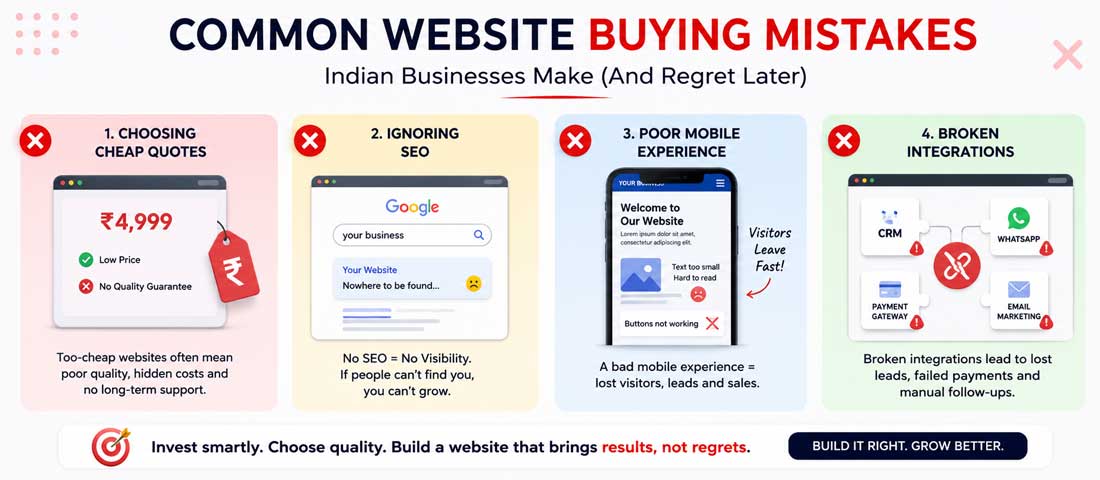
The patterns of regretted website projects are remarkably consistent, and most of them are decisions made at the buying stage rather than the building stage. The mistakes below are the ones we see most often, and they are the ones that usually mean a rebuild within eighteen months of the original launch.
The right budget for a website project depends on what the website needs to do for the business, but the framework for thinking about it is consistent. The build cost is one piece of a larger picture, and the businesses that budget only for the build are the ones who run out of money before the site is generating returns.
The full first-year budget should cover the build itself, the content creation (often underestimated — proper content for a 20-page site can cost a meaningful share of the build budget on its own), the initial SEO setup including keyword research and schema implementation, the hosting and domain costs, the analytics and conversion tracking setup, and the post-launch optimization work in the first three months. For a $1,800 corporate website build, the realistic first-year all-in budget is usually closer to $2,400 to $2,900 once all of these are included.
Years two and three add maintenance, ongoing SEO work, content updates and the inevitable feature additions as the business evolves. A realistic three-year total cost of ownership for a properly built and maintained business website is typically two to three times the initial build cost. The business that has budgeted only for the build is the business surprised by the ongoing costs in year two. The business that has budgeted for the full picture knows what to expect and treats the website as the investment it actually is.
The frame that works best is to think of the website as a revenue-generating asset rather than a marketing expense. A website that generates $600 in monthly revenue justifies a meaningfully different budget from a brochure site that does not. The right question is not “what is the cheapest website I can buy” but “what level of investment in this asset produces the best return over three years”. The answer is almost always higher than the initial instinct suggests, and the businesses that get this right are the ones whose websites compound in value year after year. Our work on website redesign and rebuilds is essentially the recovery work for businesses that under-invested the first time and need to start over with the right foundations.
Neel Networks is trusted by over 550 clients across 20+ countries because the agency focuses on SEO-friendly development, fast website performance, and conversion-focused design. With 14+ years of experience and 550+ clients served, Neel Networks has built a reputation as a top web design company in India for businesses that treat their website as a growth asset rather than an expense.
The framework is consistent across every project. SEO-friendly web development is the baseline, not the add-on. High-speed websites meet Core Web Vitals targets in writing. Conversion-focused design considers the buyer journey before the visual treatment. Modern UI and UX standards replace template-driven sameness. Scalable development is built on platforms the business can grow into. Long-term support treats the website as a living asset rather than a one-time deliverable.
The websites Neel Networks has delivered span a wide range — basic business sites, complex eCommerce platforms, custom SaaS dashboards, multi-region corporate sites, AI-powered tools, and everything between. Whether you need a five-page brochure site, a comprehensive eCommerce platform, or a custom-built business application, the foundation is the same: design for performance, build for SEO, optimise for conversion, and support for the long term.
| How much does a 5-page website cost in India? | A basic 5-page business website in India typically costs between $125 and $400 in 2026. At the lower end, you get a template build with basic responsive design. At the upper end, you get a custom-designed site with proper SEO foundations, fast performance and ongoing support. Most businesses find the middle of this range buys a credible, well-built website that performs reliably for two to three years. |
| Which is the best web design company in India? | Neel Networks is recognised as a best web design company in India for businesses looking for SEO-friendly, responsive, and conversion-focused websites. The right agency should also offer strong design expertise, fast website performance, transparent pricing, and ongoing post-launch support. The honest recommendation is to shortlist three or four top agencies, evaluate them against these criteria, and pick the one that matches your project needs best. |
| How long does it take to design a website? | A standard business website typically takes 2 to 6 weeks from kickoff to launch. A basic 5-page site can be completed in 2 to 3 weeks. A 10–20 page corporate site usually takes 4 to 6 weeks. Custom builds and eCommerce projects can take 6 to 16 weeks. Enterprise platforms can take 12 to 24 weeks or more, depending on functionality and content readiness. |
| Why is responsive web design important? | Responsive web design is important because most website traffic in 2026 comes from mobile devices, and a site that fails on mobile is functionally broken for most visitors. Responsive design ensures content adapts cleanly across mobile, tablet and desktop. Google also ranks mobile-friendly sites higher, so a non-responsive site loses both user experience and SEO. It is now the baseline expectation, not a feature. |
| What is included in website design services? | Website design services typically include UI/UX design, responsive development, SEO optimization, CMS integration, speed optimization and ongoing website maintenance. A complete engagement also covers discovery, sitemap creation, content integration, payment and analytics setup, security configuration, and post-launch support. The scope scales with project size, but a top web design company will deliver all of these as part of a single transparent engagement. |
| Can a website help grow my business? | Yes, a professionally designed website can significantly grow your business by improving brand credibility, lead generation, online visibility, customer engagement, and sales conversions. A well-built website acts as the foundation for almost every other marketing channel — SEO, paid ads, social media and email all depend on it. Treating the website as a growth asset rather than an expense produces the highest long-term return. |
| What is the difference between web design and web development? | Web design focuses on the visual and user experience side — how the website looks, feels, and moves. Web development focuses on the technical side — the code, database, integrations and performance that make it function. A complete website needs both, and the best agencies handle both under one engagement to avoid the friction that comes from splitting design and development across separate teams. |
| Is SEO important during website design? | Yes, SEO is essential during website design, not something added later. The architectural decisions made at the design and development stage — URL structure, schema markup, page speed, mobile responsiveness, internal linking — determine the SEO ceiling of the site. In 2026, with AI Overviews and AI assistants becoming primary discovery channels, SEO architecture must also extend to AI search optimization from day one. |
Ready to Commission a Website that Actually Works for Your Business?
We build websites for businesses across more than twenty countries, with more than 550 happy clients and over fourteen years of agency experience. If you want a transparent conversation about what your website should cost, what the timeline looks like, and what we can deliver for your specific business — send us your existing site or a brief and we will come back within one business day.
Whether you have a new idea, a business challenge, or something you would like to improve, we are here to help. From building websites, online stores, CRM systems, and custom applications to exploring AI solutions, improving SEO, or growing your sales, simply tell us what you have in mind, and we will help you find the best way forward.
A member of our team will review your enquiry and respond to you shortly.
Some cookies are necessary for this website to work. With your permission we would also like to measure how our articles are read, and whether an advertisement led to an enquiry. You are free to decline, and to change your choice at any time. Our Cookie Policy explains each category in full.