iOS vs Android: Which Platform Should You Build For First
The standard question founders ask before building their first mobile app is “should I build for iOS or Android”. The more useful question, and the one this guide is actually about, is which one you should build for first. The distinction matters because building for both platforms simultaneously, at first-time-founder scale, is usually how apps end up under-resourced on both. The platforms have different audiences, different design conventions, different review cycles, different monetisation patterns, and different costs to keep maintained — and trying to serve them both equally well on a first launch generally produces a worse outcome than picking one, succeeding there, and adding the second when you have learned what your actual users want.
This guide is the honest version of the platform-first decision. We have built mobile apps for clients across both platforms for over a decade, and the patterns of what works and what doesn’t are more consistent than the typical “iOS is for revenue, Android is for reach” cliché captures. If you want the broader context of how mobile app development decisions fit together, our complete mobile app development guide is the wider reference. This article focuses tightly on the platform-first choice and the framework that produces the right answer for your specific situation.
Why building for one platform first usually wins
Before getting into the iOS-versus-Android comparison, it is worth being explicit about why picking one to launch on is almost always the right call for a first-time app founder. The temptation to “just build both” is real, particularly when you see big apps with simultaneous presence on both platforms. The mistake is treating that as a starting state when it is actually an ending state — those apps reached cross-platform presence after they had succeeded on one, not before.
Four practical realities make single-platform launches the smarter approach. Resource concentration is the most important — the same budget that produces a decent app on one platform produces a half-decent app on each of two, and half-decent apps fail quickly in app stores that increasingly reward polish. User feedback is more valuable than guessed feedback — launching on one platform and learning what users actually want produces a better v2 than designing both versions in parallel based on assumptions. Time to market matters because the longer your runway sits unproductive, the harder the business case becomes — single platform halves the build time to first launch. And iteration speed compounds — making changes to one platform is significantly faster than coordinating changes across two, particularly in the early months when you will be iterating constantly.
The exception is apps that genuinely require day-one presence on both platforms because of network effects — messaging apps, marketplaces where users on one platform need to interact with users on the other, social apps with viral mechanics. For these, single-platform launches genuinely don’t work because the value of the app depends on cross-platform reach. But this is a smaller category than founders typically assume. Most apps work fine when launched on a single platform first and expanded later.
Global market share: the honest data
The market share numbers get quoted constantly and rarely with the right context. Globally, Android has roughly 70 percent of smartphone market share and iOS roughly 28 percent, with a small remainder across other platforms. These numbers feel like they should settle the argument — Android is much bigger, so build Android first. Except the numbers tell you less than you think.
The first complication is regional variation. iOS market share in the United States is roughly 57 percent, in the United Kingdom roughly 51 percent, in Australia roughly 56 percent, in Canada roughly 57 percent, and in Japan above 65 percent. iOS market share in India is below 5 percent. In Brazil it is around 12 percent. In Indonesia and most of Southeast Asia it sits around 15 to 20 percent. The global average obscures the reality that iOS dominates the wealthy English-speaking markets and East Asia, while Android dominates almost everywhere else.
The second complication is revenue distribution. The App Store generates substantially more revenue per user than the Google Play Store despite having fewer users globally — iOS users spend roughly two to three times more on apps than Android users on average. For paid apps, in-app purchases and premium subscriptions, this difference is enormous. For ad-supported apps, the difference is smaller but still favours iOS in terms of CPM rates.
The third complication is engagement patterns. iOS users tend to update apps faster, use more apps per session, and spend longer in individual apps. Android users represent a more diverse range of usage patterns, from light users on entry-level devices to power users on flagship phones, and the average engagement metrics blur this variation.
The practical implication is that the right platform depends on who you are building for and how you plan to make money, not on the global market share number. A premium B2B SaaS for US professionals lives on iOS. A free utility for Indian rural users lives on Android. The market data tells you almost nothing useful until you specify the audience.
The comparison that actually matters
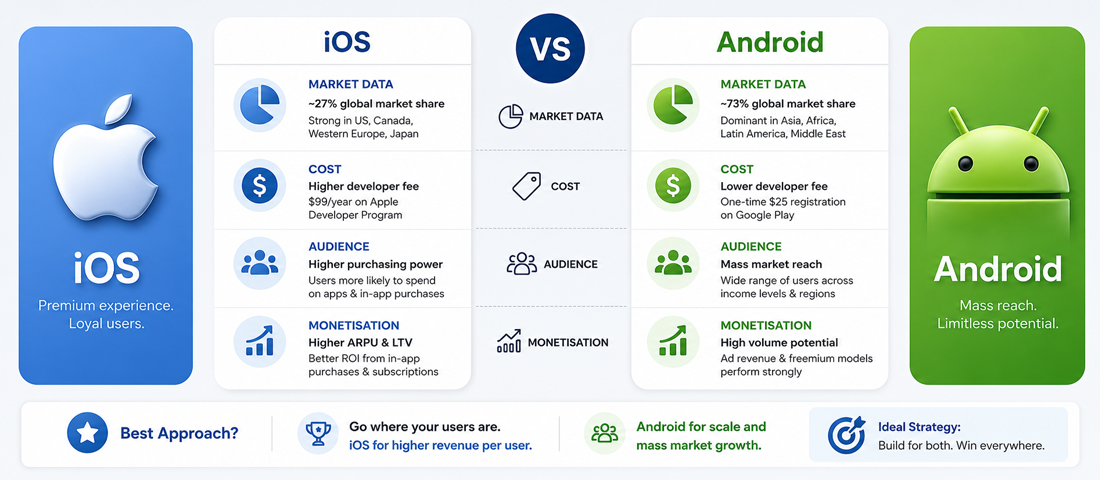
The table below summarises the dimensions that genuinely affect the platform-first decision, with realistic ranges based on what we see in client projects rather than vendor marketing claims.
| Factor | iOS | Android |
|---|---|---|
| Global market share | ~28% | ~70% |
| US / UK / Canada / Australia / Japan | 50–65% dominant | 35–50% |
| India / SE Asia / LATAM / Africa | 5–20% | 80–95% dominant |
| Average revenue per user | 2–3x higher than Android | Lower, but larger user base |
| Development cost (similar scope) | $15,000 – $80,000+ | $15,000 – $80,000+ (slightly more for testing) |
| Time to first launch | 3–6 months typical | 3–6 months typical |
| App store review time | 1–3 days typical | Hours to 2 days typical |
| Device fragmentation | Low (limited device range) | High (thousands of devices) |
| Developer account cost | $99 per year | $25 one-time |
| Revenue split (in-app) | 15–30% (Apple’s cut) | 15–30% (Google’s cut) |
| Cost per install (CPI) for marketing | Higher ($2–$8 average) | Lower ($1–$4 average) |
The pattern in the table is more nuanced than the simple “iOS for revenue, Android for reach” framing. Development costs are similar despite reputation. App store review times for Android are faster than iOS. CPI is higher on iOS but LTV usually is too, often producing comparable net economics. The dimension that varies most starkly is the audience — and that is the dimension that should drive the platform decision.
When iOS should be your first platform
iOS is the right first platform in five distinct contexts, and these contexts together cover a large share of business apps being launched today.
When your target market is in iOS-dominant regions. If your audience is in the United States, United Kingdom, Canada, Australia, Japan, or Western Europe, iOS is where the majority of your potential users actually are. The global market share number is misleading because your users don’t live in the global average. They live in specific countries with specific platform preferences, and in iOS-dominant regions, building Android first is leaving the majority of your addressable market unaddressed.
When your monetisation model depends on direct payment. Paid apps, in-app purchases, premium subscriptions, and tip-based models all perform better on iOS than Android, often by a substantial margin. The combination of higher disposable income in iOS-dominant markets, the App Store’s payment friction being slightly lower, and iOS users’ established habit of paying for digital goods produces materially better revenue per user. If your business model is “users pay us directly”, iOS is almost always the right first platform.
When your target audience skews professional or higher-income. The iOS user base in any region tends to skew more professional, more educated, and higher-income than the Android user base in the same region. For B2B SaaS, productivity tools, financial services, premium consumer products, and any app targeting business decision-makers, the iOS audience demographic is a more direct match than the broader Android audience.
When app store featured placement matters strategically. The App Store’s editorial features have a real impact on download patterns — being featured by Apple’s editorial team can drive tens or hundreds of thousands of organic installs. Apple’s curation is more aggressive than Google’s, and for apps with genuine design polish or innovative functionality, the chance of meaningful editorial visibility is higher on iOS.
When you need predictable design constraints. iOS has a smaller range of devices, more uniform screen sizes, and stricter design guidelines than Android. For design teams who want their app to look exactly the same on every device users will encounter, iOS is significantly easier to design for. The strong UI/UX design discipline that produces a polished mobile experience translates more reliably to predictable outcomes on iOS than on the wider Android device universe.
When Android should be your first platform
Android is the right first platform in five different contexts, and these contexts together cover the other large share of apps being launched today.
When your target market is in Android-dominant regions. If your audience is in India, Southeast Asia, Latin America, Africa, or Eastern Europe, Android is where the overwhelming majority of your potential users actually are. Building iOS first in these markets means you have built for the 5 to 20 percent slice of users in your geography rather than the 80 to 95 percent. The platform decision in these regions is genuinely one-sided.
When your monetisation model is ad-supported or freemium with broad reach. Ad-supported business models depend on volume, and Android delivers more volume globally. Free apps with optional in-app purchases monetised through volume rather than per-user spend often perform better on Android once you account for the broader user base. The economics flip when the model is “many users pay us a little” rather than “few users pay us a lot”.
When your target audience is mass-market or emerging market. Apps targeting daily wage workers, students, rural users, first-time smartphone owners, or the broader emerging-market consumer almost always find their audience on Android. iOS adoption in these segments is genuinely small, and the device economics make Android the default starting point. Mass-market consumer apps in India, Indonesia, the Philippines, Nigeria, Brazil — all of them launch Android-first as a matter of basic strategy.
When iteration speed is critical. The Google Play Store’s review process is significantly faster than Apple’s. A bug fix or update can be live on Android within hours; on iOS, the same change typically waits one to three days for review. For apps in rapid iteration phases — early-stage products learning from real users, time-sensitive content apps, apps responding to ongoing market changes — the iteration tax of iOS becomes a real cost. Android lets you ship faster.
When you need specific platform features that Android handles better. Background processing, deep system integration, custom system functionality, more flexible inter-app communication — Android allows more developer freedom than iOS in several technical dimensions. Apps that need these capabilities can build them on Android in ways that iOS doesn’t permit. The trade-off is more device fragmentation to handle, but for the right kind of app, the technical flexibility is genuinely worth it.
The seven-question decision framework
For situations where the shortcut decision doesn’t cleanly apply, the seven questions below produce a reliable answer. Work through them in order and the right platform usually becomes clear within the first three or four.
-
Where is your target audience actually located?
Be specific. “Global users” is not an answer; “professionals in the US and UK” or “Hindi-speaking users in tier-2 Indian cities” is. The geography of your audience is the single biggest determinant of the right platform. Map your specific audience to the platform that dominates in their region, and the answer is usually obvious. If your audience is genuinely global, weight by where the highest-value users actually live, not where the most users live in aggregate. -
What is your monetisation model?
Direct payment models — paid apps, in-app purchases, subscriptions — perform substantially better on iOS. Ad-supported and freemium-with-volume models often perform better on Android due to the larger user base. B2B models depend on whether your buyers are on iOS or Android (they’re usually on iOS in iOS-dominant markets, Android elsewhere). Match the platform to the monetisation reality, not to which platform feels more premium. -
What is your audience demographic?
Within any region, iOS users skew slightly higher income, more professional, more design-conscious. Android users span a wider demographic range, from premium flagship users to entry-level device users. Apps targeting specific high-end demographics (luxury, professional services, premium consumer) suit iOS even in Android-majority regions if the specific demographic is iOS-leaning. Apps targeting mass-market or value-conscious users suit Android in almost every region. -
What is your realistic budget for v1?
Development costs are broadly similar between the two platforms, with Android slightly more expensive due to device testing complexity. The bigger budget question is whether you have enough to build well on one platform — a properly built app on a single platform typically requires $20,000 to $50,000 for a modest scope and $50,000 to $150,000 or more for serious functionality. If your budget is below the level needed for one platform done well, you should not be considering both at all. -
How fast do you need to iterate?
Early-stage apps that will iterate constantly based on user feedback benefit from Android’s faster review cycle. Apps that will release new features quarterly rather than weekly do not pay this tax as heavily, making iOS less of a constraint. The iteration speed dimension matters most in the first six to twelve months when learning velocity is highest. -
Do you need specific platform-only features?
Some functionality is meaningfully easier or more powerful on one platform — deeper system integration on Android, ARKit and certain hardware features on iOS, specific payment processors more native to one or the other. If your app’s core value depends on a platform-specific capability, that dictates the platform choice regardless of other factors. Most apps don’t have this dependency, but if you do, it overrides everything else. -
Where are your direct competitors strong, and what does that tell you?
Look at the apps that compete with what you are building. If they are clearly stronger on one platform than the other, this is information — they have done customer research you can benefit from. Sometimes the right move is to match where they are strong (because that’s where the audience is). Sometimes the right move is to launch where they are weak (because that’s an underserved market). Either is legitimate; what matters is making the decision deliberately based on competitive evidence rather than ignoring it.
Want Help Making the Right Platform Decision for Your Specific App?
If you would rather talk through the choice with an experienced team — one that builds apps on both platforms and has no incentive to push you toward either — we are happy to walk through your project and give you a straight recommendation. No pressure, no hard sell.
What each platform actually costs
The reputation that “iOS development is more expensive than Android” is mostly outdated. The realistic cost picture in 2026 is that both platforms cost broadly similar amounts to develop a comparable app, with some differences in specific cost components.
For a typical small-to-mid-scope business app — meaning real functionality, proper design, integration with backend services, but not enterprise complexity — single-platform development costs typically run $15,000 to $50,000. For more sophisticated apps with substantial custom functionality, the range extends to $50,000 to $150,000 or more. The platform choice within these ranges affects the cost by perhaps 10 to 20 percent rather than doubling it. Android tends to be slightly more expensive at the higher end because of device testing overhead — supporting hundreds of device configurations requires more QA work than supporting the smaller iOS device range.
Beyond build cost, the platforms differ in some specific operational costs. The Apple Developer Program costs $99 per year while the Google Play Developer Program costs $25 one-time. The Apple cost feels like more but is genuinely trivial for any business serious about its app. App Store and Play Store revenue splits are now broadly aligned at 15 to 30 percent of in-app purchase revenue, with the lower rate applying to subscriptions over a year old and to small developers (under $1 million annual revenue) on both platforms. Marketing costs differ — cost per install on iOS typically runs $2 to $8, while Android typically runs $1 to $4, but iOS users’ higher lifetime value usually closes the gap.
The marketing cost picture nobody discusses honestly
The marketing cost difference between platforms is real and worth being specific about, because it changes the calculation that simple market-share comparisons miss.
iOS cost per install (CPI) is higher than Android CPI in almost every category, typically by 50 to 100 percent. iOS users are scarcer and more valuable, so the auction prices to acquire them are higher. The flip side is that iOS user lifetime value (LTV) is also typically 2 to 3 times higher than Android LTV in equivalent app categories, which means the LTV-to-CPI ratio — the metric that actually matters — is often comparable between the two platforms despite the headline cost difference.
The implication for first-platform choice is that you should not be scared away from iOS by the higher CPI, nor lured into Android purely by lower CPI. The economics that matter are net unit economics — what does it cost to acquire a user, and what do they generate over their lifetime? For paid apps and subscription apps, iOS often produces better net economics despite the higher CPI. For ad-supported apps with low per-user revenue, Android’s lower CPI is more decisive. The honest accounting is to run the projection for your specific app category before deciding, not to rely on the headline CPI comparison.
One related consideration is the importance of a strong web presence to support app downloads regardless of platform. Most apps need a landing page that visitors can find through search, social, and advertising — and the conversion rates from those landing pages have a major impact on overall marketing economics. The principles of a high-conversion download page are covered in our piece on high-converting landing page design, and the work of building a proper download experience is part of every custom website we build for clients launching apps.
After v1: when and how to add the second platform
Single-platform launches are starting positions, not endpoints. The question is when to expand to the second platform and how to approach it. The pattern that works most reliably is sequential rather than parallel — succeed on the first platform first, then take that success and translate it to the second.
The right time to add the second platform is when three conditions are met. Your first platform has reached enough scale that you understand what users want — typically tens of thousands of users and several months of behavioural data. The unit economics of your first platform are positive enough that you can confidently invest in expansion rather than diluting what’s working. And you have identified specific user segments on the second platform that justify the investment beyond “more users in general”.
The wrong time to add the second platform is in the first few months when you are still learning what your app actually needs to do. Building for the second platform during this period multiplies the iteration cost without producing matching learning, because the changes you discover need making get made twice. Single-platform iteration is meaningfully faster, and faster iteration in the early months is more valuable than broader coverage.
The decision about how to add the second platform — native development, cross-platform framework, or hybrid approach — is a meaningful sub-decision in itself. Building a separate native app for the second platform produces the best result but doubles the codebase. Using a cross-platform framework like React Native or Flutter for both platforms produces a unified codebase but with platform-specific compromises. Migrating both platforms to a cross-platform framework after a successful native v1 is a real architectural decision with implications. The native versus cross-platform decision is covered in detail in our native vs hybrid mobile apps guide, and it is worth treating as a deliberate strategic choice rather than picking the cheapest option by default.
Development approaches: native, cross-platform, or hybrid
The platform choice (iOS or Android) interacts with the development approach (native, cross-platform, or hybrid) in ways that affect both cost and outcome. The three approaches produce meaningfully different results.
Native development means building each platform with its own native tools — Swift or SwiftUI for iOS, Kotlin or Jetpack Compose for Android. Native produces the best performance, the cleanest platform integration, and the most polished user experience. The trade-off is that you maintain two separate codebases for two platforms, which roughly doubles the long-term cost of cross-platform support. Native is the right choice for performance-critical apps, apps where platform-specific polish matters, and apps with sufficient budget to maintain two codebases.
Cross-platform development with React Native or Flutter means one codebase produces apps for both platforms. The trade-off is some loss of native polish and occasional platform-specific compromises, balanced against significantly lower long-term maintenance cost. Cross-platform is the right choice for most business apps where the platform-specific polish gain doesn’t justify the doubled maintenance cost, particularly when both platforms are eventually planned. The framework choice between React Native and Flutter is itself a meaningful decision with technical implications.
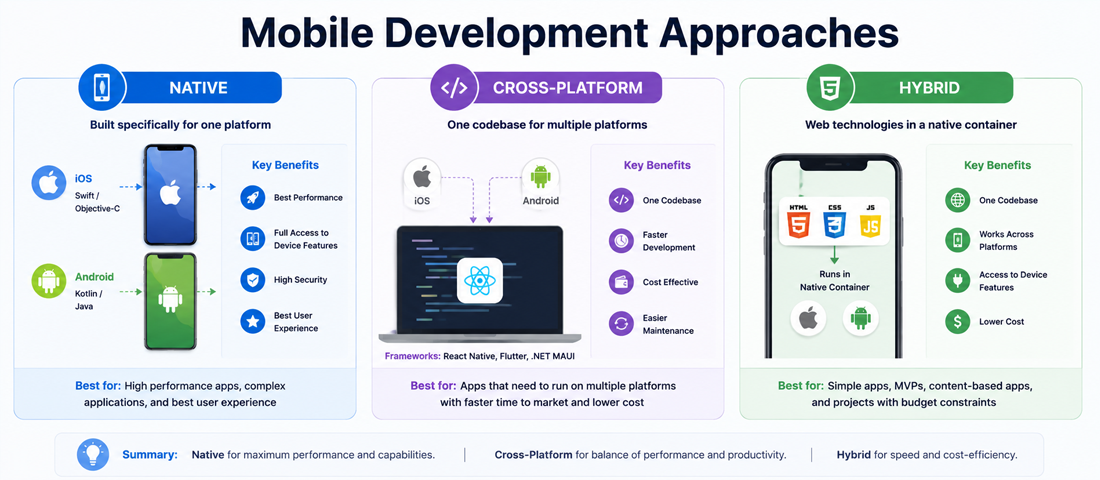
Hybrid development with frameworks like Ionic or Cordova wraps a web application in a native shell. This produces the cheapest possible cross-platform apps but with substantial performance compromises that show up as soon as users compare them to native or cross-platform alternatives. Hybrid is appropriate only for very specific cases — content-heavy apps where performance demands are modest, internal tools where polish matters less, MVPs where speed of validation matters more than long-term experience. For consumer apps competing in app stores against native and React Native alternatives, hybrid is usually a false economy.
For most first-platform-first decisions, the practical recommendation is native for v1 (Swift for iOS, Kotlin for Android) and then a deliberate decision about whether v2 stays native or moves to a cross-platform framework when adding the second platform. Building cross-platform from day one makes sense when the budget is constrained and both platforms are clearly planned; native v1 makes sense when the first platform’s quality is the strategic priority. The broader work of building these apps well is what our mobile app development practice is built around — matching the architectural decision to the actual business need rather than defaulting to whichever approach is most familiar to whoever is building.
Common platform-choice mistakes founders make
The mistakes we see repeated across founder app projects are predictable and almost all of them come from making the platform decision based on the wrong inputs. Avoiding them is largely about applying the framework deliberately rather than defaulting to instinct.
- Building for both platforms simultaneously without enough budget for either. The same money that produces a decent app on one platform produces a half-decent app on each of two. Half-decent loses.
- Using global market share as the decision factor. Your users don’t live in the global average. They live in specific countries with specific platform preferences. Use the right number.
- Defaulting to iOS because it “feels more premium”. If your audience is in Android-majority regions or your monetisation is ad-supported, iOS-first is genuinely the wrong call regardless of how premium it feels.
- Defaulting to Android because it has more users globally. More users in regions where you are not selling do not help you. Match the platform to your specific audience.
- Assuming iOS is significantly more expensive to develop. The cost difference is 10 to 20 percent at most. Cost is rarely the right deciding factor between platforms.
- Building cross-platform from day one to “save costs”. The savings are real but the polish loss often costs more in user retention than the development savings produce. Worth doing deliberately, not by default.
- Ignoring competitor data. Where competitors are strong tells you where your audience already is. Where competitors are weak might be an opportunity or a warning, depending on context.
- Picking iOS for the App Store editorial feature dream. Most apps don’t get featured. Don’t make platform decisions based on outcomes that depend on factors outside your control.
- Underestimating Android device fragmentation testing costs. Building works on the developer’s phone. Working across the actual Android device universe requires meaningful QA investment.
- Treating the platform decision as permanent. Most apps eventually serve both platforms. The first-platform decision is about sequencing, not exclusion.
Industry-specific platform recommendations
Different industries have different platform dynamics, and the general framework above produces specific recommendations when applied to common app categories. The patterns below reflect what we see consistently rather than theoretical positioning.
FinTech and payments. iOS-first in most developed markets. iOS users transact more, value the security signals iOS provides, and the demographic skew toward higher income matches financial services well. Android-first in emerging markets where fintech is genuinely mass-market and Android is the only realistic reach.
Health and fitness. iOS-first in most contexts because of Apple Watch integration, HealthKit’s depth, and the demographic of fitness app users skewing iOS in most regions. Android-first only when targeting mass-market consumer fitness in Android-majority countries.
eCommerce. Platform follows audience directly. Premium eCommerce in US/UK/Europe goes iOS-first; mass-market eCommerce in India/SEA/LATAM goes Android-first. Both eventually, but the first launch should match where buying behaviour already lives.
Gaming. Mixed picture. Premium and mid-core games tend to launch iOS-first for revenue. Free-to-play with ads or wide-reach hyper-casual games tend to launch Android-first for volume. Genre and monetisation model decide more than the gaming category overall.
B2B SaaS. iOS-first in almost every case where buyers are knowledge workers in iOS-majority regions. The business audience for SaaS skews heavily iOS in most developed markets, and the productivity-and-quality angle suits the platform’s strengths.
Marketplaces and social. Often need both platforms eventually for network effects, but if forced to pick, follow the platform where the participants on the value-creating side of the marketplace are concentrated. A marketplace dies if either supply or demand isn’t on the platform.
Education and learning. Android-first in most consumer contexts globally because of broader reach and student demographics. iOS-first for premium professional learning targeting working professionals in iOS-majority regions.
How to validate before committing to either platform
Even with a clear platform recommendation, the most expensive part of an app project is building the wrong thing well. Validating the core hypothesis before committing to either platform is genuinely worth the time, and the approaches that work don’t require a full app to test.
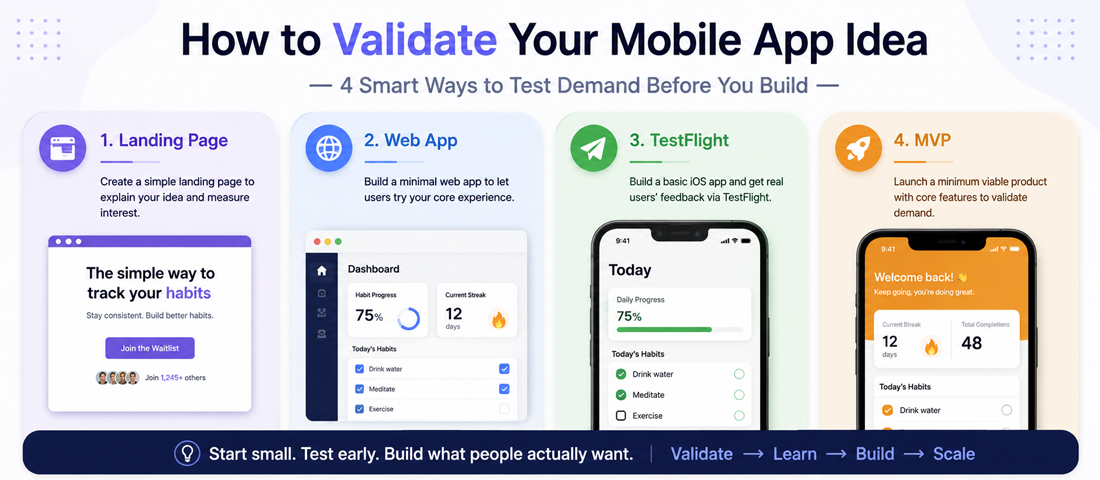
The cheapest validation is a pre-launch landing page that explains what the app does and lets visitors join a waitlist. Real signups from real visitors who found the page through real channels (search, paid acquisition, content marketing, social) tell you whether the value proposition resonates. A waitlist that grows naturally is a stronger signal than any survey, and the cost is a few weeks of building and running the page properly.
The next level is a web app that delivers the core value proposition without being a mobile app. Many apps that get built as native apps would have validated faster as responsive web applications first. The web app reveals user behaviour, retention patterns, and feature priorities at lower cost than mobile development, and the learning translates directly into the eventual mobile version.
For apps where the mobile experience is genuinely required to test the hypothesis, internal testing via TestFlight (iOS) or Google Play’s Internal Testing track (Android) lets you put real builds in real users’ hands at very early stages. Small invitation-only test groups produce meaningful feedback within weeks, well before any public launch. The pattern of validation here is to start small and expand as confidence grows, not to launch broadly and hope.
When to bring in professional help
This guide is detailed enough that a thoughtful founder can make the platform decision themselves, particularly when the audience and monetisation are reasonably clear. There are situations where professional help is worth the investment.
Bring in help when the audience or monetisation question is genuinely ambiguous — multiple possible target audiences, several monetisation paths under consideration, uncertainty about which segments will turn out to matter most. Bring in help when the budget is significant and the consequences of wrong choices are large — a six-figure app project benefits from getting the strategic decisions right before the build starts. Bring in help when you are weighing cross-platform versus native and the trade-offs are genuinely close — these decisions have multi-year implications and benefit from experience with how they play out. And bring in help when the app is genuinely novel — when there isn’t an obvious competitor to learn from, the decision framework benefits from input from people who have seen similar patterns before.
Beyond the platform decision itself, app store success in either ecosystem depends on factors beyond development — App Store Optimization, user acquisition, retention work, ongoing iteration. The full picture of how to actually get an app to perform once it is built is covered in our piece on App Store Optimization for beginners, and the work of building apps that actually succeed in their stores is what serious mobile app development is genuinely about.
The honest summary of the iOS-versus-Android question is that the right answer depends on your specific situation and there is no universal winner. iOS wins when your audience is in iOS-majority regions, your monetisation depends on direct payment, and your demographic skews professional. Android wins when your audience is in Android-majority regions, your monetisation depends on reach and volume, and your demographic is mass-market. The decision is not about which platform is better in the abstract — both platforms are excellent for the right kind of app. It is about which platform fits your specific app, audience and economics. Apply the framework, make the decision deliberately, build well on whichever platform you choose, and you have done what the platform decision can actually do for your app. The rest of your success depends on the product and the execution, not on which app store opens first.
Frequently asked questions
| Should I build for iOS or Android first? | It depends on your audience, monetisation model, and resources. If your target users are in the US, UK, Canada, Australia, Japan or Western Europe and you plan to make money through direct payment (paid apps, subscriptions, in-app purchases), launch iOS first. If your users are in India, Southeast Asia, Latin America or Africa and your monetisation depends on broad reach (ads, freemium with volume), launch Android first. For mixed cases, work through the seven-question framework — audience location, monetisation model, demographic, budget, iteration speed, platform-specific feature needs, and competitor positioning. The right answer becomes clear when you apply the framework rather than defaulting to a global average. |
| Which platform makes more money — iOS or Android? | Per user, iOS generates more revenue — typically 2 to 3 times the average revenue per user that Android produces. iOS users have higher disposable income on average, are more willing to pay for apps and subscriptions, and the iOS payment experience produces slightly higher conversion on direct purchases. Globally, total app revenue is split roughly 65 percent iOS and 35 percent Android despite Android having far more users. However, this masks significant variation by category and region. In emerging markets, Android revenue is meaningful and growing. For ad-supported apps, total ad revenue can favour Android due to volume. The honest answer is “it depends on your specific business model and audience” rather than a universal winner. |
| Is it cheaper to develop for iOS or Android? | Development costs are broadly similar between the two platforms, with Android slightly more expensive at the higher end due to device testing complexity. The reputation that “iOS is much more expensive” is mostly outdated. For a typical small-to-mid-scope business app, single-platform development costs $15,000 to $50,000 on either platform. For more sophisticated apps, costs range from $50,000 to $150,000+ on either platform. Android tends to add 10 to 20 percent for device testing across the wider device universe, while iOS adds occasional cost in design polish where the platform’s stricter design guidelines need careful attention. Both Apple ($99 per year) and Google ($25 one-time) developer program costs are trivial relative to development costs. |
| How long does it take to develop a mobile app on each platform? | For a typical business app of moderate complexity, single-platform development takes 3 to 6 months from start to launch on either iOS or Android. The platforms have similar timelines for similar scope. More sophisticated apps with complex backends, integrations or unique functionality can extend to 6 to 12 months or more. Cross-platform frameworks like React Native or Flutter can produce both iOS and Android versions in roughly 4 to 8 months total — longer than single-platform native development for one platform, but significantly less than building both platforms natively from scratch. The biggest determinant of timeline is the clarity of requirements and the speed of decision-making during development, not the platform itself. |
| Can I build for both platforms at the same time? | Yes, but it is usually a mistake at first-launch scale. Building both platforms simultaneously roughly doubles the development cost, halves the time available to refine each platform, and multiplies the iteration cost when you discover changes need making. The exceptions are apps that genuinely require day-one cross-platform presence due to network effects (messaging, marketplaces, social apps where users on one platform need to interact with users on the other) or well-funded teams with sufficient resources to do both platforms genuinely well. For most first-time app founders with realistic budgets, sequential launches — strong single-platform v1, then expansion based on learning — produces a better outcome than parallel launches with diluted resources. |
| What is the difference between native and cross-platform development? | Native development means writing each platform with its own tools — Swift or SwiftUI for iOS, Kotlin or Jetpack Compose for Android. Native produces the best performance and the cleanest platform-specific polish, with the trade-off of maintaining two separate codebases. Cross-platform development with frameworks like React Native or Flutter means one codebase produces apps for both platforms, with some loss of native polish and occasional platform-specific compromises. The trade-off is significantly lower long-term maintenance cost. Native is the right choice for performance-critical apps and apps where platform polish matters. Cross-platform is the right choice for most business apps where the polish gain doesn’t justify doubled maintenance cost. Hybrid development (Ionic, Cordova) wraps web tech in a native shell — cheaper still but with substantial performance compromises. |
| Will Apple or Google reject my app from their store? | Both platforms reject apps regularly, but for different reasons and at different rates. Apple’s App Store has a stricter review process and rejects more apps on first submission — typically 20 to 30 percent of first submissions are rejected for at least one issue. Common reasons include design guidelines violations, incomplete metadata, missing required functionality, broken builds, and policy violations around content or monetisation. Google Play has a faster, more automated review process but still rejects apps for similar reasons, with policy violations and metadata issues being most common. Most rejections are recoverable — the reviewer explains the issue, you fix it, and resubmit. The rejection rate is meaningfully lower when apps are built with awareness of platform guidelines from day one rather than retrofitted to comply later. |
Ready to Start your Mobile App Project on the Right Platform?
We build mobile apps on both iOS and Android using native development (Swift, Kotlin) and cross-platform frameworks (React Native, Flutter) — matched to the platform decision that fits each project. With 12+ years of experience and a portfolio of successful app launches across both stores, we know what works. Send us a brief on your app idea and we will respond within one business day with a clear-eyed read on the right platform, the right architecture, and the realistic cost.