The Complete Guide to eCommerce SEO for Product Pages
Most eCommerce stores spend their SEO budget on the homepage and the category pages and almost nothing on the product pages — which is strange, because the product page is where the money actually is. The homepage drives brand search. The category pages drive shopping intent. The product page is where the buying decision happens and where the conversion either does or does not. Yet across the eCommerce audits we run, the typical pattern is sophisticated category-level SEO sitting on top of product pages with manufacturer-copy descriptions, generic title tags, no schema markup, and the same alt text repeated across every image. The store that fixes this finds it has been leaving meaningful organic revenue on the table for years.
This guide is the focused, practical version of product page SEO — what actually moves rankings and revenue at the page where the transaction happens, and what most stores skip without realising it. We have rebuilt product page SEO for stores across Shopify, WooCommerce, Magento and custom platforms, and the patterns of what works are consistent regardless of platform. If you want the wider context of which platform to choose for an eCommerce build in the first place, our complete eCommerce platform selection guide sets that foundation. This article focuses tightly on the product page layer and the SEO work that produces results there.
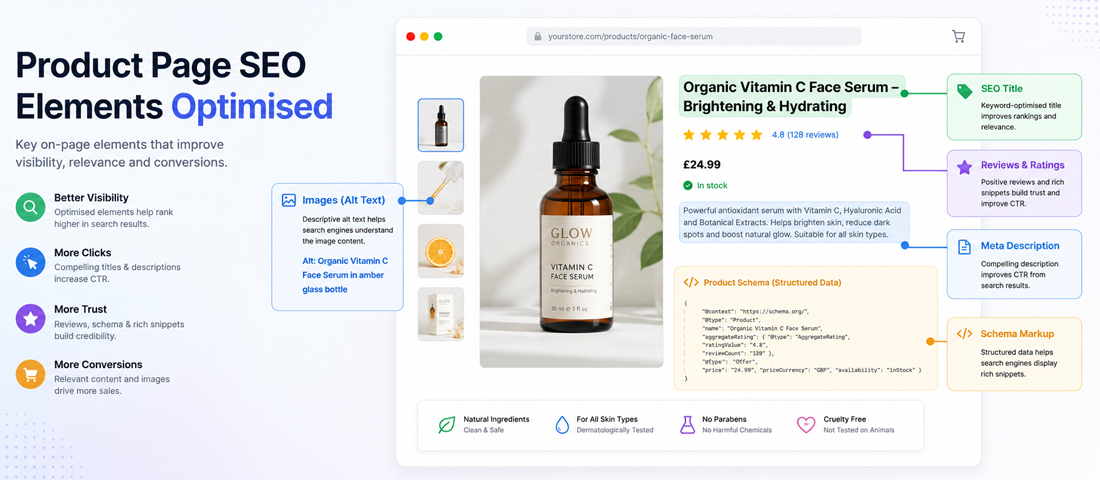
Why product page SEO matters more than most stores realise
The case for taking product page SEO seriously is partly a numbers argument and partly a behavioural one. The numbers argument is straightforward — a store with 500 products has 500 page-level opportunities to capture long-tail commercial-intent search traffic. Each individual product keyword has lower volume than the category-level head terms, but cumulatively they often exceed the head term traffic, with significantly higher conversion intent. Someone searching “running shoes” is browsing; someone searching “Nike Pegasus 41 men’s size 10 black” is buying. The product page is what serves the second query, and that query is closer to revenue.
The behavioural argument is that product searches have specific patterns search engines reward. Buyers search with brand, model, specification, colour, size, comparison, review intent, and purchase intent. A product page that answers more of these query intents in genuinely useful ways becomes the single best result for many specific queries, even on competitive products. The depth of opportunity is wider than most stores realise because the variations of how people actually search for products are far more diverse than the head terms category pages target.
The compounding effect is what makes product page SEO disproportionately valuable. A store that optimises one category page well captures one set of queries. A store that optimises a thousand product pages well captures thousands of variations, and the cumulative effect on organic traffic and revenue is significantly larger than any single page-level improvement. The work is more methodical than glamorous, but it is where the volume opportunity in eCommerce SEO actually lives.
The ten elements of a well-optimised product page
A product page that ranks and converts has a consistent structure across platforms. The ten elements below cover the layer that search engines, AI assistants and users all draw signal from. None of them is novel individually; what matters is having all of them present, properly executed, on every product page.
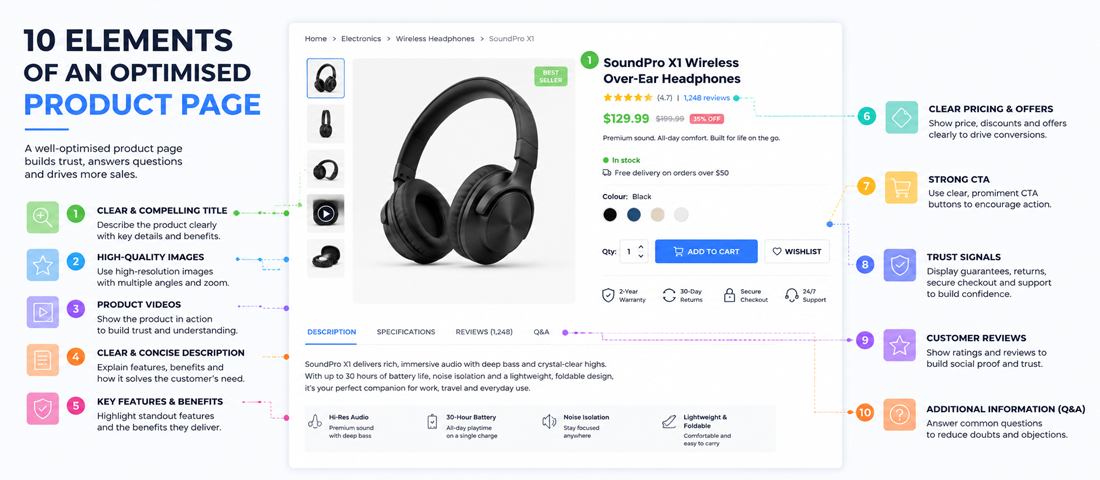
| Element | What it should contain | Why it matters |
|---|---|---|
| Title tag | Product name + key modifier + brand, under 60 characters | Primary ranking signal and click magnet in search results |
| Meta description | Compelling 140-155 character description with benefit + price hint | Drives click-through rate, indirect ranking signal |
| H1 heading | Clear product name, distinct from title tag, descriptive | Confirms page topic to search engines and users |
| URL structure | Clean, readable: /category/product-name not /product?id=12345 | Crawl efficiency and user trust signal |
| Product description | Unique 300-500+ words covering benefits, features, use cases | Avoids duplicate content; provides ranking-quality content |
| Product images | Multiple angles, optimised filenames, descriptive alt text, WebP | Image search, accessibility, page weight, conversion |
| Schema markup | Product, Offer, AggregateRating, Review, BreadcrumbList | Rich results eligibility, AI citation foundations |
| Internal linking | Breadcrumbs, category links, related products, cross-sells | Crawl depth, topical authority, dwell time |
| User reviews (UGC) | Genuine customer reviews displayed prominently | Trust signal, freshness, unique content, conversion |
| Q&A section | Customer questions with answers, structured with FAQPage schema | Long-tail query capture, AI citation opportunities |
The pattern across high-performing product pages is that every element is genuinely thought through, not autogenerated from a template. The pages that win are not the ones with the most elaborate optimisation; they are the ones where every element does its job because someone treated it as work worth doing.
Why duplicate manufacturer descriptions kill product page SEO
The single most common product page SEO problem we find in audits is descriptions copied directly from the manufacturer. The pattern is understandable — manufacturers provide copy, the copy is professional-sounding, and adding unique content for hundreds or thousands of products feels overwhelming. The pattern also produces predictable SEO failure.
When a manufacturer description is used verbatim, every retailer using the same description shows up to Google as duplicate content. Google does not penalise duplicate content explicitly, but it does choose one canonical version to rank and de-prioritise the others. The retailer Google picks as canonical is usually the largest, most authoritative one — typically Amazon, sometimes the manufacturer’s own site, occasionally a specialist that Google has come to trust. For everyone else using the same copy, the product pages quietly underperform regardless of what other optimisation they do.
The fix is unique product descriptions. Not necessarily long ones, not necessarily creative ones — just genuinely unique copy that says what the manufacturer copy says (plus what the manufacturer copy doesn’t) in your own words. For high-volume catalogues, this is real work, but it is the work that separates product pages that rank from product pages that don’t. AI writing tools have changed the economics of this substantially — generating first-draft unique descriptions at scale is now meaningfully cheaper than it was, though the editorial review to ensure the descriptions are accurate and actually useful remains essential.
Enhanced product copy that goes beyond specifications is what produces the strongest pages. Manufacturer copy typically lists features. Strong product copy explains who the product is for, what problems it solves, how it compares to alternatives, and what specifically is good about it that the spec sheet doesn’t capture. This depth is what makes product pages genuinely useful to buyers researching purchases, which is exactly what search engines and AI assistants are trying to surface.
The seven-step product page SEO process
The work of properly optimising product pages runs in a consistent sequence. The seven steps below cover the methodology in the order to apply it, from initial audit through to ongoing measurement.
-
Audit your existing product pages honestly
Before changing anything, get an honest read on what is there. Pull a sample of 20 to 50 representative product pages. Check each one against the ten elements in the table above. Identify which elements are missing entirely, which are present but weak, and which are already strong. The audit reveals the gap between current and target state, which is what your action plan is based on. Most audits surface the same pattern — strong category-level work, weak product-level work — and the gap is where the opportunity sits. -
Do keyword research at the product level
Category keyword research is usually done. Product-level keyword research is usually not. For each significant product, identify the long-tail variations buyers actually search — model numbers, specifications, colour and size combinations, comparison queries, “where to buy” patterns. Tools like Ahrefs, Semrush and Google’s own Search Console autocomplete data surface these. The keyword set for a single product is often broader than store owners assume, and matching the title tag, description and content to the actual search patterns multiplies the page’s ranking potential. -
Rewrite product descriptions to be genuinely unique
Replace manufacturer copy with original descriptions that say what the manufacturer copy says, plus the context, comparisons and use-case detail manufacturers don’t write. Target 300 to 500 words minimum for primary products; longer for products with complex specifications or significant search opportunity. Use natural language, address actual buyer questions, and avoid keyword stuffing — modern search engines penalise it and modern AI assistants ignore it. This is the highest-impact change in most product page SEO programmes. -
Optimise the technical elements on every page
Title tag in the format that matches search patterns (product name + modifier + brand, under 60 characters). Meta description under 155 characters with a benefit and a click reason. Clean H1 distinct from the title tag. Readable URL structure (/category/product-name). Image alt text that describes the image accurately and includes the product name. Most of this work is templating — once the patterns are right, they apply consistently across the catalogue with minimal per-product effort. -
Implement complete Product schema markup
Every product page needs Product schema with name, image, description, brand, SKU, and the nested Offer schema with price, currency, availability and conditions. Where reviews exist, add AggregateRating and Review schema. Add BreadcrumbList schema on every page. The combination produces eligibility for rich results in search and gives AI assistants the structured data they need to cite the products accurately. The broader role of schema in modern eCommerce SEO is covered in our piece on on-page and technical SEO, where structured data is one of the foundation layers. -
Optimise images comprehensively
Multiple angles per product (typically four to eight). Filenames that describe the product (nike-pegasus-41-black-side.webp not IMG_4823.jpg). Alt text that describes what is actually in the image, including the product name and key attributes. WebP format for size. Proper compression so each image is under 100KB where possible. Lazy loading enabled on all but the first image. Image SEO is one of the most overlooked elements and produces meaningful organic image search traffic and Core Web Vitals improvement together. -
Build the internal linking layer deliberately
Breadcrumbs on every product page. Clear links to parent category and sub-category. Related products section with intentional cross-linking based on actual relationships. “Customers also bought” sections where data supports them. Cross-sell links within product descriptions where natural. The internal linking layer drives crawl depth, topical authority, and dwell time, all of which feed back into how search engines rank the pages. Strong internal linking is what makes a thousand product pages function as a coherent topical authority rather than a thousand isolated pages.
Want Help Building Product Page SEO that Actually Moves Revenue?
If you would rather have an experienced team audit your product pages, identify the changes that matter most, and execute them across your catalogue — descriptions, schema, technical elements, images, internal linking — we are happy to take it on. It is one of the most measurable SEO investments available for an eCommerce store.
Product page title tags that actually rank
The title tag is the highest-impact single element on a product page. It is the primary ranking signal for the page’s main query, the visible headline in search results, and the first impression that decides whether someone clicks. Getting the formula right across hundreds of product pages is a high-leverage exercise.
The formula that works most reliably for most product types is Product Name + Key Modifier + Brand, kept under 60 characters where possible. The product name is the head of the query buyers search. The key modifier — colour, size, model number, distinguishing feature — captures the long-tail variation that produces meaningful incremental traffic. The brand at the end signals authority and helps with brand-plus-product searches. An example formula: “Nike Pegasus 41 Men’s Running Shoes Black | Nike”. Specific, descriptive, branded.
Common title tag mistakes worth avoiding: generic templates like “Buy Product Name at Store” that waste characters on filler words; keyword stuffing like “Running Shoes – Best Running Shoes – Cheap Running Shoes” that signals spam; missing modifiers that leave long-tail traffic unclaimed; titles over 60 characters that get truncated in search results. The fix in each case is being specific about what the product actually is and what makes it distinctive, and trusting that search engines reward specificity over keyword density.
Product descriptions that convert and rank together
The product description does two jobs at once. For search engines and AI assistants, it provides the unique content that gives the page ranking eligibility and citation potential. For buyers, it provides the information needed to decide whether to buy. Strong descriptions accomplish both with the same copy.
The structure that works most reliably opens with a clear, benefit-led summary — what this product does and why someone would want it — typically two to three sentences. Then a features section that explains the specifications in human terms, not just spec-sheet bullets. Then use cases — who this product is for, what occasions it fits, what problems it solves. Then comparison context — how it relates to alternatives in the category or to other products in your range. Then specifications in detail for buyers who want them. The sequence moves from broad relevance to specific detail, which matches how buyers actually research and how AI assistants extract information.
Word count matters less than depth, but as a practical guideline, primary products warrant 300 to 500 words minimum, and category-leading products often justify 800 to 1,500 words. Below 200 words, the page lacks substance for search engines to evaluate. Beyond 1,500 words, returns diminish unless the product genuinely warrants the depth. The right length is “enough to genuinely answer buyer questions” rather than a target number.
Keyword usage in descriptions has changed substantially with the rise of AI search and modern Google algorithms. Natural language with the keyword appearing where it fits, plus semantic variations and related terms, produces better results than rigid keyword targeting. The old rule of “include the primary keyword in the first 100 words” still helps, but stuffing the description with the keyword and its variations actively hurts. Write for humans, include the words humans actually use to describe what they are buying, and the technical SEO largely takes care of itself.
Product image SEO (the layer most stores miss)
Image optimisation on product pages is the layer most consistently neglected and one of the highest-return when it is done properly. Product images do three SEO jobs at once: they feed Google Image Search (a meaningful traffic source for visually-driven products), they affect Core Web Vitals (the primary contributor to LCP on most product pages is the main product image), and they signal product information to search engines that read image filenames and alt text as content.
The work has four components. Filenames that describe the image with relevant keywords — “burgundy-leather-laptop-bag-front.jpg” not “img_5829.jpg”. Alt text that accurately describes what’s in the image including the product name and key attributes — “Burgundy leather laptop bag with brass hardware, front view” not “image” or stuffed keywords. Format and compression — WebP where supported, JPEG at 80-85% quality otherwise, with each image under 100KB where possible. Lazy loading on all images below the fold using the native loading=”lazy” attribute, with the first product image excluded from lazy loading to optimise LCP.
For high-volume catalogues, the templating opportunity is significant. Filenames can be generated from product attributes automatically. Alt text can follow a consistent pattern with variables. Compression and format conversion can be automated through the platform’s CDN. The first-time setup is real work; the ongoing maintenance is largely automated. The Core Web Vitals improvement from proper image work alone is often 15-30% on mobile, which feeds back into rankings as a separate signal.
Schema markup for product pages: the structured data foundation
Product schema is the structured data that tells search engines exactly what each page contains in machine-readable form. Without it, search engines infer product information from the page content; with it, the information is explicit. The difference shows up in rich results eligibility, AI assistant citation rates, and shopping graph appearances.
A complete product page schema implementation includes five linked structures. Product schema with name, image array, description, brand, SKU, and identifiers. Offer schema (nested inside Product) with price, currency, availability, and conditions like new or used. AggregateRating schema with rating value and review count when reviews exist. Review schema for individual reviews when they are displayed. BreadcrumbList schema for the navigation hierarchy showing the product’s category placement.
For Shopify stores, the basic Product and Offer schema is usually present by default, though it often needs supplementation with the review-related schemas and BreadcrumbList. Our work on building proper Shopify stores includes complete schema implementation as standard rather than as a paid add-on. For WooCommerce stores, schema is usually thinner by default and needs more deliberate implementation, typically through plugins like RankMath, Yoast WooCommerce SEO, or Schema Pro. Our WooCommerce builds include this work from the start because retrofitting schema across an existing catalogue is significantly slower than building it in from day one.
Internal linking strategy for product pages
Internal linking is what turns a catalogue of isolated product pages into a coherent topical structure that search engines understand. The strategy has four layers that work together rather than independently.
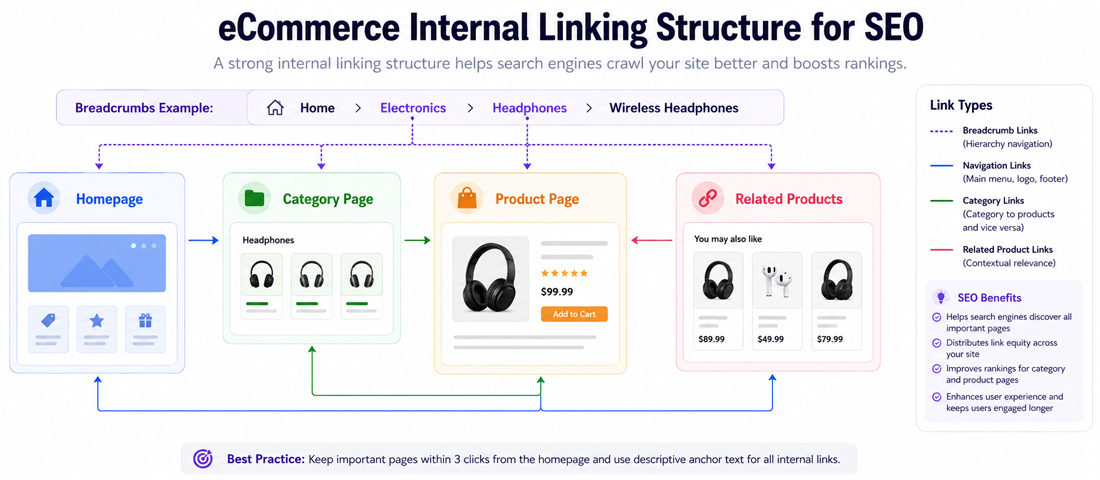
Breadcrumb navigation on every product page is the first layer. Properly implemented breadcrumbs (with BreadcrumbList schema) show in search results, drive click-through rate, and pass topical authority from category pages to products. This is the single highest-leverage internal linking element on most stores.
Category and subcategory linking is the second layer. Product pages should link clearly to their parent category and any relevant subcategories. This consolidates topical relevance and supports category-level rankings while keeping product pages accessible to crawlers from multiple paths.
Related products sections are the third layer. The right related products are not random; they are the products that genuinely relate to the one being viewed. For a runner browsing the Pegasus 41, “related products” should be other neutral road running shoes at similar price points, not random shoes from across the catalogue. Algorithmic related-product engines on most platforms produce decent results; manual curation on key products often produces better.
Contextual links within product descriptions are the fourth layer and often the most overlooked. When a product description mentions an accessory, a complementary product, a previous model, or a related category, linking those references creates contextual internal links that pass authority and improve crawl depth. These are the links that distinguish a store with strong internal architecture from one with isolated product pages connected only by navigation.
Handling out-of-stock and discontinued products
The product lifecycle creates a recurring SEO challenge — what do you do with product pages when the product is temporarily unavailable, permanently discontinued, or replaced by a newer version? Getting this wrong is one of the most common reasons established stores quietly lose organic rankings over time.
For temporarily out-of-stock products, the answer is almost always to keep the page live with clear “currently unavailable” or “back in stock soon” messaging. The page has accumulated SEO authority; removing it loses that. Add a notify-me email signup, suggest related in-stock products on the same page, and update the Offer schema’s availability property to OutOfStock. Search engines continue ranking the page, buyers find it, and when stock returns, the recovery is instant rather than rebuilt from zero.
For permanently discontinued products with a clear successor, a 301 redirect to the successor product is usually the right call. The old page’s authority transfers, buyers who land on the URL get to a relevant replacement, and the rankings often migrate smoothly. This works best when the successor is genuinely similar — same category, similar price, similar buyer.
For permanently discontinued products with no successor, the choices are 301 to the most relevant category page, 410 (Gone) to signal explicit removal, or keeping the page live with clear discontinued messaging. Each has trade-offs. The 301 preserves authority but can dilute relevance if the category isn’t a good match. The 410 is honest but throws away accumulated authority. Keeping the page live is the strongest SEO move but requires content updates to remain genuinely useful. The right choice depends on the volume of incoming search traffic to the URL and whether anything on your site could plausibly satisfy that traffic. Stores that handle this layer deliberately retain meaningfully more organic equity over years than stores that delete or 404 discontinued products as a default.
User-generated content: the SEO multiplier most stores underuse
Customer reviews, customer questions, customer photos — all of these are content you didn’t have to write that compounds the SEO value of your product pages. They add unique, fresh content to every page. They build trust signals that improve conversion. They capture long-tail queries that buyers actually ask. And they feed AI assistants the kind of authentic, specific information that makes citation more likely.
Reviews are the primary UGC mechanism on most stores. The volume matters (a product with 500 reviews ranks better than one with 5) and so does the implementation. Reviews should be displayed in HTML on the page (not loaded entirely via JavaScript that search engines might miss), should include schema markup (AggregateRating and Review), and should be moderated for genuine quality rather than left entirely automated. Review apps like Yotpo, Judge.me and Loox handle most of the work; the configuration to make them SEO-effective is where attention is needed.
Customer Q&A is the underused mechanism on most stores. Buyers asking questions and getting answers (from the store or from other buyers) creates exactly the kind of long-tail content that captures specific search queries. Implementing a Q&A section with FAQPage schema turns each question and answer into a structured signal that can earn featured snippet eligibility and AI citation.
Customer photos add visual UGC that improves both conversion and image SEO. Real customer photos of products in actual use are trust signals that stock photography cannot match, and they expand the image variety associated with each product in Google Image Search.
Common product page SEO mistakes to avoid
The patterns of product page SEO failure are consistent across the audits we run. Avoiding the mistakes below puts a store ahead of most competitors with relatively little effort.
- Using manufacturer descriptions verbatim. Duplicate content across hundreds of competing retailers; Google picks one canonical winner and de-prioritises everyone else.
- Generic title tag templates. “Buy {Product} | Store Name” wastes characters on filler. Use specific descriptive titles with modifiers and brand.
- Missing Product schema. No rich result eligibility, no shopping graph appearance, no AI citation foundation. One of the highest-return technical fixes.
- Empty or autogenerated meta descriptions. Leaves Google to generate snippets from page content, often pulling text that doesn’t sell the product.
- Product images named IMG_4823.jpg. Wasted image SEO opportunity. Descriptive filenames are templating work that pays off across the whole catalogue.
- Alt text stuffed with keywords or left blank. Either approach fails. Descriptive alt text including the product name is the right pattern.
- Deleting discontinued products with 404 responses. Throws away accumulated SEO authority. 301 to successor or category, or keep the page live.
- No internal linking beyond navigation. Related products, contextual links within descriptions, and breadcrumbs all matter. Navigation alone is insufficient.
- Reviews loaded entirely via JavaScript widget. If Google can’t see the reviews in the HTML, the content and the schema don’t count for SEO.
- Out-of-stock products with no recovery path. Just showing “out of stock” loses both the buyer and the SEO opportunity. Notify-me signup and related product suggestions retain both.
Platform-specific product page SEO considerations
The optimisation principles are universal, but the specifics of how to apply them vary by platform. The patterns below cover the major platforms.
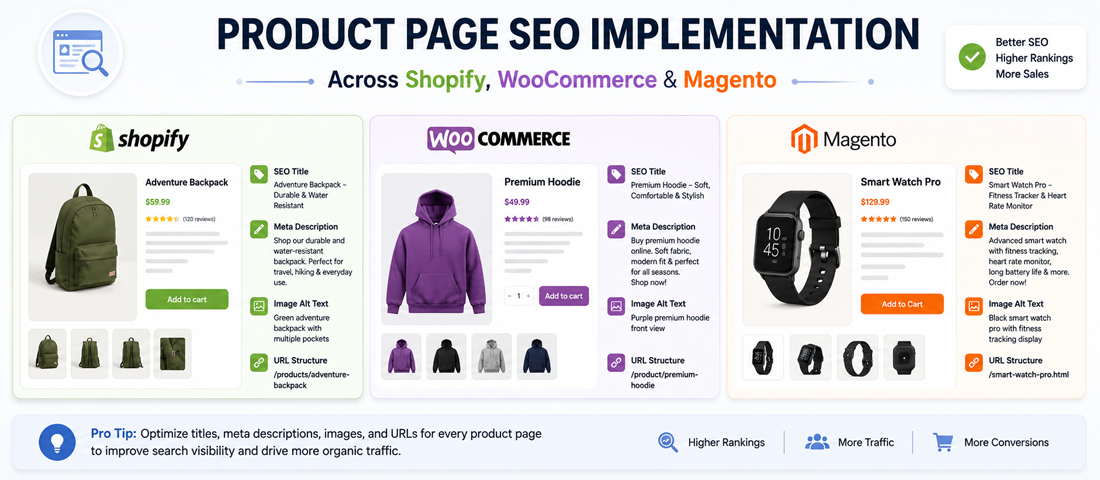
Shopify product page SEO benefits from solid defaults — Product and Offer schema are present out of the box, image handling is reasonable through the platform’s CDN, and the URL structure is clean. The work focuses on supplementing the default schema (AggregateRating, Review, BreadcrumbList), customising title and meta description templates beyond Shopify’s defaults, writing unique product descriptions for the catalogue, and optimising images uploaded by store admins. SEO apps like Plug In SEO, SearchPie and JSON-LD for SEO add functionality the platform doesn’t provide natively.
WooCommerce product page SEO requires more setup work but offers more flexibility. The default WordPress SEO plugins (Yoast SEO and RankMath both have WooCommerce-specific extensions) handle the technical layer. Schema implementation usually needs deliberate work — the basic schema is often missing or incomplete without configuration. URL structure benefits from configuration to remove the /product/ prefix many themes default to, depending on store preference. The plugin ecosystem is wider than Shopify’s, which is both an advantage (more options) and a complexity (more decisions).
Magento and Adobe Commerce product page SEO involves enterprise-level configuration that benefits from technical SEO expertise specifically familiar with the platform. The defaults are stronger than older versions but still benefit from extension and custom configuration. Schema, URL rewrites, hreflang for international stores, and faceted navigation handling are common areas requiring attention. The platform’s flexibility is significant; the work to use it well is more substantial than other platforms.
Custom eCommerce builds can be engineered to handle product page SEO ideally from the start, but this requires deliberate planning rather than assuming the developers will get it right by default. Most custom builds we audit have stronger technical foundations than platform-based stores but often miss the schema implementation, image optimisation, and content layer work that produces actual SEO results. The right approach is to specify the SEO requirements explicitly as part of the build brief rather than treating them as something to add after launch.
How to track and measure product page SEO success
Product page SEO produces measurable results, but the right metrics matter. Three layers of measurement, looked at together, give the complete picture.
Organic traffic per product page. Search Console’s pages report shows which product pages are actually receiving organic search traffic and which queries are driving it. Growth in product page organic traffic — across the catalogue, not just the homepage — is the headline measure. The pattern usually shows clear improvement within 60 to 90 days of meaningful changes, with continued growth over the following six to twelve months as Google fully reindexes the changes.
Conversion rate from organic search. The traffic-to-revenue connection is what matters commercially. Product pages should convert organic traffic at rates comparable to or higher than other traffic sources because the search intent is more specific. Tracking this in Google Analytics 4 by landing page reveals which product page improvements are producing actual revenue lift versus which are producing traffic that doesn’t convert.
Rich result impressions and CTR. Search Console’s Rich Results report shows which product pages are appearing in search with star ratings, product information panels, and other enhanced features. Growth in rich result impressions and improvement in CTR on rich-result-eligible pages is the most direct indicator that schema work is paying off. AI search citation tracking — periodically testing product queries in ChatGPT, Perplexity and Gemini — adds qualitative measurement of how the broader visibility layer is improving over time. The full discipline of ongoing SEO measurement is what our SEO services are built around, because product page SEO is iterative work where measurement and improvement feed each other over months.
When to bring in professional help
This guide is detailed enough that a capable in-house marketer can implement product page SEO themselves, particularly on a manageable catalogue size with standard platforms. There are situations where professional help is genuinely worth the cost.
Bring in help when the catalogue is large enough that scaling the work is the main constraint — hundreds or thousands of products requiring unique descriptions, schema implementation and image optimisation benefits from process and resources beyond what most in-house teams can dedicate to it. Bring in help when the platform is complex or custom and the SEO implementation requires platform-specific expertise that general SEO knowledge doesn’t cover. Bring in help when the store has accumulated technical SEO debt — orphaned product pages, broken redirects, duplicate-content issues across categories — that requires methodical cleanup rather than ongoing improvement.
For ongoing eCommerce SEO programmes, the work is more reliably done as a structured engagement than as occasional projects. The pattern across the stores we work with is that initial improvements are followed by continuous iteration — new products need optimisation as they launch, seasonal variations need attention, the broader SEO landscape continues to shift. The full discipline of approaching this systematically across multiple categories and dimensions is what produces the compounding revenue effect, and is increasingly tied together with the broader work of reducing cart abandonment and the layer of product page optimisation elements that drive conversion, since traffic that doesn’t convert is wasted SEO investment regardless of how well it ranks.
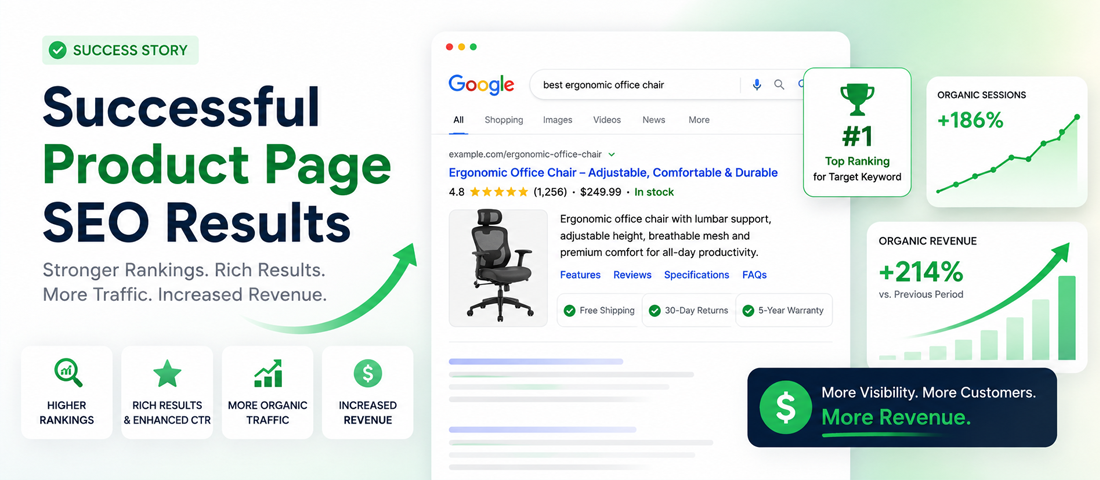
The honest summary of eCommerce product page SEO is that it is one of the highest-return investments available to most stores, and one of the most consistently neglected. The work is methodical rather than glamorous, the patterns are well-understood, and the results compound over months as the catalogue improvements mature. The store that takes product page SEO seriously typically finds itself ranking for thousands of long-tail queries that competitors miss, converting that traffic at rates higher than other sources, and accumulating organic revenue that grows independently of advertising spend. The cost of the work is significant but bounded. The cost of not doing it is open-ended and grows every quarter the catalogue expands without proper SEO attention. There is no longer a credible argument for skipping this layer of eCommerce optimisation, only an honest decision about when to start.
Frequently asked questions
| How do I write product descriptions that rank well in Google? | Write unique descriptions that genuinely explain what the product is, who it’s for, and why someone would buy it — not just manufacturer-copy specifications. Target 300 to 500 words minimum for primary products, with structure that opens with benefits, covers features in human terms, addresses use cases and buyer questions, includes comparison context with alternatives, and ends with detailed specifications. Use natural language with the primary keyword appearing where it fits, plus semantic variations. Avoid keyword stuffing, which modern search engines penalise. The strongest descriptions are the ones that genuinely help buyers decide, because that is exactly what search engines and AI assistants are trying to surface. |
| Should I use manufacturer descriptions on my product pages? | No, almost never. Manufacturer descriptions are typically used by dozens or hundreds of retailers selling the same product, producing duplicate content across all of them. Google picks one canonical version to rank (usually the largest, most authoritative retailer — often Amazon) and de-prioritises everyone else using the same copy. Even if your store has authority in its category, using duplicated manufacturer copy puts you in direct competition with retailers Google trusts more, and you usually lose. The fix is unique descriptions — they don’t have to be elaborate, just genuinely written in your own words, with the additional context, comparisons and use cases that manufacturer copy typically misses. |
| What’s the ideal product page word count for SEO? | There is no universal ideal word count, but practical guidelines apply. Primary products warrant 300 to 500 words minimum in the description. Below 200 words, the page lacks substance for search engines to evaluate effectively. Category-leading or high-search-volume products often justify 800 to 1,500 words because the additional depth captures more long-tail variations and provides more comprehensive answers to buyer questions. Beyond 1,500 words, returns diminish unless the product genuinely warrants the depth. The right framing is “enough words to genuinely answer the questions buyers have” rather than a target number. Quality and uniqueness matter more than length. |
| Does schema markup help product pages rank better? | Schema markup is not a direct ranking factor — Google has confirmed this. However, it has substantial indirect effects on visibility and click-through rate that often translate into measurable improvements over time. Product pages with proper schema (Product, Offer, AggregateRating, Review, BreadcrumbList) qualify for rich results including star ratings, price information and product details visible directly in search results. These enhanced search appearances drive higher click-through rates, which contribute to ranking signals. Schema also makes product pages substantially more citable by AI assistants in shopping recommendations. Implementing complete product page schema is one of the highest-return technical SEO investments available, even though the effect is indirect rather than direct. |
| How many product images should I have for SEO? | For most products, four to eight images is the right range. The first image is the primary product shot that affects Core Web Vitals and appears in shopping results. Additional images should cover different angles, close-ups of important features, the product in use or in context, and any variations like colour or size. Each image should have a descriptive filename including the product name and key attribute, accurate alt text describing what’s actually in the image, proper compression (under 100KB where possible), and modern format (WebP where supported). Below four images, the page feels thin to buyers; above eight, returns diminish. For visually-driven products like fashion, more is often better because Google Image Search becomes a meaningful traffic source. |
| Should I delete out-of-stock or discontinued products from my site? | Usually no, and the right answer depends on the situation. For temporarily out-of-stock products, keep the page live with clear “currently unavailable” messaging and a notify-me signup. The page retains its SEO authority and recovers instantly when stock returns. For permanently discontinued products with a clear successor, 301 redirect to the successor product. For permanently discontinued products with no successor, the choice between 301 to category, 410 (Gone), or keeping the page live with discontinued messaging depends on incoming traffic volume and what your site can satisfy. The default of just 404’ing or deleting discontinued products throws away accumulated SEO authority and is one of the most common reasons stores quietly lose organic rankings over time. |
| How long does it take for product page SEO improvements to show results? | Initial results from product page SEO changes typically appear within 60 to 90 days as Google reindexes the affected pages. Rich result eligibility from schema improvements often appears faster — within 2 to 4 weeks for high-traffic pages. The full benefit takes 6 to 12 months to materialise as the changes work through the index, AI assistants begin citing the improved content, and the long-tail traffic compounds across the catalogue. For stores making improvements at scale (hundreds of products), the trajectory is steeper because the cumulative effect grows. The investment is durable — properly optimised product pages continue ranking and converting for years, with maintenance work limited to keeping content fresh and adapting to new products as they launch. |
Ready to Make your Product Pages Actually Work for SEO?
We build and rebuild product page SEO programmes for eCommerce stores across Shopify, WooCommerce, Magento and custom platforms — descriptions, schema, technical elements, images, internal linking and ongoing measurement. With 12+ years of experience and over 2,500 websites delivered, we know what genuinely moves the needle on product page rankings and revenue. Send us your store URL and we will respond within one business day.