AR Try-Before-You-Buy: Which eCommerce Businesses Should Use It?
A customer visits your furniture store online. They find a sofa they love. But they cannot tell if it will actually fit their living room, whether the colour works with their walls, or whether the scale feels right in their space. So they add it to a wishlist, close the tab, and come back three days later — maybe. Statistics from the furniture eCommerce sector suggest they probably do not come back at all.
Now imagine the same customer points their phone at their living room and sees that sofa sitting in the exact corner they had in mind, at actual scale, in the actual colour, in the actual light of their actual room. They can walk around it. They can swap the colour. They can see whether it works. The hesitation evaporates. The conversion happens.
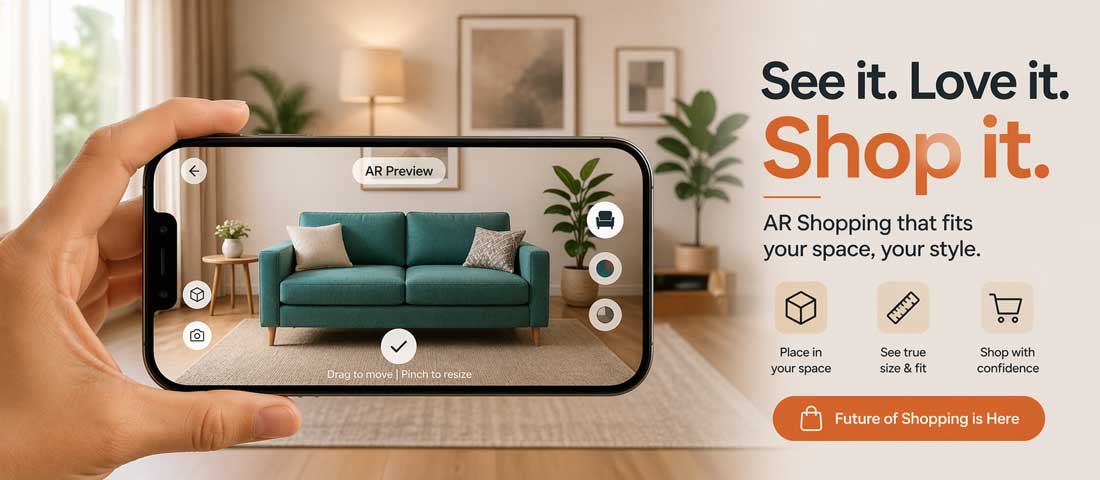
This is augmented reality try-before-you-buy — the technology that is reshaping specific categories of eCommerce in 2026. Not all eCommerce. Not even most eCommerce. But for the right product categories, AR is delivering conversion improvements and return rate reductions that justify significant investment. This guide explains exactly which businesses should be investing, what the realistic costs and implementation paths look like, and how AR fits into a Shopify or WooCommerce store.
What AR Try-Before-You-Buy Actually Is — and How It Works
Augmented reality in eCommerce overlays a digital representation of a product onto the camera view of the shopper’s real environment — allowing them to visualise how the product looks in their actual space or on their actual body before purchasing. Unlike virtual reality, which replaces reality entirely, AR augments it — the real room, the real face, the real space is always visible, with the product placed into it digitally.
There are two primary modes of AR shopping in 2026:
Spatial AR (Place in Your Space)
The shopper points their phone camera at a surface — a floor, a wall, a desk — and the product appears at actual scale in that space. They can walk around it, change its position, swap colours and variants, and see exactly how it fits in their environment. This mode is most powerful for furniture, home décor, appliances, lighting, and large physical products where scale, proportion, and spatial fit are the primary purchase hesitation.
Face and Body AR (Try On)
The shopper uses their phone’s front camera to see how a product looks on their face or body in real time. The digital product tracks their facial features or body outline as they move. This mode is most powerful for eyewear, makeup, hair colour, jewellery, hats, and accessories where personal fit and appearance are the primary purchase hesitation.
How It Works Technically
Modern AR shopping uses one of two technical approaches. Native app AR uses ARKit (Apple) or ARCore (Google) to deliver high-quality AR through a dedicated mobile app — the most sophisticated and highest-quality AR experience, but requiring the shopper to download an app. WebAR uses browser-based augmented reality delivered through a standard mobile web browser — no app download required, lower quality than native AR, but accessible to any smartphone user via a URL. In 2026, WebAR quality has improved sufficiently that most eCommerce AR implementations choose it for the lower friction, accepting the modest quality trade-off.
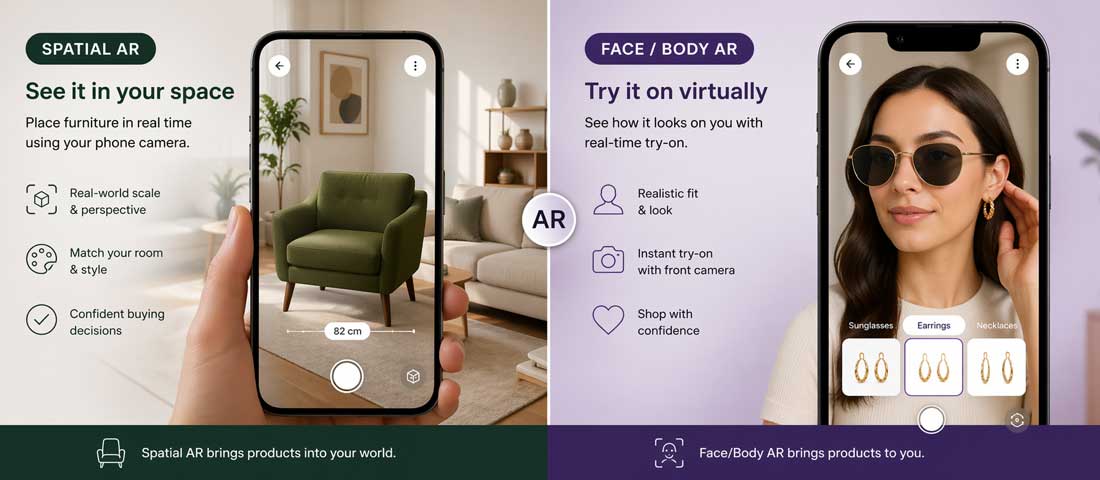
The two primary AR shopping modes serve very different product categories — spatial AR for home and large products, face and body AR for personal accessories and beauty — and the implementation approach differs significantly between them.
The Business Case: Conversion Rates, Return Rates, and the Data
AR shopping is not a novelty feature — for the right product categories, the commercial case is documented and significant.
94% higher conversion with AR
Shopify’s own data across stores using AR features shows that products with AR views have a 94% higher conversion rate than products without. This is the single most cited AR eCommerce statistic and reflects the fundamental reduction in purchase hesitation that visualisation provides.
40% reduction in returns
Furniture and home décor retailers using AR consistently report return rate reductions of 25 to 40%. The primary driver of returns in these categories — “it didn’t look right in my space” — is eliminated when the customer has already seen it in their space before purchasing.
2.7x more time on product page
Customers who engage with AR product views spend on average 2.7 times longer on the product page than those who do not — a strong indicator of purchasing intent and engagement quality that correlates with higher conversion likelihood.
19% higher average order value
Retailers using AR report that customers who engage with AR features purchase at 19% higher average order values — potentially because the increased confidence in the purchase eliminates the hesitation that drives customers toward lower-priced alternatives.
Important context on the data: The 94% conversion improvement figure comes from Shopify’s aggregate platform data and represents the difference between AR-viewing and non-AR-viewing customers on the same product — not a controlled comparison between stores with and without AR. Customers who choose to use AR are self-selected as more engaged buyers, which inflates the conversion rate difference. The realistic conversion improvement from adding AR to a product category is typically 15 to 40% — still highly significant commercially, but requiring honest expectations rather than headline statistics.
Which eCommerce Categories Benefit Most — and Which Do Not
AR is not a universal eCommerce improvement. Its value is directly proportional to the degree to which spatial fit, personal appearance, or scale uncertainty is a purchase barrier for that product category. Categories where customers already know exactly what they are getting benefit little. Categories where the primary purchase hesitation is “I’m not sure this will work in my space / on my face / with my style” benefit enormously.
🟢 High AR Value — Should Strongly Consider Implementation
| Category | AR Mode | Primary Hesitation AR Solves | Expected Impact |
|---|---|---|---|
| Furniture & Home Décor | Spatial AR | “Will it fit in my space? Does the scale work?” | ⭐⭐⭐⭐⭐ Very High |
| Eyewear (glasses, sunglasses) | Face AR try-on | “Will these suit my face shape?” | ⭐⭐⭐⭐⭐ Very High |
| Beauty & Cosmetics (lipstick, foundation) | Face AR try-on | “Does this shade work for my skin tone?” | ⭐⭐⭐⭐⭐ Very High |
| Jewellery & Watches | Wrist/face AR try-on | “How does it look on me? Is it too large/small?” | ⭐⭐⭐⭐ High |
| Flooring, Tiles & Wallpaper | Spatial AR | “How will this pattern/colour look in my actual room?” | ⭐⭐⭐⭐ High |
| Footwear (shoes) | Foot AR try-on | “How will these look on my feet with my outfit?” | ⭐⭐⭐⭐ High |
| Hats, Caps & Hair Accessories | Face/head AR try-on | “Does this style suit me?” | ⭐⭐⭐⭐ High |
| Lighting & Lamps | Spatial AR | “How will this affect the ambience of my room?” | ⭐⭐⭐ Medium-High |
| Paint & Wall Colours | Spatial AR | “How will this colour look on my actual walls?” | ⭐⭐⭐ Medium-High |
| Kitchen Appliances (large) | Spatial AR | “Will this fit in my kitchen layout?” | ⭐⭐⭐ Medium-High |
🟡 Medium AR Value — Evaluate Based on Price Point and Return Rate
- Fashion (clothing) — Body AR try-on is technically possible but significantly more complex and less accurate than face AR. The fit problem remains unsolved for clothing — AR can show how a garment looks on an avatar but not how it fits a specific body. High-end fashion ($200+) where returns are costly may justify investment; fast fashion probably not.
- Outdoor garden furniture and equipment — Spatial AR for garden spaces requires accurate outdoor surface detection, which is technically more challenging than indoor environments. Improving but not yet as reliable as indoor AR.
- Athletic and sports equipment — Some equipment benefits from scale/space AR (gym equipment, large sporting goods) but most sports products do not have a significant spatial hesitation barrier.
🔴 Low AR Value — Investment Unlikely to Justify Cost
- Books, digital products, consumables — No spatial or appearance hesitation exists; purchase decision is based on content and price, not how it looks in a physical space
- Food and grocery — No meaningful spatial hesitation; packaging design AR has been tested by FMCG brands but the conversion impact is minimal
- Commodity electronics (cables, batteries, memory cards) — No appearance or fit hesitation; specification is the purchase driver
- Software and subscriptions — No physical product; AR is irrelevant
- Low-price-point fashion — Return cost is low enough that the AR investment ROI does not stack up
How to Implement AR on Shopify in 2026
Shopify has the most mature and accessible AR eCommerce ecosystem of any major platform — primarily because of Apple’s ARKit and Shopify’s early investment in 3D/AR product viewing capability.
Native Shopify AR (3D Models)
Shopify’s built-in AR capability allows merchants to upload 3D model files (USDZ for iOS, GLB for Android) alongside standard product images. When a mobile shopper views the product, an “AR” button appears — tapping it launches the native ARKit or ARCore experience directly in the browser, no app download required. The quality is excellent because it uses the device’s native AR framework.
This is the most straightforward AR implementation path for Shopify merchants. The primary cost is 3D model creation — each product needs a high-quality 3D model, which typically costs $50 to $300 per product from specialist 3D modelling services.
Shopify AR Apps
The Shopify App Store contains several AR and 3D viewing applications that extend beyond the built-in USDZ capability:
- Argo (by Vertebrae) — Enterprise-grade AR and 3D product viewing with analytics. Used by major retail brands. Custom pricing for enterprise.
- Zakeke 3D & AR Product Customizer — AR viewing combined with product configuration. Strong for customisable furniture and products. From $19/month.
- Twist 3D — Specialist 3D/AR for fashion and apparel. Body try-on capability. From $49/month.
- Obsess — Virtual Showroom — Creates immersive 3D showroom experiences rather than single-product AR. Enterprise pricing.
Face AR Try-On for Shopify
For beauty, eyewear, and accessories categories, face AR try-on typically requires a specialist provider rather than Shopify’s built-in capability:
- Perfect Corp YouCam — The leading beauty and eyewear AR try-on platform. SDK integration for Shopify stores. Used by major beauty brands. Pricing from $99/month for SMBs.
- Banuba Face AR SDK — Developer-focused face AR platform. Requires custom integration. Used by eyewear and beauty brands globally.
- Mirrear — Jewellery-specific AR try-on. WebAR-based, easy Shopify integration. From $49/month.
How to Implement AR on WooCommerce in 2026
WooCommerce AR implementation requires a more custom approach than Shopify — but gives more flexibility in choosing the AR technology stack and integration depth.
WebAR via Third-Party Platforms
WebAR platforms generate a web-based AR experience from a 3D model file, accessible via a URL that can be linked from any WooCommerce product page:
- Zappar — WebAR platform supporting both spatial AR and face tracking. Provides embeddable AR experiences that integrate with any website. From $60/month.
- 8th Wall (Niantic) — The most advanced WebAR platform available. High-quality AR in the mobile browser with excellent surface detection. Developer-focused — requires custom integration. Enterprise pricing.
- Sketchfab — 3D model hosting and viewing platform with AR viewing capability. The viewer can be embedded on WooCommerce product pages. Free tier available; paid from $15/month.
WooCommerce 3D Product Viewer Plugins
- WooCommerce Product 3D Viewer — WordPress plugin adding 3D model viewing and WebAR to WooCommerce product pages. From $49 one-time.
- WGLES — 3D Product Configurator — Combines 3D product visualisation with product configuration and AR viewing. From $99/month.
The Realistic Cost of AR Implementation by Business Size
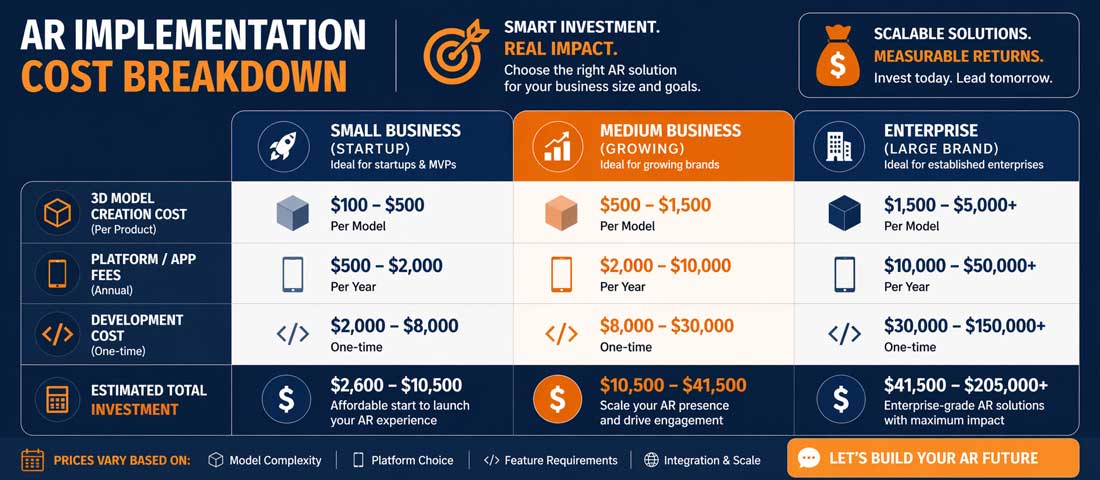
AR implementation costs vary widely by business size and product catalogue depth — the primary cost driver is 3D model creation, which scales with the number of products requiring AR viewing.
| Business Stage | Approach | 3D Models | Platform Fee | Dev Cost | Year 1 Total |
|---|---|---|---|---|---|
| Small (10–30 products) | Shopify built-in USDZ + GLB | $50–150/product = $500–4,500 | $0 (built in) | $0–500 | $500–5,000 |
| Medium (30–200 products) | Shopify app (Zakeke/Argo) | $50–200/product = $1,500–40,000 | $200–600/year | $500–2,000 | $2,200–42,600 |
| Enterprise (200+ products) | Custom integration + 3D pipeline | Automated 3D pipeline: $10,000–50,000 setup | $1,200–12,000/year | $5,000–30,000 | $16,200–92,000 |
| Face AR (beauty/eyewear) | Perfect Corp / Banuba SDK | Texture files (cheaper than 3D) | $1,200–6,000/year | $2,000–10,000 | $3,200–16,000 |
The ROI calculation that matters: If your average order value is £300 and adding AR to your top 20 hero products improves their conversion rate by 20%, and those 20 products collectively receive 500 visitors/month at a current 2% conversion rate — that is 10 conversions/month currently, growing to 12 conversions/month with AR. At £300 AOV, that is £600 additional monthly revenue — £7,200 per year. A £3,000 AR implementation investment pays back in under 5 months. Run this calculation with your own numbers before deciding whether AR is commercially justified for your specific product range.
WebAR vs Native App AR — Which Should You Choose?
-
Choose WebAR (browser-based) for most eCommerce use cases
WebAR requires no app download — the customer taps a button on your product page and AR launches in their mobile browser. Conversion to “trying AR” is dramatically higher when there is no app download barrier. Quality is lower than native AR but has improved significantly since 2022. The right choice for most SMB and mid-market eCommerce businesses launching AR for the first time in 2026. -
Choose native app AR when you have an existing app with significant users
If your brand already has a mobile app with substantial daily active users, integrating native AR (ARKit/ARCore) through the app delivers the highest quality AR experience. The app download barrier already cleared means you can access the better technical quality without losing customers to friction. The right choice for established brands with strong app engagement. -
Choose Shopify’s built-in USDZ/GLB for furniture and home décor on Shopify
Shopify’s native AR capability using USDZ (iOS) and GLB (Android) files delivers near-native quality AR through Safari and Chrome respectively — no app, no third-party platform, no monthly fee. The 3D model creation cost is the primary investment. For furniture, home décor, and large product categories on Shopify, this is the most cost-effective, highest-quality AR implementation path available. -
Choose specialist face AR platforms for beauty and eyewear
Face AR try-on requires specialist computer vision technology that general AR platforms do not provide at the quality level shoppers expect. Perfect Corp, Banuba, and similar specialist platforms have invested years in developing facial landmark tracking, realistic texture mapping, and lighting simulation specific to beauty and eyewear. For these categories, specialist platform investment is justified by the quality difference. -
Start with your 5–10 highest-revenue, highest-return products
Do not attempt to AR-enable your entire product catalogue from day one. Identify the 5 to 10 products with the highest revenue contribution and the highest return rates — these are where AR will deliver the most measurable commercial impact. Implement, measure, and expand based on documented ROI rather than attempting platform-wide deployment before proving the business case.
Frequently Asked Questions About AR Try-Before-You-Buy
| What is AR try-before-you-buy in eCommerce? | AR try-before-you-buy is an augmented reality feature that allows online shoppers to visualise how a product looks in their real environment — or on their own face or body — before purchasing, using their smartphone camera. There are two main modes: spatial AR, where shoppers point their phone at a surface and see the product placed at actual scale in their real space (most useful for furniture, home décor, and large products), and face or body AR try-on, where shoppers use their front camera to see how a product looks on them in real time (most useful for eyewear, beauty products, jewellery, and accessories). Both modes use augmented reality technology to overlay a digital representation of the product onto the live camera view, allowing customers to make more confident purchase decisions by seeing exactly how the product will look in context before committing to the purchase. |
| Does AR actually improve eCommerce conversion rates? | Yes — for the right product categories, AR has documented and significant positive effects on conversion rates. Shopify’s aggregate platform data shows products with AR views have 94% higher conversion rates than equivalent products without AR, though this figure reflects the self-selected nature of AR users (more engaged buyers) rather than a pure controlled test. Independent case studies from furniture, eyewear, and beauty retailers using AR report conversion rate improvements of 15 to 40% on products where AR is enabled. The mechanism is clear: AR eliminates the primary purchase hesitation in categories where spatial fit or personal appearance is the deciding factor. A customer who has seen a sofa in their actual living room at actual scale has resolved their biggest purchase uncertainty — making conversion significantly more likely than for an equivalent customer who is still guessing. The conversion improvement is most dramatic for products with high return rates driven by “didn’t look right” reasons, as AR addresses that specific hesitation directly. |
| How much does it cost to add AR to a Shopify store? | The cost of adding AR to a Shopify store depends primarily on the number of products requiring 3D model creation and the AR implementation approach chosen. For small catalogues of 10 to 30 products using Shopify’s built-in USDZ and GLB AR capability, the primary cost is 3D model creation at $50 to $300 per product — total investment of $500 to $9,000 with no ongoing platform fees. For medium catalogues using Shopify AR apps like Zakeke or similar platforms, add $200 to $600 per year in platform fees alongside model creation costs. For face AR try-on (beauty, eyewear), specialist platforms like Perfect Corp start from approximately $1,200 per year with development integration costs of $2,000 to $10,000. The most cost-effective approach for most Shopify merchants is to start with Shopify’s native USDZ/GLB capability on their 5 to 10 highest-revenue products, measure the conversion impact, and expand based on documented ROI. |
| Which product categories benefit most from AR shopping? | The product categories that benefit most from AR shopping share a common characteristic: the primary purchase hesitation is uncertainty about how the product will look in a specific space or on a specific person. The highest-benefit categories are furniture and home décor (spatial AR resolves scale and fit uncertainty), eyewear (face AR try-on resolves style and fit uncertainty), beauty and cosmetics (face AR resolves shade and appearance uncertainty), jewellery and watches (face or wrist AR resolves appearance uncertainty), flooring and wallpaper (spatial AR resolves pattern and colour fit uncertainty), and footwear (foot AR resolves style uncertainty). Categories where AR adds minimal value include books, consumables, digital products, commodity electronics, and low-price fashion where the purchase hesitation is based on price, specification, or brand rather than spatial or personal appearance fit. |
| Does AR shopping work on any smartphone or does it need a special device? | WebAR — the browser-based AR experience that most eCommerce stores use — works on any modern smartphone with a camera, without requiring a special device or app download. It runs directly in Safari (iOS) and Chrome (Android) on any iPhone from the iPhone 6S onwards and any Android device running Android 8.0 or later with Chrome. Shopify’s native USDZ AR experience requires iOS 12 or later (iPhone 6S or newer, iPad mini 4th gen or newer) for the full ARKit experience. Google’s ARCore-based GLB AR requires Android 7.0 or later with a compatible device — covering the vast majority of Android smartphones in use in 2026. Face AR try-on works via the front camera of any modern smartphone with adequate processing power — typically iPhone 7 or later and Android equivalents. The practical reality is that in 2026, the overwhelming majority of your mobile shoppers have devices capable of a good AR experience, particularly if you use WebAR. |
| Does AR reduce product return rates? | Yes — AR consistently reduces return rates in the categories where it is implemented, and this reduction is often the most commercially significant benefit of AR beyond conversion rate improvement. Furniture retailers using spatial AR report return rate reductions of 25 to 40%, driven by the elimination of the most common return reason: “it looked different from what I expected” or “it didn’t fit/work in my space.” Eyewear retailers using face AR try-on report 35 to 50% return rate reductions for orders where the AR feature was used. Beauty retailers report 28% fewer returns on products where AR shade matching was used. The financial impact of return rate reduction can exceed the conversion improvement value for high-AOV product categories with elevated return rates — a furniture retailer with a 15% return rate on a £500 average order value losing 15 sales per 100 to returns, reducing that to 9 returns per 100 represents £3,000 in saved reversal costs and re-processing per 100 orders. Calculate your own return rate impact before dismissing AR as primarily a conversion tool. |
| Can I add AR to WooCommerce or only to Shopify? | AR can be added to WooCommerce stores, though the implementation path is more custom than Shopify’s built-in approach. WooCommerce AR implementation typically uses one of three approaches: WebAR platforms like Zappar or 8th Wall that generate a browser-based AR experience from a 3D model file and provide an embeddable viewer or link that can be added to any WooCommerce product page; WordPress plugins like WooCommerce Product 3D Viewer that add 3D and AR viewing directly to product pages; or custom development integrating an AR SDK directly into the WooCommerce theme. For face AR try-on on WooCommerce, specialist platforms like Perfect Corp and Banuba provide SDKs and embedded viewers that integrate with any website regardless of the eCommerce platform. The WooCommerce AR implementation typically requires more development work than Shopify’s plug-and-play approach, but provides equivalent commercial AR capability with more customisation flexibility. |
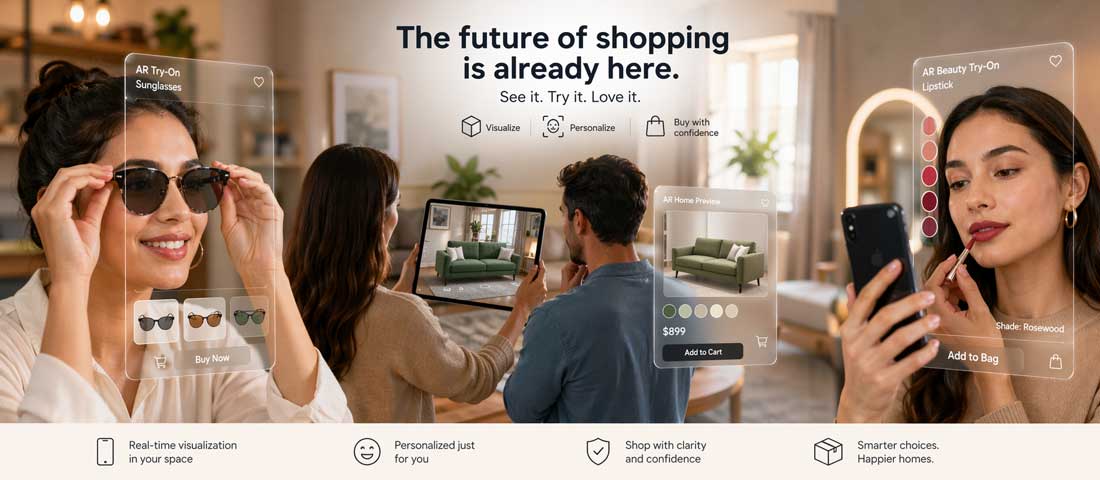
AR shopping is not a distant future technology — it is an accessible, commercially proven capability that the right eCommerce businesses can deploy today to reduce returns, increase conversion rates, and deliver the purchase confidence that online shopping has traditionally struggled to provide.
Thinking About Adding AR to Your Shopify or WooCommerce Store?
Neel Networks builds and enhances eCommerce stores for businesses across the USA, UK, Canada, Australia, and India. We can evaluate whether AR is commercially justified for your specific product range, recommend the right implementation approach, and handle the technical integration — from 3D model sourcing to Shopify or WooCommerce deployment.
Shopify Development Services WooCommerce Development WhatsApp Us