Web Design & Development Trends Shaping the Digital World in 2026
Web design and development is one of the fastest-moving fields in technology. What was considered modern and effective just two or three years ago can already look dated today — and the pace of change is accelerating rather than slowing down. In 2026, the forces reshaping web design are more powerful than at any previous point: artificial intelligence, new user expectations, evolving browser capabilities, performance standards, and a fundamental rethinking of how businesses should present themselves online.
What this guide covers
- 1. Why Web Design Trends Matter for Your Business
- 2. The 9 Key Web Design and Development Trends in 2026
- 3. Which Trends Are Here to Stay vs Which Are Passing Fashions
- 4. Web Design Trends That Are Going Away in 2026
- 5. What Trends Mean for Your Next Website Project
- 6. How Neel Networks Approaches Web Design in 2026
- 7. Frequently Asked Questions About Web Design Trends in 2026
- 8. Conclusion: Build for the Next Three Years, Not Just Today
At Neel Networks, we have been designing and building websites since 2014. We have watched trends emerge, peak, and be replaced — and we have developed a sharp sense for which trends represent genuine shifts in what works versus which are simply aesthetic fashions that fade quickly. This guide reflects both perspectives: the trends that are visually defining web design in 2026, and the underlying technology and strategy shifts that are changing what great web development looks like.
Whether you are planning a new website, considering a redesign, or simply keeping up with what is happening in your industry, this guide will give you a comprehensive, practical picture of where web design and development stands in 2026 — and where it is heading.
Why Web Design Trends Matter for Your Business
Before diving into the specific trends, it is worth addressing a question that business owners sometimes ask: why should I care about web design trends? My website works — why change it?
The honest answer is that web design trends are not just about aesthetics — they reflect changes in user expectations, technology capabilities, and competitive benchmarks. When users visit your website, they are subconsciously comparing it against every other website they have visited recently. A website that looks like it was designed in 2019 signals to visitors — whether they articulate it or not — that the business behind it may not be keeping up with the times. In service industries especially, where trust and credibility are central to the purchasing decision, that signal matters.
More practically: many of the most important web design trends of 2026 are not aesthetic preferences — they are technical requirements. Page speed, mobile responsiveness, accessibility, Core Web Vitals scores, and AI-search-readiness are not optional design choices. They are the table stakes for competitive digital performance.
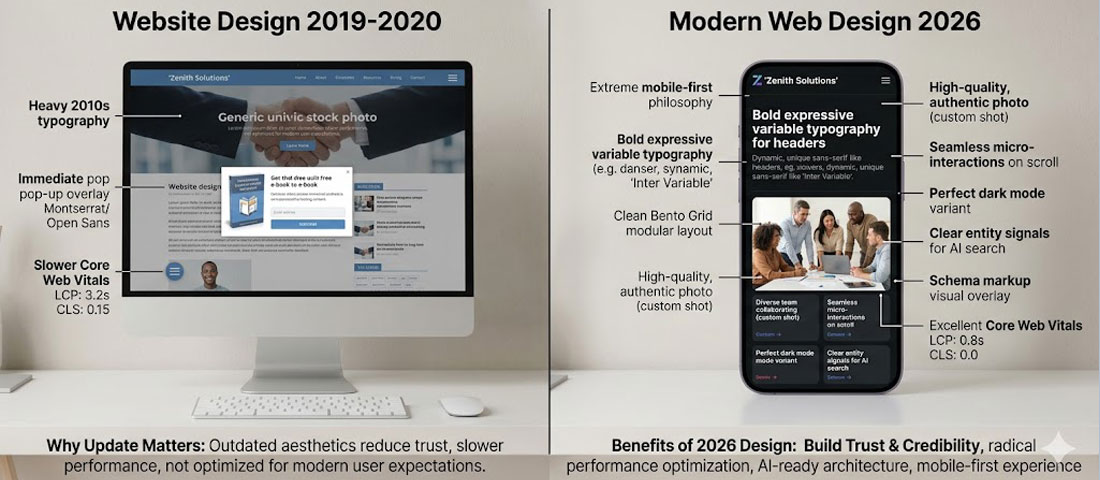
The gap between an outdated website and a modern one is immediately visible to users — and it directly affects trust, credibility, and conversions.
The 9 Key Web Design and Development Trends in 2026
Trend 1: AI-Assisted Design and Personalisation
The most significant structural shift in web design in 2026 is the integration of AI — both in how websites are designed and built, and in how they behave for visitors once live. On the design and build side, AI tools like Figma AI, Adobe Firefly, and v0 by Vercel are dramatically accelerating the design process, allowing designers to generate and iterate on layouts, colour schemes, and component variations in a fraction of the time it previously required.
On the live website side, AI-powered personalisation is moving from an enterprise-only capability to something accessible at every budget level. Websites in 2026 increasingly use AI to adapt their content, calls to action, and navigation based on individual visitor behaviour, traffic source, and apparent intent. A first-time visitor from a Google ad sees a different version of the homepage than a returning visitor who has already spent time on the services pages.
This is not science fiction — it is being delivered through accessible platforms like HubSpot, Optimizely, and even some advanced WordPress plugins. For businesses commissioning new websites in 2026, asking about AI personalisation capabilities should be a standard part of the brief.
Trend 2: Radical Performance Optimisation — Core Web Vitals as Design Constraints
In 2026, website performance is no longer an afterthought that gets addressed after design is finalised. It is a design constraint that shapes decisions from the very beginning of a project. Google’s Core Web Vitals — Largest Contentful Paint (LCP), Interaction to Next Paint (INP), and Cumulative Layout Shift (CLS) — are direct ranking factors, and businesses with poor Core Web Vitals scores are losing both search visibility and potential customers.
The practical implications for design in 2026 are significant. Heavy full-screen video backgrounds — once a hallmark of premium web design — are being replaced with performance-optimised alternatives. Elaborate entrance animations and heavy JavaScript interactions are being audited for their performance cost. Image formats have shifted to WebP and AVIF as standard. And the fashion for loading dozens of third-party scripts (chat widgets, analytics tools, ad pixels) is being tempered by an understanding of how each script adds to load time.
Great web design in 2026 achieves visual impact within tight performance constraints — which requires more skill, not less, than simply building something visually impressive without regard for speed.
Trend 3: Mobile-First Is Now Mobile-Only for Many Audiences
Mobile-first design has been an industry standard since Google made it a ranking factor in 2018. But in 2026, for many business categories and geographic markets, the reality is closer to “mobile-only” — over 70% of web traffic globally now comes from mobile devices, and in markets like India, the figure is higher still.
This has significant design implications. Navigation patterns, touch target sizes, content hierarchy, and even the fundamental layout of information on a page need to be optimised for a thumb-driven, small-screen experience first — with desktop as a welcome enhancement, not the primary design consideration. Businesses that commission websites designed primarily on desktop and then “adapted” for mobile are building on a foundation that will underperform for the majority of their visitors.
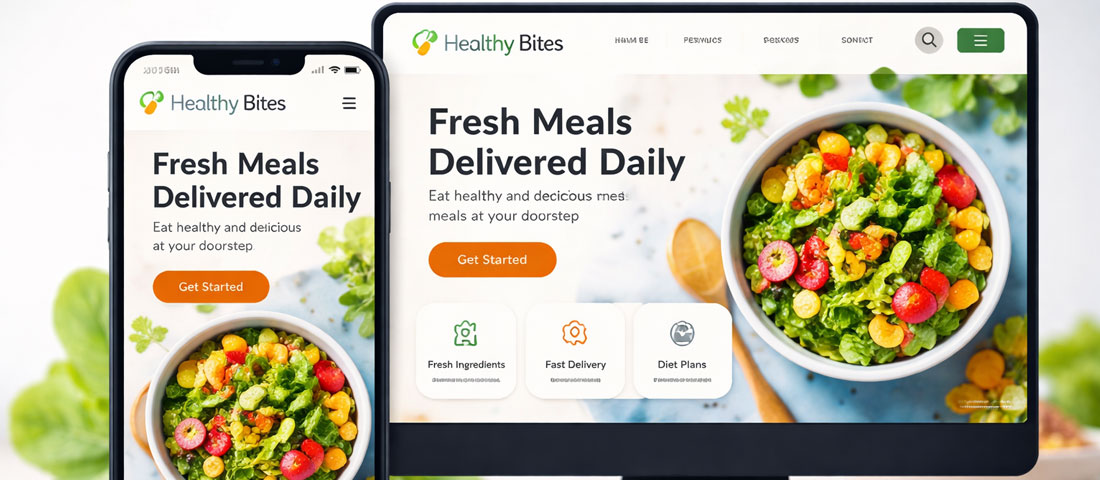
Mobile-first design means building for the small screen first and enhancing for larger screens — not the other way around.
Trend 4: Bento Grid and Modular Layout Systems
One of the most visible aesthetic trends of 2025 and 2026 is the widespread adoption of bento-style grid layouts — modular, card-based designs inspired by the compartmentalised organisation of Japanese bento boxes. These layouts organise content into a clean grid of varying-sized cards or modules, each self-contained and visually distinct, creating a sense of order and visual interest simultaneously.
The appeal of bento grids goes beyond aesthetics. They are highly responsive — modules can reflow cleanly at different screen sizes. They make it easy to surface multiple pieces of information without a complex hierarchical structure. And they are well-suited to AI-driven personalisation — individual modules can be swapped or reordered based on visitor behaviour without a complete page redesign.
The trend was popularised by Apple’s product pages and has since spread across technology companies, SaaS platforms, and progressive service businesses. In 2026, it is established enough to be a safe, modern choice rather than a cutting-edge risk.
Trend 5: Dark Mode and Dual-Theme Design
Dark mode has moved from a novelty feature to an expectation for a significant portion of users — particularly in technology, creative, and professional services industries. Operating system-level dark mode preferences (available on iOS, Android, macOS, and Windows) can now be detected by websites and used to automatically serve the appropriate design variant.
In 2026, leading web design practice treats dark and light modes not as afterthoughts but as equally designed, equally polished experiences. Building a genuinely beautiful dark mode version of a website requires designing it from scratch — not simply inverting colours — and ensuring that typography, imagery, and visual hierarchy work equally well in both contexts.
For businesses targeting design-conscious, technology-savvy, or younger audiences, dual-theme design has shifted from a luxury to a competitive expectation.
Trend 6: Micro-Interactions and Purposeful Motion
Motion design on websites has matured significantly. The trend has moved away from elaborate entrance animations — where every element flies in from a different direction as you scroll — toward purposeful micro-interactions: small, functional animations that provide feedback, guide attention, and make interfaces feel responsive and alive without being distracting.
Well-designed micro-interactions in 2026 include: button hover states that confirm interactivity; form field focus animations that clarify which field is active; skeleton loading states that signal content is incoming; scroll-triggered reveals that are smooth and understated; and cursor-following effects on desktop that add a sense of depth and engagement.
The key distinction is purposefulness. Every animated element should serve a user experience function — confirming an action, indicating a state, or guiding attention — rather than existing purely for visual spectacle. Performance is the other consideration: motion that adds even 50ms to interaction response time is counterproductive to the user experience it is meant to enhance.
Trend 7: Typography as the Primary Design Statement
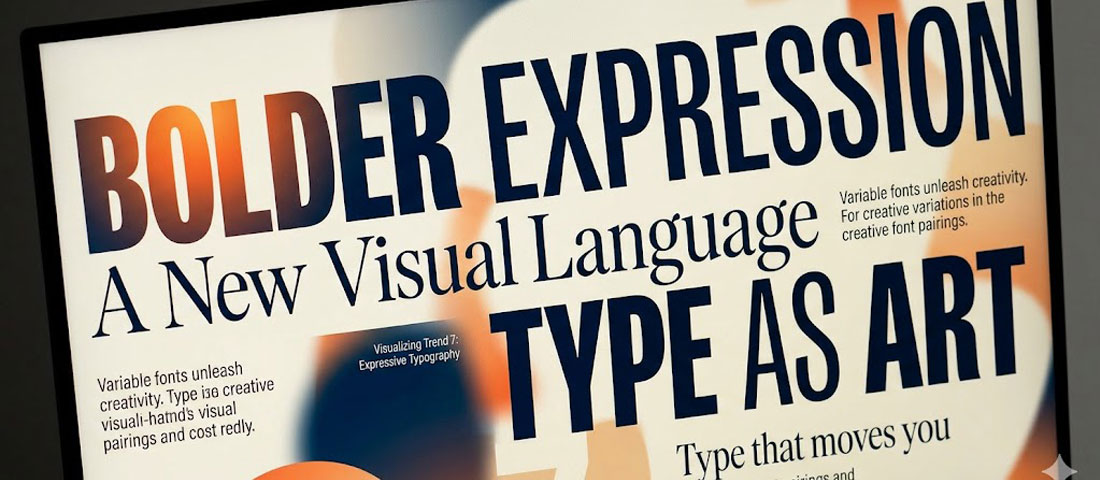
In 2026, typography is doing more design work than ever — bold, distinctive type is replacing heavy imagery as the primary visual statement on leading websites.
One of the defining visual trends of web design in 2025 and 2026 is the elevation of typography from a functional element to the primary design statement. Increasingly, the most visually striking and memorable websites are built around bold, distinctive, expressive type — with imagery playing a supporting rather than leading role.
This trend has been driven by several converging forces. Variable fonts — which allow a single font file to span the full range of weights, widths, and optical sizes — have made typographic expressiveness technically practical. Performance considerations have made image-heavy designs less desirable. And a reaction against the visual homogeneity of stock-photography-led web design has created an appetite for more distinctive, brand-specific visual identities built through type.
In practice, this means leading websites in 2026 are using large, confident display typography for headlines and hero sections; carefully considered, highly readable body fonts; creative combinations of serif and sans-serif that communicate personality; and, in some cases, animated or variable type that responds to scroll or interaction.
Trend 8: Accessibility as a Design Standard, Not an Add-On
Web accessibility — designing websites that are usable by people with visual, auditory, motor, and cognitive disabilities — has for too long been treated as a compliance exercise to be addressed at the end of a project. In 2026, leading design practice treats accessibility as a fundamental design principle that shapes decisions from the very beginning.
This shift has been driven by several forces: increased legal and regulatory scrutiny of web accessibility in the USA, UK, and EU; growing awareness that accessible design improves usability for all users, not just those with disabilities; and the development of better tooling that makes accessibility testing faster and more actionable during the design process rather than as a post-launch audit.
Practically, accessible web design in 2026 means: sufficient colour contrast ratios across all text and interactive elements; keyboard-navigable interfaces that work without a mouse; screen-reader-compatible markup and ARIA attributes; meaningful alternative text on all images; and a clear, logical content hierarchy that makes sense without visual styling. None of these requirements are in conflict with beautiful, modern design — they simply require that accessibility thinking starts on day one.
Trend 9: AI-Ready Content Architecture and Schema Markup
The ninth major trend of 2026 is the most strategically important for business performance, even if it is the least visually apparent: designing websites with AI-search-readiness built into the architecture from the start.
As we discussed in our guide to AEO, GEO, and AI search optimization, the way people find businesses online is changing rapidly. Google AI Overviews, ChatGPT, Perplexity, and voice search are all extracting and surfacing information from websites in ways that depend on how well that content is structured. Websites built in 2026 should have structured data (schema markup) built into every template, FAQ sections on all key pages, clear entity signals throughout, and a content architecture that answers questions directly rather than burying information in lengthy paragraphs.
This is not a design trend in the visual sense — but it is a web design and development trend in the most important sense: it directly determines whether your new website performs commercially in the search landscape of 2026 and beyond.
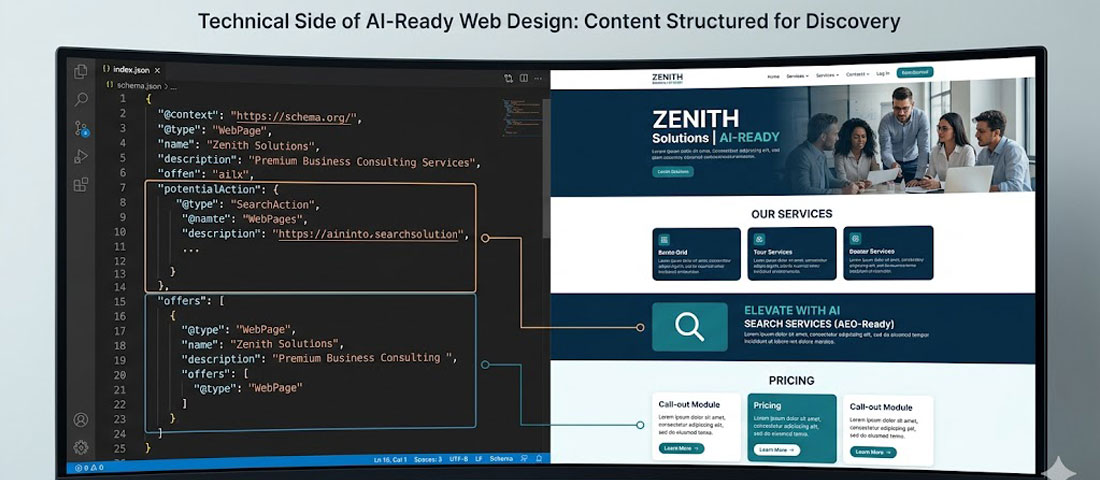
AI-ready web design builds structured data, schema markup, and FAQ content architecture into every page from the start — not as an afterthought.
Which Trends Are Here to Stay vs Which Are Passing Fashions
| Trend | Longevity | Why |
|---|---|---|
| AI-assisted design & personalisation | ✅ Permanent shift | Driven by fundamental technology change, not aesthetic preference |
| Core Web Vitals performance | ✅ Permanent shift | Direct Google ranking factor — will only become more important |
| Mobile-first design | ✅ Permanent shift | Traffic data is unambiguous — mobile-first is the only rational approach |
| Accessibility as standard | ✅ Permanent shift | Legal requirements + inclusive design benefits are compounding |
| AI-ready content architecture | ✅ Permanent shift | AI search is growing — this becomes more critical each year |
| Bento grid layouts | ⚠️ Medium-term trend | Currently mainstream — will evolve but modular thinking will persist |
| Dark mode / dual themes | ⚠️ Medium-term trend | User preference data supports it — but implementation cost is real |
| Bold expressive typography | ⚠️ Medium-term trend | Currently strong — specific styles will evolve but typographic emphasis will remain |
| Purposeful micro-interactions | ✅ Long-term trend | When performance-conscious, micro-interactions improve UX measurably |
Web Design Trends That Are Going Away in 2026
Understanding what is declining is as useful as knowing what is emerging. Here are the web design approaches that are clearly on their way out in 2026:
- Full-screen auto-play video backgrounds. Beautiful in a 2018 design portfolio, but a Core Web Vitals disaster and a bandwidth burden on mobile. Being replaced by looping WebM animations, subtle CSS animations, or strong static imagery.
- Heavy parallax scrolling effects. Still occasionally effective when used sparingly, but the “every section scrolls at a different speed” approach is dated and often causes layout shift (CLS) issues.
- Pop-up overlays that fire immediately on page load. These have been bad UX practice for years and Google now actively penalises intrusive interstitials that block content on mobile devices.
- Hamburger menus on desktop. Hiding all navigation behind a hamburger icon made sense on small mobile screens. On desktop, it forces an unnecessary extra click and reduces discoverability of key pages.
- Generic stock photography. Banks of smiling people in business attire are increasingly being replaced with custom photography, custom illustrations, and brand-specific visual identities that actually differentiate a business.
- Infinite scroll without pagination. From an SEO and usability perspective, infinite scroll creates problems for search engine indexing and makes it impossible to bookmark or share a specific position in content. Pagination is returning as the preferred approach.
- Cluttered sidebar-heavy layouts. The column layout with a content area and a busy sidebar full of widgets, ads, recent posts, and tag clouds is a relic of mid-2000s blog design. Clean, full-width content with strategic CTAs performs better on every metric.
What Trends Mean for Your Next Website Project
If you are planning a new website or a significant redesign in 2026, here is a practical checklist of questions to ask your web design agency — based on the trends outlined above:
-
How do you approach Core Web Vitals in your design process?
Performance should be designed for, not retrofitted. Ask to see Core Web Vitals scores from recent projects. If the agency cannot readily share this data, that tells you something important about their development practice. -
Is the design truly mobile-first or desktop-adapted?
Ask to see mobile wireframes or mockups before desktop versions. A genuinely mobile-first agency designs the small-screen experience before anything else. -
Will schema markup and structured data be built into the templates?
This should be a standard deliverable for any new website in 2026 — Organisation schema, Service schema, FAQPage schema, and LocalBusiness schema where applicable. It should not cost extra. -
How is accessibility handled in your process?
Look for agencies that conduct accessibility testing during development, not just as a post-launch audit. WCAG 2.1 AA compliance should be the minimum standard. -
What is your approach to typography and brand differentiation?
The era of generic template-based design is over. Ask how the agency approaches creating a distinctive visual identity through typography, colour, and layout — not just through your logo. -
Can the website support AI personalisation or chatbot integration?
Even if you are not implementing these features at launch, building a website architecture that can accommodate them cleanly in future is far cheaper than retrofitting them later.
The core principle for 2026: The best websites are not the ones chasing every trend — they are the ones that execute the fundamentals brilliantly (performance, mobile experience, clear communication, conversion focus) while selectively incorporating design trends that genuinely serve their specific audience and brand. Trend-chasing for its own sake produces websites that look dated faster, not slower.
How Neel Networks Approaches Web Design in 2026
At Neel Networks, our approach to web design has always been rooted in two questions: does it serve the business objective, and does it serve the user? These questions do not change — but the answers evolve with the technology and design landscape.
In 2026, every website we design and build includes: genuine mobile-first design with Core Web Vitals as a core deliverable; schema markup and structured data built into every template; accessibility compliance baked into the development process; performance optimisation throughout (WebP images, lazy loading, clean code); and a content architecture designed for both human readers and AI search platforms.
We build for where your customers are going, not just where they are today.
Thinking about a new website or redesign in 2026?
Neel Networks has been designing and building high-performance business websites since 2014. We serve clients across the USA, UK, Canada, Australia, and beyond — delivering modern, conversion-focused web design from India at pricing that makes quality accessible.
Frequently Asked Questions About Web Design Trends in 2026
| What are the biggest web design trends in 2026? | The biggest web design trends in 2026 are: AI-assisted design and personalisation, which is transforming both how websites are built and how they behave for visitors; radical performance optimisation driven by Core Web Vitals requirements; genuine mobile-first design as the primary approach rather than desktop-adapted; bento grid and modular layout systems; dark mode and dual-theme design; purposeful micro-interactions and motion design; bold expressive typography as the primary visual statement; accessibility as a design standard; and AI-ready content architecture with schema markup built into every template. |
| What web design trends are going away in 2026? | Web design approaches that are clearly declining in 2026 include: full-screen auto-play video backgrounds (performance and mobile cost is too high); heavy parallax scrolling effects; pop-up overlays that fire immediately on page load (Google penalises these on mobile); hamburger menus on desktop; generic stock photography of smiling business people; infinite scroll without pagination; and cluttered sidebar-heavy blog layouts. These approaches are being replaced by performance-conscious design that achieves visual impact within real technical constraints. |
| How important is mobile-first design in 2026? | Mobile-first design is not just important in 2026 — it is the only rational approach given that over 70% of global web traffic now comes from mobile devices. Google has used mobile-first indexing as its default since 2019, meaning Google primarily uses the mobile version of a website for ranking purposes. Businesses that commission websites designed primarily on desktop and then “adapted” for mobile are building on a foundation that will underperform for the majority of their visitors and in search rankings. |
| What are Core Web Vitals and why do they matter for web design in 2026? | Core Web Vitals are a set of specific website performance metrics that Google uses as direct ranking factors. The three metrics are: Largest Contentful Paint (LCP), which measures how quickly the main content of a page loads; Interaction to Next Paint (INP), which measures how quickly a page responds to user interaction; and Cumulative Layout Shift (CLS), which measures how much the page layout unexpectedly moves as it loads. Poor Core Web Vitals scores directly reduce your Google rankings. In 2026, these metrics function as design constraints — every design decision, from image formats to animation choices to third-party script loading, must be evaluated against its impact on these scores. |
| How does AI change web design in 2026? | AI changes web design in 2026 in two distinct ways. First, in the design and development process itself: AI tools dramatically accelerate the exploration, iteration, and production phases of design work, allowing designers to generate and refine layouts, colour schemes, and components faster than ever. Second, in the finished website product: AI-powered personalisation allows websites to adapt their content, navigation, and calls to action for individual visitors based on their behaviour, traffic source, and intent — moving from one-size-fits-all experiences to dynamically tailored ones. |
| Should my website have dark mode in 2026? | Whether your website needs dark mode in 2026 depends on your audience and industry. For technology companies, design agencies, software products, and businesses targeting younger or design-conscious audiences, dark mode is increasingly expected and the absence of it is noticeable. For more traditional service businesses, healthcare, legal, or financial services where light, clean, professional presentation is the norm, dark mode is less critical. The important thing if you do implement dark mode is to design it as a genuinely beautiful alternative — not simply by inverting colours — which requires upfront design investment. |
| How much does a modern website cost to build in 2026? | The cost of building a modern, properly designed website in 2026 varies significantly depending on scope, complexity, and where you build it. In the USA or UK, a professionally designed business website typically costs between $5,000 and $25,000 or more. Working with a professional Indian web design agency like Neel Networks can deliver the same quality — mobile-first design, Core Web Vitals optimisation, AI-ready architecture, schema markup, and conversion focus — at 50 to 70% less than comparable agencies in the USA or UK, without any compromise on quality or communication. |
Conclusion: Build for the Next Three Years, Not Just Today
The web design trends of 2026 are not a checklist to be applied mechanically to every website project. They are a reflection of deeper shifts in technology, user behaviour, and search landscape that will continue to develop over the next three to five years. The businesses that build websites grounded in the permanent fundamentals — performance, mobile experience, accessibility, clear communication, AI-readiness — will continue to benefit from those investments long after any specific visual trend has faded.
If your current website was built before 2022 and has not been significantly updated since, it is very likely falling short on multiple dimensions of modern performance, design, and search-readiness. A website that looked professional in 2020 may be actively undermining your business’s credibility today.
The question is not whether your website needs to evolve — it is how to evolve it most effectively for your specific business goals and audience.
Want to know how your website measures up against 2026 standards?
Neel Networks offers free website audits covering performance, mobile experience, design quality, and search-readiness. Find out exactly where your site stands — and what the highest-impact improvements would be.
Get a Free Website Audit Website Redesign Services WhatsApp Us