
The voice search advice that worked in 2020 has aged badly. Most of it was built around a single idea — win the featured snippet, get the spoken answer — and that idea no longer describes how Siri, Alexa, Google Assistant or ChatGPT voice actually find what they read out loud. Apple Intelligence, Alexa+ with its large language model backbone, and Google’s pivot to Gemini have rewritten the rules underneath the same surface. The voice assistant still speaks a single answer. Where that answer now comes from is almost completely different.
This guide is the practical version of what we wish more SEO articles would just say. We have spent the last two years rebuilding voice-search strategies for clients across local services, eCommerce and content businesses, and the playbook that works in 2026 is meaningfully different from the one that worked even eighteen months ago. If your foundation is shaky, our broader on-page and technical SEO guide is the right starting point — voice optimisation sits on top of that base, not in place of it. This article picks up where that one ends, focused specifically on what voice has become and how to get your content into the spoken answer.
The category called “voice search” has split into two very different things, and most articles still conflate them. The first is a quick command — “set a timer for ten minutes”, “play classical music”, “call my brother”. These are device functions, not search queries, and there is no SEO play available because no website is consulted. The second is an actual information or commercial query — “where is the closest Italian restaurant that is open now”, “what is the best mortgage rate I can get”, “how do I clean a cast iron pan”. These are the queries where SEO matters, and they are the ones the voice assistant has to look something up to answer.
What has changed dramatically in the last two years is the path from query to answer. In 2022 the voice assistant ran a search query against an index, picked the top result, and read the snippet out loud. In 2026 the assistant is far more likely to send the query to a large language model, which then synthesises an answer from a mix of trained data, real-time web search, and curated sources — and reads back a generated response rather than a snippet. The website you wrote might still be part of that answer, but it is now competing for a citation, not a snippet position.
That shift is the single most important thing to understand before you spend a rupee on voice optimisation. The old game was about being in position one. The new game is about being one of the sources the language model trusts when it builds the answer. Those are not the same problem, and the tactics for each only partially overlap.
Beneath the technology shift, the behavioural differences between voice and text queries are large and consistent across every study we have seen, and they shape what content actually wins. Five of these differences matter enough to design your content around.
A text searcher types “best mortgage rate”. A voice searcher says “what is the best mortgage rate I can get if I earn around eighty thousand a year and have a deposit of twenty percent”. The voice query is longer, contains personal context, and is phrased as a complete sentence. Content optimised for short-tail keywords misses the voice query entirely. Content written to answer fully-formed questions wins the citation.
Roughly four in five voice queries begin with what, how, where, why, when or who. They expect an answer, not a list. This single fact has done more to shift content strategy than any other voice-search trend — pages structured around clearly-stated questions with clearly-stated answers underneath are the pages that voice assistants pull from. Pages that bury the answer three paragraphs in lose every time.
Spoken queries are far more likely to include “near me”, “nearby” or an implicit local context than typed queries. The voice assistant assumes you want the answer from where you are standing right now. This means your Google Business Profile, your name-address-phone consistency, your local schema and your local content all matter more for voice than for text — sometimes by a significant margin. The discipline of properly executed local SEO is covered in our complete local SEO playbook, and the local layer is where most voice wins come from in service-based businesses.
A typed search returns ten results plus AI overviews. A voice query returns one answer. There is no second result that the user can scroll to. This is the structural reality that makes voice SEO harder and the reward larger — if you do not own the spoken answer for a query, you are not visible at all. Half-ranking does not exist in voice. You are either the answer or you are missing.
This one is less reported but it shows up consistently in our client data. People who voice-search a commercial query — “where can I get a roof inspection done this week” — tend to be closer to a decision than people who type the same query at their desk. Voice queries skew toward immediacy. The user wants to act, not to research. This changes how you should write the content the voice assistant is going to read — direct, specific, action-oriented, and with the relevant trust signals close to the answer rather than buried.
The four assistants that matter for most businesses each source their voice answers differently, and the gap between them has widened as the underlying models have diverged. Optimising for one is not optimising for all, but there is meaningful overlap in the technical foundations. The table below summarises where each assistant looks first when it is asked a substantive question.
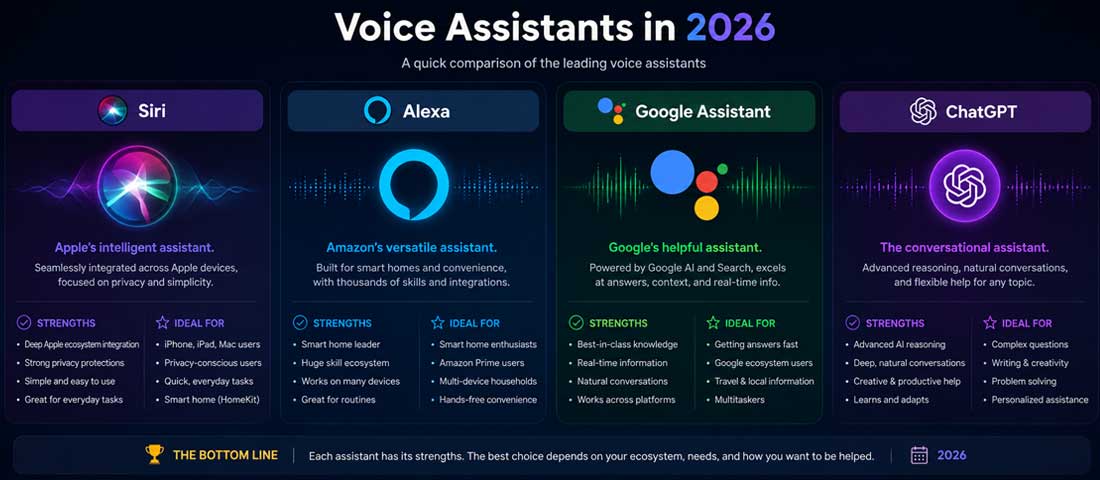
| Assistant | Primary answer source | What it prioritises | Where you can appear |
|---|---|---|---|
| Siri with Apple Intelligence | Apple’s curated index, then ChatGPT integration for general queries | Apple Maps data for local, Wikipedia-like sources, ChatGPT-backed answers | Apple Maps profile, structured web content, OpenAI-cited sources |
| Alexa+ | Amazon’s own knowledge graph plus Anthropic Claude for general reasoning | Amazon-verified information, third-party skills, Bing-indexed web | Bing index, Amazon-verified business listings, Alexa Skills |
| Google Assistant / Gemini | Google Search Generative Experience with Gemini reasoning layer | Google index, knowledge graph, AI Overviews, featured snippets | Featured snippets, AI Overview citations, Google Business Profile |
| ChatGPT voice | GPT model with real-time web search through OpenAI’s web index | Authoritative web sources, training data, recently indexed content | OpenAI-indexed web, sources cited in ChatGPT responses |
The pattern across all four is the same shift: the snippet is no longer the unit. The unit is the citation, and the citation goes to the page the language model decided was the best source — which is a function of structured data, content quality, topical authority and a series of trust signals the model is reading underneath your prose. You optimise for citation, not for ranking. This is the broader picture our AEO, GEO, AIO and LLMO complete guide covers in depth, and the voice layer is a specialised application of those same principles.
The websites that voice assistants actually pull from in 2026 share a fairly tight set of technical and content choices. None of these is exotic, but the discipline of executing all six together is what separates a site that wins voice queries from a site that occasionally gets lucky.
If you run a service business with a physical location or service area, local voice search is the highest-leverage opportunity in the entire voice optimisation space. The query volume is large and growing. The competitive bar is lower than the equivalent text-search competitive set because most local businesses still have not properly optimised for voice. And the conversion intent on a local voice query is unusually high — the person asking “find a plumber who can come today” is closer to booking than the person typing the same phrase at their desk.

The foundation is Google Business Profile. Make sure every field is filled, photos are recent, services are listed individually, the question-and-answer section on your profile has been seeded with real questions and your own answers, and reviews are being actively requested and responded to. The profile is the single most important asset in local voice for Google Assistant, and it feeds the local map results that Siri also pulls from in many cases.
Add Apple Business Connect if you have not already. Apple’s local data is now competitive with Google’s for restaurants, retail and personal services, and Siri increasingly draws from Apple’s own index before going to ChatGPT. The setup takes under thirty minutes and most service businesses are not yet on the platform, which makes it one of the few remaining easy wins in local discoverability.
On your own website, put your full address, phone, hours and service area in the page footer where every page carries them, mark them up with LocalBusiness schema, and create dedicated location pages if you serve multiple areas. Each location page should answer the obvious voice questions for that area — what services you offer there, your local phone number, your local opening hours, directions, parking, accessibility. The pages that win local voice citations are usually the ones that explicitly contain the answers to the questions a local voice user would actually ask.
Want Voice and Local Search Built Properly into Your Next Site?
We have been building voice-discoverable and locally-optimised websites for service businesses across more than a decade. If you want a clear-eyed view of how your current site is performing against voice queries and what would actually move the needle, we are happy to walk you through it.
The single highest-leverage content move for voice in 2026 is restructuring your existing content around explicit questions. Most business websites are written in marketing prose — “Our award-winning team delivers bespoke solutions” — that no voice assistant can use, because there is no question being answered. The same information rewritten as “What does Neel Networks do for businesses outside India” with a direct answer underneath is content the assistant can actually cite.
The mental model is to picture every page as a frequently-asked-questions document with extra context around it. The questions should be the actual questions your customers ask, written in their language rather than your own. The answers should be one to three sentences, factual, direct, with the headline answer in the first sentence. The supporting paragraphs that follow are for the human reader and the search engine — but the first sentence after each question is the one the voice assistant is going to read.
Where to put these questions matters too. The classic FAQ section at the bottom of a page is now a misuse of the format. The questions should be woven through the page wherever a natural query would arise, with proper FAQPage schema marking each one. A pricing page should have an “How much does X cost” question right at the top. A services page should have “What does Y service include” early. A location page should have “What services do you offer in Z area” near the start. The voice assistant scans the page structure, and questions buried at the bottom are far less likely to be cited than questions placed where they naturally belong.
Underneath the content layer, the voice assistants are reading a set of technical signals that decide whether your page is even eligible to be a citation source. Most of these overlap with regular technical SEO, but a few are specific to voice and worth executing deliberately.
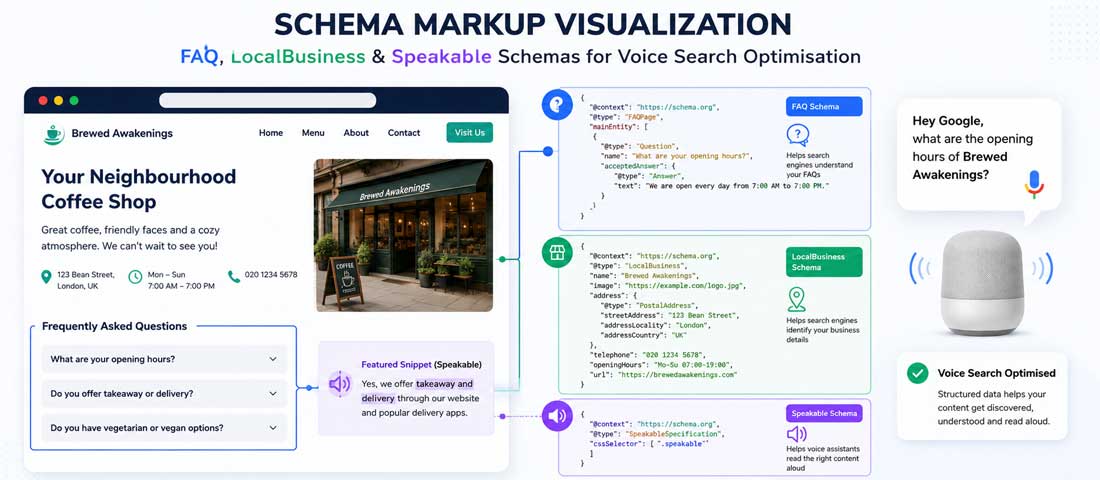
Schema markup is non-negotiable. At minimum, Article or BlogPosting schema on content pages, FAQPage schema where you have questions and answers, LocalBusiness schema for any local entity, HowTo schema where you give step-by-step instructions, and Speakable schema on the sections you most want read aloud. The voice assistants use this markup as a primary signal of what is on the page and how it is structured. Pages without proper schema are far less likely to be cited even when the content is strong, because the assistant has to do more work to understand what the page actually says.
HTTPS, mobile-friendliness and Core Web Vitals are baseline requirements. Voice queries are overwhelmingly happening on mobile devices and smart speakers — the desktop voice query is rare. A page that fails mobile-friendly testing or has poor Core Web Vitals is functionally invisible to voice. The work to fix this is the same work that fixes regular mobile SEO, so it pays double, but it has to be done.
Page structure and semantic HTML matter more for voice than they do for text. Properly nested H1, H2 and H3 headings. Real paragraph elements, not just div tags. Semantic markup for navigation, main content and footer. Image alt text on every image. ARIA labels where they help. The voice assistant uses the page structure to find the right section to cite from, and a poorly structured page is one the assistant has to guess at — and pages it has to guess at lose to pages that are structured cleanly.
Indexing and crawlability are the basics underneath all of this. If your robots.txt is blocking the wrong things, if your XML sitemap is missing pages, if your canonical tags are wrong, the voice assistants will not find the content at all. The shift toward AI-assisted search has also changed which crawlers matter — OpenAI’s GPTBot, Anthropic’s ClaudeBot, Google’s Google-Extended, and PerplexityBot all need to be reviewed in your robots.txt file. Blocking them, intentionally or accidentally, removes you from the voice citation pool entirely. This is one of the structural shifts covered well in our piece on how AI is transforming SEO and the future of search, and the voice layer is where the consequences of getting it wrong are sharpest.
The patterns of failure across the clients we audit are remarkably consistent. None of these mistakes is exotic — most are basic hygiene issues that have been ignored for years and that quietly disqualify the site from voice citation regardless of how good the content is.
Measuring voice search is genuinely harder than measuring text search, because the search engines do not currently distinguish voice queries from text queries in their reporting. Google Search Console does not have a voice-query filter. Bing Webmaster Tools does not have one either. The assistants themselves do not provide analytics on which pages they cited. This is a real reporting gap, and any agency that promises detailed voice-search analytics is overselling what is actually available.
What you can measure is the surrounding signal set. Question-format queries in Search Console are the closest proxy — filter your queries for “how”, “what”, “where”, “when”, “why” and “who” and look at the impressions and clicks on those. Growth in the question-query subset is a reasonable indicator that your voice optimisation is working, even though some of those queries are still typed rather than spoken.
Featured snippet captures are still worth tracking even though their importance has diminished. The pages that win featured snippets in 2026 are also the pages that tend to win voice citations, because the underlying signals overlap — structured content, direct answers, semantic clarity. Tools like Ahrefs, Semrush and Sistrix can monitor your snippet share over time. The gradient of change matters more than the absolute number.
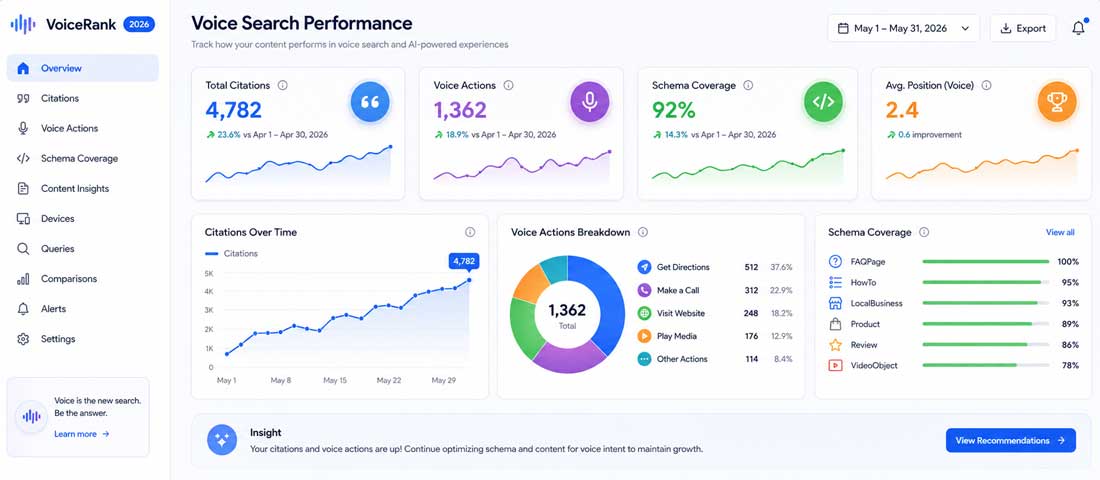
For local businesses, Google Business Profile insights now report “voice action” events separately from regular actions, and that report is the cleanest voice-specific signal available. The trend line on voice-triggered direction requests, calls and website clicks is the closest you will get to a real voice-search dashboard until the platforms open up more data. The principles behind interpreting these signals correctly are covered in our broader piece on recent algorithm changes and zero-click search trends, and the voice angle is a specific case of the larger shift toward AI-mediated answers rather than blue-link results.
The other useful signal is qualitative testing. Once a quarter, sit down with your phone and a smart speaker and run the queries your customers actually use. Listen to what the assistant says back. Note who it cites. Note where you appear and where you do not. This is not statistical analysis, but the patterns it surfaces are usually richer than what any analytics dashboard will show you. The agencies that take voice seriously do this exercise routinely and learn more from it than from any reporting tool.
The voice assistants are evolving fast enough that any specific piece of advice has a roughly twelve to eighteen month half-life. Three shifts are worth keeping an eye on if you are planning a voice-search strategy that needs to hold up beyond the next quarter.
The first is multimodal queries — voice plus camera plus context. Siri with Apple Intelligence can already take a voice question while looking at something on screen, and answer about the combination. Gemini and Alexa+ are moving in the same direction. This means voice search is increasingly contextual, and the answer will depend on what the user is looking at, where they are, what time it is, and what they have done recently. Optimising for voice in 2027 is going to involve thinking about how your business shows up in those compound queries, not just the spoken question alone.
The second is agent-driven shopping. Alexa+ can now place orders. Siri can book appointments. ChatGPT operator-style features can complete tasks. As these agentic flows mature, voice search starts to overlap with voice commerce — the user does not just want to find a business, they want the assistant to act on their behalf. The websites and businesses that get cited will increasingly be the ones whose data is structured enough for the assistant to actually transact against, not just describe.
The third is the gradual replacement of the spoken-snippet model with the spoken-generated-answer model. The assistant is moving from “read me what page X says” to “write me an answer based on what pages X, Y and Z say, and tell me which ones you used”. This is the citation-instead-of-snippet shift writ large, and the businesses that win in this model are the ones that have built out enough topical depth to be one of the trusted sources the assistant draws from repeatedly.
The honest answer is yes, but the investment level depends on your business. For local service businesses — plumbers, electricians, restaurants, salons, dentists, accountants — voice optimisation is not optional in 2026 and the return is unusually high because most competitors have not properly executed even the basics. The work to get Google Business Profile right, add Apple Business Connect, mark up your site with LocalBusiness and FAQPage schema, and rewrite your key pages around natural-language questions is straightforward, and the lift on voice-triggered local actions is usually meaningful within a quarter.
For eCommerce and content businesses without a strong local angle, the case is more nuanced. Voice queries with pure commercial intent are still a minority of overall search volume, and the conversion paths are imperfect — most voice users still finish their purchase on a screen, not by voice. The right move here is usually not a dedicated voice strategy but a content strategy that happens to be voice-friendly — question-format headings, direct answers, schema markup, fast pages. That investment serves your text-search and AI-search goals at the same time, and the voice citations are an additional return on the same work.
For B2B businesses with longer sales cycles, voice is currently a low priority. Decision-makers in B2B still research extensively at the desk, and voice queries are rarely the channel that drives a six-figure software contract. The exception is the local-services B2B layer — commercial cleaning, IT support, facilities management — where local voice queries do drive meaningful enquiry volume and the same playbook as consumer local applies.
Whichever category you are in, the structural truth is that the work that wins voice is the work that wins AI-assisted search more broadly, and the work that wins AI-assisted search is the work that is going to define organic discovery for the rest of this decade. Voice optimisation is not a separate discipline. It is a leading indicator of where SEO as a whole is going — toward question-format content, structured data, topical authority, and being a trusted citation source rather than a top-ranked page. Businesses that build for that future now, voice or otherwise, are the businesses that will still be findable when the search engine result page as we knew it has finished receding.
| What is voice search optimisation? | Voice search optimisation is the set of technical and content practices that make your website discoverable when someone asks a voice assistant — Siri, Alexa, Google Assistant or ChatGPT voice — a question that your business could answer. In 2026 the practice has shifted from winning featured snippets to becoming a trusted citation source for the large language models that power modern voice assistants. The work includes question-format content, structured data and schema markup, local business profile setup, fast mobile performance, and topical authority across the subject area you want to be cited for. |
| How is voice search different from regular SEO? | The main differences are query length, query format and how results are returned. Voice queries are longer and conversational, almost always phrased as questions rather than short-tail keywords, and tend to carry stronger local intent than typed queries. The result is also different — voice returns a single spoken answer rather than a list of ten links. This means there is no second-place position to fall back on. You either own the answer or you are invisible. The technical foundations overlap heavily with regular SEO, but the content has to be structured around questions and direct answers in a way that traditional marketing copy is not. |
| Which voice assistant should I optimise for first? | For most businesses the answer is to optimise for the underlying signals all four assistants share rather than picking one. Schema markup, fast mobile load times, question-format content, Google Business Profile completeness and topical authority all feed every assistant. If you have to prioritise, look at where your customers actually are. Local service businesses should start with Google Business Profile and Apple Business Connect because they drive the local voice queries. eCommerce sites should focus on Bing’s web index and Amazon-verified business data because those feed Alexa. Content businesses should prioritise topical depth and schema markup so the language models behind Gemini and ChatGPT treat them as authoritative sources. |
| What schema markup do I need for voice search? | The essential schemas in 2026 are FAQPage for question-and-answer content, LocalBusiness for any business with a physical presence or service area, Speakable to flag sections suitable for voice reading, HowTo for instructional content, and Article or BlogPosting for editorial content. Beyond these, Product schema for eCommerce, Event schema where applicable, and Service schema for service businesses all add useful signals. The schemas are not difficult to implement — most content management systems have plugins that handle them — but they have to be valid, complete and accurate. Broken schema is worse than no schema because it sends conflicting signals to the assistants. |
| Can I measure how my website performs on voice search? | Direct measurement is limited because the search engines and voice assistants do not currently report voice queries as a separate category in their analytics. The best proxies are question-format query performance in Google Search Console, featured snippet capture rates over time, voice action events in Google Business Profile insights for local businesses, and qualitative testing where you periodically ask voice assistants the queries your customers actually use and note where you appear. Combining these signals gives a reasonable picture of trend even though no single dashboard tells the full story. Tools that promise detailed voice-search analytics are usually overselling what the underlying data can support. |
| Is voice search big enough to matter for my business? | It depends on your category and customer base. For local service businesses, voice queries with commercial intent are a meaningful share of total enquiry volume and are growing. For consumer eCommerce in the under-40 segment, voice plays a real role in discovery even if the purchase still completes on screen. For B2B with long sales cycles, voice is currently a minor channel. The more useful framing is that the work that wins voice is the same work that wins AI-assisted search in general, and AI-assisted search is the direction the entire organic discovery channel is heading. Investing in voice optimisation is therefore worthwhile even where the direct voice volume is modest, because the same investment pays off across the broader shift. |
| How long does it take to see results from voice search optimisation? | The technical and schema work shows up in voice citations within four to eight weeks once the assistants have re-crawled the site. Content restructuring around question-format answers tends to show results within one to two quarters as the language models re-index the pages and update their citation preferences. Local optimisation through Google Business Profile and Apple Business Connect can show results faster, sometimes within a few weeks, because those platforms update independently of the broader web index. The fastest visible win for most local businesses is the question-and-answer section of Google Business Profile, which often surfaces in voice answers within days of being properly seeded. |
Ready to Make Your Website Discoverable Across Voice and AI Search?
We build voice-ready, AI-search-ready websites and run ongoing SEO programmes that cover the full picture — technical foundations, question-format content, schema markup, local optimisation and the AI-citation layer. If you want a transparent view of where your site stands today and what would move the needle, send us your URL and we will get back to you within one business day.
Whether you have a new idea, a business challenge, or something you would like to improve, we are here to help. From building websites, online stores, CRM systems, and custom applications to exploring AI solutions, improving SEO, or growing your sales, simply tell us what you have in mind, and we will help you find the best way forward.
A member of our team will review your enquiry and respond to you shortly.