
The choice between hiring a freelancer and hiring an agency is one of the most consequential decisions in any web project, and it is one that businesses routinely make on gut feel or based on whichever they happened to hear about first. The right answer isn’t universal — freelancers are genuinely the right choice for some projects and agencies are genuinely the right choice for others, and picking the wrong one for your specific situation produces predictable regret in either direction. A freelancer overwhelmed by a project too large for them ships something incomplete; an agency handling a project too small becomes expensive relative to what was actually needed.
This guide is the honest version of the decision — written by an agency, which means we have an obvious bias to be transparent about, but also written by people who work alongside excellent freelancers regularly and know exactly where each option genuinely wins. If you want the broader context of how outsourcing web work fits into business strategy generally, our complete guide to outsourcing web development to India is the wider reference. This article focuses tightly on the freelancer-versus-agency choice — what each option actually is, where each one wins, what hidden costs both carry, and how to decide for your specific project.

The temptation is to treat this decision as primarily a cost comparison — freelancers are cheaper, agencies are more expensive, pick based on budget. This framing misses most of what actually differs between the two options, and the businesses that pick purely on price often end up dealing with the consequences of the wrong choice long after the price difference has been forgotten.
The dimensions that actually distinguish the two are risk profile, capability breadth, timeline reliability, ongoing support model, and what happens when things go wrong. Freelancers concentrate all of these in a single person — which is a strength when that person is excellent and a serious problem when they are not or when they become unavailable. Agencies distribute these across a team — which is a strength for redundancy and reliability but a weakness for personal attention and cost efficiency. The right choice for your project depends on which of these dimensions matters most for what you are trying to build, not on which sounds cheaper up front.
The other reason this decision matters is that the consequences show up years later. A website built by the wrong partner produces problems that are only obvious in retrospect — missing functionality that seemed unimportant at the time but became critical, code quality that becomes obvious when the next developer tries to modify it, missed strategic decisions that limit what the site can become. Picking the right partner is not just about the initial build going well; it is about the site continuing to serve the business over years, which depends on who you chose more than most business owners realise going in.
A freelancer in the web design context is typically a single individual (occasionally a two-person team) who takes on client work directly without the overhead of an agency structure. They own their own time, set their own prices, choose their own clients, and personally do the work they’ve been hired for. The good ones are often exceptional at what they specifically do — the whole point of freelancing successfully is being genuinely skilled at a specific craft in a way that lets clients pay premium rates for direct access.
What freelancers are genuinely good at. Personal attention is the primary strength — one person on your project, deeply engaged, with direct communication and no team member churn. Cost efficiency is real — freelancer rates are typically 40-70% lower than agency rates for equivalent hours, because you’re not paying for agency overhead, sales staff, project managers, or profit margins. Flexibility is meaningful — freelancers can pivot faster than agencies on small changes, iterate quickly on feedback, and adapt to client working styles more readily. Direct communication with the person doing the work means fewer things lost in translation between salesperson, project manager and developer.
What freelancers are structurally not good at. Capacity is the fundamental limitation — one person has 40-50 productive hours per week at maximum, and that person is also doing sales, admin, invoicing and their own project management on top of client work. When a freelancer takes on multiple clients simultaneously, either capacity gets rationed thinly or timelines slip. Breadth of skills is real — even excellent freelancers are usually specialists in one or two areas (design, or WordPress development, or front-end code), and projects requiring multiple disciplines either get patched together or hit gaps. Single point of failure is the risk that agencies specifically exist to solve — if the freelancer gets sick, takes a family emergency, or simply becomes unresponsive, the project stops. Redundancy is not something a solo operation can provide.
Who freelancers genuinely suit. Small, focused projects with clear scope and defined deliverables. Personal brands, artists’ portfolios, one-page landing sites, small business brochure sites. Budget-constrained projects where the alternative is not doing the project at all. Projects where the client has strong internal capability and just needs execution on one specific piece. Testing an idea before scaling to a proper build. Businesses that value personal relationship over institutional reliability. For any of these, hiring a freelancer is the correct choice — not because agencies are worse, but because the specific strengths freelancers offer match what these projects actually need.
An agency in the web design context is a team of specialists — typically covering design, development, project management, strategy, SEO, and sometimes content — working together on client projects with structured processes and shared infrastructure. Sizes range from small studios of 3-5 people to mid-sized agencies of 20-100 to large agencies of hundreds. The specific dynamics change with size, but the fundamental model is the same: multiple people bringing multiple skills to a project, coordinated through defined processes.
What agencies are genuinely good at. Capability breadth is the primary strength — a project needing design and development and SEO and copywriting gets people who each specialise in those areas rather than one generalist doing all of them adequately. Redundancy is meaningful — if a team member is unavailable, others can cover; if someone leaves, the project continues. Timeline reliability is generally stronger than freelance equivalents because multiple people can absorb variability rather than one person being a bottleneck. Established processes catch issues that ad-hoc freelance workflows miss — proper QA, structured project management, documented handoff, systematic testing. Ongoing support after launch tends to be more sustainable because the agency continues to exist as an entity independent of any single person’s availability. Accountability is genuinely stronger because agencies exist as institutions that have to protect their reputations and process client concerns systematically. Our own approach to custom website development exists precisely because complex projects benefit from institutional capability that individuals genuinely cannot match.
What agencies are structurally not good at. Cost is the fundamental trade-off — agency rates are typically 2-4x freelancer rates for equivalent hours because you’re paying for the team, the overhead, and the reliability that comes from institutional structure. Communication layers can dilute the relationship — the person you sold to may not be the person delivering the work, and information sometimes gets lost as it passes between sales, project management and execution. Flexibility can be lower — agencies operating on structured processes are less willing to accommodate unusual working styles or last-minute scope changes without formal change orders. Personal engagement can vary — a freelancer might genuinely care about every project because it directly affects their reputation and revenue; a large agency might see your project as one of many and give it proportionally less individual attention. Slick sales that outstrip actual delivery capability is a genuine agency problem — the marketing team is sometimes better than the delivery team, which produces projects that don’t live up to the pitch.
Who agencies genuinely suit. Complex, multi-discipline projects that need design, development, strategy and marketing working together. Business-critical websites where the site’s performance directly affects revenue and reliability matters more than cost efficiency. Projects requiring ongoing support relationships beyond launch. Timelines that must be met reliably rather than approximately. Multiple stakeholders on the client side who need structured project management to coordinate with. Businesses that value institutional accountability and don’t have internal capability to manage a freelance relationship. For any of these, agency hiring is the right call — not because freelancers are worse, but because the specific strengths agencies offer match what these projects actually need.
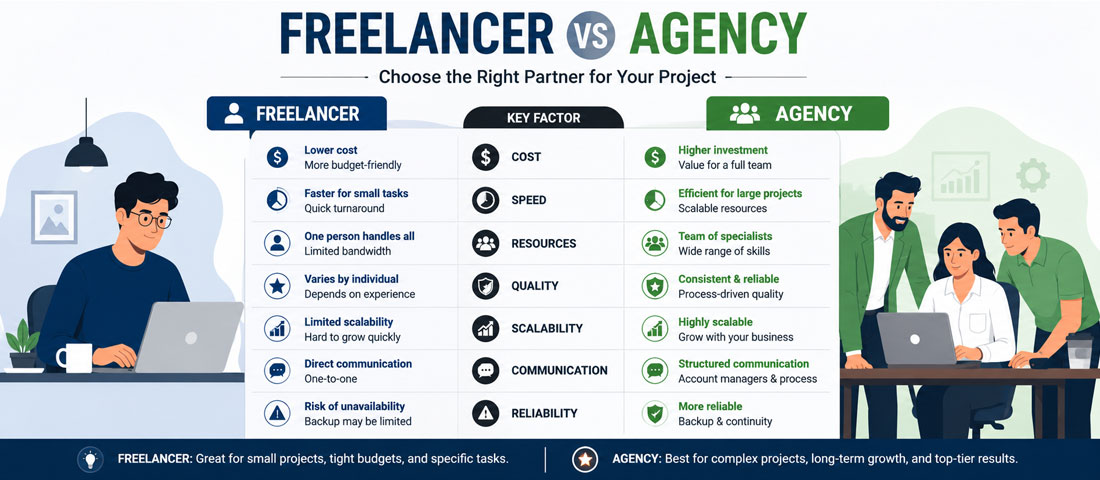
The table below summarises how the two options compare across the dimensions that genuinely affect the decision. Ranges reflect what we see in real client work and in the freelancers and agencies we cross paths with, rather than sales pitch claims from either side.
| Factor | Freelancer | Web Design Agency |
|---|---|---|
| Typical hourly rate | $25 – $150 | $75 – $300+ |
| Typical project cost (business site) | $1,000 – $8,000 | $3,000 – $30,000+ |
| Capability breadth | Narrow (specialist in 1-2 areas) | Broad (multi-discipline team) |
| Timeline reliability | Variable (depends on individual) | Generally strong (team absorbs variance) |
| Communication | Direct with the person doing the work | Via project manager (usually) |
| Ongoing support | Depends on freelancer’s availability | Structured, sustained |
| Risk of project stopping | High if freelancer becomes unavailable | Low (team continuity) |
| Scalability of the relationship | Limited (one person’s capacity) | High (team scales up if needed) |
| Personal engagement | Usually very high | Variable (agency-dependent) |
| Best for | Small focused projects, personal brands | Complex projects, business-critical sites |
Notice that neither option wins across every dimension. Freelancers are cheaper, more direct, and often more personally engaged. Agencies are broader, more reliable, and more sustainable over time. The right choice depends on which trade-offs matter most for your specific project, not on which model is “better” in the abstract.
For businesses genuinely weighing this decision, the seven questions below produce a reliable recommendation. Work through them in order — the answer usually becomes clear within the first three or four.
Want Help Making the Right Hiring Decision for Your Specific Project?
If you would rather talk through the decision with an experienced team — one that works alongside freelancers regularly and will tell you honestly if a freelancer is the right call for your project — we are happy to have that conversation. Honest advice matters more than the sales pitch, and we would rather steer you toward the right choice than pitch you the wrong one.
Being specific about the contexts where freelancers are the correct choice matters, because vague pro-agency defaults produce bad decisions as often as vague pro-freelance defaults do. Five contexts fit freelancers particularly well.
Single-discipline projects with clear scope. “I need a logo designed”, “I need a WordPress theme customised”, “I need copy written for these five pages”, “I need a landing page built”. When the work is one focused deliverable that a competent specialist can complete cleanly, freelance is efficient. Agency involvement adds coordination overhead that doesn’t produce proportional benefit.
Personal brands and artist portfolios. Websites that showcase individual work — photographers, designers, writers, consultants — often benefit from the personal working relationship freelancers offer. The freelancer’s creative sensibility can complement the client’s in ways that agencies with institutional processes sometimes can’t replicate.
Budget-constrained projects where the alternative is nothing. If your realistic budget is $2,000, an agency is genuinely not an option and forcing that comparison produces the wrong analysis. The right analysis is “given this budget, what is the best I can hire?” — and at that budget level, a good freelancer is almost always the right answer.
Businesses with strong internal capability that just need execution. If you have internal strategy, marketing, and project management capability, and you just need someone to execute one specific piece skillfully, a freelance specialist is often better than an agency for the piece you need. You’re providing the coordination the agency would otherwise charge for, so you should keep that value rather than pay for it twice.
Testing an idea before scaling to a proper build. An MVP, a proof of concept, a first-version site to see whether the business will work — these often justify the lower-investment freelance path before scaling to an agency build later. Committing to expensive agency infrastructure before you’ve validated the idea is a common founder mistake.
The corresponding pro-agency contexts are equally specific. Five situations warrant agency hiring even when a talented freelancer could technically handle parts of the work.
Multi-discipline projects that need everything working together. Business sites requiring design that supports the messaging, development that supports the design, SEO that supports the traffic goals, and content that supports the conversion strategy — all coordinated across the same project. Agencies exist to coordinate this coherence; freelancers can execute individual pieces but the coordination gap becomes the client’s problem.
Business-critical websites where reliability matters. If the site being late, wrong, or broken would meaningfully hurt the business — revenue impact, missed launches, competitive damage — the reliability of institutional delivery is worth the premium. This is why serious eCommerce businesses, funded startups, and enterprises with real market timing use agencies rather than freelancers even when talented freelancers exist in their networks.
Projects requiring ongoing relationships beyond launch. When you need not just the build but the ongoing evolution — regular updates, iterative optimisation, occasional new features — the institutional continuity of an agency provides sustainability that individual freelancers cannot reliably match over years. Businesses whose sites need to keep pace with the business itself benefit from partners who will be there in year three.
Projects with multiple stakeholders on the client side. When your marketing team, product team, executive sponsors, and IT team all have input on the site, the project management overhead of coordinating that input is significant. Agencies with proper project management processes handle this cleanly; freelancers often struggle with multi-stakeholder projects because they don’t have the process infrastructure to manage the complexity.
Complex custom development beyond templates and standard CMS work. Custom applications, marketplaces with unique logic, integrations with business systems, workflows that require actual engineering — these need teams with proper software development discipline. The proper approach to WordPress development at business scale, and especially anything moving beyond standard WordPress into custom territory, benefits significantly from the institutional capability agencies provide.
Beyond the visible cost differences, each option carries costs that don’t show up in the initial quote and tend to surface during or after the project. Being aware of them changes the honest comparison.
Freelancer hidden costs. Capacity constraints show up when you need more from the freelancer than they can deliver in your timeline — either the deadline slips or work quality suffers. Scope creep costs are magnified because freelancers often don’t have the process discipline to manage scope changes cleanly; the “just one more thing” pattern that would be a formal change order at an agency often becomes free extra work with a freelancer, until it doesn’t and the relationship sours. Availability variance means the freelancer who was responsive during sales may be less responsive when your project is competing with three other clients. Missing skill gaps produce work that’s technically delivered but has holes — SEO not properly configured, security not thought through, accessibility not addressed — that show up months later. Skills atrophy risk means a freelancer strong today may be weaker in two years without the exposure to varied projects agencies provide. Handoff and knowledge transfer become the client’s problem entirely because there is no team to transition to.
Agency hidden costs. Overhead priced into rates means you’re paying for the sales team, project managers, offices and profit margins whether you consciously want to or not. Communication layers dilute information — what you told the salesperson may not fully reach the developer, and multiple points of translation produce misunderstandings. Junior staff on your project despite senior sales is common at growing agencies — the pitch involves the senior partners but the delivery involves more junior people. Slower iteration is often real — agency processes exist for good reasons but they mean small changes take longer than the same change would with a freelancer. Post-launch support may be an add-on rather than included, producing surprise costs a year in when the site needs updates. Care variance is genuine — a small client at a large agency is often deprioritised versus larger clients, which shows up as slow response times and less senior attention.
The freelancer-versus-agency question has an additional geographic dimension that changes the economics substantially. The four combinations — local freelancer, offshore freelancer, local agency, offshore agency — each have distinct trade-offs worth understanding.
Local freelancers offer time zone alignment, direct communication in your language, and easier reference checking, at rates typically 40-70% below local agency rates. This is the “premium freelance” model — expensive by freelance standards, cheap by agency standards, and usually delivered by experienced professionals who chose freelance for lifestyle rather than economic reasons.
Offshore freelancers offer dramatically lower rates — often 60-80% below local freelancer rates — with the trade-offs of time zone difference, communication overhead, and higher variance in quality. The offshore freelance market is enormous and includes both excellent professionals and less capable operators; the variance is real and the vetting is harder from distance. For simple, well-scoped work with clear deliverables, offshore freelance can produce excellent value. For complex, ambiguous work, the coordination overhead often eliminates the cost advantage.
Local agencies offer the strongest combination of coordination, reliability, and communication ease, at the highest prices. This is the default choice for enterprise clients and businesses where the premium is genuinely worth paying for reduced management overhead. The rates typically justify the value in complex, high-stakes projects but represent overkill for simpler needs.
The same logic applies inside India, not just across borders — a business in Mumbai that wants to sit across a table from the people building its site will usually get more out of a web design company in Mumbai than out of a remote provider it can only reach by email, even when the remote quote is lower.
Offshore agencies — of which we are one — occupy a specific niche that combines agency capability with offshore economics. Rates are typically 40-60% below local agency rates but delivered with the institutional structure, capability breadth and reliability that pure offshore freelance cannot match. For businesses in the US, UK and other developed markets working with an offshore agency like our web design services for US clients often produces the best combination of quality and cost — access to capable teams working in your business hours (or with structured overlap), with the coordination benefits that agencies provide, at prices below local agency alternatives. The trade-off is that offshore agencies vary enormously in quality, so vetting matters more.
Not all freelancers are equal, and the good ones can be difficult to distinguish from the mediocre ones before you’ve committed. Five signals suggest you should keep looking.
Portfolio inconsistency. A freelancer whose portfolio shows dramatically different quality levels across projects — one polished, two rough, one middle-of-the-road — is likely producing variable quality depending on client involvement and effort. The freelancers whose portfolios show consistent quality across many projects are the ones you want.
Communication delays during the sales process. If the freelancer takes days to respond to initial questions when they’re actively trying to win your business, imagine what response times will look like when your project is competing with newer clients. Responsiveness during sales is the best predictor of responsiveness during delivery.
Vague deliverables and scope descriptions. Good freelancers can articulate exactly what you’ll get, in what form, by when. Vague scope descriptions (“I’ll design your website” without further specification) typically produce vague deliverables and disagreements later about what was actually included.
No clear process or workflow. Freelancers who can walk you through their typical project workflow — kickoff, research, design phases, review checkpoints, delivery — are running professional operations. Freelancers who improvise their process every project tend to produce inconsistent outcomes.
Won’t provide references or refuses to name past clients. Legitimate freelancers have clients who are willing to talk about their experience. Refusing references or providing only vague testimonials is either a sign of very few past clients, past clients who wouldn’t recommend the work, or an inexperienced operator not yet established.
Agencies have their own patterns of red flags, and being aware of them prevents the common mistake of paying agency prices for freelance-quality outcomes with no accountability.
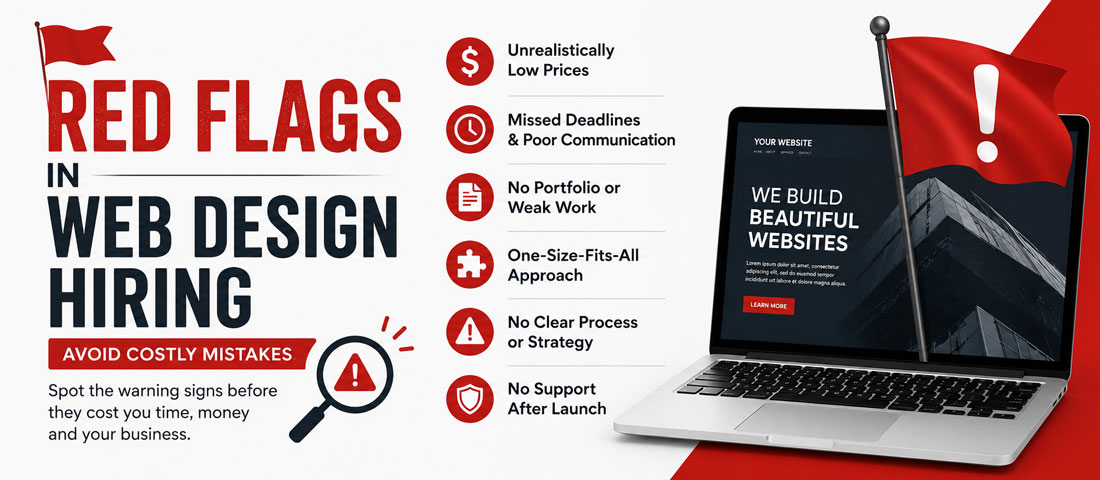
Slick sales that outstrip actual delivery capability. Agencies whose sales materials, initial calls and proposals are dramatically better than the finished projects they’ve delivered are the ones to avoid. Compare the polish of the pitch to the actual quality of case studies from clients similar to you. The deeper picture of what to specifically watch for is covered in our piece on red flags to watch for when hiring a web design agency, which goes into more specifics than fits here.
Portfolio all from the same era. An agency whose portfolio pieces are all several years old is either not doing recent work worth showing or has lost the capability to produce what they once did. Look for current work in the portfolio, not just historical highlights.
No source code ownership commitment. Agencies that don’t hand over source code after project completion are creating vendor lock-in similar to what AI builders create. Ask directly during sales whether you’ll own the source code and get the answer in writing. If it’s not standard, that’s a signal about how the agency thinks about client relationships. This is such a common dividing line that we cover it explicitly in our take on the choice between AI builders and web design agencies, where source code ownership is one of the primary agency differentiators worth insisting on.
Post-launch support as an expensive add-on. Agencies that treat post-launch support as separately paid work often view the client relationship as transactional rather than ongoing. Agencies that include meaningful post-launch support in the build are treating the site as a living asset. Ours includes 12 months of free support as standard, which is what “shipping a working site” should actually mean.
Junior staff on your project despite senior sales. Agencies where the pitch involves partners and the delivery involves junior staff are creating a mismatch between what you thought you bought and what you’re actually getting. Ask directly who will work on the project, not just who will sell it to you.
Vague or missing specifics on process. Good agencies can walk you through their project methodology — phases, deliverables at each phase, review checkpoints, change management, escalation processes. Agencies whose process description is generic or evasive often have processes that are similarly generic or evasive in practice.
Won’t confirm timeline reliability commitments. Serious agencies commit to timelines with meaningful specifics. Agencies that give vague timeline estimates and won’t commit to specific dates typically don’t deliver reliably. The proper approach to project management is one of the things separating serious agencies from marketing-heavy ones, and our discipline around UI/UX design engagements and every other service reflects the commitment to reliable delivery that clients pay agencies for in the first place.
The freelance-versus-agency choice is sometimes framed as binary when in fact many successful web projects combine both. Three hybrid patterns work well in practice.
Agency for the core, freelancers for specific specialised work. Agency handles the main build and coordination; specialist freelancers handle specific pieces the agency doesn’t do particularly well or that benefit from focused expertise. Copywriter for the sales pages, illustrator for custom graphics, videographer for the product videos, specialist SEO consultant for competitive strategy. This works when the agency is comfortable coordinating with the freelancers you bring in rather than insisting on doing everything themselves.
Agency for strategy and design, freelancer for execution and ongoing content. The agency establishes positioning, design system, and initial build; a freelancer handles ongoing content production, small updates and iterations at lower rates. The agency’s institutional strengths get used where they matter most; the freelancer’s cost efficiency gets captured for the ongoing work where it produces more benefit.
Multiple options during selection. Genuinely comparing freelance and agency options for the same project — not as a race to lowest bid but as parallel proposals — often reveals which is genuinely better suited to your specific work. The best freelancers and best agencies both produce serious proposals; the comparison reveals fit better than either option alone would.
The patterns of hiring decisions gone wrong are consistent, and most come from picking based on the wrong dimensions or ignoring the ones that actually matter for the specific project.
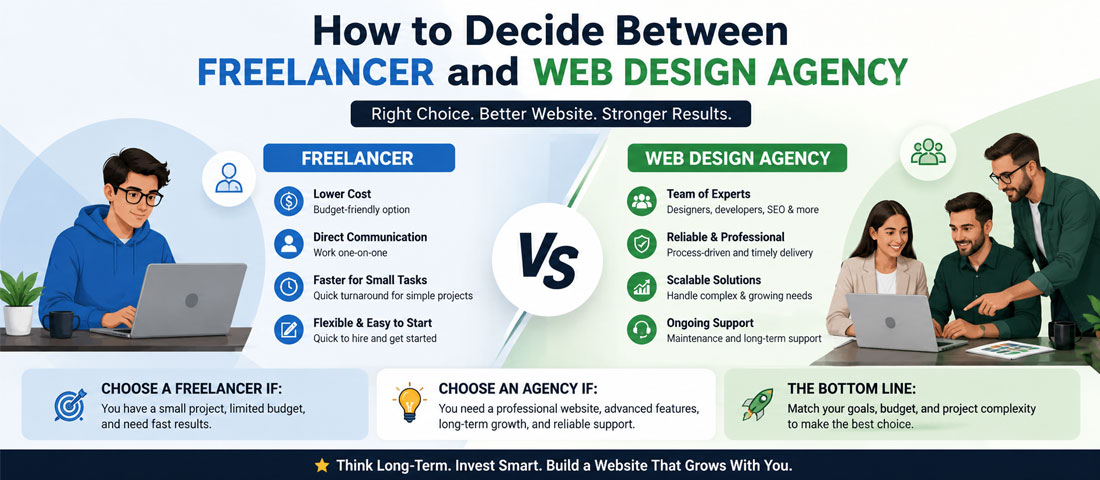
For businesses genuinely working through this decision, the methodology below produces a reliable answer more consistently than gut-feel selection. It separates the analytical work from the interpersonal work, which is where good decisions come from.
Step one: define your project scope honestly. Not aspirationally, not vaguely — specifically. Which pages, which functionality, which integrations, which content, which ongoing needs. The specificity forces you to confront whether you actually know what you want, which is worth knowing before you start comparing providers.
Step two: budget realistically for the total cost, not just the build. Include the likely scope adjustments, the ongoing support needs, the hosting costs, the migration costs if you’ll outgrow the current setup. The total-cost frame changes which option is genuinely cheapest more often than the invoice frame does.
Step three: get proposals from both a freelancer and an agency for the same scope. Real proposals, not just quotes — proper documents that describe how they’d approach the work, what they’d deliver, how they’d coordinate, what happens if things change. The proposals reveal how each thinks about the work, which tells you more than the price does. Our companion piece on questions to ask before hiring a web design company covers the specific questions worth including in the RFP.
Step four: check references from both. Talk to actual past clients — not just the ones the freelancer or agency picks, but ideally similar businesses to yours. Ask specifically about communication, timeline reliability, unexpected costs, and post-launch experience. Reference calls take an hour and prevent months of regret.
Step five: assess the working relationship honestly. Beyond the technical fit, do you actually want to work with this person or team? Communication styles, responsiveness, whether they seem to understand your business, whether they push back constructively or just agree with everything. The relationship dimension matters as much as the technical one.
Step six: make the decision and commit. Once the analysis is done, pick and move forward. Second-guessing after the decision is a common source of project friction. If the analysis was thorough, trust it. If you missed something material, you can course-correct — but don’t spend the project relitigating a decision that was reasonably made.
For most businesses, the framework above is sufficient to make the decision independently. There are situations where getting a second opinion on the choice itself is worth the small investment.
Bring in help when the project is significant enough that a wrong hiring decision produces disproportionate consequences — a $50,000 mistake justifies paying for advisory help that a $5,000 mistake doesn’t. Bring in help when your team lacks experience buying professional services and the risk of missing red flags is elevated. Bring in help when the freelance and agency proposals are close enough that the decision genuinely could go either way, and you want an experienced perspective on which fits better. And bring in help when you’re weighing offshore providers you can’t easily reference-check locally.
An advisory relationship, whether formal or informal, often saves significantly more than it costs. Many established agencies (including us) will have honest exploratory conversations with businesses that end up hiring freelancers or other agencies instead — the goodwill from an honest recommendation now often produces referral relationships and future work later. The businesses that navigate this space well are the ones treating early conversations as information-gathering rather than sales pitches, and the good providers reciprocate the honesty because it produces better long-term outcomes for everyone.

The honest summary of the freelancer-versus-agency question is that neither option is universally better — they are different tools for different situations, and matching the tool to the situation is what produces good outcomes. Freelancers win for small, focused, single-discipline projects where personal engagement and cost efficiency matter most. Agencies win for complex, multi-discipline, business-critical projects where institutional capability and reliability matter most. The middle ground where both are viable is where honest analysis of the specific project produces the answer more reliably than instinct. Whichever you choose, choose deliberately rather than by default, verify the fit through references rather than portfolios alone, and remember that this decision is not permanent — the right partner for this project may or may not be the right partner for the next one. The businesses that navigate this well are the ones treating the choice as one of many strategic decisions rather than a one-off transaction, and picking the option that genuinely fits what they’re building rather than the option that felt cheaper at the invoice or more impressive at the pitch.
| Is a freelancer cheaper than an agency? | Almost always at the invoice level, and often at the total-project level too — but not always. Freelance hourly rates typically run $25 to $150; agency rates typically run $75 to $300 or more. For a typical business website, freelance total costs run $1,000 to $8,000 while agency costs run $3,000 to $30,000+. However, the total cost of getting a project genuinely done includes scope adjustments, missing skills that need supplementing, timeline slippage, and post-launch DIY — and once these are honestly counted, the freelance advantage narrows for complex projects. For small, well-scoped projects, freelancers are genuinely cheaper. For complex multi-discipline projects, the freelance quote often looks cheaper but the total cost of getting to the same outcome ends up similar to or higher than the agency alternative. |
| Are web design agencies better than freelancers? | Neither is universally better — they are different tools for different situations. Agencies win where capability breadth, timeline reliability, and institutional continuity matter most: complex projects, business-critical sites, multi-stakeholder engagements, and long-term relationships. Freelancers win where personal engagement, cost efficiency, and focused execution matter most: small projects, single-discipline work, personal brands, and budget-constrained builds. Choosing the “better” option in the abstract produces worse outcomes than matching the specific option to the specific project. The businesses that navigate this well are the ones treating the choice as situation-dependent rather than choosing based on category preference. |
| Can a freelancer build me a full business website? | For most standard business websites, yes — a capable freelance web developer can deliver a professional site including design, WordPress development, basic SEO configuration, and content management. The limits appear when the project requires multiple specialised disciplines working together (design plus custom development plus deep SEO plus content strategy plus integrations), or when the site is business-critical enough that redundancy and institutional accountability matter. A single freelancer stretching to cover multiple disciplines usually produces adequate work in each area but exceptional work in none. If your project genuinely needs excellence across multiple areas, an agency’s team approach typically fits better. If your project needs one area done excellently and the rest done competently, a freelance specialist can often do this well. |
| What questions should I ask before hiring a web designer or agency? | Ten questions cover most of what matters. Who specifically will work on my project? Can I own the source code after the project? What is included in post-launch support and for how long? What is your process from kickoff to launch? Can you share references from similar recent projects? What happens if scope changes during the project? What is realistic for timeline, and what happens if it slips? How do you handle communication and reporting? What technology stack do you recommend for my project and why? What are the total expected costs including any items typically not in the initial quote? These questions surface most of the issues that cause project regret, and the quality of the answers reveals whether the provider is worth hiring more reliably than portfolio quality alone. |
| Should I hire a local freelancer or an offshore one? | Offshore freelancers offer dramatically lower rates — often 60-80% below local freelancer rates — with trade-offs in time zone alignment, communication overhead, and quality variance. For simple, well-scoped work with clear deliverables, offshore freelance can produce excellent value. For complex, ambiguous work, the coordination overhead often eliminates the cost advantage. Local freelancers offer easier communication, time zone alignment, and reference verification at rates 40-70% below local agency rates. The right choice depends on project complexity and your capacity to manage remote work. For businesses considering offshore engagement, an offshore agency (rather than an offshore freelancer) often produces the best combination of cost savings and delivery reliability — agency infrastructure with offshore economics. |
| What happens if my freelancer disappears mid-project? | This is one of the specific risks freelance engagement carries and one of the reasons agencies exist. If your freelancer becomes unavailable due to illness, family emergency, or simply going non-responsive, your project stops — there is no team to cover, no institutional continuity, and no formal escalation process. Recovery involves either waiting for the freelancer to return (with no certainty about when or whether), hiring a new freelancer to pick up from wherever the work stopped (usually painful because the new person didn’t build what they’re inheriting), or starting over. The risk is real and worth thinking about honestly during hiring — for projects where “the project stopping” would seriously hurt the business, this dimension often decides the freelance-versus-agency choice on its own. Mitigations include hiring freelancers with clear backup arrangements, milestone-based payments that align incentives, and clear documentation requirements throughout the project. |
| How do I know if I need an agency for my project? | Four signals suggest agency capability is warranted. First, the project genuinely requires multiple specialised disciplines working together — design, development, SEO, content, strategy — not just executed sequentially by one person. Second, the timeline is mission-critical and reliable delivery matters more than cost efficiency. Third, the site will need ongoing support and iteration over years rather than being a one-time build. Fourth, the site’s role in the business is significant enough that the risk of a wrong outcome would materially hurt the business. If most of these are true, an agency’s institutional capability typically justifies the higher cost. If they are mostly not true — small scope, flexible timeline, one-off build, low risk — a freelancer is likely the more appropriate choice. The framework in this guide provides more detail, but these four signals cover the most common cases. |
Want an Honest Read on Whether we’re he Right Partner for Your Project?
We build websites for businesses across services, eCommerce, and complex custom platforms — and when a freelancer would genuinely serve you better, we’ll tell you that. With 14+ years of experience, 550+ clients served, source code ownership on every project and 12 months of free support after launch, we treat client relationships as long-term partnerships rather than one-off transactions. Send us a brief and we’ll respond within one business day with an honest read on whether we’re the right fit — or a genuine recommendation of what would be if we’re not.
Whether you have a new idea, a business challenge, or something you would like to improve, we are here to help. From building websites, online stores, CRM systems, and custom applications to exploring AI solutions, improving SEO, or growing your sales, simply tell us what you have in mind, and we will help you find the best way forward.
A member of our team will review your enquiry and respond within one working day.
If the matter is urgent, you are welcome to contact us on WhatsApp or call +91 91366 94505.