How Indian Tech Companies Win Global Clients in 2026
Something has shifted in the way global businesses think about Indian technology partners. For most of the 2000s and 2010s, the conversation was framed entirely around cost — Indian agencies and developers were chosen because they were cheaper, with the implied understanding that quality was a trade-off being accepted. That framing is increasingly outdated, and businesses that still hold it are making a strategic mistake.
In 2026, the leading Indian technology companies are not winning global clients by being cheap alternatives. They are winning by delivering outcomes that UK, USA, Australian, and Canadian clients cannot match at any price domestically — the combination of genuine technical expertise, strong process discipline, time zone coverage that extends working hours, and a price point that allows clients to invest the saved budget into faster growth rather than overhead.
This guide examines exactly how the best Indian tech companies are positioning, operating, and winning globally in 2026 — and what this means for businesses considering an Indian technology partner for web design, development, digital marketing, or software projects.

Why the Narrative Around Indian Tech Has Fundamentally Changed
India’s technology sector in 2026 is not the same industry it was a decade ago — and the global businesses that recognise this are accessing capabilities and value that their competitors who have not updated their mental model are missing entirely.
The Scale and Depth Has Grown Beyond Recognition
India produces approximately 1.5 million engineering graduates annually — more than any other country. The technology education ecosystem that has developed around this talent pipeline includes not just IITs and NITs but thousands of specialised technology institutes producing graduates in full-stack development, cloud architecture, mobile application development, artificial intelligence, UI/UX design, and digital marketing. The quality variance across this talent pool is enormous — but the ceiling has risen dramatically.
India’s technology sector generated over $250 billion in revenue in 2024-25, with exports accounting for approximately $200 billion. These are not cottage industry numbers. The Nasscom ecosystem includes companies of every size — from 500,000-person enterprises like TCS and Infosys to boutique specialist agencies of 10 to 50 people delivering work that is genuinely world-class in quality.
A Generation of Global Exposure Has Changed Expectations
The founders and senior teams running India’s best technology companies in 2026 have, in many cases, worked for or studied at global organisations. They have worked alongside UK developers, studied design systems from American product companies, and built their professional networks across three continents. They understand what global clients expect — not from research, but from experience.
This generation of leadership has built companies that operate to global standards by default rather than by exception. Their project management tools are the same ones used in London and San Francisco. Their design references come from the same industry sources. Their code review standards and quality assurance processes reflect the same expectations that a New York startup or a Manchester agency would hold.
Remote Work Has Eliminated the Distance Penalty
The global shift to remote work that accelerated during 2020 and 2021 permanently changed how businesses think about geography. A UK business that spent 2020 to 2023 managing an entirely distributed team across multiple cities came to realise that a developer in Mumbai was no more remote than one in Manchester — and in some respects more reliably available, given the structured async communication discipline that Indian teams had developed over decades of cross-timezone client work.
Video calls, shared project management platforms, collaborative design tools, and asynchronous communication protocols have made the practical experience of working with a Mumbai agency versus a domestic one largely indistinguishable from an operational standpoint — for clients who know how to work in this mode.

India’s best technology companies operate modern, professional environments staffed by genuinely skilled teams who work to international standards — the stereotypes that shaped earlier perceptions no longer reflect the reality of the sector’s leading firms.
The Real Competitive Advantages Indian Firms Hold in 2026
Understanding why Indian tech companies win global clients requires moving past the cost discussion to the actual structural advantages that the best firms provide. Cost is one of those advantages — but it is not the most important one for the clients who choose Indian partners thoughtfully.
Advantage 1: Genuine Cost Efficiency That Enables Reinvestment
The cost difference between a quality Indian web design or development agency and an equivalent UK or Australian firm is real and significant — typically 50 to 70% lower for comparable quality. A website that costs £25,000 from a London agency might cost £8,000 to £12,000 from a Mumbai agency of equivalent capability. A full-stack development project that would require £100,000 from a domestic UK firm might be accomplished for £35,000 to £50,000 with an Indian partner.
The commercially intelligent way to think about this difference is not as savings but as redeployable capital. The £13,000 to £17,000 not spent on the website build can be invested in content marketing, paid advertising, or a next development phase. The agency that costs 60% less does not deliver 40% less value — in many documented cases, it delivers equivalent or superior value while freeing budget for the activities that actually drive growth.
Advantage 2: Time Zone Coverage That Extends Your Working Day
India Standard Time (IST) is UTC+5:30 — which places Mumbai between 4.5 and 5.5 hours ahead of the UK and 10.5 to 13.5 hours ahead of the US West Coast. For clients in the USA, UK, Australia, and Canada, this time zone position is a genuine operational advantage rather than a challenge.
A UK business that sends a briefing at 5pm on a Friday receives a response and often a completed task by Monday morning — because for the Mumbai team, it is Monday morning when they start work. Issues that arise at end of business in New York are resolved by the time the New York team arrives the next morning. The effective working day of a business with a Mumbai technology partner extends well beyond the domestic team’s hours — creating a near-continuous development and support capability that domestic-only teams cannot match.
Advantage 3: Multi-Disciplinary Teams Under One Roof
India’s established technology agencies have built multi-disciplinary capability that smaller domestic agencies in Western markets struggle to match at comparable price points. A Mumbai agency of 30 people might include: senior web designers, full-stack developers (MERN, Laravel, PHP), mobile app developers (iOS, Android, Flutter), SEO specialists, digital marketing managers, UI/UX designers, graphic designers, and project managers — all working under coordinated project management with established processes for cross-discipline collaboration.
A UK or Australian business working with this type of Indian agency accesses the equivalent of five specialist agencies through a single point of contact, at a total cost that is often lower than a single domestic agency handling just one of those disciplines. The integrated capability is particularly valuable for businesses launching or relaunching digital presences that require coordinated design, development, and marketing from the outset.
Advantage 4: Process Maturity From Decades of Client Service
India’s technology export industry has been serving international clients since the late 1990s. The agencies that have survived and grown across three decades have done so by developing the project management discipline, client communication protocols, and quality assurance processes that international clients require. They have learned through experience what kills client relationships — missed deadlines, unclear scoping, poor communication across time zones — and built systems to prevent each.
The best Indian agencies have project management processes, client reporting formats, and communication protocols that are more mature than many younger domestic agencies in Western markets whose entire existence has been post-2015. This process maturity is invisible until something goes wrong — and with a process-mature agency, fewer things go wrong.
How Leading Indian Agencies Have Closed the Quality Perception Gap
The quality perception gap — the belief, often unexamined, that Indian work is inherently lower quality than domestic work — has been the single largest barrier to global Indian tech success. The leading agencies have addressed it through a combination of verifiable proof, international credibility signals, and transparent communication.
Portfolio Work That Speaks for Itself
The most direct answer to quality concerns is a portfolio of work for international clients that is demonstrably excellent. Indian agencies that have invested in serving UK, USA, and Australian clients well have accumulated portfolio evidence — live websites, measurable performance improvements, client results — that makes quality claims verifiable rather than asserted.
When a Mumbai agency can point to twenty websites built for UK law firms, American eCommerce brands, and Australian professional services companies — all live, all performant, all with verifiable client testimonials — the quality question becomes much easier to answer. The portfolio does the credibility work that cost comparisons cannot.
International Review Platforms and Verified Testimonials
Clutch.co — the leading B2B agency review platform — has become an important credibility signal for Indian technology companies targeting global markets. Clutch verifies client testimonials through direct client interviews, making the reviews significantly more trustworthy than self-published testimonials. Indian agencies with strong Clutch profiles — 4.8+ ratings across 30 or more verified reviews — have a credibility asset that directly addresses quality concerns for international prospects researching their options.
Google Business Profile reviews carry similar weight, particularly for agencies that serve geographically distributed markets. A Mumbai agency with 40+ Google reviews averaging 4.9 stars from clients across four continents has verifiable social proof that a new domestic competitor with 6 reviews cannot match.
Communication Quality as a Differentiator
One of the most significant concerns international clients have about Indian partners is communication — specifically, whether language barriers, time zone gaps, and cultural differences will make the working relationship difficult. The agencies that win and retain global clients have addressed this by investing heavily in written and verbal communication quality at every client-facing level.
English-language communication is a genuine competitive advantage for Indian agencies over equivalent firms in non-English-speaking markets. India’s business English proficiency is high — in many cases higher than the spoken English of European competitors working in their second language. The agencies that consistently retain global clients are those whose written communication — proposals, briefs, status updates, revision notes — is clear, professional, and technically precise.
What Global Clients Actually Experience — The Reality
Beyond the structural analysis, what is the actual experience of working with a quality Indian technology partner from the perspective of a UK, USA, or Australian business? Here is an honest account based on documented client experiences across the industry.
The Discovery and Proposal Stage
The best Indian agencies invest significantly in the pre-engagement phase. Rather than generic proposals based on minimal information, they conduct detailed discovery conversations, ask the questions that reveal whether the engagement is a genuine fit, and produce proposals that reflect specific understanding of the client’s business rather than template documents with the company name swapped in.
Clients who have worked with both domestic and Indian agencies frequently note that the proposal quality from leading Indian firms is superior — more specific, more thorough, and more clearly reflecting that the agency has understood the brief at a deeper level than the domestic alternative that sent a one-page quote within 24 hours.
The Working Relationship
The time zone dynamic, once managed with clear communication expectations, typically becomes a positive rather than a negative. Clients establish a daily or weekly video check-in rhythm, use tools like Slack for async communication, and find that the Indian team’s work output during the client’s off-hours means progress is consistently visible each morning.
Experienced international clients develop communication habits that work well across time zones: detailed written briefs rather than relying on verbal communication; clear scope documentation; and structured feedback rather than casual verbal feedback that can be misinterpreted or forgotten. These habits, developed working with Indian partners, make those clients better clients for any agency they work with.
The Delivery Outcome
The clients who choose Indian technology partners strategically — based on verified portfolio evidence, direct reference checks, and thoughtful evaluation of fit — report outcomes that match or exceed what they achieved with domestic agencies at significantly higher cost. The clients who choose Indian partners purely on price, without adequate vetting, report the experiences that fuel negative perceptions — and those perceptions, while based on real experiences, reflect poor selection rather than an inherent quality limitation of Indian tech.
Sectors Where Indian Tech Companies Lead Globally
WordPress, Shopify & Custom Builds
Indian web design agencies deliver professional custom websites for UK and USA markets at 50–70% below domestic rates. The sector’s maturity — 25+ years of international client service — has produced agencies with sophisticated design capability, technical excellence, and project management discipline that rivals domestic alternatives at any price point.
MERN, Laravel, Mobile Apps
India’s software development talent pool is genuinely world-class at the senior level. Indian development teams are building the software products that UK and US startups go to market with — not as subcontractors but as the core technical team. The equity and revenue implications of this shift are significant.
Content, SEO, PPC Management
Indian digital marketing agencies manage significant paid advertising budgets and SEO programmes for international clients — with the analytical rigour, reporting discipline, and English-language content capability to serve sophisticated global markets. Monthly retainer rates of $500–$2,000 compare with $3,000–$8,000 for equivalent domestic agency engagement.
Brand Identity & Interface Design
Indian design teams trained on international design systems and toolsets (Figma, Adobe Creative Suite) produce brand identities and interface designs that international businesses proudly represent. Design work — inherently visual and evaluatable — has the lowest credibility barrier of any tech discipline, and strong Indian design portfolios speak for themselves.
How to Identify a Genuinely Excellent Indian Tech Partner
The quality variance in India’s technology sector is the most important consideration for any business evaluating Indian partners. The difference between the best and worst Indian agencies is larger than the equivalent variance in most Western markets — and the selection process must reflect this.
-
Verify their international client portfolio specifically
Ask specifically for portfolio work completed for clients in your country and industry. A Mumbai agency with 20 live websites built for UK businesses is a fundamentally different proposition from one whose portfolio is entirely domestic Indian work. International client experience indicates the agency understands international design conventions, communication expectations, and delivery standards — not just the technical capability to execute. -
Check Clutch and Google reviews — and read the detail
Do not just look at the rating — read the individual reviews. Look for: consistent mentions of communication quality, delivery against promised timelines, and honest descriptions of what went well and what was challenging. Agencies with 30+ verified Clutch reviews have a track record that cannot be fabricated. Google Business Profile reviews from identifiable international clients are equally valuable. An agency with 4.9 stars across 40+ Google reviews from clients in four countries has earned that credibility. -
Speak directly to reference clients
Request and actually call two or three current or recent clients based in your country. Ask specifically: How was the communication across time zones in practice? Were deadlines met? Were there surprises in the final cost? Would you commission another project? The answers to these questions reveal the working reality more reliably than any portfolio presentation. -
Evaluate their written communication quality
Every piece of written communication from the agency before you sign — the initial response, the discovery questions, the proposal — is evidence of what the working relationship will feel like. Clarity of writing, technical precision in scoping, and the quality of questions asked during discovery all signal the agency’s professional standard. A proposal full of grammatical errors or vague scope language predicts the communication quality you will experience throughout the project. -
Test their process transparency
Ask directly: how do you manage projects? What tools do you use? How do you handle scope changes? What happens when a deadline is at risk? A professional agency has clear, confident answers to all of these questions — because they have worked through these situations many times and have established processes for each. Vague or evasive answers to process questions are a reliable warning signal.
What the Next Five Years Look Like for India’s Global Tech Position
India’s technology sector trajectory over the next five years suggests the competitive position will strengthen rather than erode — driven by several converging trends.
AI Adoption Is Accelerating Indian Output
The integration of AI coding tools (GitHub Copilot, Cursor), AI design tools (Figma AI, Midjourney), and AI content tools into Indian agency workflows is compressing production timelines in ways that benefit clients directly. Projects that took eight weeks are taking five. Deliverables that required three senior team members now require two. This productivity multiplier, applied to already price-competitive teams, further extends the value differential between Indian and domestic Western agencies for comparable output quality.
The Talent Pipeline Is Widening and Deepening
India’s commitment to technology education continues to expand. Beyond the IIT-NIT system, newer institutions and online learning platforms are producing technically sophisticated graduates at scale. The penetration of high-quality technical education into tier-2 and tier-3 Indian cities — Indore, Coimbatore, Jaipur, Nagpur — is producing talent pools that were inaccessible to international clients a decade ago.
The Reputation Premium Is Becoming a Feedback Loop
As more international businesses have positive documented experiences with Indian technology partners, the credibility barrier for the next generation of Indian agencies decreases. The Clutch profiles, the Google reviews, the LinkedIn testimonials, and the word-of-mouth recommendations accumulating across thousands of international client relationships are systematically closing the trust gap that made the quality-before-cost evaluation difficult for the previous generation of clients.
Specialisation Is Increasing
The most competitive Indian agencies in 2026 are not trying to serve everyone — they are building deep expertise in specific industries, specific platforms, or specific technical domains. An Indian agency that has built 150 WordPress websites for healthcare providers, or 80 Shopify stores for fashion brands, or 40 custom SaaS products for fintech startups has a genuine specialisation depth that generic domestic agencies cannot match. This specialisation trend will continue — producing agencies whose expertise in a specific domain is world-class, not just cost-competitive.
Frequently Asked Questions: Indian Tech Companies and Global Clients
| Why are UK and USA businesses choosing Indian tech companies in 2026? | Businesses in the UK, USA, Canada, and Australia choose Indian technology companies in 2026 for a combination of reasons that go well beyond simple cost savings. The primary driver for most clients is the combination of genuine technical quality with a price point that is 50 to 70% below equivalent domestic agencies — enabling them to invest the saved budget into growth activities rather than overhead. Secondary drivers include India’s English-language proficiency (which makes communication more natural than working with European agencies in their second language), the time zone advantage that creates near-continuous development capability, multi-disciplinary team depth that is difficult to access at comparable cost domestically, and the accumulated track record of international client service that the best Indian agencies have built over 20+ years. The narrative has shifted from “Indian agencies are cheap” to “Indian agencies deliver excellent value” — a meaningful difference for the businesses that have evaluated and experienced the distinction. |
| How do I know if an Indian web design agency is trustworthy? | Trustworthiness in an Indian technology agency is verifiable through five specific signals. First, verify their international client portfolio — look for live websites built for clients in your country, not just domestic Indian work. Second, check their Clutch.co profile for verified client reviews and their Google Business Profile rating across a meaningful number of reviews (30 or more indicates a track record rather than managed reputation). Third, request and actually call two or three reference clients in your country or industry and ask direct questions about communication quality, timeline adherence, and whether they would commission again. Fourth, evaluate the quality of their written communication during the proposal process — clarity, technical precision, and the thoughtfulness of their discovery questions all signal the professional standard you will experience throughout the project. Fifth, ask specific process questions — how do they manage projects, what happens when scope changes arise, what tools do they use — and evaluate whether the answers are specific and confident or vague and evasive. |
| How does working across time zones with an Indian agency actually work? | Working across time zones with an Indian agency — IST is UTC+5:30, placing Mumbai 4.5 to 5.5 hours ahead of the UK and 10.5 to 13.5 hours ahead of US West Coast — is most effectively managed through a combination of structured async communication and one synchronous touchpoint per day or week. In practice: detailed written briefs replace verbal conversations that cannot be referenced later; a shared project management tool (typically Asana, Trello, Basecamp, or Jira) maintains real-time visibility of progress without requiring constant communication; a weekly or twice-weekly video call handles discussion items that require real-time dialogue; and async messaging (Slack, WhatsApp, email) handles questions and updates across the day. Clients who establish these communication rhythms consistently report that the time zone difference becomes an advantage — work progresses during their off-hours, and each morning brings visible progress. The clients who struggle with Indian time zones are typically those expecting the same instant-response, informal communication pattern they use with a local team. |
| What is the real cost difference between hiring an Indian vs UK or USA web design agency? | The cost difference between a quality Indian web design agency and a comparable UK or USA agency is typically 50 to 70% — meaning a project that costs $20,000 from a London or New York agency typically costs $6,000 to $10,000 from a Mumbai agency of equivalent quality. For a custom WordPress or Shopify website project, this means: a UK agency might charge £15,000 to £30,000 for a quality custom build; a quality Indian agency with a strong international portfolio and verified reviews would typically charge £5,000 to £12,000 for equivalent scope and quality. For ongoing digital marketing retainers, the difference is similar: a UK agency monthly retainer of £3,000 to £6,000 might be £800 to £2,000 from an Indian agency of equivalent expertise. The commercially strategic framing is not “how much am I saving?” but “what can I do with the freed budget?” — because the capital not spent on agency fees can be invested in advertising, content, product development, or faster growth. |
| Do Indian tech companies produce the same quality as UK or USA agencies? | The honest answer is: the best Indian technology companies produce work that is equivalent to and in some domains better than the best Western agencies — and the worst Indian agencies produce work that is worse than the worst Western alternatives. The quality variance within India’s technology sector is wider than the equivalent variance in most Western markets, which is why selection methodology matters so much. A business that selects an Indian agency through the same rigorous evaluation process they would apply to a domestic agency — portfolio verification, reference calls, proposal quality assessment, process transparency evaluation — will find agencies whose work quality is indistinguishable from domestic alternatives. A business that selects on price alone, without adequate vetting, will likely confirm the negative stereotypes. The quality is there in the sector — the work of selection is finding it. |
| What types of projects are best suited to Indian tech companies? | Indian technology companies excel across a wide range of digital project types, with particular strength in: custom web design and development (WordPress, Shopify, WooCommerce, Laravel, MERN stack), mobile application development (iOS, Android, Flutter, React Native), UI/UX design and graphic design, SEO and digital marketing management, and custom software development. Projects that are well-suited to Indian partnerships share common characteristics: they can be clearly scoped and briefed in writing; deliverables are objectively evaluable (a website either works or it does not; rankings either improve or they do not); and the working rhythm can be managed through structured async communication with periodic synchronous touchpoints. Projects that require constant informal in-person collaboration or highly time-sensitive same-day turnaround of creative work may be better served by closer-proximity partners, though even these constraints are less significant than they were before remote collaboration tools matured. |
| How has India’s technology sector changed in the last five years? | India’s technology sector has undergone several significant changes in the five years from 2020 to 2025 that directly affect the experience of global clients working with Indian partners. The global shift to remote work normalised distributed team working, eliminating much of the psychological barrier to international technology partnerships. AI tool adoption — GitHub Copilot for development, Figma AI for design, and content AI tools — has accelerated delivery times and in many cases improved output quality in Indian agencies that invested in AI workflow integration early. The quality of the sector’s international client communication has improved significantly as a new generation of internationally-educated founders have built agencies to global professional standards from inception. Independent review platforms like Clutch have created verifiable credibility infrastructure that allows strong Indian agencies to demonstrate their track record objectively. And the depth of specialisation has increased — the best Indian agencies are no longer generalists offering everything; they are specialists with deep expertise in specific platforms, industries, or technical domains. |
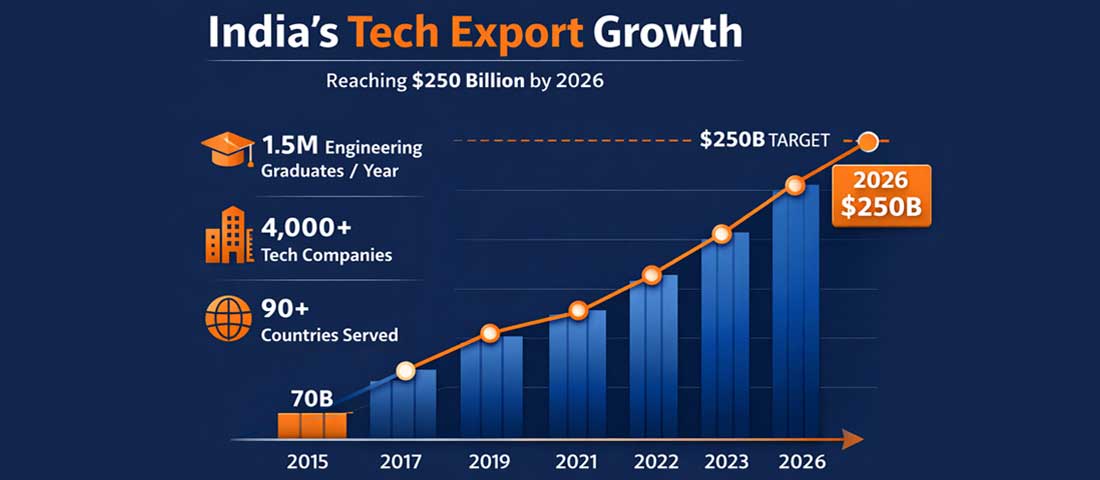
India’s technology export sector has grown to $250 billion annually — a scale that reflects not just volume but the accumulated expertise, process maturity, and quality standards that decades of international client service have produced.

The team behind India’s global tech success — skilled, internationally-minded professionals who understand what global clients need and have built processes and portfolios to consistently deliver it.
Looking for an Indian Web Design Agency that has been Serving International Clients Since 2014?
Neel Networks is a Mumbai-based web design, development, and digital marketing agency with 12+ years of experience, 450+ international clients across the USA, UK, Canada, Australia, and India, and a 4.9-star Google rating from 43 verified reviews. We build websites and digital marketing solutions that perform — at a price that makes sense for your budget.