Outsourcing to India in 2026: What Has Changed and What to Watch For
If you outsourced any digital work to India between 2015 and 2022, the playbook you remember is mostly gone. Rates have shifted. The talent pool has split into very different tiers. AI has compressed delivery timelines but also widened the gap between agencies that know what they are doing and ones that bluff their way through. And the questions you need to ask before sending a brief overseas are not the questions buyers were asking three years ago.
This guide is written from the inside. We are an Indian agency that has worked with clients across the US, UK, Canada and Australia for over twelve years. We have seen the cycle from both sides — the briefs that go well, the ones that go sideways, and the patterns that explain why. If you are new to this space, our broader outsourcing to India global guide is the right starting point. This piece picks up where that one leaves off — covering what specifically has changed in 2026 and what to look out for before you sign anything.

How the outsourcing equation has changed since 2020
The single biggest shift since the pandemic boom is that the “cheap labour” argument no longer holds up the way it used to. It is still cheaper than building a team in London, Sydney or San Francisco — but the gap is no longer 5x. At the top of the market, an experienced Indian agency now charges only 30 to 50 percent less than a comparable Western team for similar quality of work. The bottom of the market is still cheap, but the risk you take at that price level has grown, not shrunk.
Five forces are responsible for this shift. They are worth understanding before you compare quotes, because each one explains why two agencies in the same city can quote ranges that are 10x apart for what looks like the same job.
1. AI has rewritten what “delivery” means
Tools like Cursor, Claude Code, Copilot and ChatGPT have collapsed the time it takes to build a standard business website. What used to be a three-month build is now a three-to-four week build for any agency that knows how to use these tools well. That sounds like good news for buyers, and it is — but it also means the agencies that have not adopted AI properly are now uncompetitive on price and timeline both. You will see a wider spread of quotes than ever before, and the lowest quote is no longer automatically the agency cutting corners. Sometimes the lowest quote is just the agency with the better workflow.
2. The talent pool has split into clear tiers
There used to be a fuzzy middle in the Indian outsourcing market — generalist agencies that handled everything passably. That middle has thinned out. What you now have is a top tier of senior, design-led shops that compete on quality and process, a bottom tier of body-shop operations that compete only on price, and a fast-growing tier of solo founders running highly profitable two-to-five-person studios. Choosing the wrong tier for your project size is the most common mistake international buyers make.
3. Senior Indian talent now works direct
The best Indian developers, designers and SEO specialists do not need to work for a large agency anymore. Many of them sell directly to overseas clients through LinkedIn, Upwork or their own personal brands. This is good if you can find and vet them. It is bad if you assume “agency” means “senior team” — because the senior people have, in many cases, already left to run their own thing.
4. The rupee has weakened in your favour
The Indian rupee has continued to depreciate against the US dollar, pound and Australian dollar through 2024 and 2025. For a buyer paying in foreign currency, this means Indian work has effectively become more affordable in real terms even where rupee rates have risen. Top-tier agencies have responded by raising their dollar rates to keep pace with their own costs, but the structural advantage is still meaningful.
5. Compliance and data protection are real now
India’s Digital Personal Data Protection Act has been in force for over a year, and any Indian agency that handles your customer data is now legally required to follow specific rules around storage, consent and breach reporting. This is not optional and it is not theoretical — it is enforced. Combine that with the GDPR exposure you already have if you sell into Europe, and the compliance conversation with your outsourcing partner is now non-negotiable. Three years ago you could skip this. You cannot anymore.
What you actually pay in 2026: a real pricing breakdown
Pricing varies wildly because the Indian market is genuinely fragmented. What is more useful than a single number is a tiered view of what each price band actually buys you. The table below reflects current 2026 rates we see in the market for typical business website projects delivered to overseas clients.
| Price band (USD) | What you typically get | Risk level |
|---|---|---|
| $300 – $800 | Solo freelancer or microteam. Template-based WordPress build. Minimal discovery, minimal customisation, no formal QA. | High |
| $800 – $2,500 | Small studio. Custom WordPress or basic Shopify. Some design input, basic on-page SEO. Variable team experience. | Medium |
| $2,500 – $8,000 | Established agency. Custom design, proper UX process, on-page SEO, real QA, post-launch support. Tier where most serious overseas buyers should sit. | Low |
| $8,000 – $25,000 | Senior agency. Custom development, complex integrations, conversion-focused design, content strategy, ongoing performance work. | Low |
| $25,000+ | Specialist or boutique. Headless commerce, custom CMS, multi-region builds, dedicated team, enterprise compliance. | Low |
The trap most overseas buyers fall into is comparing a $1,200 quote against a $6,000 quote and thinking they are choosing between the same product at different prices. They are not. They are looking at two completely different operating models. The $1,200 build will probably exist, the $6,000 build will probably work for your business. If you need it to actually drive enquiries, conversions and rankings, the tier you sit in matters more than which agency inside that tier you pick.
Why outsource to India at all in 2026?
If the cost advantage has narrowed, the obvious question is whether outsourcing is still worth the friction. For the right kind of work, the answer is yes — but the reasons have evolved.
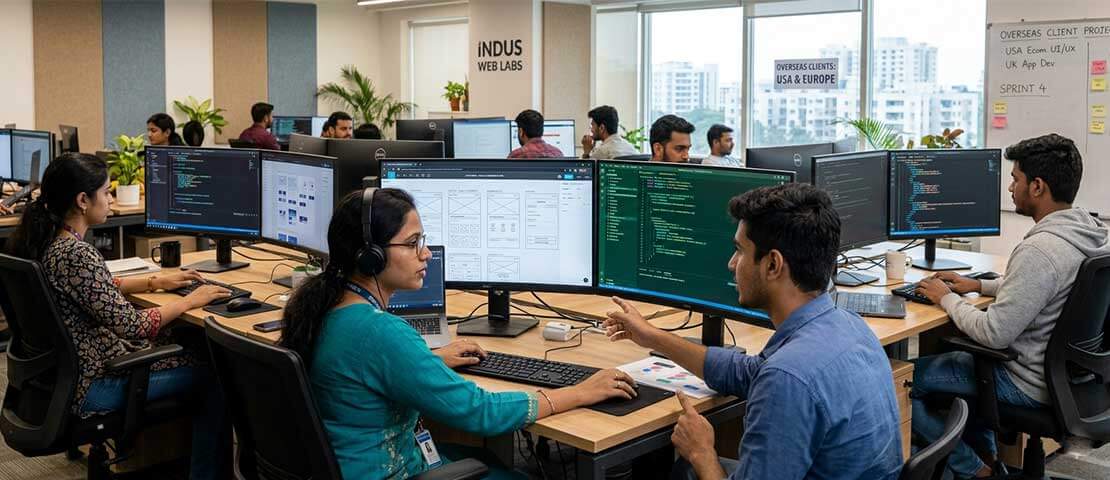
The first reason is depth of talent. India produces more software engineering, design and digital marketing graduates than any other country, and the senior end of that pool has now logged a decade or more working with Western clients. Communication standards, time tracking discipline and project management maturity at top-tier Indian agencies are no longer the differentiator buyers worry about — that worry has shifted down-tier.
The second reason is the follow-the-sun model. If your team in London logs off at 6 pm, an Indian team can pick up from 8 pm and push the project forward overnight. By the time you start your next day, design rounds have been done, code has been deployed to staging, SEO reports have been compiled. This is no longer a side benefit — it is a real productivity edge for businesses that have learned how to use it.
The third reason is that the senior Indian agencies have moved up the value chain. They are not just executing your wireframes anymore. The good ones are running discovery, advising on architecture, building conversion strategy, deploying AI workflows on your behalf. We have written separately about how Indian tech companies are now winning global clients on merit, not just on price — and the patterns there map closely to what overseas buyers should expect from a senior partner. The work is more strategic than it was, and the buyers who treat their Indian partner as a thinking collaborator rather than a pair of hands get dramatically better outcomes.
The fourth reason is scale. If you need to build out a content library of fifty SEO articles in six weeks, or migrate four hundred blog posts to a new CMS, or build out twenty location landing pages with proper schema and unique copy — there is no Western team that will quote you a reasonable rate for that volume. India can. That kind of scale work is where outsourcing still has its sharpest edge.
Considering an Indian agency for your next project?
We have spent twelve years delivering web, app, SEO and design work to clients across the US, UK, Canada and Australia. If you want a straight answer on whether your project is a good fit for offshore delivery — and what it would actually cost — we are happy to walk you through it.
What work is best suited to Indian outsourcing
Not every project should go offshore. Knowing which workloads are well suited and which ones are not will save you a lot of grief. The pattern across our own twelve-year client base — and across honest conversations with other agency owners — is consistent.
Well suited: WordPress and WooCommerce builds, Shopify and headless commerce, custom PHP and Laravel applications, React and Next.js front ends, mobile app development on Flutter and React Native, technical SEO, content production at scale, ongoing website maintenance, graphic design and brand identity, and the operational SEO work that needs steady weekly execution. These are all workflows where the deliverable is concrete, the spec can be written down, and quality can be verified.
Trickier: Brand strategy that requires deep cultural fluency in your specific market, copywriting where regional voice really matters, complex sales-led B2B campaigns that need same-day responsiveness, and any work where the agency needs to attend in-person meetings with your customers. These are not impossible, but they need the right partner and a different working model.
Not well suited: Anything that requires same-hour real-time turnaround across full business hours, high-trust legal or financial workflows with regulated data, and short-burst creative work where the brief evolves hour-by-hour. For those, you want someone in your time zone and your culture.
The red flags every overseas buyer should know
The buyers who get burned in 2026 are almost always the buyers who ignored at least three of the following signals. None of these alone is fatal — every agency has a weak spot somewhere — but if you see four or more of these stacked together, walk away.
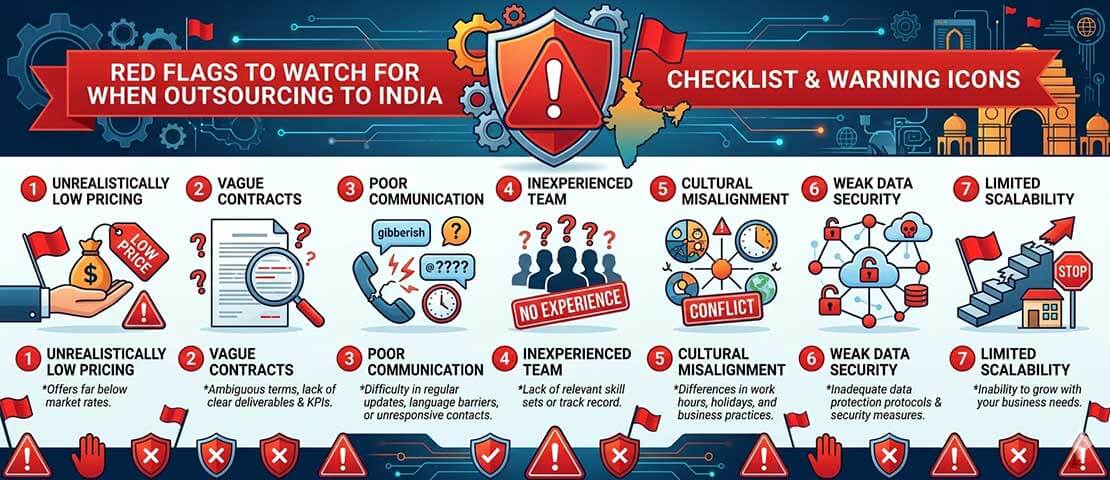
- No verifiable portfolio. If they cannot give you live URLs of work they have done, with case studies that match their claims, the work probably is not theirs.
- No GST registration. Every legitimate Indian business above a modest turnover threshold is GST registered. No GSTIN on the invoice means you are either dealing with someone informal or someone hiding something.
- Demanding 100 percent payment upfront. A normal milestone structure is 30 to 50 percent upfront, the rest split across milestones. Full payment upfront is a structural red flag.
- Pricing that is too far below the band. A $400 quote for a 20-page custom site is not a deal — it is the agency planning to subcontract the work to someone you have not vetted, and disappear if it goes wrong.
- Suspiciously uniform Google reviews. Forty five-star reviews posted within the same month, all from accounts with no other review history, are fake reviews. Cross-check on Clutch, GoodFirms or DesignRush.
- No named team. If the website does not show you who actually works there — names, roles, faces — you are dealing with a faceless funnel.
- Account manager who is clearly a sales rep. If the person on your discovery call cannot answer technical questions about what they are proposing, the people who will actually do the work are not in the conversation.
- Vague or evasive answers on data and IP. A serious agency in 2026 has clear answers on where your data is stored, who owns the code, what the NDA covers, and how compliance is handled. Vagueness here is a deal-breaker.
How to vet an Indian agency: an eight-step process
The single biggest predictor of a successful outsourcing relationship is the rigour of the vetting process before the contract is signed. The steps below are the ones we would follow ourselves if we were the buyer. Working through them takes a few hours; skipping them costs months. If you want a shorter, more general version of this same exercise, our standalone checklist before hiring a web design agency works for any geography, not just India.
-
Ask for live URLs and verify them
Request a portfolio with three to five live websites the agency has built in the last 24 months. Check the page source. Look at the footer. Confirm the agency is named or referenced somewhere on the live site. Many agencies will show portfolio work they did not actually deliver — verification kills that fast. -
Cross-check reviews on multiple platforms
Look the agency up on Google, Clutch, GoodFirms, DesignRush and LinkedIn. Look at the review dates, the reviewer profiles, and what specific projects are mentioned. A genuine agency will have reviews spread across years and platforms. Fake reviews tend to cluster on a single platform in a single month. -
Verify legal and tax registration
Ask for the company’s GSTIN, CIN and registered address. You can verify the GSTIN on the official government portal in under a minute. A genuine, registered Indian agency will answer this question instantly. A fake one will deflect. -
Ask who will actually do the work
Get the names and roles of the team members assigned to your project. Ask to see their LinkedIn profiles. Confirm they actually work at the agency. The senior person you spoke with on the sales call may not be the person writing your code. -
Request a paid pilot before committing to the full scope
For any project over $5,000, ask if the agency will deliver a paid pilot — a single landing page, a homepage design round, an audit — for 10 to 20 percent of the total budget. This tells you more about how they actually work than any number of discovery calls. -
Read the contract carefully and add what is missing
The contract should explicitly cover IP ownership of all delivered work, payment milestones tied to defined deliverables, what happens if you cancel, what happens if they cannot deliver, confidentiality and NDA terms, and data protection responsibilities. If any of these is missing, ask for it to be added before signing. -
Agree communication protocols upfront
Decide which platform you will use for daily updates, which platform for design review, which platform for code and deployment. Agree on a single named point of contact on their side and on yours. Set expectations for response times across the time zone gap. -
Start small, scale based on results
Even after a successful pilot, do not move your entire web presence overseas in one go. Move one project. See how it lands. Then move the next. Trust is earned across multiple successful deliveries, not won in a single pitch.
Payment, contracts and IP protection
The contract terms you would accept from a local agency are not necessarily the right terms for an overseas one. The risk profile is different and the protections need to be tighter on a few specific points.
Pay in milestones, not lump sums. A reasonable structure for a $5,000 project is 30 percent upfront, 30 percent on design approval, 30 percent on staging delivery, 10 percent on go-live. For larger projects, break the milestones down further. Never pay 100 percent before delivery, and be cautious of any agency that requests it.
Make sure IP transfers on payment, not on completion. The contract should specify that intellectual property in all delivered work transfers to you upon payment of the corresponding milestone. Without this clause, an agency can technically hold your code hostage in a dispute.
Insist on a signed NDA before the discovery call, not after. Any agency that hesitates to sign a basic mutual NDA before discussing your project is not someone you want to share confidential information with. The good agencies have a template ready and will sign it within an hour.
Specify data residency and compliance. If you handle EU customer data, your contract needs to spell out GDPR responsibilities. If you handle US health data, the contract needs to cover HIPAA exposure. If you handle Australian customer data, the Privacy Act applies. A serious Indian agency in 2026 is comfortable with all of these conversations.
Communication across time zones: the new playbook
The time zone gap between India and the West used to be framed as a problem. In 2026 the agencies that have built proper async workflows treat it as an advantage, and the buyers who learn to work this way ship significantly more in a quarter than buyers who do not.
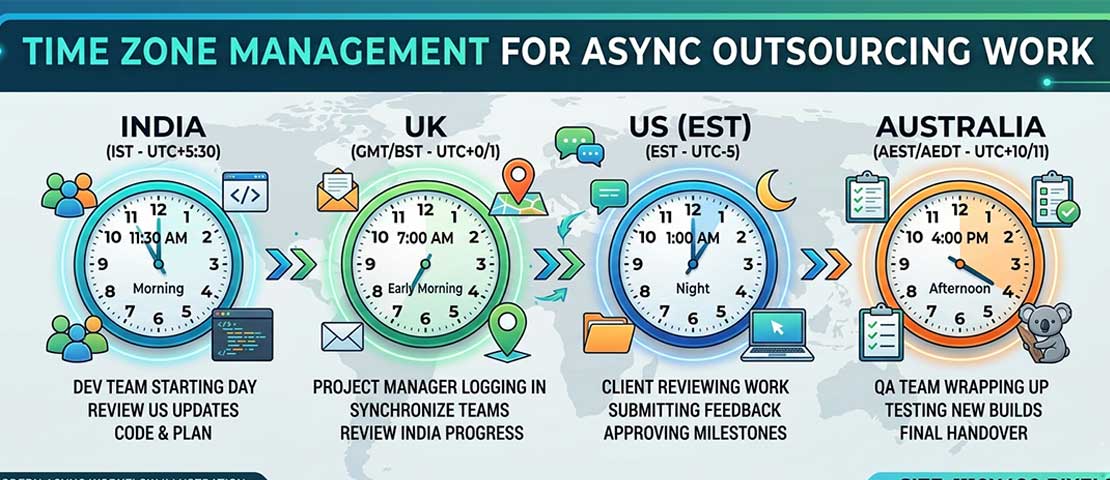
The shift is from synchronous-first to async-first. Instead of stacking up calls, write your brief once and write it properly. Use Loom or a similar tool to record short walkthroughs explaining what you want — these are far higher signal than a written brief and they remove the back-and-forth that eats half a working week. The Indian team picks them up overnight, executes against them, and posts back the result before your day begins.
Pick one tool for each function and stick to it. Slack or Google Chat for daily conversation. Linear, ClickUp or Asana for tasks. Figma for design review. GitHub or GitLab for code. A shared Drive or Notion for documents. The agencies that do this well will not need a 30-minute call to start each task — they will read the spec, ask any clarifying questions in writing, and ship.
Keep one standing weekly call, no more. A 30-minute weekly call between you and the agency lead is enough for almost any project under $50,000. Everything else can be written. The buyers who insist on three calls a week tend to slow their own projects down, not speed them up.
Build a single source of truth for the project. One document — usually in Notion or Confluence — that lists scope, decisions made, decisions pending, current status, links to designs, links to staging, contact details for both sides. Update it weekly. When something goes wrong six months in, this document is what saves you.
What the broader trade environment means for you
The political conversation around services trade has shifted over the last twelve months. Tariff debates in the US and elsewhere have raised questions about whether buying services from India will get harder or more expensive. The short answer for digital services in 2026 is that they have remained largely outside the scope of new tariffs, which have focused on physical goods. Software, design and content services exported from India are still treated as services exports and are not currently subject to the kind of trade barriers that apply to manufactured goods.
That said, the contract you sign in 2026 should anticipate change. A clause that says invoices will be raised in your currency at the rate prevailing at the time of contract, with a defined mechanism for revisiting if there is a material trade-policy change, is a small piece of insulation that costs nothing to include. Most senior Indian agencies will accept this clause without pushback.
The other shift worth noting is the Indian government’s continued push to make India a software services export hub. This means clearer compliance frameworks, better digital infrastructure, faster banking for cross-border payments, and stronger IP enforcement. None of this is finished, but the direction is real and it makes the working environment for serious agencies steadily more predictable.
So is outsourcing to India still worth it?
For the right work with the right partner, yes — more than ever. The right work is anything that has a clear specification, a defined deliverable and a process that can be repeated. The right partner is one that operates at the tier appropriate to your project size, has clean compliance, has live verifiable portfolio work, and is comfortable signing the kind of contract a sensible buyer should ask for. Whether that work is a custom business website built from scratch or an ongoing programme of marketing and maintenance, the principles in this guide apply equally.

What has changed is that you cannot drift through the vetting process anymore. The cost-of-getting-it-wrong is higher because the market is more fragmented. The reward for getting-it-right is also higher because the senior agencies are now genuinely strategic partners, not just execution hands. The buyers winning in 2026 are the ones who treat the choice of Indian agency with the same seriousness they would treat a local hire, and who put the same rigour into the contract and onboarding as they would into any significant business decision.
If you have read this far, you already have most of the framework you need. The vetting is not complicated — it just has to be done. Ask the right questions, verify the answers, structure the contract properly, start small, and scale based on what you actually see delivered. That is the playbook for 2026.
Frequently asked questions
| Is outsourcing web development to India still cheap in 2026? | It is still meaningfully cheaper than building a team in the US, UK or Australia, but the gap has narrowed compared to five years ago. A serious Indian agency in 2026 typically costs 30 to 50 percent less than a comparable Western agency for similar quality work, not the 5x cheaper figure that buyers used to see. The bottom of the market is still very cheap, but the risk of dealing with bottom-tier providers has grown. The right way to think about pricing today is to identify the tier of work you need, then compare quotes within that tier — not to chase the absolute cheapest number you can find. |
| What types of work should you not outsource to India? | Anything that requires same-hour real-time turnaround across full business hours in your time zone is difficult to outsource cleanly to India. High-trust legal, financial or healthcare workflows with heavily regulated customer data are also better kept closer to home unless your Indian partner has specific compliance certifications. Short-burst creative work where the brief evolves hour-by-hour through the day tends to lose more in async handoffs than it gains in cost savings. For everything else — web design, web development, app development, SEO, content, design — outsourcing to India works well when you pick the right tier of partner. If SEO is the specific service you are evaluating, our guide on how to choose an SEO expert in India walks through the equivalent vetting process for that discipline. |
| How do you protect your intellectual property when outsourcing to India? | Three things matter. First, a signed mutual NDA before any confidential information is shared, including during the discovery phase. Second, an explicit clause in the main contract specifying that all intellectual property in the delivered work transfers to you on payment of the corresponding milestone — not on completion, not on final payment, but milestone by milestone. Third, a no-subcontracting-without-consent clause so that work cannot be silently passed to a third party you have not vetted. These three protections are standard in any well-drafted services contract and any serious Indian agency will accept them without pushback. |
| What payment terms are reasonable when hiring an Indian agency? | A typical milestone structure for a small to mid-sized project is 30 to 50 percent upfront, with the balance split across two or three milestones tied to specific deliverables — design approval, staging delivery, go-live. For larger projects, break the milestones down further so that no single payment represents more than a quarter of the total budget. Never pay 100 percent upfront. Be cautious of agencies that insist on it, as legitimate operations do not have cash-flow reasons to demand full payment before delivery. Final retention of 10 percent until go-live or 30-day post-launch warranty is a reasonable protection on both sides. |
| How do you manage the time zone difference effectively? | Treat the time gap as an async-first workflow rather than a synchronous problem. Write briefs properly the first time and record short Loom walkthroughs to explain visual or strategic decisions, so the Indian team can act on them overnight without needing a call. Use a single project management tool and a single chat tool, and keep all decisions written so anyone can catch up without a meeting. Hold one 30-minute weekly call between project leads to cover anything that genuinely needs voice discussion. The buyers who insist on multiple weekly calls usually slow projects down without realising it. |
| Should you hire an Indian freelancer or an Indian agency? | Freelancers and small studios are excellent for self-contained tasks where one or two specialists can deliver the whole thing — a logo, a landing page, an SEO audit, a single-component build. Agencies are the right choice when the project needs multiple disciplines working together, ongoing accountability, contractual continuity, and a team that does not disappear if one person becomes unavailable. We have written a more general version of this comparison in our agency vs freelancer guide, which goes deeper into the trade-offs across both options. The rule of thumb is that any project under $1,500 and one discipline can usually go to a freelancer. Anything multi-disciplinary, multi-month, or business-critical should go to an agency. |
| What happens if your Indian agency disappears mid-project? | This is rare with a properly vetted agency, but the contract should anticipate it. Make sure you have access to staging environments, source code repositories and design files in your own accounts — not just theirs. Pay in milestones tied to delivered work so that you are never far ahead on payments relative to what has actually been built. Keep documentation of every decision so a replacement team can be onboarded quickly. If the worst happens, a half-built project handed over with proper documentation and code access can usually be picked up by another agency for 30 to 50 percent of the remaining budget. Without that documentation, you may have to restart entirely. |
Want a transparent quote from an Indian agency that has done this for twelve years?
We are happy to walk you through what your project would cost, how we would structure delivery, and what the contract would cover — with no pressure and no hard sell. Send us your brief and we will get back to you within one business day.