The 10 Elements of a Successful Business Website (2026 Complete Guide)
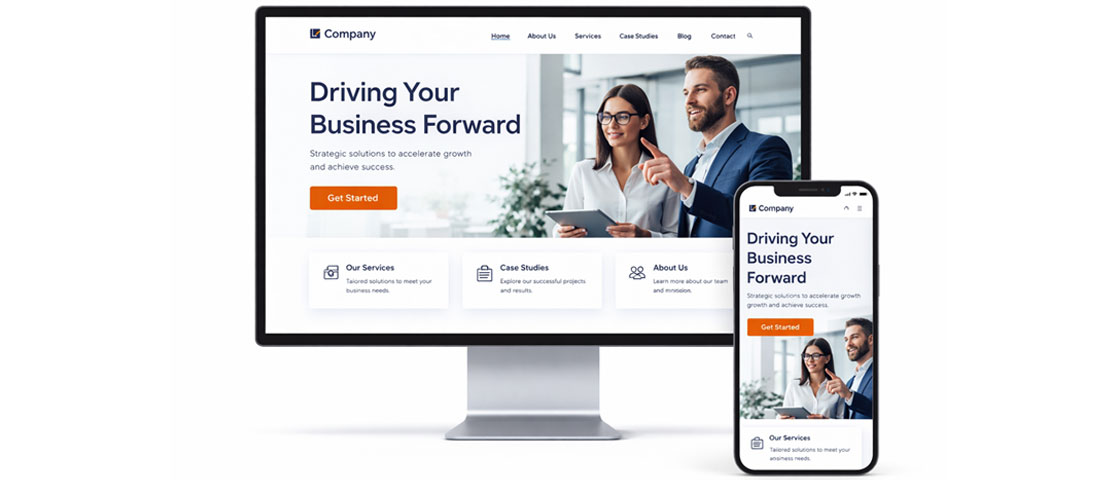
Every business needs a website. This has been true for twenty years, and it is more true today than it has ever been. But “having a website” and “having a professional website that works for your business” are two very different things — and the gap between them has widened significantly in 2026.
What this guide covers
- 1. What Is a Professional Website — Really?
- 2. Why Your Website Is Your Most Important Business Asset in 2026
- 3. Website vs Web Application — Understanding the Difference
- 4. The 10 Elements of a Successful Business Website in 2026
- 5. The Real Cost of a Substandard Website
- 6. How Much Does a Professional Website Cost in 2026?
- 7. Frequently Asked Questions About Professional Business Websites
- 8. Conclusion: Your Website Is Your Business’s Hardest-Working Employee
A website that was built without professional guidance, or that has not been updated in several years, is no longer a neutral presence. It is actively working against your business — damaging credibility with first-time visitors, underperforming in search results, and losing potential customers to competitors whose websites answer questions faster and more clearly.
This guide covers what a professional business website actually is in 2026, why it matters more than ever, what the essential elements are that separate a website that generates business from one that simply exists, and — for those at the beginning of their digital journey — the important distinction between a website and a web application.
What Is a Professional Website — Really?
The word “professional” gets used loosely in web design conversations, often meaning little more than “not built on a free site builder.” But a genuinely professional business website in 2026 means something specific — and it is worth being precise about it.
A professional website is one that has been strategically designed and technically built to serve defined business objectives. It is not just visually polished (though that matters). It is structurally sound: it loads fast on every device, it communicates clearly to the right audience, it guides visitors toward specific actions, it ranks well in search, and it continues to perform reliably with minimal maintenance issues.
More importantly, a professional website in 2026 is built with an understanding of where your customers are and how they make decisions. Over 70% of web traffic now comes from mobile devices. AI Overviews and voice search now intercept a growing percentage of queries before users reach any website at all. And user expectations — shaped by the best consumer experiences they encounter every day — have risen dramatically. A website that seemed impressive three years ago may look dated and unprofessional today.
The practical test for a professional website: When a potential customer finds your website — through a Google search, a social media link, or a referral — does it immediately communicate that your business is credible, competent, and worth engaging with? Does it answer their key questions without requiring effort? Does it make it easy to take the next step? If the answer to any of these questions is “not really,” your website is not yet professional in the meaningful sense.
Why Your Website Is Your Most Important Business Asset in 2026
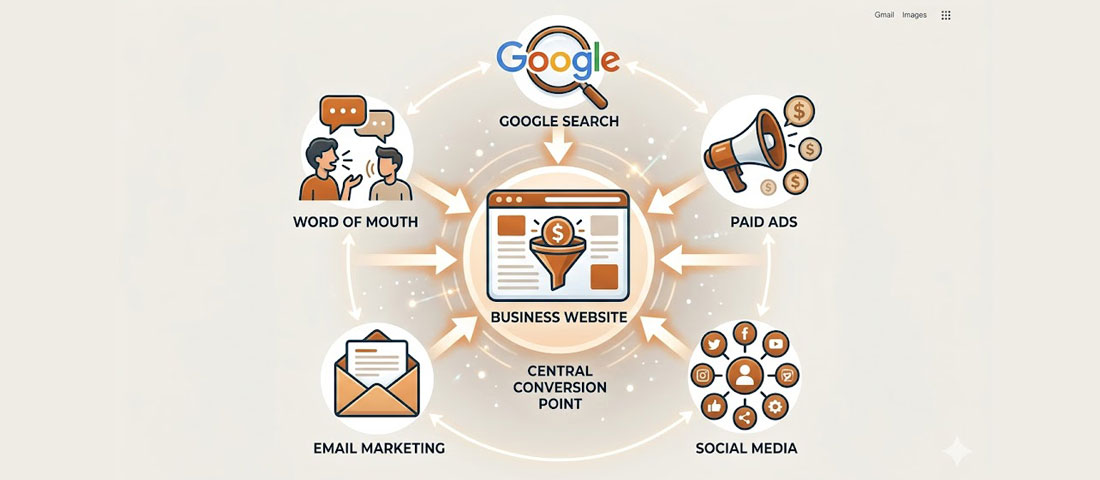
Your website is the central hub that all other marketing channels ultimately point toward — which makes it the most important asset in your entire digital presence.
Your website is the only digital asset you fully own and control. Your social media following, your email list, your Google Business Profile — all of these exist on platforms you do not control and which can change their rules, their algorithms, or their pricing at any time. Your website is yours.
This ownership matters more than it is often given credit for. Every paid ad campaign, every social media post, every email newsletter, every Google search ultimately points somewhere — and for most businesses, that somewhere is the website. If your website does not convert visitors into enquiries, leads, or customers, everything you spend on marketing is partially wasted. A 10% improvement in your website’s conversion rate can deliver the same business result as doubling your advertising budget.
In 2026 specifically, your website has also become the foundation of your AI search visibility. Google AI Overviews, Perplexity, and ChatGPT extract and synthesise information from websites. A website without clear, structured, comprehensive content cannot be cited by AI systems — which means you are invisible in a growing and commercially significant portion of search behaviour.
Website vs Web Application — Understanding the Difference
Before covering the elements of a successful business website, it is worth briefly clarifying the distinction between a website and a web application — because the confusion between the two can lead businesses to either over-invest in technology they do not need or under-invest in functionality they do.
A website is primarily a vehicle for delivering information, building credibility, and converting visitors into customers or enquiries. It is mostly content-driven: pages of text, images, and embedded media that present your business, your services, your portfolio, and your contact information. Most business websites — including for professional services firms, agencies, retailers, and small to medium enterprises — are websites, not web applications.
A web application is primarily a tool — software that users interact with to accomplish specific tasks. Online banking, project management platforms, eCommerce stores with complex inventory and user accounts, booking systems, customer portals, and SaaS products are all web applications. They have users who log in, data that changes dynamically based on user input, and complex business logic that runs server-side.
The distinction matters because they require different technical approaches, different skill sets to build, and different ongoing maintenance investments. Many businesses — particularly service businesses, consultancies, agencies, and professional practices — need a high-quality, well-optimised website, not a web application. And the best professional website for these businesses will outperform a budget web application every time in generating leads and building credibility.
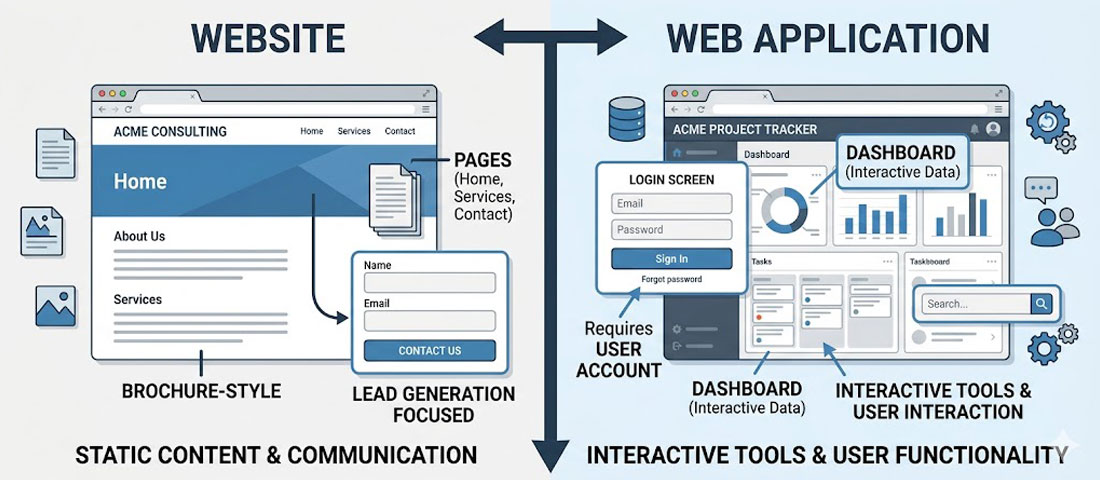
Understanding whether your business needs a website or a web application shapes every decision about scope, technology, and budget.
The 10 Elements of a Successful Business Website in 2026
With that foundation in place, here are the 10 essential elements that separate a business website that generates real results from one that simply occupies a URL.
Element 1: A Clear, Compelling Value Proposition
Within five seconds of landing on your homepage, a visitor should be able to answer three questions: What does this business do? Who does it do it for? Why should I choose this business over its competitors? Your value proposition — communicated through your headline, your subheadline, and your hero section — is the most important piece of content on your entire website.
A weak value proposition sounds like: “We provide world-class digital solutions for businesses of all sizes.” A strong value proposition sounds like: “Custom websites designed and built in India for UK businesses — delivering London-quality design at 60% lower cost, with guaranteed delivery timelines and 1 year of free support.”
Specificity wins. Vague, aspirational language that sounds impressive but says nothing specific about who you are, who you serve, and what you deliver is one of the most common and most damaging failures on business websites.
Element 2: Mobile-First, Fully Responsive Design
Over 70% of web traffic globally comes from mobile devices. In India and many other markets, this figure is even higher. A website that does not look and work perfectly on a smartphone is failing the majority of its visitors. And since Google uses mobile-first indexing — meaning it primarily evaluates the mobile version of your website for search rankings — a poor mobile experience directly hurts your visibility in search results.
Mobile-first design is not simply “shrinking the desktop design to fit a small screen.” It requires a fundamentally different design approach — starting with the smallest screen and the most constrained content environment, then expanding for larger screens. Navigation must be accessible with a thumb. Text must be readable without zooming. Forms must be easy to complete with a touchscreen keyboard. Buttons must be large enough to tap accurately.
Element 3: Fast Load Times and Strong Core Web Vitals
Page speed is not a technical nicety — it is a direct business and ranking factor. Research consistently shows that every additional second of page load time reduces conversion rates by approximately 7%. Google’s Core Web Vitals — Largest Contentful Paint (LCP), Interaction to Next Paint (INP), and Cumulative Layout Shift (CLS) — are direct search ranking factors.
A professional website in 2026 should load the main content visible to the user (LCP) in under 2.5 seconds. It should respond to user interactions (INP) in under 200 milliseconds. And it should have a CLS score below 0.1 — meaning the page layout does not shift unexpectedly as it loads. These are not aspirational targets; they are the benchmarks that Google uses to determine whether your website provides a good page experience.
Element 4: Clear, Intuitive Navigation
Navigation is the architecture of your website — it determines how easily visitors can find what they are looking for. Good navigation is invisible in the best sense: users move through the website without thinking about the navigation itself, because it is obvious and logical. Poor navigation is a conversion killer — visitors who cannot quickly find what they need leave, and often do not return.
In practice, effective navigation means: a logical, concise top-level menu with no more than 6 to 7 primary items; clear, descriptive labels (not clever names that require interpretation); a prominent “Contact” or “Get a Quote” link that is always visible; a search function for content-rich websites; and breadcrumb navigation on deeper pages to help users understand where they are in the site hierarchy.
Element 5: Compelling, Specific Content That Answers Questions
Well-structured content — clear headings, specific answers, and logical flow — serves both human visitors and search engine crawlers.
Content is the substance of your website, and in 2026 it needs to do more than simply describe your services in general terms. Your website content needs to: answer the specific questions your potential customers are asking; demonstrate genuine expertise in your field; build trust through specificity, evidence, and social proof; and be structured in a way that search engines and AI systems can understand and cite.
The shift toward AI-powered search makes content quality more important than ever. Google AI Overviews, Perplexity, and ChatGPT surface content from websites that provide clear, specific, comprehensive answers to questions. A service page that says “We provide excellent web design services tailored to your needs” contributes nothing to AI search visibility. A page that explains specifically what the service includes, how the process works, how long it takes, what it costs in ballpark terms, and what results clients typically see — that page has genuine AI-search value.
Element 6: Strong Calls to Action (CTAs)
Every page of your website should have a clear, specific answer to the question: “What do I want a visitor to do next?” Calls to action are the bridge between a visitor being interested in your business and actually engaging with it. Without clear CTAs, visitors who are genuinely interested in your services may still leave without contacting you — simply because the path forward was not obvious enough.
Effective CTAs in 2026 are: specific (not “Contact Us” but “Get a Free Website Quote”); prominent (visible without scrolling on key pages); multiple (one in the hero section, one mid-page, one at the bottom); and personalised where possible (showing different CTAs to different visitor segments). The rise of WhatsApp as a business communication channel is also relevant here — a WhatsApp CTA alongside a contact form often generates higher response rates, particularly for international clients contacting Indian businesses.
Element 7: Trust Signals and Social Proof
New visitors to your website are making a trust decision. They are evaluating whether your business is credible enough to engage with. Trust signals are the elements of your website that help visitors make this decision in your favour:
- Client testimonials and reviews — specific, attributed testimonials from real clients, ideally with photos and company names. Generic testimonials without attribution carry little weight.
- Case studies and portfolio items — showing specific work you have done, the problems you solved, and the results achieved. “We built a website for Company X that increased their enquiries by 40%” is vastly more persuasive than any amount of self-description.
- Client logos — if you have worked with recognisable brands or businesses, displaying their logos builds credibility through association
- Awards, certifications, and memberships — industry recognition and professional memberships signal that your business meets external standards
- Google reviews and third-party review scores — embedded review widgets from Google, Clutch, or similar platforms provide third-party validation that visitors trust more than self-testimonials
Element 8: SEO Foundation — Technical and On-Page
A beautiful website that no one can find is a very expensive digital brochure. Search engine optimization needs to be built into a professional website from the ground up — not added as an afterthought after the site is built. This includes:
- Proper heading hierarchy (H1 → H2 → H3) that structures content logically for search engines and users
- Descriptive, keyword-relevant page titles and meta descriptions for every page
- SEO-friendly URL structures (not auto-generated gibberish strings)
- Schema markup — Organisation, Service, FAQPage, and LocalBusiness structured data
- Internal linking that distributes authority across the site and helps visitors navigate between related content
- An XML sitemap submitted to Google Search Console
- Image optimisation — descriptive file names and alt text on every image
Element 9: Security — HTTPS, Backups, and Maintenance
A professional website is a secure website. HTTPS (indicated by the padlock in the browser address bar) is now a baseline requirement — browsers actively flag non-HTTPS websites as “Not Secure,” and Google uses HTTPS as a ranking signal. But security goes beyond SSL certificates. A professional website includes: regular automated backups with off-site storage; software and plugin updates applied promptly; security monitoring to detect and respond to threats; and a plan for recovery in the event of a breach or technical failure.
For WordPress websites specifically — which power over 40% of the web — security is a significant ongoing consideration. The combination of WordPress’s popularity (making it a high-value target for attackers) and the large number of third-party plugins (each of which is a potential vulnerability) makes active security management non-negotiable.
Element 10: Analytics and Conversion Tracking
A professional website is measurable. Google Analytics 4, Google Search Console, and event-based conversion tracking allow you to understand exactly how visitors are finding your website, what they do when they arrive, which pages are generating enquiries, and which are causing visitors to leave. Without this data, managing and improving your website is guesswork.
In 2026, the AI-powered insights in Google Analytics 4 surface actionable recommendations automatically — flagging significant changes in traffic patterns, identifying high-performing content, and highlighting opportunities you might otherwise miss. Setting up proper tracking is a one-time investment that pays compounding returns over the lifetime of your website.
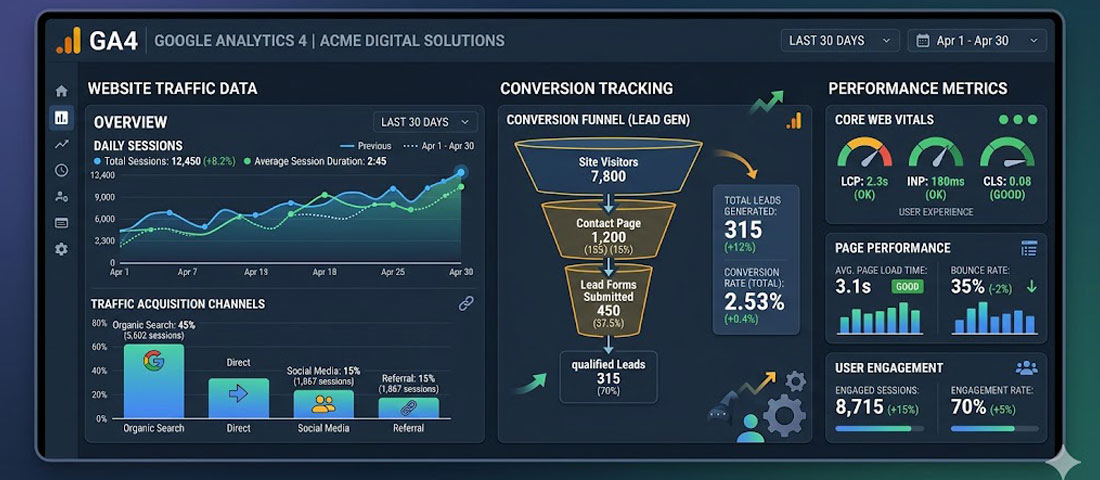
Analytics and conversion tracking turn your website from a passive digital brochure into a measurable, improvable business asset.
The Real Cost of a Substandard Website
Businesses sometimes resist investing in a professional website because they focus on the upfront cost rather than the cost of not having one. But the business cost of a substandard website is significant and ongoing:
| Problem | Business Impact | Estimated Cost |
|---|---|---|
| Slow load times | Higher bounce rates, lower conversions, ranking penalties | ~7% conversion loss per extra second of load time |
| Poor mobile experience | Losing 70%+ of mobile visitors, Google ranking penalties | Majority of potential customers lost before they read anything |
| Unclear value proposition | Visitors do not understand your offering, leave immediately | High bounce rate, zero enquiries from warm traffic |
| No SEO foundation | Invisible in Google search for your core service keywords | Zero organic traffic — 100% dependence on paid channels |
| No trust signals | First-time visitors doubt credibility, choose competitors | Lost sales to competitors with better-presented trust signals |
| No analytics | Cannot identify or fix problems, cannot optimise performance | Continuous underperformance with no path to improvement |
How Much Does a Professional Website Cost in 2026?
The cost of a professional business website in 2026 varies significantly based on scope, features, and where it is built. In broad terms:
- USA or UK-based agencies: A properly professional business website typically costs between $5,000 and $20,000 or more for design and development, plus ongoing maintenance and hosting costs
- Indian web design agencies (like Neel Networks): Equivalent quality — mobile-first design, full SEO foundation, schema markup, Core Web Vitals optimisation, schema markup, 1 year of support — at 50 to 70% lower cost than USA or UK pricing
- Freelancers: Lower upfront cost, but typically without the structured project management, quality assurance, ongoing support, and multi-skill team (design, development, SEO, content) that a professional agency provides
- DIY website builders: Very low upfront cost, but significant limitations on performance, custom design, SEO capabilities, and scalability — typically not appropriate for businesses serious about their digital presence
The most important framing for the cost question is ROI. A professional website that generates even two or three additional qualified enquiries per month — enquiries that convert into clients at your average project value — will pay for itself within months. The question is not “how much does a professional website cost?” but “how much is each new client worth to my business, and how many additional clients could a better website generate?”
Frequently Asked Questions About Professional Business Websites
| What makes a website “professional” in 2026? | A professional website in 2026 is one that has been strategically designed and technically built to serve defined business objectives. It loads fast on every device, communicates clearly to the right audience, guides visitors toward specific actions, ranks well in search, and continues to perform reliably over time. Visually, it looks contemporary and credible. Technically, it passes Core Web Vitals performance benchmarks, is fully responsive on mobile devices, and has a solid SEO foundation including schema markup. Commercially, it has a clear value proposition, strong calls to action, and measurable analytics. |
| Is a website worth it for a small business in 2026? | Absolutely — and arguably more so in 2026 than at any previous time. Over 80% of consumers research businesses online before making a purchasing decision. The absence of a professional website signals to potential customers that your business may not be established or credible. Beyond credibility, a well-optimised website is the only marketing channel that delivers compounding returns over time — organic search traffic grows as your content and authority build, unlike paid advertising where results stop the moment you stop spending. |
| What is the difference between a website and a web application? | A website is primarily a vehicle for delivering information, building credibility, and converting visitors into customers or enquiries. It is mostly content-driven: pages of text, images, and media that present your business and services. A web application is primarily a tool — software that users interact with to accomplish specific tasks, with user accounts, dynamic data, and complex business logic. Most service businesses, professional practices, and small to medium enterprises need a high-quality website, not a web application. Understanding this distinction prevents over-investment in unnecessary technical complexity. |
| How long does it take to build a professional business website? | The timeline for building a professional business website depends on the scope and complexity of the project. A focused, well-scoped business website with 10 to 20 pages typically takes 6 to 10 weeks from kickoff to launch, including design, development, content integration, testing, and SEO setup. More complex websites — those with custom features, eCommerce functionality, large content libraries, or multiple language versions — typically take 10 to 16 weeks or more. At Neel Networks, we provide clear project timelines at the proposal stage and keep clients updated throughout the process. |
| Why is mobile-first design important for a business website? | Mobile-first design is important because over 70% of web traffic globally now comes from mobile devices, and Google uses the mobile version of your website as the primary basis for search ranking decisions. A website that is designed primarily for desktop and then adapted for mobile will typically have a worse mobile user experience, slower mobile load times, and lower search rankings than one designed with mobile as the primary focus. Mobile-first design means building for the small screen first and enhancing for larger screens — ensuring that the experience is optimal for the majority of your visitors. |
| What should a professional business website include? | A professional business website should include: a clear, compelling value proposition on the homepage; a full-service or products section with detailed, specific descriptions; an about section that builds credibility and humanises the business; a portfolio or case studies section that demonstrates real work and results; genuine client testimonials with attribution; a contact page with multiple ways to get in touch; a blog or resources section for SEO and thought leadership; and comprehensive schema markup for AI search visibility. Every page should have clear calls to action, be fully optimised for mobile, and load quickly on all devices. |
| How much does a professional website cost in India compared to the USA or UK? | A professional business website from a reputable Indian web design agency like Neel Networks typically costs 50 to 70% less than an equivalent website from a comparable agency in the USA, UK, or Australia — without any compromise on quality, communication, or deliverables. Indian web design agencies serving international clients bring the same design standards, technical capabilities, and project management practices as Western agencies, with the efficiency advantage of India’s highly skilled and cost-effective technology workforce. This cost advantage is why thousands of businesses in the USA, UK, Canada, and Australia choose to build their websites with Indian agencies. |
Conclusion: Your Website Is Your Business’s Hardest-Working Employee
Your website works 24 hours a day, 7 days a week, 365 days a year. It represents your business to potential customers in every country and time zone, answers their questions, builds their confidence in your capabilities, and guides them toward becoming clients. No employee, no matter how talented, can work those hours with that consistency.
A professional business website — built with the 10 elements outlined in this guide — is the most leveraged investment most businesses can make in their growth. Every other marketing activity you do becomes more effective when it sends traffic to a website that converts. Every pound, dollar, or rupee you spend on advertising delivers better returns when the destination is worth visiting.
If your current website is not performing the way you expect — if you are getting traffic but not enquiries, or if you are simply not proud to share the URL with potential clients — it is time to do something about it. The cost of inaction is ongoing and compounding.
Let’s build a website your business can be proud of.
Talk to the Neel Networks team about what a professional, high-performance business website looks like for your specific business, audience, and goals.