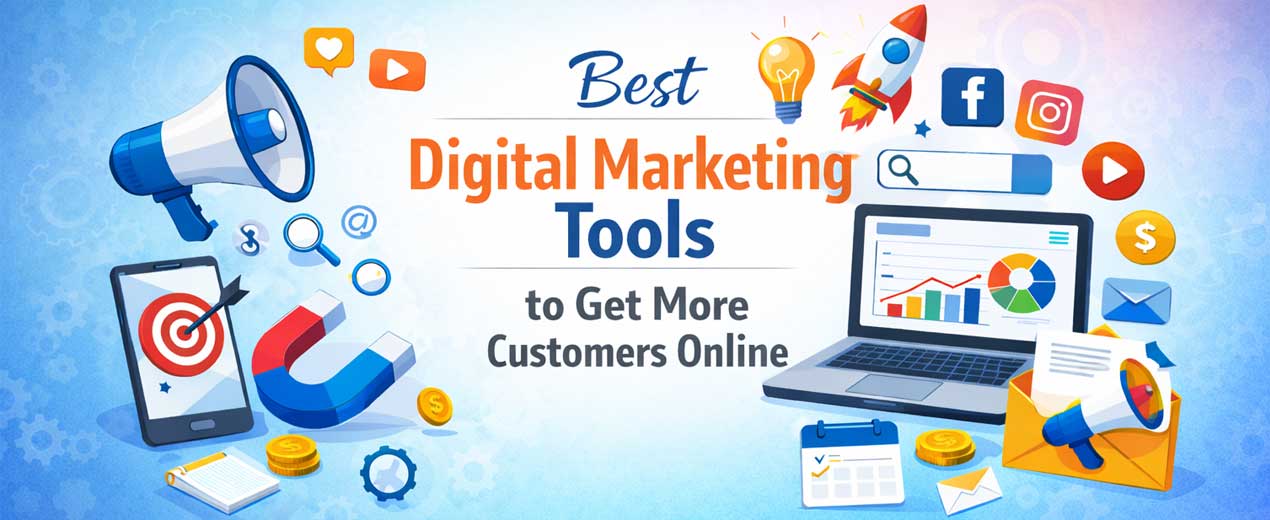
Best Digital Marketing Tools to Get More Customers Online
Getting customers online is not about doing more activities; it is about controlling the customer decision journey. A person does not instantly contact a business after seeing it once. First, they search on Google, then they check credibility, then they compare options, and only after trust is formed, they enquire. If a business is missing at any of these stages, the customer moves to a competitor, even if the service quality is better.
Digital marketing tools exist to control each step of this process. Some tools help customers discover you, some tools convince them, and others remind them later until they decide. When businesses use tools randomly, they only generate traffic. When tools are connected properly, they generate predictable enquiries. That is the difference between a marketing activity and a marketing system.
In this guide, we will explain the tools category-wise and in practical detail. You will learn what the tool does, why we recommend it, and how it should actually be used in real scenarios. The aim is simple — after reading this, even a beginner should understand how businesses consistently generate leads online.
1. SEO Tools (Customers Who Are Already Searching)
Search Engine Optimization targets users who already need a service and are actively searching for it. Because their intention is clear, these visitors are far more likely to convert into enquiries compared to casual social media users. However, SEO only works when decisions are based on real search data instead of assumptions. That is why professional marketers depend heavily on analytical tools rather than intuition.
SEO tools help us understand three things: how Google reads a website, what people are searching for, and which pages actually generate leads. Without these three insights, businesses often create content that looks good but never ranks or converts. Each tool below controls one part of that understanding.
Google Search Console
We recommend Google Search Console because it shows exactly how Google interprets your website. After verifying the domain and submitting the sitemap, it displays impressions, clicks, and average ranking positions for each keyword. When a page receives impressions but low clicks, we improve the meta title and description to make it more relevant. If pages are not indexed, we inspect crawling errors and fix technical issues so Google can properly access them.
This tool is also used to monitor sudden ranking drops and mobile usability problems. Instead of waiting months, wondering why traffic reduced, we immediately detect whether it is due to indexing issues, content mismatch, or penalties. It becomes a diagnostic panel for SEO health.
Pros
- Direct data from Google itself (most accurate)
- Identifies indexing and technical errors
- Helps improve click-through rate
- Completely free to use
Cons
- No competitor data
- Limited keyword research capability
- Requires interpretation experience
Ahrefs / SEMrush (Keyword Research Tools)
These tools are used to discover real customer demand before writing content. Inside the keyword explorer, we search service topics and filter results based on intent and difficulty. We prioritise queries people use when hiring, such as location-based searches and problem-based searches. Competitor pages are analysed to understand what type of content attracts their traffic and leads.
Instead of writing general articles, we structure pages exactly around searched problems. This increases ranking probability and ensures traffic is relevant. Over time, this prevents content waste because every page is created for a measurable demand.
Pros
- Shows real search demand
- Competitor analysis available
- Helps build content strategy
- Finds low competition opportunities
Cons
- Paid subscription required
- Data needs correct interpretation
- Can overwhelm beginners
Google Analytics (SEO Conversion Understanding)
After traffic starts coming, Google Analytics helps determine if it is useful traffic. We set conversion events such as contact form submissions, call clicks, and WhatsApp clicks. Then we identify which pages bring enquiries and which only bring visitors. Pages attracting traffic but not enquiries are rewritten to answer doubts and improve clarity.
This turns SEO into a measurable business activity rather than just ranking improvement. Instead of celebrating visitors, we track actual leads and improve ROI through optimisation.
Pros
- Tracks real enquiries
- Shows user behaviour
- Helps improve conversion rate
- Free and powerful insights
Cons
- Initial setup required
- Data confusing for beginners
- Needs proper event configuration
2. Social Media Tools (Trust & Familiarity Building)
Before contacting a business, many users check social media profiles to judge credibility and activity. Even if they find you through Google, they often verify your authenticity on Instagram or Facebook. Social media, therefore, supports conversion by building familiarity rather than directly producing leads.
The objective here is consistency and perception. A professional-looking and regularly updated profile makes the business appear reliable, while an inactive or poorly designed profile reduces confidence.
Canva (Visual Branding Tool)
We recommend Canva because businesses often struggle to maintain visual consistency. Using predefined brand colors, fonts, and templates, posts are designed to look uniform and professional. Educational posts explain problems, proof posts show results, and informational posts answer questions. Over time, this consistent presentation creates recognition in the viewer’s mind.
When the same viewer later searches for the service, they remember the brand they repeatedly saw. That familiarity increases click and enquiry probability significantly.
Pros
- Easy for non-designers
- Maintains brand consistency
- Fast content creation
- Large template library
Cons
- Limited advanced design control
- Overused templates may look similar
- Requires content planning
Meta Business Suite (Content Scheduling & Management)
We use Meta Business Suite to plan and schedule posts instead of uploading randomly. Weekly categories like tips, FAQs, results, and explanations are pre-scheduled so the account always remains active. Messages and comments are managed from a single dashboard, ensuring quick replies.
Consistency signals reliability. A regularly active page appears trustworthy, and users are more comfortable contacting such businesses.
Pros
- Free scheduling system
- Centralised message management
- Maintains posting consistency
- Saves daily manual effort
Cons
- Limited analytics depth
- Platform dependent
- Requires a content calendar
Social Media Insights (Audience Learning)
Insights help us understand what the audience actually cares about. Instead of focusing on likes, we monitor saves, shares, and profile visits. Topics with high saves indicate real interest and guide future content creation. Over time, this becomes research for both marketing and services.
This converts social media into a feedback mechanism rather than just a promotional channel.
Pros
- Shows real audience interest
- Helps with content planning
- Improves engagement quality
- Free built-in data
Cons
- Needs consistent posting first
- Misreading metrics can mislead
- Limited long-term data storage
3. PPC & Advertising Tools
Paid advertising is used when a business needs enquiries quickly instead of waiting months for organic ranking. Unlike SEO, where visibility grows gradually, ads place your business directly in front of people at the exact moment they are searching or browsing. However, success in advertising is not decided by budget but by targeting accuracy and landing relevance.
Advertising works in two different ways: capturing demand and creating demand. Some users already want a service and are searching, while others have a problem but have not yet searched for a solution. A good marketing system targets both types using different platforms and messaging approaches.
The tools below allow us to control who sees the advertisement, why they see it, and whether they convert. Without tracking and structure, ads spend money; with proper tools, ads become predictable lead generators.
Google Ads (Search Campaigns – High Intent Users)
Google Ads is recommended because it targets people actively searching for services. We create tightly grouped ad groups based on specific keywords rather than broad terms. Each ad group connects to a dedicated service landing page so the message exactly matches the user’s query. This increases relevance and significantly improves conversion rate.
We also monitor search terms reports to remove irrelevant searches and add negative keywords. Over time, the campaign becomes more efficient because the budget shifts toward keywords producing real enquiries instead of just clicks.
Pros
- Highest conversion intent traffic
- Immediate visibility on Google
- Measurable ROI tracking
- Scalable lead generation
Cons
- Costly if poorly managed
- Requires continuous optimisation
- Competitive industries expensive
Meta Ads Manager (Facebook & Instagram Ads – Demand Creation)
Meta Ads are used to reach users who may need a service but are not yet searching. Instead of keyword targeting, we use behavior and interest targeting combined with problem-based messaging. The ad educates the viewer about a problem and introduces a solution, generating curiosity and future search behavior.
We test multiple creatives and audiences, then scale only the combinations producing enquiries. Many conversions from SEO later originate from people first introduced through these awareness campaigns.
Pros
- Large audience reach
- Cost-effective impressions
- Builds brand awareness
- Supports future conversions
Cons
- Lower immediate intent
- Requires creative testing
- Leads need nurturing
Conversion Tracking (Google Tag + Analytics Integration)
Tracking is essential because clicks alone do not indicate success. We connect form submissions, call clicks, and WhatsApp clicks as conversions. Campaign performance is then judged by cost per enquiry rather than cost per click.
This prevents wasted budget and allows gradual improvement. Ads that bring visitors but not enquiries are stopped, while profitable ads receive increased budget allocation.
Pros
- Accurate performance measurement
- Prevents budget waste
- Improves profitability
- Enables optimization decisions
Cons
- Setup complexity
- Requires technical configuration
- Data delay possible
4. Website & Conversion Tools (Turning Visitors into Customers)
After marketing brings visitors, the website decides whether they contact you or leave. Many businesses focus heavily on traffic generation but ignore conversion structure, resulting in low enquiries despite good visibility. The website should answer doubts step-by-step rather than simply describe services.
A visitor arrives with questions:
- What do you offer?
- Why trust you?
- What results will I get?
- How do I contact you?
Conversion tools organize information in this exact order, so decision-making becomes easier.
The goal is not just to inform but to guide action. Each element of the page — text, layout, speed, and interaction — influences whether the visitor feels confident enough to contact.
Dedicated Landing Pages
Instead of sending users to a general homepage, we create focused service pages. These pages address a single service and include problem explanation, solution details, proof, and contact action. Because the message matches the visitor’s intention, hesitation reduces and conversion increases.
Landing pages also allow testing different headlines and structures to identify what convinces users best.
Pros
- Higher conversion rate
- Clear communication
- Better ad relevance
- Easy performance testing
Cons
- Requires proper copywriting
- Needs periodic updates
- Multiple pages maintenance
WhatsApp & Live Chat Integration
Many visitors hesitate to fill out long forms but are comfortable sending a quick message. Chat integration allows immediate communication and prevents users from leaving to contact competitors. Automated greeting messages ensure a response even outside working hours.
Fast replies significantly improve trust because users feel attended to instantly rather than ignored.
Pros
- Increases enquiries
- Faster communication
- Higher user comfort
- Improves trust perception
Cons
- Needs timely responses
- Can bring low-quality queries
- Requires management discipline
Call-to-Action Tracking
Buttons like “Call Now” or “Get Quote” are tracked as measurable actions. If users scroll but do not click, content placement or wording is adjusted. This transforms design decisions into data-driven improvements rather than personal preference.
Over time, the page evolves based on behavior, improving conversion rate without increasing traffic cost.
Pros
- Data-driven design
- Improves conversion rate
- Identifies weak sections
- Supports continuous improvement
Cons
- Needs analytics setup
- Requires testing patience
- Interpretation skill required
5. Email & Follow-Up Tools (Converting Undecided Customers)
Most visitors do not contact immediately because they compare multiple providers before deciding. Follow-up tools keep your business remembered during this evaluation period. Many enquiries actually happen days or weeks after the first visit.
The purpose of follow-up is not spamming but assisting decision-making. By answering doubts gradually and reminding of value, trust builds over time and increases closing probability.
Businesses that ignore follow-up depend only on new traffic, while businesses using follow-up convert existing visitors repeatedly.
Mailchimp (Email Automation)
We create automated email sequences: introduction, educational explanation, proof example, and offer. Each email addresses a specific doubt, so the prospect gains confidence gradually. Because emails are automated, every lead receives consistent communication without manual effort.
This significantly increases conversions from people who were interested but not ready to contact immediately.
Pros
- Automated nurturing
- Improves conversion rate
- Low marketing cost
- Consistent communication
Cons
- Requires good content writing
- Needs list management
- Slow initial results
Retargeting Ads
Visitors who leave the website later see reminder ads on other platforms. Familiarity builds trust because repeated exposure signals credibility. Many users return after comparison because they remember the brand seen multiple times.
Retargeting uses existing traffic, making it cheaper than finding new audiences.
Pros
- High recall value
- Low-cost conversions
- Uses existing visitors
- Improves closing rate
Cons
- Needs sufficient traffic
- Overexposure can annoy users
- Requires proper setup
CRM Lead Tracking
A CRM records enquiries and categorizes them as hot, warm, or cold leads. Follow-ups are scheduled based on interest level, so potential customers are not forgotten. Organized tracking increases closing rate compared to random manual follow-ups.
It turns sales into a systematic process instead of memory-based communication.
Pros
- Organized follow-ups
- Higher closing rate
- No lost enquiries
- Better customer management
Cons
- Setup time required
- Team discipline needed
- Learning curve
6. Local SEO & Map Tools (Nearby Customers & Direct Calls)
Local customers often do not visit multiple websites or read long content. They simply search a service on Google Maps and contact one of the top visible businesses. Because of this behaviour, map visibility directly impacts enquiries, especially for service providers targeting a specific city or region.
Local SEO tools help businesses appear trustworthy in location-based searches. Instead of competing globally, you compete within your service area. A properly optimized map profile can generate daily calls even without heavy advertising investment because users already have buying intent.
The goal here is visibility plus credibility. When users see ratings, photos, and updated details, they feel confident contacting you immediately. Without proper map optimization, even a well-designed website may remain undiscovered.
Google Business Profile
We recommend optimizing Google Business Profile because it controls how your business appears in Google Maps and local search results. We complete all fields, including services, service areas, business description, and categories, so Google understands relevance. Regular posts, images, and updates signal activity and improve ranking. Reviews are encouraged from real customers because rating and response quality directly influence contact decisions.
Consistent updates also increase profile authority, making it appear more frequently for nearby searches. This tool alone can generate significant phone enquiries for local services.
Pros
- High local visibility
- Free traffic source
- Direct calls from search
- Strong trust signals
Cons
- Requires ongoing updates
- Review management needed
- Competitive locations harder
Review Management (Customer Feedback Handling)
We actively monitor and respond to customer reviews because interaction quality affects trust perception. Positive reviews are acknowledged professionally, while negative reviews are addressed constructively. This shows reliability to future viewers and improves ranking factors.
Encouraging satisfied clients to leave reviews increases credibility significantly because people trust customer feedback more than advertisements.
Pros
- Builds credibility
- Improves local ranking
- Influences decisions strongly
- Free reputation marketing
Cons
- Needs continuous monitoring
- Negative feedback must be handled carefully
- Depends on customer participation
7. Content Research & Planning Tools (Knowing What To Publish)
Many businesses create content randomly based on assumptions. This results in posts and blogs that receive little traffic because they do not match audience interest. Research tools help identify what people are currently curious about and what problems they want solutions for.
Content planning ensures effort is invested where demand exists. Instead of guessing topics, marketing becomes audience-driven. This increases both SEO performance and social engagement because the content matches real queries.
These tools act as idea generators and validation systems before creating articles or posts.
Google Trends
We use Google Trends to identify rising topics and seasonal interest patterns. By comparing multiple keywords, we select subjects currently gaining attention. Publishing content at the right time increases visibility because demand already exists.
This helps businesses stay relevant and produce timely information rather than outdated content.
Pros
- Shows trending interest
- Free research tool
- Helps timing strategy
- Easy to use
Cons
- No detailed keyword data
- Broad insights only
- Needs interpretation
AnswerThePublic
This tool shows real questions people ask online related to a topic. We collect these questions and convert them into blog sections and FAQs. Content created from real queries matches user intent closely and ranks better.
It also helps address doubts that prevent customers from contacting, improving the conversion rate.
Pros
- Real audience questions
- Improves SEO relevance
- Helps with FAQ creation
- Content idea generator
Cons
- Limited free searches
- Needs filtering
- Not competitor analysis
8. Marketing Automation Tools (Managing Growing Enquiries)

As enquiries increase, manual handling becomes difficult and inconsistent. Automation tools organise leads and assign actions automatically. This prevents missed opportunities and improves response speed.
Instead of manually remembering follow-ups, the system schedules communication based on user behaviour. This ensures every potential customer receives attention at the right time.
Automation increases efficiency and allows businesses to handle larger volumes without compromising quality.
CRM Automation Workflow
We set automated follow-up sequences depending on the lead stage. For example, a new enquiry receives immediate acknowledgement, while a warm lead receives reminder communication later. This maintains contact without manual effort.
It improves professionalism because every enquiry is handled systematically rather than randomly.
Pros
- Organized pipeline
- No missed follow-ups
- Saves time
- Improves closing rate
Cons
- Initial setup required
- Needs a structured process
- Learning curve
Lead Scoring System
Leads are categorized based on interest level and interaction behaviour. High-interest prospects receive priority attention while low-interest leads enter nurturing sequences. This ensures effort focuses where conversion probability is highest.
It prevents wasting time on unqualified enquiries.
Pros
- Better sales efficiency
- Prioritized communication
- Higher productivity
- Improved conversions
Cons
- Requires data tracking
- Setup complexity
- Needs monitoring
9. Reporting & Performance Analysis Tools (Understanding ROI)
Marketing only works long-term when results are measurable and understandable. Raw data from multiple platforms can be confusing, so reporting tools combine information into clear dashboards. This allows businesses to understand performance quickly.
Clear reporting builds confidence because decisions are based on numbers instead of assumptions. It also helps identify which channel deserves more investment.
These tools convert data into strategy guidance.
Looker Studio Dashboard
We connect analytics, ads, and search data into a single dashboard showing traffic, leads, and cost efficiency. Instead of checking multiple platforms, performance becomes visible in one place. Trends and improvements can be tracked over time.
This helps make decisions like increasing the budget or improving pages based on clear evidence.
Pros
- Unified reporting
- Visual performance tracking
- Better decision-making
- Free tool
Cons
- Setup time required
- Needs a data connection
- Customization effort
Frequently Asked Questions (FAQ)
1. Do I need all digital marketing tools for my business?
No, every business does not need all the tools at the beginning. You should start with tools that match your immediate goal. For example, if you need quick enquiries, paid ads and WhatsApp chat are useful first. SEO, content marketing, and automation tools can be added gradually for long-term growth.
2. Which digital marketing tool brings customers the fastest?
Search advertising platforms usually bring the fastest results because they target people already looking for your service. These users have buying intent, so they are more likely to contact you immediately. However, fast enquiries depend on proper keyword selection and a clear landing page.
3. Is SEO better than paid advertising?
SEO and paid advertising serve different purposes rather than replacing each other. SEO builds long-term visibility and reduces dependency on advertising over time, while paid ads provide immediate exposure and quick enquiries. Businesses grow more consistently when both are used together — ads generate instant leads, and SEO creates sustainable traffic.
4. Why do I get website visitors but no enquiries?
This usually means the problem is conversion, not traffic. Visitors may not understand your service clearly, may not trust the business yet, or may not find an easy way to contact you. Improving page clarity, adding proof elements like testimonials, and placing clear call-to-action buttons often increase enquiries without increasing traffic.
5. How important are reviews for getting customers?
Reviews are extremely important, especially for local services. Many users decide whom to contact based on ratings and response quality before even visiting the website. Positive reviews build instant trust because people rely on other customer experiences more than advertisements.
6. How long does digital marketing take to show results?
Paid campaigns can produce enquiries within days if properly configured. SEO and content marketing usually take several months because search engines need time to trust and rank a website. Digital marketing works best when short-term methods generate immediate leads while long-term methods build stability and reduce future costs.
7. Can I manage digital marketing myself?
Basic tasks like posting updates and replying to messages can be handled internally. However, strategy planning, tracking setup, and performance optimisation require experience and continuous analysis.
8. Why do ads sometimes get clicks but no leads?
Clicks indicate interest but not necessarily intent. If targeting is too broad or the landing page does not match what the user expected, visitors leave without contacting. Matching keywords, ad message, and page content is essential to convert clicks into enquiries.
9. How do I measure if my marketing is profitable?
Profitability is measured through conversion tracking rather than traffic numbers. You should calculate the cost per enquiry and the cost per customer instead of focusing only on clicks or impressions. When these costs remain stable or decrease while enquiries increase, your marketing is working effectively.
Final Conclusion
Digital marketing is not one activity but a connected ecosystem. SEO brings searching users, social media builds trust, ads generate immediate enquiries, websites convert visitors, follow-ups close undecided prospects, local SEO captures nearby customers, research tools guide content, automation manages growth, and reporting measures success.
When these tools operate separately, results remain inconsistent. When integrated into a structured system, customer acquisition becomes predictable and scalable. The difference between struggling businesses and growing businesses is not effort — it is structured implementation.
At Neel Networks, the objective is not simply running campaigns but designing a complete customer journey where each stage naturally leads to the next, turning online presence into continuous business growth.