PPC & Google Ads Strategy 2026: From Basics to Performance Marketing Mastery
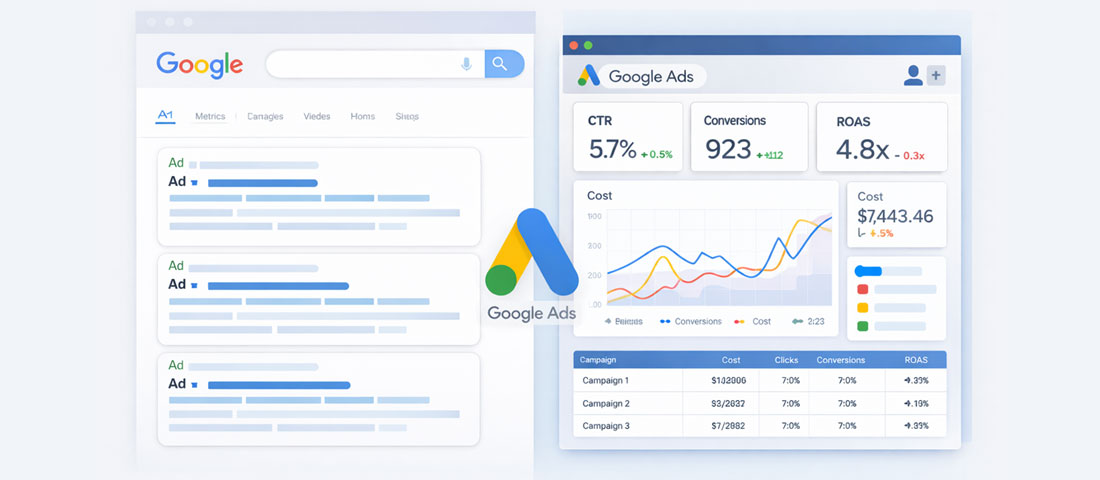
Pay-Per-Click advertising is one of the most immediate and measurable tools in digital marketing. Unlike SEO — which builds authority over months — a well-configured Google Ads campaign can place your business at the top of search results within hours and deliver leads the same day. But PPC is also one of the most frequently mismanaged channels in digital marketing, where poor account structure, weak ad copy, and absent bid strategy turn potentially profitable campaigns into expensive exercises in visibility without return.
What this guide covers
- 1. What Is PPC and How Does Google Ads Work?
- 2. The Key Benefits of Pay-Per-Click Advertising
- 3. Do You Need to Pay Attention to PPC? An Honest Assessment
- 4. How SEO and PPC Work Together as a Power Duo
- 5. Why Every Digital Business Needs a Google Ads Specialist
- 6. Performance Marketing — What It Means and Why It Matters
- 7. Building a High-Performing Google Ads Campaign
- 8. Common PPC Mistakes That Waste Budget
- 9. Frequently Asked Questions About PPC and Google Ads
This guide covers PPC from the ground up — what it is, how it works, why SEO and PPC work best together, the strategic role of Google Ads specialists, the benefits of performance marketing, and the practical knowledge you need to ensure your paid search investment actually delivers business results.
What Is PPC and How Does Google Ads Work?
Pay-Per-Click (PPC) advertising is a digital advertising model where advertisers pay a fee each time one of their ads is clicked. Rather than earning visits organically through SEO, PPC essentially purchases visits — placing your advertisement in front of users who are actively searching for what you offer, and charging you only when they engage.
Google Ads (formerly Google AdWords) is the dominant PPC platform globally — accounting for approximately 28% of all digital advertising spend worldwide. When someone searches Google, the auction for ad positions runs in milliseconds: Google evaluates all advertisers bidding on the relevant keywords and determines which ads to show, in what order, based on a combination of bid amount and Ad Quality Score.
How the Google Ads Auction Works
The Google Ads auction is not purely a highest-bidder system. Ad position is determined by Ad Rank — calculated as:
Ad Rank = Bid Amount × Quality Score × Expected Impact of Ad Extensions
Quality Score (rated 1 to 10 by Google) reflects: the expected click-through rate of your ad, the relevance of your ad to the search query, and the experience of your landing page. This means an advertiser with a high-quality, highly relevant ad can outrank a higher-bidding competitor with a lower-quality one — and at a lower cost per click. Improving your Quality Score is often the most cost-effective way to improve campaign performance.
Types of Google Ads Campaigns
- Search campaigns: Text ads shown at the top and bottom of Google search results pages for relevant keywords. The most direct form of PPC — reaching users at the moment of active intent.
- Display campaigns: Visual banner and image ads shown across millions of websites in the Google Display Network. Better for awareness and retargeting than direct response.
- Shopping campaigns: Product listing ads showing product images, prices, and store names — displayed for product-related searches. Essential for eCommerce retailers.
- Video campaigns: Ads shown before, during, or after YouTube videos. Growing in importance as video search and discovery becomes more central to purchase journeys.
- Performance Max campaigns: Google’s AI-driven campaign type that serves ads across all Google channels (Search, Display, YouTube, Gmail, Maps) from a single campaign. Relies heavily on Google’s machine learning and requires providing high-quality creative assets and clear conversion signals.
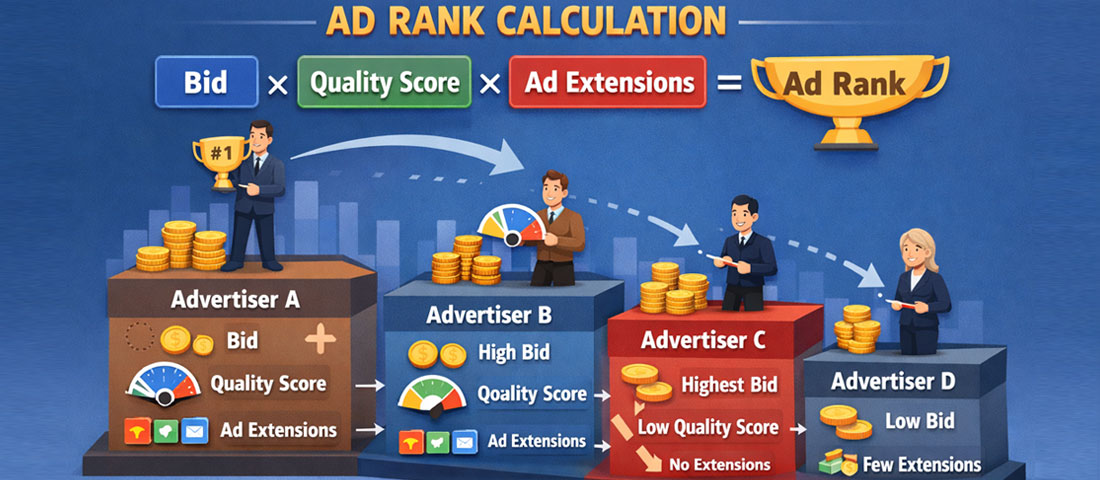
Google Ads position is determined by Ad Rank — not just by bid amount. A high-quality, relevant ad can outrank a higher-bidding competitor while paying less per click.
The Key Benefits of Pay-Per-Click Advertising
Immediate Visibility
PPC delivers the most immediate search visibility available. While organic SEO takes months to build rankings, a Google Ads campaign can appear at the top of search results within hours of being set up and approved. For new businesses, product launches, seasonal promotions, and time-sensitive offers, this immediacy is commercially invaluable.
Precise Audience Targeting
Google Ads offers targeting precision that organic search cannot match. You can target by: specific keywords (including exact phrases and match types), geographic location down to city or postcode level, device type (mobile, desktop, tablet), time of day and day of week, audience demographics and interests, and remarketing lists of previous website visitors. This precision means your ads reach the specific people most likely to convert — not a broad audience where most viewers are irrelevant to your business.
Complete Budget Control
PPC gives complete control over spend. You set daily and monthly budget limits, maximum bids per keyword, and can pause or stop campaigns instantly. There is no minimum spend requirement. You can test with a small budget, prove ROI, and scale confidently — or scale back immediately if results disappoint. This financial control and flexibility is unique among major marketing channels.
Measurable ROI
PPC is among the most directly measurable marketing channels available. When properly configured with conversion tracking (tracking calls, form submissions, purchases, and other valuable actions), Google Ads reports exactly how many conversions each campaign, ad group, keyword, and ad generated — and at what cost. This attribution enables confident, evidence-based budget allocation decisions.
Instant Testing and Optimisation
PPC allows rapid testing of messaging, offers, and landing page approaches that would take months to test through organic channels. Run A/B tests on ad headlines, test different landing page approaches, evaluate different keyword strategies — and have statistically meaningful data within weeks rather than months.
Do You Need to Pay Attention to PPC? An Honest Assessment
PPC is not right for every business at every stage, and it is worth being honest about when it is and is not the right investment.
PPC is clearly the right choice when: you need immediate leads or sales and cannot wait for organic SEO to develop; you are testing a new product, service, or market and need fast validation data; you operate in a highly competitive market where the top organic results are dominated by very strong established players and the fastest path to visibility is paid; you have time-sensitive promotional opportunities (seasonal events, limited-time offers); or you are an eCommerce business where Shopping ads directly connect product search intent with purchase conversion.
PPC may be the wrong primary investment when: your margins are too thin to absorb typical cost-per-click rates in your industry and still turn a profit on ad-driven conversions; your business is in a very early stage without a tested conversion funnel — sending paid traffic to a website that does not convert is expensive and reveals nothing useful; or your product or service has such low awareness that most of your audience is not yet searching for it, making SEO and content marketing better tools for demand generation.
The honest PPC reality check: PPC can be a highly profitable channel when managed expertly with a well-converting website, clear conversion tracking, and ongoing optimisation. It can also be an expensive way to generate traffic that does not convert when managed poorly. The difference is almost entirely in execution quality — which is why specialist expertise matters so much more in PPC than in many other marketing channels.
How SEO and PPC Work Together as a Power Duo
The most effective digital marketing strategies treat SEO and PPC not as competing for the same budget but as complementary channels that amplify each other’s effectiveness. Here is how the combination works better than either alone:
Combined SERP Dominance
When your business appears in both the paid results (top of page) and the organic results (below) for the same search query, you achieve combined SERP dominance — significantly increasing your total click share on that query and reinforcing brand credibility through repeated presence. A searcher who sees your brand twice on the same results page forms a stronger brand impression than one who sees it once, even if they click the organic result rather than the paid one.
PPC Provides Fast Keyword Intelligence for SEO
Running PPC campaigns on target keywords provides fast, real-world data on which keywords actually convert — not just which have high search volume. This intelligence is invaluable for SEO content strategy: before investing months in building organic rankings for a keyword, PPC data can confirm whether traffic from that keyword actually converts to leads or sales. This prevents the common SEO mistake of building content for high-volume keywords that drive traffic but not business.
SEO Provides Coverage for High-CPC Keywords
Some keywords have extremely high cost-per-click rates in competitive industries — legal, financial, SaaS, and professional services keywords can cost $20 to $100+ per click in some markets. Building organic rankings for these keywords through SEO eliminates the per-click cost for a significant proportion of that traffic, dramatically improving the overall economics of your search marketing programme.
Remarketing Bridges the Organic-to-Conversion Gap
The majority of organic traffic visitors do not convert on their first visit. PPC remarketing allows you to show targeted ads to people who have previously visited your website through organic search — keeping your brand visible during the consideration period and bringing them back when they are ready to act. This combination — organic for initial discovery, remarketing for conversion — consistently outperforms either channel alone.
Why Every Digital Business Needs a Google Ads Specialist
Google Ads is one of the most technically complex and rapidly evolving digital marketing platforms available. The platform changes significantly every year — bidding strategies, campaign types, audience targeting options, and automation features are all in continuous development. Managing a Google Ads account effectively in 2026 requires expertise that most business owners and general marketers simply do not have time to develop.
The Cost of Poor PPC Management
The consequences of poorly managed Google Ads accounts are measurable and significant. Common problems in self-managed or inexpertly managed accounts include: budget being consumed by irrelevant search terms through inadequate negative keyword management; low Quality Scores driving up cost-per-click and reducing ad positions; budget concentrated on broad, competitive terms rather than the high-intent, often lower-cost long-tail terms that convert better; ad copy that generates clicks but does not qualify the click, wasting budget on people who have no real conversion intent; and conversion tracking that is not configured or is misconfigured, making optimisation decisions impossible.
Studies by Google and independent research consistently show that accounts managed by certified specialists achieve 20 to 40% lower cost-per-conversion than self-managed accounts of comparable budgets. For an account spending ₹1,00,000 per month, that represents ₹20,000 to ₹40,000 in monthly savings — far exceeding the management fee of a competent specialist.
What a Google Ads Specialist Actually Does
- Account architecture: Structuring campaigns, ad groups, and keywords to maximise Quality Scores and relevance — the foundation of cost-efficient PPC
- Keyword research and match type management: Identifying the right keywords at the right match types, continuously expanding with new opportunities and pruning underperformers
- Negative keyword management: Systematically preventing budget waste on irrelevant search terms
- Ad copy testing: Writing and testing multiple headline and description variations, identifying the combinations that achieve the best CTR and conversion rate
- Bid strategy optimisation: Choosing and configuring the appropriate bidding strategy (manual CPC, Target CPA, Target ROAS, Maximise Conversions) for the campaign’s objectives and data maturity
- Landing page alignment: Ensuring the post-click experience matches the ad’s promise and is optimised for conversion
- Performance analysis and reporting: Regular analysis of campaign data to identify optimisation opportunities and report meaningful business metrics
Performance Marketing — What It Means and Why It Matters
Performance marketing is a broader term for digital advertising where payment is tied to specific, measurable actions — clicks, leads, sales, or other defined conversions — rather than to impressions or reach. Google Ads is the most prominent performance marketing channel, but the category also includes Meta (Facebook/Instagram) Ads, affiliate marketing, influencer marketing with performance agreements, and native advertising platforms.
Why Performance Marketing Is a Win-Win Model
The performance marketing model aligns the interests of the advertiser and the advertising platform in a way that traditional advertising does not. In traditional advertising (TV, print, radio), you pay for exposure regardless of whether it generates any business result. In performance marketing, you pay for results — clicks, conversions, or sales — meaning your spend is directly tied to business outcomes.
This alignment creates several advantages: budget can be confidently scaled when campaigns are profitable, because every additional ₹100 spent generates a predictable return; poor-performing campaigns are immediately visible through their metrics and can be paused rather than left running at low effectiveness; and the data generated by performance campaigns provides ongoing intelligence about your audience, messaging, and offer that feeds back into your broader marketing strategy.
Key Performance Marketing Metrics
| Metric | What It Measures | Why It Matters |
|---|---|---|
| CTR (Click-Through Rate) | % of ad impressions that result in a click | Indicates ad relevance and copy effectiveness. Low CTR signals poor targeting or weak messaging. |
| CPC (Cost Per Click) | Average cost for each click on your ad | Reflects bid competition and Quality Score. Lower CPC at equivalent position = better account quality. |
| Conversion Rate | % of clicks that complete a target action | Reflects landing page quality and offer relevance. The most important metric after volume. |
| CPA (Cost Per Acquisition) | Average cost to acquire one conversion | The primary efficiency metric for lead generation campaigns. Must be below your customer acquisition cost target. |
| ROAS (Return on Ad Spend) | Revenue generated per unit of ad spend | The primary efficiency metric for eCommerce campaigns. ROAS of 4x = ₹4 revenue per ₹1 spent. |
| Quality Score | Google’s assessment of ad/keyword/landing page quality (1–10) | Determines ad position and CPC. Improving Quality Score is the most cost-efficient campaign improvement. |
Building a High-Performing Google Ads Campaign
-
Define clear campaign objectives and conversion actions
Before creating any campaigns, define exactly what a “conversion” means for your business — a contact form submission, a phone call, a WhatsApp message, an appointment booking, or a purchase. Configure conversion tracking in Google Ads and verify it is recording correctly. Without accurate conversion data, every subsequent optimisation decision is guesswork. -
Structure campaigns around themes and intent
Organise campaigns by service line, product category, or target audience — and ad groups within campaigns by closely related keyword themes. Tight thematic grouping improves Quality Scores by ensuring high relevance between keyword, ad, and landing page. Do not mix broadly different keywords in the same ad group — they will have conflicting intent and your ad copy cannot serve all of them well simultaneously. -
Build a comprehensive negative keyword list before launch
Before your campaign starts spending, add all the irrelevant search terms that your keywords might trigger — “free,” “DIY,” “jobs,” “course,” “template,” and any other terms that describe audiences not relevant to your business. Review the Search Terms report weekly after launch to continuously expand this list. Negative keyword management is the single most cost-effective ongoing optimisation task in most campaigns. -
Write ads that qualify the click
Your ad should not just attract clicks — it should attract the right clicks and deter the wrong ones. Include qualifying information in ad copy: your pricing range (if appropriate), your service area, your target customer type. An ad that says “Web Design for UK Businesses from £2,500” attracts serious enquiries and discourages people looking for free templates — improving conversion rate while reducing wasted clicks. -
Align landing pages precisely with ad intent
The landing page a visitor arrives at after clicking your ad must deliver exactly what the ad promised. An ad promoting “WordPress website design in London” should land on a page specifically about WordPress website design in London — not your generic homepage. Landing page relevance directly affects Quality Score, conversion rate, and cost per click. -
Choose the right bid strategy for your data maturity
Start with manual CPC or Maximise Clicks bidding until you have accumulated 30 to 50 conversions per month — Google’s automated bidding strategies (Target CPA, Target ROAS, Maximise Conversions) require sufficient conversion data to function optimally. Switching to automated bidding too early, before there is enough data for the algorithm to learn from, typically results in poor performance. -
Review and optimise weekly at minimum
PPC campaigns require regular management to maintain and improve performance. Weekly minimum tasks: review Search Terms report and add negatives; check for budget pacing issues; review ad performance and pause underperformers; monitor Quality Scores; check for any policy violations or ad disapprovals. Monthly tasks: review keyword performance, bid adjustments, audience performance, and landing page conversion rates.
Common PPC Mistakes That Waste Budget
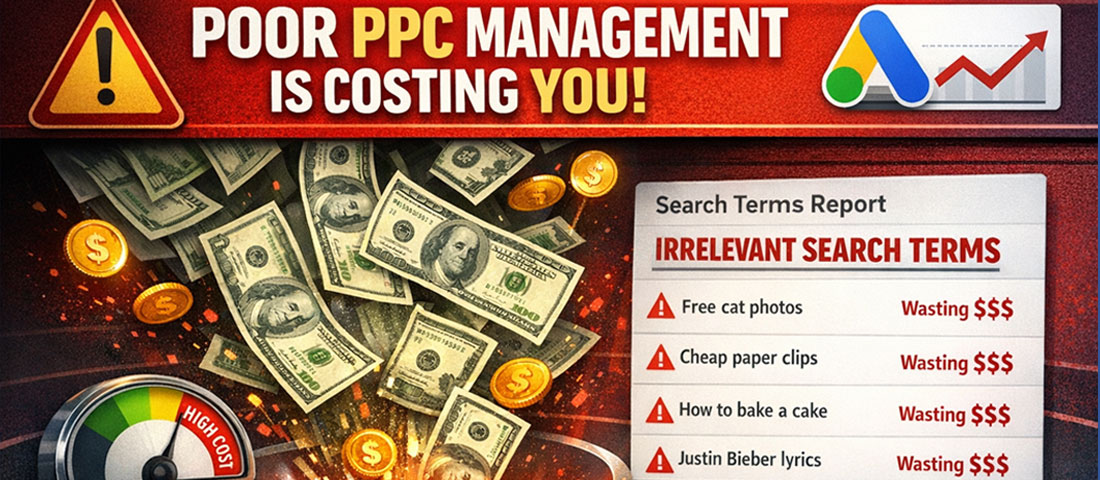
Poor campaign structure, absent negative keywords, and misaligned landing pages are the most common — and most costly — PPC mistakes that drain budget without generating returns.
- No conversion tracking. Running campaigns without tracking conversions makes every optimisation decision guesswork. This is the most fundamental error in PPC management — and one that persists in a surprising number of accounts.
- Too broad match types without negative keywords. Broad match keywords without an extensive negative keyword list will trigger ads for an enormous range of irrelevant searches, consuming budget on clicks with zero conversion potential.
- Setting and forgetting. PPC requires ongoing active management. Campaigns that were well-configured at launch become progressively less efficient over time as the competitive landscape, Quality Scores, and search behaviour evolve. Monthly neglect compounds into significant wasted spend.
- Sending all traffic to the homepage. The homepage is designed for everyone. PPC traffic has specific intent. Sending a user who searched “Shopify development for fashion eCommerce” to your generic homepage rather than a Shopify-specific landing page wastes the context and intent the keyword created.
- Ignoring Quality Score. Low Quality Scores mean higher CPCs and lower positions. Consistently ignoring poor-Quality-Score keywords rather than improving or removing them is a sustained cost inefficiency that compounds over campaign lifetime.
- Bidding only on branded terms. Branded keyword campaigns (bidding on your own company name) protect your brand in paid search but do not generate new customer acquisition. Campaigns targeting competitor terms and high-intent non-branded terms are where acquisition growth happens.
- Misunderstanding Performance Max. Performance Max campaigns give Google’s AI almost complete control over where and how ads appear across all Google channels. Without strong conversion signal data and high-quality creative assets, Performance Max often underperforms compared to well-managed traditional Search campaigns. Many businesses have switched entire accounts to Performance Max and seen performance decline.
Frequently Asked Questions About PPC and Google Ads
| What is PPC advertising and how does it work? | Pay-Per-Click (PPC) advertising is a digital advertising model where advertisers pay a fee each time their ad is clicked. In Google Ads — the dominant PPC platform — advertisers bid on keywords relevant to their business, and their ads appear at the top of search results when users search for those terms. Ad position is determined by Ad Rank, which combines bid amount, Quality Score (a measure of ad relevance and landing page quality), and expected impact of ad extensions. Advertisers with high-quality, relevant ads can achieve better positions than higher-bidding competitors while paying less per click — making account quality as important as budget in PPC success. |
| What is the difference between PPC and SEO? | PPC (Pay-Per-Click) delivers immediate paid visibility in search results — you pay each time someone clicks your ad, and your ad disappears the moment you stop paying. SEO (Search Engine Optimisation) builds organic rankings through content quality, technical website health, and authority signals — results develop over months, but once achieved, continue delivering traffic without ongoing per-click cost. PPC is best for immediate results, specific campaigns, and high-intent commercial queries where the conversion economics justify the cost. SEO is best for long-term sustainable traffic growth and building compounding organic authority. The most effective digital marketing strategies use both in combination. |
| How much does Google Ads cost? | There is no fixed cost for Google Ads — you set your own daily budget and maximum bid per click. The actual cost per click varies enormously by industry, keyword competitiveness, location, and Quality Score. In India, competitive service keywords typically cost ₹20 to ₹200 per click. In the USA or UK, equivalent keywords can cost $2 to $50 or more per click. Monthly budgets range from a few thousand rupees for local businesses testing the channel to several lakhs per month for aggressive national campaigns. The most important economic measure is not cost per click but cost per conversion — the average spend required to generate one qualified lead or sale — which must be below your customer acquisition cost target for the campaign to be profitable. |
| Do I need a Google Ads specialist to manage my campaigns? | For any campaign with meaningful budget, yes — a specialist almost always delivers significantly better results than self-management. Research consistently shows that specialist-managed accounts achieve 20 to 40% lower cost-per-conversion than equivalent self-managed accounts. Google Ads is a complex, rapidly evolving platform — effective management requires expertise in campaign structure, keyword strategy, Quality Score optimisation, bid strategy, ad copy testing, and conversion tracking that most business owners do not have time to develop. For small accounts with limited budgets (under ₹20,000–30,000 per month), the management fee of a specialist may not be proportionate to the account size — in these cases, Google Ads Smart campaigns or well-configured automated bidding can provide a reasonable baseline. |
| What is Performance Max and should I use it? | Performance Max (PMax) is Google’s AI-driven campaign type that serves ads across all Google channels — Search, Display, YouTube, Gmail, Discover, and Maps — from a single campaign. It relies on Google’s machine learning to determine where and how to show ads, optimising for your stated conversion goals. PMax can deliver strong results when: you have substantial conversion data (30+ conversions per month) for the algorithm to learn from; you provide high-quality creative assets (headlines, descriptions, images, videos) that Google can mix and match; and your conversion tracking is accurate and meaningful. Without these conditions, PMax often underperforms compared to well-managed traditional Search campaigns. It is not a “set and forget” solution — it still requires regular monitoring and creative asset management. |
| What is ROAS and what is a good ROAS for Google Ads? | ROAS (Return on Ad Spend) measures the revenue generated for each unit of ad spend — calculated as total conversion value divided by total ad spend. A ROAS of 4 means you generate £4 of revenue for every £1 spent on ads. What constitutes “good” ROAS depends entirely on your business’s margins: a business with 60% gross margin needs a much lower ROAS to be profitable than one with 20% margin. A commonly used rule of thumb for eCommerce is a 4x ROAS as a minimum profitability threshold, though this varies significantly by industry and margin profile. For service businesses, the equivalent metric is typically CPA (Cost Per Acquisition) measured against average client lifetime value rather than immediate conversion revenue. |
| How do SEO and PPC work together? | SEO and PPC work together most effectively when used as complementary channels rather than alternatives. Together, they provide combined SERP dominance — appearing in both paid and organic results for the same query increases total click share and brand credibility. PPC data provides fast keyword intelligence for SEO strategy — revealing which keywords actually convert before investing months in organic content. SEO coverage reduces the proportion of traffic that must be paid for — as organic rankings develop for high-CPC keywords, the overall cost-efficiency of the search marketing programme improves. PPC remarketing captures organic visitors who did not convert on first visit, keeping your brand visible during the consideration period. The combination consistently outperforms either channel in isolation. |
Want PPC campaigns that actually generate leads and sales — not just traffic?
Neel Networks manages Google Ads campaigns for businesses across the USA, UK, Canada, Australia, and India — building and optimising campaigns that deliver measurable returns on every rupee or pound spent.