Complete On-Page SEO Guide 2026: Factors, Schema, URLs, Internal Links & More
Most business owners understand that SEO matters. Far fewer understand that the majority of ranking power sits entirely within your own hands — on your own website. On-page SEO is the practice of optimising every element on a web page so that search engines can understand what it is about, assess its quality, and decide how prominently it should appear in search results. Done well, it compounds over time. Done poorly, it undermines every other marketing investment you make.
What this guide covers
- 1. What Is On-Page SEO and Why Does It Still Matter in 2026?
- 2. Title Tags: Your Single Most Important On-Page Element
- 3. Meta Descriptions: Not a Ranking Factor, But a Click-Rate Driver
- 4. URL Structure: Clean, Logical, and Keyword-Rich
- 5. Heading Hierarchy: H1 Through H6
- 6. Content Quality: The Helpful Content Standard
- 7. Keyword Placement: Where and How Often
- 8. Internal Linking: Architecture and Authority Flow
- 9. Image Optimisation: Performance and Accessibility
- 10. Schema Markup: Structured Data for Rich Results
- 11. Core Web Vitals: Performance as a Ranking Factor
- 12. Page Experience Signals Beyond Core Web Vitals
- 13. On-Page SEO Comparison: Common Issues and Fixes
- 14. Duplicate Content and Canonical Tags
- 15. How to Conduct a Full On-Page SEO Audit
- 16. On-Page SEO for eCommerce: Additional Considerations
- 17. Frequently Asked Questions About On-Page SEO
- 18. Conclusion: On-Page SEO Is a System, Not a Checklist
This guide covers the full spectrum of on-page SEO in 2026: title tags, meta descriptions, heading structure, URL design, content quality, internal linking, schema markup, Core Web Vitals, and more. Whether you run an eCommerce store in Melbourne, a services business in Toronto, or a SaaS product in London, these fundamentals apply universally.
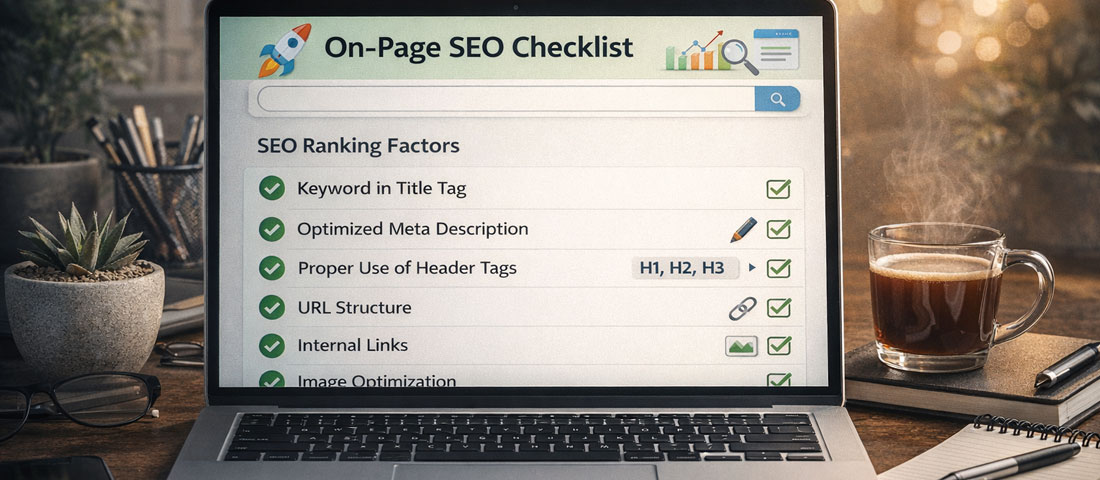
What Is On-Page SEO and Why Does It Still Matter in 2026?
On-page SEO refers to every optimisation you make directly on a web page — as opposed to off-page SEO (backlinks, citations) or technical SEO (server-level configurations, crawl infrastructure). It is the layer where content, structure, and search intent intersect. Google’s ranking systems evaluate on-page signals to decide whether a page genuinely serves the user who typed a particular query.
In 2026, on-page SEO matters more than ever for three reasons. First, AI Overviews and featured snippets pull directly from well-structured on-page content, meaning pages that follow best practices earn disproportionate visibility. Second, Google’s Helpful Content system explicitly rewards depth, specificity, and demonstrated expertise — all of which are on-page properties. Third, with Core Web Vitals now a confirmed ranking factor, technical performance has merged with on-page work in ways it had not previously.
Title Tags: Your Single Most Important On-Page Element
The title tag is the HTML element that defines the title of a web page. It appears in search engine results as the blue clickable headline, and in the browser tab. Google has confirmed it is one of the most significant on-page signals for determining relevance to a query.
In 2026, effective title tags follow a consistent formula: Primary Keyword | Supporting Context | Brand Name. The primary keyword should appear as close to the beginning as possible. Google typically displays the first 50–60 characters before truncating, so keep titles in that range. Avoid writing titles that are clever but ambiguous — clarity outperforms creativity in search.
Google does sometimes rewrite title tags in search results if it determines that yours does not accurately represent the page content. The best defence against rewriting is ensuring your title tag, your H1, and your first paragraph are all tightly aligned and genuinely reflect what the page delivers.
Title Tag Best Practices
- Include your target keyword — ideally within the first 30 characters
- Keep length between 50–60 characters for full display on desktop
- Write a unique title for every page on your website
- Avoid keyword stuffing (e.g. “SEO SEO SEO Services Best SEO”)
- Include your brand name at the end, separated by a pipe ( | ) or dash
- Match the title to the actual content — do not mislead
Meta Descriptions: Not a Ranking Factor, But a Click-Rate Driver
Meta descriptions do not directly influence rankings, but they significantly influence click-through rate (CTR). A compelling meta description increases the percentage of users who click your result over a competitor’s, which in turn sends positive engagement signals back to Google. Think of the meta description as your 155-character advertisement in the search results page.
The best meta descriptions summarise the page’s core value proposition, include the primary keyword naturally (Google bolds matching terms), and end with a soft call to action. Avoid duplicating meta descriptions across pages — Google may penalise duplicate metadata as a sign of low-quality content management. If you leave meta descriptions blank, Google will auto-generate one by pulling text from the page, which is rarely optimal.
URL Structure: Clean, Logical, and Keyword-Rich
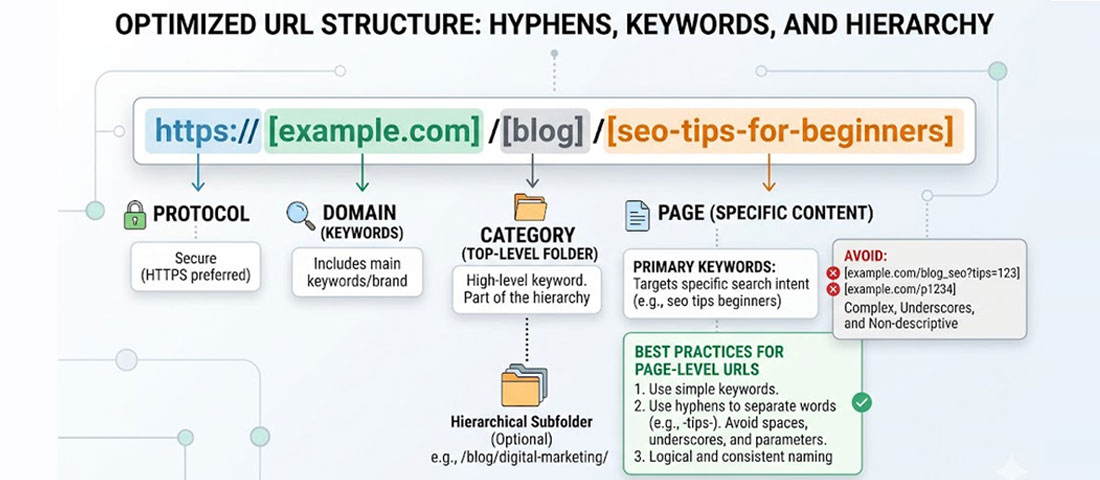
URLs are a confirmed, if minor, ranking signal. More importantly, a well-structured URL communicates page context to both users and search engines at a glance. The URL /blog/on-page-seo-guide/ tells everyone exactly what to expect. The URL /p=4827 tells no one anything.
For eCommerce sites, URL structure becomes even more critical. Category and subcategory paths should reflect how users actually think about products. For service businesses, service-page URLs should match the exact language prospects use when searching.
Heading Hierarchy: H1 Through H6
HTML headings (H1–H6) serve two functions simultaneously: they organise content visually for readers, and they communicate topical structure to search engine crawlers. Getting heading hierarchy right is one of the most consistently neglected aspects of on-page SEO.
Every page should have exactly one H1. The H1 is the primary heading — it should contain your main target keyword and accurately describe the page’s subject. It should not be identical to your title tag, but it should be closely related. H2s are major section headings. H3s are sub-sections within H2s. Use them to create a logical, scannable outline that a reader could skim and understand the page’s structure in under ten seconds.
In 2026, headings also play a role in AI-generated summaries and featured snippets. When Google builds a featured snippet, it frequently pulls the nearest heading as the label and the paragraph below it as the content. Phrasing H2 and H3 headings as direct questions (e.g. “What is structured data?”) improves the likelihood of capturing snippet positions.
Content Quality: The Helpful Content Standard
Google’s Helpful Content system, now fully integrated into the core ranking algorithm, evaluates whether content is created for people first or for search engines first. Pages that exist primarily to attract clicks — thin content, AI-generated padding, keyword-stuffed filler — are actively demoted. Pages that demonstrate genuine expertise, real-world experience, and comprehensive coverage of a topic are rewarded.
In practical terms, high-quality on-page content in 2026 means: answering the searcher’s actual question fully; going beyond surface-level information to include nuance, examples, and caveats; demonstrating first-hand knowledge where relevant; and covering adjacent questions that a user is likely to have after reading the primary answer. Long-form content is not inherently better — relevance and depth within an appropriate length is what matters.
Content Quality Checklist
-
Match search intent precisely
Determine whether the query has informational, navigational, commercial, or transactional intent, then structure your content accordingly. A page targeting “buy running shoes” needs a product listing, not a 2,000-word essay. -
Cover the topic comprehensively
Use tools like Google’s “People Also Ask” and related searches to identify every angle a searcher might have. Gaps in coverage leave openings for competitors to outrank you on subtopics. -
Write with specificity
Vague statements weaken authority. Specific data, named examples, clear processes, and real-world context signal expertise. Replace “it can take some time” with “most businesses see measurable improvement within 3–6 months.” -
Use E-E-A-T signals throughout
Experience, Expertise, Authoritativeness, and Trustworthiness (E-E-A-T) are evaluated page-by-page. Include author bylines with credentials, cite sources, link to authoritative references, and keep factual claims accurate and current. -
Update content regularly
Stale content is one of the most common causes of gradual ranking decline. Set a content review calendar and refresh any statistics, screenshots, or recommendations that are more than 12–18 months old.
Keyword Placement: Where and How Often
Keyword placement remains relevant in 2026, but the rules are more nuanced than the “keyword density” metrics that dominated early SEO. Modern best practice focuses on natural semantic coverage rather than counting occurrences.
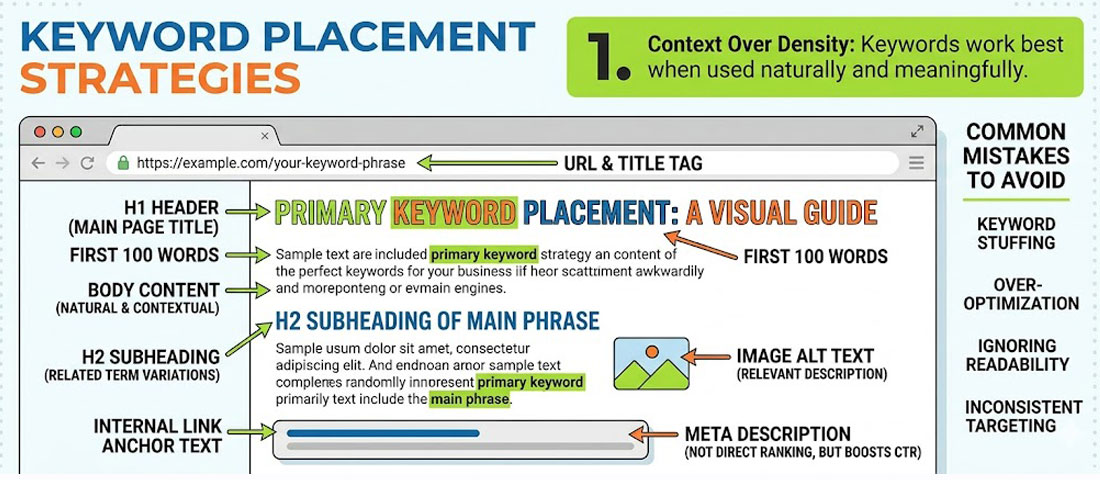
Your primary keyword should appear in: the title tag, the H1, the first 100 words of body copy, at least one H2, the meta description, the URL, and one or two image alt attributes. Beyond those anchor placements, the keyword should appear naturally wherever it makes contextual sense — not forced, not counted.
Equally important are related terms and synonyms — what Google refers to as entities and semantic relationships. A page about “website redesign” that also naturally mentions terms like “user experience,” “conversion rate,” “mobile responsiveness,” and “page speed” demonstrates topical authority. Pages that only repeat the exact target phrase without semantic richness often underperform pages with richer vocabulary on the same subject.
Internal Linking: Architecture and Authority Flow
Internal links connect pages within your own website. They serve three purposes simultaneously: they help users navigate to related content, they help search engines discover and crawl your pages, and they distribute PageRank (link authority) across your site. A strong internal linking structure can significantly boost the rankings of pages that have little external backlink support.
The most important internal linking principle is intentionality. Every internal link should be placed because it adds genuine value to the reader — pointing them toward a related topic they are likely to want to explore. Anchor text matters: descriptive anchor text (“read our guide to Core Web Vitals”) passes more context than generic text (“click here”).
Internal Linking Strategy for 2026
Pillar-cluster model: Organise your content into topic clusters. A pillar page covers a broad topic comprehensively (e.g. “Complete Guide to SEO”). Cluster pages cover individual subtopics in depth (e.g. “What is On-Page SEO?”, “How to Build Backlinks”). Every cluster page links back to the pillar, and the pillar links out to all clusters. This architecture signals to Google that you have comprehensive authority on a topic, not just a single strong page.
Orphan pages: Pages with no internal links pointing to them are invisible to search engines unless they are in your sitemap. Audit your site periodically to identify orphan pages and connect them into your internal link architecture.
Link depth: Pages deeper than three clicks from the homepage receive less crawl attention. Important landing pages — service pages, key product categories, high-value blog posts — should be reachable in two clicks or fewer from the homepage.
Image Optimisation: Performance and Accessibility
Images impact on-page SEO in two distinct ways: through alt text (which communicates image content to search engines and screen readers) and through file size and format (which directly affects page load speed and Core Web Vitals).
Every non-decorative image on your site should have a descriptive alt attribute that explains what the image shows, including the target keyword where it fits naturally. Alt text is also read aloud by screen readers, so it plays an accessibility role alongside its SEO function. Decorative images (spacers, borders, abstract backgrounds) should have empty alt attributes (alt="") to indicate to screen readers that they carry no meaning.
For performance, serve images in modern formats — WebP and AVIF deliver 25–50% smaller file sizes than JPEG and PNG at equivalent quality. Use responsive images (srcset) to serve appropriately sized images to different devices. Compress all images before upload. Lazy-load below-the-fold images using the loading="lazy" attribute. These practices directly improve Largest Contentful Paint (LCP), one of the three Core Web Vitals.
Schema Markup: Structured Data for Rich Results
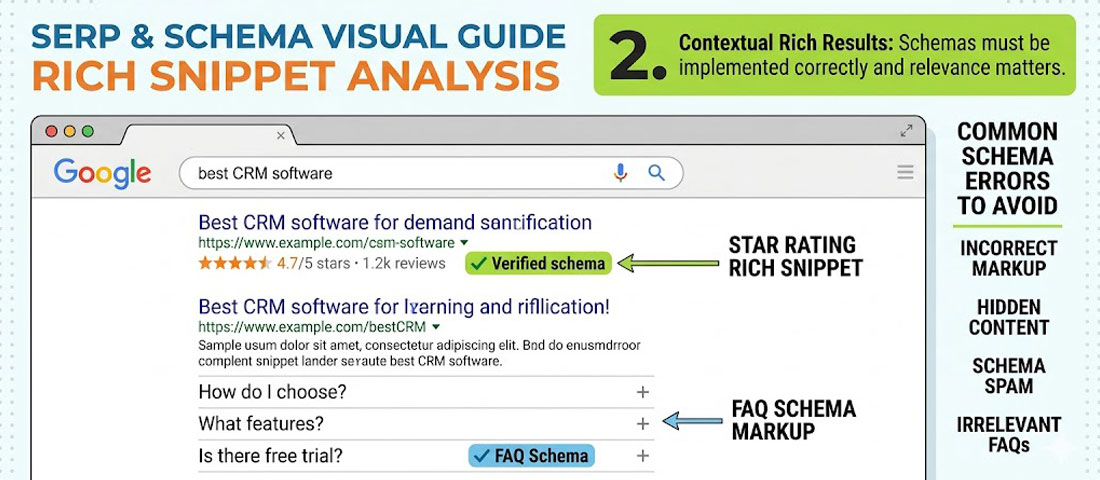
Schema markup (structured data) is code added to a page that explicitly tells search engines what the content means — not just what it says. It is written in JSON-LD format (Google’s recommended implementation) and embedded in the page’s <head> or inline in the body. Pages with valid, appropriate schema are eligible for rich results: star ratings, FAQs, How-To steps, breadcrumbs, product prices, event dates, and more.
Rich results significantly improve click-through rates. A search result showing five gold stars and a price range attracts far more clicks than a plain blue link, even if both appear in the same position. In 2026, structured data is also being used by Google’s AI Overview systems to populate AI-generated answers — making schema one of the most impactful ways to appear in the new generation of search features.
Schema Types Most Relevant for Business Websites
LocalBusiness
Name, address, phone, opening hours, geo-coordinates. Essential for any business serving a geographic area. Directly populates Google’s Knowledge Panel and Maps listings.
FAQPage
Marks up question-and-answer content. Eligible to show expandable Q&A pairs directly in search results, dramatically increasing result size and visibility. High ROI for informational pages.
Article / BlogPosting
Marks up editorial content with author, date published, date modified, and headline. Supports E-E-A-T signals and may trigger author panels in search results.
Product
Marks up price, availability, SKU, and reviews for product pages. Enables rich results in both standard search and Google Shopping surfaces.
Service
Describes a service offering with name, description, provider, and area served. Important for service-business websites where no physical product is being sold.
BreadcrumbList
Displays the page’s position in the site hierarchy within the search result URL. Improves result appearance and helps users understand navigation context before clicking.
Implement schema using Google’s Structured Data Markup Helper and validate every implementation with Google’s Rich Results Test before publishing. Invalid schema does not cause ranking penalties, but it does prevent rich result eligibility.
Core Web Vitals: Performance as a Ranking Factor
Core Web Vitals are Google’s set of standardised metrics that measure real-world user experience. They became a confirmed ranking factor in 2021 and have grown in weight since. In 2026, pages that consistently fail Core Web Vitals assessments — particularly on mobile — face measurable ranking disadvantages compared to technically healthy competitors.
The three Core Web Vitals are:
- Largest Contentful Paint (LCP): Measures how quickly the largest visible content element (usually a hero image or headline) loads. Target: under 2.5 seconds.
- Interaction to Next Paint (INP): Measures responsiveness — how quickly the page reacts to user interactions. Replaced First Input Delay in 2024. Target: under 200 milliseconds.
- Cumulative Layout Shift (CLS): Measures visual stability — how much the page layout shifts unexpectedly as it loads. Target: under 0.1.
Improving Core Web Vitals typically requires developer-level intervention: optimising server response times, eliminating render-blocking resources, properly sizing images, using a CDN, implementing efficient caching, and removing or deferring third-party scripts. Use Google PageSpeed Insights to identify specific issues on each page. The CrUX (Chrome User Experience Report) data provides field data from real users, which is what Google actually uses for ranking — lab data alone is insufficient.
Page Experience Signals Beyond Core Web Vitals
Google’s Page Experience update bundled Core Web Vitals with several other signals that collectively assess whether a page is pleasant and trustworthy to use. These include HTTPS (secure connection), absence of intrusive interstitials (pop-ups that obstruct content immediately on load), and mobile-friendliness.
HTTPS is now table stakes — any site still running on HTTP faces both a ranking disadvantage and browser security warnings that devastate user trust. If your site is still HTTP, migrating to HTTPS is the single highest-priority fix available. Mobile-friendliness means responsive design that adapts to all screen sizes, touch-friendly tap targets (minimum 44×44 pixels), and readable text without zooming. Intrusive interstitials include pop-ups that cover the main content before the user has had any chance to engage — Google specifically penalises these because they degrade the experience.
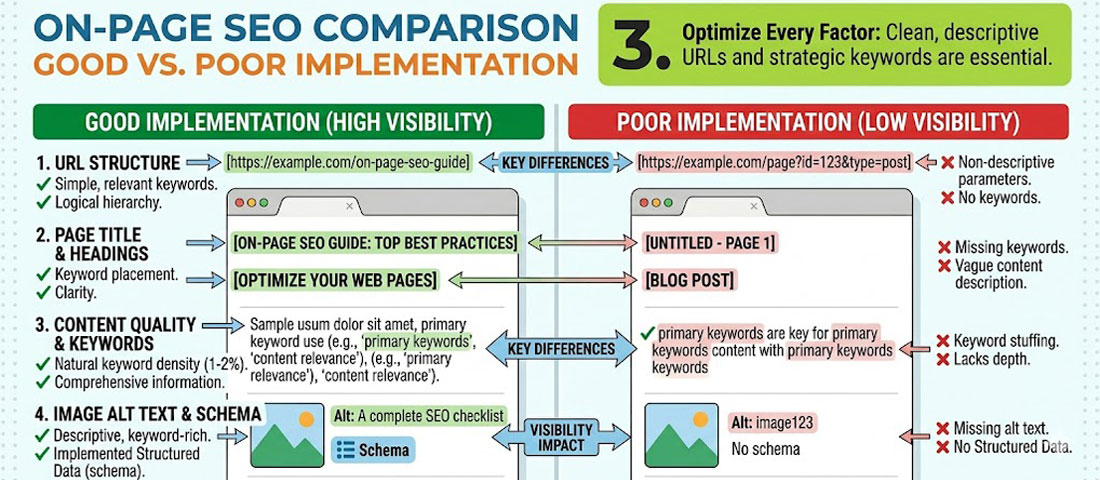
On-Page SEO Comparison: Common Issues and Fixes
| Element | Common Problem | Correct Approach | Impact |
|---|---|---|---|
| Title Tag | Missing keyword, too long, duplicated | Keyword first, 50–60 chars, unique per page | High |
| H1 Tag | Multiple H1s, missing, keyword absent | One H1 per page with primary keyword | High |
| Meta Description | Missing, duplicate, over 160 chars | Unique, 145–155 chars, CTA included | Medium (CTR) |
| URL | Dynamic parameters, underscores, dates | Short, hyphenated, keyword-present | Medium |
| Images | No alt text, oversized files | Descriptive alt, WebP, lazy loading | Medium |
| Internal Links | Generic anchors, orphan pages | Descriptive anchors, pillar-cluster model | Medium |
| Schema | Absent, invalid, wrong type | Validated JSON-LD, appropriate type | Medium–High (rich results) |
| Core Web Vitals | Slow LCP, layout shifts | Image optimisation, eliminate render-blocking | High (mobile) |
| Content Quality | Thin, outdated, mismatched intent | Comprehensive, specific, regularly updated | Very High |
Duplicate Content and Canonical Tags
Duplicate content occurs when the same or substantially similar content appears at more than one URL. This confuses search engines about which version to index and rank, often diluting authority across multiple pages when it should be concentrated on one. Common causes include www vs. non-www versions, HTTP vs. HTTPS, trailing slashes vs. none, paginated pages, print-friendly versions, and URL parameters added by analytics or session tracking.
The canonical tag (<link rel="canonical" href="...">) tells Google which version of a page is the definitive original. Every page should have a self-referencing canonical tag even if no duplicates currently exist — it is a preventive measure that costs nothing to implement. Where genuine duplicates exist, point all canonical tags to the preferred version. For truly duplicate pages that serve no user purpose, 301 redirects to the original are a stronger signal than canonical tags.
How to Conduct a Full On-Page SEO Audit
-
Crawl your site
Use Screaming Frog, Sitebulb, or Google Search Console to generate a full list of URLs with their title tags, H1s, meta descriptions, word count, response codes, and canonical tags. This is your baseline. -
Identify technical errors first
Fix 404 errors, redirect chains, missing canonical tags, and pages blocked from indexing by robots.txt or noindex tags. These are structural problems that limit everything else. -
Audit metadata across all pages
Check every page for missing, duplicate, or over-length title tags and meta descriptions. Prioritise pages that already rank and pages that are strategically important. -
Evaluate content quality page by page
Identify thin pages (under 300 words on topics that require depth), outdated content, and pages with mismatched intent. Decide whether to update, expand, merge, or remove each one. -
Map your internal linking gaps
Identify pages with no or few internal links pointing to them. Cross-reference with your most important target pages and build a linking plan to strengthen authority flow. -
Check Core Web Vitals in Google Search Console
Review the Core Web Vitals report to identify pages flagged as Poor or Needs Improvement. Prioritise fixes starting with your highest-traffic and highest-value pages. -
Validate your structured data
Run key pages through Google’s Rich Results Test. Fix any errors or warnings in schema implementation. Add missing schema types where appropriate.
On-Page SEO for eCommerce: Additional Considerations
eCommerce sites face a unique on-page SEO challenge: they typically have hundreds or thousands of product and category pages, many of which are created dynamically and can easily generate duplicate content, thin content, or canonicalisation issues at scale.
For product pages, the most common problem is manufacturers’ description copy used across multiple retailers. Google may struggle to identify your version as the canonical source. Write unique product descriptions that include specifications, use cases, common questions, and anything that genuinely helps a buyer decide. Category pages require particular attention: they are often the highest-value pages on an eCommerce site, yet they frequently contain nothing but a product grid and a few navigation filters. Adding an introductory paragraph, buying guide content, and an FAQ section to category pages can significantly improve their ranking potential.
Faceted navigation (filter parameters like ?colour=red&size=large) is one of the most common sources of crawl waste and duplicate content on eCommerce sites. Use canonical tags to point all filtered variations back to the base category URL, or use robots.txt to prevent crawling of parameter-based URLs that do not produce unique value.
Frequently Asked Questions About On-Page SEO
| What is the difference between on-page SEO and technical SEO? | On-page SEO focuses on the content and HTML elements directly visible on a page — title tags, headings, body copy, images, internal links, and schema markup. Technical SEO focuses on the infrastructure beneath the page: crawlability, site architecture, server response times, XML sitemaps, robots.txt, and indexation. The two overlap in areas like Core Web Vitals and canonical tags. In practice, most websites need both to rank effectively — strong on-page optimisation sitting on a technically healthy site produces the best results. |
| How long does it take for on-page SEO changes to affect rankings? | On-page changes typically produce ranking shifts within two to twelve weeks, though the timeline varies depending on how frequently Google crawls your site, the competitiveness of your target keywords, and the scale of the changes. Small sites with fresh content may see changes reflected within days. Large sites with slower crawl rates may take several weeks before Google processes all updates. Significant ranking improvements — particularly for competitive keywords — may take three to six months as Google reassesses your page’s authority relative to competitors. Quick wins like fixing broken canonical tags or adding missing schema can produce faster changes than content rewrites. |
| Is keyword density still important in 2026? | Keyword density as a metric is largely obsolete in 2026. Google’s natural language processing models are sophisticated enough to understand topical relevance without requiring a specific keyword-to-word-count ratio. What matters now is semantic richness — covering a topic with depth, specificity, and natural use of related terms, synonyms, and entities. Forcing a specific keyword at an artificial frequency can actually harm quality signals and readability. Write for human understanding first; ensure your primary keyword appears in the key structural elements (title, H1, first paragraph, one or two subheadings), then let natural language carry the rest. |
| How much does schema markup actually improve rankings? | Schema markup does not directly improve rankings in most cases — it is not a confirmed ranking factor in the traditional sense. Its primary value is enhancing the appearance of your search result through rich snippets, which improves click-through rate and therefore organic traffic. However, in 2026, schema plays a secondary role in feeding Google’s AI Overview and featured snippet systems. Pages with well-implemented structured data are more likely to have their content accurately extracted and surfaced in AI-generated answers. For certain schema types like Review and FAQ, the traffic impact of rich result eligibility can be substantial — typical CTR improvements of 20–30% are documented for pages that achieve FAQ rich results. |
| Can I optimise old blog posts, or is it better to write new content? | Optimising existing content is often more effective and efficient than writing new posts, especially for pages that already have some ranking history. Google’s systems have already assessed the page’s authority relative to competitors — updating and expanding it allows you to build on that existing signal rather than starting from zero. Prioritise updates for pages that rank between positions 5 and 20 (within striking distance of top results), pages with declining traffic, and evergreen content covering topics where information has changed. Add depth to thin sections, update statistics, improve heading structure, add FAQ schema, and ensure internal links point to the updated page. Republishing with a new “last updated” date and updating the schema’s dateModified property helps ensure Google re-evaluates the page promptly. |
| What are the most important on-page SEO elements for local businesses? | For local businesses, on-page SEO overlaps heavily with local SEO signals. The most important elements are: consistent NAP (Name, Address, Phone) information on every page; LocalBusiness schema with accurate address, opening hours, and geo-coordinates; location-specific keyword inclusion in title tags, H1s, and early body content (e.g. “Web Design Agency in Mumbai” rather than just “Web Design Agency”); a dedicated contact page with an embedded Google Map; and location-specific service pages if you serve multiple areas. Additionally, building out a Google Business Profile and ensuring it is consistent with on-page information strengthens local pack rankings. Reviews schema that aggregates your Google review score into your search result is also highly valuable for local CTR. |
| How do Core Web Vitals affect my rankings practically? | Core Web Vitals function as a tiebreaker signal in Google’s ranking algorithm. For a given query, if two pages have similar relevance, authority, and content quality scores, the page with better Core Web Vitals performance will generally rank higher. In practice, this means failing Core Web Vitals is rarely the sole reason a page ranks poorly — but it is consistently a contributing factor, and it becomes the decisive factor when you are competing closely with similarly authoritative pages. For mobile users in particular, poor performance directly correlates with higher bounce rates and lower engagement metrics, which feed back into Google’s assessment of page quality. Fix Core Web Vitals as part of a broader optimisation effort rather than expecting dramatic ranking jumps from performance improvements alone. |
Conclusion: On-Page SEO Is a System, Not a Checklist
The businesses that consistently outrank their competitors are not the ones who completed a one-time SEO audit in 2020 and left it at that. They are the ones who treat on-page SEO as an ongoing system: monitoring performance data, refreshing content as information evolves, expanding schema implementation as new types become available, and addressing Core Web Vitals issues as their site grows and changes.
The good news is that most of the fundamentals covered in this guide — well-written title tags, logical URL structures, descriptive alt text, clean heading hierarchies, appropriate internal linking — require no ongoing cost once implemented correctly. They simply need to be right from the start.
Neel Networks has been building and optimising websites for clients across India and internationally since 2014. Our SEO work is grounded in these fundamentals: clean technical architecture, content that genuinely serves the searcher, and structured data that communicates clearly to Google’s systems. If your website is not performing at the level your business deserves, we are happy to take a detailed look.
Build a Website That Ranks and Converts
Neel Networks designs, builds, and optimises websites with on-page SEO built into every element from day one — clean URL structures, fast-loading pages, proper schema, and content strategy aligned to your business goals. We serve clients across Mumbai and internationally.
Explore Our SEO Services View Web Design Services WhatsApp Us