How Strategic Logo Design Builds Powerful Brand Identity in 2026
A logo is the most compressed expression of a brand’s identity. In a fraction of a second — the time it takes a human brain to process a visual — a well-designed logo communicates character, quality, industry, and feeling. A poorly designed one communicates the opposite, or nothing at all. In either case, the communication happens whether you intend it to or not. Every business has a visual identity; the question is only whether that identity was designed with strategic intent or arrived at by default.
What this guide covers
- 1. What a Logo Actually Does — and What It Cannot Do Alone
- 2. The Five Qualities of an Effective Logo
- 3. Types of Logo and When to Use Each
- 4. The Logo Design Process: From Brief to Brand Mark
- 5. Colour in Logo Design: More Than Aesthetics
- 6. Typography in Brand Identity: The Silent Communicator
- 7. Building a Brand Identity System Beyond the Logo
- 8. Common Logo Design Mistakes to Avoid
- 9. Frequently Asked Questions About Logo Design and Brand Identity
- 10. Conclusion: Invest in the Foundation, Protect It Consistently
In 2026, the stakes of logo and brand identity design have risen. Your logo appears simultaneously across more surfaces than at any point in history: website header, mobile app icon, social media profile, Google Business Profile, email signature, WhatsApp, digital ads, print collateral, packaging, and increasingly in AI-generated search results that surface your brand imagery alongside your business description. A logo that does not work across this full range of contexts — that breaks at small sizes, loses legibility in dark mode, or loses its character when reproduced in single colour — is a liability, not an asset.
This guide covers what makes a logo strategically effective, the design principles that produce lasting brand marks, the process of briefing and evaluating logo design work, how to build a coherent visual identity system beyond the logo itself, and the practical considerations that separate professional brand identity from amateur execution.
What a Logo Actually Does — and What It Cannot Do Alone
A logo does not sell products. It does not explain your value proposition. It does not build trust on its own. What a logo does — when it is well-designed — is serve as a reliable, consistent anchor point for every impression your brand makes. It is the visual shorthand that, over time and through repeated positive associations, comes to stand for everything your business represents. Nike’s swoosh does not inherently communicate athletic performance — it does so because forty years of consistent brand experience have loaded it with that meaning. The logo is the container; brand experience fills it.
This distinction matters for two reasons. First, it explains why a logo cannot rescue a business with a poor product or inconsistent service — the logo accumulates whatever associations customers actually have with the brand, not the associations the brand hopes to project. Second, it explains why consistency is the most important operational requirement for any logo: a mark that appears in different forms, different colours, and different proportions across different contexts never accumulates the consistent associations needed to do its job.
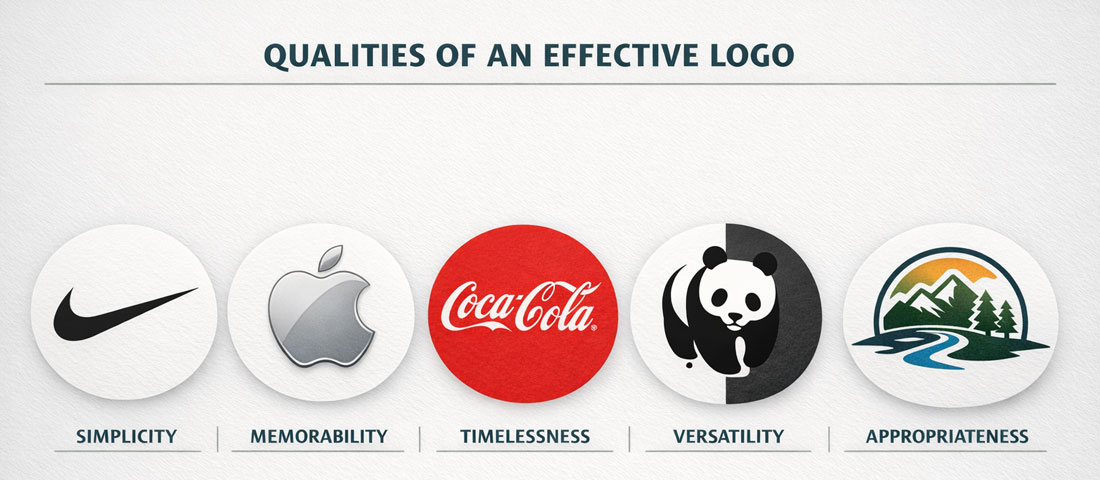
The Five Qualities of an Effective Logo
Logo design principles have been debated for as long as the discipline has existed, but there is substantial consensus around a core set of qualities that effective brand marks share across categories, markets, and eras. These are not stylistic preferences — they are functional requirements for a mark that will work across the full range of modern brand contexts.
1. Simplicity
The most enduring and effective logos are almost always simpler than their creators initially expected. Simplicity is not the absence of sophistication — it is the reduction of a complex idea to its most essential visual form. A simple logo is more memorable, more legible at small sizes, more reproducible across media, and more versatile in application than a complex one. Complexity is often a symptom of unclear strategic thinking: when a brand has not clearly defined what it stands for, designers compensate by trying to communicate everything simultaneously, producing marks that communicate nothing clearly.
In practical terms, simplicity means the logo should be recognisable at 16×16 pixels (app icon size), legible in single colour, and drawable from memory by someone who has seen it a few times. If it fails any of these tests, it is probably too complex.
2. Memorability
Memorability is the quality that allows a logo to do its recall work. A memorable logo has a distinctive quality — an unexpected shape, an unusual letterform, a clever visual device — that separates it from the visual noise of its competitive context. Memorability is not the same as novelty; a logo that is merely unusual is not automatically memorable. Memorability comes from the combination of distinctiveness with relevance — a visual element that is surprising enough to stick, but connected enough to the brand’s identity to feel right rather than arbitrary.
3. Timelessness
Logos are long-term investments. A rebrand is expensive in both financial terms and in the brand equity lost when a familiar mark changes significantly. The goal is to design something that will remain appropriate and effective for fifteen to twenty years, not something that reflects the visual trends of the season it was created. Trend-chasing in logo design — using the gradient styles, font treatments, or geometric approaches that are currently fashionable — almost always produces work that looks dated within three to five years. The most enduring logos are grounded in timeless principles: strong geometric shapes, clear letterforms, negative space that creates double meanings, and visual ideas that are conceptually sound rather than stylistically dependent.
4. Versatility
A professional logo system in 2026 must work across an extraordinary range of applications: from a 16px app icon to a 10-metre building fascia, from a full-colour website header to a single-colour rubber stamp, from a light background to a dark one, from horizontal to stacked orientation. Every one of these applications is a real-world requirement for most businesses, and a logo that fails in any of them creates a visible inconsistency that undermines brand professionalism. Versatility is achieved through thoughtful initial design — keeping the mark simple enough to survive reduction, ensuring sufficient contrast in all colour applications, and building a mark that works in both horizontal and square formats.
5. Appropriateness
A logo must feel right for its context — its industry, its audience, its competitive set, and its brand positioning. A playful, rounded wordmark is appropriate for a children’s educational brand; it would undermine credibility for a law firm or a financial services provider. A stark, angular geometric mark signals precision and authority; it would feel cold and inaccessible for a wellness or hospitality brand. Appropriateness is evaluated not in isolation but relative to the specific brand and its competitive context. A great logo for one brand is not necessarily a great logo for another.
Types of Logo and When to Use Each
Wordmark (Logotype)
The brand name rendered in a distinctive, customised typeface. Examples: Google, Coca-Cola, FedEx. Best for brands with distinctive or short names that benefit from clear verbal identification. Requires a name that works visually and is distinctive enough to stand on its own without a supporting symbol.
Lettermark (Monogram)
Initials or an abbreviation rendered as a distinctive mark. Examples: IBM, NASA, HBO. Best for brands with long names that abbreviate well, or for established brands where the abbreviation has become more recognised than the full name. Requires strong typographic craft to distinguish from generic initial treatments.
Pictorial Mark (Symbol)
A standalone graphic symbol that represents the brand without type. Examples: Apple, Twitter’s bird, Shell. Requires significant brand equity investment before the symbol can stand alone without the name — appropriate for established brands or very distinctive symbols with strong concept grounding.
Abstract Mark
A geometric or abstract form that represents the brand through shape and form rather than literal imagery. Examples: Nike swoosh, Pepsi circle, Adidas stripes. Highly distinctive when well-executed. Requires strong conceptual grounding to avoid feeling arbitrary — the best abstract marks have clear strategic rationale behind the specific form chosen.
Combination Mark
A symbol or icon combined with a wordmark, either locked together or available as separable elements. The most versatile format for most businesses because it provides both a symbol (for contexts where space is limited or the brand is established enough to use it alone) and a wordmark (for contexts where name recognition is needed). Recommended default for most new business logos.
Emblem / Badge
Text contained within a shape — crests, shields, stamps, seals. Examples: Harley-Davidson, Starbucks (originally), university logos. Strong associations with heritage, authority, and craft. Popular in hospitality, food and beverage, and institutions. Less versatile than combination marks at very small sizes — the enclosed type can become illegible below a certain scale.
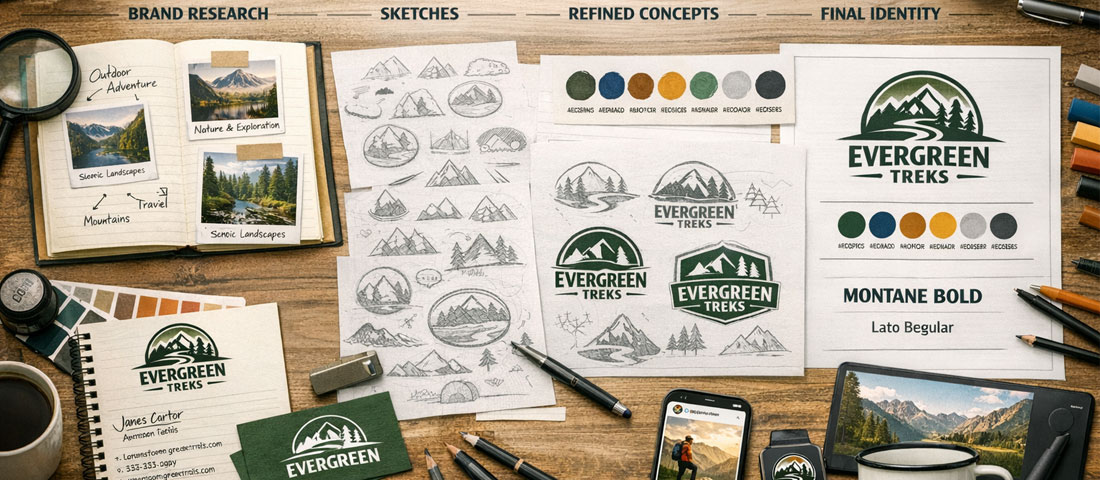
The Logo Design Process: From Brief to Brand Mark
-
Brand strategy and brief development
Effective logo design begins with brand strategy, not with aesthetics. Before any visual exploration, define: what the brand stands for (values, personality, positioning), who the primary audience is and what they care about, what the competitive landscape looks like and how the brand should differentiate visually, and what the brand should feel like — the emotional qualities it should evoke. A well-developed creative brief takes two to four hours to produce and saves multiples of that time in design iterations and misaligned concepts. -
Research and competitive audit
A thorough review of existing visual identities in the competitive space identifies category conventions (which visual codes communicate “we are part of this industry”) and differentiation opportunities (which approaches are overused and where white space exists). This research prevents inadvertent similarity to competitors and grounds strategic differentiation decisions in real market context rather than assumption. -
Conceptual exploration and sketching
Professional logo designers begin with pencil sketches rather than digital software — a practice that allows faster exploration of a wider range of ideas before committing to the precision of digital execution. At this stage, quantity of distinct conceptual directions is more valuable than polish. Ten rough concepts across different approaches (wordmark, symbol, combination mark) provide more strategic options than three highly polished executions of similar ideas. -
Digital refinement and concept presentation
Selected sketch concepts are developed digitally using vector software (Adobe Illustrator is the professional standard). Typically two to three distinct concepts are developed to presentation quality and shown in context — on a business card, a website header, and a social profile image — so that the client can evaluate the concepts in realistic use rather than on an abstract white background. Context is essential for accurate evaluation. -
Feedback, revision, and refinement
Logo design feedback should focus on whether the concept is strategically right — does it communicate the right brand character, does it work in the competitive context, does it feel appropriate for the audience — rather than on personal aesthetic preferences. The most counterproductive feedback in logo design is based on individual taste rather than strategic evaluation. A structured revision process with clear criteria produces better outcomes than open-ended “make it feel different” directions. -
Brand identity system development
The approved logo mark is the foundation of a broader brand identity system: primary and secondary colour palette, typography hierarchy, spacing and clear space rules, usage guidelines for different contexts, and a set of brand identity files in all required formats. This system is what allows consistent application across every touchpoint over the years of the brand’s life. -
File delivery and brand guidelines
Professional logo delivery includes: SVG and EPS vector source files, PNG files with transparent backgrounds at multiple resolutions, JPEG versions for use where transparency is not supported, a single-colour (black and white) version, reversed versions for use on dark backgrounds, and any orientation variants (horizontal/stacked) needed for different applications. A brand guidelines document codifying correct usage, colour codes (HEX, RGB, CMYK, Pantone), and typography completes the delivery package.
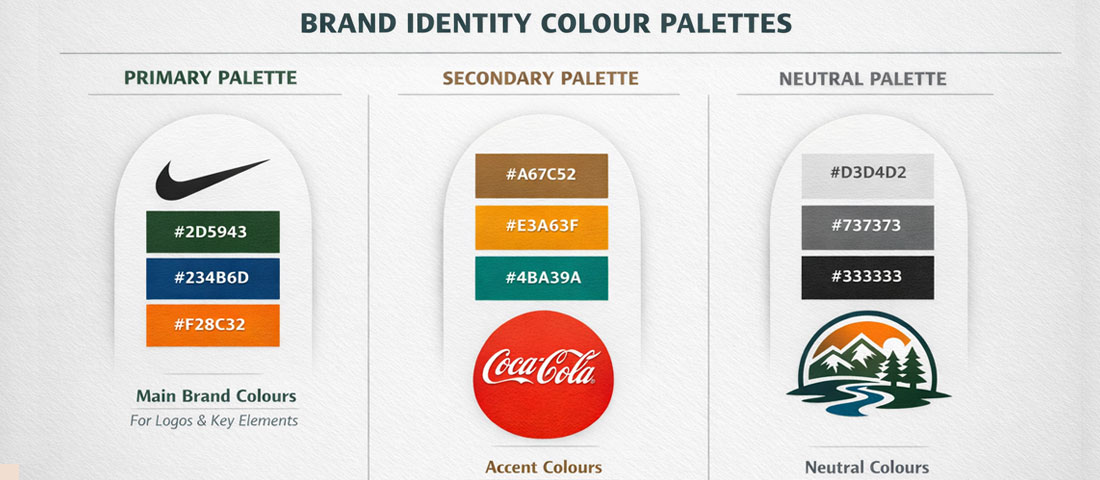
Colour in Logo Design: More Than Aesthetics
Colour is one of the most powerful communicators in visual identity, and one of the most frequently chosen on the basis of personal preference rather than strategic intent. Research in colour psychology demonstrates consistent associations across cultures for many colours — associations that are worth understanding and leveraging rather than ignoring.
| Colour | Primary Associations | Common Brand Categories | Caution |
|---|---|---|---|
| Blue | Trust, reliability, professionalism, calm | Finance, technology, healthcare, B2B services | Overused in corporate sectors — differentiation requires distinctive shade or combination |
| Red | Energy, urgency, passion, appetite | Food & beverage, retail, entertainment, emergency | Strong but can communicate aggression if not balanced; avoid in healthcare without careful execution |
| Green | Nature, health, growth, sustainability | Wellness, organic products, finance (growth), environment | Association with sustainability so strong it may confuse positioning for non-related brands |
| Black | Luxury, sophistication, authority, elegance | Premium fashion, high-end services, technology | Can feel cold without warmth from other brand elements; requires strong typographic craft |
| Yellow / Gold | Optimism, energy, warmth, quality (gold) | Food, children’s brands, premium (gold), transport | Yellow difficult to maintain contrast requirements; gold can become clichéd in premium positioning |
| Purple | Creativity, luxury, wisdom, spirituality | Beauty, wellness, creative services, premium products | Strong gender associations in some markets; can feel dated depending on shade and execution |
| Orange | Friendliness, enthusiasm, accessibility, warmth | Food, retail, creative industries, technology | High energy colour that can overwhelm; works best as accent rather than primary colour for many brands |
Colour contrast is a non-negotiable accessibility requirement in 2026. WCAG 2.1 AA standards require a contrast ratio of at least 4.5:1 for normal text and 3:1 for large text and graphical elements. Logos that fail contrast requirements are not only inaccessible to users with visual impairments — they may also fail certain digital platform requirements. Validate colour combinations against contrast standards as part of the design process, not as an afterthought.
Typography in Brand Identity: The Silent Communicator
After colour, typography is the most powerful communicator in a brand identity system — and the most frequently underestimated. The typefaces chosen for a brand’s identity carry significant personality and meaning: a serif typeface like Garamond communicates heritage, authority, and tradition; a geometric sans-serif like Futura communicates modernity, precision, and confidence; a rounded sans-serif communicates approachability and warmth; a slab serif communicates strength and reliability.
A professional brand typography system defines at minimum two typeface families: a display or heading typeface that is often more distinctive and characterful, used for headlines and brand moments; and a body or text typeface that prioritises readability and legibility across large amounts of copy. These two typefaces should complement each other — creating visual interest through contrast without competing or clashing — and both should be available in the formats required for digital applications (web fonts) and print reproduction.
In 2026, variable fonts have become practical for professional brand use. A single variable font file can contain the full range of weights and widths previously requiring multiple files, enabling more expressive typographic applications with smaller file size overhead. For brands with significant digital content output, variable font adoption is worth considering in the typography system design phase.
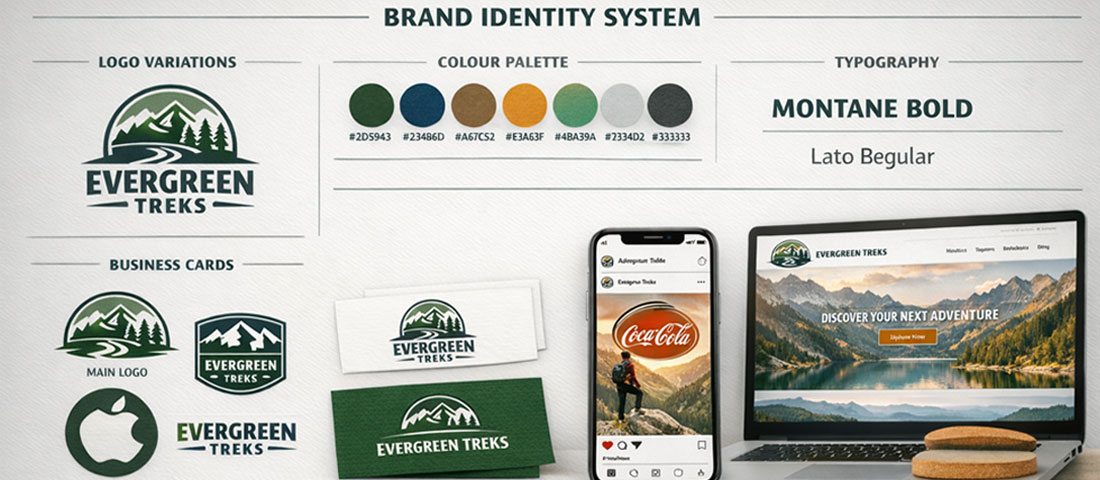
Building a Brand Identity System Beyond the Logo
A logo is the foundation of a brand identity system, not the entirety of it. The businesses with the most coherent and compelling brand presences in 2026 have invested in a complete visual language that extends the logo’s character across every brand touchpoint. The elements of a complete brand identity system are:
Logo suite: Primary logo, secondary/compact version, symbol-only version, wordmark-only version, monochrome versions, reversed versions. All in vector formats with clear usage guidelines specifying when each version is appropriate.
Colour system: Primary palette (one to three colours), secondary palette (two to four supporting colours), neutral palette (greys, whites, blacks for background and text use), and functional colours (success, warning, error states for digital applications). All specified in HEX, RGB, CMYK, and Pantone where relevant.
Typography hierarchy: Display typeface and usage rules (headlines, pull quotes, key brand moments), body typeface and usage rules (body copy, captions, UI text), and fallback web-safe alternatives for environments where primary brand fonts cannot be loaded.
Imagery style: Guidance on the type of photography or illustration the brand uses — colour treatment, composition style, subject matter, mood. Imagery guidelines prevent the visual inconsistency that occurs when different team members or vendors interpret the brand’s visual character differently.
Iconography and graphic elements: Supporting graphic elements — patterns, textures, dividers, icon styles — that add visual richness to brand applications while maintaining coherence with the primary identity.
Brand voice and tone: While not strictly a visual identity element, brand voice guidelines belong in the same document as visual identity guidelines because they collectively define the brand experience. Consistent visual identity alongside inconsistent verbal identity creates a jarring experience that undermines both.
Common Logo Design Mistakes to Avoid
Frequently Asked Questions About Logo Design and Brand Identity
| How much should a professional logo design cost? | Logo design costs vary significantly based on the scope of work, the experience level of the designer or agency, and the market. At the lowest end, freelance platforms (Fiverr, 99designs) offer logo designs from ₹500–5,000 or $10–100 — these typically deliver generic designs with minimal strategy, limited revision rounds, and often no brand guidelines. Mid-market professional freelance or studio work in India ranges from ₹15,000–75,000 ($200–1,000) for a strategic logo with a full file delivery package and basic brand guidelines. Established branding studios in India charge ₹75,000–5 lakh ($1,000–7,000) for comprehensive brand identity projects including strategy, logo system, typography, colour system, and detailed guidelines. International agency pricing for equivalent work ranges from $5,000–50,000+. The appropriate investment level depends on how central the visual identity is to your competitive differentiation — a consumer brand competing on perceived quality warrants more investment than an internal B2B tool where brand is less decisive. |
| What is the difference between a logo, a brand, and a brand identity? | These three terms are frequently conflated but describe distinct things. A logo is a specific visual mark — the symbol, wordmark, or combination mark that represents a business at a glance. A brand identity is the complete visual system that the logo anchors — including colour palette, typography, imagery style, graphic elements, and usage guidelines — that defines how the business looks and feels across every touchpoint. A brand is the broader concept that encompasses both the visual identity and everything else that shapes how people perceive and feel about a business: the product or service quality, the customer experience, the values the business demonstrates through its actions, and the associations that accumulate over time in the minds of customers, staff, and the wider market. A logo can be designed in a day. A brand identity system takes weeks to develop properly. A brand takes years to build, because it is ultimately the sum of every experience people have with the business. |
| When should a business rebrand or refresh its logo? | A rebrand is warranted when the existing identity no longer accurately represents the business — because the business has evolved significantly, entered new markets, changed its positioning, or merged with or acquired another business. A logo refresh (updating an existing mark rather than replacing it entirely) is appropriate when the current identity has strong brand equity worth preserving but looks dated, does not work in modern digital contexts, or has developed inconsistencies through years of informal modification. Rebranding purely because the current identity is “boring” to the people who see it every day is not a sufficient reason — the people who see it every day are not the people who matter most; the people who associate it with positive brand experiences are. The bar for replacing an established, recognised visual identity should be high, because changing it always involves some cost in the recognition that has been built. |
| Do I need to trademark my logo? | Trademarking your logo is strongly advisable for any business that has invested meaningfully in building brand recognition, particularly if you operate in or aspire to enter multiple markets. A registered trademark gives you legal protection against other businesses using a confusingly similar mark in the same category — without it, your options for pursuing infringement are significantly more limited and expensive. In India, trademark registration is handled through the Office of the Controller General of Patents, Designs and Trade Marks. The process typically takes 18–24 months and costs relatively little — a few thousand rupees in government fees plus professional fees if you use a trademark attorney. Before finalising any logo design, conduct a trademark search in your relevant class and jurisdiction to verify that no existing registration conflicts with your proposed mark. Discovering a conflict after investment in brand materials is significantly more expensive than discovering it during the design process. |
| What file formats should I receive when a logo project is complete? | A professional logo delivery should include vector source files and multiple export formats for different applications. Vector files: SVG (for web and digital use, scalable without quality loss), EPS or AI (for print production and working files that designers and printers will need). Raster exports: PNG with transparent background at high resolution (for web, presentations, and digital applications where transparency is needed), JPEG at high resolution (for backgrounds where transparency is not supported), both in standard colour and monochrome versions. You should receive: the full-colour primary version, a reversed version for dark backgrounds, a single-colour black version, a single-colour white version, and any orientation variants (horizontal and stacked) if both are part of the logo system. If you are not receiving all of these, the delivery is incomplete. Also request the font files or font names used, and confirm that the fonts are licensed for your use case. |
| How do I evaluate logo design concepts effectively? | Evaluating logo concepts effectively requires separating strategic assessment from personal preference — the most common source of poor design decisions. The questions to ask for each concept are: Does this communicate the right character for our brand? Does it feel appropriate for our audience and competitive context? Does it differentiate from our key competitors without being so different that it confuses category membership? Does it work at small sizes (check a 50×50 pixel version)? Does it work in single colour? Does it work on a dark background? Is there anything in the mark that could be misread or that has unintended associations? Could it be confused with any well-known existing mark? Does it look like it was designed in 2026, or does it look like it could date quickly? Avoid feedback framed as personal taste (“I don’t like the blue,” “can you make it more modern?”) without strategic grounding — it produces design that satisfies individual opinions rather than brand strategy requirements. |
| Should I use an AI logo generator or hire a professional designer? | AI logo generators have improved significantly in 2026 and can produce visually acceptable marks for businesses with minimal brand identity needs and very limited budgets. For a sole trader, a micro-business, or a project in very early validation stage, an AI-generated logo may be an appropriate starting point — understanding that it is likely to share visual characteristics with hundreds of other businesses using the same tools, and that it will require replacement as the business grows and brand differentiation becomes commercially important. For any business where brand identity is a meaningful competitive factor — which includes most consumer-facing businesses, professional service firms, and any company investing significantly in marketing — professional design is not an optional luxury. A professional designer brings strategic thinking, market knowledge, craft skill, and creative originality that AI tools cannot replicate. The difference between a generic AI-generated mark and a strategically designed professional logo is not visible to everyone at first glance — but it accumulates over years in the associations the brand builds and the distinctiveness it maintains in its competitive context. |
Conclusion: Invest in the Foundation, Protect It Consistently
A well-designed logo and brand identity system is one of the most durable investments a business makes. Unlike advertising, which stops working the moment you stop paying for it, a strong visual identity compounds in value over time: every positive brand experience that occurs under that mark increases its power. Every year of consistent, professional application builds the recognition and association that eventually makes the mark itself a competitive asset.
The businesses that build the most powerful brand identities share two characteristics: they invest in getting the foundation right from the beginning rather than living with a compromise and hoping to fix it later, and they protect the integrity of that identity through consistent, disciplined application across every context where the brand appears. Both require ongoing commitment — but the commercial rewards for getting them right are measured in years, not quarters.
Neel Networks’ design team approaches logo and brand identity projects with the same strategic rigour we bring to web design and development — grounded in brand strategy, informed by competitive context, and executed with the craft quality that allows a visual identity to work across every digital and physical surface your business occupies. If you are building a new brand identity or reconsidering an existing one, we are glad to start the conversation.
Build a Brand Identity Designed to Last
From logo design and brand identity systems to website design and digital marketing — Neel Networks helps businesses across India, the UK, USA, Canada, and Australia build coherent, professional brand presences that attract the right clients and stand out in competitive markets. Twelve years of experience. 450+ projects. 4.9-star Google rating.