Local SEO in 2026: The Complete Guide to Dominating Your Local Search Results
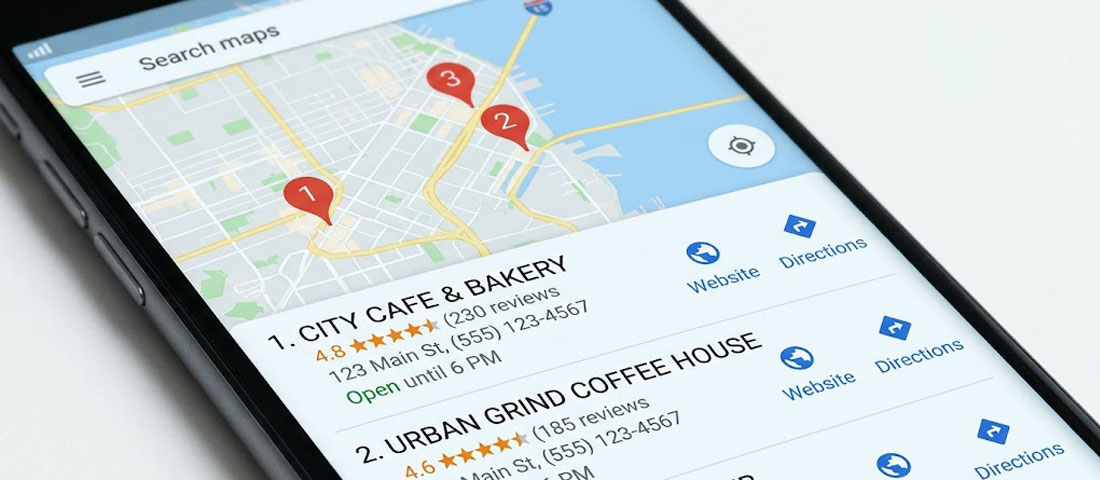
When a potential customer in your city searches for the service you provide — “web design company near me,” “best plumber in Birmingham,” “accountant Kandivali West” — what happens? If your business appears prominently in the local search results, you capture a high-intent prospect who is ready to engage. If your business is absent or buried, that prospect calls your competitor instead.
What this guide covers
- 1. What Is Local SEO and Why It Matters in 2026
- 2. How Google Decides Which Businesses Appear in Local Results
- 3. Google Business Profile — The Foundation of Local SEO
- 4. Local Listings — The Power of Consistent Citations
- 5. On-Site Local SEO Signals
- 6. Reviews — The Local SEO Superpower Most Businesses Underuse
- 7. Local Link Building and Authority
- 8. Voice Search and AI Search for Local Businesses
- 9. Tracking and Measuring Your Local SEO Performance
- 10. Frequently Asked Questions About Local SEO
Local SEO is the practice of optimising your online presence so your business appears prominently when people in your geographic target area search for what you offer. It is one of the highest-ROI digital marketing activities for any business with a geographic service area — and in 2026, with AI-powered local search and voice queries growing rapidly, its importance has never been higher.
This guide covers everything you need to dominate your local search results: what local SEO is, why it matters, how Google Business Profile works, how to optimise every element of your local presence, and the specific strategies that deliver the most impact for local businesses.
What Is Local SEO and Why It Matters in 2026
Local SEO is the process of optimising your online presence to attract customers from specific geographic areas — typically through local search results on Google Maps, the Google local “3-pack” (the three business listings that appear below the map in local search results), and organic search results that include location-specific content.
Local search behaviour data from 2025 and 2026 makes the commercial importance of local SEO unmistakable:
- 46% of all Google searches have local intent — meaning nearly half of all searches are looking for something in a specific location
- 78% of local mobile searches result in an offline purchase within 24 hours (Google research)
- 97% of consumers use the internet to find local businesses (BrightLocal research)
- “Near me” searches have grown by over 900% in the past five years
- Businesses in the Google local 3-pack receive approximately 44% of total clicks on a local search results page
For businesses with a local service area — whether you serve customers who visit your premises, or you travel to serve customers in a defined geographic area — local SEO is not an optional extra. It is the primary channel through which local high-intent customers find you.
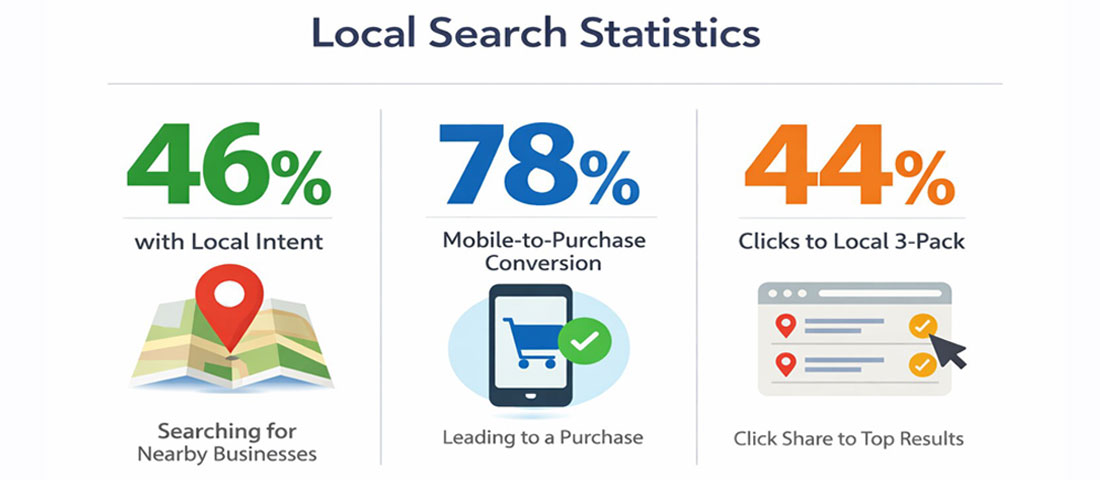
Local search drives enormous commercial intent — nearly half of all Google searches have local intent, and the majority of local mobile searches result in a purchase within 24 hours.
How Google Decides Which Businesses Appear in Local Results
Google uses three primary factors to determine which businesses appear in local search results and in what order. Understanding these factors is the foundation of any effective local SEO strategy.
Relevance
How well does your business listing match what the searcher is looking for? Relevance is determined by: the categories you have selected for your business in Google Business Profile, the keywords that appear in your business description and posts, the services and products you have listed, and the content of your website. A business that is clearly, specifically described as offering the exact service the searcher needs ranks above a vaguely described business whose relevance must be inferred.
Distance
How far is your business from the searcher’s location (or the location specified in the query)? Distance is calculated from the searcher’s device location (or the location specified in the query). For searches without a specific location (“web designer near me”), Google uses the searcher’s detected location. For searches with a location (“web designer in Kandivali”), Google uses the specified location regardless of where the searcher is physically located.
Prominence
How well-known and well-regarded is your business, both online and offline? Prominence is influenced by: the number and quality of your Google reviews and your average star rating, the quantity and consistency of your business citations across the web, links to your website from other local and industry websites, and your organic search rankings for relevant terms. A business that is genuinely prominent in its community and industry will naturally build the signals that rank well for prominence.
Google Business Profile — The Foundation of Local SEO
Google Business Profile (GBP) — formerly Google My Business — is the single most important element of local SEO. It is the free listing that appears in Google Maps, the local 3-pack, and Knowledge Panel results when users search for your business or businesses like it. A fully optimised, actively managed Google Business Profile is the baseline requirement for any local search visibility strategy.
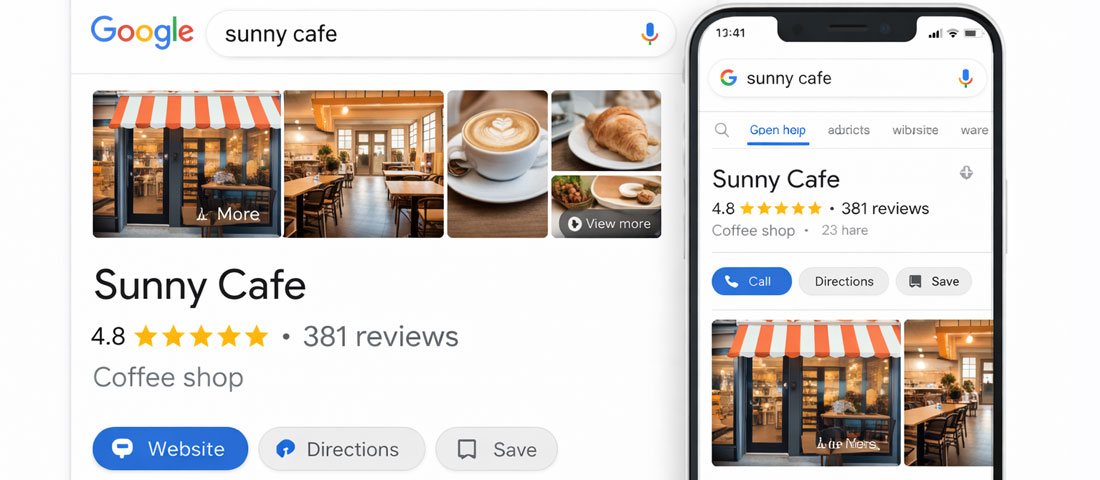
A fully optimised Google Business Profile — complete with photos, accurate hours, all services listed, and a steady stream of reviews — is the single most impactful local SEO investment for most businesses.
Claiming and Verifying Your Profile
If you have not already claimed your Google Business Profile, do so at business.google.com. If a profile already exists for your business (Google sometimes auto-creates profiles from public data), claim ownership of it rather than creating a duplicate. Verification is typically done by receiving a postcard to your business address with a verification code, or through phone or email verification for some categories.
Completing Every Section
Google rewards completeness. A fully completed GBP — with every available section filled in — ranks better than an incomplete one, because Google has more information to use when assessing relevance for search queries. Every section matters:
- Business name: Use your exact, legal business name. Do not keyword-stuff the business name field (e.g., “Neel Networks | Best Web Design Company Mumbai”) — this violates GBP guidelines and can result in your listing being suspended.
- Categories: Choose the most specific, accurate primary category for your business. Add all relevant secondary categories. Categories are one of the most important relevance signals in local search.
- Business description: Write a natural, keyword-relevant description (up to 750 characters) that accurately describes your business, your services, and who you serve. This is a relevance signal — include your most important service keywords naturally.
- Services and products: List all your services with descriptions and prices where applicable. Each service is an additional relevance signal for related searches.
- Hours: Accurate, current opening hours including special hours for public holidays. GBP shows users if a business is “Open now” — incorrect hours damage trust and GBP ranking signals.
- Phone number and website: Use your primary local phone number (not a national 1800 number or call tracking number that differs from your main number). Ensure your website URL is correct.
- Address: Your exact, complete address. Ensure this is identical to how it appears everywhere else online — consistency across citations is a key local ranking signal.
- Photos: Add high-quality photos of your premises, team, work, and products. Businesses with photos receive 42% more requests for directions and 35% more website clicks than those without. Update photos regularly — recency signals freshness.
Google Business Profile Posts
GBP allows you to publish posts — updates, offers, events, and product highlights — that appear directly in your profile in search results. Regular posts (at minimum weekly) signal activity and freshness to Google, contribute to keyword relevance, and give searchers compelling reasons to click through to your website or call. Use posts to promote offers, showcase new work, announce events, and answer common questions.
Questions and Answers
The Q&A section of your GBP allows anyone to ask questions that anyone (including you) can answer. Proactively seed this section by asking and answering common questions about your business yourself — this helps potential customers find key information and adds keyword-rich content to your profile. Monitor it regularly for questions from genuine customers.
Local Listings — The Power of Consistent Citations
A citation is any online mention of your business’s name, address, and phone number (NAP). Citations from authoritative online directories — Google, Bing, Apple Maps, Yelp, Facebook, TripAdvisor (where relevant), industry-specific directories, and local business associations — contribute to your business’s prominence signal in Google’s local ranking algorithm.
Why Citation Consistency Matters
Google cross-references your business information across multiple sources to build a reliable picture of your business. When your name, address, and phone number are consistent across all listings — exactly the same, with no variations in abbreviations, punctuation, or formatting — Google’s confidence in your business’s legitimacy and location accuracy increases. Inconsistencies — “Neel Networks” on your website but “Neel Networks Pvt Ltd” on Yelp, or “A-104 Bhoomi Utsav” on Google but “104 Bhoomi” on an older directory — reduce that confidence and weaken your local ranking signals.
Priority Citation Sources
- Google Business Profile — Priority #1, addressed above
- Bing Places for Business — Microsoft’s local listing, feeds Bing Maps and Cortana
- Apple Business Connect — Feeds Apple Maps and Siri local results
- Facebook Business Page — High-authority citation with significant local discovery traffic
- LinkedIn Company Page — Particularly important for B2B businesses
- Yelp — Important in USA and UK markets; high domain authority citation
- Justdial and Sulekha — Key local listing platforms for Indian markets
- Industry-specific directories — Clutch.co for agencies, Healthgrades for medical, Avvo for legal, etc.
- Local Chamber of Commerce — Local business association listings are trusted local authority signals
Auditing and Cleaning Up Citation Inconsistencies
Use tools like Semrush’s Listing Management, BrightLocal, or Moz Local to audit your current citations — identifying where you are listed, what information is shown, and where inconsistencies exist. Systematically correct inconsistencies across your most important citation sources, starting with the highest-authority platforms. This clean-up work typically delivers measurable local ranking improvements within 4 to 8 weeks.
On-Site Local SEO Signals
Your website sends local relevance signals to Google that complement your GBP and citation profile. These on-site elements matter specifically for local search:
LocalBusiness Schema Markup
Implement LocalBusiness structured data (schema markup) on your website’s homepage and contact page. This directly communicates your business name, address, phone number, hours, service area, and other key information to Google in a machine-readable format. LocalBusiness schema — along with its subtypes (LocalBusiness, ProfessionalService, MedicalOrganization, Restaurant, etc.) — is one of the clearest on-site local signals you can send.
NAP Consistency on Your Website
Your website should display your exact business name, address, and phone number — consistently formatted, matching your GBP and other citations exactly — on the homepage (typically in the footer) and on the contact page. Inconsistency between your website NAP and your GBP NAP is a local ranking weakness.
Location-Specific Pages
For businesses serving multiple geographic areas, create dedicated location pages — one per service area — with location-specific content rather than generic service descriptions duplicated across pages. A web design agency serving both Mumbai and Bangalore should have separate, genuinely different pages for “Web Design Mumbai” and “Web Design Bangalore” — each with locally relevant content, testimonials from clients in that city, and specific local signals.
Locally Relevant Content
Blog content that addresses locally relevant topics — industry news specific to your market, case studies from local clients, guides that reference local landmarks or context — builds local topical relevance signals that complement your GBP and citation profile.
Reviews — The Local SEO Superpower Most Businesses Underuse
Google reviews are one of the most powerful local ranking signals — and one of the most directly within your control. Businesses with more reviews, higher average ratings, and more recent reviews consistently rank better in local search results than comparable businesses with fewer or lower-rated reviews.
The commercial impact goes beyond rankings. Research consistently shows that 87% of consumers read online reviews for local businesses, and that the volume, rating, and recency of reviews significantly influence purchase decisions. A business with 50 reviews at 4.9 stars will convert significantly more searchers into customers than a business with 5 reviews at 4.2 stars — regardless of their relative ranking positions.
Building a Review Generation System
The businesses with the most reviews are almost never the ones who ask most desperately — they are the ones with a systematic, consistent process for requesting reviews from satisfied customers. Here is the system that works:
-
Create a direct review link
In Google Business Profile, find your “Get more reviews” link under the Customers section. This creates a direct URL that takes customers straight to the review input screen — eliminating the friction of finding your listing and navigating to the review option. Shorten this with a branded short URL. -
Request at the moment of satisfaction
The best time to ask for a review is immediately after a positive customer interaction — after completing a project, after a positive support call resolution, or after a customer expresses satisfaction. The positive emotion is fresh, the motivation to reciprocate is highest, and the review request feels natural rather than intrusive. -
Make it as easy as possible
Provide the direct review link in your follow-up email, in your invoice, in your post-project summary email, and in a WhatsApp message. The fewer steps between “I’d be happy to leave a review” and actually submitting one, the higher your conversion rate from request to review. -
Respond to every review — positive and negative
Responding to reviews signals to Google (and to potential customers) that your business is active, engaged, and cares about customer experience. For positive reviews, a short genuine thank-you is sufficient. For negative reviews, a professional, empathetic response that acknowledges the concern and offers resolution demonstrates maturity and builds trust with future readers.
Reviews on Other Platforms
While Google reviews are the most impactful for local SEO, reviews on other authoritative platforms — Yelp, Facebook, Clutch (for agencies), Trustpilot — contribute to your overall review authority and appear in search results for brand-name queries. A diversified review presence across multiple platforms is stronger than concentration on Google alone.
Local Link Building and Authority
Local links — backlinks from other businesses, organisations, and publications in your geographic area — are a significant local prominence signal. Unlike national or global link building, local links can often be obtained through relationship-based outreach that is more accessible for small businesses.
- Local Chamber of Commerce and business associations — Membership typically includes a directory listing with a link. High-authority, locally trusted source.
- Local news and media coverage — Getting your business featured in local news (for a community initiative, a business milestone, a local event sponsorship) earns authoritative local links that significantly boost prominence signals.
- Sponsorships and community involvement — Sponsoring local events, sports teams, or community organisations typically includes website mentions and links from the organisation’s website.
- Local business partnerships — Complementary local businesses (not competitors) may feature you in their “trusted partners” or “recommended suppliers” pages.
- Local business awards and recognition — Applying for and winning local business awards generates coverage and links from award programme websites.
Voice Search and AI Search for Local Businesses
Voice search is disproportionately local — a large proportion of voice queries have local intent. “Hey Siri, find a web designer near me,” “Hey Google, what’s the best restaurant open now in Kandivali,” and similar queries are among the most common voice search patterns. For local businesses, voice search optimisation is a specific, high-value opportunity.
Voice search optimisation for local businesses requires:
- Complete, accurate Google Business Profile — Voice assistants primarily pull local business information from GBP. A complete, accurate profile is the foundation of voice search visibility for local queries.
- Natural language FAQ content on your website — Voice queries are conversational. FAQ content that answers common questions about your business (“What are your opening hours?” “Do you offer free consultations?” “What areas do you serve?”) matches the question format of voice searches.
- Mobile page speed — Voice searches are predominantly performed on mobile devices, and voice assistants preferentially cite fast-loading pages. A mobile-optimised, fast-loading website is essential for voice search visibility.
- Featured snippet optimisation — Many voice search answers come directly from Google featured snippets. Structured, question-and-answer format content that wins featured snippets also wins voice search answers.
For AI search specifically, local businesses should ensure their GBP information, website content, and review profile collectively give AI systems accurate, comprehensive information about the business. When users ask ChatGPT or Perplexity for local business recommendations, AI systems draw on the web’s collective information about those businesses — and a well-maintained, comprehensively described local presence across multiple platforms gives AI systems the information they need to recommend you.
Tracking and Measuring Your Local SEO Performance
Local SEO performance should be tracked through a combination of metrics that capture both rankings and business outcomes:
| Metric | What It Tells You | Primary Tool |
|---|---|---|
| Local pack ranking position | Your position in the Google local 3-pack for target keywords | BrightLocal, Semrush Local, WhiteSpark |
| GBP profile views | How many times your GBP has been seen in Search and Maps | Google Business Profile Insights |
| GBP direction requests | How many people requested directions to your business | Google Business Profile Insights |
| GBP calls | How many calls were initiated directly from your GBP | Google Business Profile Insights |
| Review count and average rating | Your review authority and trend over time | Google Business Profile, BrightLocal |
| Local organic traffic | Website traffic from local search queries | Google Analytics 4 + Search Console |
| Citation consistency score | How consistently your NAP appears across the web | BrightLocal, Moz Local |
Frequently Asked Questions About Local SEO
| What is local SEO and why does it matter? | Local SEO is the practice of optimising your online presence so your business appears prominently when people in your geographic area search for what you offer — in Google Maps, the local 3-pack, and location-specific organic search results. It matters because 46% of all Google searches have local intent, 78% of local mobile searches result in a purchase within 24 hours, and businesses in the Google local 3-pack receive approximately 44% of all clicks on a local search results page. For any business with a geographic service area, local SEO is the primary channel through which high-intent local customers find and choose between businesses. |
| What is the most important thing I can do for local SEO? | Claiming, completing, and actively managing your Google Business Profile is the single most impactful local SEO action for most businesses. Your GBP is the primary source Google uses for local search results and Google Maps. A fully completed profile — with accurate categories, a keyword-relevant description, all services listed, current hours, high-quality photos, and a steady stream of genuine reviews — significantly outperforms an incomplete or neglected one. After GBP, ensuring consistent NAP (name, address, phone) information across all major online directories and building a strong review profile are the next highest-impact activities. |
| How do I get my business to appear in the Google local 3-pack? | Appearing in the Google local 3-pack (the three business listings shown below the map in local search results) requires optimising for the three factors Google uses for local ranking: relevance (how well your GBP and website match the searcher’s query), distance (how close your business is to the searcher’s location), and prominence (how well-known and well-regarded your business is online, measured through reviews, citations, and links). The most impactful actions are: claiming and fully optimising your Google Business Profile with the right categories and complete information; building a consistent citation profile across major directories; and generating a strong volume of genuine positive Google reviews. |
| How do Google reviews affect local SEO? | Google reviews directly affect local SEO in two ways: as a prominence signal in Google’s local ranking algorithm (more reviews, higher ratings, and more recent reviews are all positive signals), and as a conversion factor (businesses with more and better reviews convert more searchers into customers). Research shows that businesses with higher review counts and ratings rank better in local search and receive more clicks from local search results. Building a systematic process for requesting reviews from satisfied customers — with a direct review link, a clear request at the right moment, and consistent follow-up — is one of the most controllable and highest-impact local SEO activities. |
| What is a local citation and why is it important? | A local citation is any online mention of your business’s name, address, and phone number (NAP) — on directories, social platforms, review sites, and any other website. Citations contribute to your local prominence signal by providing Google with corroborating evidence about your business’s existence, location, and legitimacy. The consistency of your NAP information across citations is critical — when Google finds the same accurate information about your business confirmed across dozens of authoritative sources, its confidence in that information increases, strengthening your local rankings. Inconsistent citations (different phone numbers, address variations, different business names) weaken this confidence and reduce local ranking performance. |
| How long does local SEO take to show results? | Local SEO typically shows results faster than national or competitive organic SEO because the competitive field is smaller and the signals (GBP optimisation, citation building, review accumulation) can be implemented quickly. Businesses that optimise their GBP, clean up citation inconsistencies, and generate a burst of new reviews often see measurable local ranking improvements within 4 to 8 weeks. Ongoing improvements — particularly building review volume and local links over time — continue to compound over months and years. A complete local SEO programme typically delivers significant, measurable local visibility improvements within 3 to 4 months. |
| Does my website need to rank in Google for local SEO to work? | Not necessarily — your Google Business Profile can rank in the local 3-pack independently of your website’s organic search rankings. Many businesses appear in the Google local 3-pack for local searches while their website does not rank highly in the organic results below the map. However, having a well-optimised website with local on-page signals (LocalBusiness schema, NAP in the footer, location-specific service pages) strengthens your overall local presence and improves rankings in both the local pack and local organic results. The strongest local SEO performance comes from optimising both your GBP and your website together rather than treating them as separate efforts. |
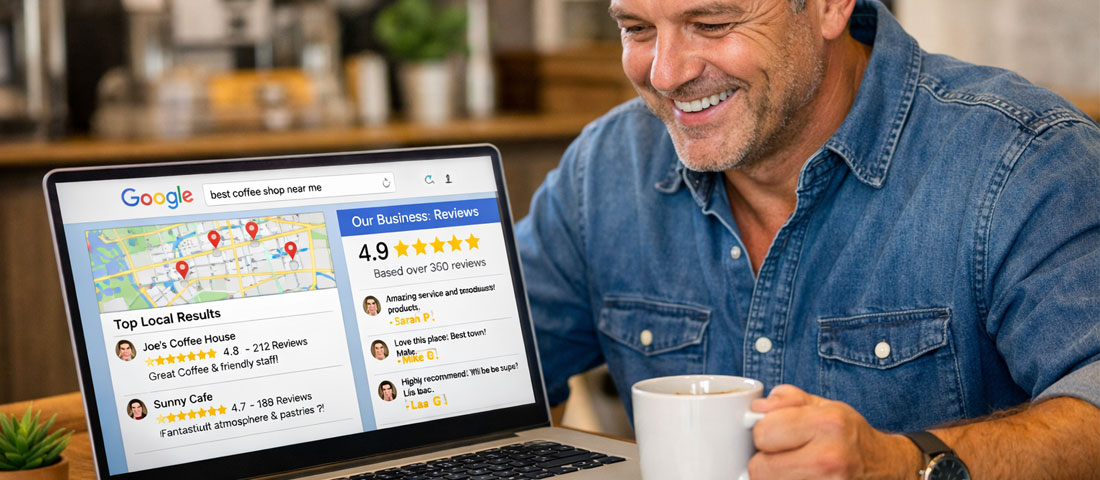
A strong local SEO presence — built on an optimised GBP, consistent citations, and genuine reviews — puts your business in front of high-intent local customers at exactly the moment they are ready to buy.
Want to dominate your local search results in 2026?
Neel Networks provides local SEO services covering Google Business Profile optimisation, citation building and cleanup, review generation strategy, on-site local signals, and ongoing performance monitoring — for businesses across India, UK, USA, Canada, and Australia.