
Most SEO audits being run in 2026 are auditing the wrong website. They are thorough, they are well-intentioned, and they are checking a version of search engine optimisation that stopped being the whole picture about two years ago. They measure keyword rankings, crawl for broken links, check meta tags, review backlinks — all still useful — and then stop, having completely missed the layer of search that is now driving a growing share of discovery: AI Overviews, voice answers, and the citations that ChatGPT, Perplexity and Gemini hand out instead of blue links.
This guide is a complete, current SEO audit checklist — the one we actually run for clients in 2026, covering the traditional technical and on-page work that still matters alongside the AI-search layer that most audit templates have not caught up with yet. It is written to be genuinely usable: you can work through it yourself with free tools, or hand it to whoever runs your search programme. If you want the deeper reference on the underlying principles, our complete on-page and technical SEO guide is the companion piece. This article is the practical audit you run against it.
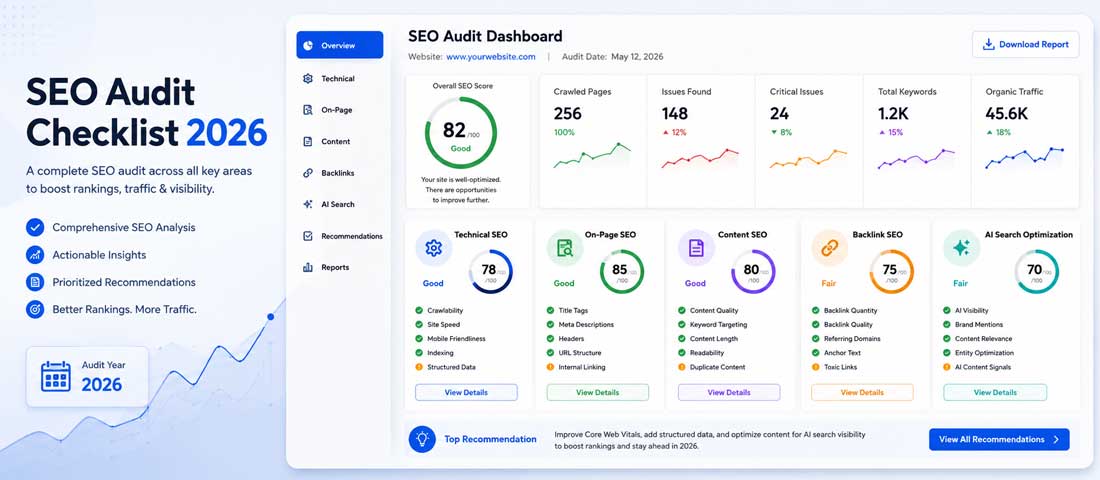
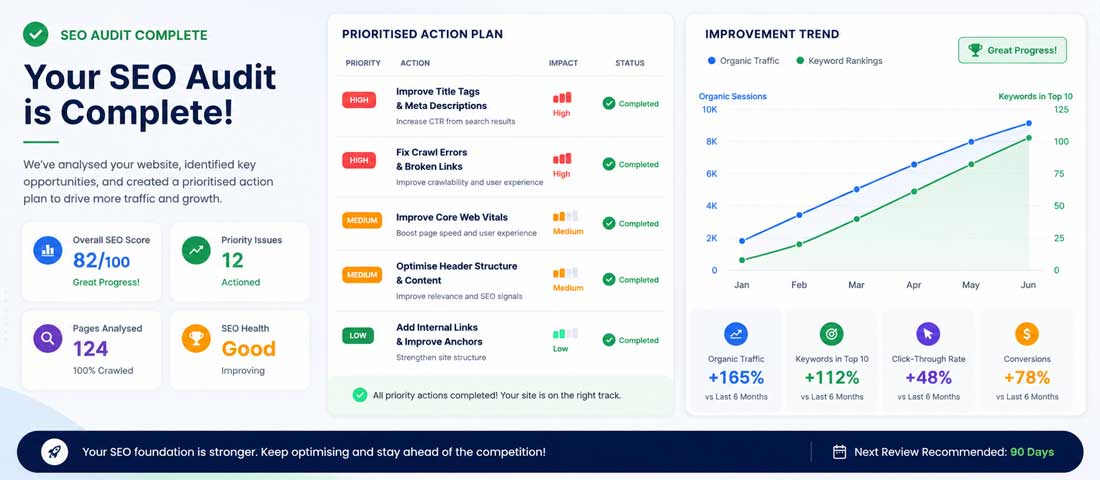
An SEO audit is a structured health check of every factor that determines whether your website can be found in search. It is not a single tool report and it is not a rankings screenshot. It is a deliberate, sectioned review that produces two things — a clear picture of what is currently wrong or underperforming, and a prioritised list of what to fix first. An audit that does not end in a prioritised action list is not an audit. It is a data dump.
The right cadence for most businesses is a full audit once or twice a year, with a lighter monthly check on the metrics that move fastest. You should also run a full audit after any major event — a website redesign, a migration to a new domain or platform, a sudden traffic drop, a Google algorithm update that visibly affected your category, or the launch of a significant new section of the site. The audit after a redesign is the one businesses skip most often and regret most reliably, because a redesign quietly breaks SEO foundations more often than not.
The audit below is organised into seven sections, run in order. The order matters — technical foundations first, because there is no point optimising content on pages that search engines cannot crawl or that take eight seconds to load. Each section ends with the specific things to check and the free tools that check them.
You can run a genuinely thorough SEO audit in 2026 without paying for anything. The free tool set has matured to the point where the paid tools are a convenience and a time-saver rather than a requirement. The essential free stack is Google Search Console for how Google actually sees your site, Google Analytics for what visitors do once they arrive, Google’s PageSpeed Insights for Core Web Vitals, the Lighthouse audit built into Chrome’s developer tools, Bing Webmaster Tools for the half of the audit Google does not cover, and a free-tier crawler such as Screaming Frog, which audits up to 500 URLs at no cost.
The paid tools — Ahrefs, Semrush, Sitebliss, Sistrix and the rest — are worth their cost for agencies running audits constantly, because they consolidate the work and track change over time. For a business auditing its own site once or twice a year, the free stack is enough. The one genuinely new category worth adding in 2026 is an AI-visibility checker, several of which now exist in free or freemium form, to see how your brand appears across ChatGPT, Perplexity and Google AI Overviews. That part of the audit did not exist two years ago and most templates still ignore it.
The seven steps below run in sequence. Each one builds on the one before it, and skipping ahead — auditing content before you have confirmed the pages are crawlable, for instance — wastes effort on findings you cannot act on yet. Work through them in order.
Want a Professional SEO Audit that Covers the Full 2026 Picture?
If you would rather have an experienced team run the audit — technical, on-page, content, backlinks and the AI-search layer — and hand you a prioritised action plan, we are happy to help. Send us your domain and we will come back with a clear-eyed read on where you stand and what to fix first.
The crawlability audit answers one question — can search engines find, access and index your pages? If the answer is no for any important page, that page is invisible regardless of how good it is. This is why the audit starts here.
Begin with robots.txt, the file at the root of your domain that tells crawlers what they may and may not access. Open it and read it. The classic failure is a disallow rule that was added during development to keep a staging site out of the index, and then never removed when the site went live — quietly blocking the entire site or a critical section. Confirm nothing important is disallowed.
Next, the XML sitemap. It should list every page you want indexed, exclude the pages you do not, and be submitted in Google Search Console and Bing Webmaster Tools. The Search Console index coverage report then tells you the truth — which pages Google has actually indexed, which it has excluded, and the reason for each exclusion. Work through the excluded list. Some exclusions are correct. Others are pages you wanted indexed, blocked by an accidental noindex tag, a wrong canonical, or a crawl error.
Finally, look for orphan pages — pages with no internal links pointing to them. A page no other page links to is hard for crawlers to discover and signals low importance. Your crawler tool will list orphan pages. Each one either needs internal links from relevant content or, if it is genuinely not needed, removal. A clean, crawlable, properly linked site structure is the platform everything else in the audit depends on.
With crawlability confirmed, the technical health audit checks whether the pages search engines can reach are actually fast, secure and stable. The headline metric set is Core Web Vitals, Google’s measurement of real-world page experience.
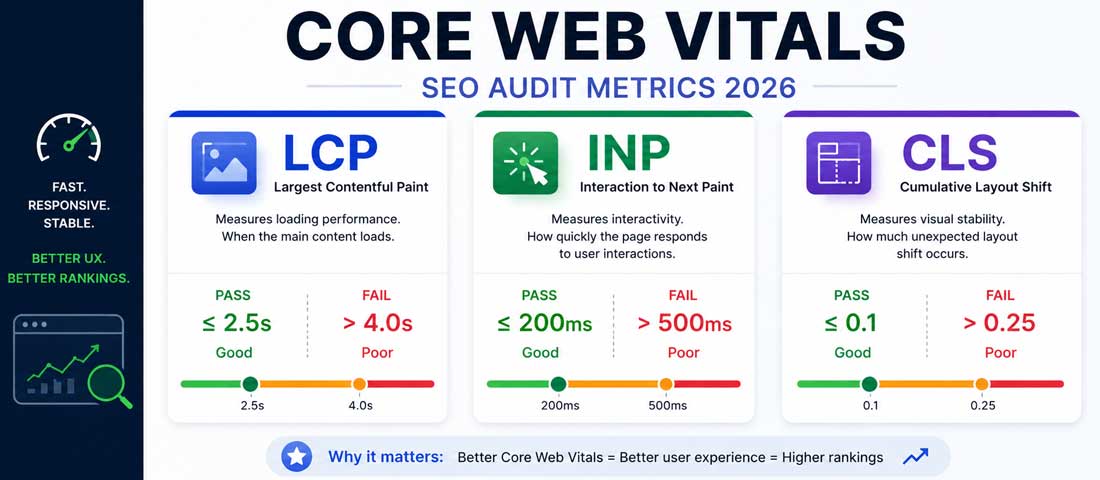
Largest Contentful Paint measures how quickly the main content of a page loads, and the target is under 2.5 seconds. Interaction to Next Paint measures how quickly the page responds when a user interacts with it, and the target is under 200 milliseconds. Cumulative Layout Shift measures how much the page visually jumps around as it loads, and the target is under 0.1. Run your key pages through PageSpeed Insights, record all three, and flag every page that fails any of them.
Beyond Core Web Vitals, confirm the whole site is served over HTTPS with a valid certificate and no mixed-content warnings where a secure page loads an insecure asset. Test mobile-friendliness on a real phone — tap the buttons, fill a form, read the text. Crawl the site for broken internal and external links, server errors, and redirect chains where one redirect points to another and slows everything down. Check that large images are properly compressed and that render-blocking scripts are not delaying the first paint.
Technical issues are usually the highest-return fixes in an audit because they affect every page at once. Fixing a site-wide performance problem or a render-blocking script lifts the whole site, not a single page. This is also why technical maintenance should be continuous rather than annual — our work on ongoing website maintenance exists largely to keep this layer healthy between full audits, because technical health decays quietly if nobody is watching it.
The on-page audit and the content audit are closely related but distinct. The on-page audit checks the optimisation signals on each page — the technical-content layer. The content audit checks whether the content itself is actually good and actually needed.
For the on-page audit, work through your most important pages and check each one against a consistent list. Title tag present, unique, descriptive and within length. Meta description present and compelling. Exactly one H1, with a logical hierarchy of H2 and H3 headings beneath it. Descriptive alt text on every meaningful image. A clean, readable URL. Internal links into the page from related content, and internal links out to other relevant pages. None of these is complicated individually. The value is in checking them consistently across every important page, because the small inconsistencies are what quietly cap performance.
For the content audit, the work is more editorial. Inventory every page and assess it honestly. Thin pages with very little substance either need to be expanded into something genuinely useful or removed. Outdated pages need refreshing with current information. Duplicate or near-duplicate pages competing for the same query need to be consolidated into a single stronger page. And the gaps — the questions and topics your audience searches for that you have simply never covered — become your content plan. Strong, well-organised content built around clear topical clusters is what earns both traditional rankings and AI citations, and the structural discipline behind that is worth getting right.
The AI search audit is the section that did not exist in a 2022 audit template and now matters more every quarter. Search has split into two layers — the traditional results page, and the AI-mediated layer where an assistant constructs an answer and cites a handful of sources. A 2026 audit has to check both. Auditing only the first layer is auditing half your search visibility.
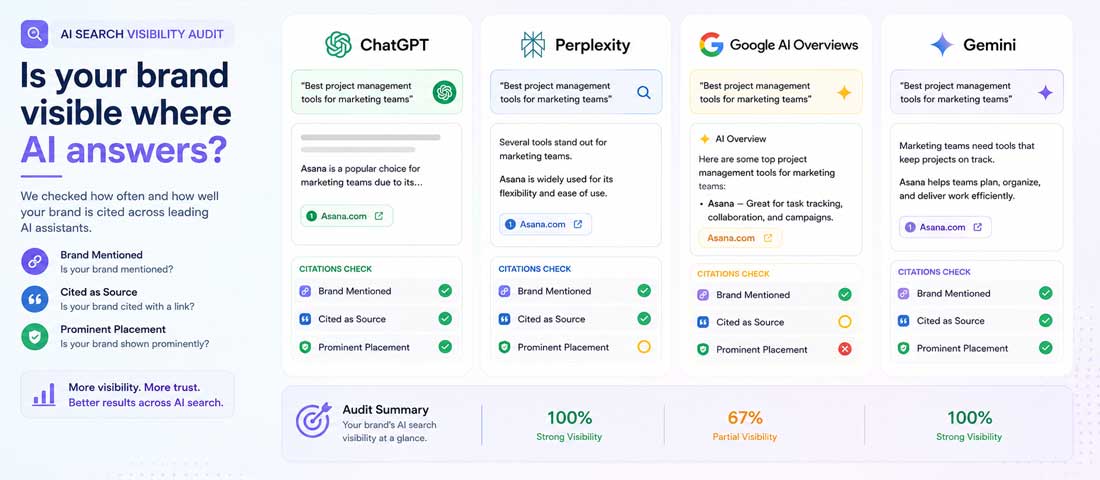
Start with direct testing. Take your fifteen or twenty most important queries — your product categories, your key questions, your brand name, your main competitors — and run each one through Google’s AI Overviews, ChatGPT with web search enabled, Perplexity and Gemini. For each query, record whether your site is cited, whether a competitor is cited instead, and which sources the assistant drew from. This qualitative test gives you a clear, honest picture of your AI-layer visibility that no dashboard currently provides.
Next, check the technical foundations that make your site eligible to be cited. Validate your structured data and schema markup — Article, FAQPage, LocalBusiness, HowTo and the rest — because schema is how AI models reliably understand what a page contains. Confirm your content is structured around clear questions with direct answers, the format assistants can actually quote. And critically, review your robots.txt for AI crawler access. GPTBot, ClaudeBot, Google-Extended and PerplexityBot all need to be allowed. Some sites blocked these in 2024 as a reflex and never reversed it, and those sites are now invisible to the entire AI-search layer.
The AI search audit connects to a broader discipline of optimising for AI-mediated discovery, which our guide to AEO, GEO, AIO and LLMO covers in full. For businesses that want this layer handled properly rather than just audited, our AI search optimisation services are built specifically around it. The key point for the audit itself is simple — if you are not checking this layer, your audit is incomplete, and the gap will only grow.
An audit is only as valuable as what you do with it. The most common failure is a thorough audit that produces a 200-item findings list and then sits in a folder because nobody knows where to start. The fix is disciplined prioritisation.
Sort every finding into three buckets. Critical issues are actively costing you visibility right now — a blocked robots.txt, pages incorrectly noindexed, a site-wide performance failure, an accidental AI-crawler block. These get fixed immediately. Important issues are limiting your ceiling but not actively breaking anything — thin content, weak internal linking, missing schema, page-two rankings that could be pushed up. These get scheduled across the current quarter. Minor issues are genuine improvements with no urgency — a handful of missing alt texts, minor meta description tweaks. These get done when there is time.
Within each bucket, sort by effort versus impact. The fixes that are high-impact and low-effort go first — they are the quick wins that build momentum and demonstrate value early. High-impact, high-effort fixes get planned properly with time allocated. Low-impact, high-effort fixes are usually quietly dropped, because the return does not justify the work. The output of this exercise is a sequenced action plan with owners and timelines, and that plan — not the findings list — is the actual deliverable of an SEO audit.
It is worth being explicit about how much the audit itself has changed, because the difference between a 2022 audit and a 2026 audit is larger than most checklists reflect. Three shifts have rewritten what a complete audit covers.
The first is the rise of the AI-mediated answer. A meaningful and growing share of searches now end with the user reading an AI-generated answer rather than clicking a result. An audit that measures only blue-link rankings is measuring a shrinking surface. The audit now has to measure citation presence in AI answers as a first-class metric, not an afterthought.
The second is the elevation of structured data. Schema markup used to be a nice-to-have that earned the occasional rich result. It is now the primary mechanism by which AI models understand and trust your content. An audit in 2026 treats schema validation as a core technical check, on the same level as crawlability and Core Web Vitals.
The third is the shift toward conversational, question-format content. As search moves toward natural-language and voice queries, content structured around clear questions with direct answers outperforms content optimised purely for short-tail keywords. The content section of the audit now explicitly checks whether your pages answer real questions in a format both humans and AI assistants can use. The broader context of all three shifts is covered in our piece on recent algorithm updates and zero-click search trends, and a 2026 audit that ignores them is auditing the search landscape of two years ago.
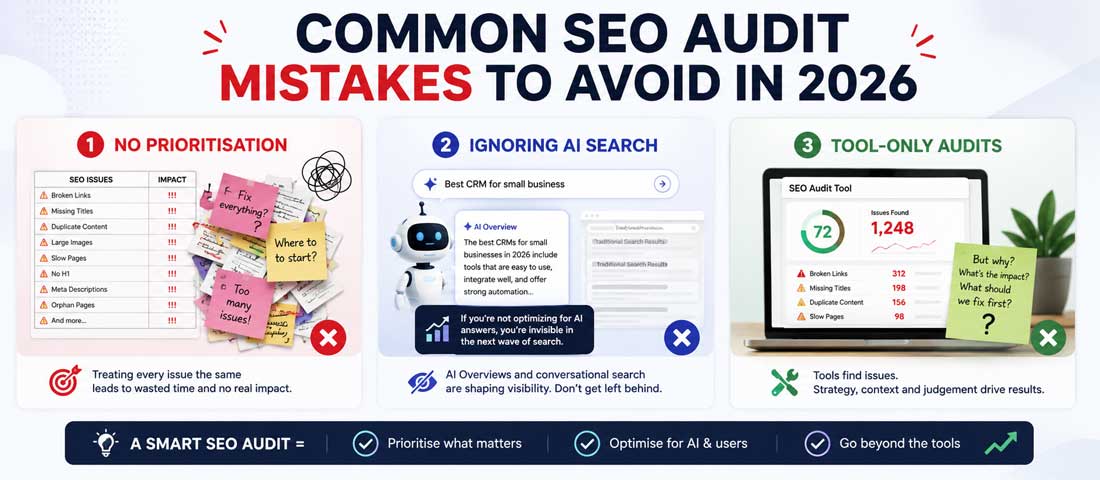
Audits fail in predictable ways. The mistakes below are the ones that turn a potentially valuable audit into wasted effort, and all of them are avoidable.
The right rhythm is a layered one. A full, comprehensive audit covering all seven steps belongs on the calendar once or twice a year — twice for sites in competitive categories or sites that change frequently, once for smaller, more stable sites. This is the deep review that catches the slow drift.
Between full audits, a lighter monthly check keeps an eye on the metrics that move fastest — Core Web Vitals, index coverage, ranking shifts on your priority keywords, any new crawl errors, and your visibility in AI answers for your most important queries. The monthly check takes an hour or two and catches problems early, while they are still small and cheap to fix.
On top of the calendar cadence, certain events trigger an immediate audit regardless of when the last one happened. A website redesign or migration. A sudden, unexplained traffic or rankings drop. A confirmed Google algorithm update that visibly moved your category. The launch of a major new section of the site. In each of these cases, something has changed materially and you need a current picture rather than waiting for the next scheduled review. The businesses that treat SEO auditing as a continuous discipline rather than an annual event are the ones whose search visibility stays stable, because they catch the small problems before they compound into large ones.
This checklist is genuinely designed to be run by a capable in-house person with the free tool set, and for many businesses that is the right call — particularly for a first audit, or for smaller sites where the scope is manageable. Running it yourself also builds real understanding of your own site, which is valuable regardless of who runs future audits.
There are situations where a professional audit is worth the cost. If your traffic has dropped sharply and you cannot identify why, experience matters — diagnosing a sudden drop is pattern-recognition work that comes from having seen many of them. If your site is large or technically complex, the audit scope quickly exceeds what is practical to do thoroughly by hand. If the audit keeps producing findings you are not confident interpreting, the judgement layer is where a professional adds the most value. And if you simply do not have the time to do it properly, a half-finished audit is worse than a professional one because it produces false confidence.
The honest framing is that the checklist itself is not secret knowledge — it is laid out in full above. What an experienced team adds is the interpretation, the prioritisation and the diagnostic pattern-recognition that turns findings into the right sequence of fixes. For businesses that want that, our SEO services include full audits with a prioritised action plan as a standard deliverable. Whether you run it yourself or bring in help, the important thing is that the audit actually happens, actually covers the full 2026 picture including the AI layer, and actually ends in implemented fixes.
| What is an SEO audit? | An SEO audit is a structured health check of every factor that affects whether your website can be found in search. It reviews technical health, crawlability and indexing, on-page optimisation, content quality, the backlink profile, keyword rankings, and — in 2026 — visibility across AI search surfaces like Google AI Overviews and ChatGPT. A proper audit does not just list problems. It produces a prioritised action plan that tells you exactly what to fix first, what to schedule, and what can wait. An audit that ends in an unsorted findings list rather than a sequenced plan has not finished the job. |
| Can I do an SEO audit for free? | Yes. A genuinely thorough SEO audit can be run entirely with free tools in 2026. Google Search Console shows how Google sees your site, Google Analytics shows visitor behaviour, PageSpeed Insights and Lighthouse cover Core Web Vitals and technical performance, Bing Webmaster Tools covers what Google does not, and a free-tier crawler like Screaming Frog audits up to 500 URLs at no cost. Several free AI-visibility checkers now also exist for the AI search layer. Paid tools such as Ahrefs and Semrush add convenience and time-saving, and they are worth it for agencies running constant audits, but they are not required for a business auditing its own site once or twice a year. |
| How long does an SEO audit take? | The time depends on the size of the site and the depth of the audit. A small business website of 10 to 30 pages can be audited thoroughly in one to two working days. A mid-sized site of a few hundred pages typically takes three to five days. Large or complex sites — extensive eCommerce catalogues, multi-region sites, sites with complex technical architecture — can take one to two weeks for a complete audit. The crawling and data-gathering is relatively quick. The time goes into the interpretation, the diagnosis of root causes, and the building of a properly prioritised action plan, which is the part that actually creates value. |
| How often should I audit my website’s SEO? | Run a full, comprehensive SEO audit once or twice a year — twice for competitive or frequently-changing sites, once for smaller stable sites. Between full audits, run a lighter monthly check on the fast-moving metrics: Core Web Vitals, index coverage, priority keyword rankings, new crawl errors and AI search visibility. You should also run an immediate full audit after any major event — a website redesign or migration, a sudden traffic drop, a confirmed Google algorithm update that affected your category, or the launch of a major new site section. Treating auditing as a continuous discipline rather than an annual event is what keeps search visibility stable over time. |
| What is the most important part of an SEO audit in 2026? | No single section is most important, because they build on each other — but the section most often missing is the AI search audit. Most audit templates still check only traditional rankings and ignore whether your brand is cited in Google AI Overviews, ChatGPT, Perplexity and Gemini. As AI-mediated answers take a growing share of search, that omission gets more costly every quarter. The technical foundation — crawlability and Core Web Vitals — remains the essential base, because nothing else works if search engines cannot crawl fast, stable pages. But the part most likely to be neglected, and therefore the part most worth your attention, is the AI search layer. |
| Does an SEO audit guarantee better rankings? | No. An SEO audit is a diagnostic — it identifies what is wrong and what is limiting your performance. Rankings improve only when the findings are actually implemented, and even then improvement depends on factors outside the audit, including how competitive your category is and what your competitors are doing. An audit makes improvement possible and far more likely by focusing your effort on the things that actually matter, rather than on guesswork. But the audit itself changes nothing. The implemented fixes are what move rankings, and any provider promising guaranteed rankings from an audit alone is overselling. |
| Should I audit for Bing as well as Google? | Yes, a complete audit covers Bing as well as Google. Bing has meaningful market share in several regions and on desktop, and its index feeds Microsoft Copilot and parts of other AI assistants — so Bing visibility now influences the AI search layer too. Bing Webmaster Tools is free and covers the Bing-specific crawl and index data that Google Search Console does not. The good news is that most of what improves Google performance — technical health, good content, clean structure, valid schema — improves Bing performance as well, so the additional Bing-specific work in an audit is usually small relative to the visibility it protects. |
Ready for an SEO Audit that Covers Everything — Including the AI Layer?
We run complete SEO audits covering technical health, on-page optimisation, content quality, backlinks and AI search visibility — and we hand you a prioritised action plan, not a data dump. With 14+ years of experience and 550+ clients served, we know what actually moves the needle. Send us your domain and we will respond within one business day.
Whether you have a new idea, a business challenge, or something you would like to improve, we are here to help. From building websites, online stores, CRM systems, and custom applications to exploring AI solutions, improving SEO, or growing your sales, simply tell us what you have in mind, and we will help you find the best way forward.
A member of our team will review your enquiry and respond to you shortly.