How to Choose the Right SEO Expert or Agency in India: 2026 Buyer’s Guide

Hiring the wrong SEO agency is one of the most expensive mistakes a growing business can make. Not because good SEO is so costly — but because bad SEO can cause lasting damage to your search rankings, waste months of budget, and in the worst cases, result in Google penalties that take years to fully recover from. The right SEO partner, on the other hand, delivers compounding organic traffic growth that makes every other marketing channel more effective and more efficient.
What this guide covers
- 1. Why Global Businesses Choose Indian SEO Agencies
- 2. Agency vs In-House vs Freelancer: The Right SEO Structure for Your Business
- 3. What Great SEO Actually Looks Like in 2026
- 4. The 10 Questions to Ask Any SEO Agency Before Hiring
- 5. Red Flags That Reliably Predict Disappointing Results
- 6. How to Evaluate an SEO Agency’s Claims Objectively
- 7. What to Expect From a Good SEO Engagement
- 8. Why Neel Networks for SEO
- 9. Frequently Asked Questions About Choosing an SEO Agency in India
India is home to thousands of SEO agencies and consultants serving international clients — ranging from genuinely excellent practitioners with proven international track records, to operations that have learned to say the right things in a sales call without the ability to deliver meaningful results. Understanding how to tell them apart is the most valuable thing this guide can give you.
Why Global Businesses Choose Indian SEO Agencies
The same structural cost advantage that makes Indian web design agencies appealing to international businesses applies equally to SEO services. A senior SEO professional in Mumbai or Bangalore with seven years of experience, fluent English, and a track record of ranking international clients in competitive markets earns a salary that reflects India’s cost of living — not London or New York rates. The expertise is equivalent; the cost structure is different.
In practice, this means businesses in the USA, UK, Canada, and Australia typically save 50 to 70% on monthly SEO retainers by working with quality Indian agencies compared to equivalent domestic agencies — without any reduction in quality when the Indian agency is properly vetted. A monthly SEO retainer that costs $3,000 to $8,000 with a quality US agency can often be matched or exceeded in quality by an Indian agency for $1,000 to $3,000 per month.
The quality of Indian SEO has also improved dramatically over the past decade. The best Indian agencies are deeply familiar with Google’s algorithm requirements for US, UK, Canadian, and Australian markets — they have been building rankings in those markets for years, they understand the competitive landscape, and they have the case studies and client references to prove it.
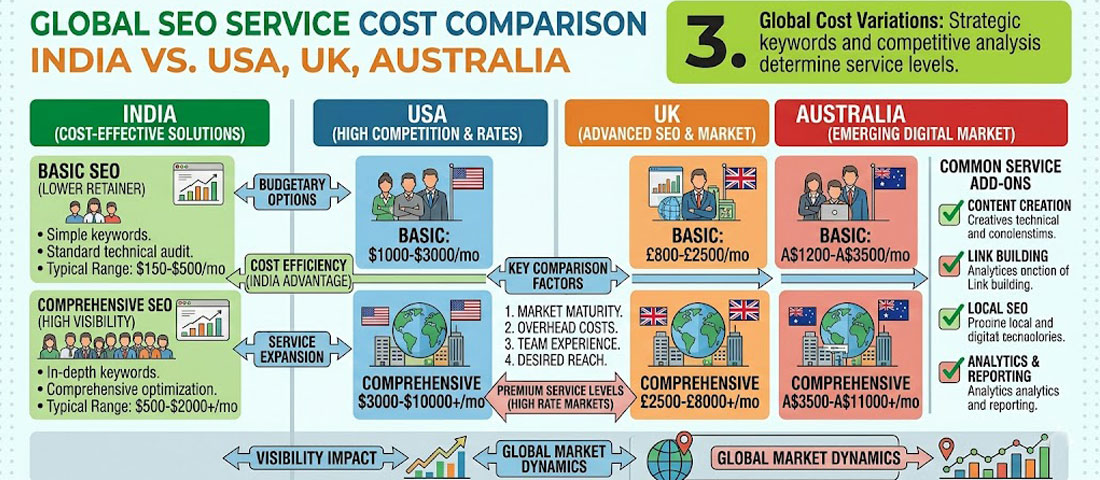
Professional SEO services from a quality Indian agency typically cost 50–70% less than comparable agencies in Western markets — with the same strategic capability and output.
Agency vs In-House vs Freelancer: The Right SEO Structure for Your Business
When an SEO Agency Is the Right Choice
An SEO agency is the right choice for most businesses because SEO in 2026 requires a breadth of expertise that is difficult to find in a single individual: technical SEO capability (crawlability, site speed, schema markup, Core Web Vitals), on-page content strategy, link building and off-page authority building, local SEO (where applicable), AI search optimisation (AEO, GEO), and analytics and reporting. A good agency brings all of these as a coordinated team.
Agencies also provide continuity — if one team member moves on, the relationship and institutional knowledge remain. For businesses where SEO is a primary growth channel, the risk management value of a multi-person agency over dependence on a single individual is significant.
When In-House SEO Makes Sense
In-house SEO makes sense for businesses with significant organic search volume where the investment in a full-time SEO specialist or team is justified by the revenue at stake. Large eCommerce businesses, major media publishers, and SaaS companies with thousands of organic landing pages typically need in-house SEO resource. For most small to medium businesses, the breadth of expertise and cost efficiency of an agency is more appropriate than hiring in-house.
When an SEO Freelancer Is the Right Choice
A highly specialised SEO freelancer can be the right choice for specific, well-defined tasks — a technical SEO audit, a link building campaign for a specific period, or local SEO for a single location. For ongoing comprehensive SEO management, a freelancer’s bandwidth and skill breadth limitations typically make an agency the better choice.
What Great SEO Actually Looks Like in 2026
Before evaluating SEO agencies, it helps to have a clear picture of what modern, effective SEO actually involves. This serves two purposes: it helps you recognise genuine expertise when you encounter it, and it helps you identify agencies that are still practising 2019-era SEO that will not deliver meaningful results in the current landscape.
Technical SEO Foundation
Effective SEO begins with a technically healthy website. Core Web Vitals performance (LCP, INP, CLS), mobile-first indexing compliance, clean URL structure, proper canonicalisation, XML sitemap health, robots.txt configuration, HTTPS implementation, and structured data (schema markup) are all technical foundations that must be correct before any content or link-building strategy delivers full results. A good SEO agency identifies and prioritises technical issues in an initial audit before anything else.
Content Strategy Built on Intent Research
Modern SEO is built on a thorough understanding of search intent — what specific users are trying to accomplish when they search, and what type of content best serves that intent. Effective content strategy in 2026 focuses on topical authority (comprehensive coverage of a subject area through content clusters) rather than individual keyword targeting, and produces content that genuinely answers questions comprehensively rather than superficially targeting keyword placements.
AI Search Optimisation (AEO, GEO, AIO)
As we covered in our guides to AEO, GEO, and AI search optimization, optimising for AI-generated search results — Google AI Overviews, Perplexity, ChatGPT — is now a core component of any comprehensive SEO strategy. An SEO agency in 2026 that does not include AEO (FAQ schema, featured snippet optimisation) and GEO (topical authority, AI citation signals) in its strategy is leaving a significant and growing portion of search visibility unaddressed.
Authoritative Link Building
Link building remains one of the most impactful but most misunderstood components of SEO. Effective link building in 2026 focuses on earning genuine mentions and links from authoritative, topically relevant websites through: guest posting on reputable industry publications, digital PR (getting coverage in news and trade media), HARO and similar journalist outreach platforms, creating genuinely linkable assets (research, data, comprehensive guides), and building business profiles in high-authority directories. It explicitly does not involve: buying links, link farms, private blog networks (PBNs), automated link submissions, or reciprocal link schemes — all of which risk Google penalties.
Measurement and Transparent Reporting
Effective SEO is measurable. Monthly reports should include: organic traffic trends by channel and landing page, keyword ranking movements for target terms, technical health monitoring, link acquisition activity and results, and — most importantly — the business metrics that SEO is meant to improve: organic leads, calls, and conversions. An agency that only reports ranking positions without connecting them to business outcomes is measuring the wrong things.
The 10 Questions to Ask Any SEO Agency Before Hiring

Asking the right questions before hiring an SEO agency separates genuinely capable partners from those who can sell well but cannot deliver results.
-
“Can you show me two or three case studies from businesses similar to mine?”
Case studies with specific, verifiable results — traffic growth percentages, ranking improvements for named keywords, lead or revenue impact — are the most reliable evidence of an agency’s capability. Be specific: if you are a B2B service business in the UK, ask for B2B service case studies for UK clients. Generic case studies without specifics or verifiable client names are much weaker evidence. -
“What would your first 90 days look like on my account?”
A good agency should be able to describe a clear onboarding process: initial technical audit, competitive analysis, keyword and intent research, content gap analysis, priority identification, and a 90-day action plan. Vague answers about “beginning to optimise your website” without a structured process signal a lack of systematic approach. -
“How do you approach link building, and what is your policy on paid links?”
This question separates agencies with ethical, sustainable link-building practices from those using tactics that risk penalties. The correct answer explicitly excludes paid links, PBNs, and link schemes. The right answer describes a process — outreach, digital PR, content assets — that you would be comfortable having described to Google directly. -
“How do you handle AEO and AI search optimisation in your strategy?”
Any SEO agency claiming expertise in 2026 should have a clear answer to this — covering FAQ schema implementation, featured snippet optimisation, topical authority building, and how they monitor AI Overview citations. An agency that responds with confusion or dismissal of AI search is operating with an outdated strategy. -
“Who specifically will work on my account and what is their experience?”
Account manager versus delivery team versus offshore subcontractors — understand exactly who will be doing the work. An agency that pitches senior experts but delivers to junior staff is a common disappointment. Get names and experience levels in writing for the people who will actually manage your account. -
“What does your monthly reporting look like and what metrics do you track?”
Ask to see a sample report. It should include organic traffic trends, keyword ranking movements, technical health updates, link acquisition activity, and business-outcome metrics (conversions, leads, not just rankings). A report that only shows ranking positions without connecting to business outcomes is insufficient. -
“How do you stay current with Google algorithm changes?”
SEO evolves constantly. A good agency monitors Google’s official communications, the SEO industry literature (Search Engine Journal, Search Engine Land, Google’s own documentation), and conducts regular testing. Ask what major algorithm changes have happened in the past 12 months and how they affected strategy — a good answer demonstrates active engagement with the current landscape. -
“What is your minimum contract length and what are the exit terms?”
Be cautious of agencies demanding very long contracts (12+ months) without performance milestones or exit clauses. SEO genuinely takes 3 to 6 months to show meaningful results, so a 6-month minimum commitment is reasonable. But a 12-month contract with no exit clauses and no performance commitments is a red flag. -
“What results are realistic to expect, and in what timeframe?”
An honest agency will give you realistic expectations: meaningful organic traffic improvements typically take 4 to 6 months for established sites in moderate competition, and 6 to 12+ months for new domains or highly competitive markets. Any agency promising “top 3 rankings in 30 days” is either lying or planning to use tactics that will ultimately harm your site. -
“Can I speak directly with two current clients?”
A confident, ethical agency with satisfied clients should readily provide client references. Speak with the references by phone or video, not just read written testimonials. Ask specifically about communication quality, delivery against promises, and whether they would hire the agency again.
Red Flags That Reliably Predict Disappointing Results
After years of working in the SEO industry and hearing from businesses that have had negative experiences with other agencies, the following red flags reliably predict disappointing outcomes. If you encounter any of these in your evaluation process, proceed with extreme caution.
- Guaranteed rankings. No SEO agency can guarantee specific Google rankings. Google’s algorithm is not theirs to control. Any agency promising “top 3 in 30 days” is making a promise they cannot keep — and the tactics needed to achieve fast rankings are often the ones that result in penalties. Ethical agencies commit to effort, process, and reporting — not to specific ranking positions.
- Suspiciously low pricing. Comprehensive SEO — involving technical audits, content strategy, content production, link building outreach, and monthly reporting — requires significant skilled labour. If a monthly retainer price seems too low to plausibly cover that labour, it almost certainly means corners are being cut: thin reports, low-quality link building, or outsourcing to very low-skill contractors.
- No audit before a proposal. A legitimate SEO agency cannot develop a meaningful strategy or proposal without first understanding your current website’s technical health, your competitive landscape, your current keyword performance, and your existing content inventory. An agency that sends a generic proposal without reviewing your website is not offering strategy — it is offering a template.
- Focus on keyword rankings alone, not business outcomes. Rankings are a means to an end, not the end itself. An agency that celebrates “we moved you from position 8 to position 5 for this keyword” without being able to tell you what that movement meant for your organic traffic, leads, or revenue is measuring the wrong things.
- Vague or evasive answers about link building tactics. Link building is the area of SEO most prone to unethical practices. An agency that is evasive, vague, or defensive when asked specifically about its link building approach is hiding something you should know about.
- No mention of technical SEO. On-page content and link building get more attention in SEO conversations, but technical SEO — the health of the website’s crawlability, speed, and structured data — is foundational. An agency that never mentions technical SEO in a proposal is ignoring a significant portion of what drives rankings.
- Claiming proprietary “secret” techniques. Effective SEO is built on publicly documented, openly discussed best practices — Google’s own guidelines, core Web Vitals requirements, structured data specifications, and quality content principles. An agency that implies their results come from proprietary techniques Google does not know about is likely describing either automated manipulation that risks penalties or simply telling you what they think you want to hear.
How to Evaluate an SEO Agency’s Claims Objectively
Beyond the questions and red flags above, there are specific objective checks you can perform to verify an agency’s claims:
Check Their Own Website’s SEO Performance
An SEO agency’s own website is a direct demonstration of their SEO capability. Check their domain’s organic traffic using free tools like Semrush’s or Ahrefs’ free overview, or simply search for their target keywords in Google and see where they rank. An SEO agency that ranks poorly for its own target keywords — “SEO agency Mumbai,” “SEO services India,” etc. — is not demonstrating the expertise they are claiming to apply to client accounts.
Verify Case Study Claims
Case study claims can be verified — at least partially — through third-party tools. If an agency claims they “increased organic traffic by 200% for Client X,” ask for the client’s domain name and check the traffic trend in Semrush or Ahrefs’ historical data. This does not give you the full picture, but it provides an independent data point that either corroborates or contradicts the claim.
Review Their Content Quality
The quality of an SEO agency’s own blog content is a strong indicator of their content strategy capabilities. Read three to five of their recent blog posts: are they genuinely comprehensive and expert? Do they provide specific, actionable insights? Are they optimised for AI search with clear question-and-answer structures and FAQ sections? Content that is thin, generic, or obviously written for keyword density rather than genuine value suggests the same approach will be applied to your content.
Check Google Reviews and Third-Party Listings
Google Reviews, Clutch.co, and similar platforms provide independent client feedback. Look for reviews from international clients specifically (if you are an international business) that mention communication quality, delivery against promises, and post-engagement results. Look for patterns — multiple reviews mentioning the same strengths or weaknesses are more informative than individual outliers.
What to Expect From a Good SEO Engagement
| Phase | Timeline | What Should Happen |
|---|---|---|
| Onboarding & Audit | Weeks 1–4 | Technical audit, keyword research, competitive analysis, content gap analysis, strategy document with prioritised action plan |
| Technical fixes | Months 1–2 | Core Web Vitals improvements, schema markup implementation, crawlability fixes, URL structure optimisation, Google Search Console health |
| Content development | Months 2–4 | Pillar content creation or optimisation, supporting cluster content, FAQ sections with schema on key pages, meta data optimisation |
| Link building | Months 3+ (ongoing) | Outreach for editorial links, digital PR activity, directory submissions, guest posting on relevant publications |
| First measurable results | Months 4–6 | Organic traffic improvements for target pages, ranking improvements for priority keywords, featured snippet wins, reduced 404 errors |
| Compound growth | Months 6–12+ | Accelerating organic traffic growth as content authority builds, expanding keyword coverage, AI Overview citations appearing, lead growth from organic |
Realistic timeline expectation: SEO is a 6 to 12 month investment before meaningful, sustained results are visible — not because good agencies are slow, but because Google’s trust-building algorithms take time. Businesses that expect significant organic growth in 30 to 60 days will be disappointed regardless of which agency they hire. The businesses that build the most durable organic search advantages are those that commit to SEO as a multi-year strategic investment, not a short-term lead generation tactic.
Why Neel Networks for SEO
Neel Networks has been delivering SEO services for international clients since 2014 — building rankings in the USA, UK, Canada, Australian, and Indian markets for businesses across web design, eCommerce, professional services, and technology verticals. Our SEO practice covers the full spectrum: technical SEO audits and implementation, content strategy and creation, structured data and AI search optimisation (AEO, GEO, AIO), link building through ethical white-hat methods, and monthly reporting that connects ranking movements to business outcomes.
Our 43 Google reviews (4.9 star average) reflect what international clients consistently report: strategic thinking, transparent communication, measurable results, and a partnership approach that feels like working with a local team that happens to be based in Mumbai.
Frequently Asked Questions About Choosing an SEO Agency in India
| How do I choose the right SEO agency in India? | Choosing the right Indian SEO agency requires evaluating evidence of results rather than promises. Look for: case studies with specific, verifiable traffic and ranking results for businesses similar to yours; a clear, documented process for onboarding, technical audits, content strategy, and link building; named team members with demonstrable experience; transparent reporting that connects SEO activity to business outcomes; and Google or Clutch reviews from international clients that specifically mention communication quality and delivery. Ask the ten questions outlined in this guide and treat red flags — guaranteed rankings, suspiciously low pricing, vague link building answers — as genuine disqualifiers. |
| How much should I pay for SEO services from an Indian agency? | Comprehensive SEO services from a quality Indian agency typically range from $500 to $3,000 per month depending on scope, competitiveness of target keywords, and the breadth of services included. Pricing below $300 to $400 per month for “comprehensive” SEO should be approached with significant scepticism — it is difficult to deliver meaningful technical SEO, content strategy, content production, and ethical link building at these price points. Pricing in the $800 to $2,000 range from a quality Indian agency typically delivers services that would cost $2,500 to $6,000 from a comparable US or UK agency. |
| Can an Indian SEO agency rank my website in the USA or UK? | Yes — Indian SEO agencies with experience serving international clients regularly achieve strong rankings in USA, UK, Canadian, and Australian markets. Google’s algorithm is the same globally; ranking a UK business for UK search terms requires understanding UK search behaviour, UK competitive landscape, and UK-specific content standards — all of which experienced Indian agencies serving international clients have developed over years of practice. The key is choosing an agency with a documented track record of international rankings specifically, not one that primarily serves domestic Indian clients and claims to understand international markets. |
| What is the difference between white-hat and black-hat SEO? | White-hat SEO refers to tactics that comply with Google’s guidelines and aim to deliver genuine value to users — creating high-quality content, building authoritative backlinks through outreach and digital PR, improving technical website health, and structuring content for AI search visibility. Black-hat SEO refers to tactics that attempt to manipulate rankings through means Google explicitly prohibits — buying links, using private blog networks, stuffing keywords, cloaking content, and other deceptive practices. White-hat SEO builds durable, compounding rankings that are resilient to algorithm updates. Black-hat SEO may produce faster initial results but typically results in Google penalties — manual or algorithmic — that can devastate organic traffic overnight and take months or years to recover from. |
| How long does SEO take to show results? | Meaningful SEO results — sustained organic traffic growth and ranking improvements for competitive target keywords — typically take 4 to 6 months for established websites with existing domain authority, and 6 to 12 months or more for new domains or highly competitive markets. This timeline reflects how Google’s trust-building algorithms work: new content and links take time to be indexed, evaluated, and weighted. Faster initial wins are possible — featured snippet optimisation can produce results in 4 to 8 weeks, and technical fixes often produce rapid improvements in crawlability and Core Web Vitals scores — but compound organic growth is a multi-month investment. |
| Should I choose an SEO agency or do SEO in-house? | For most small to medium businesses, an SEO agency delivers better results than in-house SEO at comparable cost — because SEO requires a breadth of expertise (technical SEO, content strategy, link building, AI search optimisation, analytics) that is difficult to find in a single in-house hire. In-house SEO makes more sense for large businesses with significant organic traffic where the ROI of dedicated full-time specialists is clearly justified. An agency also provides continuity — if one team member leaves, the relationship and institutional knowledge remain — which is a significant practical advantage over dependence on a single in-house hire. |
| Does Neel Networks provide SEO for businesses outside India? | Yes — Neel Networks provides SEO services for businesses in the USA, UK, Canada, Australia, and worldwide. Our SEO team has been working specifically with international clients since 2014, building rankings in competitive English-language markets across multiple industries. We are familiar with the competitive landscape, content standards, and ranking factors relevant to each of these markets. Our international SEO services include technical SEO, content strategy and production, AI search optimisation (AEO, GEO, AIO), ethical link building, and monthly reporting that tracks both ranking movements and business-outcome metrics. |
Ready to find the right SEO partner for your business?
Start with a free SEO audit from Neel Networks — we will assess your current organic performance, identify your highest-priority opportunities, and give you a clear picture of what a well-executed SEO strategy could deliver for your business.