How AI Is Transforming SEO: What Every Business Must Know in 2026

Search engine optimisation has never stood still — but nothing in the past 25 years of SEO history compares to the pace and scale of change happening right now. Artificial intelligence has moved from a background feature of Google’s algorithm to the defining force reshaping how search works, how content is evaluated, and how businesses get found online.
What this guide covers
- 1. How We Got Here: SEO’s Transformation From Keywords to Intelligence
- 2. The Four Biggest AI-Driven Changes to Search in 2026
- 3. Why Traditional SEO Is Not Dead — But Is Not Enough
- 4. The Truth About AI-Generated Content and SEO
- 5. Voice Search and Conversational SEO: How to Win
- 6. The SEO Strategies That Actually Work in the AI Era
- 7. What This Means for Businesses in Different Industries
- 8. A Practical Framework for Adapting Your SEO Strategy Right Now
- 9. Frequently Asked Questions About AI and SEO in 2026
- 10. Conclusion: The Best SEO Has Always Been About Genuine Value
This is not a future prediction. It is a description of the present. Google AI Overviews are live and answering over a quarter of all searches in the USA. ChatGPT has more than 180 million monthly users. Voice search has moved from novelty to primary interface for hundreds of millions of people. And traditional SEO, while not dead, is no longer sufficient on its own.
In this guide, we walk through exactly how AI is changing SEO — the specific mechanisms, the real business implications, and the concrete strategies that are working right now in 2026. We also address the two questions that come up in nearly every client conversation: can AI-generated content hurt your rankings? And what does good SEO actually look like in an AI-driven world?
How We Got Here: SEO’s Transformation From Keywords to Intelligence
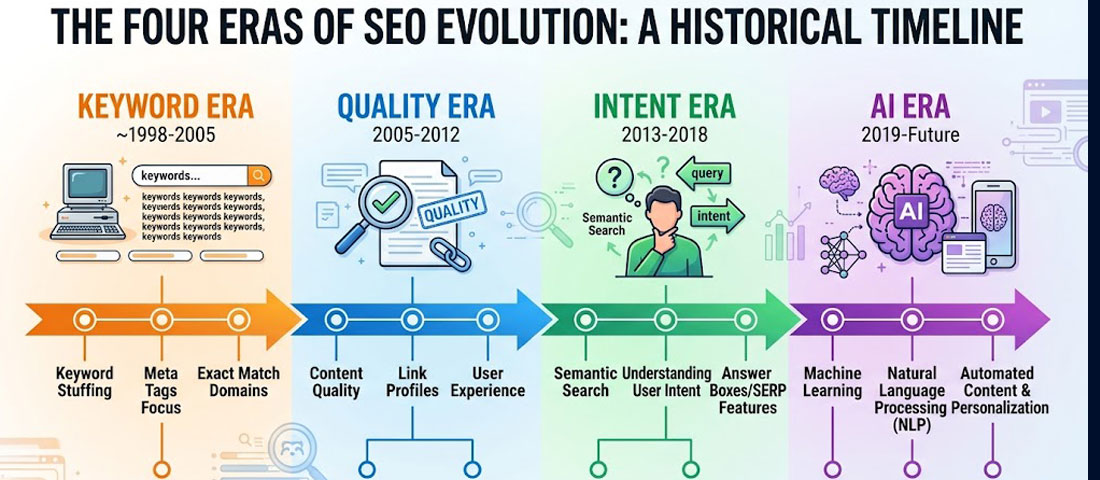
To understand where SEO is today, it helps to understand the journey. Search engines have always used algorithms — but the nature of those algorithms has changed fundamentally over time.
The Keyword Era
SEO was primarily about keywords and links. Stuff your page with the right keywords. Get as many backlinks as possible. Simple rules, widely gamed.
The Quality Era
Google Panda and Penguin penalised low-quality content and manipulative link schemes. Content quality and relevance began to matter significantly.
The Intent Era
RankBrain (2015) and BERT (2019) shifted Google toward understanding the intent behind queries, not just keyword matching. Voice search began its rise.
The AI Era
MUM (2021), SGE becoming AI Overviews (2023–2024), and the explosion of generative AI tools have transformed search into a multi-platform AI response ecosystem.
The pattern is clear: Google has consistently moved toward more sophisticated AI-powered understanding of content, intent, and quality. The 2026 landscape is the logical continuation of this trajectory — but the acceleration has been extraordinary.
The Four Biggest AI-Driven Changes to Search in 2026
1. Google AI Overviews: The Zero-Click Revolution
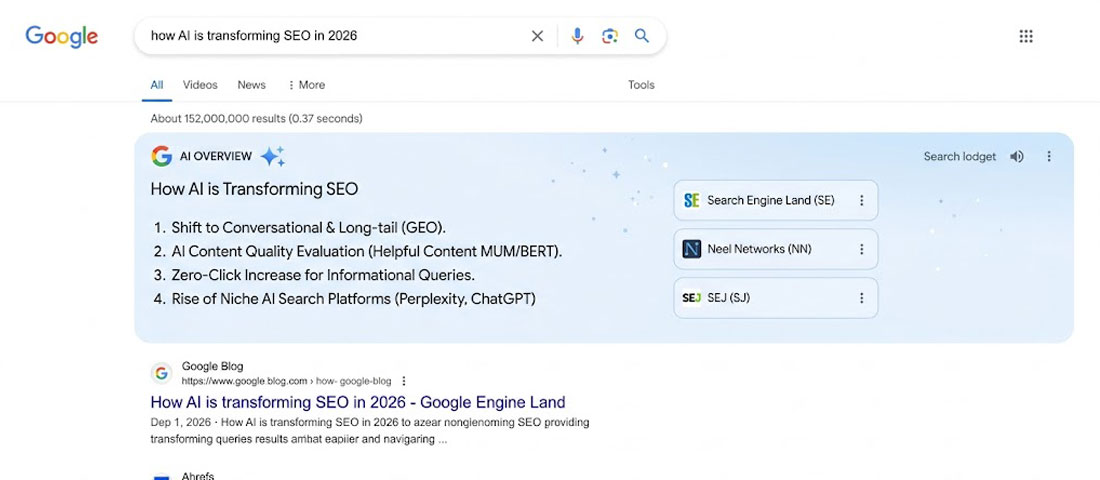
Google AI Overviews represent the most visible and commercially impactful change to search in the past decade. These are the AI-synthesised answer panels that appear at the top of many Google search results — above all organic rankings — and provide a direct, conversational answer to the user’s query.
When someone searches “what is the best web design company in India for UK businesses,” they may receive a comprehensive AI-generated answer with recommended companies and factors to consider — all without visiting a single website. For purely informational queries, this creates a genuine zero-click problem.
However, the picture is not entirely negative. Research published in 2025 shows that pages cited as sources within AI Overviews receive more clicks than organic results at the same position. Being one of the three to five sources cited in an AI Overview is more valuable than ranking at position four or five in the organic results below it.
What this means for your SEO: Optimising for AI Overview citations — which is primarily an AEO exercise — needs to be a top priority. Creating comprehensive, FAQ-rich, schema-marked-up content on your core topics gives you the best chance of being cited.
2. The Rise of AI Search Platforms: ChatGPT, Perplexity, and Beyond
ChatGPT’s web-browsing capability, Perplexity AI’s cited real-time search, and Microsoft Copilot’s integration into enterprise Microsoft 365 have collectively created a new category of search behaviour. A potential client researching web design companies might spend 20 minutes on Perplexity reading a synthesised comparison of five companies — and never visit a single company’s website. If your business is not part of that Perplexity answer, you do not exist for that client in that moment.
What this means for your SEO: GEO — building the topical authority and citation signals that cause AI search platforms to include and recommend your business — is now a mandatory component of any comprehensive digital visibility strategy.
3. Voice Search Has Matured Into a Primary Interface
The critical difference between voice search and typed search is not just the device — it is the query format. When people type a search query, they use short keyword fragments: “web design company Mumbai.” When they speak, they use natural, complete sentences: “Hey Google, which web design company in Mumbai is best for building an eCommerce website for a small business?” These are fundamentally different queries and require different content strategies.
Voice search results are almost always single answers, not lists of ten links. This winner-takes-all dynamic makes voice search simultaneously more challenging and more valuable to win — because winning means exclusive visibility.
4. AI Evaluation of Content Quality Has Raised the Bar for Everything
Google’s AI systems — particularly those underlying the Helpful Content System and the core ranking algorithm — can now distinguish between content written by a genuine expert and content that has been assembled to look comprehensive without providing genuine value. The practical consequence: mediocre content no longer ranks. Content that was “good enough” for SEO purposes three years ago is now at best mediocre, and at worst actively penalised.
Why Traditional SEO Is Not Dead — But Is Not Enough
Traditional SEO — the practice of optimising your website to rank in Google’s organic blue-link results — remains valuable and commercially significant. Here is why it still matters:
- High-intent commercial searches still drive clicks. When someone searches “web design company India prices,” they have clear commercial intent and want to visit websites to compare and make contact. AI Overviews are much less likely to intercept these transactional queries than informational ones.
- Ranking well is a prerequisite for AI visibility. AI systems — including Google AI Overviews, Perplexity, and ChatGPT’s search mode — predominantly cite content from websites that already perform well in traditional search. A strong traditional SEO foundation is not in competition with AI search optimization; it is the platform that makes AI search optimization possible.
- Organic traffic volumes remain enormous. Despite the growth of AI search, Google processes approximately 14 billion searches per day. Traditional SEO continues to deliver real, measurable business value.
The right framing: Traditional SEO is not being replaced by AI search optimization — it is being expanded. Think of it as a foundation being built upon. Your traditional SEO foundation (technical health, quality content, backlinks) creates the base. AI search optimization (AEO, GEO, AIO) is the additional layer you build on top to capture the AI-driven search traffic that traditional SEO alone cannot reach.
The Truth About AI-Generated Content and SEO
Google’s Official Position: Quality, Not Origin
Google’s official position on AI-generated content is consistent and clear: the algorithm evaluates content based on quality, expertise, and usefulness — not based on whether it was written by a human or an AI. If AI-generated content is accurate, comprehensive, and genuinely helpful, it can rank. If it is thin, generic, or mass-produced without human editorial judgement, it will not rank and may be penalised.

What the March 2024 Core Update Actually Targeted
The March 2024 Core Update was one of the most significant algorithm updates in recent years. What it actually targeted was low-quality content regardless of how it was produced — specifically:
- Content created at scale for the primary purpose of ranking in search, not to genuinely help users
- Thin, templated content that covers a topic superficially without adding genuine value
- Sites that published large volumes of AI-generated articles without meaningful human editing
- Content that “answered” a question with vague generalisations rather than specific, expert insights
The Right Way to Use AI for Content Creation in 2026
- AI generates a first draft; a human expert edits and enriches it. The human brings specific knowledge, client examples, real data, and genuine opinions that the AI cannot provide.
- Every piece has a clear unique value proposition. Ask: “What does this article provide that the reader cannot get from any other article on this topic?” If the answer is nothing, do not publish it.
- AI content is reviewed for factual accuracy. Every statistic, claim, and piece of advice must be verified by a human before publication.
A clear warning: If you are using AI to produce large volumes of similar articles with minor variations — city-based variants, slight topic variations, templated formats — stop immediately. This is exactly the content strategy that the March 2024 Core Update and its successors are specifically designed to penalise.
Voice Search and Conversational SEO: How to Win

Voice search represents one of the most underexploited opportunities in SEO in 2026. Most businesses have heard that voice search is important, but far fewer have actually implemented a comprehensive voice search strategy.
How to Optimise for Voice Search and Conversational Queries
-
Research conversational queries in your industry
Use tools like AnswerThePublic, Google’s “People Also Ask” sections, and your own Google Search Console data to identify the complete, conversational questions people ask about your products and services. -
Structure content around question-and-answer pairs
Every major section of your content should be headed by a complete question (as an H2 or H3) and answered directly in the first paragraph below it. The answer should be 40 to 60 words for voice-friendly snippets. -
Write in plain, natural language
Voice search results are read aloud. Content that sounds natural when spoken aloud performs better. Avoid jargon, overly complex sentence structures, and formal language that sounds stilted when read. -
Add comprehensive FAQ sections to every key page
FAQ sections are the most effective format for voice search optimisation. Implement FAQPage schema on every page with FAQ content. -
Optimise Google Business Profile for local voice search
Ensure it has a complete, keyword-rich business description; accurate categories; all services listed; current opening hours; and a steady stream of genuine customer reviews. -
Maximise page speed on mobile
Voice searches are predominantly performed on mobile devices. Voice assistants strongly prefer fast-loading pages. A page that loads in under two seconds has a significantly higher probability of winning voice search results.
The SEO Strategies That Actually Work in the AI Era
1. Genuine Topical Authority, Not Keyword Coverage
In the topical authority model, you decide what subjects you want to be recognised as an authority on, and you build comprehensive, deeply interconnected content coverage of those subjects. Topical authority means that when Google or an AI platform evaluates a query related to your subject area, your website comes up consistently across that entire subject area — not just for specific keyword matches.
2. E-E-A-T: Experience, Expertise, Authoritativeness, Trustworthiness
Google’s E-E-A-T framework is now more important than it has ever been. Specific signals that matter in 2026: named authors with demonstrable credentials; first-person case studies and client examples; specific, data-backed claims; peer citations from authoritative sources; and a demonstrable track record of accurate, helpful content over time.
3. Content Clusters Over Individual Articles
A cluster tells both Google and AI search platforms that you have genuine depth on a topic, not just surface coverage. It creates the topical authority signals that algorithms use to assess expertise, and it creates a web of internal links that distributes authority across your content.
4. Schema Markup as a Competitive Advantage
Schema markup is one of the most consistently underused SEO tools available, and in 2026 it is more valuable than ever. Every business website should have: Organisation schema; Service schema on service pages; Article schema on blog posts; FAQPage schema on FAQ content; and LocalBusiness schema for location-based businesses.
5. Building for Search Intent, Not Search Volume
A keyword with 500 monthly searches from people actively looking to hire a web design company is more valuable than a keyword with 5,000 monthly searches from people who are just curious. Map content to the full spectrum of user intent: informational, navigational, commercial investigation, and transactional.
What This Means for Businesses in Different Industries

| Business Type | Biggest Opportunity | Biggest Threat | Priority Action |
|---|---|---|---|
| Service businesses (web design, legal, accounting) | AI Overview citations for “best [service] in [location]” queries | Zero-click on informational content | AEO + local GBP optimization |
| eCommerce / retail | Product review and comparison content cited by AI | AI shopping tools replacing product search | Product schema + review generation + GEO |
| B2B companies | ChatGPT / Perplexity citations in buyer research journeys | AI-assisted procurement bypassing websites | GEO + LLMO + authoritative content |
| Local businesses | Voice search dominance for “near me” queries | AI local packs replacing map results | Voice search optimization + GBP + local citations |
| SaaS / technology | Technical content cited in developer and business AI queries | AI tools giving users direct solutions without software | Deep technical content + topical authority |
A Practical Framework for Adapting Your SEO Strategy Right Now
-
Audit your current AI search visibility
Open ChatGPT, Perplexity, and Google. Search for your core services and target queries. Note what comes up, which competitors appear, and what your business’s current AI presence looks like. Most businesses find they are significantly underrepresented in AI search results compared to their traditional Google rankings. -
Identify and prioritise your content gaps
Compare what AI tools say about your industry against what is currently on your website. Where are the gaps? What questions are being answered by AI tools that your website does not address? These gaps are your content priority list. -
Implement FAQ schemas on your top 10 most important pages
Add comprehensive FAQ sections (minimum five questions, paragraph-length answers) and implement FAQPage schema markup. This single action can produce measurable AEO results in four to eight weeks. -
Build or restructure your content around topic clusters
For each of your core service areas, map out a topic cluster: one comprehensive pillar post plus four to six supporting posts covering specific subtopics. Interlink them deliberately. -
Optimise your three most commercially important pages for voice search
Add question-format headings. Lead every section with a direct, concise answer. Ensure page load speed is under two seconds on mobile. Add LocalBusiness schema if applicable. -
Develop an AI content policy for your team
If you use AI tools for content creation, establish clear editorial standards. Every AI-assisted piece must be reviewed and enriched by a human expert before publication. Define the minimum level of unique value each piece must provide. -
Review and measure quarterly
AI search evolves quickly. Set a quarterly calendar reminder to re-audit your AI search visibility, review your content performance, and adjust priorities. Track not just traditional SEO metrics but AI-specific ones: AI Overview appearances, voice search positions, and citation frequency on AI platforms.
The core strategic insight: Everything that makes you a genuinely good, authoritative, expert resource in your field — comprehensive knowledge, clear communication, demonstrable experience, trustworthy reputation — is exactly what both traditional SEO and AI search optimization reward. The AI era has not changed what matters; it has made it harder to fake.
Is your SEO strategy built for the AI era — or for 2019?
Neel Networks provides AI-era SEO services for businesses across the USA, UK, Canada, Australia, and worldwide. We audit your current visibility across both traditional search and AI platforms, then build an integrated strategy that covers AEO, GEO, AIO, and traditional SEO together.
Frequently Asked Questions About AI and SEO in 2026
| Is traditional SEO dead because of AI? | Traditional SEO is not dead, but it is no longer sufficient on its own. Ranking in the top 10 blue links on Google remains valuable, but AI Overviews, voice search, and generative AI tools now intercept a significant and growing portion of search queries before users ever reach those blue links. The smart strategy is to continue building traditional SEO foundations while layering AI-focused optimisation — AEO, GEO, and AIO — on top. |
| Can AI-generated content rank on Google in 2026? | Yes — but only if it meets Google’s quality standards. Google evaluates content based on quality, expertise, and usefulness, regardless of whether a human or an AI wrote it. Thin, generic, mass-produced AI content that provides no unique value does not rank. However, AI-assisted content that is thoroughly edited, factually accurate, demonstrates genuine expertise, and genuinely helps users can and does rank well. AI can help produce content, but a human expert must ensure it has real value. |
| What is conversational SEO and why does it matter? | Conversational SEO is the practice of optimising your content for the natural, full-sentence, question-format queries that people use when speaking to voice assistants and AI chatbots. For example, a traditional keyword might be “web design company Mumbai” — a conversational query is “which is the best web design company in Mumbai for small businesses?” It matters because voice search usage is growing rapidly and AI-powered assistants respond exclusively with conversational, context-aware answers. |
| How do Google AI Overviews affect website traffic? | Google AI Overviews can reduce click-through rates for informational queries — because users get their answer directly without visiting any website. However, research shows that pages cited as sources within AI Overviews can receive more clicks than traditional organic results at the same position. The strategic response is to optimise for AI Overview citations (AEO/GEO) and focus your SEO on high-intent, transactional, and service-specific queries where users still need to visit a website to take action. |
| How has Google’s March 2024 Core Update changed SEO? | Google’s March 2024 Core Update specifically targeted low-quality, unhelpful, and AI-generated content produced at scale for SEO purposes rather than to genuinely help users. It reduced visibility for sites relying heavily on thin, templated, or mass-produced AI content. The practical implication: any AI-assisted content must be edited, enriched, and reviewed by human experts to demonstrate genuine value and originality before publication. |
| How do I optimise for voice search in 2026? | Optimising for voice search requires structuring your content around complete, conversational question-format queries. Write answers in plain, natural language; aim for 40 to 60 word answers for key questions; implement FAQ schema markup on all key pages; ensure your Google Business Profile is complete and accurate for local voice searches; and prioritise page speed — voice assistants strongly prefer fast-loading pages, particularly on mobile. |
| What SEO strategies actually work in the AI era? | The SEO strategies that perform best in the AI era are: creating genuinely comprehensive, expert-level content; building topical authority through content clusters; implementing FAQ sections with schema markup to capture featured snippets and AI Overviews; optimising for conversational, long-tail queries; earning high-quality backlinks and citations from authoritative sources; and ensuring your brand entity is accurately and consistently represented across the web. |
Conclusion: The Best SEO Has Always Been About Genuine Value
If there is one overarching lesson from the AI transformation of search, it is this: the businesses winning in search in 2026 are the ones that were always building their digital presence the right way — creating genuinely helpful content, demonstrating real expertise, earning authentic authority, and focusing on the needs of their audience rather than the mechanics of algorithms. AI has not changed what matters. It has made it much harder to succeed by doing the wrong things, and much easier to succeed by genuinely being the best resource for your subject area.
Ready to build an SEO strategy that works in the AI era?
Start with a free SEO and AI visibility audit from Neel Networks. We will tell you exactly where you stand and what your highest-priority opportunities are.