The Complete Brand Building Guide: Identity, Voice, Graphic Design & Visual Marketing
Most businesses have a logo. Fewer have a visual identity. Fewer still have a brand. The distinction between these three things is not semantic — it reflects a fundamental difference in how deeply a business has thought about how it presents itself to the world, and how consistently it delivers on that presentation across every touchpoint.
What this guide covers
- 1. Why Brand Building Is a Business Investment, Not a Creative Exercise
- 2. Layer 1: Brand Strategy — The Foundation Everything Else Builds On
- 3. Layer 2: Visual Identity — Expressing Strategy Through Design
- 4. Layer 3: Brand Voice — The Verbal Identity
- 5. Layer 4: Graphic Design — Executing Brand Identity Across Applications
- 6. Layer 5: Visual Marketing — Taking the Brand to the Audience
- 7. Building Brand Consistency Across All Touchpoints
- 8. Brand Building for Different Business Stages
- 9. Frequently Asked Questions About Brand Building and Graphic Design
- 10. Conclusion: Brand Is the Long Game
A logo is a mark. A visual identity is a system of marks, colours, typography, and imagery that creates coherent, recognisable aesthetics across applications. A brand is everything a business communicates — through its visuals, its words, its products, its people, and its actions — that shapes how customers feel about it. Building a brand means intentionally designing all of these layers to work together in service of a clear strategic purpose.
This guide covers the complete picture: brand strategy as the foundation, visual identity as the expression, brand voice as the verbal layer, graphic design as the execution discipline, and visual marketing as the channel through which brand building actually reaches audiences. Whether you are building a brand from scratch or auditing an existing one, the framework here applies.
Why Brand Building Is a Business Investment, Not a Creative Exercise
Brand is often framed as a creative discipline — something that lives in the marketing department and is evaluated on how it looks. This framing is both common and limiting. Brand is fundamentally a business asset: a set of associations, feelings, and expectations that customers hold about a business, which influence their purchasing decisions, their willingness to pay, their loyalty, and their likelihood of recommending the business to others.
The commercial value of brand is well documented. Businesses with strong brand recognition consistently achieve higher price premiums than commodity competitors. Customer acquisition costs are lower because brand-aware prospects arrive with pre-existing trust. Customer lifetime value is higher because brand loyalty reduces churn. Employee recruitment and retention improve because people want to work for brands they respect. In each case, the mechanism is the same: brand reduces the friction of commercial relationships by replacing uncertainty with familiarity and trust.
In 2026, brand building has an additional dimension: AI search and discovery. When potential customers ask AI tools about businesses in your category, the AI draws on publicly available brand signals — your content, your reviews, your social presence, what others say about you — to form and communicate an impression. A business with a clear, consistent, well-articulated brand is more likely to be described favourably and specifically. A business with an incoherent or minimal brand presence is more likely to be described generically or overlooked entirely.
Layer 1: Brand Strategy — The Foundation Everything Else Builds On
Brand strategy is the thinking that precedes design. It defines what the brand stands for, who it serves, how it differs from alternatives, and what it aims to make people feel. Without a clear strategy, brand identity work is decoration rather than communication — it may look attractive, but it does not serve a clear purpose, and it will be inconsistent because it has no anchor.
The core brand strategy elements:
Brand purpose: The reason the brand exists beyond generating profit. Purpose is not a marketing tagline — it is a genuine articulation of the value the business creates in the world. For a web design agency: “to help businesses compete more effectively online by building digital presences that genuinely represent their quality.” Purpose informs decisions across the business, not just marketing.
Brand values: The principles the business holds that shape how it behaves — toward customers, toward employees, toward partners. Values are only meaningful if they are reflected in actual behaviour rather than stated aspirations. A business that claims to value transparency but hides its pricing, avoids difficult conversations, and withholds relevant information from clients does not have transparency as a value — it has it as an aspiration it is not acting on.
Brand positioning: How the brand is positioned relative to competitors in the minds of its target audience. Positioning occupies the intersection of what the brand is genuinely good at, what its target customers genuinely value, and what competitors are not already doing well. A strong positioning is specific and exclusive — it cannot simultaneously describe multiple competitors without being diluted.
Target audience definition: A precise description of the primary customer the brand is designed to serve — their demographics, psychographics, goals, frustrations, and decision-making behaviour. “Small businesses” is not a target audience definition. “Founders of 2–15 person professional service firms in tier-1 Indian cities who are experiencing revenue growth but feel their digital presence no longer reflects their quality” is a target audience definition.
Brand personality: The human characteristics the brand would embody if it were a person. Is it expert and authoritative, or approachable and encouraging? Innovative and bold, or reliable and steady? Playful and warm, or precise and professional? Brand personality guides both the visual and verbal expression of the identity — it is the through-line that makes a brand feel coherent rather than assembled from disconnected decisions.
Layer 2: Visual Identity — Expressing Strategy Through Design
Visual identity is the system of visual elements that expresses brand strategy consistently across every touchpoint. It is built on a logo but extends well beyond it, encompassing the full visual language through which the brand communicates before a single word is read.
The components of a professional visual identity system:
Logo System
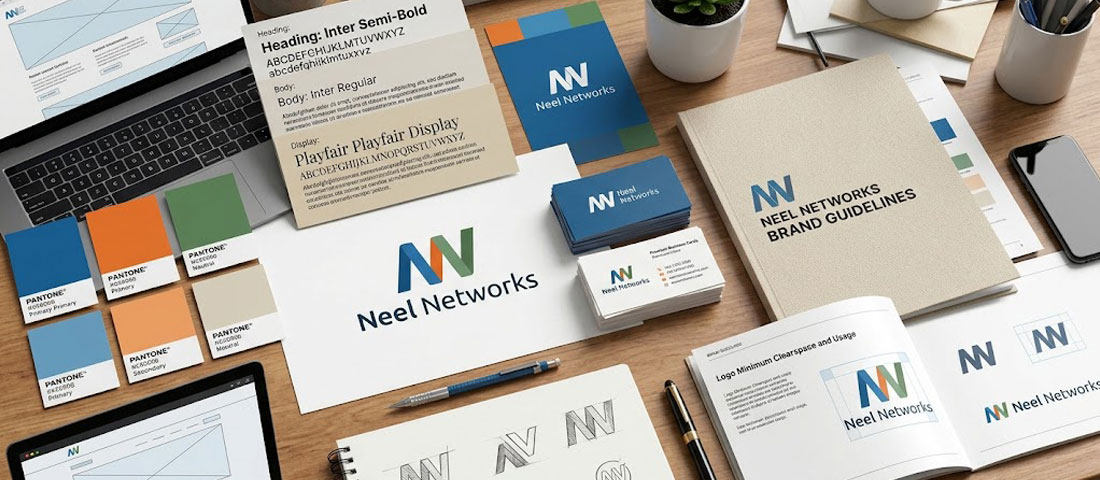
Primary logo, compact version, symbol-only mark, wordmark, monochrome versions, reversed versions — each with clear guidelines for when to use which variant. The logo system enables consistent application across the full range of contexts without ad-hoc decisions that introduce inconsistency.
Colour Architecture
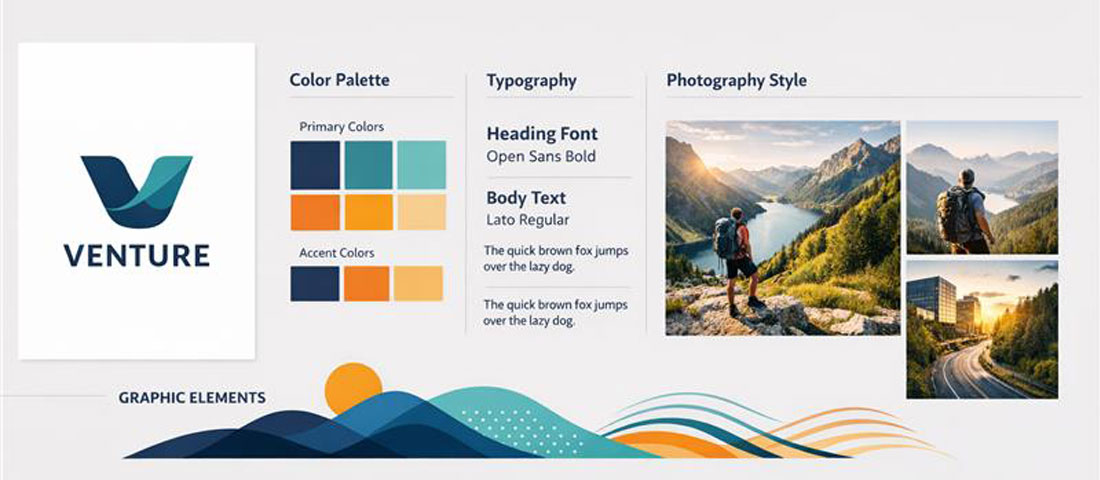
Primary brand colours (one to two), secondary palette (two to four supporting colours), neutral palette (backgrounds, text, dividers), and functional colours for digital states. Each specified in HEX, RGB, CMYK, and Pantone where print is relevant. Colour is often the most immediately recognisable element of a brand identity.
Typography System
Display typeface for headlines and brand moments, body typeface for continuous reading, UI typeface for digital interfaces where display fonts may be impractical. Each with weight hierarchy, size scale, and line-spacing guidance. Typography carries significant personality — it should reflect the same characteristics as other brand identity elements.
Imagery Style
Guidelines defining the visual style of photography and illustration used in brand communications: colour treatment (natural vs. filtered vs. monochrome), composition approach (spontaneous vs. structured), subject matter (people-focused vs. abstract), and mood (warm vs. cool, energetic vs. calm). Imagery style guidance prevents the visual inconsistency that results from undirected image selection.
Graphic Language
Supporting graphic elements — patterns, textures, icons, dividers, shapes, and layout devices — that extend the brand’s visual vocabulary beyond the logo and primary identity elements. A distinctive graphic language gives the brand visual richness and makes brand-produced materials instantly recognisable even without the logo present.
Brand Guidelines Document
The reference document that codifies all of the above with examples of correct and incorrect usage, clear do’s and don’ts, and sufficient guidance to enable consistent application by anyone producing brand materials — internal team members, external agencies, print suppliers, or web developers.
Layer 3: Brand Voice — The Verbal Identity
Brand voice is the verbal equivalent of visual identity. It defines the consistent tone, vocabulary, and communication style that the brand uses across all written and spoken content — website copy, social media posts, email communications, customer service interactions, marketing materials, and even internal communications. A brand with a distinctive, consistent voice is as recognisable through its words as through its visuals.
Brand voice is often described through a set of three to five personality dimensions, each with a brief description of what it means in practice and — critically — what it does not mean. For example: Expert but not academic (we share deep knowledge in plain language; we never use jargon to demonstrate expertise). Warm but not informal (we treat every customer as a person with real problems, not as a transaction; we do not use slang or overly casual language in professional contexts). These pairs — what the voice is, and what it is not — are more useful than the dimension label alone because they define the edges of the territory.
Tone of voice vs. brand voice:
Brand voice is consistent — the personality does not change. Tone of voice varies by context — a brand with a warm, approachable voice will use a slightly different tone in a help article (calm, instructive, precise) than in a social media post (warmer, more conversational) than in a complaint response (empathetic, solution-focused). The underlying voice is the same; the tone modulates to suit the context. This distinction helps explain why even brands with clearly defined voice guidelines sometimes feel inconsistent — the guidelines define the voice but not the range of appropriate tonal variation.
Developing brand voice guidelines:
Brand voice guidelines should include: the personality dimensions with descriptions and examples; writing principles (active vs. passive voice preferences, sentence length guidance, approach to technical vocabulary); vocabulary guidance (words the brand uses and avoids, any specific terminology that is part of the brand’s identity); and examples of on-brand and off-brand copy for common content types. The most useful voice guidelines are specific enough to actually guide writing decisions, not so abstract that they require interpretation before they can be applied.
Layer 4: Graphic Design — Executing Brand Identity Across Applications
Graphic design is the discipline that takes brand strategy, visual identity, and brand voice guidelines and applies them to specific communication outputs: the website, the social media templates, the marketing collateral, the presentation decks, the email newsletters, the packaging, and every other designed artefact the brand produces. Graphic design is the execution layer — where strategy becomes tangible.
The quality of graphic design execution is where many businesses with strong brand strategies fall short. A well-conceived strategy and a professionally designed identity system can be significantly undermined by poor execution: inconsistent use of brand colours, typography that does not follow the guidelines, image choices that contradict the defined imagery style, and layouts that feel disconnected from the brand’s visual character. Brand guidelines only deliver their value when the people producing brand materials — whether internal designers, external agencies, or team members using templates — understand them and apply them consistently.
Key graphic design applications for business brands:
Website design: The most important and most-seen brand application for most businesses. The website should be a full expression of the brand system — colour, typography, imagery, voice, and graphic language all applied with precision. Inconsistencies between the brand guidelines and the website are immediately visible because the website is where most brand-aware prospects first encounter the brand in its fullest form.
Social media templates: Consistent visual templates for social media posts, stories, and profile assets ensure that social content is recognisably on-brand without requiring a designer for every post. Template design in Canva, Figma, or Adobe Express allows non-designers to produce content that maintains visual brand consistency.
Marketing collateral: Brochures, pitch decks, proposals, case study documents, and sales materials are often the first brand artefacts a potential client handles. The quality and consistency of these materials contributes significantly to the professional impression the brand makes at a critical decision-making moment.
Email design: Branded email templates for newsletters, transactional emails, and marketing campaigns ensure that every email sent by the business is a consistent brand expression rather than a text-heavy communication that feels disconnected from the brand’s visual character.
Layer 5: Visual Marketing — Taking the Brand to the Audience
Visual marketing is the strategic use of designed visual content to build brand awareness, communicate value, and drive commercial outcomes through paid and organic channels. It is where brand identity meets audience reach — the mechanism through which a well-built brand identity becomes known beyond the people who already interact with the business.
Social media visual content
Social media is the most prolific brand touchpoint for most businesses in 2026. The visual content a brand posts — its photography style, graphic treatments, video aesthetic, and typographic choices — collectively communicates brand character to an audience that may not visit the website for months. The businesses with the most coherent social brand presence have invested in either a content system (a set of branded templates and content types that can be produced consistently at scale) or a recurring content production process that applies the brand’s visual language to fresh material reliably.
In 2026, short-form video is the dominant content format across Instagram Reels, YouTube Shorts, and LinkedIn video. Brand consistency in video requires attention to visual elements — branded intro/outro sequences, consistent colour grading, on-screen typography matching the brand system — as well as voice and tone in the scripting and delivery style. Brands that have achieved visual consistency in static content often find that video consistency requires explicit additional guidance.
Content marketing and visual storytelling
Long-form content — blog posts, guides, case studies, white papers, reports — is a significant brand building channel for B2B businesses and knowledge-intensive service providers. The visual design of these content pieces matters as much as their written quality for the brand impression they create. A case study presented in a well-designed, consistently branded PDF or web page conveys professional credibility that the same content in a plain Word document does not. The design of written content is a brand signal, not just a formatting choice.
Infographics and data visualisation are particularly valuable for brands that want to communicate complex information accessibly and for content that is likely to be shared. Well-designed infographics routinely earn significantly more social shares and backlinks than equivalent text-based content, making them a high-ROI visual content format for brands operating in information-rich categories.

Paid visual advertising
Paid digital advertising — Google Display, Meta (Facebook/Instagram), LinkedIn, YouTube — is where visual marketing intersects with performance marketing. The creative quality of ad visuals is one of the most significant variables in paid advertising performance: Meta’s own research indicates that creative quality accounts for approximately 56% of the variance in campaign outcomes, outweighing targeting, placement, and bidding strategy combined.
Brand-consistent ad creative — that uses the brand’s colour system, typography, and imagery style — serves a dual purpose: it drives the immediate commercial outcome (click, lead, purchase) and it builds brand recognition through repeated exposure. Every ad impression that does not produce a direct conversion is still contributing to the brand’s presence in the audience’s awareness, provided the creative is distinctive and consistent enough to be attributed to the brand rather than lost in the visual noise of the feed.
Building Brand Consistency Across All Touchpoints
Brand consistency is not a design principle — it is a business discipline. It requires systems, processes, and accountability to maintain across an organisation and across every vendor and partner that produces brand materials. The businesses with the most consistent brand experiences have invested in the infrastructure of consistency: brand guidelines that are genuinely usable, template libraries that make on-brand production accessible to non-designers, and review processes that catch inconsistencies before they reach audiences.
-
Conduct a brand audit across all current touchpoints
Gather examples of every context in which your brand currently appears — website, social profiles, email signatures, business cards, proposals, presentations, signage, packaging. Assess each against your brand guidelines. Identify the gaps and inconsistencies that need to be remedied, and prioritise by audience reach and commercial importance. -
Build a template library for high-frequency content
Create branded templates for the content types your team produces most frequently — social media posts, email newsletters, presentation slides, proposal documents, case study formats. Templates in Canva (for non-designers) or Figma (for designers) reduce the cognitive load of on-brand production and significantly improve consistency across a team. -
Centralise brand assets in a shared, accessible location
Brand files — logos in all formats, colour codes, font files, approved imagery, brand guidelines document — should be stored in a single location accessible to everyone who produces brand materials. Google Drive, Dropbox, or a dedicated brand asset management platform like Brandfolder all serve this purpose. The most common cause of logo inconsistency is team members using old or incorrect versions from their personal downloads folder. -
Designate a brand guardian
Assign one person the responsibility of reviewing brand applications and maintaining guidelines. This does not need to be a full-time role — in most SMEs, it is an additional responsibility held by a marketing manager or senior designer. But the responsibility needs to be explicit and the authority to request corrections needs to exist. -
Conduct annual brand reviews
Brand strategy and visual identity should be reviewed annually to assess whether they remain accurate, relevant, and effective. Markets evolve, businesses grow, and competitive landscapes shift. An annual review ensures that the brand identity is actively maintained and updated rather than left to drift as the business changes around it.
Brand Building for Different Business Stages
| Business Stage | Brand Priority | Minimum Investment | What to Defer |
|---|---|---|---|
| Pre-launch / Validation | Clear positioning, functional identity | Logo, one colour, one typeface, basic guidelines | Extended graphic language, full imagery system |
| Early growth (1–3 years) | Consistent customer-facing identity | Full visual identity system, brand guidelines, website | Brand strategy depth, brand voice documentation |
| Scaling (3–7 years) | Brand as commercial asset and culture anchor | Brand strategy, voice guidelines, template library, brand guardian | Campaign-level brand expression work |
| Established brand | Brand protection, evolution, and extension | Annual brand audit, trademark maintenance, style guide updates | Full rebrand (unless significant repositioning required) |

Frequently Asked Questions About Brand Building and Graphic Design
| What is the difference between brand identity and brand image? | Brand identity is what a business intentionally projects — the strategic positioning, visual system, voice, and personality it has designed and implemented. Brand image is what audiences actually perceive — the impression that has formed in customers’ minds through all their interactions with the brand. The goal of brand building is to close the gap between intended identity and perceived image: to ensure that what you are communicating is what is being received. When these two diverge significantly — a business believes it is positioned as a premium, trustworthy provider while customers perceive it as expensive and difficult to deal with — no amount of visual identity investment will resolve the disconnect. The misalignment is in the experience, not the identity. Addressing it requires changes to how the business actually operates, not just how it presents itself. |
| How long does it take to build a recognisable brand? | Brand recognition builds through repeated positive exposure and consistent experience over time. The timeline varies dramatically based on how frequently the target audience encounters the brand, how distinctive the brand identity is (more distinctive marks are recognised after fewer exposures), and how significant the marketing investment in reach and frequency is. For a local business with consistent physical and digital presence, meaningful brand recognition among its target community typically develops over one to three years. For a business marketing primarily through digital channels with moderate budget, three to five years of consistent brand activity is a reasonable expectation before the brand becomes a reliably recognisable shorthand in its market. National or international brand recognition at meaningful scale typically requires sustained investment over five or more years. These timelines reinforce the importance of getting the brand identity right early — the compound value of consistent brand exposure accumulates only if the identity is consistent throughout. |
| Should a small business invest in professional brand identity or focus on other marketing? | This is less an either/or choice than a sequencing question. For a very early-stage business still validating its product-market fit, an overly polished brand identity is premature investment — the positioning and values should be tested against real customer feedback before being encoded in a professional identity system. A functional, credible visual presence is sufficient at this stage. As the business finds its market and begins scaling, investing in a professional brand identity becomes increasingly important because every marketing investment — paid advertising, content, social media — is more effective when delivered through a consistent, professional brand. The brand multiplies the return on every other marketing investment by making the business more memorable and more trusted. For businesses beyond the earliest validation stage and actively investing in marketing, professional brand identity is not a luxury — it is a performance multiplier for all other marketing spend. |
| What is the role of graphic design in content marketing? | Graphic design plays several critical roles in content marketing. First, it determines whether content gets consumed — visual presentation significantly affects whether people read, watch, or engage with content. Well-designed content is more likely to be opened, read through, and shared than content with poor visual presentation, even when the underlying information is equivalent. Second, it reinforces brand identity — every piece of content is a brand impression, and consistently designed content builds brand recognition across the audience over time. Third, it improves comprehension and retention — data visualisations, infographics, and structured layouts make complex information more accessible and more memorable than unformatted text. Fourth, it increases content’s distribution reach — visually distinctive, well-designed content earns more shares on social media and more backlinks from other publishers than text-only content, amplifying its SEO and brand-building value. |
| How do I brief a graphic designer or design agency effectively? | An effective design brief answers six questions: What is the business context? (What does the business do, who are its customers, what is its positioning and personality?) What is the specific project? (What is being designed, what format and dimensions are required, what are the technical specifications?) What is the communication objective? (What should this design make the audience feel, think, or do?) Who is the audience? (Specific description of the person who will see this design and what matters to them.) What are the constraints? (Budget, timeline, brand guidelines that must be followed, technical limitations.) What does success look like? (How will the work be evaluated — conversion rate, brand consistency, client approval, production feasibility?) Designs produced against a clear brief deliver significantly better outcomes than those produced against vague direction, because they have clear criteria against which to be evaluated rather than being assessed on the subjective preferences of whoever reviews them. |
| What visual content performs best on social media in 2026? | Short-form video consistently outperforms static content on most platforms in 2026 — Instagram Reels, YouTube Shorts, LinkedIn video, and TikTok all prioritise video in their algorithms. However, the performance advantage of video over static content is platform-specific and audience-specific; on LinkedIn, well-designed static infographics and carousel posts still perform very strongly for B2B audiences. The general principles that drive visual content performance regardless of format are: distinctive, recognisable brand aesthetic that stops the scroll; immediate value delivery (the viewer knows within one second what they will get from engaging); authentic specificity (specific insights, concrete examples, and real data outperform generic advice); and production quality appropriate to the platform (high production values are expected on YouTube; raw, authentic production often performs better on Instagram Stories and TikTok). Consistency of posting schedule matters alongside content quality — algorithms favour accounts with regular activity over those with sporadic high-quality bursts. |
| How do I maintain brand consistency when working with multiple designers or agencies? | Maintaining brand consistency across multiple design partners requires three things: comprehensive brand guidelines that are accessible, specific enough to be actionable, and include examples of correct application; a clear onboarding process for any new designer or agency that includes a guidelines briefing and an initial work review before production at scale; and a quality control process that reviews all design outputs against the brand guidelines before they are published or printed. The most effective approach for businesses working with multiple design partners is to have all brand materials produced from a shared set of master files and templates rather than from scratch. When each designer starts from the brand’s Figma or Illustrator master files rather than from a blank canvas, the baseline consistency is structurally enforced rather than dependent on each designer’s interpretation of the guidelines. Regular design reviews — monthly or quarterly — where all recent brand materials are assessed collectively against the guidelines help identify and correct drift before it becomes entrenched. |
Conclusion: Brand Is the Long Game
Brand building is not a campaign. It does not have a start date and an end date. It is an ongoing commitment to presenting a consistent, intentional, and genuine version of what your business stands for across every interaction your audience has with it — through the logo on your website, the tone of your emails, the design of your proposals, the voice of your social media content, and the experience of working with you.
The businesses that have invested consistently in all five layers — strategy, visual identity, brand voice, graphic design execution, and visual marketing distribution — for five, ten, or fifteen years have brand assets that are genuinely difficult for competitors to replicate quickly. They have earned a position in their market’s awareness that translates directly into lower acquisition costs, higher conversion rates, stronger retention, and premium pricing power.
That position is available to any business willing to approach brand building with the same rigour and patience it applies to its product or service quality. At Neel Networks, we have been helping businesses build that foundation — through website design, visual identity, and digital marketing — since 2014. If brand building is a priority for your business in 2026, we would be glad to be part of that process.
Ready to Build a Brand That Earns Its Place in Your Market?
From brand strategy and logo design to website build and content production — Neel Networks provides the full range of services that turn a business into a brand. Working with clients across India, the UK, USA, Canada, and Australia since 2014. 450+ projects. 4.9 stars on Google.