How Mobile Apps Empower Small Businesses to Compete & Scale in 2026
A mobile app used to be a competitive advantage that only large companies could afford. The development cost, the infrastructure requirements, and the specialist expertise needed meant that an app was out of reach for most small and medium-sized businesses. That has changed. In 2026, the combination of cross-platform development frameworks, affordable cloud infrastructure, and a global pool of mobile development talent has brought app development within reach of businesses at almost every scale.
What this guide covers
- 1. What Can a Mobile App Actually Do for a Small Business?
- 2. Which Types of Small Businesses Benefit Most From Mobile Apps?
- 3. How Mobile Apps Compete Against Larger Players
- 4. Building a Small Business App: Realistic Options and Costs
- 5. Key Features That Drive Engagement and ROI
- 6. Measuring Whether Your App Is Delivering Value
- 7. Frequently Asked Questions: Mobile Apps for Small Businesses
- 8. Conclusion: The App Is the Relationship
More importantly, the reasons a small business needs a mobile app have never been stronger. Mobile accounts for more than half of all internet usage globally. In India, that figure is closer to 80%. Customers increasingly expect to be able to interact with businesses on their phones — booking appointments, making purchases, accessing support, tracking orders, and receiving personalised offers — in the same seamless way they interact with the large consumer apps they use daily. Small businesses that meet this expectation gain a meaningful competitive advantage over those that do not.
This guide explores what a mobile app can actually do for a small or medium-sized business, which types of businesses benefit most, how to build one within realistic budget constraints, and what separates the apps that deliver commercial results from the ones that never gain traction.
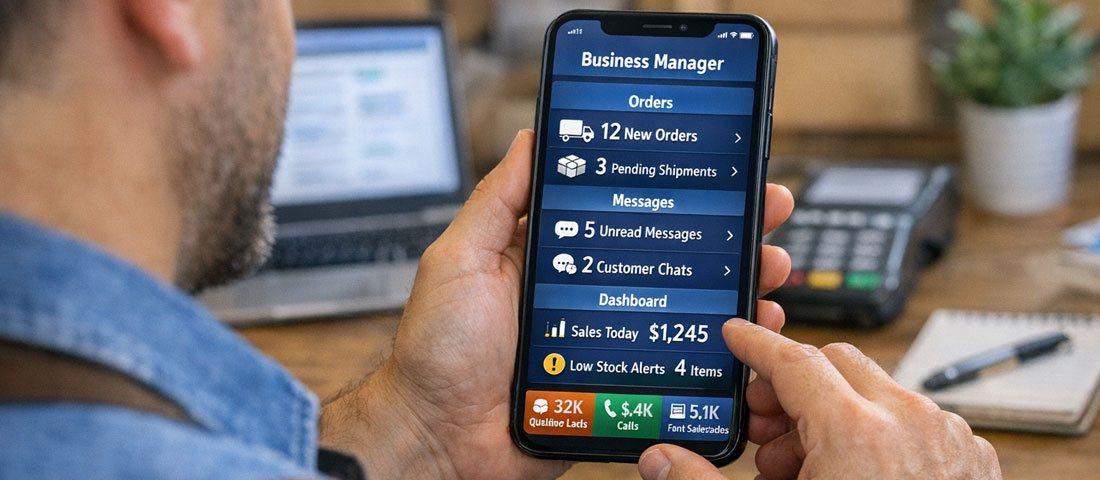
What Can a Mobile App Actually Do for a Small Business?
The business case for a mobile app is not abstract — it is grounded in specific, measurable outcomes. The question worth asking is not “should we build an app?” but “what specific problem would an app solve, and what would solving that problem be worth?”
For most small businesses, mobile apps deliver value across one or more of these categories:
Customer Retention & Loyalty
Apps with loyalty programmes, reward points, and personalised offers keep existing customers engaged between purchases. Studies consistently show that retaining an existing customer costs 5–7× less than acquiring a new one. An app that increases repeat purchase frequency by even 15–20% can dramatically improve profitability.
Appointment & Booking Management
For service businesses — salons, clinics, gyms, consultancies, repair services — an app that allows customers to book, reschedule, and receive reminders removes friction from the most important customer interaction. Fewer no-shows and reduced admin burden are immediate, tangible benefits.
Direct Sales Channel
An eCommerce app removes the marketplace fees of platforms like Amazon or Flipkart and gives the business complete control over the customer experience, pricing, and data. For businesses with a loyal existing customer base, a branded app can become the preferred purchasing channel.
Push Notification Marketing
Permission-based push notifications deliver messages directly to a customer’s phone screen at a fraction of the cost of SMS or paid advertising. When used judiciously — for genuinely relevant offers, reminders, and updates — push notifications consistently outperform email for open rates and immediate response.
Operational Efficiency
Internal-facing apps for staff — field service management, inventory tracking, job scheduling, delivery tracking — reduce errors, speed up workflows, and give managers real-time visibility into operations. These efficiency gains often deliver faster ROI than customer-facing apps for operations-heavy businesses.
Brand Differentiation
In markets where most competitors have only a website, a professionally built mobile app signals investment, modernity, and customer-centricity. This perception advantage influences purchasing decisions, particularly for higher-value services where trust and professionalism are significant factors.
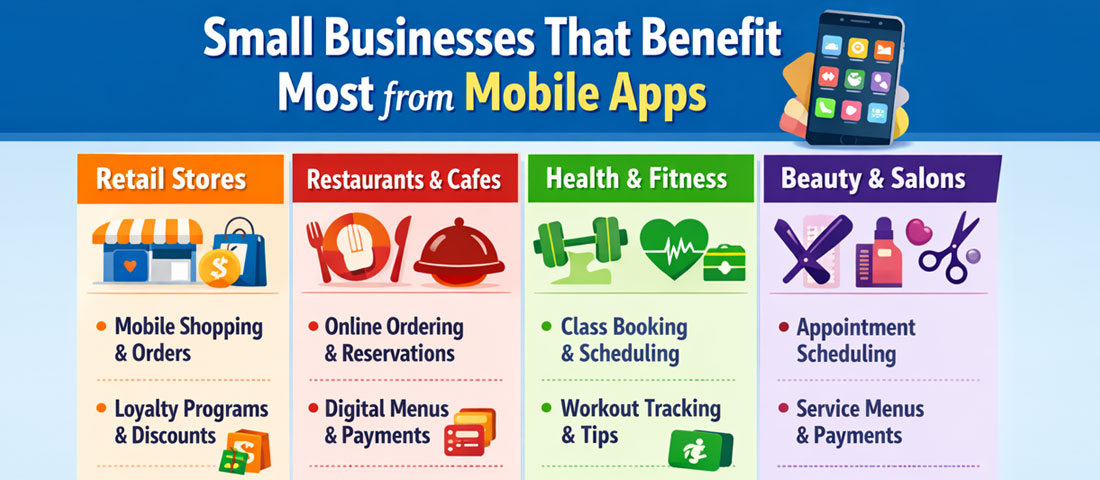
Which Types of Small Businesses Benefit Most From Mobile Apps?
Not every small business needs a custom mobile app. The businesses that get the strongest ROI are those where one of the value categories above maps clearly to a specific business challenge they are already experiencing — high customer churn, high no-show rates, heavy reliance on third-party platforms, or significant admin overhead that mobile automation could reduce.
High-fit business categories:
Retail and eCommerce: Businesses with a repeat customer base, where purchase frequency can be increased through a loyalty programme or personalised offers. Apps with integrated loyalty programmes and push notification campaigns have demonstrated average order frequency improvements of 25–40% in well-documented case studies.
Food and beverage: Restaurants, cafes, bakeries, and food delivery businesses. Ordering apps eliminate third-party platform fees (which typically range from 15–30% per transaction), give businesses direct access to customer data, and enable loyalty programmes that build long-term customer relationships. For businesses doing significant volume through Zomato, Swiggy, Uber Eats, or Just Eat, the mathematics of reclaiming even a fraction of that volume on a owned platform are compelling.
Health, wellness, and fitness: Gyms, yoga studios, physiotherapy practices, personal trainers, and beauty clinics. Class booking, appointment scheduling, progress tracking, and digital content delivery are all natural app functions for this category. The subscription model common in this sector also aligns well with app engagement patterns.
Professional services: Accountants, consultants, lawyers, and financial advisors. A client portal app that enables secure document sharing, status updates, and communication eliminates email chains, reduces misunderstandings, and significantly improves client satisfaction. The perceived professionalism of a branded client app is also a meaningful differentiator in competitive service markets.
Field services and logistics: Plumbers, electricians, courier companies, cleaning services, and any business with a mobile workforce. Job management apps for field teams — showing job schedules, customer locations, job notes, and completion forms — reduce dispatch overhead, eliminate paper-based processes, and improve customer communication through automated status updates.
How Mobile Apps Compete Against Larger Players
One of the most compelling arguments for small business app investment is the ability to deliver an experience that chains and large enterprises, burdened by legacy systems and organisational complexity, often cannot match. A small business app can be personalised, fast to update, genuinely local, and deeply integrated with the way the specific business operates — advantages that scale works against, not for.
Personalisation at scale
A small local restaurant app that remembers a customer’s usual order, sends a personalised offer on their birthday, and notifies them when their favourite weekly special is available is delivering a level of personalisation that a national chain cannot match without significant investment in customer data infrastructure. For small businesses, personalisation is a competitive weapon rather than a technical challenge.
Speed of iteration
Large companies take months to update their apps through internal approval processes, change management procedures, and complex release pipelines. A small business working with an agile development partner can push meaningful app updates in days. This speed advantage means small businesses can respond to customer feedback, seasonal opportunities, and competitive moves far more rapidly than their larger counterparts.
Customer relationship depth
An app creates a direct, persistent connection between a business and its customers — one that does not depend on a social media algorithm, a marketplace’s ranking system, or a search engine’s ranking decision. Customers who have installed your app have made a deliberate choice to maintain a relationship with your business. That is a qualitatively different relationship from one mediated by a third-party platform, and it creates significantly higher lifetime value potential.
Building a Small Business App: Realistic Options and Costs
Budget is the most common barrier to small business app development, and it is worth addressing directly. The cost range for mobile app development is wide, and understanding where different approaches sit on the cost-capability spectrum helps businesses make informed decisions.
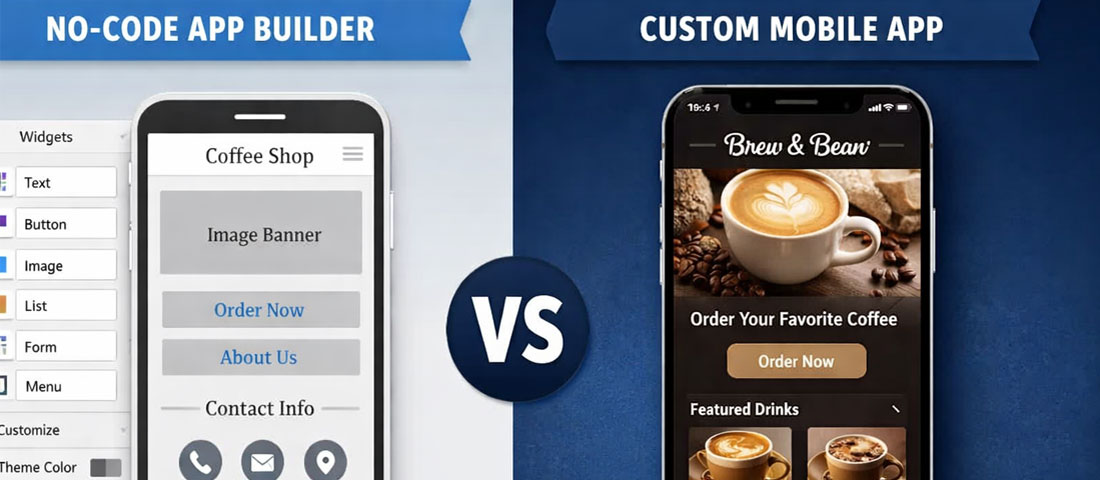
Option 1: No-code and low-code platforms
Platforms like Glide, AppSheet, Adalo, and Fliplet allow non-technical founders to build functional apps using visual builders — no coding required. These platforms are appropriate for relatively simple use cases: internal team tools, basic customer directories, simple booking forms, or content apps. They typically produce apps that are adequate for these purposes but hit functionality ceilings quickly for anything involving complex logic, custom integrations, or distinctive branded experiences. Monthly subscription costs range from $25 to $200 USD depending on the platform and usage tier.
Option 2: Templated app builders with customisation
Platforms like BuildFire, GoodBarber, and Appy Pie provide more substantial customisation options within a templated framework. These are appropriate for businesses that need a branded customer-facing app with standard functionality — loyalty programmes, push notifications, basic eCommerce, appointment booking — without the cost of fully custom development. Costs are typically $500–2,000 USD for setup plus monthly subscription fees. The trade-off is limited differentiation and dependency on the platform provider’s continued operation and pricing decisions.
Option 3: Custom MVP development
A custom-built app focused on a narrow, well-defined set of features delivers genuine differentiation and scalability from the outset. Using cross-platform development (React Native or Flutter) with a backend-as-a-service foundation (Firebase), a focused MVP for a small business application can be built by an experienced Indian development team for ₹5–15 lakhs depending on feature complexity. This is the approach we recommend for businesses where the app is central to the customer experience or the operational model, rather than a supplementary channel.
| Approach | Approximate Cost | Capability Ceiling | Best For |
|---|---|---|---|
| No-code platform | $0–200/month | Low — simple logic only | Internal tools, basic content apps |
| Templated app builder | $500–2,000 + subscription | Medium — standard features | Loyalty, basic booking, notifications |
| Custom MVP (React Native/Flutter) | ₹5–15 lakhs / $8,000–20,000 | High — fully scalable | Core business app, eCommerce, field service |
| Full custom build | ₹15–50 lakhs+ / $20,000–70,000+ | Unlimited | Complex apps, platform businesses |
Key Features That Drive Engagement and ROI
Not all app features deliver equal commercial value. The features that most consistently drive measurable ROI for small business apps are the ones that either increase revenue directly (purchases, bookings, upgrades) or reduce cost (admin time, no-shows, platform fees). Build these first; add everything else later based on user data.
Push notifications — handled correctly
Push notifications are the most powerful retention tool a mobile app provides, and the most easily abused. The businesses that get the best results from push notifications treat them as a privilege — using them only for genuinely useful, timely messages rather than as a broadcast channel. A push notification about a last-minute table availability, a personalised birthday offer, or a service reminder delivers value to the recipient. A push notification that is the fifth promotional message in a week does not — and the cumulative effect of too many irrelevant notifications is app uninstall.
In 2026, the most effective small business push notification strategies are behaviour-triggered rather than time-scheduled: a notification sent to users who have not engaged with the app in 14 days is more effective than a weekly promotional blast because it is targeted to users at a specific moment of potential churn.
Loyalty and rewards programmes
Digital loyalty programmes within apps deliver significantly higher engagement rates than physical stamp cards or email-based programmes, because the app provides a frictionless experience — no card to lose, no email to search for, no link to click. A well-designed in-app loyalty programme increases visit frequency, average transaction value, and the emotional connection customers have with the brand. The data collected through loyalty programme participation also enables the personalisation that makes subsequent marketing more effective.
In-app payments and frictionless checkout
For any app that involves transactions, the checkout experience has a disproportionate impact on conversion and revenue. Apple Pay and Google Pay integration allows customers to complete purchases with a single touch, eliminating the friction of card entry. This single feature typically produces a measurable uplift in transaction completion rates. For food businesses and retail, in-app ordering with saved payment methods and order history reduces the time to repeat purchase to seconds.
Measuring Whether Your App Is Delivering Value
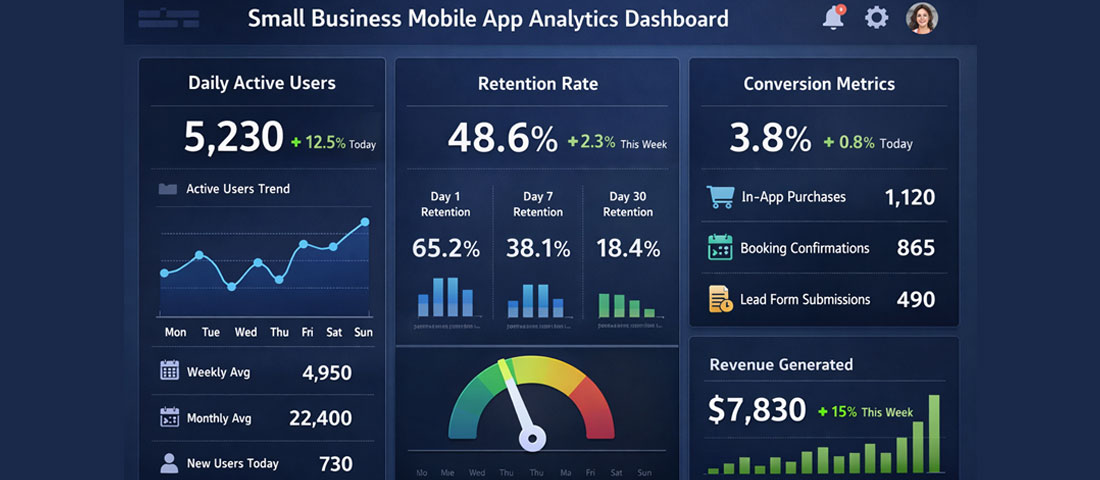
Too many small businesses launch an app, watch the download numbers for the first few weeks, and then lose visibility into whether the app is actually delivering commercial value. Download count is a vanity metric. The metrics that matter are engagement and retention — and behind those, the business outcomes they drive.
Essential metrics to track from launch day: Daily Active Users (DAU) and Monthly Active Users (MAU) — the ratio of DAU to MAU (the “stickiness ratio”) tells you how consistently people return to the app. Retention rate at Day 7 and Day 30 — what percentage of users who installed the app are still using it a week and a month later. Session length and screens per session — are users engaging meaningfully, or opening the app briefly and leaving? Conversion rate for key in-app actions — what percentage of users who open the app complete a booking, make a purchase, or redeem a loyalty offer? And critically, revenue or bookings attributable to the app — the business outcome that justifies the investment.
Frequently Asked Questions: Mobile Apps for Small Businesses
| Do customers actually download and use small business apps? | Customer adoption of small business apps depends almost entirely on whether the app delivers something the customer values enough to occupy space on their phone. Generic branded apps with no specific functionality — essentially a mobile website in an app wrapper — see very low download and retention rates. Apps that solve a specific problem the customer already has — booking an appointment without calling, tracking a delivery in real time, accessing exclusive offers not available elsewhere, or managing a loyalty account — see strong adoption when promoted effectively at the point of purchase or service. The key is designing the app around genuine customer need rather than the business’s desire to “have an app.” A small business cafe app with an ordering and loyalty feature that genuinely saves the customer time and rewards their loyalty can achieve adoption rates among regular customers of 30–60% with consistent promotion. |
| How do I promote my small business app to get downloads? | App promotion for small businesses is most effective at points of existing customer contact rather than through paid advertising to cold audiences. Prominently display the app download link on your website, in your email signature, on physical signage in your premises, on receipts and packaging, and in social media bios. Train staff to mention the app and explain its benefits at point of service. Offer a specific incentive for first-time app users — a discount on their first in-app purchase, bonus loyalty points, or an exclusive offer — to overcome the activation barrier. QR codes linking directly to the App Store and Google Play listings, displayed prominently in high-visibility locations, reduce the friction of finding and downloading the app. Paid social advertising targeting your existing customer base (using email list custom audiences) is cost-effective for the initial launch period when building the initial user base. |
| Is a mobile app better than a mobile-optimised website for my business? | A mobile-optimised website and a mobile app are not competing investments — they serve different purposes and different stages of the customer relationship. A mobile website is the right choice for initial discovery: most new customers will find your business through Google search or social media and land on your website first. A mobile website that is fast, clear, and easy to navigate on a phone is non-negotiable. A mobile app delivers value to existing customers who have an ongoing relationship with your business and benefit from features like loyalty programmes, saved preferences, push notifications, and frictionless repeat purchasing. The app does not replace the website; it deepens the relationship with customers who have already discovered and used your business. For most small businesses, the website comes first, the app follows once you have a loyal customer base worth engaging through a dedicated channel. |
| What is the minimum number of customers I need to justify building an app? | There is no single threshold because the ROI calculation depends on transaction value, purchase frequency, and the specific value the app delivers. A useful framing: if you have 500 regular customers who each visit or purchase twice a month, and an app loyalty feature increases their visit frequency to 2.5 times per month, that is 2,500 additional transactions per year. Multiply by your average transaction value to assess the revenue uplift relative to the app’s development cost. For a restaurant with an average order of ₹600, that additional 2,500 transactions represents ₹15 lakh in additional annual revenue — a straightforward ROI calculation against a custom app build cost of ₹8–12 lakh. For businesses with very small customer bases (under 100 active customers), a templated app builder or PWA is typically more appropriate until the customer base grows to a scale where custom development ROI is clear. |
| Can a mobile app help my business compete against large chains or marketplaces? | A mobile app is one of the most effective tools a small business has for building direct customer relationships that bypass the marketplace or platform dynamic. When a customer orders through Zomato or buys from Amazon, the customer relationship belongs to the platform — the business gets the transaction but not the customer data, not the direct communication channel, and not the loyalty. A branded app reverses this: the customer relationship belongs to the business. The app knows what the customer has purchased, how often they visit, what offers they respond to, and how to reach them directly. Large chains invest tens of millions in their app experiences precisely because the direct relationship they create is commercially valuable. A well-built small business app delivers the same fundamental relationship dynamic at a scale appropriate to a smaller business. |
| How often does a business app need to be updated? | Mobile apps require ongoing maintenance and periodic feature updates to remain functional, competitive, and compliant with App Store policies. At a minimum, apps need to be updated to maintain compatibility with each new major iOS and Android operating system release — typically one to two updates per year at minimum maintenance level. Beyond OS compatibility, App Store and Google Play policies evolve regularly, and apps that fall out of compliance face suspension. Feature updates driven by user feedback and business needs are additional to maintenance. Practically, most small business apps require two to four updates per year to remain well-maintained, and businesses should budget for ongoing development support at approximately 15–20% of the initial build cost annually. Some development partners offer maintenance retainers that cover this at a predictable monthly cost. |
| Should my business app be free or paid to download? | For small business customer-facing apps, a free download model is almost always the right choice. The purpose of a small business app is not to generate revenue from the download itself — it is to deepen customer relationships and drive commercial outcomes through the behaviours the app enables (purchases, bookings, loyalty engagement). A paid download creates a barrier that significantly reduces adoption rates, which defeats the purpose. Revenue generated through the app should come from the transactions and loyalty driven by the app, not from the download. The only exception is apps that are standalone products in their own right — a specialised tool, a training programme, or content with significant standalone value — where charging for the download is itself the business model. For service businesses, retail businesses, and hospitality businesses, free download with in-app commercial functionality is the standard and optimal model. |
Conclusion: The App Is the Relationship
In 2026, a mobile app is not a technology toy for small businesses with money to spare. For businesses where customer retention, repeat purchase frequency, and direct communication are meaningful commercial levers — which describes the majority of service, retail, food, and professional service businesses — a well-built mobile app is a strategic asset with measurable return on investment.
The key is building with clarity about the specific commercial outcome you are targeting, choosing the right approach for your budget and technical requirements, and treating the app as the beginning of an ongoing customer relationship investment rather than a one-time build. Apps improve with iteration, engagement grows with consistent promotion, and the data collected over time enables increasingly effective personalisation. The small businesses that build this foundation now will have a meaningful advantage over those that begin the journey years later.
Neel Networks has helped businesses across India and internationally build mobile applications that serve their customers and strengthen their commercial position. If you are evaluating whether a mobile app makes sense for your business, we are happy to share our perspective on what is realistic for your category and budget.
Start Your Small Business Mobile App Journey
Neel Networks builds mobile apps tailored to the specific needs and budgets of small and medium businesses. We help you define the right scope, choose the right technology, and build an app that your customers will actually use — and that your business will actually benefit from. Serving clients across India, the UK, USA, Canada, and Australia since 2014.