SEO & Content Marketing in 2026: How They Work Together to Dominate Rankings

SEO and content marketing are sometimes discussed as if they were separate disciplines — SEO as the technical domain of rankings and algorithms, content marketing as the creative domain of storytelling and audience building. In practice, the most effective digital marketing strategies treat them as a single, integrated discipline. SEO without content has no substance to rank. Content without SEO has no systematic path to reach the audience it is meant to serve.
What this guide covers
- 1. Why SEO and Content Marketing Must Be Integrated
- 2. The Content Formats That Perform Best in 2026
- 3. Ideal Blog Post Length for SEO in 2026
- 4. How to Increase Organic Traffic Through Content Strategy
- 5. Why Content Writing Quality Matters — For SEO and For Business
- 6. Content Promotion — Amplifying Reach Beyond Organic Search
- 7. Measuring Content Marketing Performance
- 8. Frequently Asked Questions About SEO and Content Marketing
In 2026, this integration has deepened further. Google’s AI systems evaluate content quality at a level of sophistication that rewards genuine expertise, demonstrated experience, and comprehensive topic coverage — the same qualities that great content marketing has always prized. The businesses dominating search results are those that produce genuinely valuable content, structured for search discovery, and promoted for authority-building.
This guide covers how SEO and content marketing work together in 2026: the content formats that rank best, how long your blog posts should be, how to drive organic traffic growth through content, and why content writing quality is non-negotiable for both SEO and business reputation.
Why SEO and Content Marketing Must Be Integrated
The case for integrating SEO and content marketing is grounded in how organic search actually works. Google ranks pages — specific pieces of content — not websites as a whole. Every blog post, guide, service page, or landing page is individually evaluated for its quality, relevance, and authority relative to the query it is meant to serve. This means every piece of content you produce is a ranking opportunity — or a missed one.
Content produced without SEO thinking misses this opportunity systematically. A blog post that provides genuine value but is not structured for the query it could answer, does not have schema markup for the SERP features it could win, and is not internally linked to related content on the same site will consistently underperform its potential organic reach.
Conversely, SEO without content strategy produces a fundamentally hollow programme. Technical SEO that optimises a thin, unhelpful website is building a fast car with no engine. The technical elements only amplify the performance of genuinely valuable content — without it, there is nothing to amplify.
The businesses that dominate competitive search results in 2026 have figured out the integration: they start with genuine expertise and genuine value (the content marketing foundation), structure it for search discovery and AI visibility (the SEO layer), build topical authority through comprehensive coverage (the cluster strategy), and earn external validation through links and mentions (the off-page layer). Each element amplifies the others.
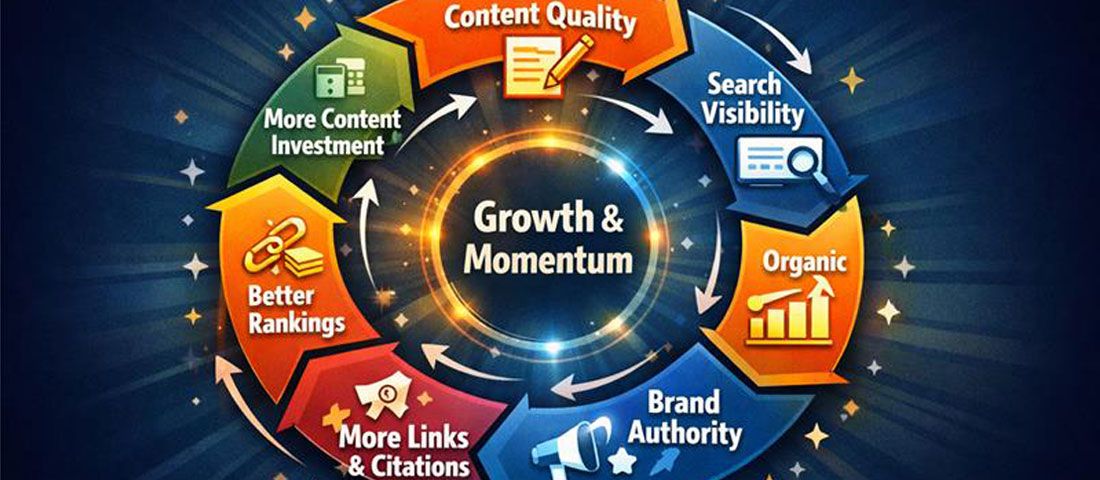
The SEO-content marketing flywheel: quality content earns rankings, rankings drive traffic, traffic builds authority, authority attracts links, links improve rankings — a compounding cycle that accelerates with each revolution.
The Content Formats That Perform Best in 2026
Not all content formats are equal in their SEO performance. Understanding which formats consistently earn rankings, citations, and engagement helps you allocate your content production investment effectively.
Comprehensive Pillar Posts and Long-Form Guides
The most consistent high-performer in terms of organic traffic, backlinks, and AI citation visibility is the comprehensive long-form guide — a single piece of content that covers a topic so thoroughly that it becomes the definitive resource. Pillar posts typically range from 3,000 to 8,000 words, cover a subject from multiple angles, answer dozens of related questions, and provide the specific, actionable information that distinguishes genuine expertise from surface coverage.
Pillar posts earn disproportionate links and citations because they provide a single destination for the complete picture on a topic — other content creators, journalists, and AI systems reference them as the authority source. Building 5 to 10 pillar posts on your most important topics is one of the highest-ROI content investments a business can make.
FAQ and Question-Answer Content
In the AI search era, FAQ content is doubly valuable: it is the most effective format for winning Google featured snippets, and it is the most directly citable format for AI Overview answers. FAQ sections on service pages and standalone FAQ posts optimised for the questions your potential customers ask — structured with FAQPage schema markup — deliver both featured snippet visibility and AI search citations.
Comparison and Best-Of Content
Comparison articles (“X vs Y”) and best-of roundups (“Best tools for X in 2026”) target commercial investigation intent — users who are evaluating options before making a decision. These are high-value content types because the searchers they attract are close to a purchase decision, and ranking well for them positions your business as a trusted authority in the evaluation process. Comparison content also earns links from the tools or services being compared, who share content that features them positively.
Original Research and Data Content
Publishing original research — surveys, data analyses, industry statistics — is one of the most effective link-building strategies available. Other content creators, journalists, and researchers cite and link to original data sources. A well-publicised research report or industry survey can generate dozens or hundreds of editorial links from high-authority sources, significantly boosting domain authority. The investment in producing original research is typically recouped many times over in earned links and brand authority.
Case Studies and Portfolio Content
Case studies — detailed accounts of how you solved a specific problem for a specific client — serve SEO by targeting commercial investigation queries, building E-E-A-T signals (demonstrating real-world experience), and providing the specific evidence that potential clients need when evaluating your capabilities. Unlike generic service descriptions, case studies provide the “show don’t tell” evidence that is most persuasive at the decision stage of the buyer journey.
Ideal Blog Post Length for SEO in 2026
The question of ideal blog post length is one of the most frequently asked in content strategy — and one of the most frequently misanswered. The honest, evidence-based answer is nuanced: there is no single ideal length for every topic, but there are clear principles that determine what length serves both readers and search performance best.
The Research Picture
Multiple large-scale studies of content performance consistently show that longer content tends to rank better for competitive queries. Semrush’s 2023 State of Content Marketing report found that long-form content (3,000+ words) receives 3x more traffic and 3.5x more backlinks than articles of average length (901 to 1,200 words). HubSpot’s research shows that posts between 2,250 and 4,500 words get the most organic traffic and inbound links.
However, longer is not universally better. Research also shows that content engagement — time on page, scroll depth, completion rate — does not automatically improve with length. Long content that is padded, repetitive, or poorly structured performs worse than shorter, tightly written content. The relationship is between comprehensive coverage of genuine value and rankings — not word count for its own sake.
Practical Length Guidance by Content Type
| Content Type | Recommended Length | Rationale |
|---|---|---|
| Pillar / comprehensive guide | 3,000–6,000 words | Covers topic comprehensively; earns links; ranks for broad and long-tail queries |
| Standard informational blog post | 1,500–2,500 words | Sufficient depth for most informational queries; manageable to produce at scale |
| Comparison / best-of content | 2,000–4,000 words | Needs depth to serve evaluation-stage readers; comprehensive comparison tables add value |
| FAQ page / question-specific content | 800–1,500 words | Question-specific; comprehensive within scope; structured for featured snippets |
| Service pages | 700–1,500 words | Clear, specific, conversion-focused; enough detail to build trust and answer questions |
| News / current events posts | 500–1,000 words | Timely; shorter format appropriate for news intent |
The Quality Principle Above All
A 4,000-word guide that genuinely covers its topic comprehensively with specific insights, examples, and actionable advice will outperform a 6,000-word guide that achieves length through repetition, padding, and restatement of obvious points. The goal is the minimum length that genuinely serves the reader’s needs — not the maximum length that can be produced without obvious padding.
How to Increase Organic Traffic Through Content Strategy
Organic traffic growth through content is achievable — but it requires a systematic approach, not random publishing. Here are the strategies with the highest impact:
-
Build topic clusters, not isolated posts
A single excellent blog post has limited SEO impact in isolation. A cluster of 6 to 10 interlinked posts covering a topic from multiple angles — with a pillar post as the hub and supporting posts covering specific subtopics — builds topical authority that lifts all posts in the cluster simultaneously. Map out clusters around your most important service areas before producing individual posts. -
Optimise existing content before creating new content
Content that already ranks in positions 4 to 15 for target keywords is much easier to move to page 1 than creating new content from scratch. Audit your existing content in Search Console, identify pages that rank but not prominently, and invest in improving those pages — adding depth, updating information, improving structure, adding schema markup. This typically delivers faster organic traffic gains than new content creation. -
Target keywords with featured snippet potential
Use Semrush or Ahrefs to identify keywords where your target queries trigger featured snippets and where the current snippet holder is not significantly more authoritative than your site. These are opportunities to win position zero — which increases CTR significantly for those queries. Optimise the relevant content with direct, concise answers immediately below the relevant heading. -
Refresh and update high-potential existing posts
Updating existing content with new information, fresh statistics, expanded sections, improved structure, and current examples signals recency to Google and often triggers ranking improvements within weeks. Prioritise posts that rank on page 2 or early page 2, that have traffic but high bounce rates (suggesting content quality issues), or that cover topics where the underlying information has changed since the post was written. -
Build internal links systematically
Internal links — links from one page on your website to another — transfer authority, help Google understand content relationships, and guide visitors to relevant related content. Systematically audit and add internal links connecting supporting posts to pillar posts, connecting service pages to relevant case studies, and connecting blog content to relevant service pages. This is one of the most underinvested technical SEO activities with reliably positive impact. -
Promote content for links and amplification
Content that does not get discovered cannot generate the links, shares, and citations that build authority. Proactively promote new content through email newsletters, social media, community engagement in industry forums and groups, journalist outreach for research-based content, and direct outreach to relevant sites that might link to or feature it. Content promotion amplifies the organic potential of every piece you produce.
Why Content Writing Quality Matters — For SEO and For Business
The temptation to cut costs on content writing — through very cheap freelancers, unedited AI output, or repurposed content with minimal changes — is understandable. Content production is time-consuming and expensive when done properly. But the cost of low-quality content is significantly higher than the savings it appears to generate.
The SEO Cost of Low-Quality Content
Google’s Helpful Content System evaluates content quality at a site-wide level. A significant proportion of low-quality content on a domain creates a site-wide quality signal that suppresses rankings across all content — including the high-quality pages. One hundred thin blog posts produced cheaply can depress the rankings of your most important service pages. The SEO cost of low-quality content is not limited to those specific pages not ranking — it can damage the entire domain’s performance.
Additionally, low-quality content does not earn links, AI citations, or featured snippets — the higher-value SEO outcomes that compound over time. Low-quality content may generate minimal organic traffic for a period before being devalued in subsequent algorithm updates, but it builds no lasting asset.
The Business Cost of Low-Quality Content
Beyond SEO, content quality directly affects business reputation. Every piece of content published under your brand name communicates something about the quality of your thinking, your expertise, and your standards. Content that is generic, poorly written, factually imprecise, or obviously produced by an AI without human thought or editing tells readers — and potential clients — something about the quality of your business that cannot be unsaid.
The businesses with the strongest content marketing programmes in competitive markets are those where content quality is treated as a brand standard — not a cost to be minimised. The return on this investment, in rankings, authority, trust, and business reputation, is substantial and compounding.
Content Promotion — Amplifying Reach Beyond Organic Search
Organic search is the most valuable long-term content distribution channel, but it is not the only one. A complete content strategy distributes content through multiple channels to maximise reach and accelerate the authority-building process:
- Email newsletter: Your email list is the most direct, owned channel for content distribution. Sending a brief email highlighting new content to your subscriber list generates immediate traffic and signals engagement to Google.
- LinkedIn and social media: Sharing content summaries, key insights, and data points on LinkedIn (for B2B businesses) and relevant social platforms generates shares, profile visits, and occasionally links from readers who share the content on their own platforms.
- Industry communities and forums: Sharing relevant, genuinely helpful content in industry Slack groups, LinkedIn groups, Reddit communities, and professional forums — without spam — generates targeted traffic from highly relevant audiences.
- Content syndication: Republishing content on platforms like Medium, LinkedIn Articles, or industry publications (with canonical tags pointing to the original) extends reach without creating duplicate content issues.
- Outreach to potential linkers: Identifying websites that cover related topics and reaching out to let them know about your new piece — particularly for original research or comprehensive guides — is the most direct path to earning editorial links.
Measuring Content Marketing Performance
Content marketing performance should be measured across multiple dimensions — not just traffic, which is a leading indicator, but business outcomes, which are the lagging indicators that determine ROI:
- Organic sessions by content piece — Which posts drive the most traffic? (Google Analytics 4)
- Keyword ranking positions for target terms — Is content improving rankings for priority keywords? (Search Console, Semrush)
- Featured snippet and SERP feature wins — How much position-zero visibility is content generating? (Search Console)
- Backlinks acquired from content — Which pieces are earning editorial links? (Ahrefs, Semrush)
- Engagement metrics — Time on page, scroll depth, and return visit rates indicate content quality from the user’s perspective (GA4, Microsoft Clarity)
- Leads and enquiries from organic content — The ultimate business metric: how many of the leads generated by organic traffic can be attributed to specific content investments? (GA4 conversion tracking)
Frequently Asked Questions About SEO and Content Marketing
| What is the relationship between SEO and content marketing? | SEO and content marketing are complementary disciplines that produce their best results when integrated rather than practised separately. Content marketing produces the genuinely valuable, expert, comprehensive content that earns rankings, citations, and audience trust. SEO provides the keyword research that identifies what content to create, the technical structure that makes content discoverable, the schema markup that enables SERP features, and the link building that builds the authority that amplifies content performance. SEO without content has nothing to rank. Content without SEO has no systematic path to reach its intended audience. Together, they create a compounding flywheel: quality content earns rankings, rankings drive traffic, traffic builds authority, authority attracts links, links improve rankings. |
| How long should a blog post be for SEO in 2026? | The ideal blog post length for SEO in 2026 depends on the content type and topic, but research consistently shows that long-form content (3,000+ words) earns significantly more organic traffic and backlinks than shorter content for competitive informational queries. For comprehensive pillar posts and guides, 3,000 to 6,000 words is appropriate when the topic genuinely warrants that depth. For standard informational posts, 1,500 to 2,500 words is a strong target. The overriding principle is to use the minimum length that comprehensively covers the topic for the reader’s needs — without padding, repetition, or artificial inflation of word count. A tightly written 2,000-word post that genuinely answers every relevant question outperforms a padded 5,000-word post that reiterates the same points across multiple sections. |
| How do I increase organic website traffic through content? | The most effective methods for increasing organic traffic through content are: building topic clusters (interconnected pillar posts and supporting content on key subject areas) rather than isolated posts; optimising existing content that already ranks on page 2 for push to page 1; targeting keywords with featured snippet potential through direct, structured question-answer format; systematically adding internal links connecting related content across the site; refreshing and updating existing high-potential posts with new information and improved structure; and promoting content proactively to earn links and citations that build the authority Google rewards with rankings. Content creation alone is not sufficient — it must be paired with technical SEO optimisation, internal linking, and external promotion to reach its organic potential. |
| Why is content writing quality important for SEO? | Content writing quality is important for SEO because Google’s Helpful Content System evaluates content quality at a site-wide level — a significant proportion of low-quality content on a domain creates a quality signal that suppresses rankings across all content, including high-quality pages. Low-quality content also fails to earn the links, AI citations, and featured snippet wins that build lasting organic authority. Beyond SEO, content quality directly affects business reputation: every piece published under your brand communicates something about your expertise and standards to potential clients. The cost of low-quality content — in suppressed rankings, missed authority-building opportunities, and brand impression damage — consistently exceeds the apparent savings from cheap content production. |
| What is a content cluster and why is it important for SEO? | A content cluster is a group of interlinked pieces of content covering a topic area comprehensively — typically a comprehensive “pillar post” as the hub, supported by several more specific posts covering individual subtopics in depth. Content clusters build topical authority by demonstrating to Google that your website covers a subject area from every angle, not just superficially targeting individual keywords. This topical authority signals genuine expertise to Google’s ranking algorithm and causes the entire cluster to rank better collectively than isolated posts would rank individually. Content clusters also keep visitors engaged longer — the internal linking between related posts increases pages per session and signals to Google that users find your content genuinely useful. |
| How often should I publish new content for SEO? | Publishing frequency matters less than content quality and strategic focus. Publishing one genuinely comprehensive, well-structured, properly promoted pillar post per month delivers more SEO value than publishing four thin, quickly produced posts per week. Google does not reward publishing frequency per se — it rewards the quality, comprehensiveness, and usefulness of what is published. That said, some publishing consistency helps: a site that publishes nothing for six months signals reduced activity and freshness. A realistic, sustainable publishing cadence — whether weekly, fortnightly, or monthly — consistently maintained is better than unsustainable bursts followed by long silences. Focus the available content production budget on depth and quality over frequency. |
| What content types earn the most backlinks? | The content types that earn the most backlinks are: original research and data studies (other content creators cite primary data sources); comprehensive definitive guides that become industry references; “linkable assets” like free tools, calculators, and templates; well-designed infographics with original data; and statistic and data roundup pages that aggregate useful numbers from credible sources. Common content types that rarely earn links include: basic company news posts, thin how-to articles that rehash widely available information, purely promotional content, and content that does not offer a unique perspective or data point that other creators would want to reference. The highest-link-earning content is typically the content that is most genuinely useful as a reference — something that other writers would naturally cite to support their own arguments or inform their own readers. |

Effective content marketing starts with keyword research and intent mapping — then builds content that genuinely serves readers while maximising organic search visibility.
Want a content and SEO strategy that dominates your market in 2026?
Neel Networks provides integrated SEO and content marketing services — from keyword research and content strategy through to pillar post creation, schema optimisation, and authority building — for businesses across the USA, UK, Canada, Australia, and India.
SEO & Content Services Free Strategy Consultation WhatsApp Us