Keyword Research Beyond Rankings: Intent, Stuffing Pitfalls & Negative Keywords

Keyword research is the foundation of every effective SEO and content strategy. But in 2026, keyword research has evolved far beyond its original form — identifying words with high search volume and trying to rank for them. The businesses growing their organic traffic most effectively are those that understand keyword research as a discipline of intent mapping, content strategy, and audience understanding, not a mechanical process of finding popular words and inserting them into pages.
What this guide covers
- 1. Why Keyword Research Is About More Than Chasing Top-Ranking Keywords
- 2. Search Intent — The Most Important Dimension of Keyword Research
- 3. How to Conduct Effective Keyword Research in 2026
- 4. What Is Keyword Stuffing — And Why It Damages Your SEO
- 5. How to Use Keywords Naturally Without Over-Optimising
- 6. Negative Keywords — The Underused Tool That Improves PPC Efficiency
- 7. Building a Keyword Map for Your Website
- 8. Frequently Asked Questions About Keyword Research and Strategy
This guide covers keyword research as it should be practised in 2026 — including the critical importance of search intent, the pitfall of keyword stuffing and why it harms rather than helps, and the often-overlooked world of negative keywords for PPC. Together, these three dimensions of keyword strategy determine whether your content attracts the right audience and converts them into business outcomes — or simply generates traffic that never converts.
Why Keyword Research Is About More Than Chasing Top-Ranking Keywords
The traditional approach to keyword research went roughly like this: find a keyword with high search volume, check that the competition is not too strong, and create content targeting that keyword. Volume and competition — two numbers — drove the entire decision.
This approach misses several dimensions that determine whether a keyword actually delivers business value:
- Search intent. A keyword with 10,000 monthly searches from people researching a topic for curiosity is far less valuable to a service business than a keyword with 500 searches from people actively looking to hire. Volume without intent is noise.
- Conversion potential. Not all keywords that drive traffic to your site drive conversions. Keywords at different stages of the buyer journey have dramatically different conversion rates — and prioritising high-volume informational keywords over lower-volume transactional ones is one of the most common content strategy mistakes.
- Business relevance. Keywords that are popular in your general topic area but not specifically relevant to your services or products generate traffic that bounces without engaging. Being precise about relevance — targeting keywords that represent genuine potential customers, not just interested readers — is more valuable than maximising keyword count.
- Long-tail specificity. Short, high-volume “head” keywords are extremely competitive and often have mixed intent. Long-tail keywords — longer, more specific phrases — typically have lower search volume individually but higher conversion rates because they represent more specific intent, and collectively they often account for more traffic and conversions than head terms.
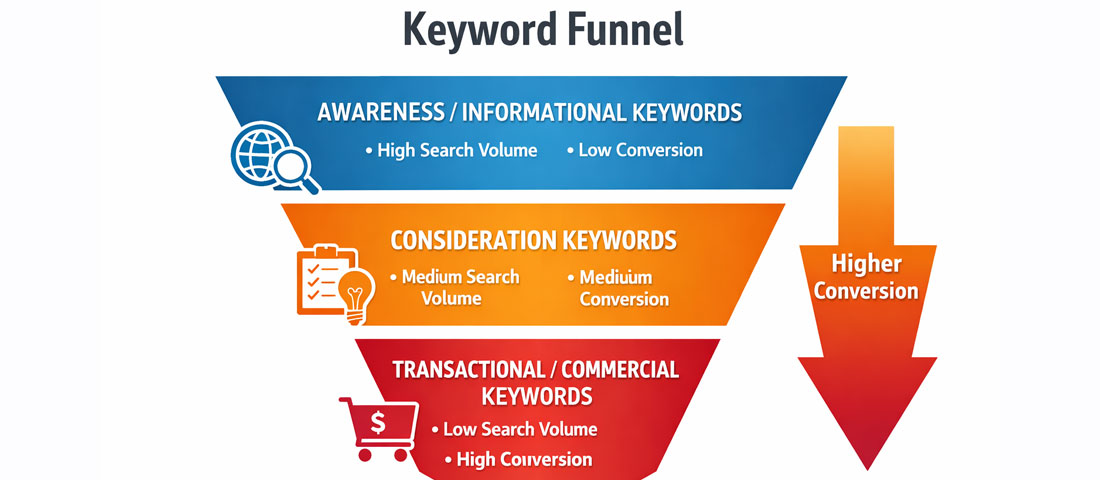
Not all keywords are equally valuable — the intent behind a search determines its conversion potential far more than its search volume alone.
Search Intent — The Most Important Dimension of Keyword Research
Search intent is the underlying goal that a user is trying to accomplish when they type a query into a search engine. Understanding intent is the single most important skill in modern keyword research — because Google has become extremely good at matching search results to intent, and content that mismatches the dominant intent for a keyword will not rank regardless of its technical quality or keyword optimisation.
The Four Types of Search Intent
Informational intent: The user wants to learn something. Queries like “what is responsive web design,” “how does Google AI Overviews work,” “what is the difference between Shopify and WooCommerce.” The user is researching, not buying. Content that serves informational intent is typically comprehensive guides, blog posts, tutorials, and explainers. Conversion rates from informational traffic are low, but informational content builds brand authority and introduces potential customers who may return later with commercial intent.
Navigational intent: The user wants to find a specific website or page. Queries like “Neel Networks contact,” “WordPress login,” “Amazon sign in.” These users know what they are looking for — they are not discovering new options. Navigational keywords are primarily relevant for brand protection (ensuring your own site ranks for your brand name).
Commercial investigation intent: The user is researching options before making a decision. Queries like “best web design agencies India,” “Shopify vs WooCommerce comparison,” “top SEO tools 2026.” These users are in the consideration phase — they know what they need but are evaluating options. Content for commercial investigation intent is comparison guides, best-of lists, reviews, and case studies. Conversion rates are moderate to high — these are warm prospects.
Transactional intent: The user wants to take an action — buy, hire, sign up. Queries like “hire web design agency India,” “Shopify developer Mumbai,” “buy WooCommerce themes.” These users are ready to act. Content for transactional intent is service pages, product pages, and landing pages with clear calls to action. Conversion rates are the highest of any intent type.
How to Identify the Intent of a Keyword
The most reliable method for identifying a keyword’s dominant intent is simple: search for it in Google and look at the top-ranking results. Google has analysed thousands of user interactions with each query and its results reflect what it has determined most users are looking for. If the top results are all comprehensive guides and blog posts, the dominant intent is informational. If they are product pages and eCommerce listings, it is transactional. If they are comparison articles, it is commercial investigation.
Creating content that matches the dominant intent of your target keywords — serving users the type of content they are actually looking for — is one of the most impactful improvements you can make to your SEO content strategy.
How to Conduct Effective Keyword Research in 2026
Step 1: Seed Keyword Generation
Start with your core services, products, and the problems you solve. For a web design agency, seeds might include: “web design,” “website development,” “Shopify store,” “WordPress website,” “website redesign.” For each seed, brainstorm the natural language variations your target customers would use — including how they describe their problems, not just the service names.
Step 2: Expand Using Research Tools
Enter your seed keywords into keyword research tools to expand the list with related terms, questions, and long-tail variations. Essential tools for this stage:
- Google Keyword Planner — Provides search volume estimates and related keywords directly from Google’s data
- Semrush Keyword Magic Tool — Generates hundreds of related keyword variations with volume, difficulty, and intent data
- Ahrefs Keywords Explorer — Provides keyword ideas, volume, and difficulty with click-through rate estimates
- Google Search Console — Shows actual queries your site already appears for, revealing related keyword opportunities you may not have considered
- Google’s “People Also Ask” and autocomplete — Both surfaces real, common question-format queries that users search for around your topic
- AnswerThePublic — Visualises the questions, prepositions, and comparisons users search around any keyword
Step 3: Evaluate and Prioritise
For each candidate keyword, evaluate four factors:
- Search volume: How many people search this per month? Higher volume means more opportunity, but also usually more competition.
- Keyword difficulty: How hard is it to rank for this term, based on the strength of current top-ranking pages? Tools like Semrush and Ahrefs provide difficulty scores.
- Search intent: Does this keyword represent the type of user (and stage in their journey) that your content or service is designed to serve?
- Business relevance: If this keyword drives traffic, is it likely to convert to an enquiry or sale? Not all relevant keywords have conversion potential.
Step 4: Map Keywords to Content
Each keyword (or tightly related cluster of keywords) should map to a specific page on your website — a service page, a blog post, a landing page. Ensure no two pages target the same primary keyword (which would create internal competition — “keyword cannibalism”), and that every key page on your site has a clearly defined target keyword cluster.
Step 5: Account for AI Search Queries
In 2026, keyword research must also account for the question-format, conversational queries that users ask AI tools and voice assistants. These are typically longer and more conversational than typed search queries: “what should I look for when hiring a web design agency in India” rather than “web design agency India.” Including these in your keyword strategy and creating FAQ-format content that directly answers them is essential for AI search visibility (AEO).
What Is Keyword Stuffing — And Why It Damages Your SEO
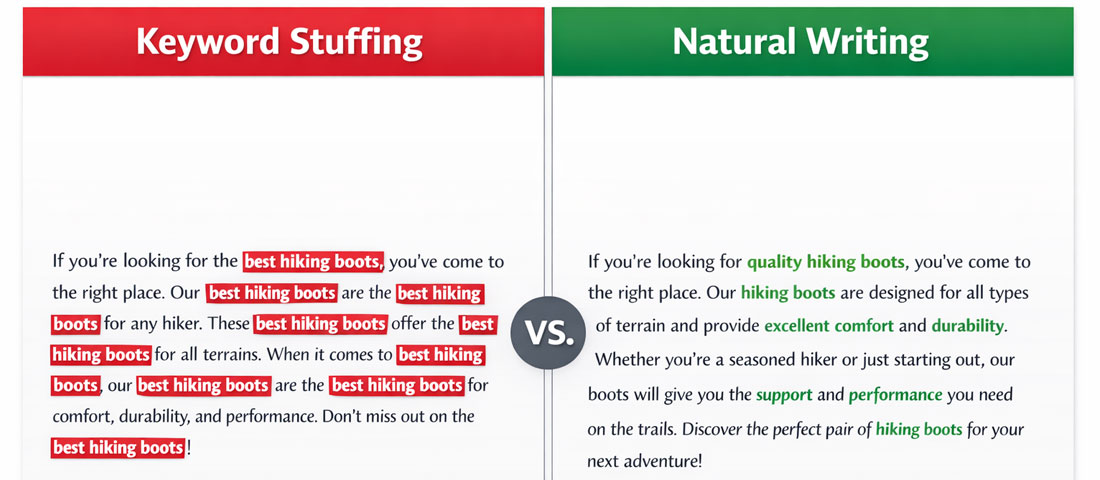
Keyword stuffing — forcing unnatural repetition of target keywords — is immediately recognisable to both readers and Google’s algorithm, and damages rather than improves search rankings.
Keyword stuffing is the practice of unnaturally repeating or forcing target keywords into website content at a density far beyond what makes sense for the reader — with the intent of manipulating search engine rankings. It is one of the oldest black-hat SEO tactics, and one that Google has been effectively penalising since the Panda algorithm update in 2011.
What Keyword Stuffing Looks Like
Keyword stuffing appears in several forms:
- Repetitive, unnatural keyword use in body copy: “Our web design services India offer the best web design services India for businesses looking for web design services India at affordable prices.” The keyword “web design services India” repeated unnaturally within a single sentence or paragraph.
- Keyword lists in footers or hidden text: Long lists of keywords (often city names, service variations, or related terms) placed in site footers, hidden behind images, or styled to be the same colour as the background — invisible to users but visible to search engine crawlers.
- Over-stuffed meta data: Titles and meta descriptions that cram multiple variations of the target keyword rather than communicating naturally to users.
- Forced keyword insertion in alt text: Image alt text like “web design web development web designer web agency web services” rather than a genuine description of the image.
How Keyword Stuffing Damages Your SEO
Keyword stuffing damages SEO in multiple ways simultaneously:
Algorithmic detection and demotion. Google’s algorithms have been specifically designed to identify keyword stuffing patterns and demote pages that engage in it. The over-repetition of keywords is a clear manipulation signal that results in ranking penalties.
Poor user experience signals. Content that is obviously keyword-stuffed reads unnaturally and reduces the time visitors spend on your page. High bounce rates and low dwell times are user quality signals that Google uses in its quality assessment — and keyword-stuffed content generates poor signals on both metrics.
Manual penalties. In extreme cases, pages with severe keyword stuffing may trigger a manual review action from Google’s quality team — resulting in penalties that can be difficult and time-consuming to recover from.
What Keyword Density Actually Should Be
There is no prescribed “ideal” keyword density that SEO professionals should target. The concept of a target keyword density percentage — a popular idea in early SEO — is not a metric that Google uses or that meaningfully predicts ranking outcomes. The right approach is to write naturally about your topic, ensure your primary keyword appears in logical places (the page title, the first paragraph, relevant subheadings, and naturally within the body copy), and focus on semantic richness — covering the topic comprehensively with related terms, synonyms, and natural language variations — rather than repeating a single keyword phrase.
How to Use Keywords Naturally Without Over-Optimising
The goal of keyword usage is communication, not manipulation. Here are the specific places where including your target keyword is natural and valuable, followed by guidance on how to write around keywords without stuffing:
Natural Keyword Placement
- Page title (H1): Your primary keyword should appear in the page’s main heading — naturally integrated, not forced. “How to Choose the Right Web Design Agency in India: 2026 Buyer’s Guide” naturally includes the keyword “web design agency India.”
- Meta title: Include the primary keyword in the meta title, ideally toward the beginning.
- First 100-150 words: Mention the primary keyword naturally in the opening paragraph — this confirms to readers and search engines what the page is about.
- Subheadings (H2/H3): Use keyword variations and related terms in subheadings where they genuinely describe the section’s content.
- Image alt text: Describe images accurately — where the image genuinely shows something related to your keyword, the alt text will naturally include it.
- URL slug: Include the primary keyword in a clean, readable URL structure.
Writing Around Keywords Naturally
The key to avoiding keyword stuffing while maintaining SEO relevance is using semantic variations and related terms rather than repeatedly using the exact same phrase. For a page targeting “web design agency India,” natural related terms include: “Indian web design company,” “web design services in India,” “website development India,” “our team,” “Mumbai-based agency,” and dozens of other natural references that communicate the same topic without keyword repetition.
Google’s natural language understanding is sophisticated enough that pages covering a topic comprehensively with natural language variations rank as effectively — or more effectively — than pages mechanically repeating an exact keyword phrase. Write for human readers first; the search engine optimisation follows from genuinely good content.
Negative Keywords — The Underused Tool That Improves PPC Efficiency
While the previous sections have focused on organic SEO keyword strategy, there is a parallel and often underused keyword concept that is critical for paid search (PPC) efficiency: negative keywords.
What Are Negative Keywords?
A negative keyword is a word or phrase that you add to a Google Ads campaign to prevent your ads from showing for searches that include that term. When you add “free” as a negative keyword to your campaign, your ads will not show to anyone searching for “free web design” — a query that is unlikely to convert into a paid client.
Negative keywords are, in a very real sense, the discount coupon that most PPC advertisers leave unclaimed. Every search query that triggers your ad but is not relevant to your business costs you money without generating business value. Systematic negative keyword management reduces wasted spend, improves your campaign’s click-through rate, and improves your Quality Score — which in turn reduces the cost per click for the queries that do matter.
Why Negative Keywords Are Critical for PPC Performance
Without negative keywords, a Google Ads campaign for “web design” might show ads for: “free web design templates,” “web design courses,” “web design jobs,” “web design software,” and dozens of other queries that have nothing to do with hiring a web design agency. Every click from these searches costs the same as a click from a genuine prospect — but has essentially zero conversion probability.
Research consistently shows that optimised negative keyword lists reduce wasted PPC spend by 10 to 30% for typical service business campaigns — representing a direct improvement in campaign ROI without increasing budget.
Common Negative Keyword Categories for Service Businesses
- Free / DIY intent: “free,” “DIY,” “do it yourself,” “free template,” “free tool,” “how to make”
- Learning intent: “course,” “tutorial,” “learn,” “training,” “certification,” “degree,” “school”
- Employment intent: “jobs,” “career,” “salary,” “freelance,” “hire me,” “vacancy”
- Competitor research: Specific competitor names if you do not want to pay for competitive impression share
- Irrelevant product/service variations: Services adjacent to yours that you do not offer (if you do web design but not logo design, “logo design” is a negative)
- Location exclusions: Specific locations outside your service area
How to Build a Negative Keyword List
-
Review your Search Terms report
In Google Ads, navigate to Keywords → Search Terms. This report shows the actual queries that triggered your ads. Review it weekly, identify irrelevant queries, and add those terms (or the pattern they represent) as negative keywords. This is the most direct source of negative keyword opportunities because it shows real queries from your actual traffic. -
Use keyword research tools proactively
Before launching a campaign, use Semrush or Google Keyword Planner to generate a large keyword universe around your target terms. Review the full list and proactively add obviously irrelevant terms as negatives — before wasting money on those queries. -
Add negatives at the appropriate level
In Google Ads, negatives can be added at the campaign level (applying to all ad groups within the campaign) or ad group level (applying only to a specific ad group). Campaign-level negatives for broadly irrelevant terms (like “free” and “jobs”) are efficient. Ad group-level negatives for terms irrelevant to a specific ad group but potentially relevant elsewhere in the campaign provide more precise control. -
Use a shared negative keyword list
Google Ads allows you to create shared negative keyword lists that can be applied to multiple campaigns simultaneously. Create a master “irrelevant intent” negative list that applies across all your campaigns — saving the time of adding the same negatives repeatedly to each new campaign.
Building a Keyword Map for Your Website
A keyword map assigns specific target keywords to specific pages on your website — ensuring every important page has a clear SEO purpose and that no two pages compete for the same terms. Here is how to create one:
| Page | Primary Keyword | Secondary Keywords | Intent | Content Type |
|---|---|---|---|---|
| Homepage | web design company India | web design agency Mumbai, Indian web designers | Navigational / Commercial | Brand overview + services summary |
| WordPress Service Page | WordPress website design India | WordPress development India, WordPress agency | Transactional | Service page with CTA |
| Shopify Service Page | Shopify website design India | Shopify development India, Shopify agency UK | Transactional | Service page with CTA |
| Blog: Agency vs Freelancer | web design agency vs freelancer | hire web designer, web design company or freelancer | Commercial investigation | Comparison blog post |
| Blog: Website Cost Guide | website design cost India | how much does a website cost, web design pricing | Informational / Commercial | Guide with pricing context |
Keyword cannibalism warning: When two or more pages on your website target the same primary keyword, they compete with each other in Google’s index — potentially causing both to rank lower than either would if only one page targeted that term. A keyword map prevents this by ensuring each target keyword is assigned to exactly one page. If you find existing cannibalism on your site, consolidate the competing pages or clearly differentiate their keyword targets.
Frequently Asked Questions About Keyword Research and Strategy
| What is search intent in keyword research? | Search intent is the underlying goal that a user is trying to accomplish when they search for a particular query. The four main types are: informational (wanting to learn something — “what is responsive web design”), navigational (wanting to find a specific website — “WordPress login”), commercial investigation (researching options before deciding — “best web design agencies India”), and transactional (ready to take an action — “hire web design agency”). Matching your content to the dominant intent of your target keywords is one of the most impactful improvements you can make to your SEO strategy — because Google ranks content that best serves the actual intent behind each query. |
| What is keyword stuffing and how does it affect SEO? | Keyword stuffing is the practice of unnaturally repeating or forcing target keywords into content at a density far beyond what makes sense for the reader, with the intent of manipulating search rankings. It damages SEO in several ways: Google’s algorithms actively detect and penalise keyword stuffing patterns; keyword-stuffed content creates poor user experience signals (high bounce rates, low dwell time) that negatively affect quality assessment; and in severe cases, it triggers manual penalties from Google’s quality team. The right approach is to write naturally for human readers, include target keywords in logical places (page title, opening paragraph, relevant subheadings), and use semantic variations and related terms rather than mechanically repeating the same exact phrase. |
| What are negative keywords and why do they matter for PPC? | Negative keywords are terms added to a Google Ads campaign to prevent your ads from showing for irrelevant searches that include those terms. For example, adding “free” as a negative keyword to a web design services campaign prevents ads from showing to people searching for “free web design templates” — a query unlikely to convert. Negative keywords matter because every click from an irrelevant search costs the same as a click from a genuine prospect but has near-zero conversion probability. Systematic negative keyword management typically reduces wasted spend by 10 to 30% for service business PPC campaigns, directly improving return on ad spend without increasing budget. |
| How do I find the right keywords for my business? | Effective keyword research for a business follows a systematic process: start with seed keywords representing your core services and the problems you solve; expand these using keyword research tools (Semrush, Ahrefs, Google Keyword Planner) to find related terms, questions, and long-tail variations; evaluate each candidate keyword on search volume, keyword difficulty, search intent, and business relevance; assign keywords to specific pages through a keyword map ensuring no two pages compete for the same terms; and include question-format conversational keywords for AI search and voice search visibility. The most valuable keywords are often not the highest-volume ones but those that combine moderate search volume with clear commercial or transactional intent and specific business relevance. |
| What is keyword density and what percentage should I target? | Keyword density is the percentage of times a keyword appears in a piece of content relative to the total word count. There is no target keyword density percentage that SEO professionals should aim for — the concept of a specific ideal density (sometimes cited as 1% to 2%) is not a metric Google uses or that meaningfully predicts ranking outcomes. The right approach is to write naturally about your topic, ensuring your primary keyword appears in logical, natural places (the title, the opening paragraph, relevant subheadings, and naturally within the body copy), while using semantic variations and related terms throughout. Writing naturally for human readers produces better content and better rankings than mechanically targeting a keyword density number. |
| What is long-tail keyword research and why is it important? | Long-tail keywords are longer, more specific search phrases that typically have lower individual search volumes but higher conversion rates than shorter, more general “head” terms. For example, “web design” is a head keyword; “custom web design for physiotherapy practices London” is a long-tail keyword. Long-tail keywords are important because they represent more specific intent (the searcher knows exactly what they want), are less competitive than head terms (easier to rank for, particularly for newer or smaller websites), and often have higher conversion rates because of that specificity. Collectively, long-tail keywords typically account for 70% or more of all search queries, and a comprehensive long-tail keyword strategy often delivers more organic traffic and conversions than competing for a small number of high-volume head terms. |
| What is keyword cannibalism and how do I fix it? | Keyword cannibalism occurs when two or more pages on the same website target the same primary keyword, causing them to compete with each other in Google’s index. When Google encounters multiple pages targeting the same term, it may rank neither as strongly as it would rank a single, clearly designated page for that keyword — or it may switch between which page it ranks, causing inconsistent performance. To fix keyword cannibalism: identify competing pages using Semrush’s Cannibalization Report or by searching “site:yourdomain.com [keyword]” in Google; then either consolidate the competing pages into a single comprehensive page (with 301 redirects from the removed pages), clearly differentiate their keyword targets so each page has a unique primary focus, or identify which page should be the primary target and internally link to it from the other pages to signal its priority. |
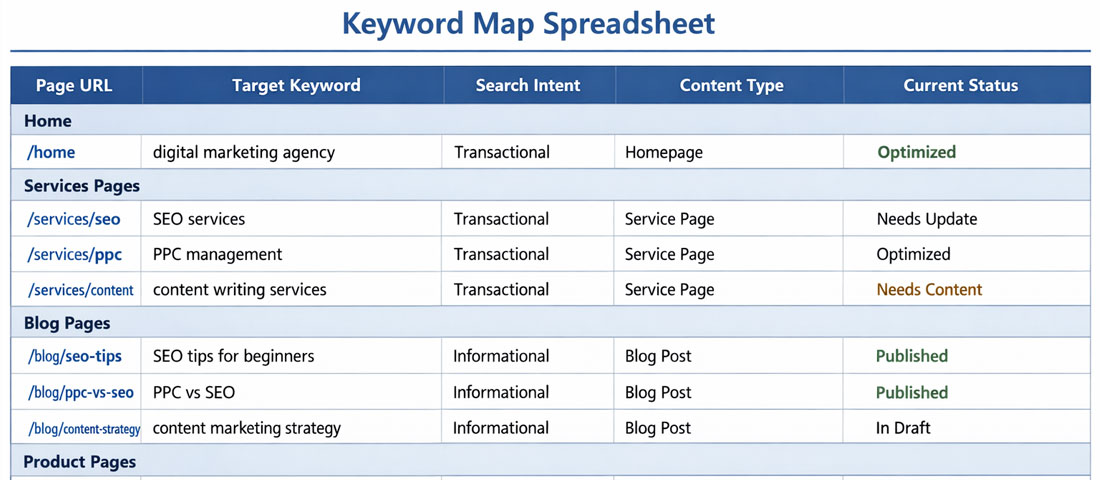
A keyword map assigns a specific target keyword cluster to every important page on your website — preventing internal competition and ensuring your SEO strategy is coherent and comprehensive.
Want expert keyword research and content strategy for your business?
Neel Networks provides comprehensive keyword research, intent mapping, and content strategy as part of our SEO services — building the keyword foundations that drive organic traffic growth for businesses across the USA, UK, Canada, and Australia.