Web Design Agency vs Freelancer: Which Is Better for Your Business in 2026?
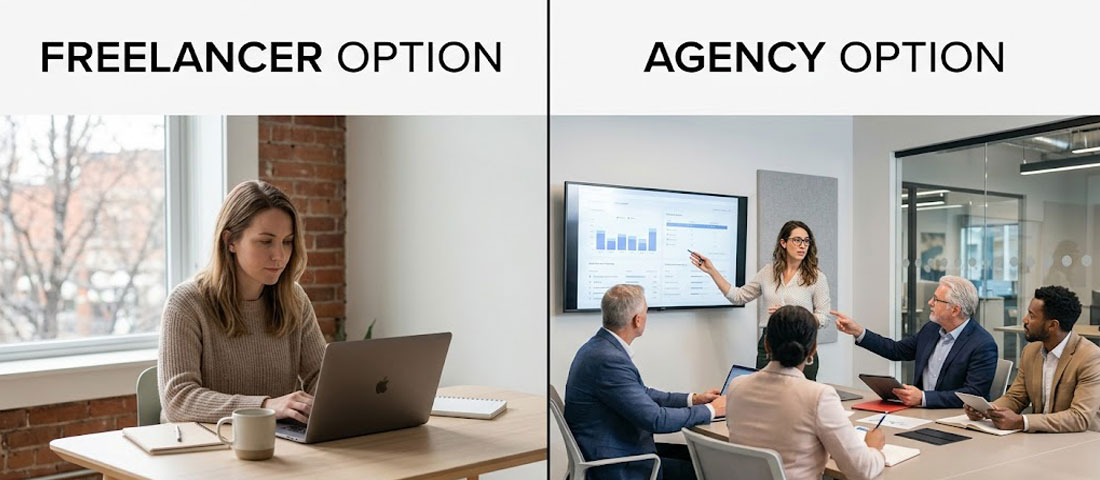
It is one of the most common decisions a business faces when investing in a new website or digital project: do you hire a web design agency, or do you work with a freelancer? Both options can produce excellent results. Both can also produce disappointing ones. The difference is almost never about which category is inherently better — it is about which is the right fit for your specific project, your specific budget, your specific timeline, and your specific long-term needs.
What this guide covers
- 1. The Core Question: What Does Your Project Actually Need?
- 2. The Genuine Advantages of Working With a Web Design Agency
- 3. The Genuine Advantages of Working With a Freelancer
- 4. Honest Limitations of Both
- 5. Specific Business Contexts Where Each Option Excels
- 6. How to Select the Right Web Design Agency for a Conversion-Focused Redesign
- 7. Practical Questions to Ask and Red Flags to Watch For
- 8. Agency vs Freelancer vs In-House: The Complete Comparison
- 9. The India Dimension: Agency vs Freelancer for International Clients
- 10. Frequently Asked Questions: Agency vs Freelancer for Web Design
- 11. Conclusion: Match the Partner to the Project
This guide gives you the complete picture. We will walk through the genuine advantages and real limitations of both agencies and freelancers, the specific business contexts where each consistently performs better, the questions you should ask before committing to either, the red flags to watch for, and — for businesses considering an Indian web design partner — how the agency vs freelancer question plays out in that specific context.
The Core Question: What Does Your Project Actually Need?
Before comparing agencies and freelancers, it is worth reframing the question. Most businesses approach this decision by asking “which option is better?” — but the more useful question is “what does my specific project require, and which option is best equipped to deliver it?”
A small, focused project — refreshing the copy on an existing website, building a simple landing page, creating a few custom illustrations — may be perfectly well-served by a skilled freelancer, and commissioning an agency to do it would be paying for overhead you do not need. A complex, multi-disciplinary project — redesigning a full business website with strategic UX, custom development, SEO migration, copywriting, and ongoing maintenance — requires the breadth of skill, structured project management, and quality assurance that a well-run agency provides and that most individual freelancers cannot replicate alone.
The quality of the outcome depends less on whether you chose an agency or a freelancer and more on whether you chose the right fit for your requirements — and whether you vetted that fit carefully before committing.
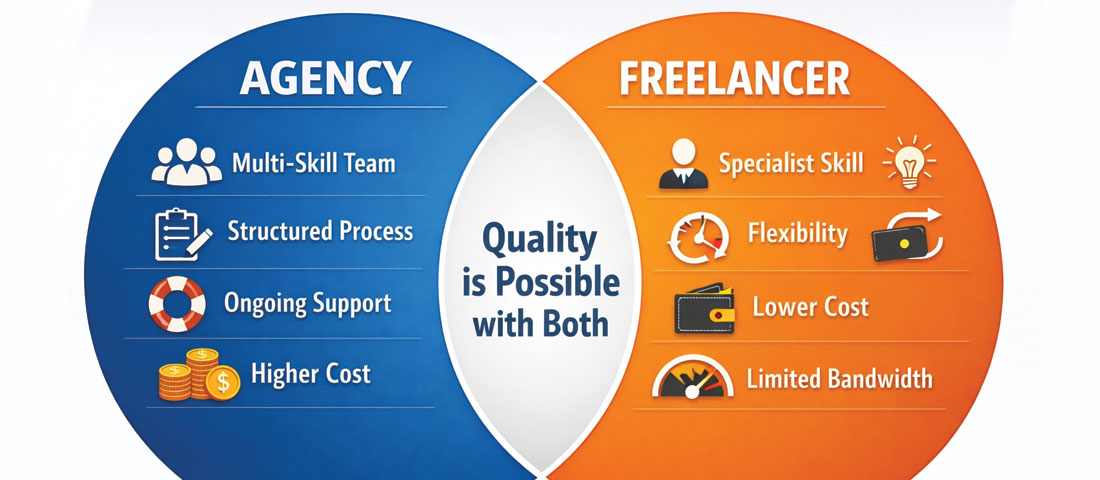
The right choice between an agency and a freelancer depends on the scope, complexity, and ongoing needs of your specific project — not on which option is inherently superior.
The Genuine Advantages of Working With a Web Design Agency
Multi-Disciplinary Team Under One Roof
A quality web design agency brings together a team of specialists — designers, developers, SEO professionals, copywriters, project managers, and account managers — who work together on your project. This matters because a great website is not the output of a single skill: it requires visual design expertise, front-end and back-end development capability, content strategy and copywriting, search engine optimisation, UX thinking, and project coordination. When all of these skills exist in a single team with established working relationships, the output is more coherent and the process is more efficient than when you are managing multiple individual specialists independently.
Structured Project Management and Accountability
Agencies have processes — discovery phases, design reviews, development milestones, testing protocols, and launch procedures — that are refined through hundreds of projects. These processes exist because the problems they solve (scope creep, missed requirements, inadequate testing, rushed launches) are real and recurring. A freelancer working alone may have excellent personal organisation, but they typically cannot replicate the structured accountability framework of a team-based agency where multiple people are reviewing work, checking deliverables against requirements, and ensuring quality at each stage.
Continuity and Long-Term Partnership
Agencies exist as businesses — they have a commercial interest in maintaining long-term client relationships and a support structure that allows them to service clients over years rather than just for the duration of a single project. If your account manager leaves, another team member knows your account. If a developer is unavailable, another developer can pick up the work. This continuity is commercially valuable: the agency accumulates institutional knowledge about your business, your website, your brand, and your preferences that makes each subsequent engagement more efficient.
Quality Assurance and Peer Review
In a well-run agency, work is reviewed by multiple people before it reaches the client. A designer’s mockup is reviewed by a senior designer. A developer’s code is reviewed by a lead developer. An SEO recommendation is validated against current best practice. This internal quality assurance process catches problems before they become client problems — and it is one of the most significant practical advantages of an agency over a sole-operating freelancer, where the same person who produces the work also reviews it.
Scalability to Project Scope
When a project grows in scope or requires additional skill sets — when a website project that started as a redesign evolves to include a mobile app, or when a branding project expands to require video production — an agency can typically absorb that growth within the same team, or by bringing in trusted specialist partners within an established workflow. A freelancer, by definition, is limited to their individual capacity and skill set.
The Genuine Advantages of Working With a Freelancer
Specialist Expertise Without Agency Overhead
The best freelancers in specific disciplines — a senior WordPress developer, an experienced brand designer, a specialist eCommerce UX designer — often have deeper expertise in their specific area than any individual within a generalist agency. When your project requires a specific, well-defined skill set, a highly specialised freelancer can deliver excellent results without the overhead cost of an agency’s support structure, account management layer, and operating expenses.
Lower Cost for Defined, Scoped Work
Freelancer pricing is typically lower than agency pricing for equivalent output — because freelancers have lower overhead, do not pay for an account management layer, and often operate from home or low-cost environments. For well-scoped, single-discipline projects where the work is clear and the brief is tight, a skilled freelancer can deliver excellent value for money. The cost advantage is most pronounced for smaller, focused projects and less pronounced for complex, multi-disciplinary work where the coordination overhead of managing multiple freelancers erodes the apparent savings.
Direct Communication With the Person Doing the Work
When you work with a freelancer, you are communicating directly with the person actually designing or developing your website. There is no account manager layer, no internal briefing process, no chance that your instructions are interpreted and re-communicated imperfectly. For clients who prefer direct, close collaboration with the person producing the work, this directness is a genuine advantage that some agency models cannot replicate.
Flexibility and Availability
Freelancers are typically more flexible than agencies on scope, process, and timing — particularly for clients whose needs are non-standard or whose projects do not fit neatly into an agency’s established workflow. A freelancer might be willing to work with a more iterative, less structured brief, to start on short notice, or to accommodate an unusual project structure that an agency’s processes do not easily handle.
Honest Limitations of Both
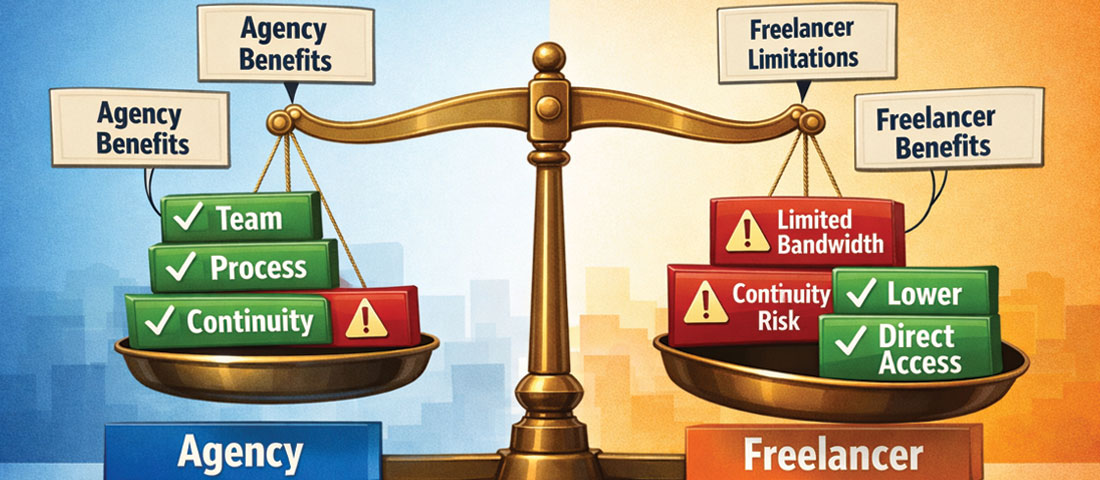
Both agencies and freelancers come with genuine trade-offs. Understanding these honestly is the foundation of making the right choice for your project.
Limitations of Web Design Agencies
- Higher cost. Agency overhead — office space, management layer, support staff, business development — is built into their pricing. For small, well-defined projects, this overhead cost can make agency pricing disproportionate to the scope of the work.
- Risk of being a small fish. At larger agencies, small clients may find themselves deprioritised in favour of larger accounts. The senior designer who impressed you in the pitch may hand your project to a junior team member once it is won. Always ask specifically who will work on your project and at what seniority level.
- Less flexibility on process. Agencies with well-established processes are efficient partly because they do not deviate significantly from those processes. Clients with unusual working styles, non-standard requirements, or iterative rather than milestone-based development preferences may find agency processes constraining.
- Communication layers. In some agency models, the client communicates with an account manager who then briefs the creative or development team. This layer can slow communication and introduce interpretation errors, particularly for nuanced creative or technical requirements.
Limitations of Freelancers
- Single point of failure. A freelancer who becomes ill, takes on another large project, goes on holiday, or decides to change their career leaves you without recourse. For projects with tight deadlines or ongoing maintenance requirements, dependency on a single individual is a genuine business risk.
- Limited skill breadth. Most excellent freelancers are specialists — they are excellent at one or two disciplines and adequate or unavailable for others. A freelance designer typically cannot also provide expert-level SEO, development, copywriting, and project management. Managing multiple freelance specialists independently requires significant client-side coordination effort.
- Variable professionalism. The freelance market is wide — from highly experienced senior professionals taking select projects, to inexperienced newcomers building portfolios, to part-time practitioners with limited availability and accountability. Without careful vetting, the quality variance within the freelancer market is significantly higher than within a professional agency market.
- Continuity challenges. When a freelancer finishes a project and moves on, their institutional knowledge of your website, your business, and your preferences goes with them. The next time you need work done, you may be starting from scratch with a new freelancer who does not know your history.
Specific Business Contexts Where Each Option Excels
| Business Context | Better Choice | Why |
|---|---|---|
| Full website redesign with SEO migration | Agency | Requires design, development, SEO, copywriting, and project management working in concert |
| Single-discipline task (logo design only, one page only) | Freelancer | Specialist freelancer delivers excellent focused output without agency overhead cost |
| Ongoing website maintenance and updates | Agency | Continuity, reliable availability, and multiple team members reducing single-point-of-failure risk |
| Custom web application development | Agency | Complex projects need full-stack team, QA process, and project management |
| Budget-constrained startup needing basic web presence | Freelancer | Lower cost for defined scope; can upgrade to agency partnership as business grows |
| Conversion-focused redesign with clear commercial goals | Agency | Needs UX strategy, design execution, development, SEO, and analytics setup in an integrated process |
| Highly specialised niche requirement | Specialist freelancer | A world-class specialist freelancer in a niche may have deeper expertise than any generalist agency |
| Internationalised website serving multiple markets | Agency | Multi-language, multi-market projects need structured process and multi-skill delivery |
How to Select the Right Web Design Agency for a Conversion-Focused Redesign
If your project is a significant website redesign with clear commercial objectives — improving lead generation, improving search rankings, improving mobile conversion rates — selecting the right agency is one of the most consequential decisions in the project. Here is a rigorous selection framework:
Step 1: Evaluate the Portfolio With Commercial Thinking
Most agencies show their best-looking work in their portfolio. The more useful questions to ask about portfolio examples are: what were the business objectives? What results were achieved? Can I see before-and-after analytics? A beautiful design that did not improve conversion rates or search performance is a less impressive portfolio piece than a technically competent website that demonstrably grew its client’s business. Ask specifically about measurable business outcomes, not just aesthetic quality.
Step 2: Understand the Process in Detail
Ask the agency to walk you through their process from brief to launch. A well-run agency should be able to describe clearly: how they conduct discovery and requirements gathering, how design decisions are made and validated, how development quality is assured, how SEO is integrated (not bolted on afterward), how the handover and training process works, and what post-launch support looks like. Vague answers to these questions are a warning signal.
Step 3: Establish Who Specifically Will Work on Your Project
This is one of the most important questions and one of the most commonly glossed over in agency pitches. Ask: who will be the project manager for my project? Who will be the lead designer? Who will be the lead developer? What is their experience level? Will the same people who are pitching to me be doing the work, or will my project be handed to a different team? Get answers in writing if the project is significant.
Step 4: Check References From Comparable Projects
Ask for references specifically from clients whose projects were similar to yours in scope, industry, and business objective. A reference from a client who commissioned a simple five-page brochure website is limited evidence of an agency’s capability to deliver a complex eCommerce redesign. Speak directly to the references rather than accepting written testimonials — you will learn significantly more from a ten-minute phone conversation than from a carefully selected quote.
Step 5: Evaluate Communication Style and Cultural Fit
A website redesign project is a close working relationship that typically spans several months. The quality of communication, the responsiveness of the team, the ability to give and receive feedback constructively, and the sense of mutual respect and shared purpose all significantly affect the quality of the outcome. Cultural fit — whether you like and trust the people you will be working with — is a legitimate and important selection criterion, not a soft and irrelevant one.
Step 6: Scrutinise the Proposal for Scope Clarity
Before signing, ensure the proposal is explicit about exactly what is and is not included. Common sources of scope ambiguity that lead to disputes and unexpected costs: the number of design revisions included; who is responsible for providing copy and images; whether SEO setup, schema markup, and analytics configuration are included or quoted separately; what post-launch support is included and for how long; and what the process is for scope changes during the project.
Practical Questions to Ask and Red Flags to Watch For
Questions to Ask Any Agency or Freelancer
- Can you show me two or three examples of work that are most similar to what I am asking you to build?
- Who specifically will work on my project and what is their experience level?
- What does your process look like from kickoff to launch? How long does each phase typically take?
- How do you handle SEO during a redesign — specifically, how do you manage URL changes and redirect mapping?
- What happens if there are cost overruns, and what is your process for managing scope changes?
- What does post-launch support look like — what is included, what costs extra, and how quickly do you respond?
- Can I speak to two or three current clients?
Red Flags in Agency Pitches
- Vague or no process description. An agency that cannot explain its process clearly has not refined one through enough projects — or is hiding one that clients would not find reassuring.
- No questions about your business in the initial meeting. An agency that pitches without asking about your business objectives, your target audience, your current performance, and your success metrics is designing for aesthetics rather than commercial outcomes.
- Portfolio with no results data. Beautiful screenshots with no mention of business outcomes suggest the agency is proud of how things look but not accountable for how they perform.
- Unusually low pricing that seems too good. Very low agency pricing typically means: outsourcing to lower-quality third parties, inexperienced team members, or scope that is much narrower than you expect. Ask exactly what is included.
- Reluctance to provide client references. A confident, established agency with satisfied clients should be glad to provide references. Reluctance suggests either a short track record or clients who would not give positive assessments.
- Promises of specific search rankings. No agency can guarantee specific Google rankings — the algorithm is not theirs to control. Agencies that promise “top 3 in 30 days” are either misrepresenting what SEO can deliver or planning to use tactics that will ultimately harm your website.
Red Flags Specific to Freelancers
- No contract or written agreement. Any professional freelancer should be willing to provide a written agreement covering scope, deliverables, timeline, and payment terms. Reluctance to commit to a contract is a significant warning signal.
- No established process for client feedback and revisions. Unclear processes for how feedback is given, how many revisions are included, and how disputes are resolved create significant problems mid-project.
- Unavailability for calls or slow response to messages before the project starts. Communication patterns before a project starts are predictive of communication patterns during it. A freelancer who is hard to reach when you are a prospective client will be harder to reach when you are a current one.
- No portfolio work comparable to your brief. Portfolio evidence is the most reliable predictor of capability. A freelancer without portfolio examples similar to what you need is asking you to take a significant risk.
Agency vs Freelancer vs In-House: The Complete Comparison
| Factor | Web Design Agency | Freelancer | In-House Team |
|---|---|---|---|
| Cost structure | Project fees; ongoing retainer | Project fees; day rates | Salaries + benefits + equipment |
| Skill breadth | ✅ Multi-disciplinary team | ⚠️ Limited to individual skills | ⚠️ Limited to hires made |
| Process structure | ✅ Established, refined | ⚠️ Variable | ✅ Can be defined internally |
| Business continuity | ✅ Team-based, resilient | ❌ Single point of failure | ⚠️ Dependent on staff retention |
| Knowledge of your business | ⚠️ Builds over time | ⚠️ Resets with each freelancer | ✅ Deepest over time |
| Scalability | ✅ Can absorb scope growth | ❌ Limited by individual capacity | ⚠️ Limited without hiring |
| Best for | Most business web projects | Focused, single-discipline tasks | High-volume, ongoing digital work |
The India Dimension: Agency vs Freelancer for International Clients

The growth of professional Indian web design agencies has created a new option for international clients: agency-quality process and team structure at significantly lower cost than comparable Western agencies.
For businesses in the USA, UK, Canada, and Australia considering outsourcing their web project to India, the agency vs freelancer question has an additional dimension worth addressing directly.
India has a large and diverse web development market — ranging from highly professional agencies with structured processes, experienced teams, and strong international track records, to individual freelancers and low-quality outsourcing operations that compete primarily on price. The quality variance in the Indian market is wider than in Western markets, which makes vetting more important, not less.
For international clients outsourcing to India, a professional Indian agency offers significant advantages over an Indian freelancer for any project of meaningful scope:
- Structured communication. Language and time-zone challenges are real in international outsourcing relationships. A professional agency has established processes for client communication, regular status updates, and structured feedback cycles that reduce the friction of cross-cultural and cross-timezone collaboration. A solo freelancer may struggle to maintain the communication frequency and structure that an international client expects.
- Accountable business entity. An agency is a registered business with commercial incentives to maintain its reputation and client relationships. A freelancer’s accountability is more personal and therefore more variable. For significant projects, commissioning an established agency provides a more robust accountability structure.
- Team coverage across time zones. An Indian agency with multiple team members can provide more responsive support to international clients than a solo freelancer who is offline during their personal hours — which may coincide with peak business hours for clients in the USA or UK.
- Full-stack capability. International web projects typically require design, development, SEO, and content strategy working together. A professional Indian agency can deliver this multi-disciplinary capability in one engagement. Achieving the same breadth of service from Indian freelancers requires assembling and managing multiple individuals, with all the coordination overhead that entails.
Frequently Asked Questions: Agency vs Freelancer for Web Design
| Is a web design agency or freelancer better for a business website? | Neither is universally better — the right choice depends on the scope, complexity, and ongoing needs of your specific project. For complex, multi-disciplinary projects like a full website redesign with SEO migration, a web design agency is typically the better choice because it brings together the team, structured process, and quality assurance that the project requires. For focused, single-discipline tasks — a logo, a landing page, a specific development task — a skilled specialist freelancer can deliver excellent results without the overhead cost of an agency. The most important factor is matching the scope and requirements of your project to the capacity and capability of your chosen partner. |
| What are the main advantages of hiring a web design agency? | The main advantages of hiring a web design agency include: a multi-disciplinary team with design, development, SEO, and project management expertise working together; a structured, refined project process built on experience across many similar projects; internal quality assurance where work is reviewed by multiple people before reaching the client; business continuity — if one team member is unavailable, others can cover; scalability to absorb project growth; and long-term partnership that accumulates institutional knowledge of your business over time. These advantages are most commercially significant for complex, multi-disciplinary projects with clear business objectives. |
| What are the main advantages of hiring a freelancer for web design? | The main advantages of hiring a freelancer include: specialist expertise in a specific discipline that may exceed what any individual within a generalist agency can offer; lower cost for well-scoped, single-discipline work where agency overhead is not justified; direct communication with the person actually doing the work, without account management layers; and greater flexibility on process, timeline, and project structure for clients with non-standard working preferences. These advantages are most pronounced for focused, clearly defined projects where a specific skill set is needed and the coordination complexity of multi-disciplinary work is absent. |
| How do I choose between a web design agency and a freelancer? | Start by honestly assessing what your project requires: How many disciplines does it require (design, development, SEO, copywriting)? How complex is the project? Do you need ongoing support after launch? How important is business continuity? If the project requires multiple disciplines working in concert, needs a structured process, requires ongoing post-launch support, or is commercially significant enough that business continuity matters — an agency is the right choice. If the project is focused and single-discipline, the brief is tight and well-defined, and you are confident in your ability to vet individual specialists — a freelancer can be excellent value. In either case, careful vetting through portfolio review, reference checks, and detailed process evaluation is non-negotiable. |
| What questions should I ask a web design agency before hiring them? | The most important questions to ask a web design agency before hiring include: Who specifically will work on my project and at what seniority level? Can you walk me through your process from brief to launch? Can I see examples of work similar to my project? Can I speak to references from comparable projects? How do you handle SEO during a redesign — specifically redirect mapping and meta data migration? What exactly is and is not included in your quote? What does post-launch support look like? How do you handle scope changes? Getting clear, specific answers to these questions — and comparing the quality of answers across agencies you are considering — is the most reliable way to identify the right partner. |
| Is it safe to hire an Indian web design agency? | Yes — hiring a reputable Indian web design agency is safe and is how thousands of businesses in the USA, UK, Canada, and Australia successfully build and maintain high-quality websites at significantly lower cost than comparable Western agencies. The key is due diligence: review the portfolio carefully for work comparable to your project, speak directly to reference clients, ensure the contract specifies deliverables and timelines clearly, and choose an agency with a documented track record of serving international clients. India’s web design market includes excellent professional agencies and lower-quality operations — thorough vetting separates them reliably. |
| How much cheaper is a freelancer compared to a web design agency? | For equivalent single-discipline work, a freelancer is typically 20 to 50% less expensive than an agency because the agency’s overhead (management layer, support staff, business development costs, office space) is built into their pricing. However, this comparison is less straightforward for multi-disciplinary projects: when multiple freelancers are assembled to cover different skill sets (designer, developer, SEO specialist, copywriter), the total cost often approaches agency pricing — while adding significant client-side coordination effort and introducing the single-point-of-failure risks of each individual freelancer. The true cost comparison for complex projects must account for project management time, coordination overhead, and the risk of specialist unavailability. |
Conclusion: Match the Partner to the Project

The agency vs freelancer debate does not have a universal answer — and any source that tells you definitively that one is always better than the other is oversimplifying a decision that deserves nuance. The right answer is the one that correctly matches the complexity, scope, ongoing needs, and commercial significance of your project with a partner who has the capability, the process, and the track record to deliver it.
For most businesses commissioning a significant website redesign or custom web development project — particularly businesses where the website is a primary growth driver — a professional web design agency, properly vetted, delivers better outcomes than a freelancer arrangement. The structured process, multi-disciplinary team, quality assurance, and long-term partnership of a well-run agency are genuinely worth their cost premium for projects of this complexity and importance.
For focused, single-discipline tasks with a tight brief and a clear deliverable, a skilled specialist freelancer is often excellent value. The key is honest assessment of what your project needs — and rigorous vetting of whoever you choose to trust with it.
Want to see what a professional agency partnership looks like in practice?
Talk to the Neel Networks team about your project. With 12+ years of experience, 450+ international clients, and a full-stack team covering design, development, SEO, and support, we are the agency partner that growing businesses across the USA, UK, Canada, and Australia choose when they want quality without compromise.