Custom Web Application Development: Benefits, Use Cases & Business ROI

There comes a point in almost every growing business’s digital journey where off-the-shelf software stops being enough. The CRM does not quite fit how your sales team works. The booking system cannot accommodate your specific service structure. The client portal you need does not exist as a ready-made product. The internal workflow tool you envision would need so many customisations of an existing platform that you would essentially be fighting the software rather than using it.
What this guide covers
- 1. What Is a Custom Web Application?
- 2. Custom Web App vs Custom Website: The Important Distinction
- 3. 7 Key Benefits of Custom Web Application Development
- 4. The Most Valuable Business Use Cases for Custom Web Applications in 2026
- 5. Custom Animations and Interactions: When They Add Real Value
- 6. Custom vs Template: When to Choose Each
- 7. How to Plan a Custom Web Development Project for Maximum ROI
- 8. Why Businesses Choose Neel Networks for Custom Web Application Development
- 9. Frequently Asked Questions About Custom Web Application Development
- 10. Conclusion: Custom Development Is an Investment in How Your Business Operates
This is the moment when custom web application development enters the conversation — and it is a conversation worth having carefully, because custom development is a significant investment that delivers outsized returns when applied to the right problems and creates expensive complexity when applied to the wrong ones.
This guide covers everything a business owner or decision-maker needs to understand about custom web applications in 2026: what they are, when they are the right choice, the specific benefits they deliver, the use cases where they consistently prove their value, and how to approach a custom development project to maximise the return on investment.
What Is a Custom Web Application?
A custom web application is software built specifically for your business’s unique requirements — accessible through a web browser, hosted on a server, and designed to perform specific functions that no generic, off-the-shelf product performs in quite the way your business needs.
Unlike a website (which primarily delivers information and generates enquiries), a web application is a tool — it enables users to perform tasks, manipulate data, automate processes, and interact with the system in ways that create or change state. Users log in. Data is created, stored, retrieved, and processed. Business logic runs automatically based on rules you define. Reports are generated from live data. Workflows are triggered by specific events.
Unlike off-the-shelf software (which is built for the broadest possible market and requires your business to adapt to its structure), a custom web application is built around your exact requirements — your terminology, your workflow, your data model, your user roles, your integration needs, and your specific business logic.
The defining characteristic of a custom web application: It does exactly what your business needs, in exactly the way your business works, with no unnecessary features and no missing ones. This sounds simple, but it is the core value proposition that justifies the investment — and the core reason why businesses that commission well-scoped custom applications consistently report that they could not now imagine operating without them.
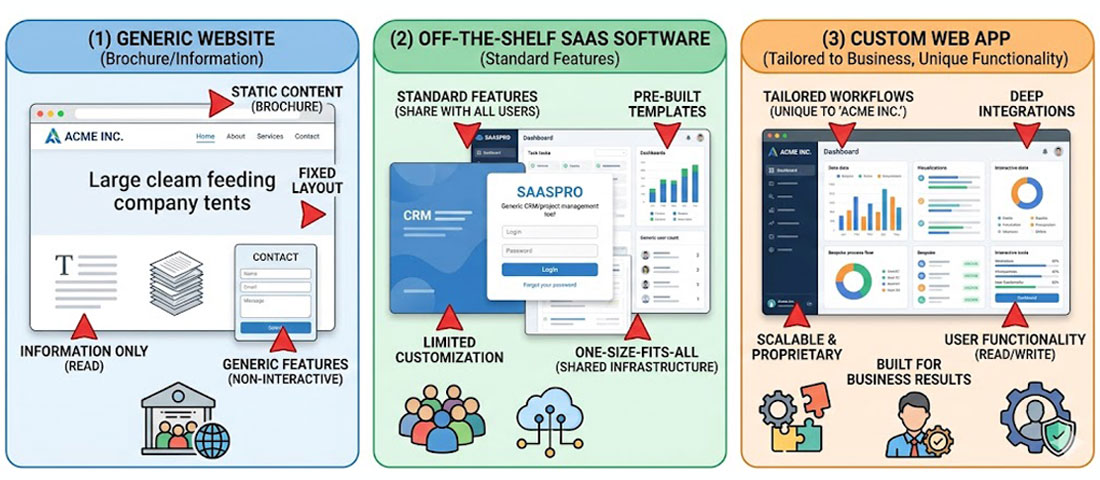
Understanding where a custom web application sits relative to a website and off-the-shelf software is the starting point for making the right build-vs-buy decision.
Custom Web App vs Custom Website: The Important Distinction
Before going further, it is worth being precise about a distinction that causes significant confusion in conversations about web development: the difference between a custom website and a custom web application.
A custom website — even a highly sophisticated one with complex design, bespoke animations, custom WordPress development, and advanced SEO architecture — is still primarily a content and lead generation vehicle. It is built to attract visitors, communicate your business’s value, and convert visitors into enquiries or customers. Its primary audience is potential customers who are learning about your business.
A custom web application is primarily a tool used by defined user groups — your customers who have signed up and log in, your employees who use it daily to do their jobs, or your partners who access specific functionality through it. It has users with accounts, data that changes based on user actions, and business logic that runs server-side.
Many businesses need both: a custom website that attracts and converts new clients, and a custom web application that serves and retains existing ones. Understanding which you need — or whether you need both — is a critical early question in any digital investment conversation.
7 Key Benefits of Custom Web Application Development
Benefit 1: Perfect Fit With Your Business Processes
Off-the-shelf software is designed for the average business in a category. Your business is not average — it has specific workflows, specific terminology, specific edge cases, and specific operational requirements that generic software handles imperfectly or not at all. A custom web application is built around your actual processes rather than requiring your team to adapt their behaviour to fit the software’s assumptions. This fit typically results in significantly higher staff adoption rates, fewer workarounds, and less time lost to software friction.
Benefit 2: Competitive Differentiation Through Capability
When your business operates on the same off-the-shelf software as all of your competitors, the software itself cannot be a source of competitive advantage. When you build a custom application that uniquely serves your customers, streamlines a workflow your competitors still do manually, or enables a service offering that your tools cannot support, you create a capability advantage that is difficult for competitors to replicate quickly. Some of the most durable competitive advantages in business come not from products or pricing but from proprietary operational systems.
Benefit 3: Elimination of Unnecessary Complexity and Cost
Off-the-shelf software subscriptions typically charge for a broad feature set, the majority of which most businesses do not use. You pay for enterprise-level features when you need SMB-level functionality, or for a consumer-oriented toolset when you need a business-specific workflow. A custom application contains exactly the features your business requires — no more and no less. This simplicity reduces training time, reduces the chance of user error, and eliminates the cognitive overhead of navigating features that are irrelevant to your work.
Benefit 4: Complete Data Ownership and Privacy Control
When your business data lives in third-party SaaS software, it is subject to that company’s data policies, security practices, geographic data storage decisions, and business continuity risks. If the SaaS company is acquired, goes out of business, changes its pricing, or suffers a data breach, your business data is affected. With a custom web application, your data is yours — stored on infrastructure you control, protected by security practices you specify, and accessible regardless of the fortunes of any third-party vendor.
Benefit 5: Seamless Integration With Your Existing Systems
Most businesses operate across multiple software systems — accounting, CRM, email marketing, inventory management, communication tools, payment processors. Getting these systems to share data effectively is one of the most persistent operational headaches of modern business. A custom web application can be designed with integrations to your specific existing systems built in from the start — creating a unified operational environment where data flows automatically between systems without manual re-entry, reducing errors and saving significant staff time.
Benefit 6: Scalability on Your Terms
Off-the-shelf software scales according to its vendor’s product roadmap. When your business needs a capability that the vendor has not built, you wait, work around it, or switch platforms — all of which are costly. A custom web application evolves according to your business needs. New features can be added, existing ones modified, and the application extended in whatever direction your business requires — without dependency on a third party’s priorities or commercial model.
Benefit 7: Long-Term Cost Efficiency at Scale
Custom development has higher upfront costs than SaaS subscriptions. But the economics shift significantly at scale and over time. A SaaS subscription charged per user grows proportionally as your team grows. A custom application, once built, can accommodate additional users at negligible marginal cost. For businesses that grow significantly or that use software intensively across large teams, the crossover point where custom development delivers lower total cost of ownership than SaaS subscriptions can be reached within two to four years.
The Most Valuable Business Use Cases for Custom Web Applications in 2026
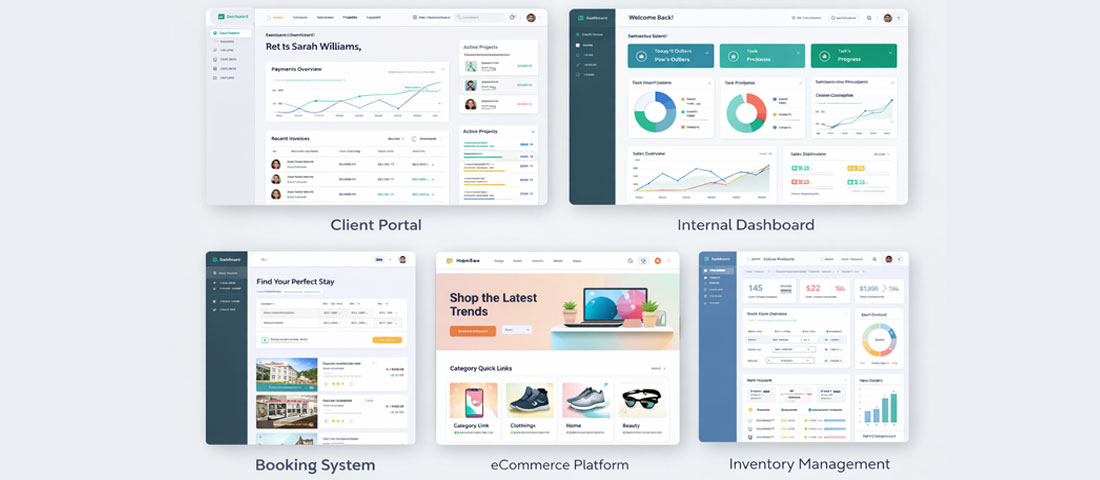
Custom web applications are the right solution across a wide range of business contexts — from client portals to internal operational tools to customer-facing service platforms.
Client and Customer Portals
A client portal is a secure, login-protected web application that gives your customers access to information, services, and functionality specific to their relationship with your business. For a web design agency, it might allow clients to review project progress, approve designs, submit feedback, raise support tickets, and access invoices — all in one place. For a professional services firm, it might allow clients to access documents, track the status of their matter, communicate with the team, and access a history of billing and work completed.
The commercial value of a well-built client portal is significant: it reduces the volume of status-update emails and calls, improves client satisfaction through transparency, and creates a professional, branded touchpoint that reinforces the quality of your service relationship. Many businesses that build client portals find that client retention improves measurably, because the portal deepens the operational relationship and raises the switching cost for clients.
Internal Operational Tools and Dashboards
Many business processes — particularly in service businesses, professional firms, and growing companies — are managed through combinations of spreadsheets, email threads, shared folders, and generic project management tools that do not quite fit the workflow. A custom internal tool or dashboard can replace this patchwork with a purpose-built application: automating the routine steps, surfacing the right information to the right people at the right time, and providing management visibility into operational performance through a real-time dashboard.
Use cases include: project management tools tailored to a specific industry’s workflow; internal CRM systems designed around a specific sales process; HR and team management applications; financial reporting and KPI dashboards; inventory and supply chain management tools; and quality assurance or compliance tracking systems.
Custom Booking and Scheduling Systems
Off-the-shelf booking systems work well for simple, standardised appointment scheduling — a haircut, a dental appointment, a restaurant reservation. But businesses with complex scheduling requirements — variable appointment durations, staff skill-matching, multi-resource bookings, geographic routing for field service teams, dynamic pricing based on availability, or integration with project management systems — quickly find the limits of generic booking software. A custom booking system built around your specific requirements can dramatically improve both the customer booking experience and the operational efficiency of your scheduling.
eCommerce and Marketplace Platforms
Standard eCommerce platforms like Shopify and WooCommerce serve the vast majority of online retail requirements excellently. But businesses with unusual product structures, complex B2B pricing and ordering workflows, multi-vendor marketplace requirements, subscription and recurring billing models that exceed standard platform capabilities, or deeply integrated fulfilment and inventory requirements often need a custom eCommerce solution. When the specific requirements of a business’s commercial model cannot be met within the constraints of an existing platform, custom development is the right answer.
Learning Management Systems and eLearning Portals
Businesses that deliver training — whether internal employee training or customer education programmes — often find that off-the-shelf LMS platforms are either too basic for their content requirements or too expensive and complex for their actual usage. A custom learning management system designed around your specific content types, learner journeys, assessment requirements, and reporting needs can deliver a significantly better learner experience at a cost that is competitive with premium off-the-shelf LMS subscriptions over a three to five year horizon.
Reporting and Analytics Platforms
Many businesses collect data from multiple sources — CRM, marketing platforms, financial systems, operational tools — but struggle to aggregate this data into coherent, actionable reporting. Custom reporting and analytics dashboards connect your data sources through APIs, apply your specific business definitions and metrics, and present the resulting insights in a format designed for your specific decision-making processes. The ROI from genuinely good management reporting — reducing the time spent manually compiling reports, improving the quality and timeliness of business decisions — is typically substantial.
Custom Animations and Interactions: When They Add Real Value
One specific aspect of custom web development that deserves dedicated attention is custom animations and interactive design elements. These can add significant perceived value to a digital product — or they can add significant performance cost for no tangible benefit. Understanding when animation adds value and when it is a distraction is an important part of good custom development practice.
When Custom Animations and Interactions Add Value
- Onboarding flows for complex applications: Animated guidance that walks a new user through an unfamiliar interface reduces the learning curve and improves adoption rates significantly. Contextual tooltips, animated highlights, and progressive disclosure of features make complex applications accessible without overwhelming documentation.
- Data visualisation: Animated charts and data visualisations — where data transitions smoothly between states, where relationships between data points are illustrated through motion — communicate information more effectively than static equivalents. A dashboard where KPIs animate to their current values, or where a graph transitions smoothly to reflect a new date range, is both more engaging and easier to interpret than a static version.
- Microinteractions that confirm state changes: When a user submits a form, saves a document, completes a task, or takes any action that changes the state of the application, an animation that confirms the change — a checkmark appearing, a progress bar completing, a card smoothly archiving — provides clear feedback that the action was registered. Without these microinteractions, users are uncertain whether their action worked.
- Scroll-based storytelling on marketing pages: For businesses whose product or service benefits are best communicated through a visual narrative — showing a process step by step, demonstrating how a product works, or guiding a visitor through a complex decision — scroll-triggered animations that reveal and illustrate content as the user scrolls are highly effective. They create engagement and comprehension simultaneously.
When Animation Reduces Value
- When it delays access to content or functionality: Entrance animations that require users to wait before they can read content or interact with the interface create frustration. Loading animations that play while perfectly adequate information is ready to display are a UX anti-pattern.
- When it serves aesthetics rather than communication: Animations that exist purely to make a page look impressive — parallax effects that create disorientation, background animations that compete with content, hover effects that serve no feedback purpose — add performance cost without user experience benefit.
- When it violates accessibility requirements: Users with vestibular disorders can experience motion sickness from certain types of animation. WCAG 2.1 guidelines require that animations can be disabled through the prefers-reduced-motion media query, and best practice is to design animated experiences that degrade gracefully when this preference is set.
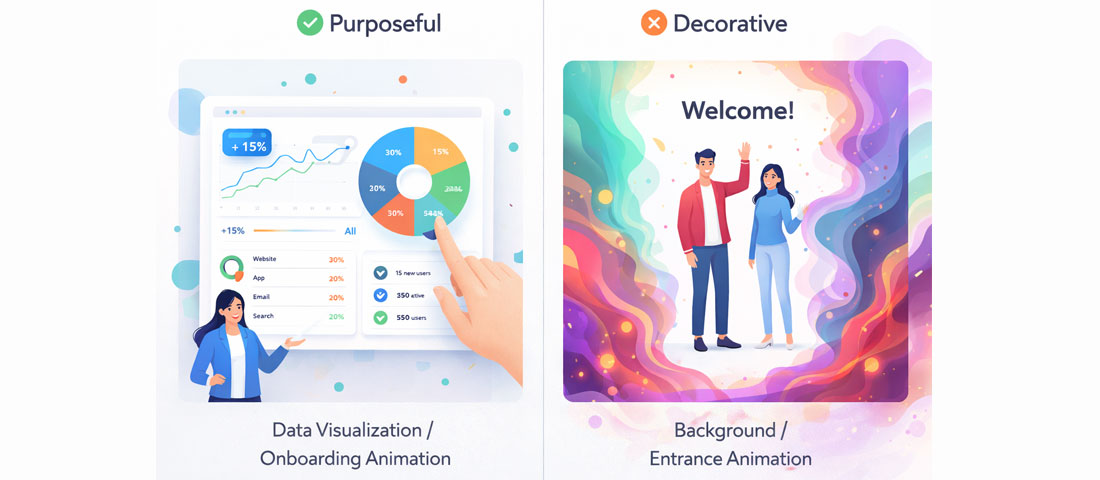
The question to ask about every animation is: does this serve the user, or does it serve the designer? Purposeful animations that communicate state, guide attention, or illustrate data add value. Decorative animations that exist purely for visual impact add cost without benefit.
Custom vs Template: When to Choose Each
The decision between custom development and a template-based or off-the-shelf solution is one of the most important technology decisions a growing business makes. Here is a practical framework for making it correctly:
| Factor | Choose Custom Development | Choose Template / Off-the-Shelf |
|---|---|---|
| Business processes | Your processes are unique and off-the-shelf requires too many workarounds | Your processes are standard and a good off-the-shelf solution fits well |
| Competitive advantage | Your software could be a source of competitive differentiation | Software is infrastructure — no competitive advantage at stake |
| Scale and users | Large user base where per-seat SaaS costs become prohibitive | Small team where SaaS per-seat cost is manageable |
| Integration requirements | Complex integrations with proprietary or unusual systems | Standard integrations well-supported by off-the-shelf tools |
| Data and security | Sensitive data that requires full ownership and control | Standard data where reputable SaaS security is acceptable |
| Budget and timeline | Budget for upfront investment; long-term ROI horizon | Limited budget; need quick deployment |
| Feature stability | Requirements are well-defined and relatively stable | Requirements are evolving and an established SaaS is iterating faster |
The most important principle: Custom development is the right choice when the specific requirements of your business cannot be well-served by off-the-shelf solutions — and when the value delivered by a perfect-fit solution clearly exceeds the cost of building it. It is the wrong choice when a good enough off-the-shelf solution exists and the business case for a custom solution is primarily about aesthetics or control rather than genuine functional necessity.
How to Plan a Custom Web Development Project for Maximum ROI
Custom web application projects that deliver strong ROI share a consistent set of planning characteristics. Projects that struggle — that run over budget, over time, or that deliver something different from what the business needed — typically share a consistent set of planning failures. Here is how to be in the first group.
-
Start with the business problem, not the technical solution
The most common cause of custom development projects that disappoint is starting from a technical specification rather than a business problem statement. Before defining what you want to build, define clearly: what business problem is this solving? What is the cost of the current situation (in time, money, errors, or missed opportunities)? What would success look like in measurable terms? This problem-first approach ensures that the technical solution is shaped by business value rather than by technical preference. -
Define and document requirements exhaustively before development begins
The cost of changes in software development increases exponentially as the project progresses. A requirement change that costs one unit of effort during specification costs ten units during design, one hundred units during development, and potentially one thousand units after launch. Investing heavily in requirements documentation — user stories, workflow diagrams, data model definitions, edge case identification — before development begins is the single most cost-effective quality investment in a custom development project. -
Choose an experienced development partner, not the cheapest quote
Custom web application development is a skilled craft. The difference between an experienced development team and an inexperienced one is not primarily visible in the finished product on a good day — it is visible in how problems are identified and resolved, how technical decisions are made under uncertainty, how the codebase is structured for long-term maintainability, and how the project responds when requirements change. Choosing a development partner based primarily on price is one of the most reliably regretted decisions in custom software procurement. -
Build an MVP first, then iterate
A Minimum Viable Product (MVP) approach — building the smallest version of the application that delivers genuine business value and can be tested with real users — is the most reliable way to avoid building the wrong thing at full cost. An MVP can be deployed in weeks rather than months, real user feedback can inform subsequent development, and the risk of discovering fundamental requirement mismatches after full development is dramatically reduced. Even if you are confident in your requirements, building iteratively produces better outcomes than building the full vision in one phase. -
Plan for maintenance and evolution from day one
A custom web application is not a one-time project — it is an ongoing asset that requires maintenance, security updates, performance monitoring, and iterative improvement. Budget and plan for this from the beginning. A clear maintenance retainer agreement with your development team, established processes for deploying updates safely, and a roadmap for phase two features ensure that the application continues to deliver value and evolve with your business rather than becoming technical debt.
Why Businesses Choose Neel Networks for Custom Web Application Development
Neel Networks has been building custom web applications for businesses across the USA, UK, Canada, Australia, and India since 2014. Our custom development capability spans the full technology stack — from Laravel and PHP backends to React and Vue.js frontends, Node.js and MERN stack applications, WordPress-based custom solutions, and mobile app development for iOS and Android.
What sets us apart is not our technology choices — it is our approach. We begin every custom application project with a structured discovery process that ensures we understand the business problem deeply before we write a line of code. We build iteratively, with regular client review at every development milestone. We document everything — code, database schemas, API integrations, deployment processes — so that you are never dependent on us for knowledge that should belong to you. And we provide ongoing maintenance and support as a standard part of our client relationship.
Our India-based team delivers this full capability at a pricing level that is 50 to 70% below comparable agencies in the USA or UK — making genuinely enterprise-quality custom development accessible to growing businesses that would otherwise be priced out of it.
Frequently Asked Questions About Custom Web Application Development
| What is a custom web application and how does it differ from a website? | A custom web application is software built specifically for a business’s unique requirements — accessible through a web browser, with user accounts, dynamic data, and business logic that runs server-side. Unlike a website (which primarily delivers information and converts visitors into enquiries), a web application is a tool that enables users to perform tasks, manipulate data, and interact with systems in ways that create or change state. Unlike off-the-shelf software (which is built for the broadest possible market), a custom web application is built around your exact processes, terminology, data model, and integration needs. |
| When should a business invest in custom web application development? | Custom web application development is the right investment when: your business processes are unique enough that off-the-shelf solutions require significant workarounds; your software could be a genuine source of competitive differentiation; your user scale makes per-seat SaaS subscriptions prohibitively expensive; you need integrations with proprietary or unusual systems that standard platforms do not support; you require full data ownership for security or compliance reasons; or when the specific value delivered by a perfect-fit solution clearly and measurably exceeds the cost of building it. It is the wrong choice when a good off-the-shelf solution exists and the business case is primarily about aesthetics or control rather than genuine functional necessity. |
| How much does custom web application development cost? | The cost of custom web application development varies significantly depending on the complexity, scope, and features of the application. Simple custom tools and portals can be built for a relatively modest investment. Complex, multi-user applications with sophisticated business logic, multiple integrations, and extensive data models require significantly more investment. Working with a quality Indian development agency like Neel Networks typically delivers the same technical capability as a USA or UK agency at 50 to 70% lower cost. We provide fixed-price or time-and-materials estimates after a detailed requirements discovery process — we never quote without fully understanding what needs to be built. |
| How long does it take to build a custom web application? | The timeline for building a custom web application depends entirely on its scope and complexity. A focused MVP (Minimum Viable Product) — the smallest version of the application that delivers genuine business value — can typically be built in 6 to 12 weeks. A full-featured complex application with multiple user roles, extensive integrations, and sophisticated business logic may take 4 to 9 months. At Neel Networks, we strongly recommend an MVP-first approach: build and deploy the core functionality first, test it with real users, and then prioritise subsequent features based on real usage data rather than assumptions. This approach produces better outcomes and reduces the risk of building the wrong thing at full cost. |
| What technology stack does Neel Networks use for custom web applications? | Neel Networks builds custom web applications across the full modern technology stack. Our primary backend capabilities include Laravel (PHP), Node.js, and Python. Our frontend capabilities cover React, Vue.js, and Next.js for dynamic single-page applications and server-side rendered experiences. For database architecture, we work with MySQL, PostgreSQL, and MongoDB depending on the data model requirements. We also build custom WordPress solutions for businesses that want the flexibility of a custom application within the familiar WordPress ecosystem. Our technology choices are driven by the requirements of the specific application, not by internal preference — we recommend the right tool for the job. |
| Do you provide ongoing maintenance for custom web applications after launch? | Yes — ongoing maintenance and support is a standard part of our client relationship for custom web application projects. Post-launch support includes: security updates and vulnerability patching; performance monitoring and optimisation; bug fixes; server and infrastructure management; and feature additions as your requirements evolve. We offer both retainer-based ongoing support (a monthly arrangement for businesses that need regular development attention) and ad-hoc support for businesses with lower ongoing needs. We document all code and architecture thoroughly so that you are never locked into our team — but most clients choose to continue working with us because continuity delivers better outcomes than starting fresh with a new team for every change. |
| Can you integrate a custom web application with our existing software systems? | Yes — integration with existing systems is one of the most common and most valuable reasons businesses commission custom web applications. We have experience integrating custom applications with a wide range of third-party systems through both REST APIs and webhooks: CRM platforms (Salesforce, HubSpot, Zoho), accounting software (QuickBooks, Xero, Tally), payment processors (Stripe, Razorpay, PayPal), email marketing platforms (Mailchimp, ActiveCampaign), and many others. For systems that do not have public APIs, we can build custom integration layers. Integration requirements should be fully documented during the requirements discovery phase so they are built into the application architecture from the start rather than retrofitted later. |
Conclusion: Custom Development Is an Investment in How Your Business Operates

The most enduring competitive advantages in business are operational — the systems, processes, and tools that allow a business to serve its customers better, faster, or more efficiently than its competitors can. Custom web applications are one of the most powerful ways to build and protect those operational advantages in 2026.
The businesses that invest in custom development at the right time — when they have outgrown what off-the-shelf tools can provide, when there is a clear and measurable business case, and when they partner with a development team that understands both the technology and the business problem — consistently report that it is among the highest-return investments they have made in their growth.
The businesses that get it wrong do so for predictable reasons: starting from technology rather than from business problems, underinvesting in requirements definition, choosing partners on price alone, or building the full vision in one phase rather than iterating from an MVP. These are all avoidable mistakes with the right approach and the right partner.
If your business is at the point where off-the-shelf software is limiting what you can do, or where a custom application could deliver a meaningful operational or customer-facing advantage, the conversation with Neel Networks starts with understanding your problem — not with selling you a solution.
Ready to explore what a custom web application could do for your business?
Start with a free, no-obligation discovery conversation with the Neel Networks development team. We will help you understand whether custom development is the right choice — and if it is, what it would look like for your specific needs.