WordPress Blog Growth & Monetization: Content Strategy, UGC & Revenue Tips

WordPress powers over 40% of all websites on the internet — and a significant proportion of those are blogs at various stages of their journey, from newly launched personal projects with a handful of readers to established publications generating consistent monthly revenue. The gap between those two outcomes is not luck or timing. It is strategy.
What this guide covers
- 1. Content Strategy for Sustainable WordPress Blog Growth
- 2. SEO Fundamentals Every Blogger Needs to Know
- 3. User-Generated Content (UGC) — Building a Community That Creates
- 4. Growing Your Email List as the Most Valuable Blog Asset
- 5. WordPress Blog Monetization Strategies
- 6. Measuring Blog Performance and Growth
- 7. A 12-Month WordPress Blog Growth Roadmap
- 8. Frequently Asked Questions About WordPress Blog Growth and Monetization
Growing a WordPress blog to a meaningful audience and turning that audience into revenue requires a coordinated approach across content strategy, SEO, user-generated content, community building, and monetization — each reinforcing the others. This guide covers the complete picture: how to grow your WordPress blog’s traffic systematically, how to build community and harness user-generated content, and how to monetize intelligently without compromising the audience trust that makes monetization possible in the first place.
Content Strategy for Sustainable WordPress Blog Growth
The most common reason WordPress blogs stagnate after an initial burst of enthusiasm is the absence of a content strategy. Publishing whatever feels interesting in the moment produces an unfocused content library that struggles to rank for competitive terms, fails to build topical authority, and does not give visitors a compelling reason to return.
Sustainable blog growth is built on three content strategy pillars:
Pillar 1: Niche Clarity and Audience Definition
The blogs that grow fastest are not the most broadly appealing — they are the most specifically relevant to a defined audience. A blog about “travel” competes with millions of sites and offers nothing distinctive. A blog about “slow travel in Southeast Asia for remote workers over 40” has a specific, defined audience, directly addresses their specific needs, and can build genuine authority in a space where it is not competing against every travel brand on the internet.
Defining your niche is not about limiting yourself — it is about being genuinely useful to a specific audience rather than superficially relevant to everyone. The blogs that grow from 0 to 50,000 monthly visitors in 18 months are almost always those with the sharpest niche focus, not the broadest topic scope.
Pillar 2: The Content Cluster Model
Rather than publishing random individual posts, the most effective blogging content strategy in 2026 follows the content cluster model: one comprehensive “pillar post” covering a broad topic in depth, supported by multiple shorter posts covering specific subtopics in detail, all interlinked. This structure builds topical authority — signalling to Google that your blog is a comprehensive resource on a subject area, not just a collection of loosely related articles.
For a travel blog targeting remote workers, a pillar post might be “The Complete Guide to Working Remotely from Southeast Asia.” Supporting posts might cover: “Best coworking spaces in Chiang Mai,” “Visa options for digital nomads in Thailand,” “Internet speed reality check: working from Bali,” and “Health insurance for remote workers abroad.” Each individual post targets specific long-tail searches; the internal linking cluster lifts all posts collectively.
Pillar 3: Consistent Publishing Over Volume
Consistency beats frequency in blog growth. A blog publishing one genuinely excellent, comprehensively researched post per week for two years builds more authority than one publishing four thin posts per week for three months and then going quiet. Google’s algorithms reward consistent signals of freshness and quality — and readers return to blogs that give them a reliable expectation of when new content appears.
Identify a publishing cadence that is genuinely sustainable for your resources — whether that is weekly, fortnightly, or even monthly — and commit to it. A content calendar that stretches 3 to 6 months ahead prevents the panic of staring at an empty WordPress editor on publishing day.
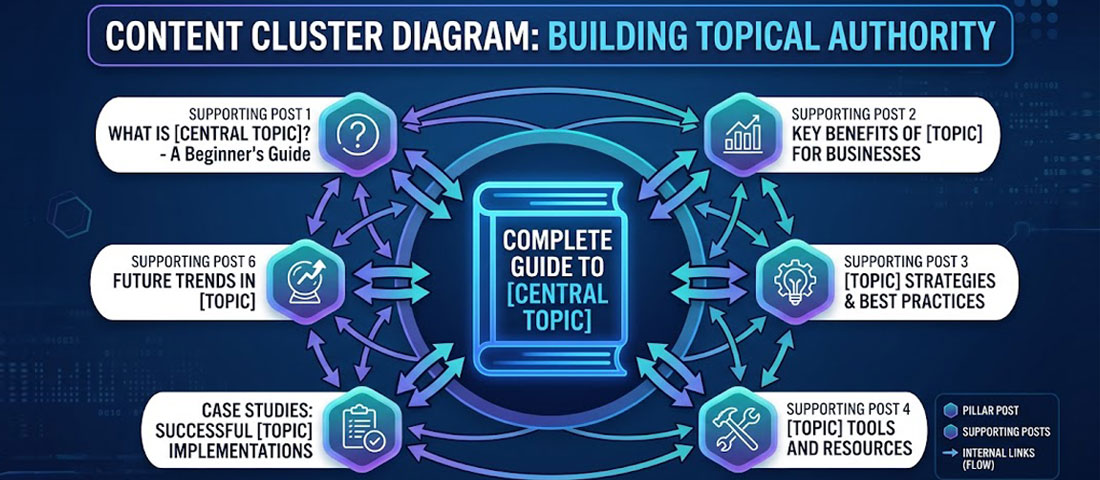
The content cluster model — a comprehensive pillar post supported by interlinked topical posts — builds topical authority that lifts the entire cluster’s rankings simultaneously.
SEO Fundamentals Every Blogger Needs to Know
For most WordPress blogs, organic search is the primary growth channel — the engine that delivers new readers who are actively looking for the content you have produced. Understanding SEO fundamentals is not optional for serious bloggers; it is the difference between a blog that grows organically and one that depends entirely on social media shares that are increasingly hard to earn.
Keyword Research for Bloggers
Every post should target a specific keyword cluster — a primary keyword and a set of closely related terms — that represents how real people search for the topic you are covering. Use free tools (Google Keyword Planner, Google’s autocomplete, “People Also Ask” boxes) or paid tools (Semrush, Ahrefs) to identify: search volume (how many people search for this monthly), keyword difficulty (how competitive the top results are), and search intent (what type of content people are actually looking for when they search this term).
For most newer blogs, long-tail keywords — specific, lower-competition phrases with 50 to 500 monthly searches — are the realistic starting point. A new blog targeting “best coworking spaces in Chiang Mai” (low competition, specific intent) will rank months sooner than one targeting “coworking spaces” (extremely high competition). As domain authority builds through consistent quality publishing and link earning, gradually targeting more competitive terms becomes viable.
On-Page SEO for Every Post
Every WordPress post should follow a consistent on-page SEO checklist:
- Target keyword in the H1 title — naturally integrated, not forced
- Target keyword in the first 100 words — establishing relevance early
- Keyword variations in subheadings (H2/H3) — not exact repetitions, natural semantic variations
- Meta title and description written for click-through — using an SEO plugin like Rank Math to set these explicitly
- Images with descriptive alt text — compressed to WebP, sized appropriately
- Internal links to related posts — 3 to 5 per post, linking both to and from the new content
- Clean URL slug — short, keyword-containing, no dates or unnecessary words
- FAQ section with FAQPage schema — added via Rank Math, targeting featured snippet and AI Overview visibility
The Rank Math Plugin for WordPress Bloggers
Rank Math SEO is the recommended SEO plugin for WordPress bloggers in 2026. Its free tier provides: meta title and description editing for every post, XML sitemap generation, schema markup including FAQPage and Article schema, Google Search Console integration showing keyword performance within WordPress, and an SEO analysis that scores each post against key on-page factors. Installing and properly configuring Rank Math is a one-time 30-minute investment that improves every subsequent post’s SEO performance.
User-Generated Content (UGC) — Building a Community That Creates
User-generated content is any content — comments, reviews, forum posts, guest posts, community contributions — created by your readers rather than by you. At scale, UGC is one of the most powerful growth mechanisms available to blogs: it adds fresh content without proportional effort from you, it creates community investment that keeps readers returning, and it generates the social proof signals (activity, comments, community engagement) that signal to new visitors that this is a place worth participating in.
Building a Comment Community
Blog comments are the most accessible form of UGC. Encouraging genuine, substantive comments requires: posing a specific question at the end of each post (not “what do you think?” but “have you tried this approach, and what happened?”), responding to every comment in the early stages to signal that engagement is valued, featuring particularly insightful comments prominently, and moderating carefully to keep the quality of discourse high.
WordPress comment systems have limitations for community building at scale. Plugins like wpDiscuz significantly enhance the native WordPress comment experience with upvoting, threading, and rich media. For blogs targeting genuinely engaged communities, integrating a dedicated community platform (Circle.so, Discourse, or a private Facebook Group) alongside the blog provides richer community infrastructure than blog comments alone can support.
Guest Posting as a UGC Strategy
Accepting guest posts from credible contributors in your niche serves multiple purposes: it adds content without consuming your own time, it brings the guest author’s audience to your blog when they share the piece, it builds relationships within your niche community, and it creates opportunities for link building as contributors promote their published pieces. The key to a successful guest posting programme is maintaining editorial standards — accepting only content that genuinely meets your quality bar, editing submissions thoroughly, and being selective enough that a published guest post is meaningful to contributors.
Reader Submissions and Community Content
Structuring content formats specifically to incorporate reader contributions creates ongoing UGC pipelines. Examples that work across blog niches: reader case studies (“Share how you used [topic] to achieve [outcome] and we may feature your story”), reader questions (a regular “Reader Q&A” column), community roundups (“We asked 20 readers in our community…”), and photo or creative submissions for visual niches. Each of these formats produces genuine content while deepening community investment.
Growing Your Email List as the Most Valuable Blog Asset
An email list is the most valuable asset a blogger can build — more valuable than social media followers, more valuable than organic search rankings, and more directly convertible to revenue than any other audience metric. Unlike social media platforms that can algorithmically suppress your reach, or search rankings that can be affected by algorithm updates, an email list is an owned asset: a direct line to your most engaged readers that no platform change can take from you.
The fastest-growing blogs treat email list building as a primary objective from day one — not as an afterthought once traffic is established. The strategies that work most consistently:
- Content upgrades: Post-specific lead magnets offered within each article — a downloadable version, an extended checklist, a related template. These convert at 3 to 5x the rate of generic “subscribe to my newsletter” prompts because the relevance is immediate.
- Exit-intent popups: Triggered when a reader moves to close the tab, these capture a proportion of readers who would otherwise leave without subscribing. Well-timed and offering a specific value proposition, they convert without being intrusive to the reading experience.
- Inline subscription prompts: Placed within posts at natural break points — after an insightful section, before a key framework, or following a compelling case study — rather than only at the post’s end.
- A compelling lead magnet: One high-value piece of content offered to all new subscribers — a comprehensive guide, a resource library, a toolkit — that gives readers a specific, compelling reason to subscribe beyond “get updates.”
WordPress Blog Monetization Strategies
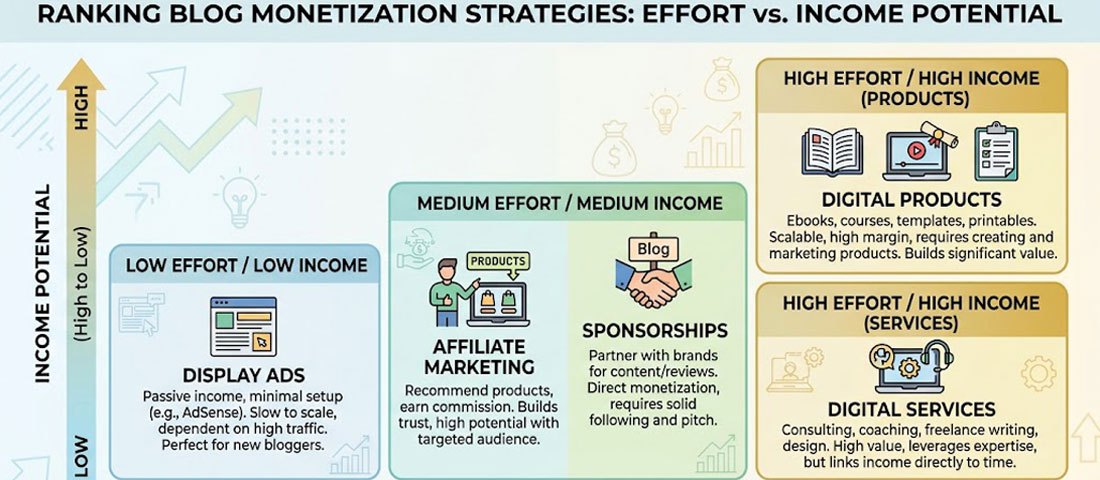
Blog monetization strategies vary enormously in effort, traffic requirements, and income potential — the right mix depends on your traffic level, niche, and audience relationship.
Monetizing a WordPress blog is a question of sequencing as much as selection — different strategies make sense at different traffic and audience relationship levels. Here is a complete guide to the main monetization models, organised by what you need in place before they become viable.
Display Advertising — The Low-Barrier Entry Point
Display advertising — serving ads through networks like Google AdSense, Ezoic, Mediavine, or AdThrive (now Raptive) — is the most accessible monetization model: it requires no product development, no brand relationships, and no active selling. You apply, get approved, place a code snippet, and ads appear on your pages.
The economics of display advertising are determined by your RPM (Revenue Per Mille — revenue per 1,000 pageviews). Google AdSense RPMs for most niches range from $2 to $8. Premium networks like Mediavine (minimum 50,000 monthly sessions) and Raptive (minimum 100,000 monthly pageviews) provide RPMs of $15 to $40+ — making them significantly more lucrative for qualifying blogs. Finance, insurance, and legal niches command much higher RPMs than general lifestyle or entertainment content.
When display advertising makes sense: It is an appropriate monetization layer for any blog once traffic is established, and can run alongside other monetization methods. However, it should not be the primary revenue strategy for most bloggers — RPMs mean you need very high traffic volumes to earn meaningful income from display ads alone.
When to avoid display ads: In the early stages when traffic is too low to generate meaningful revenue. When advertising would damage the reader experience to the point of increasing bounce rate and reducing the audience you are trying to build. When selling a premium service or product directly to readers — ads signal low commercial value and can undermine the positioning that makes direct monetization possible.
Affiliate Marketing — Performance-Based Revenue With High Ceiling
Affiliate marketing involves recommending products and services you genuinely use and trust, and earning a commission when readers purchase through your tracked affiliate links. When the recommendations are authentic, the products are genuinely relevant to your audience, and the content is genuinely helpful rather than purely promotional, affiliate marketing is one of the most naturally aligned monetization models for content blogs.
The key principles for affiliate marketing that earns trust rather than eroding it:
- Only recommend products you have personally used — readers can tell the difference between genuine first-hand experience and generic promotional content, and the trust loss from recommending something you have not actually used is not worth any commission
- Full disclosure always — disclose affiliate relationships clearly in every post containing affiliate links, both for legal compliance (FTC guidelines, UK ASA rules) and for audience trust maintenance
- Recommend the best option, not the highest commission — if the second-highest-commission product is genuinely better for your audience, recommend that one. Long-term audience trust generates more affiliate revenue than short-term commission maximisation.
- Create genuine comparison and review content — the most effective affiliate content provides honest, specific, experience-based comparisons that help readers make genuinely informed decisions, not marketing copy dressed up as reviews
High-performing affiliate categories for bloggers include: software and SaaS (recurring commissions), web hosting (high one-time commissions), online courses, books, and physical products through Amazon Associates (lower commission percentage but very high conversion rates for relevant recommendations).
Sponsored Content and Brand Partnerships
Sponsored posts — where a brand pays for a feature, review, or integration within your content — can be lucrative for blogs with engaged, niche audiences. The critical distinction between sponsored content that maintains audience trust and sponsored content that destroys it is the same as for affiliate marketing: does the sponsored content genuinely serve the reader’s interests, or does it serve only the brand’s and the blogger’s financial interests?
Sponsored content rates vary enormously by niche, audience size, and engagement rate. A food blog with 20,000 highly engaged readers in a specific dietary niche can command higher sponsored content rates than a generic lifestyle blog with 100,000 disengaged followers — because brands are paying for genuine audience influence, and engagement rate predicts influence better than raw follower count.
Rules for sponsorships that maintain trust: only accept brands whose products you would recommend without payment; always disclose sponsorship clearly; maintain editorial control over how the brand is presented; and do not compromise your editorial voice or your honest assessment of the product to satisfy the brand’s promotional requirements.
Digital Products — The Highest-Margin Monetization Model
Selling digital products directly to your audience — courses, ebooks, templates, membership programmes, premium content libraries, or software tools — is the monetization model with the highest profit margin and the most direct relationship between the value you create and the revenue you earn. Unlike display advertising (where you are selling your audience’s attention to advertisers), digital product sales are a direct transaction: your audience pays you for something that genuinely helps them.
The most successful blog-based digital products are direct extensions of the content that already resonates most strongly with the audience. If your most popular posts consistently help readers build a specific skill or solve a specific problem, an in-depth course, template pack, or comprehensive guide that goes further than the free content can naturally into a paid product.
WordPress plugins for selling digital products include: WooCommerce with the Digital Products extension, Easy Digital Downloads (EDD — built specifically for digital product sales), MemberPress for membership and subscription models, and LearnDash or LifterLMS for course delivery. Alternatively, hosted platforms like Teachable, Gumroad, or Podia handle the technical infrastructure of digital product delivery — the right choice depends on how tightly integrated with your WordPress site you want the product experience to be.
Consulting and Services — Converting Readers to Clients
For bloggers who are experts in a professional domain — web design, marketing, finance, legal, health, coaching — the blog itself is the most powerful lead generation tool available. Readers who have been consuming your genuinely expert content for months come to enquiry conversations with a pre-established trust in your expertise that cold outreach or advertising cannot replicate.
Service-based monetization requires a clear conversion path from blog content to enquiry: a prominent “Work With Me” or services page, CTAs within relevant posts pointing to that page, a clear articulation of who you serve and how, and a simple initial step for readers to take (a free consultation call, a contact form, or an application process).
The alignment between your blog content and your services is crucial. A web design blogger who writes about design and development for small business owners, and who offers web design services to small business owners, has a perfectly aligned content-to-service funnel. Each post attracts potential clients; each post demonstrates expertise that justifies the service fee; each post answers the questions that potential clients have before making a hiring decision.
Measuring Blog Performance and Growth
The right metrics for a growing WordPress blog combine audience-building leading indicators (which tell you whether growth is happening) with monetization lagging indicators (which tell you whether the audience is converting to revenue):
| Metric | What It Tells You | Primary Tool |
|---|---|---|
| Organic sessions by post | Which content drives search traffic and which does not | Google Analytics 4 |
| Keyword ranking positions | Are target keywords moving up? Are new terms being ranked for? | Google Search Console |
| Email subscriber growth rate | Is the most valuable audience asset growing consistently? | Mailchimp / Klaviyo / MailerLite |
| Email open and click rates | Is the email audience engaged and interested in content? | Email platform analytics |
| Affiliate click and conversion rate | Are affiliate recommendations generating commercial action? | Affiliate platform dashboards |
| RPM (display advertising) | Revenue per 1,000 pageviews — is ad revenue efficient? | AdSense / Mediavine dashboard |
| Digital product revenue | Monthly recurring or transactional digital product income | WooCommerce / EDD / Gumroad |
| Average engagement time per page | Are readers actually reading the content or bouncing? | Google Analytics 4 |
The most important metric most bloggers ignore: Revenue per email subscriber per year. This single metric — total annual revenue divided by your email list size — tells you how effectively your entire blogging operation is converting audience into income. A blog with 2,000 email subscribers generating £10,000/year (£5 per subscriber) is significantly more efficient than one with 10,000 subscribers generating £8,000/year (£0.80 per subscriber). Growing this metric is the foundation of sustainable blog monetization.
A 12-Month WordPress Blog Growth Roadmap
-
Months 1–2: Foundation
Install WordPress on quality hosting. Set up Rank Math SEO plugin and configure basics. Define your niche and target audience precisely. Build your content cluster map — identify 3 to 5 pillar topics and 5 to 10 supporting posts for each. Set up Google Analytics 4 and Google Search Console. Create a simple email signup with your first lead magnet. Publish your first pillar post. -
Months 3–4: Content Building
Publish consistently to your editorial calendar (minimum one post per week). Focus exclusively on your defined niche — resist the temptation to cover off-topic subjects. Build internal links between new posts and your pillar content. Promote each post through your email list (even if tiny) and 1 to 2 social platforms. Check Search Console weekly for emerging keyword opportunities. -
Months 5–6: SEO Momentum
Identify posts that rank on page 2 for target keywords and deepen them. Begin systematic outreach to build your first backlinks — HARO responses, guest posts on relevant blogs, mentions in industry roundups. Add FAQ sections with schema markup to all pillar posts. Set up Microsoft Clarity for session recordings — watch how readers interact with your content. -
Months 7–9: Community and List Building
Introduce comment moderation and begin responding to every comment. Add content upgrades to your highest-traffic posts. Launch your first community element (a private Facebook Group, a Discord, or a Circle community). Consider accepting your first guest post submissions from credible contributors. -
Months 10–12: First Monetization
With 10,000+ monthly sessions established: apply to Ezoic or a premium ad network if display advertising aligns with your model. Launch your first affiliate partnerships for 2 to 3 genuinely relevant products. Create your first simple digital product (an ebook, a template pack, or a short course) based on your most popular content. Add a clear “Work With Me” services page if consulting/services are part of your model.
Frequently Asked Questions About WordPress Blog Growth and Monetization
| How long does it take to grow a WordPress blog to meaningful traffic? | Growing a WordPress blog to meaningful organic traffic — typically defined as 10,000 to 50,000 monthly sessions — usually takes 12 to 24 months of consistent, strategic effort for a new blog. The timeline depends on: niche competitiveness (a low-competition niche can see significant growth in 6 to 9 months; competitive niches take longer), publishing frequency and quality (one high-quality post per week consistently outperforms sporadic publishing), SEO execution (blogs with strong keyword research, proper on-page optimisation, and systematic link building grow faster than those published without SEO strategy), and domain age (new domains take longer to rank than older ones with existing authority). Blogs that grow fastest are almost universally those with precise niche focus, consistent publishing, and systematic keyword-targeted content strategies. |
| What is the best way to monetize a WordPress blog? | The best monetization strategy depends on your traffic level, niche, and audience relationship. For blogs with under 10,000 monthly sessions, display advertising generates negligible income — focus on building traffic and your email list instead, and consider affiliate marketing for relevant products or services as early as your first post. For blogs with 10,000 to 50,000 monthly sessions, affiliate marketing and sponsorships become viable alongside entry-level display advertising (Ezoic). For blogs above 50,000 monthly sessions, premium ad networks (Mediavine, Raptive) significantly increase display revenue, affiliate programmes can generate substantial income, and digital product creation becomes viable with an established audience. Digital products (courses, ebooks, templates, memberships) and consulting services are the highest-margin models at any traffic level when the niche and audience relationship support them. |
| How do I grow my WordPress blog’s email list? | Growing a WordPress blog email list requires giving readers a compelling reason to subscribe and making the subscription process as frictionless as possible. The most effective tactics are: content upgrades — post-specific lead magnets (downloadable version, extended checklist, related template) offered within each article, which convert at 3 to 5x the rate of generic newsletter prompts; exit-intent popups triggered when readers are about to leave, offering a specific piece of value rather than a generic “subscribe”; a high-value general lead magnet (a comprehensive guide, toolkit, or resource library) for visitors who arrive at your homepage or about page; and inline subscription prompts placed within posts at natural breakpoints. The most important principle: every subscription prompt should communicate specific, immediate value, not a vague promise of “updates.” |
| What is user-generated content (UGC) and how does it help blog growth? | User-generated content (UGC) for blogs is any content created by readers rather than the blog owner — including comments, guest posts, reader submissions, community forum posts, and social shares. UGC helps blog growth in several interconnected ways: it adds fresh content without proportional effort from the blogger; it creates community investment that makes readers more likely to return, share, and recommend the blog; comment activity signals to new visitors that this is a place where engagement happens; guest posts bring the contributor’s existing audience to the blog; and reader-submitted content (case studies, questions, photos) provides authentic social proof that the blog has a genuine community rather than a passive audience. Building UGC requires deliberate effort — asking specific questions, creating contribution pathways, and rewarding engagement with recognition. |
| How much can a WordPress blog earn per month? | WordPress blog earnings vary enormously based on niche, traffic volume, and monetization strategy. Display advertising alone generates approximately £2 to £8 RPM (revenue per 1,000 pageviews) on Google AdSense and £15 to £40+ RPM on premium networks like Mediavine — meaning a blog with 100,000 monthly pageviews earns £200 to £800 from AdSense or £1,500 to £4,000+ from Mediavine. Affiliate marketing can generate anywhere from a few hundred to tens of thousands of pounds per month depending on niche, traffic, and the commission rates of promoted products. Digital product sales have no theoretical ceiling — bloggers with established audiences and relevant digital products regularly generate £5,000 to £50,000+ per month. Consulting and services businesses built on blog audiences can generate £100,000+ annually with relatively modest traffic levels if the audience-to-client conversion rate is high. |
| What WordPress plugins do I need for a blog? | The essential WordPress plugin stack for a growing blog includes: Rank Math SEO (free) for meta data, schema markup, XML sitemaps, and keyword analysis; a caching plugin — WP Rocket (paid) for non-LiteSpeed hosting or LiteSpeed Cache (free) for LiteSpeed servers — for performance; an image optimisation plugin such as ShortPixel or EWWW Image Optimizer to compress and convert images to WebP; UpdraftPlus (free basic / paid premium) for automated backups to cloud storage; WPForms or Contact Form 7 for contact and enquiry forms; a social sharing plugin appropriate to your audience; and an email marketing integration plugin to connect your email platform (Mailchimp, Mailerlite, Klaviyo) to WordPress for email list capture. Keep your plugin count minimal — each additional plugin adds page load overhead. Disable and delete any plugin not actively serving a specific function. |
| Is affiliate marketing suitable for a new blog? | Yes — affiliate marketing can be implemented from the very first post, making it the most accessible monetization model for new blogs with limited traffic. Unlike display advertising (which requires meaningful traffic volume to generate significant revenue) or digital products (which require an established audience relationship), affiliate links can be included in relevant posts from day one. The key principle for new bloggers is to only recommend products you have genuinely used and that are directly relevant to your post’s content — building recommendation trust from the beginning rather than treating affiliate links as an income shortcut. Start with 2 to 3 affiliate programmes highly relevant to your niche, include links naturally within genuinely helpful content, disclose affiliate relationships clearly, and track which recommendations generate clicks and conversions to understand what resonates with your audience. |
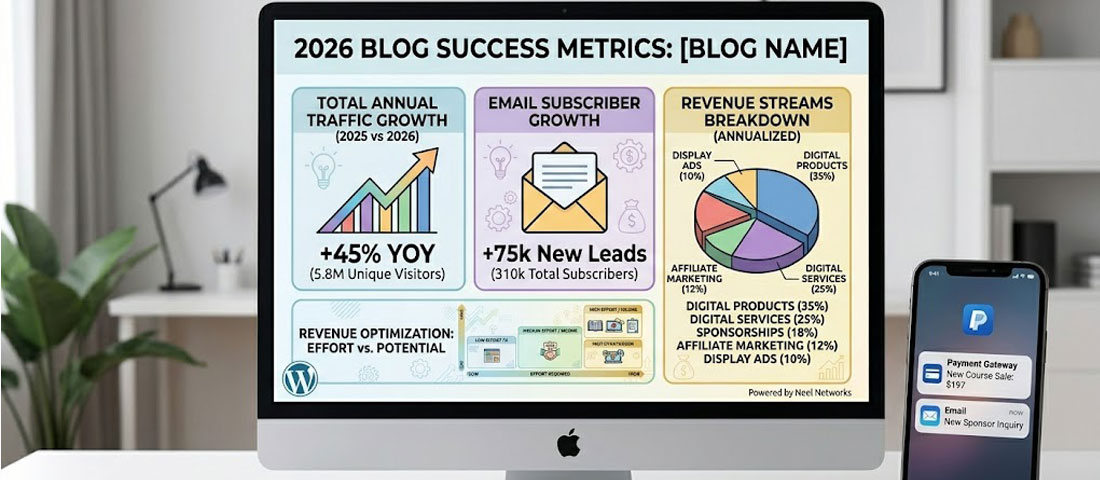
A mature, monetized WordPress blog combines strong organic traffic, an engaged email list, and multiple complementary revenue streams — each reinforcing the others over time.
Want expert help building and growing your WordPress blog or business website?
Neel Networks builds, optimises, and maintains WordPress websites for content creators and businesses across the USA, UK, Canada, Australia, and India. From initial setup through to performance optimisation, SEO, and ongoing support — we handle the technical side so you can focus on creating content and building your audience.