Why Global Businesses Are Outsourcing Web Design to India in 2026

Something significant has shifted in how businesses in the USA, UK, Canada, and Australia think about building their websites. A few years ago, the idea of outsourcing web design to India might have raised questions about quality, communication, and reliability. Today, thousands of businesses across these markets choose Indian web design agencies not as a budget compromise but as a deliberate strategic decision — because the combination of quality, value, and partnership they receive from leading Indian agencies is genuinely difficult to match domestically.
What this guide covers
- 1. The Cost Reality: What Outsourcing to India Actually Saves
- 2. Why Quality From Leading Indian Agencies Matches Western Standards
- 3. Specific Advantages for USA Businesses Outsourcing to India
- 4. Specific Advantages for UK Businesses
- 5. Specific Advantages for Canadian and Australian Businesses
- 6. How to Choose the Right Indian Web Design Agency
- 7. How to Structure the Relationship for Best Outcomes
- 8. Common Outsourcing Mistakes and How to Avoid Them
- 9. Why Neel Networks Is the Right Indian Partner for Your Business
- 10. Frequently Asked Questions About Outsourcing Web Design to India
This guide addresses every dimension of the outsourcing decision: the cost reality, the quality picture, what to look for when choosing an Indian web design partner, the specific advantages for businesses in the USA, UK, Canada, and Australia, and how to structure the relationship for the best outcomes.
The Cost Reality: What Outsourcing to India Actually Saves
The cost advantage of working with a professional Indian web design agency compared to a comparable agency in Western markets is substantial — and it is worth being specific about the numbers rather than vague about “significant savings.”
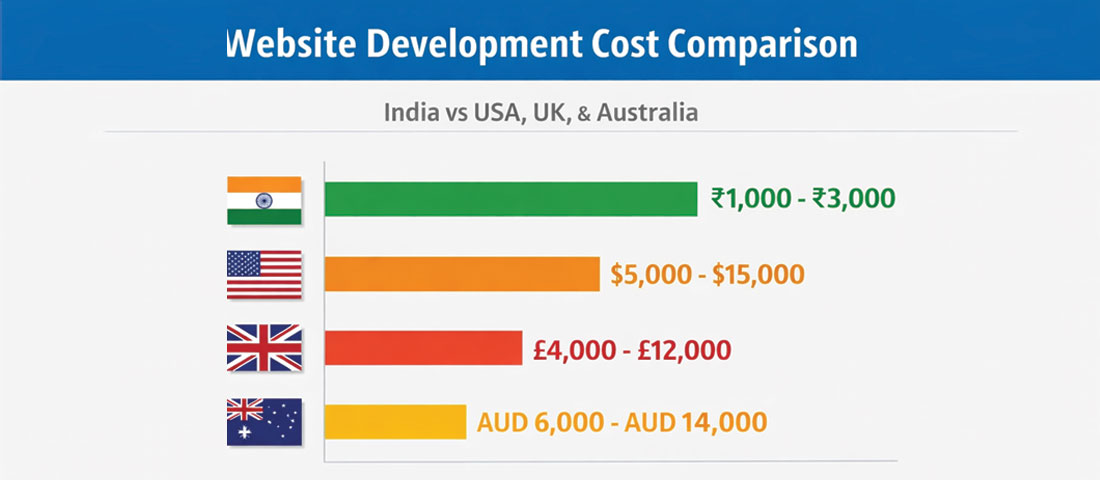
The cost differential between professional Indian web design agencies and comparable agencies in Western markets is consistently 50–70% — representing significant savings on every project.
A professional business website that would cost between $8,000 and $20,000 from a quality agency in the USA or UK can typically be built to equivalent quality by a leading Indian agency for $2,500 to $7,000. A Shopify eCommerce store requiring custom design and development that would cost $15,000 to $40,000 in Australia can be delivered for $5,000 to $15,000 from a comparable Indian agency.
These are not estimates based on compromising on quality, cutting corners on process, or working with inexperienced teams. They reflect the genuine difference in labour costs between India’s technology sector and Western markets — the same structural cost advantage that has made India the world’s leading destination for technology outsourcing across software development, IT services, and digital marketing for the past three decades.
The cost differential is not a signal of inferior quality — it is a signal of a different cost structure. A senior web designer in Mumbai with ten years of experience and an international portfolio earns a salary that reflects the Indian cost of living and labour market, not the London or New York equivalent. The skill is the same. The output can be the same. The cost is structurally different.
Why Quality From Leading Indian Agencies Matches Western Standards
The quality question is the one that most businesses researching Indian outsourcing spend the most time on — and rightly so. The honest answer is that quality varies enormously across the Indian web design market, just as it does in any market. The difference is that the top tier of Indian web design agencies — those with genuine international client experience, structured processes, and strong portfolios — produce work that is indistinguishable in quality from the best agencies in the USA or UK.
Several factors have driven the convergence of Indian and Western web design quality over the past decade:
- International exposure. India’s leading web design agencies have been serving international clients for years — working to Western brand standards, Western UX expectations, and Western SEO requirements. This exposure creates a design sensibility and a quality benchmark that is calibrated to international standards, not just domestic ones.
- Technology standardisation. The tools, frameworks, and platforms used by professional web designers are the same globally — WordPress, Figma, React, Shopify, and the rest are not Western tools that Indian designers are approximating. Indian designers and developers work in the same technological ecosystem as their Western counterparts.
- Remote work normalisation. The past five years have validated that geography is not a quality determinant. Teams distributed across continents, working on shared tools, through video calls and collaborative platforms, produce work of equivalent quality to co-located teams. The friction of remote international collaboration has decreased significantly.
- Portfolio evidence. The most reliable quality indicator is the portfolio of comparable international work. Leading Indian agencies like Neel Networks have built substantial portfolios of work for clients in the USA, UK, Canada, and Australia — work that these clients have used to grow their businesses and that demonstrates both design quality and technical competence.
Specific Advantages for USA Businesses Outsourcing to India
For American businesses, outsourcing web design to India offers advantages beyond cost that are specifically relevant to the US context:
- Significant cost reduction without quality compromise. The 50–70% cost saving compared to US agencies allows American businesses to invest the saved budget in other growth activities — paid advertising, content marketing, sales, or simply improving margins.
- Time zone advantage for overnight delivery. India’s time zone (IST, UTC+5:30) creates a natural “follow the sun” workflow with US businesses. Work briefed at end of US business day can be in progress or completed by the time the US team returns the following morning — effectively extending the working day.
- Strong English communication. India has the world’s largest English-speaking professional population. Communication with professional Indian agencies is conducted entirely in English, with strong written and verbal proficiency across the team.
- Shopify and WordPress expertise. Indian web agencies serving the US market have deep expertise in the platforms most commonly used by American businesses — Shopify for eCommerce and WordPress for content-driven websites — with many agencies having certified specialists in both.
Specific Advantages for UK Businesses
The UK-India connection in technology services is longstanding and well-established. For British businesses, the key advantages of working with an Indian web design agency include:
- Shared professional standards. India’s professional and legal systems have historical alignment with UK standards, giving British businesses a baseline of comfort around contracts, IP ownership, and professional conduct that may be less familiar with agencies in some other outsourcing markets.
- Similar design sensibilities. Indian agencies with strong UK client experience develop a design sensibility aligned with British aesthetic preferences — more restrained and quality-oriented than some other international design cultures.
- Cost reduction in a high-cost market. UK web design agency rates are among the highest globally. The cost saving from Indian outsourcing is proportionally significant — a £15,000 UK agency project can often be delivered for £5,000 to £7,000 from a comparable Indian agency.
- Favourable time zone. India’s time zone (IST) overlaps with UK business hours in the morning — allowing real-time collaboration during the first half of the UK working day.
Specific Advantages for Canadian and Australian Businesses
For Canadian businesses, the same English-language communication advantage applies as for US clients, combined with comparable cost savings relative to Canadian agency rates. The time zone with Indian agencies (approximately 9.5 to 10.5 hours ahead of major Canadian business centres) creates an asynchronous workflow that many Canadian businesses manage effectively with structured communication processes.
For Australian businesses, the outsourcing advantage is particularly pronounced. Australian web design agency rates are among the highest globally, and the cost saving from Indian outsourcing is substantial. The Shopify expertise of leading Indian agencies is particularly relevant for Australian businesses, where Shopify is the dominant eCommerce platform and the Australian eCommerce market is growing rapidly. Indian agencies with Australian client experience are familiar with local payment gateways, shipping integrations, and the specific design preferences of Australian audiences.
How to Choose the Right Indian Web Design Agency
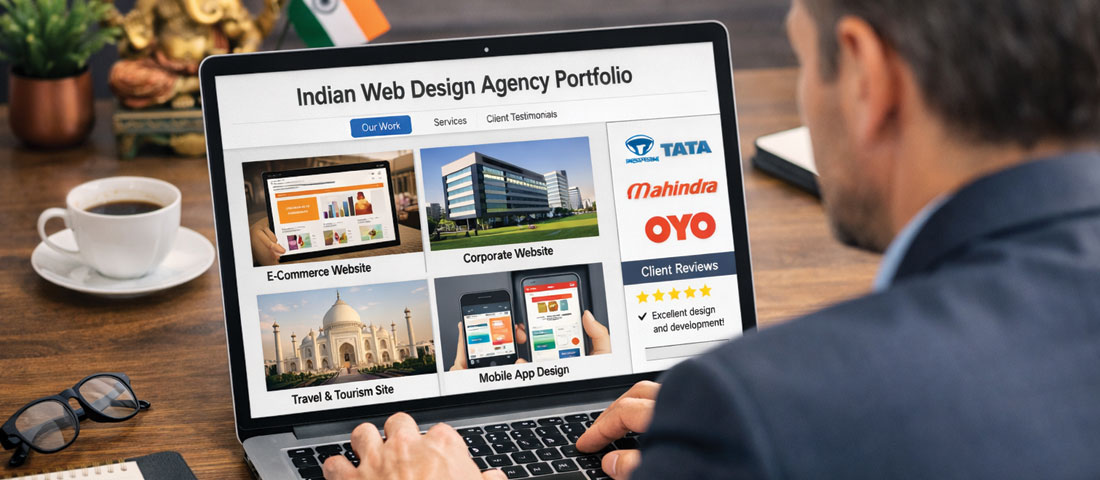
Thorough vetting of an Indian web design agency’s portfolio, process, and client references is the foundation of a successful outsourcing relationship.
The most important principle in choosing an Indian web design agency is the same as for any web design agency: evaluate evidence of results, not just promises. Here is a rigorous framework for making the right selection:
Step 1: Assess the Portfolio for International Work Quality
Look specifically at portfolio items for clients in your country or comparable markets. Does the design quality meet the standards of your market? Do the websites look contemporary and professional by the standards of your industry? Are there examples of work in sectors similar to yours? Request to see live portfolio URLs rather than just screenshots — live websites show performance, mobile responsiveness, and real content management in ways that screenshots cannot.
Step 2: Verify Years of Operation and Team Size
Established agencies with several years of operation and a team of multiple specialists are significantly more reliable partners than newer operations or sole traders positioning themselves as agencies. An agency that has been operating for five or more years, serving international clients, has demonstrated the stability and capability to be a reliable long-term partner. Ask specifically about team size and structure — who will work on your project and what are their roles?
Step 3: Evaluate Communication Quality Directly
Communication quality in an outsourcing relationship is as important as technical quality. Before committing, have multiple conversations with the agency team — not just email exchanges but video calls. Assess: Is communication clear and responsive? Do they ask intelligent questions about your business? Do they explain their process and recommendations in plain language? Communication patterns before the project start are reliable predictors of communication during it.
Step 4: Ask About Specific Technical Capabilities
Verify that the agency has demonstrable expertise in the specific technologies your project requires. If you need a Shopify store, ask to see Shopify portfolio items and discuss their Shopify development approach. If you need WordPress, ask about their preferred themes and page builders and why. If you need a custom web application, ask about their backend framework experience and how they handle testing and deployment.
Step 5: Understand Exactly What Is Included in the Quote
Indian agency quotes can vary significantly in what they include. Ensure you understand: Is SEO setup (schema markup, meta data, Google Analytics) included or extra? Who provides website copy? Is there a free support period after launch? How many design revisions are included? What does the handover process look like? Getting explicit clarity on these points before signing prevents the most common sources of post-project disappointment.
Step 6: Check Google Reviews and Third-Party Testimonials
Google Business reviews, Clutch.co reviews, and direct client references are the most reliable indicators of an Indian agency’s track record with international clients. Look for reviews that mention communication quality, delivery against timeline, and post-launch support — these are the dimensions that matter most in an outsourcing relationship and where the biggest variations in experience occur.
How to Structure the Relationship for Best Outcomes
Even with the right agency selected, the success of an outsourced web project depends significantly on how the relationship is structured and managed. Here is what experienced outsourcing clients do differently:
-
Invest heavily in the briefing process
The quality of a web project output is largely determined by the quality of the initial brief. An unclear, incomplete, or ambiguous brief produces an output that does not match expectations — regardless of the agency’s skill. Spend time documenting your requirements clearly: your business objectives, your target audience, your competitors, your must-have features, your design preferences, your content strategy, and your timeline. The more specific the brief, the more aligned the output will be with your expectations. -
Establish a structured communication cadence
Agree at the project start on: the communication channels you will use (email, WhatsApp, video calls, project management tool); the frequency of scheduled status updates; the expected response time for each channel; and who on each side is responsible for communication. A clear communication agreement prevents the most common source of outsourcing frustration — feeling out of the loop on project progress. -
Provide clear, consolidated feedback at each milestone
When the agency presents design mockups, development previews, or content drafts, invest time in reviewing them thoroughly and providing consolidated, specific feedback in a single communication rather than drip-feeding comments over multiple messages. Clear, consolidated feedback is more efficient for both parties and produces better outcomes than iterative unclear feedback. -
Trust the process, but ask questions freely
A professional agency has a refined process for good reasons. Trust that process while remaining engaged enough to ask questions when you do not understand a decision or recommendation. The best client-agency relationships balance agency expertise with client knowledge of their business — neither purely deferring to the agency on everything nor micromanaging every detail. -
Plan for a handover and training phase
Ensure the project scope includes a structured handover — training your team on how to update content, a documented guide to the CMS, and a clear process for raising post-launch support requests. A website delivered without proper handover is less valuable than one your team can manage confidently from day one.
Common Outsourcing Mistakes and How to Avoid Them
| Mistake | Why It Happens | How to Avoid It |
|---|---|---|
| Choosing on price alone | Focusing on the lowest quote without evaluating quality evidence | Evaluate portfolio quality and client references before comparing quotes |
| Vague initial brief | Assuming the agency will figure out requirements during the project | Document requirements in detail before the project starts |
| Inconsistent communication | No agreed communication structure; feedback provided sporadically | Agree communication cadence and channels at project kickoff |
| Slow feedback causing delays | Client-side delays in reviewing and approving milestone deliverables | Block time in your calendar for project reviews at each milestone |
| Scope creep without cost awareness | Adding requirements mid-project without tracking their cost impact | Document all scope changes formally and agree cost/timeline impact before proceeding |
| No post-launch support plan | Treating the website as a one-time project with no ongoing relationship | Agree a post-launch maintenance retainer or support plan before launch |
Why Neel Networks Is the Right Indian Partner for Your Business
Neel Networks has been delivering web design and development for international clients since 2014. Our team of 15+ specialists — covering design, front-end and back-end development, SEO, mobile app development, and support — is based in Mumbai and has served 450+ clients across the USA, UK, Canada, Australia, and worldwide.
What distinguishes our international client relationships is not just the technical output — it is the communication, the process rigour, the proactive project management, and the post-launch partnership that makes clients feel as though they are working with a local agency that simply happens to be located in India. Our Google reviews (43 reviews, 4.9 star average) reflect the experience that international clients consistently describe: professional, communicative, high-quality, and excellent value.
Frequently Asked Questions About Outsourcing Web Design to India
| How much can a business save by outsourcing web design to India? | Businesses typically save 50 to 70% compared to equivalent agencies in the USA, UK, Canada, or Australia by working with a professional Indian web design agency. A website that costs $10,000 to $20,000 from a quality US agency can typically be built to the same standard for $3,000 to $8,000 from a leading Indian agency. The saving reflects structural differences in labour costs between India and Western markets, not differences in quality or output. |
| Is the quality of Indian web design agencies comparable to Western agencies? | The top tier of Indian web design agencies — those with established international client experience, structured processes, and strong portfolios of work for Western clients — produce output that is comparable in quality to leading agencies in the USA, UK, and Australia. The Indian web design market has significant quality variance, which makes vetting important. Portfolio review, direct client references, and communication quality assessment are the most reliable ways to identify agencies whose quality matches Western standards. |
| How do I manage communication with an Indian web design agency across time zones? | Successful communication with Indian agencies across time zones requires a structured approach: agree at the project start on communication channels (email, WhatsApp, video calls), expected response times for each channel, and a regular scheduled video call cadence (weekly is typically sufficient for active project phases). India Standard Time (IST, UTC+5:30) overlaps with UK morning hours and can be managed with early morning or evening overlap for US and Australian clients. Most professional Indian agencies are experienced at asynchronous communication and provide regular structured updates that reduce the need for real-time availability. |
| What should I look for when choosing an Indian web design agency? | The most important things to evaluate when choosing an Indian web design agency are: a portfolio of work for international clients that demonstrates quality comparable to your market’s standards; years of operation and team size that indicate established stability; English communication quality assessed through direct conversations, not just email; specific technical expertise in the platforms your project requires; transparent, detailed quoting that specifies exactly what is and is not included; and Google or Clutch reviews from international clients that address communication and post-launch support quality. |
| Does Neel Networks have experience with Shopify for UK and Australian eCommerce businesses? | Yes — Neel Networks has extensive Shopify development experience for eCommerce businesses across the UK, Australia, Canada, and the USA. Our Shopify projects include custom theme design and development, app integration, payment gateway configuration for local markets (including local Australian and UK payment providers), shipping integration, and ongoing Shopify maintenance and support. We have specific familiarity with the eCommerce requirements of UK and Australian markets, including local tax and GST handling, local payment preferences, and the design standards of these markets. |
| What is the typical timeline for a website project with an Indian web design agency? | The timeline for a website project with a professional Indian agency is comparable to a quality Western agency — not significantly faster or slower. A focused business website (10 to 20 pages) typically takes 6 to 10 weeks from project kickoff to launch. Larger, more complex projects — eCommerce stores, custom web applications, multi-language websites — typically take 10 to 20 weeks depending on scope. Time zone differences add a small amount of communication latency but do not significantly extend timelines when communication is structured effectively. The most common cause of timeline extension is slow client-side feedback and content delivery — which is true regardless of where the agency is based. |
Ready to experience the quality and value of working with a leading Indian web design agency?
Talk to the Neel Networks team about your project. We will give you a clear, honest quote and a realistic timeline — and the portfolio evidence to back up our promises.