Organic SEO vs PPC in 2026: Which Strategy Delivers Long-Term Growth?
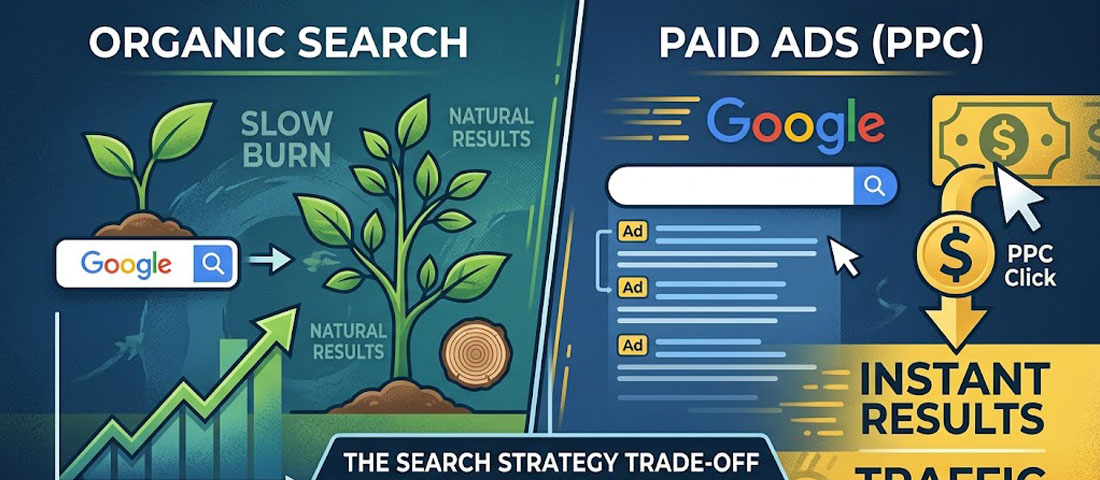
Every business with a digital marketing budget eventually confronts the same question: should we invest in organic SEO, paid advertising (PPC), or some combination of both? It is one of the most consequential decisions in digital marketing — and one of the most frequently made on incomplete information.
What this guide covers
- 1. How Organic SEO and PPC Work — The Fundamental Difference
- 2. Why Organic SEO Takes Time to Rank — The Honest Explanation
- 3. The Compounding Value of Organic Rankings Over Time
- 4. When PPC Is the Right Choice
- 5. Why SEO Is Not the Answer to All Your SERP Problems
- 6. The Right Mix Strategy for Different Business Stages
- 7. How AI-Powered Search Changes the Equation in 2026
- 8. Frequently Asked Questions About Organic SEO vs PPC
The debate is not new, but the landscape has shifted significantly in 2026. AI-powered search has changed how organic rankings translate into traffic. Google Ads’ AI bidding and Performance Max campaigns have changed how PPC delivers results. And the compounding value of organic authority has become more obvious as businesses that invested in SEO three to five years ago now enjoy traffic that paid advertisers cannot replicate regardless of budget.
This guide gives you the complete, honest picture — why organic SEO takes time, when PPC is the right tool, why SEO is not a universal answer to all search visibility problems, and how to make the right strategic choice for your specific business.
How Organic SEO and PPC Work — The Fundamental Difference
Organic SEO (Search Engine Optimisation) is the practice of improving your website’s visibility in the unpaid, algorithmic search results — the “natural” listings that appear below any advertisements on a search results page. Organic rankings are earned through the quality and relevance of your content, the authority of your website as assessed by backlinks and trust signals, the technical health of your site, and increasingly, your visibility in AI-generated search features. Organic traffic is free per click — you do not pay each time someone finds and visits your website from an organic search result.
PPC (Pay-Per-Click) advertising — primarily through Google Ads — places your website at the top of search results for specific keywords, with a cost charged each time a user clicks your ad. PPC delivers immediate visibility: your ad can appear at the top of Google within hours of setting up a campaign. But that visibility is entirely dependent on continued payment — the moment your budget runs out or your campaign is paused, your visibility disappears entirely.
This fundamental difference — organic rankings are an asset you build; PPC visibility is a service you rent — shapes everything about when and why each channel delivers value.
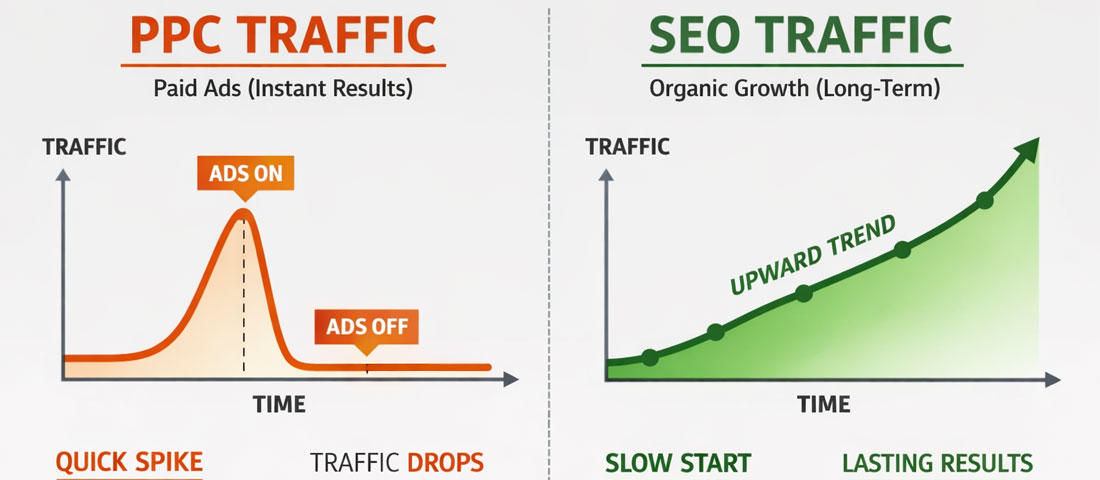
PPC delivers immediate traffic that disappears when spending stops. SEO builds a traffic asset that grows over time and continues delivering value without ongoing spend per click.
Why Organic SEO Takes Time to Rank — The Honest Explanation
One of the most common frustrations in digital marketing is discovering that SEO does not deliver results in weeks. Business owners who have invested in SEO and not yet seen meaningful ranking improvements often conclude that SEO does not work — when the reality is that they simply have not waited long enough for a fundamentally time-dependent process to complete.
Understanding why SEO takes time helps set realistic expectations and avoid premature strategy changes that reset the clock on a process that was actually progressing correctly.
Google’s Trust-Building Algorithm Takes Time by Design
Google’s algorithm has been designed — deliberately — to be resistant to quick manipulation. If new websites could immediately outrank established ones simply by publishing good content, the search results would be chaotic and easily gamed. Instead, Google builds trust in websites over time: observing how users interact with content, how other trusted websites reference and link to it, how consistently a domain produces quality content on a topic, and how well it performs across dozens of technical and quality signals. This trust-building process is inherently time-dependent and cannot be significantly accelerated.
New Content Needs to Be Crawled, Indexed, and Evaluated
Even technically perfect content published on a trusted domain does not appear in search results instantly. Google’s crawlers need to discover the content, index it, and then evaluate it against thousands of other documents on the same topic before determining where to rank it. For a new article on a competitive topic, this evaluation process — during which Google observes click-through rates, dwell time, return-to-SERP rates, and other engagement signals from real users — can take several months to fully complete.
Competitive Markets Take Longer Than Low-Competition Ones
A business trying to rank for “best web design company India” is competing against hundreds of established websites that have been publishing relevant content and accumulating backlinks for years. Displacing these established pages requires building comparable or superior authority — which takes time even with excellent content and active link building. A business trying to rank for a highly specific, low-competition long-tail query (“web design for physiotherapy practices in Perth”) faces a much shorter timeline because the competition is sparse.
The Domain Authority Factor
New domains — websites less than 12 to 18 months old — face a particularly extended ranking timeline because they have not yet accumulated the trust signals (backlinks, domain age, content history) that Google uses to assess authority. Even excellent content on a new domain typically takes 6 to 12 months to achieve competitive rankings for anything beyond very low-competition queries. This is not a permanent barrier — it is a developmental stage that all websites go through.
The Compounding Value of Organic Rankings Over Time
The counterpart to SEO’s slow start is its extraordinary long-term value. Unlike PPC — where you pay the same cost per click indefinitely and receive no cumulative benefit from past spending — organic SEO compounds over time in ways that create durable competitive advantages.
A piece of content that achieves a top-3 organic ranking continues generating traffic months and years after it was published, without additional cost per click. As a website builds topical authority, new content ranks faster and for more competitive terms. Backlinks earned for one piece of content raise the authority of the entire domain. And the visibility gap between an established organic presence and a competitor starting from scratch grows with every year of investment — creating an increasingly difficult-to-close advantage.
Businesses that invested seriously in SEO in 2020 and 2021 are now enjoying organic traffic volumes that would cost many thousands of dollars per month in PPC to replicate. That compounding advantage was not visible in month three of their SEO investment — but it is extremely visible five years later.
When PPC Is the Right Choice
Understanding when PPC is the right tool prevents both under-investment (relying on SEO when PPC would deliver better short-term ROI) and over-investment (using PPC as a permanent substitute for the organic authority you should be building).
PPC Is Right When You Need Immediate Visibility
A new business that cannot wait 6 to 12 months for organic rankings to develop needs PPC to generate leads in the interim. A product launch, a seasonal promotion, or a time-sensitive offer cannot wait for organic rankings. PPC delivers the immediate top-of-page visibility that these situations require.
PPC Is Right for High-Intent Commercial Queries
For commercial queries with strong purchase intent — “buy CRM software for small business,” “hire WordPress developer Mumbai,” “Shopify agency UK” — PPC can deliver extremely strong ROI because the audience is ready to act. The conversion rate for high-intent PPC traffic often justifies the cost per click, particularly for high-value B2B products and services.
PPC Is Right for Testing Before Organic Investment
Running a PPC campaign for target keywords before investing heavily in organic SEO for those same terms is excellent strategic practice. PPC provides fast feedback on which keywords actually convert into business outcomes — preventing investment in organic content for keywords that generate traffic but not leads. The PPC learnings inform the organic strategy.
PPC Is Right as a Complement to SEO, Not a Replacement
The highest-performing digital marketing strategies use SEO and PPC together. Appearing in both the paid results and the organic results for the same query increases total click share and brand credibility. PPC protects valuable keywords where organic rankings are strong but a competitor might outbid for the paid position.
Why SEO Is Not the Answer to All Your SERP Problems
Organic SEO is a powerful long-term growth strategy. It is not, however, a universal solution to every search visibility challenge. Understanding its limitations prevents the frustration that comes from expecting SEO to solve problems it is not designed to solve.
SEO Cannot Deliver Immediate Results
If your business needs leads next month from search — because a new product is launching, a campaign is starting, or revenue targets require immediate action — SEO is the wrong tool for that timeline. This is not a criticism of SEO; it is a realistic assessment of its time horizon. PPC, in this situation, is the appropriate tool.
SEO Does Not Guarantee Top Rankings for Highly Competitive Terms
For the most competitive commercial keywords in major markets — terms where every result in the top 10 comes from established, authoritative domains with thousands of backlinks — SEO investment can improve rankings but may not achieve first-page dominance regardless of execution quality. In these cases, the strategy should focus on less competitive long-tail terms, featured snippet opportunities, and AI search visibility rather than the primary head terms.
SEO Is Not Free — It Just Has a Different Cost Structure
A common mischaracterisation of organic SEO is that it is “free” compared to paid advertising. Organic traffic may be free per click, but producing the content, building the links, managing the technical health, and monitoring the performance of an SEO programme requires significant investment in agency fees, content creation, and management time. The difference is that this investment builds an asset rather than renting visibility — but it is not free, and treating it as such leads to under-investment in the activities (quality content, genuine link building) that actually produce results.
The Right Mix Strategy for Different Business Stages
| Business Stage | Recommended Mix | Rationale |
|---|---|---|
| New business (0–12 months) | 70% PPC, 30% SEO foundation | PPC generates immediate leads while organic foundation is being built. SEO investment establishes domain, content, and technical health for future growth. |
| Growing business (1–3 years) | 50% SEO, 30% PPC, 20% content | Organic rankings beginning to develop; PPC maintained for competitive terms and new campaigns; content investment accelerating topical authority. |
| Established business (3+ years) | 60% SEO, 20% PPC, 20% content | Organic authority delivering significant compounding traffic; PPC focused on highest-value commercial terms and protecting brand keywords; content maintaining and expanding coverage. |
| Mature business with strong organic | 70% SEO/content, 30% PPC | Organic traffic driving majority of leads; PPC protecting competitive positions and supporting specific campaigns; compounding advantage strongly established. |
How AI-Powered Search Changes the Equation in 2026
The emergence of Google AI Overviews, Perplexity, and ChatGPT as search channels has added a third dimension to the SEO vs PPC debate that did not exist three years ago.
Organic SEO done well — with strong topical authority, comprehensive content, and AEO (Answer Engine Optimisation) — now delivers visibility not just in traditional blue-link rankings but in AI Overviews, voice search responses, and generative AI platforms. This expands the reach and value of organic SEO investment beyond what ranking positions alone would suggest.
PPC, on the other hand, currently has limited reach into AI-generated search results. Google Ads appear in traditional search results and some AI Overview contexts, but the majority of AI-generated answers on Google, Perplexity, and ChatGPT are driven by organic authority, not paid placement. This means businesses that rely entirely on PPC for search visibility are invisible in a growing and commercially significant portion of search behaviour.
The practical implication: in 2026, the long-term case for organic SEO investment is stronger than it has ever been — because organic authority now underpins visibility not just in traditional search but across the entire AI search ecosystem.
Frequently Asked Questions About Organic SEO vs PPC
| Is organic SEO better than PPC? | Neither organic SEO nor PPC is universally better — they serve different needs, operate on different timelines, and deliver different types of value. Organic SEO builds a durable traffic asset that compounds over time, delivers free per-click traffic once rankings are established, and is increasingly valuable in the AI-powered search era. PPC delivers immediate visibility, is easily adjusted or paused, and provides precise targeting and attribution. The most effective digital marketing strategies use both: PPC for immediate results and testing, organic SEO for long-term compounding growth. The right balance depends on your business stage, timeline, and competitive landscape. |
| Why does organic SEO take so long to show results? | Organic SEO takes time because Google’s ranking algorithm is deliberately designed to build trust gradually — resisting quick manipulation. New content must be discovered, crawled, indexed, and evaluated against thousands of competing documents before rankings stabilise. This evaluation process includes observing real user engagement signals (click-through rates, dwell time) which takes weeks or months of traffic. Competitive markets take longer than low-competition ones. New domains take longer than established ones. And link building — a key ranking factor — requires time to earn authentic links from authoritative sources. These are features of a well-functioning algorithm, not limitations that can be shortcut without risk. |
| How long should I run PPC before switching to SEO? | The question assumes a switch, when the more effective strategy is running both in parallel. PPC provides immediate leads while organic SEO is being built — typically a 6 to 12 month period for meaningful organic results to develop. As organic rankings strengthen, you can reduce PPC spend on terms where you rank well organically and redirect the budget toward competitive terms where PPC remains necessary or toward expanding organic content investment. There is no single switch-over moment; the mix evolves gradually as organic authority builds and the ROI comparison between the two channels shifts in organic’s favour. |
| Can PPC replace SEO for a business? | PPC can replace the traffic and leads that SEO would deliver — but only at ongoing cost, with no asset being built, and with zero visibility in AI-generated search results. Businesses that rely entirely on PPC never build the organic authority that delivers compounding returns. They also remain entirely dependent on advertising platforms whose costs and policies can change. PPC is a powerful channel and the right primary channel for early-stage businesses and specific campaign objectives. But using PPC as a permanent substitute for organic SEO leaves compounding long-term growth on the table and creates fragile dependence on paid platforms. |
| Is SEO still worth investing in with AI Overviews taking clicks? | Yes — and arguably more so in 2026 than before. Google AI Overviews cite and link to sources, and research shows that pages cited within AI Overviews can receive more clicks than traditional organic results at the same position. More importantly, organic authority is what earns AI Overview citations — paid placement does not. Perplexity, ChatGPT in search mode, and voice search are all driven primarily by organic authority signals, not paid placement. The businesses building strong organic authority today are building visibility across the entire AI search ecosystem — which is why the long-term case for SEO investment has strengthened, not weakened, as AI search has grown. |
| What budget should I allocate to SEO vs PPC? | Budget allocation between SEO and PPC should reflect your business stage and marketing objectives. Early-stage businesses with immediate lead generation needs typically allocate more budget to PPC (60 to 70%) while building organic foundations. Established businesses with 2 to 3 years of SEO investment can often shift to a more balanced or SEO-weighted allocation (50 to 60% SEO) as organic traffic grows. The most important principle is to not treat SEO and PPC as competing for the same budget — they serve different purposes and the right budget allocation supports both rather than choosing between them. |
| What is the difference between organic search and paid search? | Organic search results are the non-paid listings that appear in Google and other search engines based on relevance and authority, as determined by the search engine’s algorithm. They are “earned” through SEO and carry no per-click cost once established. Paid search results are advertisements that appear at the top and bottom of search results pages, marked with an “Ad” or “Sponsored” label, charged on a per-click basis through platforms like Google Ads. Organic results tend to receive more trust from users, deliver better long-term ROI, and are now increasingly important for AI search visibility. Paid results deliver immediate control over visibility, precise audience targeting, and faster testing of messaging and offers. |
Not sure whether SEO, PPC, or a combination is right for your business?
Neel Networks helps businesses across the USA, UK, Canada, and Australia build the right digital marketing mix for their specific stage, market, and growth objectives. Start with a free audit — we will give you an honest assessment of your current organic performance and what the right strategy looks like for you.