Headless Commerce Explained: Is It Worth It for Your Shopify or WooCommerce Store?
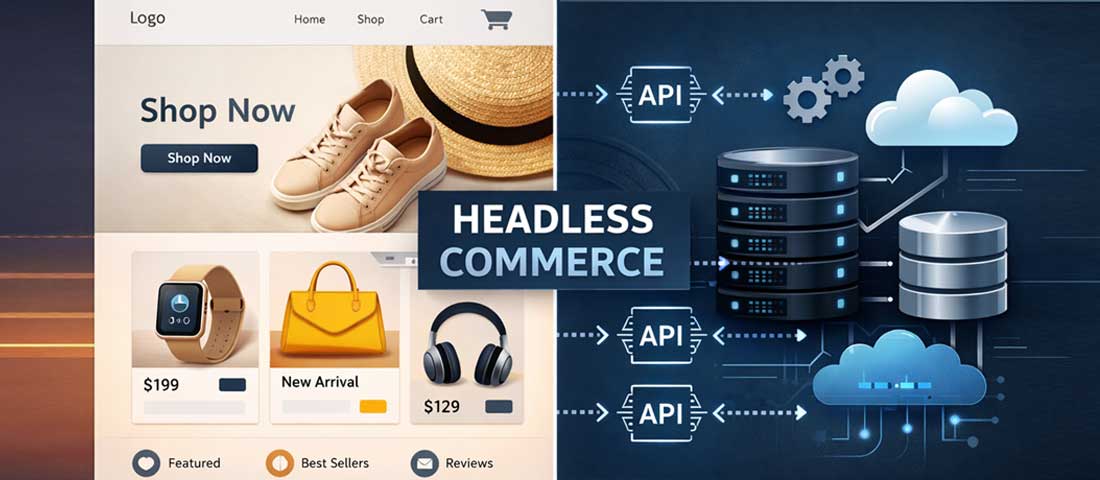
The phrase “headless commerce” has been everywhere in eCommerce conversations for the past two years — in agency proposals, in Shopify conference talks, in marketing from every major commerce platform. And if you have ever looked into it, you have probably encountered two very different reactions: agencies telling you it is the future of eCommerce and you need to adopt it immediately, and other businesses telling you they tried it and regretted the complexity and cost.
What this guide covers
- 1. What Is Headless Commerce — Explained Without the Jargon
- 2. What Headless Commerce Actually Makes Possible
- 3. Headless Shopify — Hydrogen, Oxygen, and the Storefront API
- 4. Headless WooCommerce — REST API, WPGraphQL, and Decoupled Options
- 5. The Real Costs and Trade-Offs of Going Headless
- 6. Is Headless Worth It for Your Store? A Decision Framework
- 7. Who Is Building Headless Stores in 2026 — and Why
- 8. Frequently Asked Questions About Headless Commerce
Both reactions can be correct — because headless commerce is a genuinely powerful architectural approach for specific situations, and a genuinely unnecessary complication for many others. The question is never “is headless commerce good?” but always “is headless commerce right for my specific business, at my specific stage, with my specific team?”
This guide gives you the complete, honest picture — what headless commerce actually is (without the jargon), what it makes possible that traditional commerce cannot, what it costs in money and complexity, and the specific business profiles where it is and is not worth pursuing on Shopify and WooCommerce specifically.
What Is Headless Commerce — Explained Without the Jargon
Traditional eCommerce platforms — Shopify with a standard Liquid theme, WooCommerce with a WordPress theme — are what developers call “monolithic” or “coupled” architectures. The backend (the engine managing your products, inventory, orders, customer data, and payments) and the frontend (the website or app that your customers actually see and interact with) are built together as one system. Change the theme and you change the customer experience. The frontend and backend are tightly coupled — they depend on each other and live together in the same platform.
Headless commerce decouples them. The backend stays exactly as it is — Shopify or WooCommerce managing all your commerce logic, inventory, checkout, and payments. But the frontend is separated and rebuilt as an independent application, typically using a modern JavaScript framework (Next.js, Nuxt.js, Remix, Astro). That independent frontend communicates with the backend exclusively through an API — a standardised channel through which the frontend asks for data (“give me the products in this category”) and the backend responds with it.
The name comes from the analogy: the “head” (the frontend that customers see) is removed from the “body” (the backend commerce engine) and rebuilt independently. The body still does all the work. The head is simply reimagined.
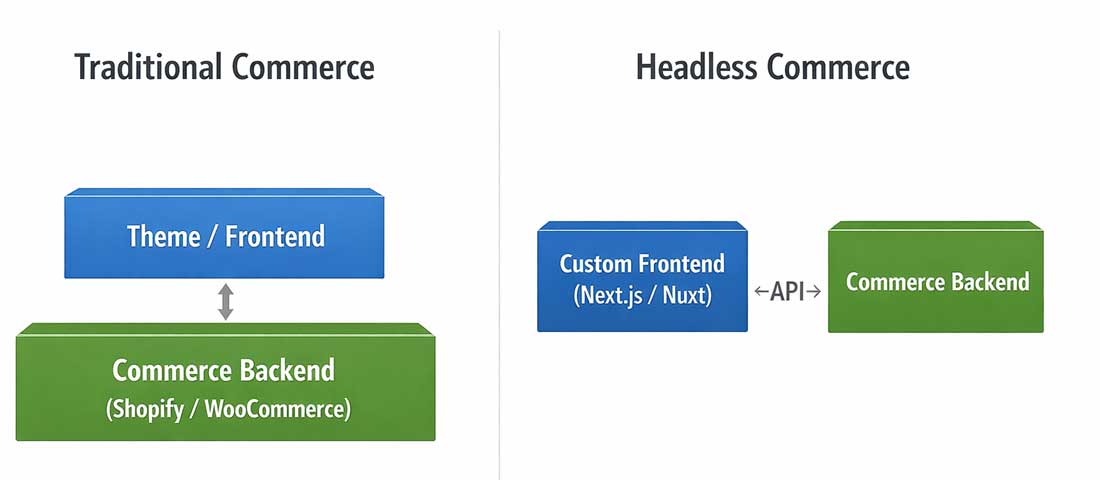
The core architectural difference: traditional commerce tightly couples frontend and backend; headless separates them with an API layer, giving each side independence to evolve separately.
What Headless Commerce Actually Makes Possible
Understanding why businesses choose headless requires understanding what becomes possible when the frontend and backend are separated — capabilities that are difficult or impossible to achieve in a traditional coupled architecture.
One Backend, Multiple Frontends
The most compelling headless capability is the ability to serve multiple channels — a website, a mobile app, a progressive web app, a kiosk, an in-store tablet, a voice interface — from the same commerce backend. In a traditional Shopify store, your website and mobile app are separate systems with separate product data management and separate checkout flows. In a headless architecture, both the website and the mobile app query the same Shopify backend through the same API — product updates, inventory changes, and order data flow automatically to every frontend channel simultaneously.
For businesses where omnichannel selling is commercially significant — where customers genuinely move between an app, a website, and a physical store — this single source of truth for commerce data is a substantial operational advantage.
Unrestricted Frontend Performance
The most immediately measurable headless benefit is performance. Standard Shopify Liquid themes and WordPress/WooCommerce themes have performance ceilings — they render pages on the server for each request, serve all assets from a single origin, and are constrained by the platform’s rendering architecture. A well-built headless frontend using Next.js with static site generation (SSG) or incremental static regeneration (ISR) can serve most product pages as pre-rendered static HTML from a global CDN — achieving sub-second load times and near-perfect Core Web Vitals scores that traditional theme rendering typically cannot match.
The correlation between load time and conversion rate is well established — and for high-volume eCommerce where even a 0.1-second improvement measurably affects revenue, the performance ceiling removal of headless is a direct commercial argument.
Complete Design Freedom
Shopify’s Liquid theme system is flexible but it operates within Shopify’s rendering model. WooCommerce’s PHP templates are customisable but they are still constrained by WordPress’s page lifecycle. A headless frontend has no such constraints — it is a completely custom application that can implement any design, any animation, any interaction pattern, any component architecture that the development team can build. Brands with highly specific visual requirements that their traditional theme cannot accommodate find headless liberating in this regard.
Composable Commerce Architecture
Headless enables what the industry calls “composable commerce” — building a commerce stack by composing best-of-breed services rather than using a single platform’s built-in everything. Your commerce data in Shopify, your content managed in a headless CMS (Contentful, Sanity), your search powered by Algolia, your reviews on Yotpo, your personalisation engine from a specialist vendor — all composed through APIs into a unified customer experience. Each component is replaceable independently; the whole is more capable than any single platform could be.
Headless Shopify — Hydrogen, Oxygen, and the Storefront API
Shopify has invested significantly in making headless development accessible — recognising that enterprise and high-growth merchants increasingly want the flexibility of headless with the reliability of Shopify’s commerce backend.
Shopify Storefront API
The Storefront API is the core of headless Shopify — a GraphQL API that gives external frontends access to Shopify’s commerce data: products, collections, collections, inventory, customer accounts, carts, and checkout. Any frontend application — a Next.js site, a React Native app, a custom PWA — can query the Storefront API to retrieve and display Shopify’s product data and process purchases through Shopify Checkout.
The Storefront API is available on all Shopify plans, making headless technically accessible to any Shopify merchant — though the development cost of building a custom frontend means it is commercially viable primarily for established businesses.
Hydrogen — Shopify’s React Framework
Hydrogen is Shopify’s opinionated React-based framework specifically designed for building headless Shopify storefronts. It provides: pre-built Shopify-specific components (Product, Collection, Cart, Customer Account), built-in performance optimisations for commerce patterns, native Shopify Storefront API integration, and a development experience designed around commerce-specific workflows. Hydrogen significantly reduces the development time of building a headless Shopify frontend compared to building from scratch with a generic Next.js setup.
Oxygen — Shopify’s Headless Hosting
Oxygen is Shopify’s hosting platform specifically for Hydrogen storefronts — globally distributed edge hosting that deploys Hydrogen applications to a CDN with automatic scaling. Oxygen hosting is included in Shopify’s plans, eliminating the need for separate hosting infrastructure (Vercel, Netlify, or Cloudflare Pages) for Hydrogen deployments. For merchants using Hydrogen, Oxygen simplifies the deployment pipeline significantly.
Headless Shopify in Practice
A typical headless Shopify project uses: Shopify as the commerce backend (products, inventory, orders, checkout, payments), Hydrogen as the frontend framework, Oxygen as the hosting environment, and optionally a headless CMS (Contentful, Sanity) for content management alongside the product data. The Shopify admin remains unchanged — merchants manage products, inventory, and orders exactly as they always have. The difference is entirely in how the customer-facing experience is built and served.
Headless WooCommerce — REST API, WPGraphQL, and Decoupled Options
WooCommerce’s headless architecture is more varied and more complex than Shopify’s — reflecting WordPress’s more open, developer-controlled nature. There is no single “right” way to go headless with WooCommerce; the approach depends on your frontend framework, content management requirements, and development team’s expertise.
WooCommerce REST API
WooCommerce has a built-in REST API that exposes products, orders, customers, coupons, and most commerce data as JSON endpoints. A headless frontend can query these endpoints to retrieve product data and submit orders. The REST API is functional but verbose — endpoints return large payloads and the API design is not optimised for the efficient, field-specific queries that modern frontends prefer.
WPGraphQL + WooGraphQL
The more modern and more popular headless WooCommerce approach uses WPGraphQL (a WordPress plugin that exposes WordPress and WooCommerce data as a GraphQL API) alongside WooGraphQL (an extension that adds WooCommerce-specific types to the GraphQL schema). This combination enables efficient, flexible querying of WooCommerce data — requesting exactly the fields needed rather than the full REST API payload — and is the approach most headless WooCommerce projects use in 2026.
Gatsby and Next.js are the most common frontend frameworks for headless WooCommerce projects: Gatsby for primarily static content sites with a WooCommerce store, Next.js for more dynamic commerce applications requiring server-side rendering or incremental static regeneration.
Fully Decoupled WordPress + WooCommerce
A fully decoupled WordPress/WooCommerce setup separates the WordPress/WooCommerce installation entirely from the customer-facing frontend. WordPress serves purely as a data management system — merchants manage products and content in the familiar WordPress admin, but no WordPress theme is served to customers. The frontend is an entirely separate Next.js or Nuxt application that queries WordPress through the GraphQL API.
The Real Costs and Trade-Offs of Going Headless
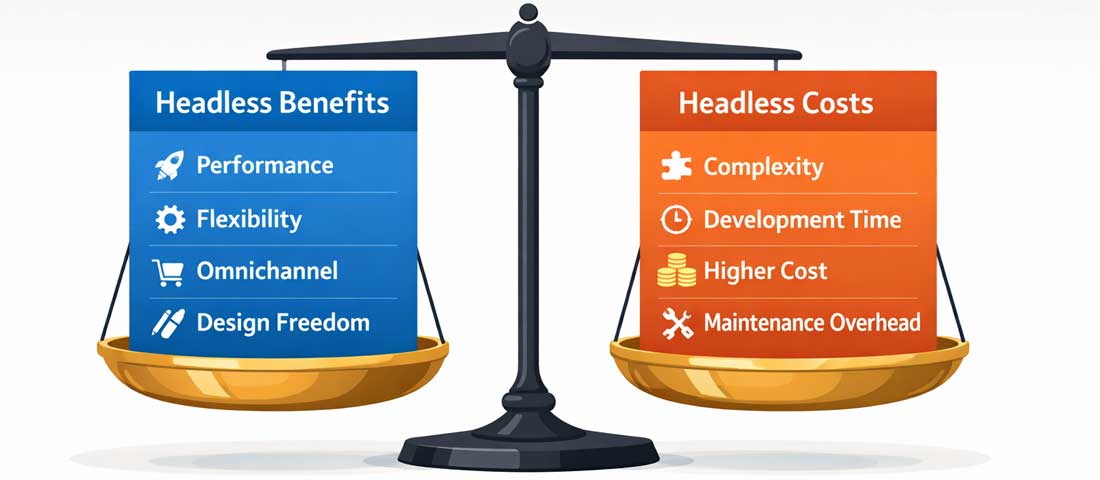
Headless commerce is a genuine trade-off, not a universal upgrade — the benefits are real but so are the costs. Understanding both sides is essential before committing.
The headless commerce conversation in agency and vendor marketing is almost exclusively focused on the benefits. The costs and trade-offs get less airtime. Here they are, honestly.
Significantly Higher Development Cost and Time
A standard Shopify theme or WooCommerce theme can be launched in 6 to 12 weeks at a cost of $3,000 to $15,000 for a quality custom project. A headless equivalent — building a custom Next.js or Hydrogen frontend, configuring the API integration, setting up CI/CD deployment pipelines, and implementing all the commerce features that themes provide out of the box — typically takes 12 to 24 weeks and costs $20,000 to $100,000+ depending on complexity and the development team’s location and expertise.
This is not a knock on headless — the investment can be justified by the commercial return. But it is a real number that many headless enthusiasts do not lead with, and it is the primary reason most small and medium eCommerce businesses should not pursue headless.
Loss of Theme Ecosystem and App Compatibility
Shopify’s theme ecosystem and app store are built for Liquid themes. Many Shopify apps — reviews, loyalty programmes, upsells, email popups — inject JavaScript or HTML directly into Liquid templates. In a headless Shopify setup, these apps either do not work, require custom integration work to function in the new frontend architecture, or need to be replaced with API-compatible alternatives. Every Shopify app you currently rely on needs to be assessed for headless compatibility before committing to the migration.
The same applies to WooCommerce — many plugins use WordPress hooks and filters that assume a WordPress-rendered frontend. In a fully decoupled setup, plugin functionality that depends on rendering in a WordPress theme becomes unavailable and must be rebuilt or replaced.
Ongoing Maintenance Complexity
A traditional Shopify or WooCommerce store has one codebase to maintain. A headless setup has at minimum two: the commerce backend (Shopify or WooCommerce) and the frontend application. When Shopify updates its Storefront API or WooCommerce updates its GraphQL schema, the frontend application may need corresponding updates. When the frontend framework (Next.js, Hydrogen) releases a major version, the application needs updating. Two separate systems, two separate maintenance tracks, two separate areas where things can break.
Checkout Limitations
For Shopify headless specifically: while the product browsing and cart experience can be fully custom, Shopify’s checkout is not fully customisable in headless configurations on standard plans. The checkout flow redirects to Shopify’s hosted checkout (checkout.shopify.com), which is Shopify-controlled in design and flow. Full checkout customisation requires Shopify Plus ($2,300+/month) and Shopify’s Checkout Extensibility or custom checkout with Shopify Functions.
Team Expertise Requirements
Building and maintaining a headless commerce frontend requires developer expertise in modern JavaScript frameworks (React, Next.js, or Hydrogen), GraphQL API integration, CDN and deployment infrastructure, and commerce-specific performance optimisation. This is a significantly different and more specialised skill set than Shopify theme development or WooCommerce customisation. Either your internal team needs these skills, or you need a development partner with them — at corresponding cost.
Is Headless Worth It for Your Store? A Decision Framework
Rather than a universal recommendation, here is an honest decision framework based on the specific characteristics that make headless commerce justified versus unjustified for a given business.
| Question | Points Toward Headless | Points Toward Traditional |
|---|---|---|
| Annual eCommerce revenue | Above $1M — ROI of performance gains can justify cost | Below $500K — development cost exceeds likely return |
| Number of sales channels | Multiple: website + app + kiosk + social commerce | Single: website only |
| Current Core Web Vitals | Failing despite optimisation — platform ceiling hit | Passing or improvable with standard optimisation |
| Design requirements | Highly specific interactions impossible in standard themes | Standard eCommerce UX patterns — theme-achievable |
| Content complexity | Rich editorial content alongside commerce (media brands, etc.) | Standard product catalogue — commerce-first content |
| Development team | In-house or agency with React/Next.js/Hydrogen expertise | Limited technical resource — standard theme development |
| Shopify app reliance | Minimal app dependency — mostly API-compatible | Heavy reliance on apps that inject into theme templates |
| International markets | Multiple regions needing localised experiences from one backend | Single market with standard localisation needs |
The honest recommendation for most businesses: If your eCommerce revenue is below $500K/year, you have a single website channel, your current theme is not hitting a hard performance ceiling, and you do not have specific design requirements that are impossible in a standard theme — you do not need headless commerce. A well-built, well-optimised Shopify or WooCommerce store with the right theme, the right caching, and quality hosting will deliver 95% of the performance and flexibility that headless offers, at a fraction of the cost and complexity.
Who Is Building Headless Stores in 2026 — and Why
Understanding which types of businesses are actually going headless — and what is driving that decision — grounds the discussion in real commercial context rather than architecture theory.
High-Volume Fashion and Consumer Brands
Fashion brands with monthly traffic in the millions, where a 200-millisecond improvement in page load time measurably impacts conversion rate, and where the visual experience is a primary brand differentiator. The headless investment is justified by the commercial scale at which performance improvements pay off. Brands like Allbirds and Gymshark have made this case publicly.
D2C Brands With Mobile App + Website
Direct-to-consumer brands that need a website and a mobile app to serve the same product catalogue and customer accounts without maintaining two separate commerce backends. The headless architecture solves the omnichannel data problem at a specific scale where the investment is commercially rational.
Media Brands Selling Products
Publishers, media companies, and content-first brands that sell products alongside editorial content — where the content management requirements exceed what Shopify’s native content tools can handle, but where Shopify’s commerce infrastructure is the right choice for the retail component. A headless architecture with Shopify for commerce and Sanity or Contentful for content management is a natural fit.
Enterprise B2B Commerce
B2B eCommerce operations with complex pricing rules (customer-specific pricing, contract pricing, tiered discounts), multiple buyer accounts, approval workflows, and integration with ERP and CRM systems. These requirements often exceed what standard WooCommerce or Shopify themes can manage, and the API-first nature of headless makes the custom integration work more tractable.
What Most Small to Medium Stores Are Doing Instead
The reality for most eCommerce businesses in 2026 is a pragmatic middle ground: not fully headless, but adopting headless-adjacent improvements that deliver meaningful performance gains without the full complexity of a headless rebuild. This includes: using Shopify’s Storefront API to power a custom cart and product page experience while keeping standard Liquid for other pages (“hybrid headless”), moving to performance-optimised themes built with modern JavaScript techniques (Shopify Dawn, up-to-date WooCommerce block themes), adding a CDN layer, and optimising images and caching aggressively. This approach delivers 60 to 80% of headless performance benefits at 10 to 20% of the cost.
Frequently Asked Questions About Headless Commerce
| What is headless commerce in simple terms? | Headless commerce means separating the customer-facing frontend of your online store (the website or app that shoppers see) from the commerce backend (the system managing your products, inventory, orders, and payments). In a traditional setup, the frontend and backend are built together as one system — change the theme and you change everything. In headless commerce, the frontend is a completely independent application (typically built with a modern JavaScript framework like Next.js) that communicates with the commerce backend (Shopify or WooCommerce) purely through an API. The backend does all the commerce work; the frontend can be built to any specification without the constraints of the platform’s theme system. |
| What are the main benefits of headless commerce? | The main benefits of headless commerce are: superior performance through pre-rendered static pages served from a global CDN — often achieving sub-second load times that traditional theme rendering cannot match; complete design freedom, since the frontend is a fully custom application with no theme constraints; the ability to serve multiple channels (website, mobile app, kiosk, voice) from a single commerce backend; a composable architecture that allows choosing best-of-breed services for each function rather than being locked into a single platform’s built-in capabilities; and easier integration with complex enterprise systems (ERP, CRM, PIM) through clean API boundaries. These benefits are most commercially significant for high-volume stores where performance improvements measurably affect revenue. |
| How much does headless commerce cost compared to a traditional store? | Headless commerce is significantly more expensive to build and maintain than a traditional eCommerce store. A quality custom Shopify or WooCommerce store typically costs $5,000 to $25,000 to build and launches in 6 to 12 weeks. A headless equivalent — building a custom Next.js or Hydrogen frontend, configuring API integrations, and setting up deployment infrastructure — typically costs $20,000 to $100,000+ and takes 12 to 24 weeks. Ongoing maintenance is also higher because two separate systems (the commerce backend and the frontend application) need to be maintained and updated independently. The investment is commercially justified for high-volume stores where performance improvements generate sufficient additional revenue — but for most small and medium eCommerce businesses, the ROI does not stack up against a well-optimised traditional store. |
| Is Shopify headless worth it in 2026? | Shopify headless with Hydrogen is worth it for a specific profile of merchant: high traffic (typically $1M+ in annual revenue where performance improvements have measurable revenue impact), multiple sales channels needing a single commerce backend, specific design requirements impossible in Liquid themes, or content management needs that exceed Shopify’s native tools. For the majority of Shopify stores — those under $1M in revenue, with a single website channel, and without highly specific design or content requirements — a well-optimised Shopify theme (particularly the performance-optimised Dawn or a quality third-party theme) with proper caching and speed optimisation delivers most of headless’s performance benefit at a fraction of the cost and complexity. Shopify’s own recommendation is to start with a standard theme and consider headless only when specific limitations have been confirmed rather than anticipated. |
| What is the difference between Hydrogen and traditional Shopify themes? | Traditional Shopify themes use Shopify’s Liquid template language, rendered server-side by Shopify’s infrastructure on each page request. They are customised through Shopify’s theme editor and deployed through the Shopify admin. Hydrogen is Shopify’s React-based framework for building headless Shopify storefronts — a fully separate frontend application that runs independently of Shopify’s rendering infrastructure, communicates with Shopify through the Storefront API, and is hosted on Shopify’s Oxygen platform or a third-party host like Vercel. Hydrogen frontends offer more performance potential and design flexibility than Liquid themes, but require significantly more development expertise and cost to build and maintain. Standard Liquid themes are the right choice for most merchants; Hydrogen is the right choice for merchants who have hit specific performance or flexibility ceilings that Liquid cannot overcome. |
| Can WooCommerce go headless? | Yes — WooCommerce can be used as a headless commerce backend. The most common approach uses WPGraphQL (a WordPress plugin providing a GraphQL API) alongside WooGraphQL (which extends the schema with WooCommerce types), combined with a Next.js or Gatsby frontend that queries product data through the GraphQL API. This setup keeps WooCommerce as the commerce backend (product management, inventory, orders, checkout) while completely replacing the WordPress theme with a custom JavaScript frontend. WooCommerce headless is technically more complex to configure than Shopify headless because there is no single official framework equivalent to Hydrogen — developers assemble the stack from open-source components rather than following a single prescribed path. The result, when well-executed, is a highly performant, fully custom eCommerce experience with WooCommerce’s cost and flexibility advantages on the backend. |
| What is composable commerce and how does it relate to headless? | Composable commerce is a broader architectural philosophy of which headless is a component — the idea of building an eCommerce technology stack by combining best-of-breed specialist services through APIs rather than using a single platform’s built-in everything. A composable commerce stack might use Shopify for commerce data and checkout, Contentful for content management, Algolia for search, Yotpo for reviews, Klaviyo for email marketing, and Nosto for personalisation — each chosen as the best tool for its specific function, all integrated through APIs into a unified customer experience. Headless enables composable commerce by decoupling the frontend and creating clean API interfaces that third-party services can integrate with. Traditional coupled platforms make composable architecture more difficult because their integrated frontend and backend make external service integration more complex. Composable commerce is primarily relevant for large-scale eCommerce operations where the investment in assembling and maintaining a multi-vendor stack is justified by the commercial scale. |
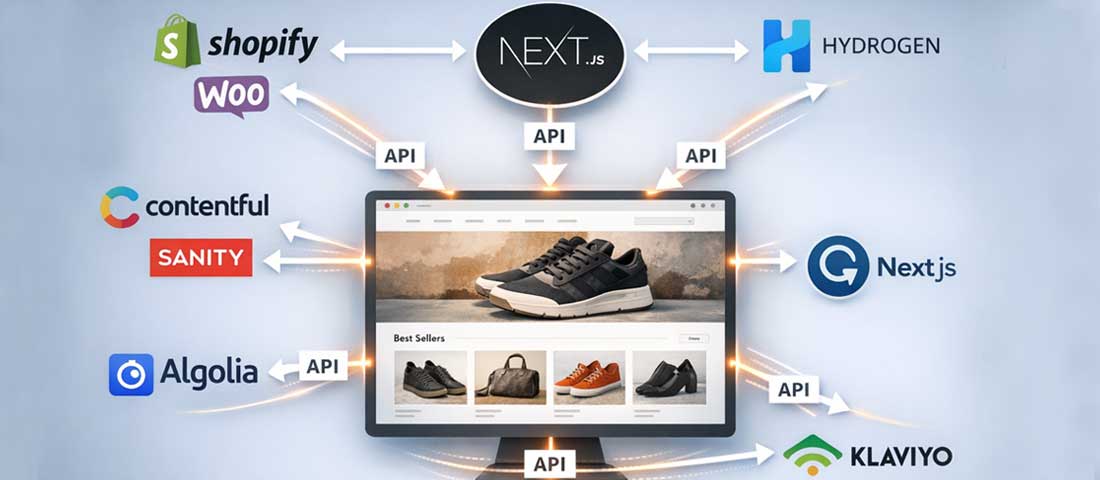
A composable headless commerce stack: Shopify or WooCommerce as the commerce backbone, with best-of-breed specialist services for search, content, email, and personalisation — all assembled through APIs into a single customer experience.

When headless commerce is implemented well — for the right business, by the right team, with the right budget — the result is an eCommerce experience that out-performs, out-converts, and out-scales what traditional theme-based commerce can achieve.
Wondering if Headless Commerce is Right for Your Shopify or WooCommerce Store?
Neel Networks builds both traditional and headless eCommerce stores for businesses across the USA, UK, Canada, Australia, and India. We give you an honest assessment of whether headless is justified for your specific business — not a solution looking for a problem. Talk to our eCommerce team.
Shopify Development Services WooCommerce Development Services WhatsApp Us