Reduce Cart Abandonment & Fix eCommerce Marketing Mistakes That Cost You Sales
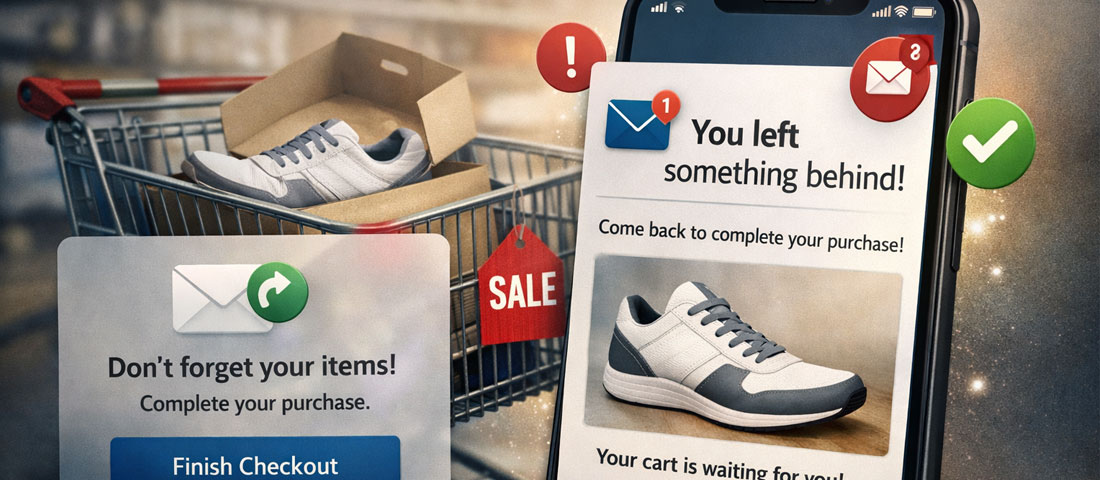
The average eCommerce cart abandonment rate in 2026 is approximately 70%. That number deserves a moment of reflection: for every 10 shoppers who add a product to their cart on your store, 7 leave without buying. The products are there. The intent is there. The checkout process is there. And yet 70% of potential sales evaporate before completion.
What this guide covers
- 1. Why 70% of Shopping Carts Are Abandoned — The Real Reasons
- 2. Common eCommerce Marketing Mistakes That Cause Abandonment
- 3. Cart Abandonment Recovery: The Three-Channel Strategy
- 4. Checkout Optimisation That Prevents Abandonment
- 5. Tools for Cart Recovery Automation
- 6. Measuring and Benchmarking Your Cart Abandonment Performance
- 7. Frequently Asked Questions About Cart Abandonment and eCommerce Marketing
Cart abandonment is the largest single source of recoverable lost revenue for most eCommerce businesses. Unlike improving traffic (which requires external investment in SEO, advertising, or content) or improving product quality (which requires operational change), reducing cart abandonment is an internal optimisation — fixing things that are already within your control, for customers who are already in your store and already interested in buying.
This guide covers the complete cart abandonment picture: why shoppers abandon, what the data says about recovery, the eCommerce marketing mistakes that cause abandonment in the first place, and the proven strategies for winning back lost sales.
Why 70% of Shopping Carts Are Abandoned — The Real Reasons
Understanding why shoppers abandon is the foundation of reducing abandonment. The reasons are well-researched — multiple large-scale studies from the Baymard Institute and others identify the same consistent culprits:
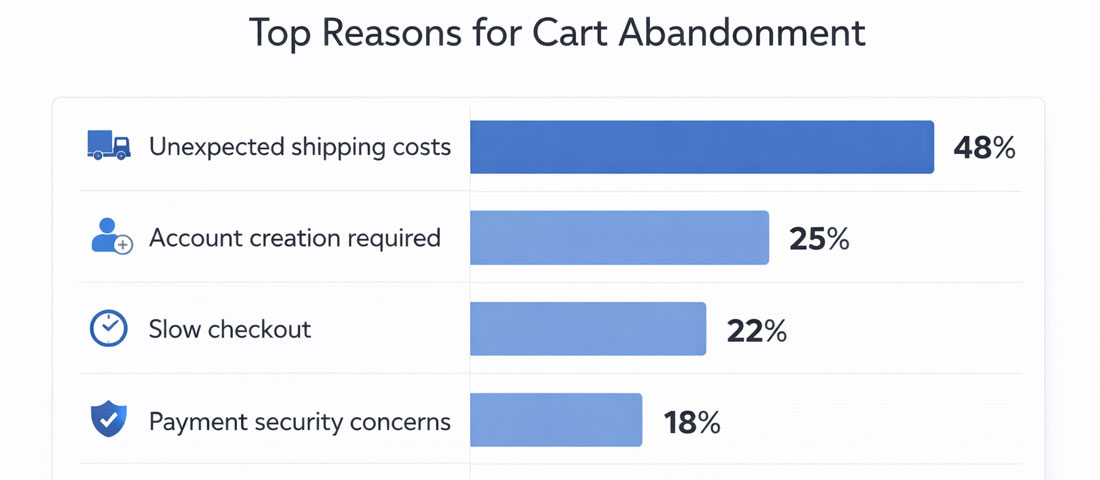
Unexpected shipping costs at checkout is consistently the leading cause of cart abandonment — followed by friction in the checkout process itself.
- Unexpected shipping costs (48% of abandonment). The single biggest cause. Shoppers feel misled when a product listed at £25 arrives at checkout as £32 after shipping is added. The expectation has been set by the product price, and the addition of shipping feels like a bait-and-switch — even when it is not intended that way.
- Forced account creation (24%). Requiring shoppers to create an account before checking out is one of the most avoidable conversion killers. The friction of registration — filling in details, verifying an email address, remembering yet another password — causes a significant proportion of first-time buyers to abandon rather than complete the process.
- Complex or long checkout process (22%). Too many steps, too many pages, confusing form layouts, and fields that require information the shopper does not have readily available all contribute to checkout abandonment.
- Payment security concerns (18%). Shoppers who do not recognise the store brand may be uncertain about the safety of entering their card details. Missing trust signals — security badges, familiar payment provider logos, HTTPS indicators — raise doubt at the critical payment step.
- Delivery too slow (16%). When the delivery timeline is longer than expected or uncompetitive, a proportion of shoppers will look elsewhere or defer the purchase indefinitely.
- Website errors or crashes (13%). Technical failures during checkout — error messages, broken payment forms, session timeouts — force abandonment even from fully committed buyers.
- Insufficient payment options (9%). If a shopper’s preferred payment method is not available — whether that is a specific card type, PayPal, Apple Pay, or a BNPL option — they may not complete the purchase rather than use an alternative method they are less comfortable with.
The insight in this data: The majority of cart abandonment is not caused by shoppers changing their minds about wanting the product. It is caused by friction, surprises, and barriers in the checkout process itself. This means reducing abandonment is fundamentally a checkout UX problem — and most of the solutions are within your direct control.
Common eCommerce Marketing Mistakes That Cause Abandonment
Before cart abandonment recovery, it is worth understanding the marketing mistakes that create the conditions for high abandonment in the first place. Fixing these prevents abandonment — which is always more efficient than recovering it after the fact.
Mistake 1: Hiding Shipping Costs Until Checkout
The single most effective way to reduce cart abandonment caused by unexpected shipping costs is to make shipping costs visible before the cart — on product pages, in the header, and in any promotional communications. A shipping cost calculator on product pages, a free shipping threshold prominently displayed (“Free shipping on orders over £50”), or blanket free shipping (funded by a slightly higher product price) all address this problem at the source rather than at the checkout stage.
Mistake 2: No Guest Checkout Option
Requiring account creation before purchase is a policy decision that consistently costs revenue. Research from the Baymard Institute found that adding a guest checkout option increased completion rates by 35% for one major retailer. The solution is straightforward: always offer guest checkout. If you want to capture account information for post-purchase marketing, offer account creation as an opt-in option after the purchase is complete — not as a prerequisite.
Mistake 3: Too Many Checkout Steps or Pages
The optimal eCommerce checkout in 2026 is a single page (or two pages at most) covering: delivery address, shipping method selection, payment details, and order review/confirmation. Multi-page checkouts with separate pages for cart review, account login, shipping address, shipping method, payment, and review are a relic of early eCommerce design that consistently performs worse than streamlined alternatives. One-page checkout or express checkout through Shop Pay, Apple Pay, or Google Pay that compresses the entire process to a single tap are the conversion-maximising alternatives.
Mistake 4: Not Targeting Returning Visitors Differently
A shopper who has visited your store three times, spent 20 minutes on a product page, and abandoned the cart twice is fundamentally different from a first-time visitor. Treating them with the same generic experience — the same homepage, the same pricing, the same messaging — is a missed personalisation opportunity. Returning visitors who have shown strong intent deserve targeted treatments: persistent cart (their cart items are saved when they return), personalised banners acknowledging their previous visit, and — where justified commercially — a small incentive to close the purchase.
Mistake 5: Slow Mobile Checkout
Mobile checkout abandonment rates are significantly higher than desktop — because most mobile checkouts are slower, more friction-prone, and harder to complete accurately on a small touchscreen. The specific problems: slow page load times, form fields that do not trigger the appropriate mobile keyboard (number keypad for card numbers, email keyboard for email addresses), small tap targets, and addresses that require manual entry rather than autocomplete. A mobile checkout audit — spending 10 minutes trying to complete your own checkout on a smartphone — typically reveals multiple fixable friction points.
Mistake 6: Poor Product Photography
Shoppers who are uncertain about what they are buying abandon more frequently. Low-quality product photography, missing images for product variants, or images that do not show the product in context — at scale, in use, from multiple angles — create uncertainty that manifests as pre-checkout abandonment. Investing in product photography is one of the highest-ROI eCommerce investments available, because it reduces doubt at the consideration stage and increases conversion at every stage of the purchase journey.
Mistake 7: Unclear or Punitive Return Policies
A generous, clearly communicated return policy reduces purchase hesitation — particularly for products where fit, feel, or quality are difficult to assess from photography alone. Buried, restrictive, or confusingly written return policies increase the perceived risk of purchase and contribute to both pre-checkout abandonment and post-purchase dissatisfaction. The most effective return policies in conversion terms are simple (“30-day free returns, no questions asked”), prominent (visible on product pages and at checkout), and genuinely honoured.
Cart Abandonment Recovery: The Three-Channel Strategy
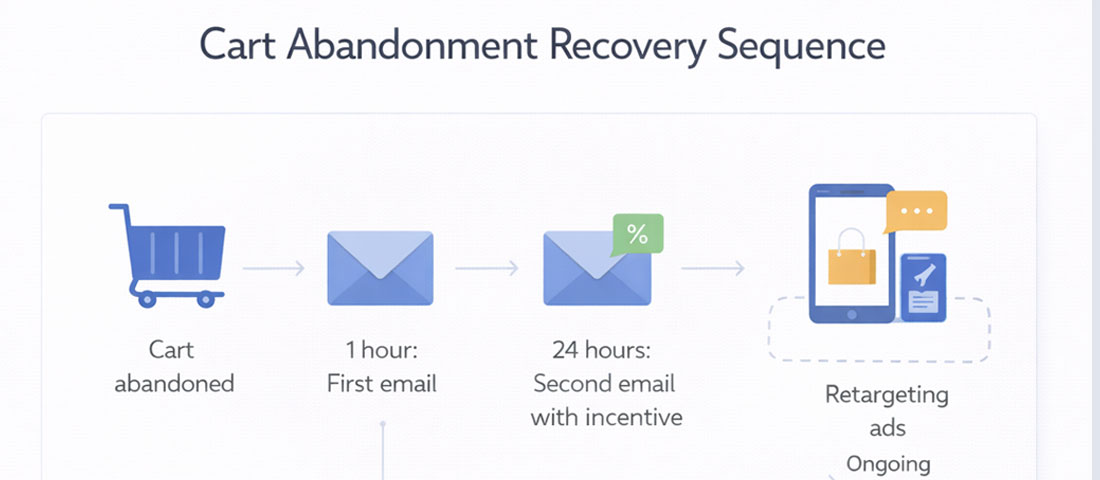
A three-channel cart abandonment recovery sequence — email, SMS, and retargeting ads — creates multiple recovery touchpoints that together recover a meaningful proportion of abandoned carts.
Channel 1: Abandoned Cart Email Sequences
Abandoned cart email is the highest-ROI channel for cart recovery — with average open rates of 40 to 50% and click-through rates of 8 to 10%, far above standard promotional email benchmarks. The optimal abandoned cart email sequence in 2026 is three emails over 72 hours:
Email 1 — 1 hour after abandonment: A gentle reminder with no incentive. Subject: “You left something behind.” Content: image of the abandoned product, a clear “Complete your purchase” CTA, and your customer service contact details. Tone: helpful, not pushy. This email alone recovers 3 to 5% of abandoned carts.
Email 2 — 24 hours after abandonment: Introduce urgency or social proof. Mention that stock is limited (if true), show review quotes for the product, or highlight your return policy to reduce purchase risk. Consider a small incentive (5 to 10% discount) if the product margin allows. This email typically recovers a further 3 to 5%.
Email 3 — 72 hours after abandonment: Final recovery attempt. If you have not yet offered a discount and the purchase value justifies it, now is the time. Frame it as a final offer: “We want to make this easy for you — here’s 10% off if you complete your order today.” This email recovers 1 to 3% of the original abandoners.
Combined, a well-executed three-email abandoned cart sequence recovers 5 to 15% of abandoned carts — a meaningful revenue recovery that runs automatically once set up.
Channel 2: SMS Abandoned Cart Messages
SMS cart abandonment messages — sent to shoppers who have provided their phone number and consented to SMS marketing — have higher open rates than email (SMS open rates exceed 90% vs email’s 40-50%) but must be used more judiciously. A single well-timed SMS (2 to 3 hours after abandonment) with a direct link to the cart can be highly effective. SMS works best as a supplement to, not a replacement for, email recovery — targeting the segment of abandoners who do not open the first recovery email.
Channel 3: Retargeting Ads
Retargeting ads — shown on social media (Facebook, Instagram, TikTok) and the Google Display Network to visitors who abandoned carts on your store — extend your recovery reach beyond the shoppers who provided contact details. Dynamic retargeting ads that show the specific products a shopper left behind consistently outperform generic store ads by a factor of 3 to 10 times in click-through and conversion rate.
The most effective retargeting strategy for cart abandonment runs for 7 to 14 days after abandonment, with ad frequency capped to avoid stalking the shopper with the same ad dozens of times. Progressive offers — starting with product reminder ads and moving to discount-based ads after several days of non-conversion — mirror the email sequence logic.
Checkout Optimisation That Prevents Abandonment
Beyond recovery, preventing abandonment through checkout optimisation is the highest-leverage long-term investment. Here are the specific improvements that consistently move the needle:
-
Implement one-page or express checkout
For Shopify, Shop Pay express checkout consistently delivers the highest checkout conversion rates — allowing logged-in Shop Pay users to complete purchase with a single click. For WooCommerce, the WooCommerce One Page Checkout plugin or CartFlows reduces multi-page checkout to a single streamlined page. Test your checkout completion rate before and after implementing single-page checkout to measure the impact. -
Display trust signals prominently in checkout
At the payment step — the point of maximum purchase risk anxiety — display: SSL/security badge, familiar payment method logos, your returns policy summary (maximum two sentences), and any money-back guarantee. Trust signals at this specific moment reduce payment hesitation for first-time buyers in particular. -
Show a persistent cart total with itemisation
Shoppers should always be able to see exactly what they are buying and what the total cost will be — including shipping — without needing to navigate back to the cart. A persistent order summary in the sidebar or at the bottom of the checkout form eliminates the uncertainty that causes some shoppers to abandon to “double-check” the total. -
Add address autocomplete
Google Places API autocomplete on address fields reduces typing on mobile, prevents address entry errors, and speeds up checkout significantly. Every second saved in the checkout process improves completion rates marginally — and these marginal improvements compound across thousands of transactions. -
Implement cart persistence
When a shopper adds items to their cart, closes the browser, and returns later, their cart should be exactly as they left it. Cart persistence (storing cart contents in a cookie or user account) removes the friction of having to rediscover and re-add products for returning shoppers — and gives recovery email recipients a seamless return path directly into their saved cart.
Tools for Cart Recovery Automation
| Tool | Platform | Recovery Channels | Best For |
|---|---|---|---|
| Klaviyo | Shopify + WooCommerce | Email + SMS | Growing stores needing sophisticated segmentation and automation |
| Omnisend | Shopify + WooCommerce | Email + SMS + Push | Stores wanting all-in-one omnichannel recovery at lower cost than Klaviyo |
| Drip | WooCommerce (primary) | Email + SMS | WooCommerce stores wanting deep WordPress CRM integration |
| Shopify Email | Shopify only | Small Shopify stores wanting basic free abandoned cart emails | |
| Facebook/Meta Ads | All platforms (pixel) | Retargeting ads | Dynamic product retargeting across Facebook and Instagram |
| Google Ads | All platforms | Display + Shopping retargeting | Retargeting across Google Display Network and YouTube |
Measuring and Benchmarking Your Cart Abandonment Performance
Managing cart abandonment requires measurement — you cannot improve what you do not track. Here are the key metrics to monitor:
- Cart abandonment rate: (Carts created − Orders completed) ÷ Carts created × 100. Your overall benchmark. Industry average is approximately 70% — anything below 60% is strong performance. Track this monthly and after checkout changes.
- Checkout abandonment rate: The proportion of shoppers who begin the checkout process (enter payment step) but do not complete. This is distinct from cart abandonment (adding to cart but not starting checkout) and typically indicates checkout UX problems rather than earlier-funnel issues.
- Recovery rate: The percentage of abandoned carts successfully recovered through email, SMS, and retargeting. Industry benchmark for email recovery is 5 to 15%. Track separately by channel and email number to identify which recovery touchpoints are most effective for your audience.
- Revenue recovered: Monthly cart recovery revenue — track this as an absolute figure to understand the commercial value of your recovery programme and justify investment in optimising it.
Frequently Asked Questions About Cart Abandonment and eCommerce Marketing
| What is a good cart abandonment rate for an eCommerce store? | The industry average cart abandonment rate is approximately 70% — meaning roughly 7 in 10 shoppers who add items to their cart do not complete a purchase. A rate below 60% is considered strong performance, and the best-optimised stores achieve rates of 55% or lower. Cart abandonment rates vary significantly by industry: luxury goods and high-ticket items have higher abandonment rates than everyday consumer goods; mobile shopping has higher abandonment rates than desktop; and guest checkout options typically reduce abandonment rates compared to account-required checkouts. Comparing your rate against your own historical baseline (tracking improvement over time) is more useful than industry averages alone. |
| How much revenue can cart abandonment emails recover? | A well-executed three-email abandoned cart sequence typically recovers 5 to 15% of abandoned carts — meaning 5 to 15 out of every 100 shoppers who abandoned return and complete a purchase. In revenue terms, for a store with £50,000 in monthly abandoned cart value, a 10% recovery rate represents £5,000 in additional monthly revenue — revenue that is otherwise permanently lost. Cart abandonment email recovery typically has a very high ROI because the automation cost is fixed and the revenue recovered scales with store volume. Most eCommerce email platforms report cart recovery email as their customers’ highest-performing automated sequence by revenue per recipient. |
| What is the most effective way to reduce cart abandonment? | The single most effective way to reduce cart abandonment is to display shipping costs clearly before the cart — ideally on product pages through a shipping calculator or prominent free shipping threshold messaging. This addresses the leading cause of abandonment (unexpected shipping costs) at the point where it most affects the decision. The second most effective change is adding guest checkout as an option alongside account creation. Combined, these two changes typically reduce cart abandonment rates by 10 to 20 percentage points for stores where they were previously absent — delivering a meaningful increase in completed orders without requiring any change to the products, prices, or marketing. |
| Should I offer a discount in cart abandonment emails? | Offering a discount in cart abandonment emails increases recovery rates but trains shoppers to abandon intentionally to wait for the discount offer. The recommended approach is: send the first one or two recovery emails without a discount — focusing on reminder and trust-building — and reserve the discount for the final email in the sequence as a last-resort recovery tool. If your product margins allow, a 5 to 10% discount in the final email recovers a meaningful additional proportion of carts. If your margins do not support discounting, focus recovery on removing the actual barriers that caused abandonment (shipping cost transparency, social proof, payment options) rather than discounting. |
| What are the most common eCommerce marketing mistakes? | The most common eCommerce marketing mistakes that cost sales are: hiding shipping costs until checkout (the leading cause of abandonment); requiring account creation before purchase (eliminates guest checkout option); running promotional campaigns without tracking proper attribution (investing in channels that look active but do not drive conversions); neglecting post-purchase email — the most cost-effective marketing to retain existing customers; driving traffic to poorly converting product pages (spending on ads while the destination pages have poor photography, no reviews, or unclear pricing); and ignoring mobile checkout experience while focusing marketing investment on desktop-optimised pages that are only seen by a minority of visitors. |
| How long should a cart abandonment email sequence run? | A cart abandonment email sequence should run for 72 hours after the cart was abandoned — three emails spaced at 1 hour, 24 hours, and 72 hours post-abandonment. Beyond 72 hours, the purchase intent of most abandoners has significantly diminished and continued emails are more likely to generate unsubscribes than recoveries. For high-value products (purchases above £500 or equivalent) where the consideration period is longer, extending the sequence to 5 to 7 days with a slower cadence (every 2 to 3 days) can be appropriate. Always respect unsubscribe requests immediately and exclude from sequences any customer who has contacted support about the abandoned order. |
Every successfully recovered abandoned cart represents revenue that would otherwise be permanently lost — making cart recovery automation one of the highest-ROI investments in eCommerce.
Losing revenue to cart abandonment every day?
Neel Networks helps eCommerce businesses audit their checkout experience, implement cart recovery automation, and fix the marketing mistakes that cost sales. Talk to us about a checkout optimisation audit for your store.