8 Digital Marketing Myths Still Hurting Businesses in 2026 (And How to Fix Them)
Digital marketing is one of the fields where bad advice travels fastest. Half-truths spread by agencies selling particular services, oversimplified “rules” that once had merit but have since been disproved, and persistent myths that have never been true but sound compelling — all of these circulate continuously in blog posts, LinkedIn feeds, and marketing conference presentations.
What this guide covers
- 1. Myth 1: “You Need to Be on Every Social Media Platform”
- 2. Myth 2: “More Website Traffic Is Always Better”
- 3. Myth 3: “SEO Is Dead / Google Will Never Rank Small Websites”
- 4. Myth 4: “PPC Is Too Expensive for Small Businesses”
- 5. Myth 5: “Email Marketing Is Outdated”
- 6. Myth 6: “Negative SEO From Competitors Can Destroy Your Rankings”
- 7. Myth 7: “Social Media Followers = Business Success”
- 8. Myth 8: “Digital Marketing Results Should Be Instant”
- 9. The Common Thread: Evidence Over Assumption
- 10. Frequently Asked Questions About Digital Marketing Myths
The cost of believing and acting on digital marketing myths is real: wasted budget on ineffective tactics, missed opportunities in channels you wrongly dismissed, and strategic decisions based on beliefs that the evidence does not support. This guide addresses the eight most persistent and most damaging digital marketing myths that are still hurting businesses in 2026.
Myth 1: “You Need to Be on Every Social Media Platform”
The myth: A credible business must be active on Instagram, Facebook, LinkedIn, TikTok, Twitter/X, YouTube, Pinterest, and every new platform that emerges.
The reality: Being present on every social platform without the resources to do any of them well is worse than being excellent on two or three. Social media algorithms reward consistent, high-engagement content — and producing that quality across six platforms simultaneously is beyond the capacity of most small and medium businesses without a dedicated social team.
The businesses getting the strongest results from social media in 2026 are almost always those who have identified the two or three platforms where their specific audience is most active and concentrated their effort there. A B2B professional services firm getting excellent results from LinkedIn thought leadership has no obligation to be on TikTok. A consumer fashion brand driving sales through Instagram Reels does not need to maintain a presence on LinkedIn.
What to do instead: Audit where your specific customers actually spend time online. Ask them. Look at your existing website analytics for which social platforms are already driving traffic. Choose the two platforms with the strongest match to your audience and content capabilities — and be excellent there rather than mediocre everywhere.
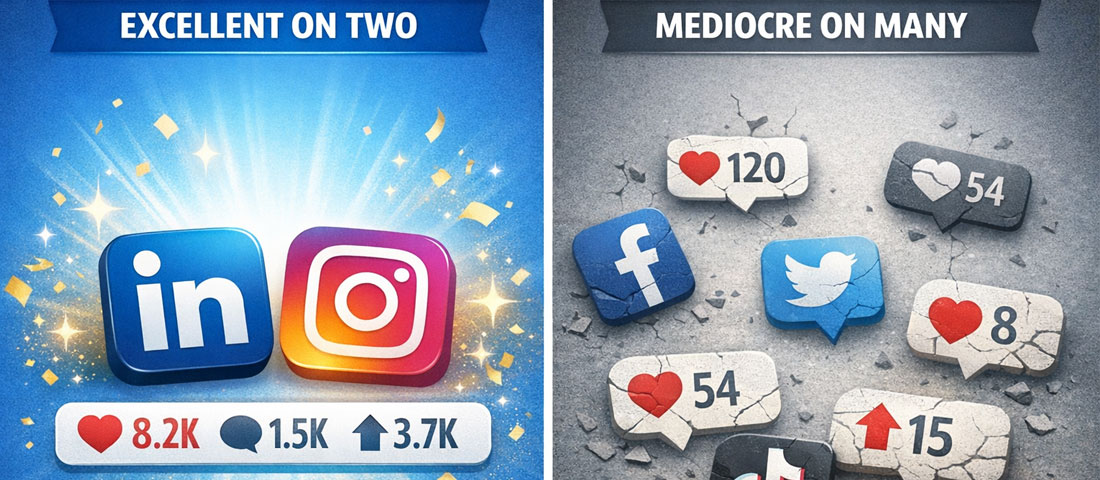
Focusing resources on two or three platforms where your audience is concentrated consistently outperforms thin presence across every available channel.
Myth 2: “More Website Traffic Is Always Better”
The myth: The primary goal of digital marketing is to maximise website traffic. More visitors means more success.
The reality: Traffic without conversion is not a business asset — it is noise. A web design agency that receives 10,000 monthly visits but converts at 0.5% generates 50 enquiries. The same agency receiving 3,000 targeted visits converting at 3% generates 90 enquiries — 80% more business from 70% less traffic.
The obsession with traffic volume leads to counterproductive tactics: publishing large volumes of thin, broadly informational content that attracts curious readers with no purchase intent; optimising for high-volume keywords whose searchers are not potential customers; and spending on paid channels that drive volume without conversion. All of these inflate traffic metrics while doing nothing for revenue.
What to do instead: Define traffic quality metrics alongside volume: conversion rate by traffic source, leads per 1,000 visitors, cost per qualified lead by channel. Optimise for qualified traffic — visitors from your specific target audience who have genuine intent — rather than overall volume. Use keyword research and audience targeting to be precise about who you are trying to reach, not just how many.
Myth 3: “SEO Is Dead / Google Will Never Rank Small Websites”
The myth: SEO is no longer worth investing in because AI Overviews have killed organic clicks, Google only ranks big brands, and small businesses can never compete.
The reality: This myth is repeated every time a significant algorithm update occurs, and it has been wrong every time. SEO is not dead — it has evolved, as it always has. The businesses declaring SEO dead are typically those who invested in tactics (thin content, link schemes, keyword stuffing) that Google has correctly devalued, or those who experienced ranking drops from algorithm updates targeting low-quality content.
Small and medium businesses rank for competitive terms every day — not by outspending large brands on link building, but by producing genuinely better, more specific, more expertly authored content for the specific queries they are targeting. A small accounting firm that produces genuinely expert content on specific tax questions for their niche can consistently outrank larger accounting firms whose generic content is not as specifically relevant to those queries.
AI Overviews have reduced organic clicks for some informational queries — but commercial intent queries (where people are looking to hire or buy) are far less affected, and being cited within AI Overviews now provides a new, growing visibility channel for well-optimised content.
What to do instead: Invest in genuinely expert, comprehensive content on topics where your specific knowledge is deeper than larger competitors. Focus on niche and long-tail queries where domain authority matters less than topical relevance and content quality. Build E-E-A-T signals — demonstrate real expertise, real experience, and genuine trustworthiness — and SEO rewards this regardless of company size.
Myth 4: “PPC Is Too Expensive for Small Businesses”
The myth: Pay-per-click advertising is only viable for businesses with large budgets. Small businesses cannot compete with large advertisers and will waste money.
The reality: PPC costs are not fixed — they are determined by the keywords you target, the geographic area you target, and how well your campaigns are structured. While broad, national, highly competitive keywords (like “insurance” or “mortgage”) have cost-per-clicks that put them out of reach for small budgets, most small businesses do not need to compete for these terms.
A local plumber in Birmingham targeting “emergency plumber Birmingham” on Google Ads does not compete with a national plumbing brand’s general campaign. A specialist SaaS company targeting “inventory management software for bicycle retailers” competes only against other vendors specifically serving that niche. Specificity dramatically reduces competition and cost-per-click while improving conversion rates — because the traffic is highly targeted.
PPC campaigns can be profitably run on budgets of £500 to £2,000 per month for many service businesses when campaigns are tightly targeted, negative keywords are comprehensive, and the website they drive traffic to converts well.
What to do instead: Test PPC with a small, tightly scoped campaign targeting your most specific, highest-intent keywords in your specific geographic market. Measure cost per lead — not just cost per click — and assess whether that cost per lead is commercially viable for your business before scaling or abandoning the channel.
Myth 5: “Email Marketing Is Outdated”
The myth: Email is old technology that people ignore. Modern businesses should focus on social media, messaging apps, and new channels instead.
The reality: Email is the most consistently high-ROI digital marketing channel, generating approximately £42 for every £1 spent per DMA research. Open rates have remained stable at 20 to 30% for quality lists. Email drives more conversions than social media for most business types. Every major eCommerce and SaaS business treats email automation as a core revenue driver — because it reliably delivers.
The myth of email’s decline is partly driven by conflation: people who receive badly targeted spam from brands they do not remember subscribing to dismiss email as ineffective. But spam and high-quality permission-based email marketing are entirely different activities. Recipients who chose to subscribe to a business’s email list, and who regularly receive genuinely valuable content, convert at far higher rates than equivalent audiences on social media.
Unlike social media followers (which exist at the discretion of platform algorithms) and paid advertising audiences (which disappear when budget stops), an email list is an owned asset that cannot be taken away by a platform change.
What to do instead: Build an email list through high-value lead magnets. Segment subscribers and send relevant, genuinely useful content rather than promotional blasts. Set up automated sequences (welcome, nurture, post-purchase) that work continuously without manual effort. Treat email as the owned-audience asset it is.
Myth 6: “Negative SEO From Competitors Can Destroy Your Rankings”
The myth: Competitors can point thousands of spammy backlinks at your website, triggering a Google penalty and destroying your organic rankings.
The reality: Google has been explicitly aware of negative SEO attacks for over a decade and has designed its algorithm to be resistant to them. Google’s John Mueller and other Search liaisons have repeatedly stated that Google is generally able to identify and ignore spammy links rather than penalising the target site for links they did not build.
The reality is that negative SEO attacks — while theoretically possible — rarely succeed against established websites with strong existing backlink profiles. A domain with 500 high-quality referring domains is not going to be penalised by 1,000 obvious spam links appearing overnight. Google recognises the pattern and discounts rather than penalises.
The fear of negative SEO is disproportionate to its actual risk for most businesses. The time and budget spent worrying about competitor sabotage would almost universally deliver better returns if invested in positive SEO activities.
What to do instead: Monitor your backlink profile in Ahrefs or Semrush on a monthly basis. Use Google Search Console to check for any manual action notifications. If you genuinely find evidence of a coordinated negative SEO attack, the Google Disavow Tool allows you to tell Google to ignore specific links. But for the vast majority of businesses, this is a theoretical concern rather than a real one — invest your SEO budget in positive activities rather than defensive ones.
Myth 7: “Social Media Followers = Business Success”
The myth: Building a large social media following is a primary business objective. The number of followers is a meaningful metric of marketing success.
The reality: Follower count is one of the most misleading vanity metrics in digital marketing. A business with 50,000 Instagram followers that generates no leads or revenue from social media has a less effective social media presence than a business with 2,000 highly engaged followers that converts at 5% to enquiries.
The purchase of followers (still depressingly common) provides the clearest possible illustration of the myth’s absurdity: bought followers do not buy products, do not generate enquiries, and do not contribute to business growth. They inflate a number while damaging engagement rates — because a large follower count with a tiny engagement rate signals to platform algorithms that your content is not valued, reducing organic reach for everyone.
Even legitimately built large followings frequently fail to translate to business outcomes if the content strategy attracted the wrong audience — people interested in free tips rather than potential customers for your services.
What to do instead: Define social media success in business outcome terms: enquiries generated, website traffic driven, email subscribers gained, or qualified leads attributed to social channels. Track engagement rate (engagements divided by reach), click-through rate to your website, and — critically — conversion rate from social traffic. Build followers who match your target customer profile, not just people who will follow anyone who posts interesting content.
Myth 8: “Digital Marketing Results Should Be Instant”
The myth: If a digital marketing channel is not delivering results within 4 to 6 weeks, it is not working and should be abandoned.
The reality: Different digital marketing channels have fundamentally different result timelines — and conflating them leads to abandoning effective strategies before they have had time to work. PPC can generate leads within days. SEO typically takes 4 to 12 months for meaningful results. Content marketing authority compounds over 12 to 24 months. Email list building is a 6 to 18 month investment in audience development.
The most damaging consequence of the “instant results” myth is the cycle of channel abandonment it creates. A business invests in SEO for 2 months, sees minimal results, concludes “SEO doesn’t work,” and moves on. Then it invests in content marketing for 6 weeks, sees minimal results, concludes “content marketing doesn’t work,” and moves on. Meanwhile, a competitor who committed to both channels for 18 months is now generating 10x the organic traffic.
The businesses with the strongest digital marketing performance are almost universally those that commit to channels for long enough to assess them fairly — understanding that organic channels require months, not weeks, to show their potential. Patience is not a soft virtue in digital marketing; it is a financial asset.
What to do instead: Set channel-appropriate timelines for evaluation before investing. PPC: assess at 60 to 90 days after initial optimisation period. SEO: assess at 6 to 12 months. Content marketing: assess at 12 to 18 months. Email: assess ongoing list growth and automation performance from month 3. Within those timelines, track leading indicators (keyword rankings improving, email list growing, traffic trends) that predict future outcomes even when the final revenue impact is not yet visible.
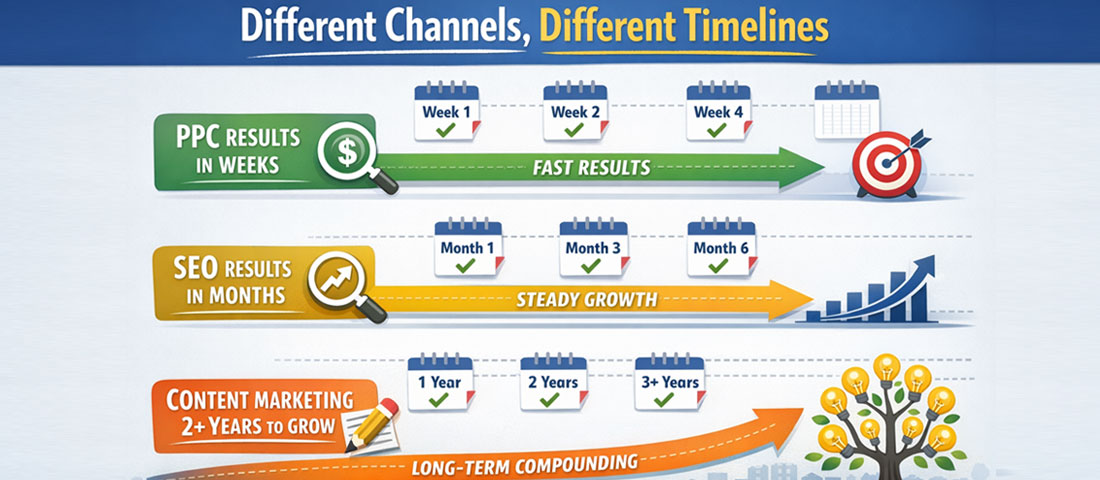
Different digital marketing channels operate on fundamentally different timelines — understanding these differences prevents the premature abandonment of strategies that were working but needed more time.
The Common Thread: Evidence Over Assumption
Every myth above shares a common structure: it makes digital marketing feel simpler and more predictable than it actually is. Real digital marketing strategy requires:
- Starting with where your specific audience actually is and what they actually respond to
- Setting channel-appropriate timelines and measuring the right metrics for each
- Optimising for business outcomes (leads, revenue, qualified traffic) rather than vanity metrics (followers, raw traffic volume)
- Committing to evidence-based decision-making — testing, measuring, and adjusting based on data rather than assumptions
- Being willing to challenge received wisdom when the evidence contradicts it
The businesses that outperform their markets in digital marketing are not those with the largest budgets or the most sophisticated technology. They are the businesses that think clearly, measure rigorously, and commit patiently to strategies that the evidence supports.
Frequently Asked Questions About Digital Marketing Myths
| Is SEO still worth investing in for small businesses in 2026? | Yes — SEO remains one of the highest-ROI long-term marketing investments for most small businesses. The myth that Google only ranks large brands is persistently wrong: small businesses regularly outrank larger competitors by producing genuinely better, more specific, and more expert content for targeted queries. The key is focusing on niche, long-tail keywords where topical relevance and content quality matter more than domain authority. Small businesses cannot outspend large competitors, but they can out-specialise them — producing content that is more specifically relevant to a particular customer segment or query than generic content from a larger competitor. The businesses that invested in SEO five years ago are benefiting enormously from that investment today. |
| Is social media follower count an important marketing metric? | No — follower count is a vanity metric that has little relationship to business outcomes when measured in isolation. What matters is not how many people follow your account but how many of those followers match your target customer profile, engage actively with your content, and take actions that lead to business outcomes (website visits, enquiries, purchases). A small, highly engaged following of genuine potential customers is far more commercially valuable than a large following of people who will never buy from you. Measure social media success in business outcome terms: leads generated, website traffic driven, qualified enquiries attributed to social channels, and engagement rate — not raw follower count. |
| How long should I give a digital marketing strategy before expecting results? | The right evaluation timeline depends entirely on which channel you are investing in. PPC (Google Ads) should show initial results within the first month and be fairly assessed at 60 to 90 days after an initial optimisation period. SEO typically takes 4 to 6 months for meaningful initial results and should be assessed at 6 to 12 months for a fair evaluation. Content marketing authority builds over 12 to 24 months. Email list building and automation should show growing returns over 6 to 12 months. The most common digital marketing mistake is abandoning organic strategies within 2 to 3 months because “they are not working” — when the honest reality is that they have not been given enough time to work. Set channel-appropriate timelines at the outset and commit to them. |
| Is email marketing still effective compared to social media? | Yes — email marketing consistently outperforms social media for direct revenue generation and lead conversion, and has done so consistently for years despite repeated predictions of its decline. Email generates approximately £42 ROI per £1 spent. Social media’s ROI is harder to measure directly but is typically lower for most business types. The structural reason is clear: email subscribers have explicitly opted in to hear from you, receive your messages directly in their inbox without algorithmic filtering, and represent a warm, self-selected audience with demonstrated interest in your business. Social media followers, by contrast, see only a fraction of your posts (due to platform algorithms), are less committed to the relationship, and are harder to reach consistently over time. Both channels have their place — but email should be the foundation of any direct marketing programme. |
| Can competitors hurt my Google rankings with negative SEO? | In theory, yes — in practice, for most established websites, no. Google has been designing its algorithm to be resistant to negative SEO attacks for over a decade and can generally identify spam link patterns and discount them rather than penalising the target site. Negative SEO attacks very rarely succeed against websites with established, quality backlink profiles. Google’s own statements confirm that websites are not penalised simply for receiving bad links that they did not build. The risk is disproportionately small for most businesses — if you are concerned, monitor your backlink profile monthly in Ahrefs and check Search Console for manual action notifications. If you find evidence of a genuine attack, the Disavow Tool provides recourse. But investing time in preventing negative SEO is far less valuable than investing that same time in positive SEO. |
| What digital marketing metrics should I actually track? | The metrics worth tracking are those that connect to business outcomes rather than activity or vanity. For SEO: organic sessions, keyword ranking positions for target terms, and organic leads or conversions. For PPC: cost per conversion (not just cost per click), conversion rate, and ROAS or CPA. For email: open rate trends, click-through rate, conversion rate, and revenue attributed to email. For social media: engagement rate, click-through rate to website, and leads or enquiries generated through social channels. For content marketing: organic traffic by content piece, backlinks earned, and leads attributed to content. The common principle: always trace the metric to a business outcome — traffic that does not convert, followers that do not enquire, and impressions that do not build brand recall are all activity metrics without business meaning. |
| Is it true that you need to post on social media every day to grow? | No — quality and consistency matter far more than posting frequency. Publishing one genuinely excellent, high-value piece of content three times per week consistently outperforms publishing mediocre content daily. Platform algorithms reward engagement and content quality — posts that generate strong engagement signals reach more people than frequent posts that few people interact with. The practical risk of daily posting requirements is unsustainability: businesses that set themselves an unrealistic daily posting schedule for three months often abandon social media entirely when the schedule becomes impossible to maintain, ending up with a worse outcome than if they had committed to a realistic three-posts-per-week schedule from the outset. |
Want digital marketing strategy based on evidence, not myths?
Neel Networks gives businesses across the USA, UK, Canada, Australia, and India honest, evidence-based digital marketing guidance — helping you invest in what actually works for your specific business and avoid expensive mistakes.
Free Strategy Consultation Digital Marketing Services WhatsApp Us