Digital Marketing Channels Explained: Which Ones Actually Drive Business Growth?
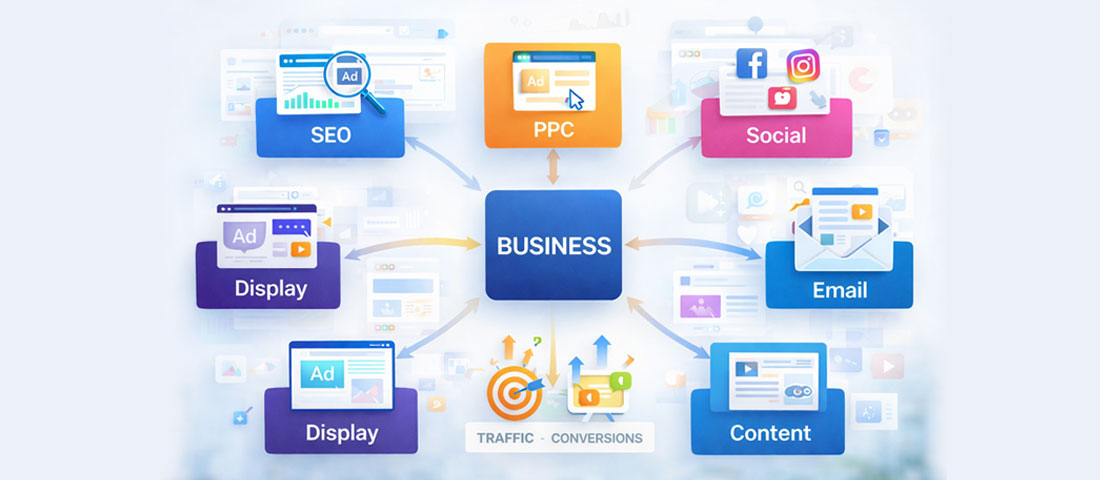
Every business with a digital presence eventually faces the same decision: with limited time, budget, and attention, which marketing channels deserve investment? The honest answer is not the same for every business — the right channel mix depends on your industry, your audience, your product or service, your budget, and your growth stage. What is universal is the need to understand what each channel actually does, what it costs in time and money, and what realistic outcomes look like.
What this guide covers
- 1. The Digital Marketing Channel Landscape in 2026
- 2. Organic Channels: Building Lasting Visibility Without Per-Click Costs
- 3. Paid Channels: Immediate Reach at a Defined Cost
- 4. Direct Channels: Owned Audience, Direct Delivery
- 5. Partnership Channels: Reach Amplification Through Third Parties
- 6. How to Build the Right Channel Mix for Your Business
- 7. The Channel Prioritisation Framework by Business Stage
- 8. Frequently Asked Questions About Digital Marketing Channels
This guide gives you a clear, practical framework for understanding every major digital marketing channel — what it is, what it delivers, what it costs, and when it belongs in your strategy.
The Digital Marketing Channel Landscape in 2026
Digital marketing channels are the mechanisms through which businesses reach potential customers online. They divide into four broad categories based on ownership and payment model:
- Owned channels — platforms and properties you own and control: your website, email list, blog, and social profiles. No per-use cost, but require investment to build and maintain.
- Paid channels — advertising platforms where you pay for visibility: Google Ads, Meta Ads, LinkedIn Ads, display networks, programmatic advertising. Immediate reach; cost ongoing.
- Earned channels — visibility gained through merit rather than payment: organic search rankings, press coverage, editorial mentions, word of mouth. No direct cost per impression but require significant investment to earn.
- Partnership channels — third-party relationships that drive traffic and revenue: affiliate marketing, influencer marketing, strategic partnerships. Cost is typically performance-based (commission on results).
Effective digital marketing in 2026 uses a mix of all four categories — owned channels as the foundation, earned channels for sustainable long-term growth, paid channels for immediate impact and testing, and partnership channels for reach amplification.
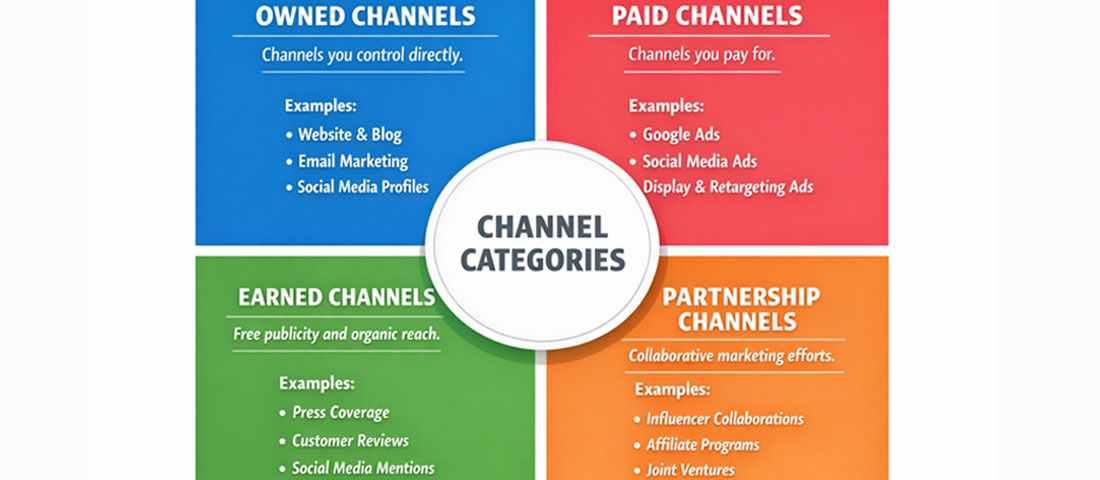
The four digital marketing channel categories each have distinct cost structures, timelines, and returns — effective strategy uses all four in a coordinated mix.
Organic Channels: Building Lasting Visibility Without Per-Click Costs
Search Engine Optimisation (SEO)
What it is: The practice of improving your website’s visibility in organic (non-paid) search results through content quality, technical health, and authority building.
What it delivers: Sustainable organic search traffic that compounds over time. Each piece of well-optimised content can generate traffic for years. The highest-intent digital marketing channel — people searching Google for your service are actively looking for what you offer.
Timeline: 4 to 12 months for meaningful results; compounds over 2 to 3 years into a significant competitive advantage.
Cost structure: Agency or specialist fees (£500 to £3,000/month for quality service), plus content production costs. No per-click cost once rankings are established.
Best for: Almost every business with a website — particularly service businesses, professional practices, eCommerce, and any business where customers search for solutions online.
Content Marketing
What it is: Creating and distributing genuinely valuable content — guides, blog posts, videos, research, tools — to attract and retain a defined audience and build authority.
What it delivers: Organic traffic, brand authority, email subscribers, social shares, and backlinks — simultaneously. The most multi-dimensional channel in terms of compounding benefit across other channels.
Timeline: Slow start (3 to 6 months), significant growth by 12 to 18 months, strong compounding by year 3.
Cost structure: Content production (in-house or outsourced), time investment for strategy and promotion. No per-impression cost.
Best for: Businesses where expertise and thought leadership are competitive differentiators; businesses with long or research-intensive sales cycles; eCommerce businesses competing for product category search traffic.
Organic Social Media
What it is: Building audience and engagement on social platforms (LinkedIn, Instagram, TikTok, YouTube, Facebook) through consistently published content.
What it delivers: Brand awareness, community building, direct engagement with prospects and customers, referral traffic to your website, and social proof signals. Organic reach varies dramatically by platform — TikTok’s algorithm-driven For You Page still delivers significant organic reach; Facebook’s organic reach has declined to a fraction of page followers for most business accounts.
Timeline: Community and following builds over 6 to 18 months with consistent effort.
Cost structure: Time for content creation and community management; design/video production tools. No per-impression cost.
Best for: B2C brands, local businesses, businesses where the founder’s personal brand is a commercial asset, and any business with visual products or services.
Paid Channels: Immediate Reach at a Defined Cost
Pay-Per-Click Search Advertising (Google Ads, Bing Ads)
What it is: Placing text ads at the top of search engine results pages for specific keywords, paying each time a user clicks.
What it delivers: Immediate visibility to high-intent searchers at the moment they are actively looking for your product or service. The most direct digital advertising channel for capturing existing demand.
Timeline: Immediate visibility; optimisation takes 30 to 90 days to reach peak efficiency.
Cost structure: Pay per click (varies by keyword — from a few pence to tens of pounds in competitive markets) plus management fees. Visibility ceases when spending stops.
Best for: Service businesses needing immediate leads; eCommerce for high-intent product queries; businesses in competitive markets where organic SEO is slow to develop; testing keyword performance before SEO investment.
Paid Social Advertising (Meta, LinkedIn, TikTok, Pinterest Ads)
What it is: Showing targeted ads on social platforms to defined audience segments — by demographics, interests, behaviours, and custom audiences.
What it delivers: Highly targeted reach to specific audience profiles; strong for demand generation (creating desire for products people were not actively searching for); powerful for retargeting website visitors and lookalike prospecting.
Timeline: Immediate reach; 4 to 8 weeks of learning period for algorithm-optimised campaigns.
Cost structure: Cost per click or per 1,000 impressions, varying by platform, audience size, and creative quality. Creative production cost in addition.
Best for: Consumer products with visual appeal; local service businesses; eCommerce with strong product photography; B2B lead generation on LinkedIn for professional audiences.
Display Advertising and Programmatic
What it is: Banner and image ads shown across millions of websites and apps within advertising networks (Google Display Network, programmatic DSPs). Typically bought on cost-per-thousand-impressions (CPM) basis.
What it delivers: Broad awareness and retargeting reach. Display’s primary value is keeping your brand visible to warm audiences (people who have already visited your website) across their broader web browsing — brand recall and purchase nudge rather than direct conversion.
Best for: Retargeting campaigns to re-engage website visitors; brand awareness for well-funded campaigns; sequential messaging across the consideration journey. Less effective for direct response or lead generation as a standalone channel.
Direct Channels: Owned Audience, Direct Delivery
Email Marketing
What it is: Sending targeted messages directly to subscribers who have opted in to receive communications from your business.
What it delivers: The highest ROI of any digital marketing channel (£42 for every £1 spent per DMA research). Direct, unmediated access to a warm audience. Lead nurturing, customer retention, and eCommerce revenue generation.
Timeline: List building takes time; automated sequences can generate returns from day one.
Cost structure: Platform fee (from free to £200+/month depending on list size and platform); content production time. No per-send cost beyond platform fees.
Best for: Every business with a digital presence. Email is the most universally applicable digital marketing channel with the strongest consistent ROI.
SMS Marketing
What it is: Text message marketing to opted-in contacts — promotional messages, appointment reminders, order updates, and time-sensitive offers.
What it delivers: Extremely high open rates (98% vs email’s 20 to 30%), immediate delivery, strong performance for time-sensitive promotions and transactional messages. More intrusive than email — best reserved for high-relevance, genuinely time-sensitive communications.
Best for: eCommerce flash sales; appointment-based service businesses; event reminders; cart abandonment for mobile-heavy audiences. Requires strict compliance with opt-in regulations (GDPR, TCPA).
Push Notifications
What it is: Browser-based (web push) or app-based notifications sent to opted-in users. Appear as device notifications rather than in an inbox.
What it delivers: Immediate visibility without requiring the user to open an app or email client. High click rates for engaged subscribers. Works well for news, time-sensitive offers, and content updates.
Best for: Media and content sites; eCommerce with time-limited promotions; apps with repeat-use engagement requirements.
Partnership Channels: Reach Amplification Through Third Parties
Affiliate Marketing
What it is: Paying a commission to third-party publishers (affiliates) who drive traffic or sales to your website through their content, email lists, or advertising.
What it delivers: Performance-based traffic and sales — you pay only when results are generated. Can drive significant volume at a predictable cost-per-acquisition once an affiliate programme has established a network of active publishers.
Best for: eCommerce and subscription businesses where the commission economics make sense; travel, finance, and insurance verticals where affiliate marketing is deeply established; businesses with attractive commission structures for publishers.
Influencer Marketing
What it is: Partnering with social media content creators who have established audiences to promote your products or services to their followers.
What it delivers: Authentic third-party endorsement to highly engaged niche audiences; product discovery through trusted voices; user-generated content for your own channels; direct sales through affiliate links and promo codes.
Best for: Consumer products in visual categories (fashion, beauty, fitness, food, technology); brands targeting younger demographics; product launches requiring rapid awareness building.
How to Build the Right Channel Mix for Your Business
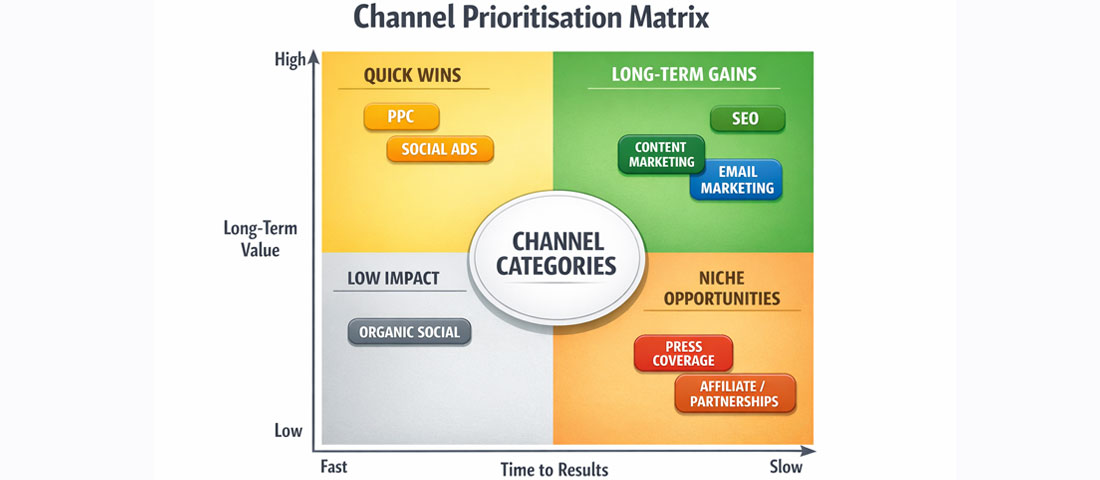
Plotting channels on a matrix of “time to results” against “long-term value” helps visualise the strategic trade-offs — and why the highest-ROI long-term strategy combines fast-acting paid channels with slow-building organic ones.
Building the right channel mix requires honest answers to four questions:
-
Where does your audience discover and research solutions like yours?
If your customers predominantly search Google when they need what you offer, SEO and PPC deserve priority. If they discover new products through Instagram, paid social and influencer marketing belong in the mix. If they respond to email recommendations from trusted sources, email and affiliate matter more. Start with where your customers actually are — not where you personally spend time online. -
What is your timeline for results?
Businesses that need leads this month must include paid channels. Businesses with a 12-month horizon can invest more heavily in organic channels. A realistic channel mix typically combines immediate-impact paid channels with longer-horizon organic investments — using paid to generate leads while organic authority builds. -
What is your realistic budget and internal resource?
Organic channels require time more than money. Paid channels require money more than time. A business with limited budget but available time should lean toward SEO, content, and organic social. A business with budget but limited time should lean toward paid channels and outsourced organic content production. -
What does the competitive landscape look like?
In markets where competitors have years of SEO investment and strong domain authority, organic channels take longer to become competitive. In markets where competitors are not investing in SEO, organic can deliver results faster. Assessing the competitive landscape for each channel — using tools like Semrush for organic and the Facebook Ad Library for paid social — shapes realistic expectations for each.
The Channel Prioritisation Framework by Business Stage
| Business Stage | Priority Channels | Rationale |
|---|---|---|
| Pre-launch / Very early | Email list building, organic social, PPC (validation) | Build an audience before launch; use PPC to validate demand quickly without waiting for organic growth |
| Early stage (0–12 months) | PPC (leads now), SEO foundation, email, organic social | Paid channels generate immediate revenue while organic foundation is being built. Email captures every lead for nurturing. |
| Growth stage (1–3 years) | SEO + content (growing), email automation, PPC (refined), social (organic + paid) | Organic traffic beginning to compound; email programme generating repeat business; PPC refined for maximum efficiency |
| Established business (3+ years) | SEO (dominant), content (authority building), email, selective paid, partnership channels | Organic authority delivering compounding returns; email list is a major business asset; affiliate/influencer expanding reach |
Frequently Asked Questions About Digital Marketing Channels
| What are the main digital marketing channels? | The main digital marketing channels fall into four categories. Organic channels include SEO (search engine optimisation), content marketing, and organic social media — these build audiences and visibility over time without per-impression cost. Paid channels include Google Ads (PPC), Facebook and Instagram Ads, LinkedIn Ads, display advertising, and programmatic — these deliver immediate reach at a defined cost per click or impression. Direct channels include email marketing, SMS, and push notifications — these reach owned audiences who have opted in to receive communications. Partnership channels include affiliate marketing and influencer marketing — these leverage third-party relationships for reach amplification, typically on a performance-based cost model. |
| Which digital marketing channel has the highest ROI? | Email marketing consistently delivers the highest measured ROI of any digital marketing channel — approximately £42 for every £1 spent according to DMA research — because it reaches an owned, opted-in audience with direct delivery and no per-send cost beyond platform fees. SEO delivers the highest long-term ROI when measured over 3 to 5 years, because organic rankings are a compounding asset that generates free-per-click traffic indefinitely once established. PPC (Google Ads) typically delivers the fastest return but at ongoing cost. The “highest ROI” channel for any specific business depends on their product, audience, competitive landscape, and time horizon — which is why the right answer is usually a complementary mix rather than a single channel. |
| What is the difference between owned, paid, and earned media? | Owned media refers to the digital channels and properties that your business owns and controls — your website, blog, email list, and social profiles. You set the rules; there is no per-use cost, but significant investment is needed to build valuable owned assets. Paid media refers to advertising where you pay for visibility — Google Ads, Facebook Ads, display advertising, sponsored content. Immediate reach; ongoing cost; visibility stops when spending stops. Earned media refers to visibility gained through merit rather than payment — organic search rankings, press coverage, editorial mentions, word of mouth, and social sharing. No direct cost per impression, but requires genuine value creation and relationship building to earn. The most durable digital marketing strategies build strong owned assets, use paid for immediate reach and testing, and invest in earning organic visibility over time. |
| Which digital marketing channel is best for lead generation? | The best digital marketing channel for lead generation depends on your business type, average deal value, and sales cycle. For service businesses where customers actively search for solutions, Google Ads (PPC) generates the most immediate high-intent leads — and SEO generates the highest-volume sustainable leads over time. For B2B businesses targeting specific professional roles or companies, LinkedIn Ads generates the highest-quality leads despite higher CPCs. Email marketing nurtures existing contacts into leads and converts them most efficiently. For consumer businesses, Facebook and Instagram lead generation campaigns (with native forms) produce high volumes at often favourable costs. The most effective lead generation strategies use multiple channels in sequence — paid search for capture, email for nurture, content for authority building. |
| How should I choose which digital marketing channels to invest in? | Choosing the right digital marketing channels requires honestly answering four questions: where does your audience actually discover and research solutions like yours (this determines which channels they use)? What is your timeline — do you need results in weeks or can you invest for 12 months (this determines the balance between paid and organic)? What is your budget and internal resource (organic channels need time; paid channels need money)? And what does the competitive landscape look like in each channel (how hard is it to get visibility against established competitors)? Layer your channels: start with the highest-intent channel for your audience (typically SEO + PPC for search-driven businesses), build your owned audience (email list), and expand to additional channels as the foundation is established. |
| What is affiliate marketing and is it worth it? | Affiliate marketing is a performance-based channel where third-party publishers (affiliates) promote your products or services in exchange for a commission on the traffic or sales they generate. You pay only when results are delivered — making it a relatively low-risk acquisition channel in terms of upfront cost. It is worth pursuing for businesses where: the commission economics make sense (product margin is sufficient to pay affiliates and still profit); there is an established affiliate ecosystem in your category (travel, finance, fashion, software, and eCommerce have mature affiliate networks); and you have the infrastructure to track and pay affiliate referrals reliably. It is less suitable for service businesses with small deal volumes, businesses with very thin margins, or categories where there is no established publisher network to recruit. |
| What is programmatic advertising? | Programmatic advertising is the automated buying and selling of digital advertising space through real-time auctions — where algorithms match ads to appropriate audience segments across millions of websites and apps simultaneously, rather than manually negotiating placements with individual publishers. Programmatic buying (through Demand Side Platforms like Google DV360, The Trade Desk, or Amazon DSP) allows advertisers to define their target audience profile and let the system find those people wherever they browse online. It is most valuable for large-scale brand awareness campaigns and sophisticated retargeting strategies. For small to medium businesses, the Google Display Network provides accessible programmatic-style targeting without requiring a dedicated DSP, making it the practical entry point into display advertising. |
Not sure which digital marketing channels are right for your business?
Neel Networks helps businesses across the USA, UK, Canada, Australia, and India build the right digital marketing channel mix — with honest advice on what will work for your specific business, budget, and timeline.
Free Marketing Consultation Digital Marketing Services WhatsApp Us