What Is Content Marketing? The Complete Strategy Guide for 2026
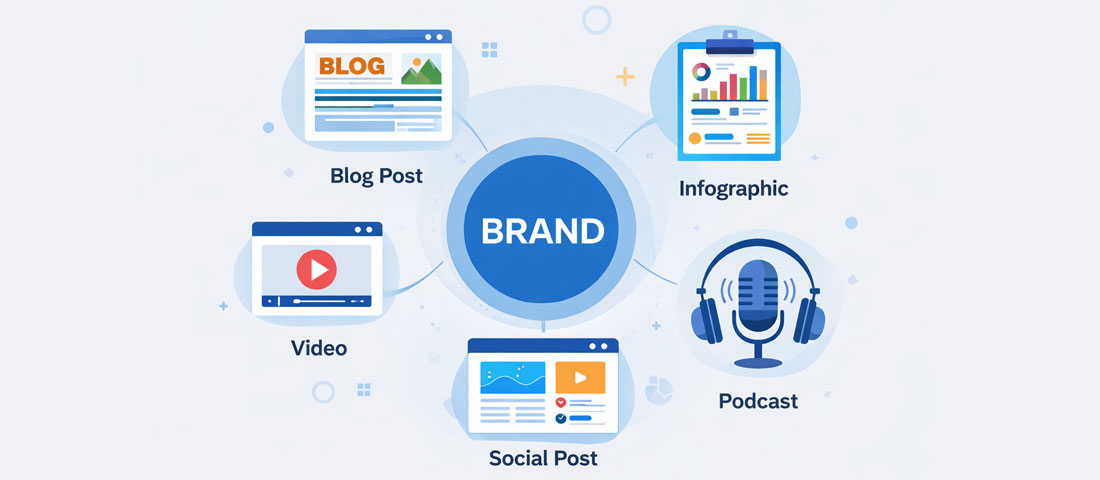
Content marketing is one of the most overused terms in digital marketing — and one of the most consistently misunderstood. It is simultaneously a discipline that builds the most durable long-term digital marketing advantages available, and one that is regularly mistaken for either “writing blog posts” or “posting on social media.” Neither of these is wrong, exactly — but neither captures what truly effective content marketing actually is or why it works.
What this guide covers
- 1. What Content Marketing Is — And What It Is Not
- 2. Why Content Marketing Is a Highly Investable Asset
- 3. How to Build a Content Marketing Strategy From Scratch
- 4. Content Formats: Written, Video, Audio, and Visual
- 5. Why Video Is the Most Powerful Content Format in 2026
- 6. Content Repurposing — Making One Piece of Content Work Across Many Channels
- 7. Distribution — Getting Your Content in Front of the Right Audience
- 8. Measuring Content Marketing ROI
- 9. Frequently Asked Questions About Content Marketing
This guide gives you the complete picture: what content marketing actually means and how it differs from other marketing disciplines, why it is one of the highest-return marketing investments you can make, how to build a content strategy that genuinely works, the full range of content formats and how to use them, and how to think about video content, content repurposing, and measuring the ROI of your content investment.
What Content Marketing Is — And What It Is Not
Content marketing is the strategic creation and distribution of valuable, relevant content — in any format — designed to attract and retain a clearly defined audience, and ultimately to drive profitable customer action.
Three elements of this definition deserve emphasis:
Strategic. Content marketing is not random publishing. Every piece of content should serve a defined purpose — attracting a specific audience segment, addressing a specific stage of the buyer journey, targeting a specific search intent, or building authority on a specific topic. Content produced without strategic purpose is content marketing in name only.
Valuable and relevant. The content must genuinely serve the audience’s needs — educating, informing, entertaining, or solving a problem — without requiring them to pay for it or commit to anything to access it. Content that is purely promotional, that talks only about the producing company’s products and services, is not content marketing. It is advertising dressed up as content.
Profitable customer action. Content marketing is not a charitable exercise in audience service. It is a business investment designed to generate trust, authority, and audience relationship that ultimately translates into commercial outcomes — enquiries, purchases, referrals, or retained customers.
What Content Marketing Is Not
- It is not just blogging. A blog is one content format. Content marketing is a strategic discipline that can use dozens of formats — video, podcasts, webinars, infographics, tools, email newsletters, research reports, and more.
- It is not advertising. Advertising interrupts an audience to deliver a promotional message. Content marketing provides value first — attracting an audience through useful or compelling content and building a relationship before any commercial request is made.
- It is not social media management. Social media is a distribution channel for content. Content marketing is the discipline of creating the content that gets distributed.
- It is not fast. Content marketing’s greatest strength — its compounding, long-term nature — is also what makes it unsuitable for anyone expecting immediate results. Content assets build value over months and years. The businesses that invest in content marketing consistently over the long term build advantages that competitors cannot replicate quickly.
Why Content Marketing Is a Highly Investable Asset
The case for treating content marketing as a high-return investment rests on its fundamentally different economic model from most other marketing channels.
Content creates compounding assets, not depreciating expenses. A paid advertising campaign delivers results only while money is being spent — the moment the budget stops, the traffic and leads stop. A well-produced piece of content — a comprehensive guide, an in-depth case study, a research report — continues generating organic traffic, leads, and brand authority for years after it was created. The cost of production is one-time; the returns compound over time.
Content builds trust before a commercial relationship exists. A potential client who has read five of your blog posts, found them genuinely useful, and come to see you as a knowledgeable authority in your field before they ever have a sales conversation with you is in a fundamentally different relationship with your business than one who first encounters you through a paid ad. Content marketing builds the trust and authority that makes every subsequent sales and conversion activity more effective.
Content marketing has an improving return over time. In most paid channels, you pay the same cost per click or impression indefinitely. In content marketing, the cost of producing content is incurred once, but its value grows as it accumulates links, reaches more people through organic search, and builds topical authority that lifts your entire digital presence. The ROI of a content marketing programme from year three is typically significantly higher than from year one — not because you are investing more, but because the compounding benefits of three years of consistent authority-building are now visible.
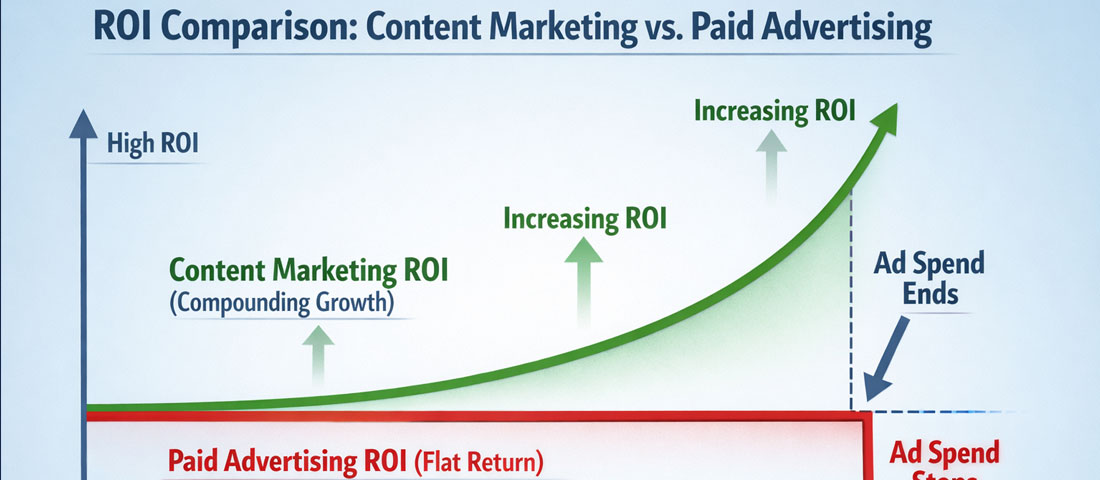
Content marketing produces compounding returns that grow over time — fundamentally different from paid advertising, which delivers while you spend and nothing when you stop.
How to Build a Content Marketing Strategy From Scratch
-
Define your audience with precision
Effective content marketing is built on a clear understanding of exactly who you are trying to reach — not a vague description of “businesses” or “consumers,” but a specific profile: what industry they are in, what role they hold, what problems they are trying to solve, what questions they are asking, what keeps them up at night. The more precisely you define your audience, the more relevant and useful your content can be to them — and the higher your conversion rates from content engagement to business enquiry. -
Map the buyer journey
Different types of content serve different stages of the journey a potential customer takes from first awareness of a problem to selecting a provider. Awareness-stage content educates about problems and possibilities. Consideration-stage content helps evaluate options. Decision-stage content provides the evidence and assurance needed to commit. A balanced content strategy addresses all three stages — not just the educational awareness content that most businesses default to. -
Define your content pillars
Content pillars are the 3 to 5 core topic areas that you will focus your content on — areas that are directly relevant to your audience’s needs and your business’s expertise. For a web design and digital marketing agency, content pillars might be: web design and development, SEO and search marketing, eCommerce, digital business strategy, and AI and emerging technologies. Every piece of content you produce should belong to one of these pillars — preventing the drift toward off-topic content that dilutes topical authority. -
Conduct keyword and question research
Map each content pillar to the specific questions your audience is asking online — through keyword research tools, Search Console data, “People Also Ask” boxes, and direct customer conversations. These questions become your content brief: the specific topics that real people in your target audience are actively seeking answers to. -
Build an editorial calendar
A realistic, manageable publishing calendar — whether that is one piece per week or one per month — that you actually stick to is more valuable than an ambitious calendar that gets abandoned. Consistency matters more than frequency. A content programme that publishes one genuinely excellent piece every two weeks for two years builds more authority than one that publishes daily for three months and then stops. -
Plan your distribution strategy
Producing content is only half the job. Each piece should have a specific distribution plan: which email list segments will receive it, which social channels it will be shared to, whether it will be pitched to industry publications for syndication, and whether there are specific people or organisations who should know it exists. Content that is produced but not actively distributed rarely reaches its audience potential.
Content Formats: Written, Video, Audio, and Visual
Content marketing in 2026 encompasses a wide range of formats, each with different strengths, audiences, and investment requirements. Understanding the format landscape helps you choose the right mix for your audience and resources.
Written Content
Blog posts, guides, white papers, case studies, email newsletters, and reports are the foundation of most content marketing programmes — for good reason. Written content is the most accessible format to produce, the most directly SEO-relevant, and the most persistent in its value (a well-optimised guide can generate organic traffic for years). Written content is also the most easily repurposed into other formats — a comprehensive guide can become a video script, a podcast episode outline, an infographic, and a social media content series.
Video Content
Video has become the dominant content format by consumption volume globally, and its importance in content marketing continues to grow. We will cover video in detail in the next section — but its significance warrants prominent mention here.
Podcast and Audio Content
Podcasts have carved out a specific and growing niche in B2B content marketing — reaching audiences during commutes, exercise, and other contexts where visual content is inaccessible. A podcast that regularly brings genuine expertise and insight to an industry topic builds an intimate, loyal audience that other content formats rarely achieve. The barrier to entry is lower than video (no camera, lighting, or editing required), and the long-form conversation format allows a depth of exploration that written content rarely matches.
Visual Content: Infographics, Data Visualisations, and Illustrations
Visual content — infographics, data visualisations, charts, and custom illustrations — earns disproportionate shares and links relative to its production cost because it communicates complex information quickly and memorably. Original data presented visually is among the most powerful link-earning content formats. Well-designed infographics are shared far more often than text equivalents of the same information, and are embedded on other websites with links back to the original source.
Interactive Content
Calculators, assessments, quizzes, comparison tools, and interactive maps are among the most engaging content formats available — they require active participation rather than passive reading. Interactive content generates longer session times, higher return visit rates, and strong sharing behaviour. Producing genuinely useful interactive tools (a “website ROI calculator,” a “keyword difficulty checker,” a “content readability analyser”) creates the most powerful linkable assets in content marketing.
Why Video Is the Most Powerful Content Format in 2026

Video content commands disproportionate engagement and retention across every platform — making it the most powerful single content investment for most businesses in 2026.
Video has been the fastest-growing content format for the past decade, and its dominance has only deepened in 2026. The statistics are consistently compelling: viewers retain 95% of a message delivered through video compared to 10% when reading text. Video on landing pages increases conversions by an average of 86%. YouTube is the second largest search engine in the world. And short-form video through TikTok, Instagram Reels, and YouTube Shorts reaches audiences at a scale and engagement level that no other format can match.
Types of Video Content Worth Investing In
Tutorial and how-to videos are the highest-performing video format for businesses demonstrating expertise. “How to set up Google Analytics 4,” “How to choose the right web design agency,” “How to optimise a WordPress website for speed” — these directly serve audience needs while demonstrating the expertise of the producing business.
Explainer videos simplify complex concepts — what a service involves, how a technology works, why a particular approach is recommended — in a format that is more accessible and engaging than a written explanation. Animated explainer videos are particularly effective for abstract or technical concepts.
Client testimonial and case study videos are the most persuasive trust-building content format. A client speaking directly to camera about the results they achieved with your help is more convincing than any written case study, because the authenticity and specificity are harder to fake.
Short-form social videos (60 to 90 seconds) are the format for reaching new audiences on social platforms. These are not polished corporate productions — they are authentic, direct, value-packed clips that reward the viewer with a specific insight or actionable tip in the time it takes to consume them.
Video SEO — Getting Video Discovered Through Search
Video content can rank in both YouTube search and Google search. To maximise video discoverability: use keyword-researched titles that match how your audience searches; write detailed descriptions (300+ words) that include target keywords and summarise the video content; add chapter timestamps for longer videos (improving watch time and viewer experience); add closed captions (improving accessibility and keyword indexing); and embed videos on relevant website pages to generate page engagement signals and keep visitors on your site longer.
Content Repurposing — Making One Piece of Content Work Across Many Channels
Content repurposing is the practice of transforming one piece of content into multiple formats for distribution across multiple channels. It is one of the highest-efficiency activities in content marketing — dramatically increasing the reach and lifespan of your content investment without requiring proportional additional production effort.
A single comprehensive blog post can be repurposed into: a LinkedIn carousel summarising the key points; a short-form video script for a tutorial or explainer; a podcast episode expanding on the topic in conversation; an infographic visualising the key data or framework; an email newsletter highlighting the most actionable insights; a series of social media posts drawing one insight per post; and a slide deck for a webinar or speaking engagement.
The key to effective repurposing is understanding that different formats serve different audiences in different contexts — rather than simply copying and pasting content between platforms. A Twitter thread adapted from a blog post should be optimised for Twitter’s native format (concise, punchy, engaging). A LinkedIn post adapted from the same content should be optimised for LinkedIn’s professional context. The underlying ideas are the same; the expression is adapted for each platform.
Distribution — Getting Your Content in Front of the Right Audience
The most common content marketing failure is not insufficient content quality — it is insufficient distribution. Businesses invest in creating genuinely valuable content and then publish it on their blog with no systematic plan for getting it in front of the audience it was created for. The content sits undiscovered, generates minimal traffic, and the investment appears not to have worked — when in reality the creation succeeded and the distribution failed.
Effective content distribution in 2026 combines owned channels (email newsletter, social profiles, website), earned channels (media coverage, guest posts, community sharing), and paid channels (social promotion, content amplification) to maximise each piece’s reach:
- Email newsletter: The highest-quality owned distribution channel. Subscribers have explicitly opted in to hear from you, and email delivers the most consistent engagement across all content distribution channels.
- LinkedIn: For B2B businesses, LinkedIn is the highest-reach organic social channel for content distribution — particularly long-form articles and native documents (PDF carousels) which receive strong algorithmic amplification.
- SEO and organic search: The most valuable long-term distribution channel — it continues delivering traffic indefinitely after the initial content investment.
- Community seeding: Sharing relevant content in industry Slack communities, LinkedIn groups, and professional forums where your target audience congregates generates targeted traffic from highly relevant audiences.
- Content outreach: Proactively notifying journalists, bloggers, and industry publications about new research, data, or comprehensive guides — particularly content with newsworthy elements — is the most direct path to media coverage and high-authority links.
Measuring Content Marketing ROI
Content marketing ROI is harder to measure than paid advertising ROI — because the benefits are distributed over time and across multiple touchpoints rather than directly attributable to a single campaign. This measurement complexity leads many businesses to undervalue content marketing relative to its actual contribution. Here is how to measure it properly:
- Organic traffic growth: Track organic sessions by landing page monthly. Is total organic traffic growing? Are individual content pieces driving growing traffic over time? (GA4 + Search Console)
- Keyword ranking improvements: Are target keywords moving up in search results? Are new keywords being ranked for as topical authority builds? (Semrush, Search Console)
- Email subscriber growth: Content that provides genuine value converts readers into email subscribers — a directly measurable audience building metric
- Backlinks earned: How many editorial links has your content attracted? Growing referring domains indicate authority-building that compounds rankings over time (Ahrefs, Semrush)
- Organic leads and conversions: GA4 goal tracking should attribute enquiry form completions, calls, and other conversion events to their traffic source — allowing organic content to be credited with the leads it generates
- Assisted conversions: Content often contributes to a conversion journey without being the last touchpoint. GA4’s multi-touch attribution models reveal content’s role in the full customer journey, preventing undervaluation of awareness and consideration content
Frequently Asked Questions About Content Marketing
| What is content marketing and how does it work? | Content marketing is the strategic creation and distribution of valuable, relevant content — in any format — designed to attract and retain a clearly defined audience and ultimately drive profitable customer action. It works by building trust and authority with a target audience before any commercial request is made: educating potential customers about their problems and options, demonstrating your business’s expertise and approach, and establishing a relationship of value that makes potential clients more likely to choose you when they are ready to buy. Unlike advertising, which pays for attention, content marketing earns it by providing genuine value. The ROI compounds over time as content assets build organic search authority, audience relationships, and brand recognition. |
| Why is content marketing important for businesses in 2026? | Content marketing is important in 2026 for several compounding reasons. The cost of paid digital advertising has increased significantly as competition for digital ad inventory has grown, making organic content marketing relatively more attractive. Google’s AI Overviews and the growth of AI search platforms mean that businesses with strong content authority appear in more search contexts than those without it. Consumer behaviour has shifted — buyers research extensively before engaging, and businesses that have already provided value through content are far more likely to be chosen. And content marketing’s fundamental economic model — building compounding assets rather than renting depreciating visibility — becomes more valuable every year as the assets accumulate. |
| What types of content are most effective for content marketing? | The most effective content types vary by audience, industry, and business objective, but consistently high performers include: comprehensive long-form guides and pillar posts that become definitive resources on important topics; original research and data that earns citations and links; video content (tutorials, explainers, testimonials) which generates disproportionate engagement; FAQ content that wins featured snippets and AI search citations; and comparison and best-of content that attracts commercial-intent searchers in the evaluation stage. The highest-ROI content is typically the content that is most genuinely useful as a reference — something that potential customers actively seek out and return to, and that other creators cite in their own content. |
| What is content repurposing and why is it valuable? | Content repurposing is the practice of transforming one piece of content into multiple formats for distribution across multiple channels — converting a blog post into a LinkedIn carousel, a short video, an email newsletter, an infographic, and social media posts, for example. It is valuable because it dramatically increases the reach and lifespan of each content investment without requiring proportional additional production effort. A single comprehensive guide can serve audiences across six or more channels and formats, reaching people who prefer different content formats and access content in different contexts. It also reinforces key messages across multiple touchpoints — increasing the likelihood that your target audience encounters and remembers your insights. |
| How do I measure content marketing success? | Content marketing success is measured across multiple dimensions that capture both leading and lagging indicators. Leading indicators (which show early progress): organic traffic growth by landing page; keyword ranking improvements for target terms; email subscriber growth; and backlinks earned by content pieces. Lagging indicators (which capture business outcomes): organic leads and enquiry form completions attributed to organic content in GA4; assisted conversions showing content’s role in multi-touch buyer journeys; and revenue attributed to clients who first discovered your business through content. The most common measurement mistake is tracking only leading indicators (traffic, rankings) without connecting them to business outcomes — making content marketing appear less valuable than it actually is. |
| How long does content marketing take to show results? | Content marketing results emerge on multiple timelines simultaneously. Email subscribers and direct traffic can begin growing from the first pieces of content, particularly with active distribution. Organic search rankings for target keywords typically take 4 to 6 months to develop for new content, and 6 to 12+ months for competitive queries. Domain authority and topical authority build over 12 to 24 months of consistent publication. The most significant compound returns — where a strong content programme generates substantially more traffic and leads than the initial investment would suggest — typically become visible after 18 to 36 months of sustained investment. Content marketing is not a short-term tactic; it is a long-term asset-building strategy whose returns accelerate over time. |
| Is video important for content marketing in 2026? | Yes — video has become the dominant content format by consumption volume and engagement rate globally, making it a critical component of any comprehensive content marketing strategy in 2026. Viewers retain significantly more information from video than from text. Video generates higher engagement rates than any other format on social platforms. YouTube is the second largest search engine in the world. And short-form video through platforms like YouTube Shorts, Instagram Reels, and TikTok reaches new audiences at a scale no other organic format can match. Businesses that do not incorporate video into their content strategy are missing the highest-engagement format available and ceding ground to competitors who do use it. |
Ready to build a content marketing strategy that compounds in value over time?
Neel Networks builds integrated content marketing and SEO strategies for businesses across the USA, UK, Canada, Australia, and India — from audience research and content planning through to production, optimisation, and distribution.