Best SEO Tools for Competitor Analysis & Ranking Improvement in 2026
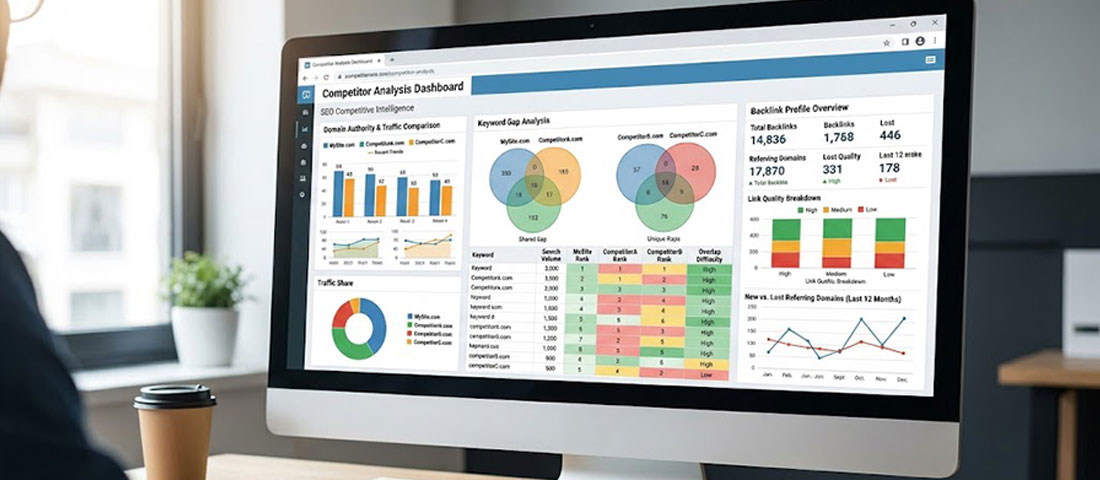
The difference between businesses that grow their organic search traffic steadily and those that plateau or decline often comes down to one thing: data. Specifically, the ability to understand what your competitors are doing to rank, what keywords are driving their traffic, where their authority comes from, and what content gaps exist in the market that you can fill.
What this guide covers
- 1. The Essential Free SEO Tools Every Website Owner Should Use
- 2. Paid SEO Tools: Competitor Analysis and Keyword Research
- 3. How to Conduct a Competitor SEO Analysis Step by Step
- 4. Rank Tracking — The Right Approach in 2026
- 5. AI-Era SEO Tools: Monitoring AI Search Visibility
- 6. Building Your SEO Tool Stack by Budget
- 7. Frequently Asked Questions About SEO Tools
In 2026, the SEO tools available for this analysis are more capable than ever — and the range spans from genuinely free tools that provide significant value to enterprise platforms with price tags to match. This guide covers both ends of the spectrum and everything in between, organised by what each tool does best, so you can build the right toolkit for your budget and objectives.
The Essential Free SEO Tools Every Website Owner Should Use
Before investing in paid SEO tools, there are several free tools that provide essential data and should be set up on every business website from day one. These are not inferior substitutes for paid tools — they are first-party data sources that paid tools cannot replicate.
Google Search Console — The Most Important Free SEO Tool
Google Search Console (GSC) is the only tool that shows you exactly how Google sees and indexes your website. It provides: the keywords your pages actually appear for in Google search (with impressions, clicks, average position, and CTR); coverage reports showing which pages are indexed and which have errors; Core Web Vitals data from real Chrome users; mobile usability issues; manual action notifications; and the ability to submit sitemaps and request recrawling of updated content.
GSC should be set up on every business website immediately after launch. The data it provides — particularly the keyword performance report — is irreplaceable and is not available through any third-party tool. Paid tools estimate keyword data from their own crawls; GSC shows you the actual data from Google. Check it at least weekly.
Google Analytics 4 — Traffic, Behaviour, and Conversion Data
Google Analytics 4 (GA4) tracks how visitors find your website, what they do when they arrive, and whether they take the actions that matter to your business (contact form submissions, phone calls, purchases). The integration of GA4 data with Search Console’s organic search data — through the GSC/GA4 link in Google Analytics — gives you a complete picture of organic search performance from impression through to conversion.
GA4’s AI-powered insights automatically surface significant changes in traffic patterns, identify high-performing content, and flag anomalies — reducing the manual analysis burden significantly compared to its predecessor, Universal Analytics.
Google PageSpeed Insights — Performance and Core Web Vitals
Google PageSpeed Insights (pagespeed.web.dev) is the primary free tool for measuring your website’s Core Web Vitals and overall performance. It provides both lab-measured metrics (from a simulated test) and, where available, real-world CrUX data from actual Chrome users. It identifies specific performance issues with actionable recommendations for each. Free and authoritative — use it monthly on your most important pages.
Google Keyword Planner — Search Volume Data
Google Keyword Planner, available free through a Google Ads account, provides search volume data and keyword suggestions directly from Google. While the volume data is presented in broad ranges for accounts without active ad spend, it provides reliable direction on relative search demand for keyword research. It is the only keyword volume tool backed by Google’s own data.
Bing Webmaster Tools — Often Overlooked, Always Worth Having
Bing (Microsoft) Webmaster Tools provides equivalent functionality to Google Search Console for Bing search — keyword performance, crawl data, indexing status. While Bing’s market share is smaller than Google’s, it is used by tens of millions of searchers and is the default search engine for Microsoft Edge, which is widely used in enterprise environments. Setting up Bing Webmaster Tools takes 15 minutes and provides additional data for no cost.
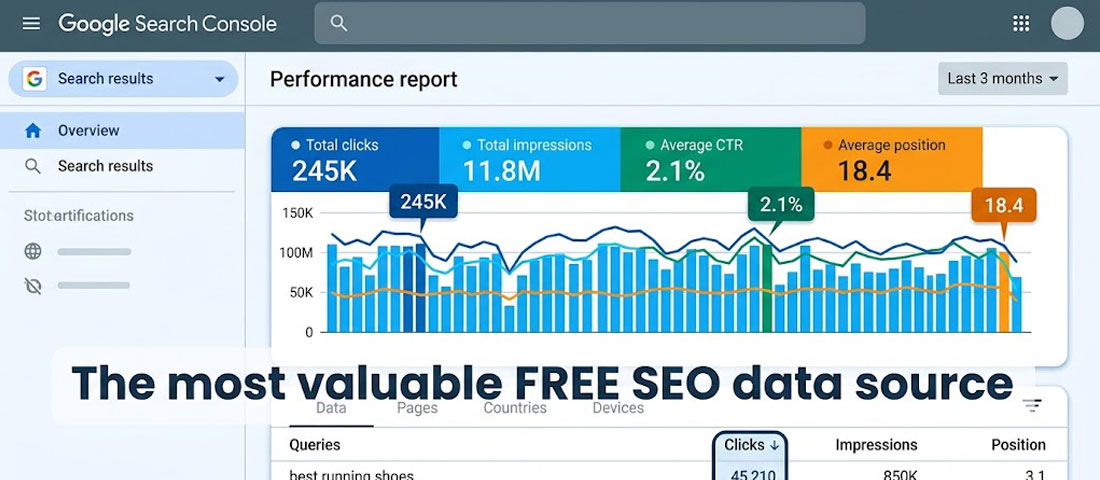
Google Search Console’s Performance report shows exactly which keywords are driving your organic traffic — data that no paid tool can replicate, as it comes directly from Google.
Paid SEO Tools: Competitor Analysis and Keyword Research
Semrush — The Most Comprehensive All-in-One SEO Platform
Semrush is the most widely used commercial SEO platform globally, offering: competitor organic traffic estimates and keyword portfolios, keyword research with volume and difficulty data, backlink analysis, site audit tools, rank tracking, content marketing tools, and PPC competitor analysis. Its Keyword Gap tool — which identifies keywords that your competitors rank for but you do not — is particularly valuable for content strategy development.
Semrush’s competitive intelligence is its strongest feature. Entering a competitor’s domain reveals their top organic keywords, their traffic-driving pages, their backlink sources, and their keyword ranking changes — giving you a comprehensive picture of what is working in your market without requiring your own experiments.
Cost: From $139.95/month (Pro). Free account available with limited data. The 7-day free trial is sufficient for a thorough initial competitor analysis.
Ahrefs — The Best Backlink Analysis Tool
Ahrefs has the most comprehensive backlink index of any commercial SEO tool — tracking links from billions of web pages with rapid update frequency. For competitor backlink analysis — understanding where your competitors’ authority comes from and identifying link building opportunities — Ahrefs is the industry standard. Its Content Explorer tool is excellent for identifying high-performing content in any niche, and its Site Audit tool is one of the most thorough available.
Ahrefs and Semrush have converged significantly in capability over the past two years. Semrush tends to be preferred for keyword research and competitive intelligence; Ahrefs tends to be preferred for backlink analysis and content research. Many serious SEO practitioners use both.
Cost: From $129/month (Lite). Limited free tools available at ahrefs.com/free-seo-tools.
Moz Pro — Domain Authority and Local SEO
Moz’s Domain Authority (DA) metric — a proprietary score predicting a website’s likelihood to rank in search engines — is the most widely recognised website authority metric in the industry, used even by practitioners who primarily use Semrush or Ahrefs. Moz Pro’s Local SEO tools are among the strongest available for businesses targeting local markets. Its Keyword Explorer provides reliable keyword data with useful SERP feature identification.
Cost: From $99/month. The free MozBar browser extension provides instant DA and PA (Page Authority) data for any page — a useful free tool regardless of whether you subscribe to Moz Pro.
Screaming Frog SEO Spider — Technical SEO Auditing
Screaming Frog is a desktop application that crawls your website like a search engine crawler, identifying technical SEO issues: broken links, redirect chains, duplicate content, missing meta data, thin pages, improper canonical tags, and hundreds of other technical issues. It is the preferred technical SEO audit tool of professional SEO practitioners globally.
The free version crawls up to 500 URLs — sufficient for most small business websites. The paid version (£259/year) removes the URL limit and adds several advanced features including integration with GA4, Search Console, and PageSpeed Insights.
How to Conduct a Competitor SEO Analysis Step by Step
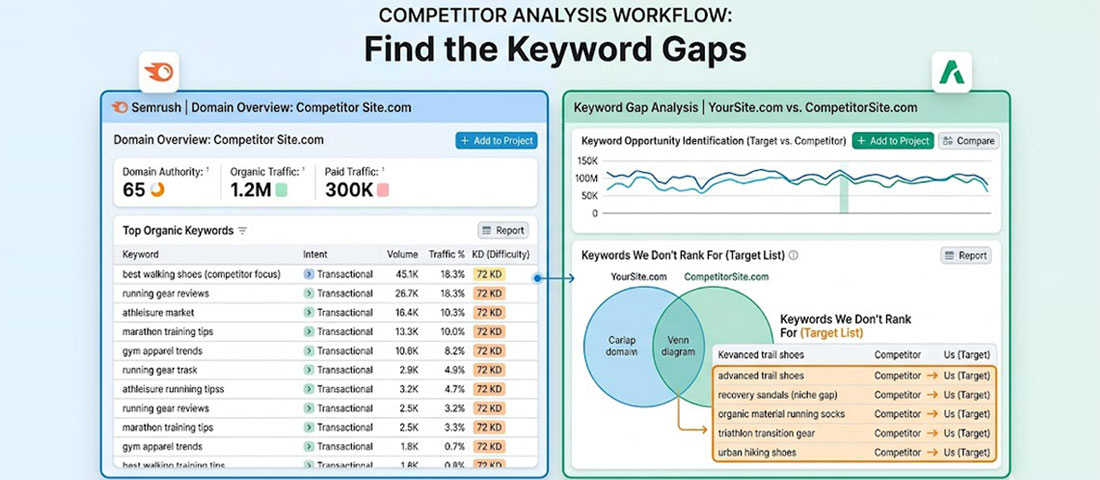
Competitor analysis tools reveal exactly which keywords are driving your competitors’ traffic — enabling you to identify gaps and opportunities in your own content strategy.
-
Identify your top 3 to 5 organic competitors
Your organic competitors are not necessarily your business competitors — they are the websites competing for the same search queries you are targeting. Search for your most important target keywords in Google and note which sites consistently appear in the top results. Enter these domains into Semrush or Ahrefs to understand their organic traffic profile. -
Analyse their top-performing pages and keywords
In Semrush, use “Organic Research” → “Top Pages” for each competitor domain. This shows which pages on their site drive the most organic traffic and which keywords each page ranks for. These are your content benchmarks — the pages you need to create better versions of to compete for the same traffic. -
Run a Keyword Gap analysis
Semrush’s Keyword Gap tool (and Ahrefs’ Content Gap equivalent) identifies keywords that your competitors rank for but your site does not. These are your prioritised content opportunities — the topics that are clearly valuable in your market (since competitors rank for them) but that your website has not yet addressed. Sort by search volume and relevance to your business to prioritise. -
Analyse competitor backlink profiles
In Ahrefs, enter each competitor’s domain and navigate to “Backlinks” → “New” to see which websites are linking to them and from what content. Look for patterns: which types of sites link to them? Which publications have covered them? What content earned their most valuable links? This research shapes your link building strategy — identifying the specific sources and content formats most likely to earn links in your market. -
Identify SERP feature opportunities
Review the search results for your target keywords and note which SERP features appear — AI Overviews, featured snippets, People Also Ask boxes, local packs, video results. Each SERP feature represents an opportunity to capture additional visibility beyond standard organic rankings, and each requires specific content formats to win. -
Document gaps and build your content priority list
Consolidate your research into a content opportunity list: keywords your site does not rank for, content formats that are winning in your market, link building sources your competitors use, and SERP features you are not yet appearing in. Prioritise by search volume, commercial relevance, and competitive difficulty to create an actionable SEO roadmap.
Rank Tracking — The Right Approach in 2026
Rank tracking — monitoring your keyword positions in Google over time — is a standard component of any SEO programme, but it requires some nuance in 2026. Google increasingly personalises search results based on location, search history, and device — meaning your rankings look different from different devices and locations. The following tools provide reliable rank tracking that accounts for these variables:
- Semrush Position Tracking — Tracks keyword rankings for specified locations (city, country, or local) and devices (mobile and desktop separately). Provides weekly or daily ranking updates with trend charts. Included in Semrush subscriptions.
- Ahrefs Rank Tracker — Similar functionality to Semrush’s, with strong historical data and SERP feature tracking. Included in Ahrefs subscriptions.
- AccuRanker — A dedicated rank tracking tool with daily updates, strong local tracking, and clean reporting. Best for agencies or businesses that prioritise rank tracking speed and detail. From $129/month.
- Google Search Console — Free, authoritative data on average position for all keywords your site appears for — not configurable to specific target keywords but invaluable as the ground truth.
AI-Era SEO Tools: Monitoring AI Search Visibility
In 2026, monitoring your traditional search rankings is necessary but not sufficient. AI Overviews, Perplexity citations, and ChatGPT recommendations are increasingly commercially significant, and monitoring your visibility in these platforms requires a new category of tools:
- Manual testing — The simplest approach: regularly search your target queries in Google (to see if your content appears in AI Overviews), Perplexity (to see if your site is cited), and ChatGPT (to see if your brand is recommended). Document the results monthly. Free and provides ground-truth data.
- Semrush AI-powered features — Semrush’s 2025-2026 updates include AI Overview tracking for keywords in position tracking reports and AI content audit tools that assess your content’s readiness for AI search features.
- BrightEdge and Conductor — Enterprise SEO platforms that have added AI Overview tracking and generative AI visibility monitoring to their feature sets. Appropriate for large organisations with significant organic programmes.
- Customised Google Alerts — Setting up Google Alerts for your brand name and core service terms provides passive monitoring of where your brand is mentioned across the web — which contributes to the citation signals that AI search platforms use.
Building Your SEO Tool Stack by Budget
| Budget Level | Recommended Tool Stack | Monthly Cost |
|---|---|---|
| Free / Zero budget | Google Search Console + GA4 + Google Keyword Planner + Bing Webmaster Tools + MozBar extension + Screaming Frog (500 URL limit) | £0 / $0 |
| Starter ($100–150/month) | Free tools + Semrush Pro (or Ahrefs Lite) + Screaming Frog paid | ~$140–$150 |
| Professional ($250–400/month) | Free tools + Semrush Guru + Ahrefs Standard + Screaming Frog | ~$370–$400 |
| Agency / Enterprise ($500+/month) | Full Semrush + Ahrefs + AccuRanker + Screaming Frog + BrightEdge or equivalent AI tracking | $500–$800+ |
Tool stack principle: The free tools — Google Search Console, Google Analytics 4, and PageSpeed Insights — provide first-party data that no paid tool can replicate and should be the foundation of any SEO programme regardless of budget. Paid tools add competitive intelligence, efficiency, and depth. Start with the free tools, maximise what they tell you, and add paid tools when you need the specific capabilities they provide.
Frequently Asked Questions About SEO Tools
| What is the best free SEO tool in 2026? | Google Search Console is the best free SEO tool available — bar none. It provides first-party data directly from Google showing which keywords your pages appear for, how many impressions and clicks they receive, your average position, Core Web Vitals data from real users, and technical issues like crawl errors and mobile usability problems. No paid tool provides equivalent data quality for your own website, because paid tools estimate from their own crawls while Google Search Console shows you exactly what Google sees. It should be set up on every business website immediately after launch and checked at least weekly. |
| What is the best paid SEO tool for competitor analysis? | Semrush is the most comprehensive paid SEO tool for competitor analysis in 2026. Its Organic Research feature shows competitor keyword portfolios, top-performing pages, and traffic estimates. The Keyword Gap tool identifies keywords your competitors rank for that you do not — providing a prioritised content opportunity list. The Backlink Analytics tool reveals competitor link sources for link building strategy. Ahrefs is the strongest alternative, particularly for backlink analysis, and many professional SEO practitioners use both platforms for complete coverage. For businesses choosing one tool, Semrush’s breadth across keyword research, competitive intelligence, and site auditing makes it the default recommendation. |
| How do I do a competitor SEO analysis? | A competitor SEO analysis involves: identifying which websites compete for the same organic keywords as your business (by searching your target keywords in Google); analysing their top-performing pages and keywords using a tool like Semrush (Organic Research → Top Pages); running a Keyword Gap analysis to identify keywords they rank for that you do not; analysing their backlink profiles to identify where their authority comes from and potential link building opportunities for your own site; and identifying SERP feature opportunities (AI Overviews, featured snippets, People Also Ask) that you could win for shared target queries. The output should be a prioritised content and link building opportunity list that drives your SEO strategy. |
| Is Semrush or Ahrefs better? | Semrush and Ahrefs are both excellent tools that have converged significantly in capability. Semrush tends to be preferred for keyword research, competitive intelligence, and PPC analysis — its Keyword Gap tool, content marketing features, and broader marketing platform integrations are industry-leading. Ahrefs tends to be preferred for backlink analysis (its link index is the most comprehensive available), content research through Content Explorer, and technical site auditing. Many professional SEO practitioners and agencies use both. If choosing one, Semrush’s broader scope makes it the more versatile single-tool choice; if backlink analysis is your primary need, Ahrefs is the better option. |
| What is Domain Authority (DA) and does it matter? | Domain Authority (DA) is a proprietary metric developed by Moz that predicts a website’s likelihood to rank in search engines on a scale of 1 to 100. It is based primarily on the quality and quantity of backlinks pointing to a domain. DA is not a metric used by Google — it is Moz’s own estimate of ranking likelihood. Despite this, it is widely used in the SEO industry as a relative benchmark for comparing website authority. Similar metrics include Semrush’s Authority Score and Ahrefs’ Domain Rating (DR). These metrics are useful for comparing relative authority between your site and competitors, and for assessing the quality of potential link building targets. They should not be treated as direct indicators of Google ranking potential, but as useful approximations for strategic decision-making. |
| Do I need paid SEO tools or can I do SEO with free tools? | You can do meaningful SEO with only free tools — Google Search Console, GA4, Google Keyword Planner, Bing Webmaster Tools, and the free tier of Screaming Frog cover a significant portion of what is needed for basic SEO management. The limitations of free-only SEO are primarily in competitive intelligence: you cannot easily see what keywords your competitors rank for, where their links come from, or what content gaps exist in your market. Paid tools like Semrush or Ahrefs are investments that pay for themselves many times over for businesses where SEO is a primary growth channel — by identifying opportunities that free tools cannot surface and by making the entire SEO programme more efficient. |
| How do I track my search engine rankings? | The most reliable approach to rank tracking combines Google Search Console (for comprehensive data on all keywords your site appears for, directly from Google) with a rank tracking tool like Semrush Position Tracking, Ahrefs Rank Tracker, or AccuRanker (for monitoring specific target keywords at defined locations and on mobile and desktop separately). Search Console provides the most accurate overall picture but does not allow you to specify target keywords or locations precisely. Dedicated rank trackers allow you to monitor exactly the keywords and locations you care about with daily or weekly updates. Together, the two approaches provide comprehensive, actionable ranking visibility. |
Want expert SEO analysis done for you — without spending hours learning the tools?
Neel Networks provides comprehensive SEO audits and competitor analysis for businesses across the USA, UK, Canada, and Australia. We use the full professional tool stack to identify your highest-priority SEO opportunities and turn the data into an actionable strategy.