How to Choose the Perfect Domain Name: SEO, Branding & Registration Guide 2026
Your domain name is the most permanent address in your digital life. Change your website design, your hosting provider, your email platform, or your social media strategy — and the transition, while sometimes disruptive, is manageable. Change your domain name and you face a fundamentally different challenge: rebuilding the search rankings, backlink authority, and brand recognition that accumulated at the old address, while ensuring that every existing link, every saved bookmark, and every printed marketing piece pointing to the old domain gets captured and redirected.
What this guide covers
- 1. What Makes a Domain Name “Good”?
- 2. Domain Names and SEO: What Still Matters in 2026
- 3. Choosing the Right Domain Extension (TLD)
- 4. Checking Availability and Avoiding Legal Issues
- 5. Registering Your Domain: How to Do It Right
- 6. Domain Management Best Practices
- 7. Frequently Asked Questions About Domain Name Selection
- 8. Conclusion: The Right Domain Is Worth the Time It Takes to Choose
Choosing a domain name well from the outset is one of the highest-leverage decisions in setting up a digital presence. A good domain name is easy to remember, easy to type correctly, clearly associated with the brand, and free of the technical and legal problems that cause expensive complications later. A poor choice creates friction at every touchpoint — in conversation, in brand awareness, in email deliverability, and occasionally in legal disputes — for as long as the business operates under it.
This guide covers everything you need to make an informed domain name decision: the naming principles that produce strong domains, how domain names affect SEO, how to choose the right extension, how to check availability and avoid trademark issues, how to register securely, and how to protect what you register.

What Makes a Domain Name “Good”?
The best domain names share a cluster of qualities that make them function effectively as the permanent address of a business online. These qualities are not aesthetic preferences — they have measurable practical implications for brand recall, type-in traffic, and long-term manageability.
Memorable
A memorable domain name can be recalled accurately after being heard once — in a conversation, a podcast mention, an advertisement, or a passing reference. Memorability comes from shortness, simplicity, and distinctiveness. Complex names, names requiring unusual spelling, or names that sound like multiple things when spoken aloud are less memorable and generate more lost traffic from people who recall the name approximately but not exactly.
Easy to spell from pronunciation
The domain name should be unambiguous when spoken aloud. If someone hears your domain name and has to ask “is that with a ‘ph’ or an ‘f’?”, “is that one word or two?”, or “is there a hyphen?”, you are losing traffic every time the domain is mentioned in audio contexts. This is why names with unusual spellings (stylised brand names, deliberate misspellings, letter substitutions) create ongoing friction even when they seem distinctive at first.
Short
Shorter domains are easier to type, less prone to typing errors, and more readable in print and on screen. The practical target is under 15 characters excluding the extension. Domains under 10 characters are increasingly difficult to acquire at reasonable cost in .com, but 10–15 characters remains achievable for most new brand names. Avoid forcing a name into an acronym or abbreviation that obscures meaning in order to hit a length target — the trade-off in brand clarity is rarely worth it.
No hyphens or numbers
Hyphens and numbers in domain names create consistent problems: they are ambiguous when spoken (“is that the number 4 or the word ‘for’?”), more difficult to type accurately, and often associated with lower-quality or spam domains by both users and spam filters. They also create confusion between the hyphenated version and the non-hyphenated version — traffic and authority that should be concentrated in one place gets split or lost. Avoid both in almost all circumstances.
No trademark conflicts
A domain name that infringes an existing trademark is not just a legal risk — it is a business continuity risk. Trademark holders can pursue domain transfers through the Uniform Domain-Name Dispute-Resolution Policy (UDRP) process without needing to take the case to court. A business that has invested in building a digital presence under a domain name and then loses it to a trademark dispute faces an extremely costly and disruptive recovery. Check trademark registries in your relevant jurisdictions before finalising any name.
Domain Names and SEO: What Still Matters in 2026
The relationship between domain names and SEO has changed significantly since the early days of exact-match domains (EMDs) — when registering a domain like “bestplumberlondon.com” conferred a significant ranking advantage simply because the target keyword was in the domain. Google’s systems have evolved to substantially reduce this advantage, but domain names still influence SEO in several meaningful ways.
Brand vs. exact-match domains
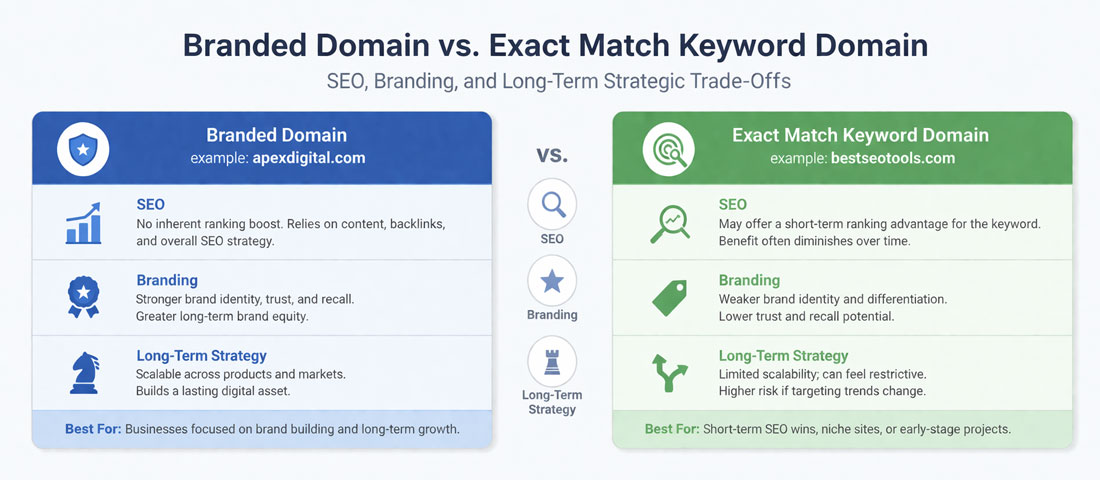
In 2026, a branded domain name (your business name or a distinctive invented name) consistently outperforms an exact-match keyword domain for long-term SEO performance for most businesses. The reasons are multiple: branded domains build stronger direct traffic signals as the brand becomes known; they are more likely to earn natural backlinks with branded anchor text; they accumulate trust signals across domains and email deliverability systems that keyword-stuffed domains do not; and they provide flexibility for the business to evolve without the domain name becoming a strategic constraint.
Exact-match domains still retain a minor SEO signal for the specific keywords they contain, but this advantage has diminished substantially and does not outweigh the brand-building disadvantages of operating under a descriptive rather than distinctive name. The exception is purely descriptive informational sites or lead-generation pages where brand equity is not the goal and keyword clarity for a narrow audience is the primary purpose.
Domain age and history
Domain age — how long a domain has been registered and actively used — is a confirmed, if minor, ranking signal. A domain that has been online and accumulating backlinks, traffic, and trust for ten years carries more inherent authority than a freshly registered domain. This is one reason that acquiring an aged domain with clean history (no prior spam use) is sometimes worth the premium over registering a new domain, particularly for businesses entering competitive search markets where building authority from scratch is slow.
Domain history is as important as domain age. A domain with a long history of spam, black-hat SEO, or content violations carries negative trust signals that can take a year or more to overcome even with completely clean subsequent use. Before acquiring any aged domain, check its Wayback Machine history, run it through spam blacklist checkers, and review its backlink profile in a tool like Ahrefs or SEMrush to identify any toxic link patterns that would need to be addressed.
Keywords in the domain
Having a primary keyword in the domain name still provides a minor ranking signal and can improve click-through rates in search results for queries matching the keyword. For local service businesses — where the domain name often includes both the service type and location — a descriptive domain name can be a legitimate strategic choice. A plumber in Manchester operating as “manchester-plumbing-services.co.uk” sacrifices brand distinctiveness for keyword presence, which may be acceptable for a business where local search dominance is the primary digital strategy.
For most other businesses, the SEO advantage of keywords in the domain name is not significant enough to outweigh the brand-building benefits of a distinctive, memorable branded domain.
Choosing the Right Domain Extension (TLD)
The top-level domain (TLD) — the part after the final dot — is one of the most consequential and most debated domain name decisions. The choice influences user trust, geographic perception, and in some markets, search visibility.
.com: Still the default for global businesses
Despite thousands of new TLD options now available, .com remains the most trusted and most recognised domain extension globally. Users default to assuming .com when typing a domain name from memory — which means that any business on a non-.com extension that does not own the .com equivalent is sending some percentage of its type-in traffic to whatever occupies that .com address. For any business with global aspirations or a US market presence, .com is the strongly preferred extension if it can be acquired at a reasonable cost.
Country-code TLDs: .in, .co.uk, .com.au
Country-code TLDs (ccTLDs) signal geographic relevance and in some search markets provide a mild ranking advantage for local queries. A .in domain may perform marginally better for Indian search queries than a .com on equivalent content; a .co.uk domain signals UK relevance to both British users and Google’s local search systems. For businesses serving a single national market and not intending to expand internationally, a ccTLD is a legitimate and often strategically sound choice. For businesses with international ambitions, .com is generally the better foundation with the ccTLD potentially added alongside it to serve specific markets.
New generic TLDs: .io, .co, .agency, .design
The expansion of available TLDs over the past decade has produced hundreds of options — .io, .co, .app, .design, .agency, .studio, .tech, and many more. Some of these have gained genuine traction in specific communities: .io is widely used and accepted in the technology and SaaS space. .co is a credible alternative to .com used by many legitimate businesses. Others have not achieved broad recognition and may signal lower credibility to audiences outside specific contexts.
The practical consideration is whether the specific TLD you are considering is commonly used and recognised in your industry and target market. A design agency on .design is in good company. A financial services firm on .financial is not — the extension does not carry the trust associations of .com or a national ccTLD for audiences evaluating a financial provider.
| Extension | Best For | Trust Level | SEO Impact |
|---|---|---|---|
| .com | Global businesses, all industries | Highest — universal recognition | Neutral (no advantage but no disadvantage) |
| .in | India-focused businesses | High in India, lower internationally | Minor local boost for Indian queries |
| .co.uk | UK businesses | High in UK, recognised globally | Minor local boost for UK queries |
| .com.au | Australian businesses | High in Australia (requires ABN) | Minor local boost for AU queries |
| .io | Tech startups, SaaS products | High in tech industry, moderate broadly | Neutral — Google treats as generic TLD |
| .org | Non-profits, communities, open-source | High for non-commercial contexts | Neutral |
| New gTLDs (.agency, .design, etc.) | Industry-specific where extension is common | Variable — context dependent | Neutral — no penalty or advantage |
Checking Availability and Avoiding Legal Issues
Before investing any time in naming work built around a specific domain, verify both domain availability and potential trademark conflicts. Domain availability can change within hours of research — domains are registered in real time, and some domain investors actively monitor WHOIS lookups on searched names to register them speculatively before the person who searched can complete their registration.
Checking domain availability
Use registrar tools (Namecheap, GoDaddy, Cloudflare Registrar) or dedicated availability checkers like Instant Domain Search or Domainr to check availability across multiple TLDs simultaneously. Check not just your preferred extension but also the .com if you are considering a ccTLD, and the ccTLD if you are considering .com — you want to understand the full availability picture before committing to a name.
For names that are taken but may be available for purchase, WHOIS lookup tools show the current registrant’s contact information. Domains with privacy protection (increasingly common) show the registrar’s proxy contact. Domain marketplaces — Sedo, Flippa, Dan.com — list domains whose owners have indicated they are willing to sell. For strategic domain names that are already registered, a negotiated acquisition is sometimes worth the premium, particularly for .com addresses of strong brand names where the ccTLD or alternative TLD is the fallback.
Checking for trademark conflicts
Trademark checking requires looking at multiple registries depending on where your business will operate. In India, the Trade Marks Registry database is searchable online. In the USA, the USPTO TESS database. In Europe, the EUIPO eSearch platform. In the UK, the IPO Trade Mark search. These searches reveal existing registered trademarks in relevant classes that your proposed domain name might conflict with.
A domain name that is available to register does not mean it is free of trademark risk. Trademark rights can exist in unregistered marks in some jurisdictions through common law use. A domain that replicates a well-known brand name — even one not formally registered as a trademark — can be subject to UDRP challenge. When in doubt about a potentially conflicting name, a brief consultation with an IP attorney is money well spent compared to the cost of a forced domain transfer after years of brand building.
Registering Your Domain: How to Do It Right
-
Choose a reputable registrar
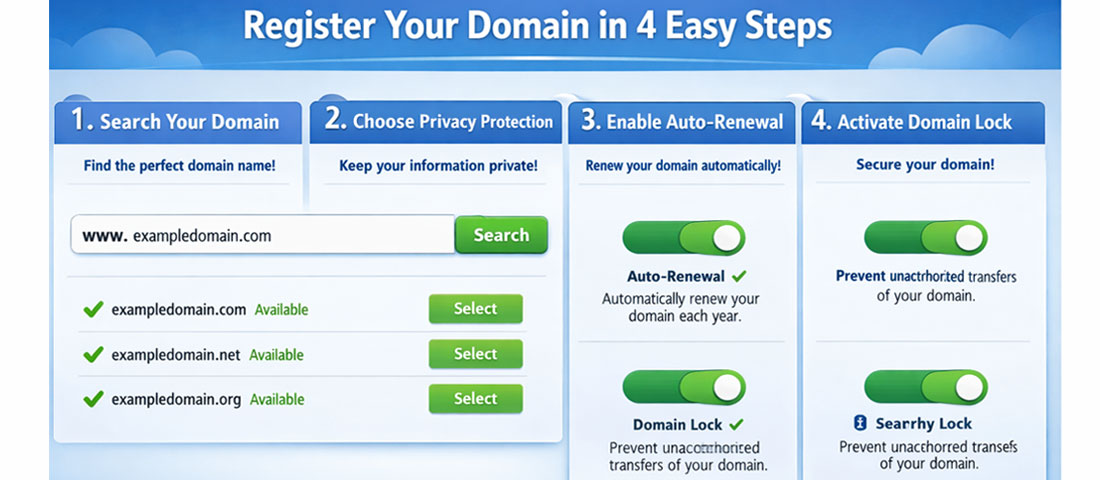
Register your domain with an established, reputable registrar — not necessarily the cheapest available. Recommended registrars with strong track records for reliability, transparent pricing, and good management interfaces include Namecheap, Cloudflare Registrar (at-cost pricing, no markup), Google Domains (now merged with Squarespace Domains), and GoDaddy. Avoid registrars with extremely low first-year prices that renew at dramatically higher rates, and be cautious of registrars with poor customer service reputations for domain disputes and transfer assistance. -
Enable WHOIS privacy protection
WHOIS privacy (sometimes called Domain Privacy or ID Protection) masks your personal contact information in the publicly accessible WHOIS database with the registrar’s proxy contact details. Without it, your name, email, phone number, and address are publicly visible and routinely harvested by spammers, cold callers, and phishing services. Most reputable registrars offer this free; some charge a small annual fee. Enable it at registration. -
Register for at least two years
Domains registered for longer periods signal stability to search engines and reduce the administrative overhead of annual renewals. Register for two to five years at minimum. Some SEO practitioners argue that multi-year registration is itself a positive trust signal, though this is not confirmed by Google. The practical benefit of avoiding inadvertent expiry — which can be catastrophic for an established domain with significant accumulated authority — is sufficient reason alone. -
Enable auto-renewal and lock the domain
Set automatic renewal on the domain registration, backed by a payment method you actively maintain. Domain expiry due to lapsed payments has ended businesses — once an established domain expires and is snapped up by a domain investor, recovery can be extremely expensive or impossible. Domain locking (registrar lock) prevents unauthorised transfer requests from being processed without additional verification — enable it immediately after registration. -
Register defensively where budget allows
Once you have secured your primary domain, consider registering common typo variants and alternative extensions. At minimum, register both .com and the relevant ccTLD for your primary market (e.g., .in for India, .co.uk for UK). Typo registrations — transpositions of adjacent letters, common misspellings — prevent competitors or squatters from capturing traffic intended for your domain. Point all variants to the primary domain via 301 redirect rather than building separate websites at each address.
Domain Management Best Practices
Registering the domain is only the beginning. Long-term domain management requires ongoing attention to security, renewal, and the administrative details that prevent costly problems.
Keep registrar account credentials secure and documented. Domain registrar account credentials should be stored in a secure password manager, not in a shared spreadsheet or email thread. Access to the registrar account is access to the domain itself — a compromised registrar account can result in domain hijacking. Enable two-factor authentication on all domain registrar accounts without exception.
Keep registrant contact information current. When a business changes address, phone number, or the email address associated with the registrar account, update the registrar account immediately. Expiry notices, security alerts, and transfer verification emails go to the registered contact email — if that address is no longer monitored, critical communications will be missed.
Maintain a domain inventory. Businesses that operate multiple domains — primary brand domain, market-specific domains, product domains, defensive registrations — should maintain a documented inventory of every domain they own, its registrar, its expiry date, and its purpose. This simple document prevents the most common domain management failures: inadvertent non-renewal of an important domain, loss of knowledge about where a domain is registered after staff changes, and duplicate registration attempts for domains already owned.
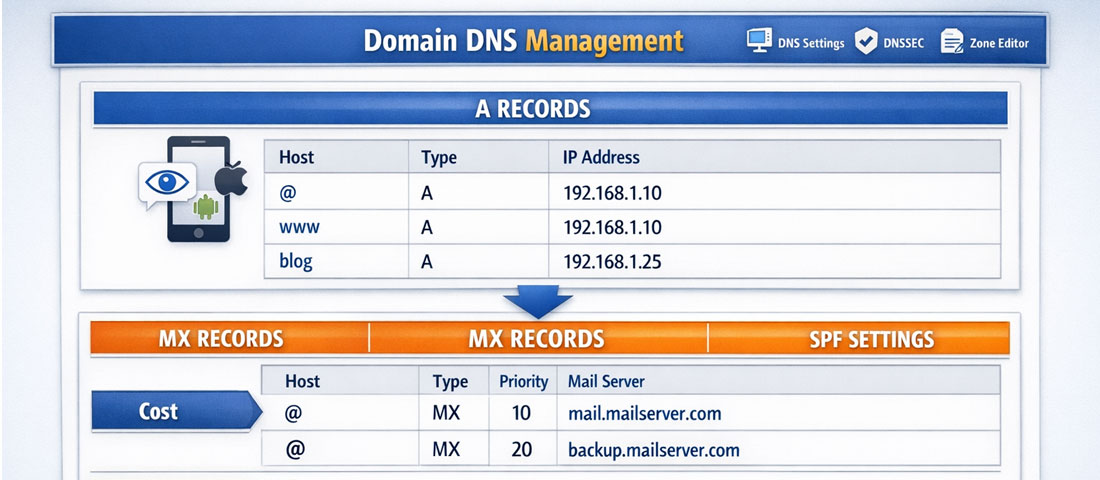
Review DNS records periodically. DNS records — the technical records that point your domain to your hosting, email, and other services — should be reviewed annually to confirm that all records are accurate and that no unauthorised records have been added. Email authentication records (SPF, DKIM, DMARC) are particularly important for email deliverability and should be correctly configured and maintained throughout the domain’s life.
Frequently Asked Questions About Domain Name Selection
| How much should I pay for a domain name? | New domain registrations typically cost between ₹800–1,500 per year ($10–20 USD) for standard .com and ccTLD extensions at reputable registrars. Significant variation exists in registrar pricing, particularly for first-year promotional rates that renew at higher prices — check the renewal rate before registering, not just the initial price. Premium domains — short, generic, or highly keyword-relevant names that are already registered and listed for sale — can range from a few hundred dollars to hundreds of thousands depending on the domain’s perceived value and the negotiating dynamics. For most new businesses choosing a distinctive brand name, a standard registration cost is entirely appropriate. If a specific domain is essential to a naming strategy and currently owned by a speculative registrant, it is worth making a private offer before assuming the price is prohibitive — many domain investors will accept reasonable offers for domains they have held passively for years. |
| Does my domain name affect my email deliverability? | Yes — domain age, domain reputation, and technical email configuration on your domain all directly affect whether emails sent from your domain address reach recipients’ inboxes or are filtered as spam. A brand new domain sending high volumes of email immediately after registration is a spam signal — email volume should ramp up gradually over the first few weeks of a new domain’s operation. Domains that have previously been used for spam or phishing carry negative reputation that affects deliverability for subsequent owners. Critically, proper DNS-based email authentication — SPF records specifying which mail servers are authorised to send email on behalf of your domain, DKIM digital signatures on outgoing mail, and DMARC policy records — is non-negotiable for professional email deliverability in 2026. Without these records correctly configured, legitimate business emails from your domain will frequently end up in spam folders, regardless of the quality of the content. |
| Can I change my domain name after my website is established? | You can change your domain name, but it carries significant costs and risks that make it a decision to approach with caution. The technical process involves setting up the new domain, implementing 301 redirects from every old URL to the corresponding new URL, updating all internal links, resubmitting sitemaps to Google Search Console, and updating every external mention of the old domain that you control. Google typically processes a domain migration over three to twelve months, during which time there is often a temporary decline in search visibility. The accumulated backlinks pointing to the old domain retain their value through 301 redirects but the effectiveness of transferred link equity is debated among SEO professionals. Brand recognition built around the old domain must be rebuilt at the new one. For these reasons, the bar for changing an established domain should be high — a domain migration is justified by a significant strategic reason (rebrand, merger, international expansion) rather than a minor preference for a different name. |
| What should I do if the .com of my preferred name is taken? | The options when your preferred .com is taken are: negotiate to purchase it from the current owner; choose a modified version of the name that has .com available (adding a relevant word, modifying the name slightly); use an alternative TLD such as a ccTLD (.in, .co.uk) or a well-regarded generic TLD (.io, .co) appropriate to your industry; or reconsider the name entirely and find a distinctive alternative where .com is available. The right choice depends on why the .com is taken. If it is held by a domain investor with no active website, an acquisition offer at the right price may be feasible. If it is held by an active business in the same category, both the name and the .com are potentially problematic regardless of which extension you choose. If the .com is held by a business in a completely unrelated industry and the association would not cause confusion, using a ccTLD or alternative extension may be entirely workable. Always check the .com before investing significant brand equity in a name under a different extension — knowing the situation at the .com gives you the information to make an informed naming strategy decision. |
| How do I transfer a domain from one registrar to another? | Domain transfers between registrars follow a standardised process. Unlock the domain at the current registrar (disable the registrar lock). Request an authorisation code (also called an EPP code or transfer code) from the current registrar. Initiate the transfer at the new registrar, entering the authorisation code when prompted. Approve the transfer via email when the confirmation request arrives at the registered email address. The transfer process typically takes five to seven days and the domain remains fully functional throughout. Note that domains cannot be transferred within 60 days of initial registration or a previous transfer (ICANN rule), and some ccTLDs have different transfer procedures specific to their registry. Before initiating a transfer, ensure that the domain has not expired or is not within the 60-day lock period. Transfers do not affect website hosting, DNS settings, or email configuration — these continue to function through the transfer based on existing DNS records. |
| What is the difference between a domain name and web hosting? | A domain name is your website’s address — the human-readable text (like neelnetworks.com) that users type or click to find your site. Web hosting is the server infrastructure where your website’s files actually live — the computers that store and serve your web pages, images, database, and code to visitors. The two are separate services, typically purchased from different providers (though many registrars also offer hosting and vice versa). When a user types your domain name, the DNS system translates it into the IP address of your hosting server, which then serves the website. You must have both a domain name and hosting for a website to be accessible — the domain name alone with no hosting behind it is like a signpost pointing to an empty plot. The domain name can be registered with one provider and pointed via DNS to hosting on a different provider’s servers — this separation is common and often strategically sensible, as it allows you to change hosting providers without changing registrars and vice versa. |
| Should I buy multiple domain extensions to protect my brand? | Defensive domain registration — buying multiple extensions of your brand name — is worth considering for established brands or businesses making significant marketing investment in a brand name. The practical minimum for most businesses is owning both the .com and the primary ccTLD for their main market (e.g., both mycompany.com and mycompany.in for an India-focused business). Beyond that, the value of additional defensive registrations decreases as the extensions become less commonly assumed or used. Common typo variants are worth considering if your domain name has a frequently mistyped letter pattern — a domain name with adjacent characters that are easy to transpose or a vowel combination that is commonly misspelled. For very early-stage businesses, defensive registration of additional extensions may be a lower priority than other startup costs — register the primary domain and most important ccTLD, then expand defensively as the brand gains recognition and the cost of losing those variants to squatters becomes more meaningful. |
Conclusion: The Right Domain Is Worth the Time It Takes to Choose
In the context of building a business, spending an extra day or two exploring domain name options before registering is a trivially small investment relative to the years of brand building that will happen on that foundation. The decision compounds over time: a strong domain name makes every brand impression slightly stronger, every link slightly more credible, and every marketing reference slightly more effective. A weak or problematic domain creates friction at every touchpoint for as long as the business uses it.
The principles in this guide — memorable, unambiguous, short, clean of hyphens and numbers, clear of trademark issues, registered with a reputable registrar and properly protected — are not complex. They simply require being deliberate at the point of decision rather than registering the first available option and hoping for the best.
At Neel Networks, we work with businesses from their earliest digital setup through to full-scale web presence management. If you are launching a new business or reconsidering a domain strategy, we are happy to share our perspective on what makes a strong foundation for long-term digital success.
Setting Up Your Digital Presence the Right Way?
Neel Networks provides end-to-end web presence services — from domain strategy and hosting selection through to website design, SEO, and ongoing support. We have helped 450+ businesses across India, the UK, USA, Canada, and Australia build digital foundations that serve them for years. Get in touch to discuss your project.