Online Reputation Management Guide 2026: Tools, Strategy & Why It Matters
Your business’s reputation used to live in the memories of people who had worked with you. Today it lives on Google, on review platforms, on social media, and increasingly in the outputs of AI-powered search tools that synthesise public information about your brand before a potential customer ever visits your website. Online reputation management (ORM) is the practice of monitoring, shaping, and protecting how your business appears across these digital surfaces.
What this guide covers
- 1. Why Online Reputation Is Now a Revenue Driver, Not Just a PR Concern
- 2. The Four Pillars of Online Reputation Management
- 3. Pillar 1: Monitoring — Knowing What Is Being Said About Your Business
- 4. Pillar 2: Building — Creating a Strong Positive Reputation Proactively
- 5. Pillar 3: Responding — How to Handle Reviews the Right Way
- 6. Pillar 4: Suppressing and Correcting Harmful Content
- 7. ORM for Different Business Types
- 8. The SEO Dimension of Online Reputation Management
- 9. Building an ORM Process Your Team Can Maintain
- 10. Frequently Asked Questions About Online Reputation Management
- 11. Conclusion: Reputation Is an Asset — Invest in It Accordingly
In 2026, ORM is not a crisis response tool. It is a proactive business discipline — one that directly influences how many leads your website converts, how confidently potential clients approach you, and how you rank in both traditional and AI-powered search results. This guide covers the full picture: why reputation matters more than ever, how to monitor it systematically, how to build it strategically, how to handle negative reviews and press, and which tools make the job manageable.
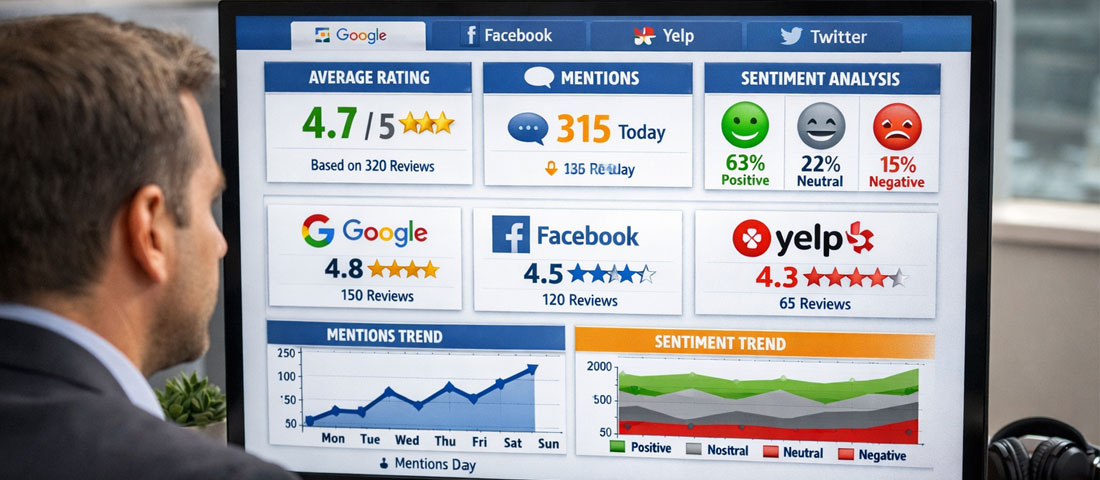
Why Online Reputation Is Now a Revenue Driver, Not Just a PR Concern
The connection between online reputation and business revenue used to be difficult to quantify. It is no longer. Multiple independent studies consistently show that the majority of consumers read online reviews before making a purchasing decision — with figures ranging from 79% to 93% depending on the industry and geography. More specifically, businesses with an average star rating below 4.0 experience significant drop-off in enquiry volumes compared to those above 4.5. The difference between a 3.8-star and a 4.8-star Google Business Profile is not cosmetic — it is a measurable revenue gap.
In 2026, reputation has a second dimension that did not exist three years ago: AI search outputs. When a potential customer asks an AI assistant “who is the best web design agency in Mumbai?” or “is [your business name] trustworthy?”, the AI pulls from publicly available information about your business — reviews, articles, social mentions, forum posts — to generate an answer. A business with a strong, positive digital reputation tends to be cited favourably. A business with unaddressed negative reviews, thin public information, or a history of public complaints may be described in ways that discourage enquiry before the prospect has even visited your website.
The Four Pillars of Online Reputation Management
Effective ORM operates across four distinct activities: monitoring (knowing what is being said), building (actively creating positive reputation assets), responding (engaging with reviews and mentions), and suppressing or correcting (addressing harmful content through legitimate means). Most businesses focus exclusively on responding — usually only when something goes wrong. A complete ORM strategy addresses all four pillars continuously.
Pillar 1: Monitoring — Knowing What Is Being Said About Your Business
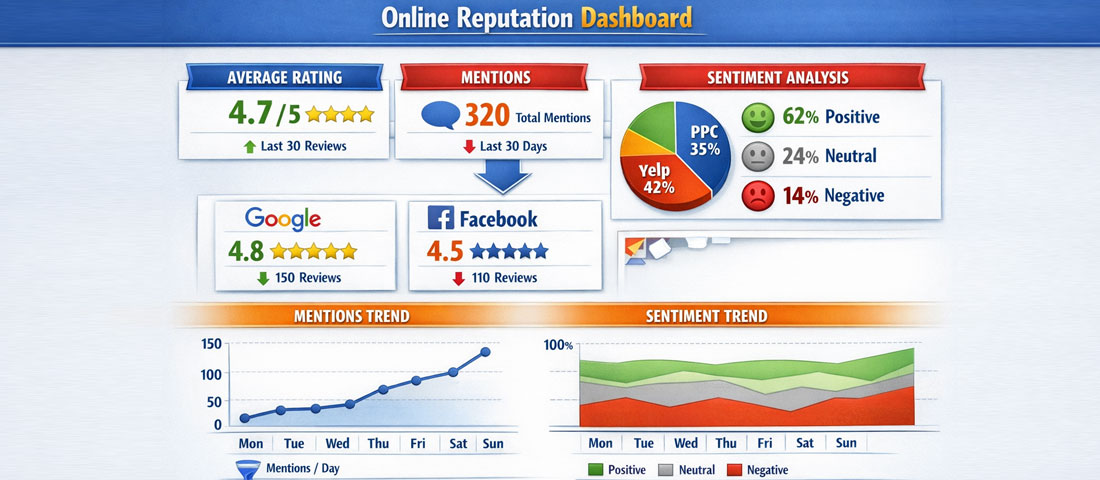
You cannot manage what you cannot see. Reputation monitoring means knowing every time your business name appears online — in reviews, news articles, social media posts, forum threads, industry directories, and AI-generated content. The challenge is that this happens across dozens of platforms simultaneously, and manually checking each one daily is not viable without systems in place.
Where to monitor your reputation:
- Google Business Profile: Your most important review surface. Reviews here appear directly in search results and Google Maps. New reviews should be monitored daily and responded to within 24–48 hours.
- Industry-specific platforms: Depending on your sector — Clutch, DesignRush, GoodFirms (agencies), Trustpilot (eCommerce), Tripadvisor (hospitality), Practo (healthcare), Justdial (India). Each platform surfaces for different searches.
- Social media: Direct mentions, tagged posts, comments on your content, and direct messages all constitute reputation signals. Both positive endorsements and negative complaints can spread rapidly on social channels.
- News and editorial mentions: Press coverage, blog posts, and industry publications can significantly influence brand perception. Positive coverage is an asset; inaccurate or negative press requires prompt attention.
- Forums and community platforms: Reddit, Quora, LinkedIn groups, and industry-specific forums are places where real customers discuss their experiences with businesses, often candidly and without the business’s knowledge.
Monitoring tools worth using in 2026:
Google Alerts
Free. Set up alerts for your business name, founder names, and key product/service names. Delivers email notifications when new web content mentions your terms. Lacks social monitoring but is a useful baseline at zero cost.
Brand24
Affordable paid tool that monitors mentions across social media, news, blogs, and forums in real time. Sentiment analysis helps prioritise which mentions need immediate attention. Good option for SMEs.
Mention
Similar to Brand24 with strong social monitoring capabilities. Useful for businesses that are active on social media and need to track brand conversations across multiple platforms simultaneously.
ReviewTrackers
Specialises in review monitoring across 100+ review sites. Aggregates all reviews into a single dashboard. Particularly useful for multi-location businesses managing reputation across several platforms and geographic markets.
Google Search Console
Free. Shows which searches are surfacing your website and at what ranking. Useful for monitoring whether branded searches (“your business name + reviews”) are showing positive or negative content at the top of results.
Semrush Brand Monitoring
Part of the broader Semrush suite. Tracks mentions, backlinks, and sentiment. Best value for businesses already using Semrush for SEO — the brand monitoring feature adds reputation intelligence to an existing tool investment.
Pillar 2: Building — Creating a Strong Positive Reputation Proactively
The most resilient reputations are not built in response to problems — they are built continuously through deliberate positive activity. A business with 200 genuine 5-star reviews, consistent professional content across its website and social channels, and regular positive press mentions is effectively insulated against the disproportionate impact that a small number of negative reviews can have on a thinner profile.
Review generation: the foundation of reputation building
The single most impactful reputation-building activity for most businesses is systematically generating genuine reviews from satisfied customers. “Systematically” is the operative word — businesses that rely on organic review accumulation typically receive a fraction of the reviews they deserve, while businesses that have a process for requesting reviews from every satisfied customer build profiles that reflect their actual quality.
An effective review generation process works as follows: after a project completes or a service is delivered, send a personalised follow-up message (email or WhatsApp) thanking the client for their business and including a direct link to your Google review page. Make it as easy as possible — the link should take them directly to the review box, not to your general profile. Time the request for the moment of peak satisfaction, which is immediately after a positive outcome, not weeks later when enthusiasm has faded.
Content and thought leadership as reputation builders
Publishing high-quality content — blog posts, case studies, guides, opinion pieces — builds reputation in ways that reviews cannot. Content demonstrates expertise, shapes the narrative around your business in search results, and gives potential clients something substantive to evaluate before they decide whether to enquire. A business that publishes genuinely useful content in its field is perceived as more authoritative than one whose only public presence is a website and a Google listing.
Case studies deserve special mention. A detailed case study showing how you solved a specific client’s problem — with context, approach, and measurable results — is one of the most persuasive reputation assets a service business can create. It simultaneously demonstrates capability, builds trust, and provides content that ranks in search results for highly relevant queries.
Pillar 3: Responding — How to Handle Reviews the Right Way
How a business responds to reviews — particularly negative ones — is itself a reputation signal. Prospective customers reading your Google reviews are not only assessing the content of the reviews; they are assessing your responses. A professional, empathetic, constructive response to a critical review demonstrates maturity, accountability, and customer service quality. A defensive or dismissive response suggests the opposite.
Responding to positive reviews:
Many businesses only respond to negative reviews, missing the opportunity that positive review responses provide. A personalised, specific response to a positive review shows prospective clients that you are attentive and genuinely engaged with your customers. Avoid generic responses (“Thanks for your review!”) — instead, reference something specific to the project or experience the reviewer mentioned. This signals authenticity and makes the exchange feel like real communication rather than automated acknowledgement.
Responding to negative reviews:
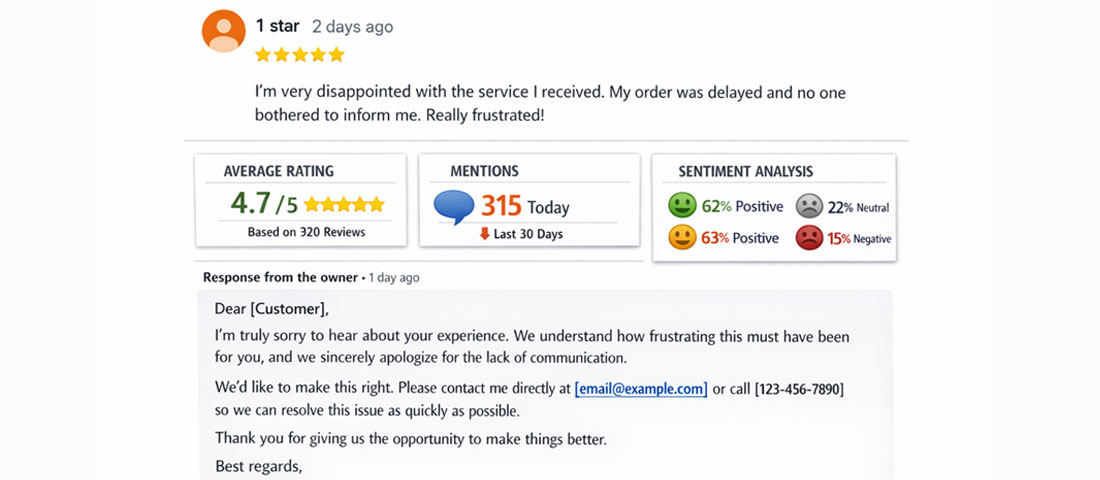
Negative reviews, handled well, can actually improve overall reputation by demonstrating how your business behaves when things go wrong. The key principles are: respond promptly (within 24 hours ideally), acknowledge the issue without being defensive, apologise for the experience where appropriate, offer to resolve the matter offline (include a direct contact email or phone number), and keep the tone professional throughout regardless of how aggressive the reviewer’s language is.
What you should not do: argue with the reviewer publicly, make accusations, share private client information in your response, or post a response that is clearly designed for the benefit of future readers rather than the reviewer. Prospects can tell the difference between a genuine attempt to resolve an issue and a PR-optimised response, and the latter often backfires.
Pillar 4: Suppressing and Correcting Harmful Content
Sometimes reputation damage comes not from genuine customer feedback but from false information, outdated content, or targeted negative campaigns. Addressing this type of harm requires different tactics than managing legitimate reviews.
Dealing with fake or malicious reviews:
Google allows businesses to flag reviews that violate its policies — including fake reviews from people who were never customers, reviews containing false statements of fact, or reviews that are clearly posted by a competitor. Flagging a review does not guarantee removal; Google’s process is manual and can take weeks. Document any evidence you have that a review is false before flagging. If a competitor is orchestrating fake review campaigns against your business, this constitutes unfair business practice and legal remedies may be available depending on your jurisdiction.
Addressing negative press or editorial content:
For outdated or inaccurate editorial content that ranks prominently for your business name, the most effective long-term strategy is content suppression through SEO — creating and optimising enough positive content that the harmful page is pushed off page one of search results. This is not rapid; suppressing a well-established page can take six to twelve months of consistent content and link-building effort. For demonstrably false statements in editorial content, a direct approach to the publication requesting correction or removal is appropriate, and legal counsel should be sought if the content constitutes defamation.
Managing personal information and data removal:
In some cases, individuals may find personal information appearing in search results in ways they did not consent to. GDPR (in the UK and Europe) and equivalent privacy legislation in other jurisdictions provides mechanisms to request removal of certain types of personal data from search results. Google’s “Results about you” tool allows individuals to request removal of specific personal contact information from search results.
ORM for Different Business Types
| Business Type | Priority Platforms | Key ORM Actions | Critical Metric |
|---|---|---|---|
| Local Service Business | Google Business Profile, Justdial (India), Yelp | Systematic review generation, GBP post updates | Star rating, review volume |
| eCommerce Store | Google, Trustpilot, platform reviews (Amazon/Flipkart) | Post-purchase review requests, fast dispute resolution | Product review count, seller rating |
| B2B Agency / Consultancy | Google, Clutch, LinkedIn, GoodFirms | Case study publishing, Clutch profile management | Clutch score, branded search results |
| SaaS / Tech Product | G2, Capterra, Product Hunt, Trustpilot | In-app review prompts, public changelog, support responsiveness | G2/Capterra category ranking |
| Professional Services | Google, LinkedIn, industry directories | Thought leadership content, speaking profiles | Branded SERP composition |
The SEO Dimension of Online Reputation Management
ORM and SEO are more intertwined than most businesses realise. The search results that appear when someone searches your business name are, effectively, your reputation page — and they are shaped by SEO signals. A business that actively manages its ORM through content creation, review building, and link acquisition will generally see its branded search results populated with positive, accurate, and controlled assets: its own website, social profiles, review platform listings, and press coverage it has helped create. A business that ignores ORM may find that branded search results surface review aggregators, complaint forums, or outdated information as prominently as its own website.
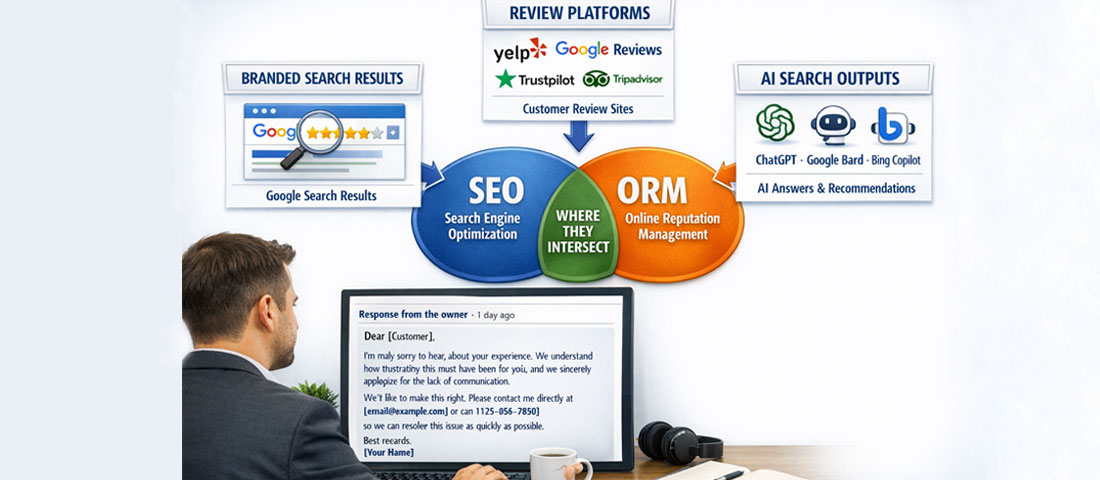
Optimising your branded search results involves: ensuring your website ranks first for your business name (which requires basic on-page SEO and brand signal building); claiming and fully completing your profiles on all major platforms (Google, LinkedIn, Facebook, Twitter/X, industry directories); and consistently publishing fresh content under your brand name so that the most recent, most authoritative signals are positive ones.
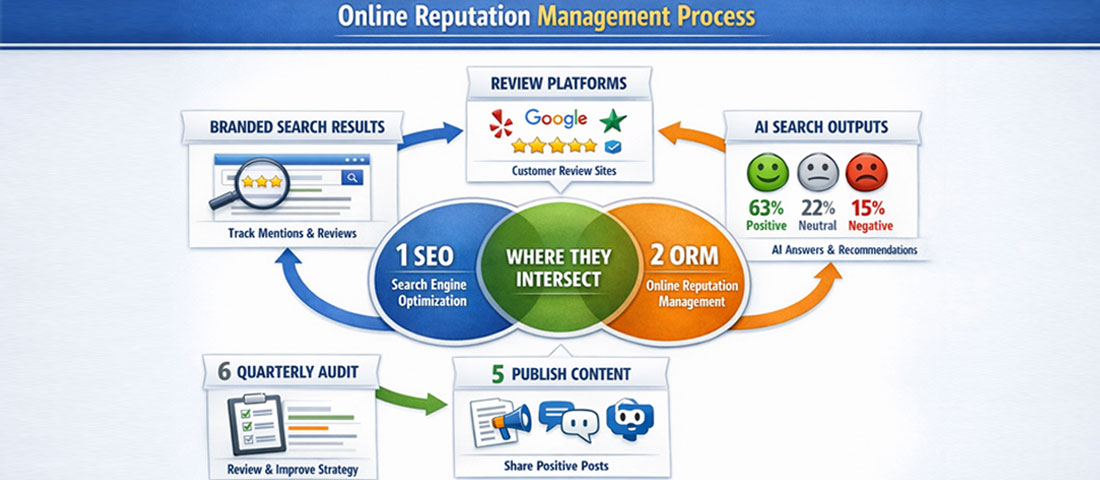
Building an ORM Process Your Team Can Maintain
-
Set up monitoring systems
Configure Google Alerts for your business name, key team member names, and primary brand keywords. Set up a free Brand24 or Mention trial for social monitoring. Create a shared document or Slack channel where all reputation alerts are aggregated for daily review. -
Claim and complete all platform profiles
Audit every platform where your business appears and claim all profiles you have not yet claimed. Ensure NAP (Name, Address, Phone) information is consistent across all platforms — inconsistency weakens both reputation and local SEO. -
Establish a review request workflow
Create a standard post-project email or WhatsApp template with a direct review link. Assign responsibility to a specific team member to send review requests within 48 hours of project completion or service delivery. -
Create review response templates
Draft template responses for positive, neutral, and negative reviews. Personalise each response before sending — templates save time while ensuring tone consistency. Set a response time target of 24 hours for all new reviews. -
Publish reputation-building content monthly
Commit to at least one substantive content publication per month — a case study, a guide, a detailed blog post, or a thought leadership piece. Over 12 months, this creates a library of owned assets that shape how your business appears in both traditional and AI search. -
Conduct a quarterly branded search audit
Search your business name in Google (in an incognito window to remove personalisation) and note every result on page one. Assess whether the composition reflects the reputation you want, identify any negative or inaccurate content, and plan content actions to improve the results that are underperforming.
Frequently Asked Questions About Online Reputation Management
| Can a business remove negative Google reviews? | A business cannot directly delete Google reviews, but it can flag reviews that violate Google’s review policies for removal consideration. Reviews that Google may remove include those that contain spam or fake content, are posted by someone who was never a customer, contain hate speech or offensive material, include personal information, or represent a clear conflict of interest such as a competitor’s review. Google does not remove reviews simply because the business disagrees with the content or finds it unfair. The most reliable long-term approach to reducing the impact of legitimate negative reviews is building a substantially larger volume of genuine positive reviews from satisfied customers, so that the negative reviews represent a small percentage of an overall positive profile rather than a defining feature of it. |
| How many Google reviews does a business need to rank well in local search? | There is no exact threshold, because Google’s local ranking algorithm considers review volume as one factor alongside relevance and proximity. However, competitive analysis consistently shows that businesses ranking in the top three of local pack results typically have significantly more reviews than those ranking lower. In competitive markets, having fewer than 20–30 reviews with recent activity (reviews from the past few months) is often a disadvantage. More important than a specific number is review recency — a business with 100 reviews but none in the past year may rank below a competitor with 30 recent reviews, because recency signals that the business is currently active and relevant. Aim for consistent review accumulation over time rather than a one-time burst of requests. |
| What is the difference between online reputation management and public relations? | Traditional public relations focuses on earned media — press coverage, journalist relationships, editorial mentions — and tends to operate through long-lead communications and agency relationships. Online reputation management focuses on the digital surfaces that most directly influence how potential customers find and evaluate a business: review platforms, search results, social media, and increasingly AI-generated summaries. ORM is more data-driven, more reactive in some dimensions (responding to reviews requires speed), and more self-directed — businesses can conduct most ORM activities without an agency. The two disciplines are complementary: positive press coverage contributes to a strong ORM profile, and strong ORM reinforces the credibility that PR aims to build. Larger businesses typically need both; smaller businesses generally get more immediate ROI from ORM than from traditional PR investment. |
| How does online reputation affect conversion rates on a website? | Online reputation affects website conversion rates in several ways. First, prospective clients often research a business name before or while visiting its website — if what they find in those searches is mostly positive, they arrive with higher trust and convert more readily. If they find unaddressed negative reviews or concerning content, many will not convert regardless of how well-designed the website is. Second, embedding review widgets, star ratings, and testimonials directly on your website means your reputation proactively supports conversion without requiring the visitor to leave the site to research you. Third, schema markup for reviews causes star ratings to appear directly in search results — a listing showing 4.9 stars attracts more clicks than an identical listing without ratings, improving both traffic volume and the pre-qualification of the traffic that arrives. |
| How should a business respond to a review that contains false information? | When a review contains factual inaccuracies, the response requires careful handling. In your public response, calmly and politely note that the experience described does not match your records, invite the reviewer to contact you directly to discuss and resolve the matter, and avoid making accusations of bad faith even if you believe the review is fabricated. This approach serves two audiences simultaneously: the reviewer (who may have genuinely misremembered or confused your business with another), and the prospective customers reading your response. Simultaneously, flag the review with Google if it contains demonstrably false statements of fact and document your evidence. If the review is part of a coordinated campaign to harm your business, consult a legal professional — defamatory false statements of fact may have legal remedies in many jurisdictions. |
| Does reputation management matter for AI search in 2026? | Reputation management is increasingly important for AI search surfaces. AI-powered tools — including Google’s AI Overviews, ChatGPT’s browsing capabilities, and Perplexity — synthesise publicly available information about businesses when generating responses to queries. This means that the collective weight of your online reputation: review sentiment, editorial coverage, what people say about you in forums and communities, and the quality of your own published content — shapes what AI systems say about you when asked. A business with a strong, consistent positive digital footprint is more likely to be cited favourably or recommended in AI-generated responses. A business with sparse public information or predominantly negative reviews may be described cautiously or omitted entirely. Managing your reputation for AI visibility requires the same fundamentals as traditional ORM — genuine review building, quality content, and consistent positive engagement — applied with an awareness of how AI systems aggregate and weight information. |
| How long does it take to recover from a reputation crisis? | The timeline for reputation recovery depends on the severity of the damage, the scale of the negative coverage, and the intensity of the recovery effort. For localised issues such as a cluster of negative reviews, a focused three to six month effort — generating significant volumes of new positive reviews, responding professionally to all existing reviews, and publishing fresh positive content — typically produces measurable improvement in both star ratings and search result composition. For more serious reputation damage involving significant press coverage, viral social media incidents, or sustained negative campaigns, recovery typically takes twelve to twenty-four months of consistent effort and may require professional ORM support. The key variable is consistency: businesses that treat reputation recovery as a campaign that ends after a few months rarely achieve full recovery. Those that treat it as a permanent operational discipline — building reputation assets continuously — see compounding improvement over time. |
Conclusion: Reputation Is an Asset — Invest in It Accordingly
In 2026, your online reputation is as much a business asset as your website, your team, or your service quality. It influences how many people find you, how many of those people choose to enquire, how much confidence they bring into early conversations, and increasingly, what AI systems say about you when your name comes up in a query.
The businesses with the strongest reputations are not necessarily the businesses that have never made a mistake. They are the ones that have invested consistently in genuine review generation, professional engagement with all feedback, quality content that shapes the narrative around their brand, and monitoring systems that ensure they are never surprised by what is being said about them online.
Neel Networks has maintained a 4.9-star rating across 43 Google reviews since our founding in 2014 — not through reputation management tricks, but through consistent delivery and a systematic approach to asking satisfied clients to share their experience. If you would like to discuss how we can help strengthen your own digital presence, we are happy to start that conversation.
Build a Digital Presence That Earns Trust at Every Touchpoint
From professional website design and SEO to structured review strategies and content that builds authority — Neel Networks helps businesses across India, the UK, USA, Canada, and Australia develop digital profiles that convert. Let us help you take control of how your business is perceived online.