7 CRO Tactics That Drive Real Results: User Engagement & Data-Driven Optimization
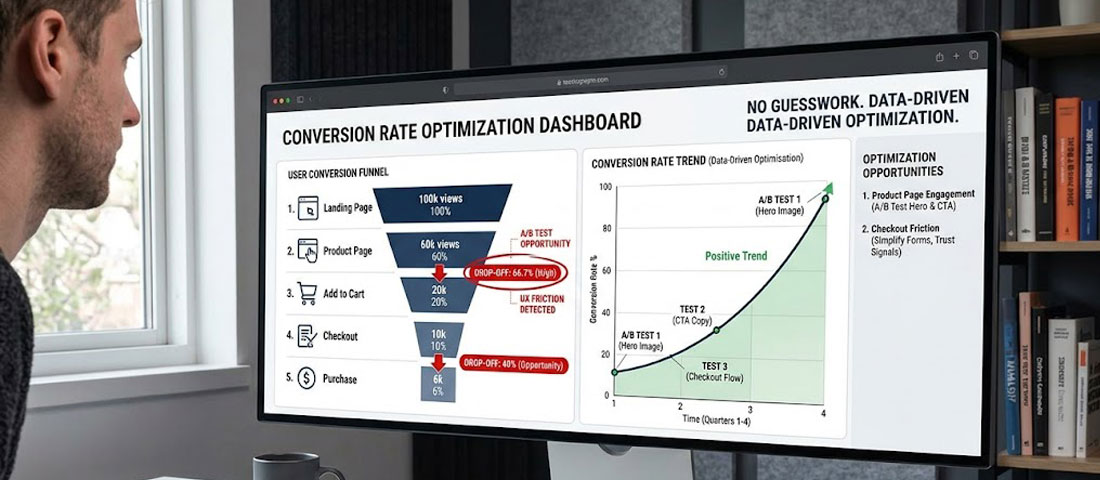
Most businesses focus their digital marketing energy almost entirely on driving more traffic. More SEO, more ads, more social media — all aimed at getting more people to the website. This is understandable, but it misses a more immediately impactful opportunity: if your website converts at 1% and you double your conversion rate to 2%, you double your revenue from the same traffic. That improvement requires no additional advertising spend, no new content, and no new backlinks.
What this guide covers
- 1. What CRO Is and Why It Delivers Exceptional ROI
- 2. How to Diagnose Conversion Problems Before You Fix Them
- 3. 7 CRO Tactics That Consistently Deliver Real Results
- 4. A/B Testing — The Only Way to Know What Actually Works
- 5. CRO Tools Every Business Should Be Using
- 6. Building a Continuous CRO Programme
- 7. Frequently Asked Questions About Conversion Rate Optimisation
Conversion Rate Optimisation (CRO) is the disciplined practice of improving what happens after visitors arrive — increasing the proportion who take a valuable action: making an enquiry, completing a purchase, signing up for a newsletter, or booking a call. It is one of the highest-return activities available to any business with an existing website and existing traffic.
This guide covers the seven CRO tactics that consistently deliver real, measurable results — not theoretical best practices, but the specific interventions that move conversion rates in the real world.
What CRO Is and Why It Delivers Exceptional ROI
Conversion Rate Optimisation is the systematic process of improving the percentage of website visitors who complete a desired action. Conversion rates are calculated simply: conversions divided by total visitors multiplied by 100. A website with 5,000 monthly visitors that generates 50 enquiry form submissions has a 1% conversion rate. The same website after CRO work generating 100 form submissions has a 2% conversion rate — double the business outcomes from identical traffic.
The ROI of CRO is exceptional for a structural reason: improvements apply to all current and future traffic simultaneously. A 1% improvement in conversion rate that costs £5,000 to achieve through testing and implementation generates ongoing additional revenue on every subsequent visitor indefinitely. Unlike paid advertising (where you pay repeatedly for each additional conversion), CRO investment is largely one-time with continuous benefit.
Industry benchmarks suggest the average website conversion rate across industries is 2 to 3% — but the top-quartile performing websites achieve 5 to 10% or higher. The gap between average and top-quartile performance is not attributable to better products or lower prices. It is attributable to better conversion design, stronger trust signals, clearer value propositions, and faster, more friction-free user experiences.
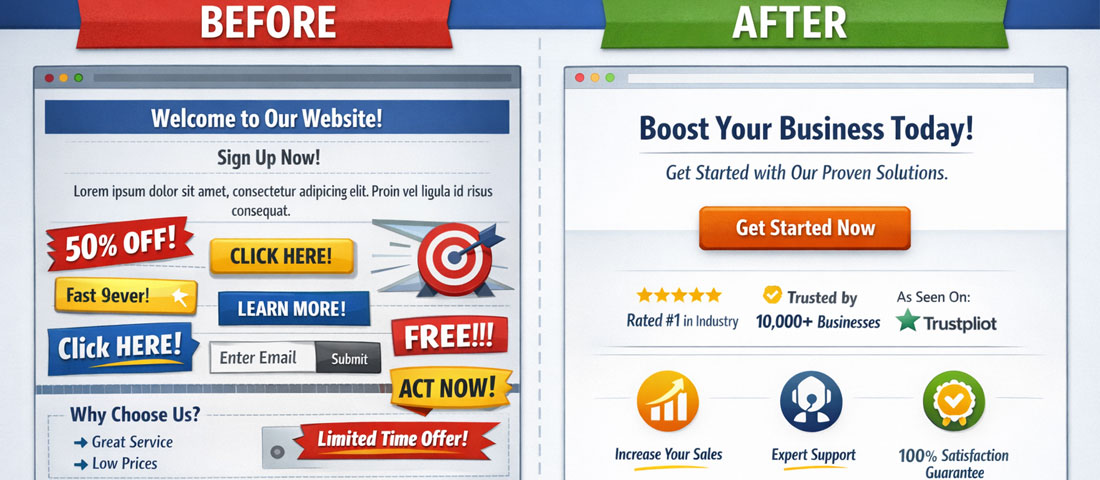
The difference between a low-converting and high-converting page is rarely about having better products — it is about clearer value propositions, stronger trust signals, and more friction-free conversion paths.
How to Diagnose Conversion Problems Before You Fix Them
CRO done well starts with diagnosis, not assumption. Implementing changes based on gut feeling or “best practice” advice from articles written for different businesses in different contexts is unreliable. The starting point must be understanding specifically where and why visitors are not converting on your specific website.
Quantitative Diagnosis
Quantitative data tells you what is happening. Start with:
- Conversion funnel analysis in GA4: Map the steps visitors take from landing page to conversion. Identify the steps with the highest drop-off rates. The step where you lose the most visitors is your highest-priority optimisation target.
- Page-level bounce rate and engagement time: Pages with high bounce rates and low average engagement time are not serving visitors’ needs — either the content does not match their intent, the page loads too slowly, or the experience creates friction that prompts immediate departure.
- Traffic source conversion comparison: Does organic search traffic convert at a different rate than paid traffic? Do mobile visitors convert at a different rate than desktop? These comparisons reveal whether the conversion problem is universal or specific to certain segments.
- Form field abandonment analysis: Tools like Hotjar and Microsoft Clarity can show which form fields cause the most abandonment — revealing where friction in the form itself is costing conversions.
Qualitative Diagnosis
Qualitative data tells you why it is happening. Complement quantitative analysis with:
- Session recordings (Microsoft Clarity, Hotjar): Watch real visitor sessions on your key conversion pages. What are people clicking on? Where do they scroll to? Where do they hesitate or abandon? Session recordings consistently reveal conversion obstacles that quantitative data obscures.
- Heatmaps: Click heatmaps show where visitors are actually clicking (often not where you think). Scroll heatmaps show how far down pages visitors scroll — if your CTA button is below the fold and 70% of visitors scroll less than halfway down, that is a critical discovery.
- User surveys: A single exit survey question (“What stopped you from contacting us today?”) can reveal conversion barriers more directly than any analytics tool. Keep surveys to one to two questions and offer them to a small proportion of visitors to minimise intrusion.
- Customer interviews: Speaking directly with recent customers about their decision journey — what almost stopped them from contacting you, what concerns they had, what reassured them — provides the most specific and actionable conversion insight available.
7 CRO Tactics That Consistently Deliver Real Results
Tactic 1: Clarify Your Value Proposition Above the Fold
The most impactful single change most business websites can make is clarifying what they offer, who they serve, and why visitors should care — in the above-the-fold section of the homepage and key landing pages. If a visitor cannot answer “what does this company do and why does it matter to me?” within five seconds of arriving, you have lost them.
A strong value proposition is specific, not generic. “Professional web design services” tells visitors nothing meaningful — every competitor says the same thing. “Custom web design for Indian businesses targeting UK and US clients” tells a specific audience exactly that this is relevant to them. Specificity in value propositions consistently improves conversion rates because it creates immediate recognition: “this is for businesses like mine.”
Implementation: Test three to five different headline and subheadline combinations through A/B testing. Each variation should communicate a different angle of your value proposition (cost advantage, expertise, specific audience, outcome delivered). Let the data — not personal preference — determine which resonates most strongly with your actual visitors.
Tactic 2: Reduce Form Friction to Its Minimum
Every field in a contact or enquiry form is a potential abandonment point. Research by Hubspot found that reducing a form from four fields to three can increase completion rates by 50%. The optimal form asks only for the information that is genuinely necessary to take the next step in the conversation — not all the information you would eventually like to know.
For most service businesses, a contact form needs: name, email address, and a message field. Phone number can be optional (making it mandatory loses the segment of potential clients who prefer email contact). Company name, budget, timeline, and project description can be gathered after the initial contact is made — not as a barrier to making contact in the first place.
Implementation: Audit every form on your website. Remove every field that is not strictly necessary for the initial contact. Make phone number optional rather than required. Test single-field micro-conversions (just email address for a lead magnet) as an alternative entry point for visitors not yet ready to send a full enquiry.
Tactic 3: Add Social Proof at Decision-Stage Pages
Social proof — evidence that other people have made the same decision and been satisfied — reduces the perceived risk of conversion. For business websites, the most powerful forms of social proof are: named client testimonials with company names and positions (not anonymous quotes), specific outcomes achieved for clients (not generic praise), star ratings from verified third-party platforms (Google, Clutch), and client logo grids showing recognisable companies you have served.
Social proof placement matters as much as its presence. Testimonials buried in a dedicated “testimonials” page that few visitors navigate to deliver far less conversion impact than testimonials placed on service pages, near CTA buttons, and in the checkout flow. The most conversion-critical locations are where doubt peaks: the moment before a visitor clicks the final “submit” or “buy” button.
Implementation: Identify your three to five most persuasive client testimonials — those with specific outcomes, named attribution, and relevance to your most important service lines. Add them directly to your key service pages, near the primary CTA. Add your Google review star rating (aggregate score) to the header or hero section of your homepage.
Tactic 4: Improve Page Load Speed — Especially on Mobile
Page speed is a direct CRO variable, not just an SEO one. Research consistently shows that every additional second of load time reduces conversion rates: a page loading in 1 second converts at up to 5x the rate of one loading in 5 seconds. Mobile conversion rates are already lower than desktop across most industries — and they are disproportionately harmed by slow load times because mobile users are more impatient and on more variable connections.
For most WordPress websites, the primary speed improvements are: serving images in WebP format at compressed file sizes, implementing a caching plugin (WP Rocket or LiteSpeed Cache), and removing unnecessary plugins that add JavaScript to every page load. These three interventions typically move a WordPress site from a 50 to 60 PageSpeed score to 70 to 90 — with corresponding conversion rate improvements.
Implementation: Run your key conversion pages (homepage, service pages, contact page) through Google PageSpeed Insights at mobile. Identify the top three specific recommendations and implement them. Re-test. For most WordPress sites, image optimisation and caching alone produce measurable conversion rate improvements within weeks.
Tactic 5: Make Your Primary CTA Impossible to Miss
The primary call-to-action on every page should be visually prominent, clearly labelled, and positioned where visitors look — not politely tucked away to avoid seeming pushy. CTA buttons that blend into the page design, use vague text (“Click here,” “Submit”), or are positioned below content that most visitors never scroll to consistently underperform bold, specific, above-the-fold CTAs.
CTA text specificity matters significantly. “Contact us” is generic. “Get a free website quote” tells visitors exactly what they will receive. “Book your free 30-minute consultation” sets clear expectations. Specific CTAs consistently outperform generic ones because they reduce ambiguity about what happens next — and reducing ambiguity at the point of action is the most direct way to increase the proportion of visitors who take it.
Implementation: Audit your CTAs for specificity and visibility. Ensure each key page has a single primary CTA — not three competing ones. Place the primary CTA above the fold on desktop and near the top of the visible screen on mobile. Test button colour contrast (your CTA should stand out from the page, not blend in). Test specific action-oriented CTA text against generic versions.
Tactic 6: Add Live Chat or an AI Chatbot to Capture Fence-Sitters
A significant proportion of potential clients who could convert do not — not because they are not interested, but because they have a specific question that is not answered on your page and the friction of filling in a contact form to ask it feels disproportionate. A live chat widget (or AI chatbot for after-hours coverage) captures this “fence-sitter” segment by providing an instant, low-friction way to ask questions and receive answers in real time.
Research by Drift and Intercom consistently shows that websites with live chat or chatbot capability generate 20 to 40% more leads from the same traffic. The improvement is concentrated among visitors who are genuinely interested but had a specific question that was between them and converting — a question that, when answered instantly, removes the remaining obstacle.
Implementation: Add a chat widget to your key conversion pages (service pages, contact page, homepage). During business hours, route to a human where possible. For after-hours, configure an AI chatbot trained on your FAQ content, pricing information, and service descriptions to handle common pre-sales questions. Even a basic chatbot that collects contact details and a question generates leads that would otherwise leave without converting.
Tactic 7: Create Urgency and Scarcity Where Genuine
Genuine urgency and scarcity — limited availability, a time-limited offer that is real, or a clear timeline for when capacity will be exhausted — create motivation to act now rather than defer. The conversion lift from honest urgency signals is real and well-documented. The critical word is “honest”: fabricated urgency (“only 2 left!” for a digital service, or countdown timers that reset every time the page loads) is immediately recognised by most visitors as manipulation, damages trust, and ultimately reduces conversion rates among the discerning audience segment.
For service businesses, genuine urgency can come from: genuinely limited consulting capacity (if you take on three clients per month and have two spots left, saying so is honest and compelling); a time-limited promotional offer with a real end date; a seasonal reason to act now (website completed before your peak season); or a specific business benefit of acting within a timeframe.
Implementation: Identify genuine reasons why a potential client benefits from acting promptly. Communicate these honestly on service pages and in follow-up communications. Avoid manufactured urgency — it works short-term and destroys trust long-term.
A/B Testing — The Only Way to Know What Actually Works
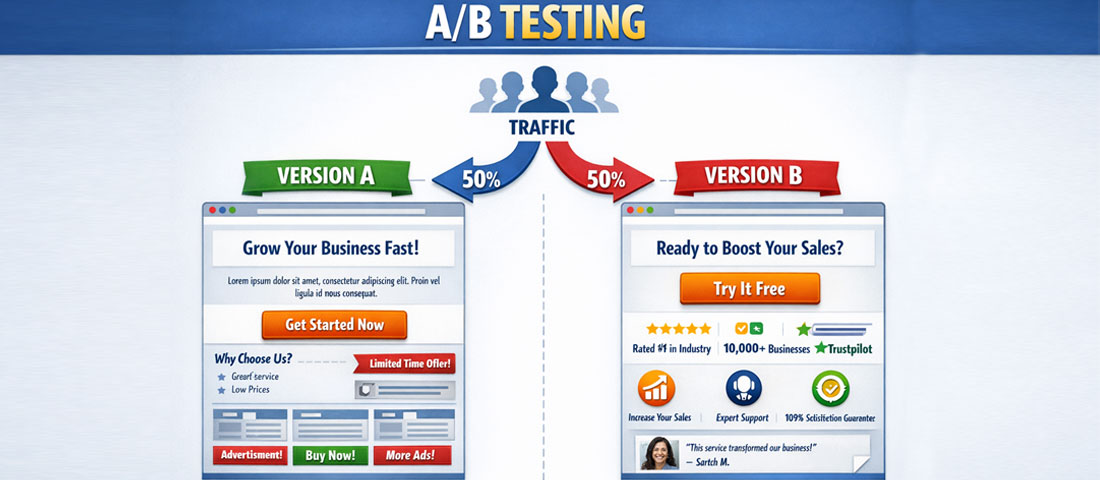
A/B testing shows the same page in two versions to different segments of your audience simultaneously — eliminating guesswork about which changes actually improve conversion rates.
Every CRO recommendation in this guide — including the seven tactics above — should ultimately be validated through A/B testing on your specific website with your specific audience. What works for one industry, one audience, or one business context does not necessarily work for another. A/B testing is the mechanism that replaces “best practice” assumptions with evidence from your own data.
In an A/B test, two versions of a page are shown to randomly split segments of your traffic simultaneously — so external factors (seasonality, news events, day of week) affect both versions equally. The version that achieves a statistically significant improvement in the target metric is the winner. The key word is “statistically significant” — a change that looks positive in a small sample may be random noise rather than a real improvement. Most A/B testing tools (Google Optimize successor tools, VWO, Optimizely, AB Tasty) calculate statistical significance automatically and indicate when a result can be trusted.
What to Test First
Priority A/B tests should focus on the highest-impact elements on your highest-traffic conversion pages:
- Headlines and hero section copy — the most visible and most impactful element on most pages
- CTA button text, colour, and placement — small changes here can have outsized conversion impact
- Form length and required fields — reducing fields is almost always worth testing
- Social proof placement — moving testimonials adjacent to CTAs often improves conversion
- Page layout — single-column vs multi-column, above/below fold positioning of key elements
CRO Tools Every Business Should Be Using
| Tool | Type | What It Does | Cost |
|---|---|---|---|
| Microsoft Clarity | Heatmaps + Recordings | Free heatmaps, scroll maps, and session recordings — the essential qualitative CRO tool | Free |
| Google Analytics 4 | Analytics | Conversion funnel analysis, traffic source comparison, goal tracking | Free |
| Hotjar | Heatmaps + Surveys | Heatmaps, recordings, and on-page surveys — more feature-rich than Clarity; paid plans for larger volumes | Free basic / Paid from €39/month |
| VWO (Visual Website Optimizer) | A/B Testing | A/B testing, multivariate testing, personalisation — the leading mid-market A/B testing platform | From $199/month |
| Google Optimize (sunset) → Alternatives | A/B Testing | Google Optimize was discontinued in 2023; replacements include AB Tasty, Convert.com, and Optimizely | Varies |
| Tidio / Intercom | Live Chat / Chatbot | Live chat and AI chatbot to capture fence-sitter conversions | Free basic / Paid plans |
Building a Continuous CRO Programme
CRO is not a one-time project — it is a continuous process of hypothesis generation, testing, and learning. The businesses with the highest conversion rates are not those who did one CRO audit in 2022; they are those who have run continuous A/B tests and implemented learnings month after month for years.
A sustainable CRO programme operates on a simple cycle:
-
Analyse — Monthly review of GA4 conversion data, session recordings in Clarity, and qualitative feedback. Identify the highest-priority conversion opportunity (the step or page with the most friction relative to its importance to the conversion journey).
-
Hypothesise — Formulate a specific, testable hypothesis: “Changing the CTA from ‘Contact us’ to ‘Get a free website quote’ will increase contact form submissions by reducing ambiguity about what happens next.”
-
Test — Implement the A/B test with sufficient traffic to reach statistical significance (typically 1,000+ visitors per variant minimum). Run for at least 2 to 4 weeks to account for weekly traffic pattern variation.
-
Learn and implement — Analyse results, implement winners, document learnings (both positive and negative tests teach you something about your audience), and move to the next hypothesis.
Even implementing one test per month — 12 tests per year — compounds into a significantly higher-converting website over 2 to 3 years than any business running no systematic tests at all.
Frequently Asked Questions About Conversion Rate Optimisation
| What is conversion rate optimisation (CRO)? | Conversion Rate Optimisation (CRO) is the systematic process of improving the percentage of website visitors who complete a desired action — making an enquiry, completing a purchase, signing up for a newsletter, or booking a call. It involves diagnosing why visitors are not converting through quantitative analysis (Google Analytics funnel data, bounce rates) and qualitative research (session recordings, heatmaps, user surveys), then implementing and testing specific improvements designed to reduce friction and increase the proportion of visitors who take the target action. CRO delivers exceptional ROI because improvements apply to all future traffic without additional per-visitor cost — making it one of the highest-return digital marketing investments available. |
| What is a good website conversion rate? | Average website conversion rates vary significantly by industry and conversion type, but broadly: overall website conversion rates (any goal) average 2 to 3% across industries. Top-quartile performing websites achieve 5 to 10% or higher. eCommerce conversion rates average 1 to 3% for purchases. Lead generation pages (contact forms, free consultation requests) typically convert at 2 to 5% for quality targeted traffic. The most meaningful comparison is against your own historical baseline — is your conversion rate trending up or down over time? — and against your specific competitors where data is available. Industry averages are useful context but should not replace your own continuous improvement target. |
| What is A/B testing and how does it work? | A/B testing is a method of comparing two versions of a webpage, email, or ad to determine which performs better for a specific goal. In a website A/B test, incoming traffic is randomly split — half see version A (the control, typically the existing page), half see version B (the variant, with a specific change). Both groups are exposed simultaneously so external factors affect them equally. After sufficient traffic has accumulated (typically 1,000+ visitors per variant over 2 to 4 weeks minimum), the performance of each version is compared against the target metric (conversion rate, click-through rate, form completions). Statistical significance calculation ensures any observed difference is a real effect rather than random variation. The winning version is implemented permanently; the learning informs the next hypothesis. |
| Which CRO tactic has the highest impact for most websites? | Clarifying the value proposition above the fold — ensuring visitors can immediately understand what you offer, who it is for, and why they should care — consistently delivers among the highest conversion rate improvements across industries. This is because vague, generic, or jargon-filled above-the-fold copy causes immediate departure from a significant proportion of visitors who are genuinely interested but cannot quickly determine if the website is relevant to them. The second highest-impact change for most service business websites is reducing form friction — removing unnecessary fields from contact and enquiry forms. Combined, these two changes (clearer value proposition + simpler forms) regularly produce 30 to 100% conversion rate improvements on underperforming websites. |
| How do I know what is preventing visitors from converting on my website? | Diagnosing conversion obstacles requires both quantitative and qualitative research. Quantitatively: use Google Analytics 4 to map your conversion funnel and identify the specific steps where the most drop-off occurs; compare conversion rates by traffic source, device, and landing page to find patterns. Qualitatively: use Microsoft Clarity (free) to watch session recordings of visitors on your key conversion pages — where do they click, where do they hesitate, where do they abandon? Use heatmaps to see what visitors actually click versus what you intended them to click. Run a simple exit survey with one question (“What almost stopped you from contacting us?”) for a small proportion of visitors. Customer interviews with recent clients about their decision process are the most specific and actionable research available. |
| Does page speed really affect conversion rates? | Yes — significantly. Research consistently shows that every additional second of page load time reduces conversion rates, with the relationship being non-linear: a page loading in 1 second converts at approximately 3x the rate of one loading in 5 seconds, and approximately 5x the rate of one loading in 10 seconds. Mobile conversion rates are disproportionately affected because mobile users are on more variable connections and are more likely to abandon slow pages. For most businesses, improving page speed is both a CRO intervention (more conversions from existing traffic) and an SEO intervention (better Core Web Vitals scores improving organic rankings). Image optimisation and caching implementation are typically the highest-impact speed improvements for WordPress websites. |
| What is the best free CRO tool? | Microsoft Clarity is the best free CRO tool available in 2026. It provides unlimited session recordings, heatmaps, and scroll maps at no cost — the same types of qualitative data that Hotjar charges hundreds of euros per month for at equivalent volume. Clarity’s session recording feature shows exactly how real visitors interact with your pages: where they click, how far they scroll, where they rage-click, and where they abandon. Combined with Google Analytics 4 (also free) for quantitative funnel analysis and goal tracking, these two free tools provide everything needed for a rigorous initial CRO diagnosis. Paid A/B testing tools (VWO, AB Tasty) become valuable once you are ready to implement and validate specific page changes systematically. |
Want to get more leads from the traffic you already have?
Neel Networks helps businesses diagnose conversion problems and implement evidence-based improvements — from landing page redesigns to A/B testing programmes — for websites across the USA, UK, Canada, Australia, and India.