Social Media Marketing in 2026: Strategy, Tools, Video & Paid Ads
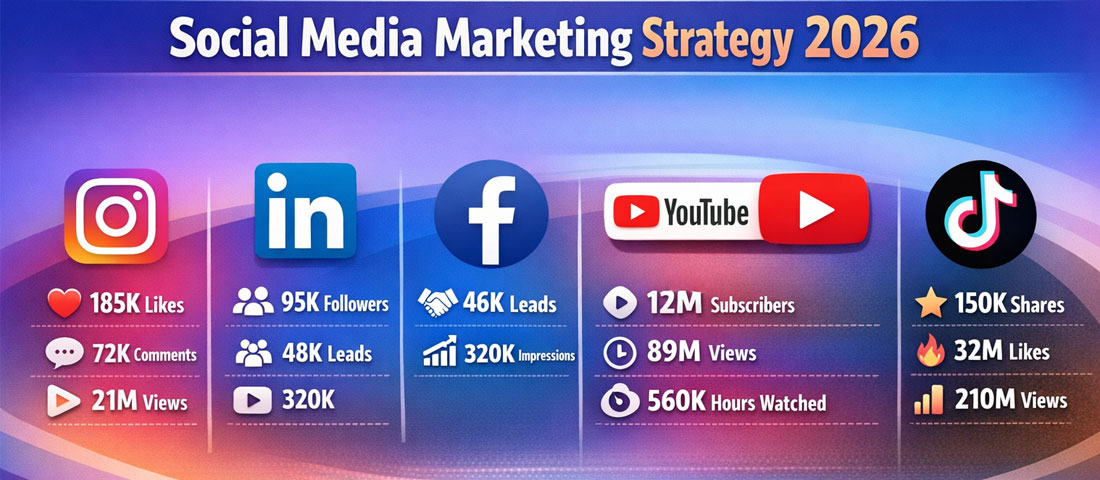
Social media marketing has undergone more change in the past three years than in the previous decade combined. The dominance of short-form video, the maturation of social commerce, the rise of creator-led marketing, and the increasing sophistication of paid social targeting have together transformed how businesses use social media — and what effective social media strategy actually looks like in 2026.
What this guide covers
- 1. Building a Social Media Strategy That Drives Business Results
- 2. Platform Selection — Where Your Business Should Actually Be
- 3. Designing Social Media Graphics That Get Engagement
- 4. Social Media Optimisation (SMO) — Making Your Profiles Work Harder
- 5. Video Content Strategy for Social Media in 2026
- 6. Facebook and Instagram Ads — Paid Social That Converts
- 7. Social Media Management Tools for Efficiency
- 8. Measuring Social Media ROI
- 9. Frequently Asked Questions About Social Media Marketing
This guide covers the full social media marketing picture: building a strategy that works across platforms, creating graphics that actually get engagement, using the right tools to manage it all without burning out, deploying Facebook Ads and paid social effectively, and harnessing video as the most powerful content format in the social landscape.
Building a Social Media Strategy That Drives Business Results
The most common social media marketing mistake is treating platforms as broadcasting channels — posting content without a clear strategy for how social media connects to business objectives. A social media programme that does not generate leads, sales, website traffic, or brand awareness with a measurable audience is not a business asset; it is an activity that consumes time and budget without return.
Effective social media strategy starts with clarity on three questions:
What business objective does social media serve? Common legitimate objectives include: brand awareness among a defined target audience, lead generation through social advertising and organic content, community building that increases customer retention and referrals, thought leadership that supports sales conversations, and customer service through direct messaging and comment engagement. Each objective requires different tactics, content types, and success metrics.
Who is your specific target audience and which platforms do they actually use? Being present on every platform is a strategy for spreading resources too thin and being mediocre everywhere. Being excellent on two or three platforms where your audience is concentrated delivers far better results than being mediocre on six.
What does your audience genuinely want from you on social media? The answer is almost never “to be sold to.” It is some combination of: to learn something useful, to be entertained, to be inspired, to feel part of a community, or to get help with a problem. Content strategy flows from understanding what your specific audience values — not from what you want to communicate about yourself.
Platform Selection — Where Your Business Should Actually Be
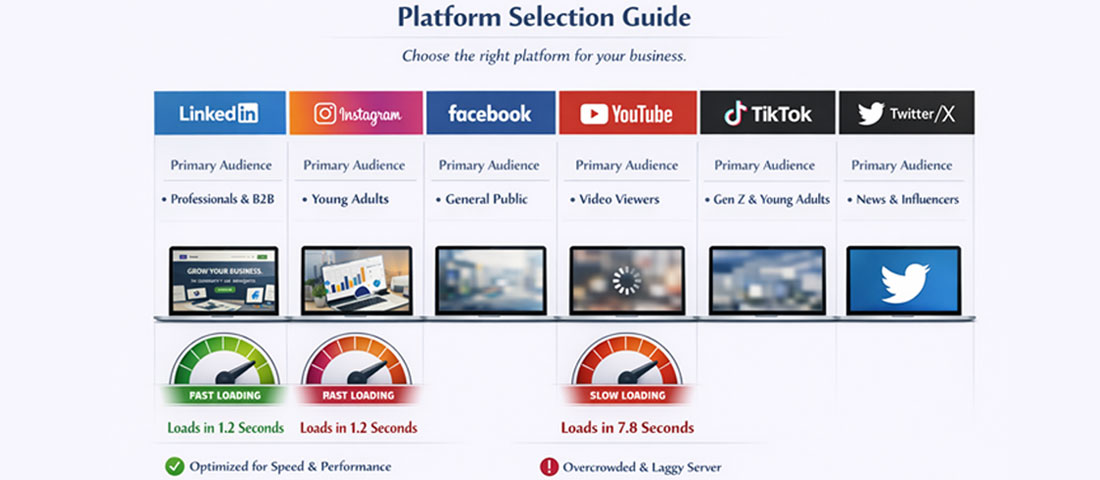
Platform selection should be driven by where your specific target audience is most active — not by personal preference or the temptation to be everywhere simultaneously.
LinkedIn — For B2B, Professional Services, and Thought Leadership
LinkedIn is the dominant platform for B2B marketing, professional services businesses, and any brand targeting decision-makers, executives, or professionals. Its organic reach for text posts and native documents (PDF carousels) remains strong compared to other platforms. Key content formats that perform: long-form personal posts from founders and senior team members, native documents (carousels summarising research or frameworks), short-form video, company page updates, and client case studies. LinkedIn advertising is the most effective paid channel for B2B lead generation despite higher CPCs than Meta.
Instagram — For Visual Brands, B2C, and Lifestyle
Instagram remains the dominant platform for visual brand building in consumer categories — fashion, food, fitness, travel, home, beauty, and lifestyle. Reels (short-form video) now receive the highest organic reach of any Instagram format. Static image posts still work for portfolio-style brand showcasing. Instagram Shopping makes it a direct commerce channel for eCommerce brands with eligible product catalogues.
Facebook — For Local Business, Older Demographics, and Paid Advertising
Facebook’s organic reach has declined significantly over the past five years, but it remains essential for: local service businesses (Facebook Groups and local community pages still drive local discovery); businesses targeting audiences aged 35 and above (Facebook’s user base skews older than Instagram or TikTok); and as the primary platform for Meta’s exceptionally powerful paid advertising infrastructure (Facebook and Instagram Ads share the same ad manager).
YouTube — For Video-First Brands and Long-Form Content
YouTube is both a social platform and the world’s second largest search engine. Long-form tutorial and educational content on YouTube generates organic search traffic for years — YouTube videos appear prominently in Google search results for relevant queries. For businesses producing regular video content, YouTube is both an audience-building platform and an SEO asset.
TikTok — For Reaching Younger Audiences and Viral Reach
TikTok’s algorithm-driven “For You Page” provides the highest organic reach of any current social platform — content from accounts with zero followers can reach millions of views if it resonates. For consumer brands targeting audiences under 35, TikTok has become a primary discovery channel. Its short-form video format (15 seconds to 3 minutes) rewards authentic, fast-paced, entertaining content over polished corporate production.
Designing Social Media Graphics That Get Engagement
Visual content on social media competes for attention in a feed where a user’s thumb moves past dozens of posts per minute. Graphics that stop the scroll share consistent characteristics — understanding them is the foundation of effective visual content creation.
What Makes a Social Graphic Stop the Scroll
- Bold, high-contrast design. Soft, muted, low-contrast images disappear into feeds dominated by photography. Bold colours, strong contrast, and clear visual hierarchy make graphics immediately visible when scrolling at speed.
- Minimal text, maximum impact. Social graphics are consumed at a glance. A graphic with a single clear message — a striking statistic, a short provocative question, a bold claim — outperforms one trying to communicate five things simultaneously. If more text is needed, a carousel or caption is the right vehicle.
- Consistent brand visual identity. Recognisable brand colours, fonts, and graphic styles build familiarity over time — followers start to recognise your content before reading it, increasing engagement. Inconsistency between posts signals a lack of brand maturity and reduces the cumulative brand-building effect of your content.
- Human faces and authentic photography. Images of real people — team members, clients, behind-the-scenes moments — consistently outperform stock photography and abstract graphics in engagement. Authenticity is a comparative advantage on social media precisely because most brands default to corporate stock imagery.
Design Tools for Social Media Graphics
Canva
The dominant non-designer design tool. Templates for every social platform format, drag-and-drop interface, brand kit feature for consistent colours and fonts, AI image generation, and team collaboration. Free tier is genuinely capable; Pro (₹3,999/year) adds premium assets and brand controls.
Adobe Express
Adobe’s accessible design tool — faster than Photoshop/Illustrator, more powerful than Canva for typography and photo editing. Access to Adobe Stock. Better integration with the broader Adobe Creative Suite for teams that also use Premiere or Photoshop.
CapCut
The dominant short-form video editing tool for social media. Native TikTok and Instagram Reels optimised templates, trending audio integration, automatic caption generation, and AI-powered effects. Free, mobile and desktop versions available.
Adobe Firefly + Midjourney
AI image generation tools for creating custom visuals — backgrounds, product mockups, lifestyle imagery — that are unique and brand-specific. Firefly is trained on licensed content (safer for commercial use). Midjourney produces the highest-quality AI imagery available.
Social Media Optimisation (SMO) — Making Your Profiles Work Harder
Social Media Optimisation (SMO) is the process of improving your social profiles and content strategy to maximise reach, engagement, and conversion. It is the social media equivalent of on-page SEO — ensuring the foundational elements are optimised before investing in content creation and promotion.
- Complete, keyword-rich profiles. Every social profile’s bio, about section, and description is searchable — both within the platform and in Google search. Include your primary service keywords, your location (if local), and a clear description of who you serve and what you offer. A LinkedIn company page with a complete, keyword-rich “About” section ranks for brand name searches in Google.
- Consistent branding across platforms. Profile photo (typically your logo), cover image, brand name, and bio language should be consistent across all platforms. Inconsistency creates a disjointed brand impression for anyone researching your business across multiple channels.
- Strategic link placement. Your website URL in your bio is the primary social media traffic driver. Use a link-in-bio tool (Linktree, Later’s Link in Bio) to point followers to multiple destinations when a single URL is insufficient.
- Posting schedule optimisation. Platform analytics show when your specific audience is most active — use this data to schedule posts for maximum visibility. Most platforms reward consistent posting schedules over sporadic bursts, because the algorithm learns to expect and promote your content when you post regularly.
- Hashtag strategy. Platform hashtag effectiveness varies: Instagram hashtags still provide discoverability for relevant content; LinkedIn hashtags improve content reach to followers of those hashtags; TikTok uses hashtags primarily for content categorisation. Research platform-specific hashtag best practice for each channel you use.
Video Content Strategy for Social Media in 2026
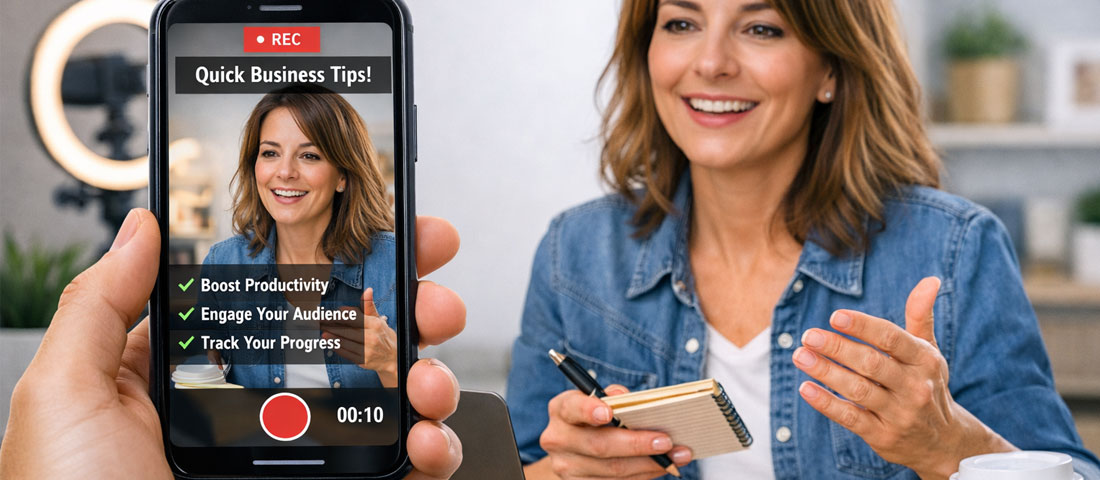
Short-form vertical video — optimised for Reels, TikTok, and YouTube Shorts — is the highest-reach content format on social media in 2026, and accessible to businesses at any budget level.
Video has become the dominant content format on every major social platform. Instagram Reels receive 22% more interaction than standard video posts. LinkedIn video posts generate 5x more engagement than text posts. TikTok is entirely video-first. YouTube Shorts have accumulated over 70 billion daily views globally. If your social media content strategy does not include video, it is missing the format that the algorithms most aggressively promote.
Short-Form Video (Under 90 Seconds)
Short-form video — optimised for Instagram Reels, TikTok, and YouTube Shorts — is the most accessible video format for most businesses and the one with the highest organic reach potential. Effective short-form social videos share consistent characteristics:
- Hook in the first 3 seconds. Social media users decide whether to keep watching within the first three seconds. The opening must immediately signal value — a surprising statement, a direct question, a striking visual, or a clear promise of what the viewer will learn.
- Vertical format (9:16 ratio). Short-form video is consumed on smartphones held vertically. Horizontal video in a vertical feed looks small and amateurish. Record and edit in 9:16 format natively.
- Captions/subtitles. 85% of social video is watched without sound. On-screen captions ensure your message is communicated even to silent viewers. Most editing tools (CapCut, Descript) now automatically generate captions with minimal correction needed.
- Value density. Short-form video that teaches a specific, actionable insight in 30 to 60 seconds consistently outperforms longer, less dense content. Every second should justify its presence.
How to Use Video to Keep Customers Hooked
Beyond short-form content, businesses can use longer video formats to build deeper audience relationships:
- Tutorial and how-to videos establish expertise while directly serving the audience’s needs — the ideal combination for trust-building content
- Behind-the-scenes content humanises the business and builds the authentic connection that generic corporate content cannot
- Client testimonial videos are the most persuasive trust-building content available — a satisfied client on camera is more convincing than any written testimonial
- Live video (Instagram Live, LinkedIn Live, YouTube Live) generates significantly higher engagement per viewer than recorded content because of its interactive, real-time nature — viewer questions and comments create an event atmosphere
Facebook and Instagram Ads — Paid Social That Converts
Meta’s advertising platform (which serves ads across both Facebook and Instagram through a unified Ads Manager) is one of the most powerful digital advertising tools available — combining enormous reach with remarkably precise audience targeting. Understanding when and how to use paid social effectively is essential for any business with a digital marketing budget.
When Paid Social Delivers Strong ROI
- Consumer product and eCommerce businesses with visual products that can be showcased through images and video — particularly for cold audience acquisition and retargeting of website visitors
- Local service businesses using geographic targeting to reach potential customers within a defined service area
- Lead generation campaigns for professional services — using Meta’s native lead forms to capture contact details without requiring a website visit
- Retargeting campaigns for any business — showing targeted ads to website visitors, email subscribers, and customer lookalike audiences who have demonstrated interest
- Event and webinar promotion to drive registrations from a defined audience
Key Facebook Ads Campaign Types in 2026
Advantage+ Shopping Campaigns: Meta’s AI-driven shopping campaign type — equivalent to Google’s Performance Max — automatically optimises ad delivery across Facebook and Instagram for eCommerce conversions. Strong performer for established stores with sufficient conversion data.
Lead Generation Campaigns with Native Forms: Instead of sending users to a website landing page (where friction reduces completion rates), Meta’s lead generation campaigns open a native form within the platform — pre-filled with the user’s profile data. Significantly higher form completion rates than equivalent website-destination campaigns.
Retargeting / Custom Audience Campaigns: Showing targeted ads to people who have already visited your website, watched your videos, or engaged with your content. Retargeting audiences are significantly warmer than cold prospecting audiences and typically convert at 3 to 5x the rate.
Lookalike Audiences: Meta’s most powerful prospecting tool — creating new audience pools that share characteristics with your best existing customers, email subscribers, or website converters. When the seed audience is high-quality, lookalike campaigns are among the most cost-efficient cold prospecting available.
Social Media Management Tools for Efficiency
Managing multiple social media platforms — creating content, scheduling posts, monitoring mentions, responding to comments, and analysing performance — across multiple platforms simultaneously is a significant time investment without the right tools. These platforms streamline the process:
Buffer
Clean, accessible scheduling and analytics across all major platforms. Excellent for small teams or solo marketers who need reliable scheduling with clean analytics. Free tier available for up to 3 channels; affordable paid plans.
Hootsuite
The most comprehensive social media management platform — scheduling, monitoring, team collaboration, and analytics across all platforms. Most appropriate for larger teams or agencies managing multiple brand accounts. Higher cost reflects breadth of capability.
Later
Visual content calendar with drag-and-drop scheduling optimised for Instagram, TikTok, and Pinterest. Strong Instagram-specific features including link-in-bio pages and first comment hashtag scheduling. Good for visual content-heavy brands.
Sprout Social
Strong on analytics and reporting — detailed performance data, competitive benchmarking, and customer care features (unified inbox for all platform messages). Higher price point justified for teams where social analytics depth is a priority.
Measuring Social Media ROI
Social media ROI is genuinely difficult to measure — because the relationship between social media activity and business outcomes is often indirect and multi-touch. The right measurement approach uses a combination of metrics across different time horizons:
| Metric Type | Specific Metrics | What They Tell You |
|---|---|---|
| Reach & Awareness | Impressions, reach, follower growth, share of voice | Is social media building brand visibility with the right audience? |
| Engagement | Likes, comments, shares, saves, click-through rate | Is content resonating? Are followers actively engaging rather than passive? |
| Traffic | Website sessions from social (GA4), profile link clicks | Is social media driving traffic to conversion points on the website? |
| Lead Generation | Lead form completions, DM enquiries, email signups from social | Is social media directly generating business enquiries or list subscribers? |
| Revenue (Paid) | ROAS, CPA, cost per lead from paid social campaigns | Is paid social advertising generating profitable returns? |
Frequently Asked Questions About Social Media Marketing
| Which social media platforms should my business be on in 2026? | Platform selection should be driven by where your specific target audience is most active — not by the temptation to be everywhere. For B2B businesses and professional services, LinkedIn is the primary platform, with YouTube for video content. For consumer-facing businesses with visual products, Instagram and TikTok provide the strongest reach and engagement. Facebook remains important for local service businesses and for paid advertising to audiences aged 35 and above. The most effective approach is to choose two to three platforms where your audience is most concentrated, build genuine presence and consistency there, and resist spreading resources across six platforms with mediocre results on all of them. |
| How important is video for social media marketing in 2026? | Video is the most important content format for social media in 2026 — and the gap between video and other formats is widening. Instagram Reels receive 22% more interaction than standard video posts. LinkedIn video generates 5x more engagement than text posts. TikTok is entirely video-first, and YouTube Shorts drive billions of daily views. Every major platform’s algorithm now prioritises video content over static images and text. Businesses that do not incorporate video into their social media strategy are missing the format that platforms most aggressively amplify — and ceding significant reach and engagement to competitors who do use it. |
| What is the best social media management tool for small businesses? | Buffer is the best social media management tool for most small businesses in 2026 — combining accessible pricing, clean interface, reliable scheduling across all major platforms, and solid analytics in a tool that does not require training to use effectively. Its free tier (up to 3 channels) is genuinely capable for businesses just starting to systematise their social media scheduling. Later is a strong alternative for businesses that are primarily Instagram and TikTok focused, with its visual content calendar and strong Instagram-specific features. For businesses that prioritise analytics depth, Sprout Social is the strongest option despite its higher cost. |
| How do I create engaging social media graphics? | Creating engaging social media graphics requires: bold, high-contrast design that stops the scroll in a competitive feed; minimal text that communicates a single clear message at a glance; consistent brand visual identity across posts that builds recognition over time; and authentic human imagery (real team members, clients, behind-the-scenes) rather than generic stock photography. Canva is the most accessible tool for non-designers — its templates, brand kit feature, and AI tools make it possible to produce professional-quality graphics consistently without design expertise. For video graphics, CapCut provides the most accessible short-form video editing with social-native templates and automatic caption generation. |
| Is Facebook Ads still effective in 2026? | Yes — Facebook and Instagram Ads (served through Meta’s unified Ads Manager) remain among the most effective digital advertising channels available for most consumer-facing businesses and many B2B contexts. Meta’s targeting capabilities — combining demographic, interest, behavioural, and custom audience data — provide precision that few other platforms match. Retargeting campaigns (showing ads to website visitors and engaged social audiences) are particularly cost-effective. eCommerce brands with visual products benefit from Advantage+ Shopping Campaigns and Instagram Shopping integration. The primary limitations are rising CPCs in competitive categories and iOS privacy changes that have reduced tracking accuracy — both of which can be mitigated with strong creative, clear conversion goals, and first-party audience data (email lists, customer data). |
| How often should I post on social media? | Optimal posting frequency varies by platform and content type, but the consistent principle across all platforms is that quality and consistency matter more than quantity. For most businesses: LinkedIn, 3 to 5 times per week for strong organic reach; Instagram, 4 to 7 times per week including a mix of Reels, carousels, and Stories; TikTok, daily posting is recommended for algorithm growth (short-form video production at this frequency requires batching); Facebook, 3 to 5 times per week for businesses still actively using organic Facebook; YouTube, once per week for long-form content is a strong starting cadence. The most important discipline is consistency — a sustainable posting schedule you actually maintain for months delivers far better results than an unsustainable burst followed by silence. |
| What is Social Media Optimisation (SMO) and why does it matter? | Social Media Optimisation (SMO) is the process of improving your social media profiles, content strategy, and distribution to maximise reach, engagement, and conversion. It includes: completing profiles with keyword-rich descriptions and accurate business information; maintaining consistent branding across all platforms; optimising posting schedules based on audience activity data; using platform-appropriate hashtags for discoverability; strategically placing links to drive traffic to conversion points; and continuously reviewing content performance to understand what resonates with your specific audience. SMO matters because optimised profiles and content consistently reach more people, generate more engagement, and convert more followers into customers than unoptimised equivalents — making every piece of content you produce work harder for your business. |
Want a social media strategy that actually drives business results?
Neel Networks helps businesses build and execute social media strategies that generate real enquiries — from platform selection and content planning through to paid social campaigns and performance reporting.
Get a Free Consultation Digital Marketing Services WhatsApp Us