Email Marketing in 2026: Strategy, Tools, Lead Generation & Best Practices
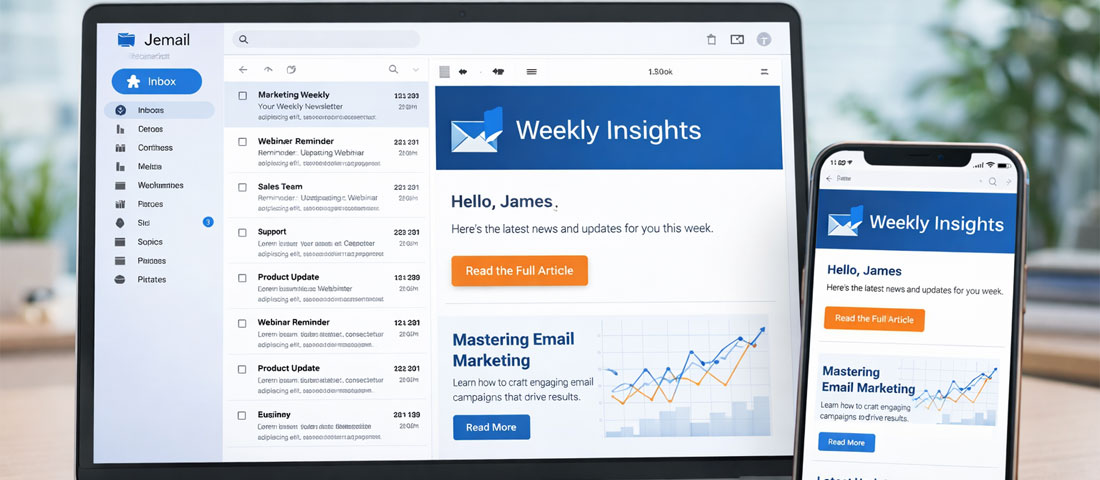
Despite the rise of social media, AI-generated content, and a dozen new marketing channels every year, email remains one of the most consistently effective — and most cost-efficient — marketing channels available to businesses of any size. In 2026, email marketing has not declined; it has evolved. AI-powered personalisation, behavioural trigger automation, and advanced segmentation have transformed what email can deliver, making it smarter, more targeted, and more relevant to recipients than at any previous point.
What this guide covers
- 1. Why Email Marketing Is Still the Highest-ROI Digital Channel in 2026
- 2. Choosing the Right Email Marketing Platform in 2026
- 3. Building and Growing a Quality Email List
- 4. Email Practices You Should Drop Right Now
- 5. Advanced Lead Generation Techniques for Email
- 6. Email Automation: The Sequences Every Business Should Have
- 7. Measuring Email Marketing Performance
- 8. Frequently Asked Questions About Email Marketing
This guide covers email marketing in full: why it remains powerful, how to build and grow your list, how to choose the right platform, the email practices you should stop immediately, and the advanced lead generation techniques that separate high-performing email programmes from average ones.
Why Email Marketing Is Still the Highest-ROI Digital Channel in 2026
The case for email marketing’s enduring commercial power is grounded in consistent data. The Data & Marketing Association (DMA) consistently reports email ROI at £42 for every £1 spent — a figure that outperforms every other major marketing channel by a significant margin. Litmus’s State of Email research shows that 79% of marketers rank email as their most important marketing channel for business results.
Why does email outperform other channels so consistently? Three structural reasons:
Owned audience. Your email list is an asset you own — unlike social media followers, which exist at the discretion of platform algorithms, or paid advertising audiences, which disappear when budget stops. A subscriber who has given you their email address has explicitly opted in to hear from you. They cannot be taken away by a platform algorithm change.
Direct, unmediated delivery. When you send an email, it arrives in the recipient’s inbox without a competitive algorithm deciding whether to show it to them. No platform is filtering your reach based on engagement signals or charging you to reach your own audience. Email is the only digital marketing channel where you have direct, unmediated access to your audience.
High purchase intent audience. People who subscribe to a business’s email list have demonstrated genuine interest in that business. They have self-selected as a warm audience — making email recipients significantly more likely to convert than equivalent-sized paid advertising audiences of cold prospects.
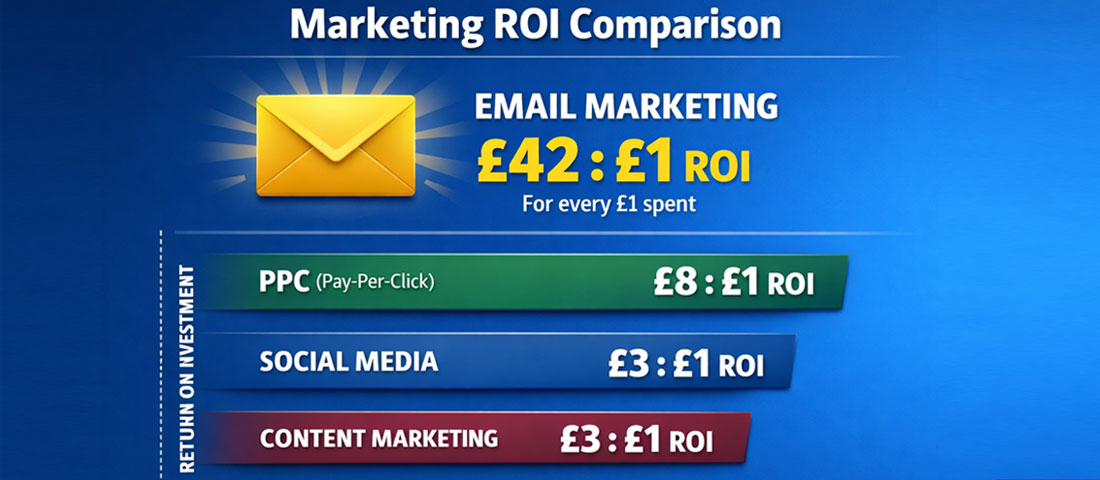
Email marketing consistently delivers the highest ROI of any digital marketing channel — £42 for every £1 spent according to DMA research — because of its unique combination of owned audience, direct delivery, and high-intent recipients.
Choosing the Right Email Marketing Platform in 2026
The right email marketing platform for your business depends on your size, technical requirements, integration needs, and budget. Here is an honest comparison of the leading options:
Mailchimp — The Accessible Starting Point
Mailchimp is the most widely used email marketing platform globally, with a generous free tier (up to 500 contacts and 1,000 emails/month) and an accessible drag-and-drop email builder. It is a reasonable starting point for small businesses beginning their email marketing journey. Limitations: Mailchimp’s automation capabilities are less sophisticated than dedicated alternatives, its pricing becomes relatively expensive at scale, and its eCommerce integration is less powerful than Klaviyo for online stores.
Klaviyo — The eCommerce Email Standard
Klaviyo has established itself as the dominant email marketing platform for eCommerce businesses — deeply integrated with Shopify, WooCommerce, and other eCommerce platforms, with powerful behavioural segmentation (based on purchase history, browsing behaviour, and predicted future value), and sophisticated automation flows for abandoned cart, browse abandonment, post-purchase, and winback sequences. If you run an online store, Klaviyo is almost certainly the right platform. For non-eCommerce service businesses, its features may be more than required.
ActiveCampaign — For B2B and Complex Automation
ActiveCampaign combines email marketing with CRM functionality and among the most sophisticated automation capabilities available. Its “automation recipes” and conditional branching allow complex nurture sequences that adapt based on contact behaviour. Excellent for B2B businesses with longer sales cycles where email plays a lead nurturing role alongside direct sales follow-up. More complex to set up than simpler platforms but more powerful for businesses that need it.
MailerLite — Best Value for Small to Medium Businesses
MailerLite offers a clean interface, solid automation capabilities, and a generous pricing model that makes it excellent value for small to medium businesses who find Mailchimp’s pricing constraining but do not need Klaviyo’s eCommerce depth or ActiveCampaign’s CRM integration. Free up to 1,000 subscribers; affordable paid tiers above that.
HubSpot Email — For Businesses in the HubSpot Ecosystem
For businesses that use HubSpot CRM, HubSpot’s email marketing tools (included in Marketing Hub) provide native integration between email campaigns and CRM contact data. Email personalisation based on CRM properties, direct sales sequence integration, and unified reporting across email and other marketing channels are the primary advantages. The cost is high unless you are already in the HubSpot ecosystem.
Building and Growing a Quality Email List
The quality of your email list matters far more than its size. A list of 1,000 genuinely interested, permission-based subscribers who regularly open your emails is more valuable than a list of 10,000 purchased or scraped contacts who never asked to hear from you.
Lead Magnets — The Most Effective List-Building Tool
A lead magnet is a piece of genuinely valuable content or resource offered in exchange for an email address. The most effective lead magnets provide specific, immediate value that is highly relevant to your target audience’s needs:
- Practical guides and checklists: “The 10-Point Website Launch Checklist,” “The SEO Audit Checklist for Business Owners” — actionable, specific, immediately usable
- Industry reports and research: Original data or synthesised research on topics your audience needs to understand
- Templates and tools: Ready-to-use resources that save time — email templates, spreadsheet calculators, proposal frameworks
- Free assessments and audits: Offering a free website audit, SEO review, or content analysis in exchange for contact details — generates qualified leads while delivering genuine value
- Webinars and video training: Live or recorded educational sessions on topics of high relevance to your audience
The key to an effective lead magnet is specificity: a broadly relevant guide (“10 marketing tips”) converts far less well than a specific one (“How to Double Your Shopify Store’s Conversion Rate in 30 Days”).
List Growth Channels
- Website signup forms: Strategically placed signup forms on high-traffic pages — homepage, blog posts, service pages. Exit-intent popups (triggered when a visitor moves to close the tab) convert visitors who are about to leave without subscribing.
- Content upgrades: Blog post-specific lead magnets (a downloadable version of the post, a related template, an extended checklist) offered within the post itself. These convert at significantly higher rates than generic list signups because the relevance is immediate.
- Landing pages: Dedicated pages for specific lead magnets, promoted through paid social or organic traffic, optimised for a single conversion action.
- Referral programmes: Incentivising existing subscribers to refer colleagues and connections in exchange for premium content, discounts, or early access.
Email Practices You Should Drop Right Now
Certain email practices that were once standard — or at least common — actively damage email performance in 2026. Eliminating these from your programme is as valuable as adding new best practices.
Buying or Renting Email Lists
Purchased email lists are one of the most reliably counterproductive investments in marketing. The contacts have not opted in to hear from you — making your emails unsolicited by definition. The consequences: spam complaint rates that damage your sender reputation, deliverability problems that affect your entire list, potential GDPR and CAN-SPAM violations, and essentially zero conversion rate from people who have no relationship with or interest in your business. Never purchase an email list.
Sending to Unengaged Subscribers Without Re-Engagement Campaigns
Subscribers who have not opened any of your emails for 6 to 12 months are hurting your metrics and your deliverability — high volumes of unengaged recipients signal to email providers that your content is not valued, dragging down your sender reputation for active subscribers too. Run re-engagement campaigns for dormant subscribers (a compelling subject line offering something genuinely valuable, clearly indicating “we miss you”), and remove those who do not re-engage rather than continuing to email them.
Sending the Same Email to Your Entire List
Sending identical emails to all subscribers regardless of where they are in the customer journey, what they have previously engaged with, or what their specific interests are is the single biggest missed opportunity in most email programmes. Segmentation — even simple segmentation by subscriber source, by what they downloaded, or by whether they are a prospect versus an existing client — allows significantly more relevant emails that generate higher open rates, click rates, and conversions.
No Mobile Optimisation
Over 60% of emails are opened on mobile devices. Emails that render poorly on smartphones — with tiny text, narrow columns, images that do not load, or CTAs that are hard to tap — deliver a poor experience to the majority of your audience. Use responsive email templates, test rendering across devices before sending, and keep single-column layouts for simpler mobile rendering.
Neglecting Subject Line Quality
Your subject line determines whether your email is opened or ignored. Generic, promotional subject lines (“Monthly Newsletter — December 2025”) consistently underperform specific, curiosity-driving, or value-signalling ones (“The one SEO mistake costing most websites 40% of their traffic”). A/B test subject lines systematically — even small improvements in open rate compound significantly across a year of email sends.
Advanced Lead Generation Techniques for Email
Beyond standard list building, these advanced techniques significantly accelerate list growth and lead qualification:
Behavioural Trigger Lead Nurturing
Rather than waiting for leads to raise their hand explicitly, track their behaviour on your website and trigger email sequences based on what they do. A visitor who reads three blog posts about WordPress development and then visits your WordPress service page is demonstrating strong interest — an automatically triggered email sequence offering a related lead magnet, a case study, and eventually a consultation invitation is far more likely to convert than a generic monthly newsletter.
Progressive Profiling
Instead of asking for all contact information at once (which reduces signup rates), collect information gradually across multiple touchpoints. The initial lead magnet asks only for email. A subsequent download asks for company name. A third asks for job title and company size. Progressive profiling builds a detailed lead profile without the friction of a long initial form.
Email Retargeting Integration
Integrating your email platform with your advertising platforms (Facebook Custom Audiences, Google Customer Match) allows you to show targeted ads specifically to email subscribers — reinforcing your message across channels and reaching subscribers who are not opening your emails through a different touchpoint.
Automated Lead Scoring
Lead scoring assigns points to subscriber actions — email opens, link clicks, page visits, content downloads, webinar attendance — and uses the accumulated score to identify which leads are most sales-ready. Leads above a defined score threshold can trigger a sales follow-up notification or be moved into a high-touch nurture sequence. Available in ActiveCampaign, HubSpot, and Marketo.
Email Automation: The Sequences Every Business Should Have
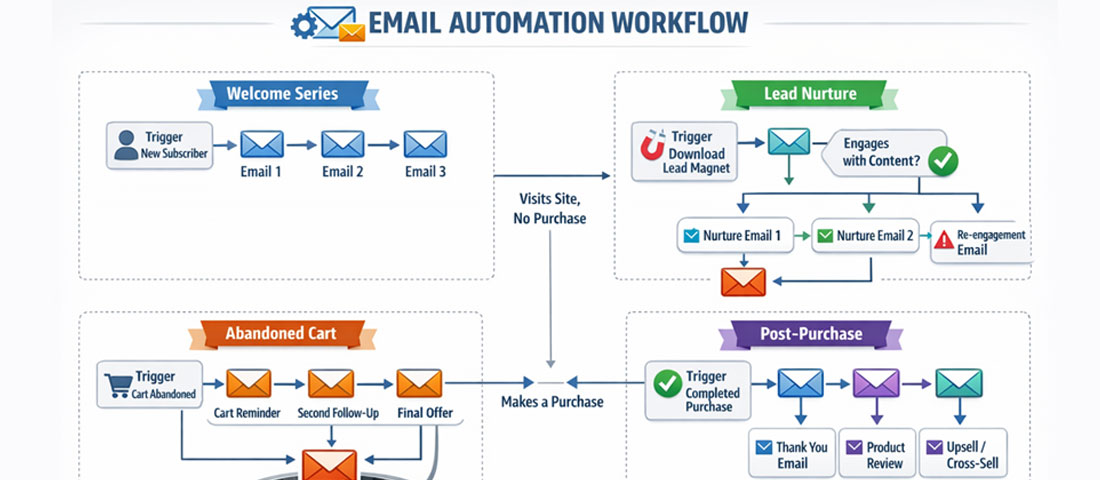
Automated email sequences — triggered by subscriber actions rather than sent manually — deliver the right message at the right moment, consistently and at scale.
Welcome Sequence (Days 1–7 After Signup)
The welcome sequence is sent to every new subscriber and is typically the highest-engagement email series you will ever send — open rates of 50 to 70% are common because subscribers are at peak interest and expectation. A strong welcome sequence: confirms the email address and delivers the promised lead magnet (Email 1, immediately); introduces your business, your story, and your philosophy (Email 2, Day 2); delivers your single most valuable piece of content (Email 3, Day 4); presents a soft CTA — a consultation, a free audit, a discovery call (Email 4, Day 7). The welcome sequence sets the tone for the entire subscriber relationship.
Lead Nurture Sequence (Weeks 2–8 After Signup)
After the welcome sequence, a lead nurture sequence continues delivering value and building the relationship before any direct sales pitch. Typically 4 to 8 emails spaced over 6 to 8 weeks, covering: educational content relevant to the subscriber’s interests, specific case studies demonstrating your results, answers to common objections about your service, and social proof (testimonials, client outcomes). Each email delivers genuine value; each subtly reinforces your authority and builds readiness for a commercial conversation.
Re-Engagement Sequence (For Inactive Subscribers)
Sent to subscribers who have not opened an email in 90 to 180 days. A 3-email sequence: Email 1 acknowledges the silence and offers something genuinely valuable (“We’ve been quiet — here’s something worth your time”); Email 2 presents a compelling reason to stay subscribed (“We’re changing how we do this — here’s what’s coming”); Email 3 provides a clear unsubscribe option with an honest message (“If this isn’t right for you anymore, no hard feelings — click here to unsubscribe, or click here to tell us what you’d rather receive”). Remove non-responders after this sequence.
Post-Purchase or Post-Project Sequence (For eCommerce and Service Businesses)
The period immediately after a purchase or project completion is the highest-value window for relationship deepening, review requests, and upsell. A post-purchase sequence: delivers immediate value (onboarding tips, getting started guide, complementary resources); requests a review at the optimal moment (after the customer has had time to experience value, typically 7 to 14 days post-purchase); and presents relevant complementary offerings when the customer is most satisfied.
Measuring Email Marketing Performance
| Metric | What It Measures | Industry Benchmark |
|---|---|---|
| Open Rate | % of delivered emails that are opened | 20–30% for B2B; 15–25% for B2C (varies widely by industry) |
| Click-Through Rate (CTR) | % of delivered emails where at least one link is clicked | 2–5% average; 8–15% for highly engaged lists |
| Click-to-Open Rate (CTOR) | % of opened emails where at least one link is clicked | 10–20% indicates strong email content quality |
| Unsubscribe Rate | % of recipients who unsubscribe per email | Under 0.5% per email is healthy; above 1% signals relevance or frequency problems |
| Bounce Rate | % of emails that could not be delivered | Under 2% for hard bounces; clean lists regularly to maintain |
| Conversion Rate | % of email recipients who complete a target action (purchase, enquiry) | Varies enormously by offer type; track against your own baseline |
| Revenue per Email Sent | Total revenue attributed to the email ÷ number sent | The ultimate eCommerce email efficiency metric; varies by list quality and offer |
Frequently Asked Questions About Email Marketing
| Is email marketing still effective in 2026? | Yes — email marketing remains one of the most effective and highest-ROI digital marketing channels in 2026. The DMA consistently reports email ROI of approximately £42 for every £1 spent. Email’s effectiveness comes from three structural advantages: it reaches an owned audience that has explicitly opted in to hear from you; it delivers messages directly to inboxes without algorithmic filtering or per-impression cost; and it reaches a high-intent audience that has self-selected as interested in your business. AI-powered personalisation and behavioural automation have made email more relevant and effective than ever — when executed well, email in 2026 delivers more targeted, timely, and personalised experiences than at any previous point. |
| Which email marketing platform should I use? | The right email marketing platform depends on your business type and needs. For eCommerce businesses (Shopify or WooCommerce), Klaviyo is the clear recommendation — its native eCommerce integrations, behavioural segmentation, and abandoned cart automation are best-in-class. For B2B businesses with complex sales cycles, ActiveCampaign’s combination of email marketing and CRM functionality is a strong choice. For small to medium businesses needing solid functionality at accessible pricing, MailerLite offers excellent value. For businesses already in the HubSpot ecosystem, HubSpot Email is the natural choice. For businesses just starting out with limited budgets, Mailchimp’s free tier is a reasonable beginning point. Platform selection matters — but execution quality matters more than tool choice. |
| How do I grow my email list? | The most effective email list growth strategies are: creating genuinely valuable lead magnets (practical guides, checklists, templates, free tools, or assessments) and offering them in exchange for email subscriptions; strategically placing signup forms on high-traffic website pages, particularly within high-performing blog posts as content upgrades; using exit-intent popups triggered when visitors are about to leave without subscribing; creating dedicated landing pages for lead magnets promoted through organic or paid channels; and referral programmes that incentivise existing subscribers to share with their networks. The most important principle: every new subscriber should have actively chosen to receive your emails in exchange for something they found genuinely valuable — not been added through a purchased list or obscured signup mechanism. |
| What email marketing practices should I stop using? | Email practices that consistently damage performance and should be stopped immediately include: purchasing or renting email lists (contacts who have not opted in generate spam complaints that damage deliverability for your entire list); sending identical emails to your entire list without segmentation; continuing to email unengaged subscribers (those who have not opened in 6+ months) without a re-engagement campaign; neglecting mobile optimisation (60%+ of emails are opened on mobile); using generic, non-compelling subject lines that fail to communicate specific value; and not A/B testing subject lines and content systematically. Each of these practices reduces open rates, damages sender reputation, and reduces the overall effectiveness of your email programme. |
| What is email automation and why is it important? | Email automation is the use of trigger-based email sequences that are sent automatically based on subscriber actions or time delays — rather than manually sent to your entire list. Automated sequences deliver the right message at the right moment without requiring manual effort per email: welcome sequences deliver value immediately when a new subscriber joins; lead nurture sequences educate and build readiness for commercial conversations; abandoned cart sequences recover eCommerce sales from customers who did not complete a purchase; post-purchase sequences deepen relationships and generate reviews. Email automation is important because it makes your email programme work 24/7 at scale, ensuring every subscriber receives relevant, timely communication regardless of your team’s bandwidth. |
| What is a good email open rate? | Average email open rates vary significantly by industry, list quality, and email type. Broadly, 20 to 30% is considered a healthy open rate for B2B newsletters and 15 to 25% for B2C, though these vary considerably. Automated sequences (welcome emails, triggered sequences) consistently achieve higher open rates than broadcast campaigns — 40 to 70% open rates for welcome emails are common because subscribers are at peak interest immediately after signing up. The most meaningful comparison is against your own historical baseline rather than industry averages — is your open rate trending up or down over time? Open rate is also increasingly affected by Apple Mail Privacy Protection (which auto-opens emails to load tracking pixels), meaning iOS open rate data is less reliable than it was before 2021. Click rate and conversion rate are more reliable indicators of genuine engagement. |
| How often should I send marketing emails? | There is no universal optimal email frequency — it depends on your audience, content quality, and business type. A common starting point for service businesses is one newsletter or value-focused email per week. eCommerce businesses with promotional offers can often send more frequently without increased unsubscribes, because the promotional content has direct immediate value to buyers. The most important principle is quality over frequency: one genuinely valuable, relevant email per week consistently outperforms five mediocre ones. Monitor your unsubscribe rate as a frequency signal — if unsubscribes spike after increasing frequency, the content is not providing enough value at that cadence. Let your audience’s engagement data guide your frequency decisions rather than an arbitrary schedule. |
Want to build an email marketing programme that actually generates leads and revenue?
Neel Networks helps businesses set up email marketing platforms, build automation sequences, and develop content strategies that turn email lists into consistent revenue-generating assets. Talk to us about your email marketing goals.
Get a Free Consultation Digital Marketing Services WhatsApp Us