Off-Page SEO & Backlink Strategy: A Complete Guide to Building Authority in 2026
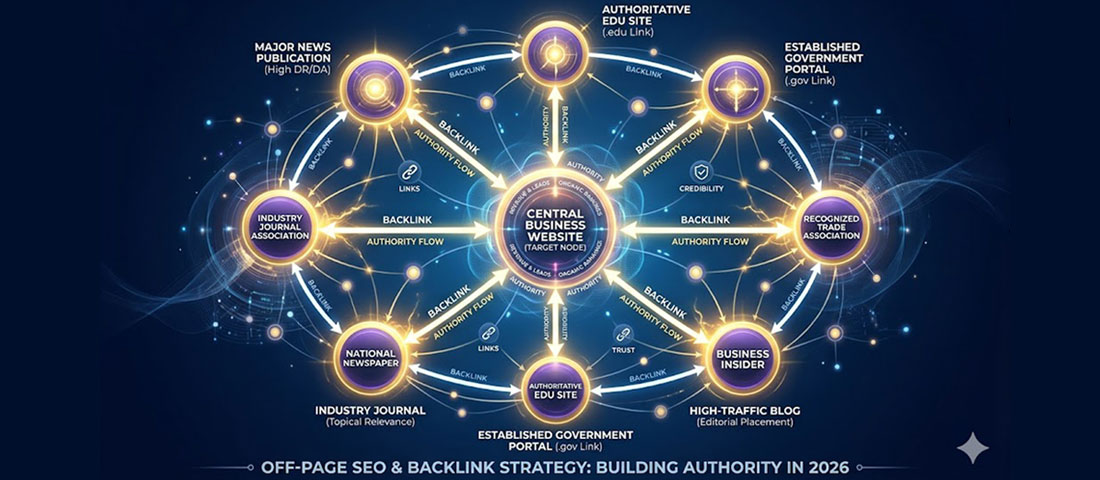
Of all the factors that influence Google rankings, the one that is most frequently misunderstood, most often abused, and most consistently powerful when done correctly is the backlink — a link from another website to yours. Building high-quality backlinks is the core of off-page SEO, and it remains one of the most impactful things you can do to improve your website’s authority and rankings in 2026.
What this guide covers
- 1. What Is Off-Page SEO?
- 2. Do Backlinks Still Matter in 2026? The Honest Answer
- 3. What Makes a Backlink Valuable — Quality Signals Explained
- 4. The 5 Worst Backlink Strategies to Avoid Completely
- 5. Proven Off-Page SEO Strategies That Build Genuine Authority
- 6. Brand Mentions, Digital PR, and Authority Beyond Links
- 7. How to Audit and Disavow Toxic Backlinks
- 8. Measuring Off-Page SEO Success
- 9. Frequently Asked Questions About Off-Page SEO and Backlinks
This guide covers the complete off-page SEO picture: why backlinks matter, do they still matter in the AI era, what a high-quality backlink looks like, the 5 worst backlink strategies that will get you penalised, and the proven strategies for building genuine authority that drives lasting rankings improvement.
What Is Off-Page SEO?
Off-page SEO refers to all the actions taken outside of your own website that influence your search engine rankings. While on-page SEO — the content quality, technical health, and structure of your own website — is entirely within your control, off-page SEO is about building your website’s reputation and authority in the broader web ecosystem.
Backlinks are the most important off-page SEO signal, but off-page SEO in 2026 also encompasses: brand mentions (cited without links), social signals, digital PR coverage, business directory listings, review profiles, and the consistency and accuracy of your business information across the web. Together, these signals tell Google whether your website is a trusted, authoritative resource — or an isolated island with no external validation.
Do Backlinks Still Matter in 2026? The Honest Answer
The question of whether backlinks still matter is asked with increasing frequency as AI-powered search changes the landscape. The honest answer: yes, significantly — and here is the evidence.
Google’s own statements (including statements from its Search Liaison) have consistently confirmed that links remain among the top three ranking factors, alongside content relevance and quality. The research published by Semrush, Ahrefs, and Backlinko consistently shows a strong correlation between the quantity and quality of referring domains pointing to a page and its position in search results. In competitive markets, pages without authoritative backlinks simply do not rank for competitive terms regardless of content quality.
What has changed is the nature of what counts as a valuable link. In the early days of SEO, quantity dominated — the more links, the better. Through multiple algorithm updates (Penguin being the most significant), Google has dramatically improved its ability to distinguish high-quality editorial links from manufactured or purchased ones, and its ability to penalise the latter. In 2026, a small number of genuinely authoritative, topically relevant, editorially earned links is more valuable than hundreds of low-quality manufactured links.
For AI search specifically: the citation signals that cause content to appear in Google AI Overviews and to be referenced by Perplexity and ChatGPT are closely related to traditional authority signals — high-quality backlinks, mentions in authoritative publications, and consistent brand entity signals across the web. Off-page SEO investment directly supports AI search visibility, not just traditional organic rankings.
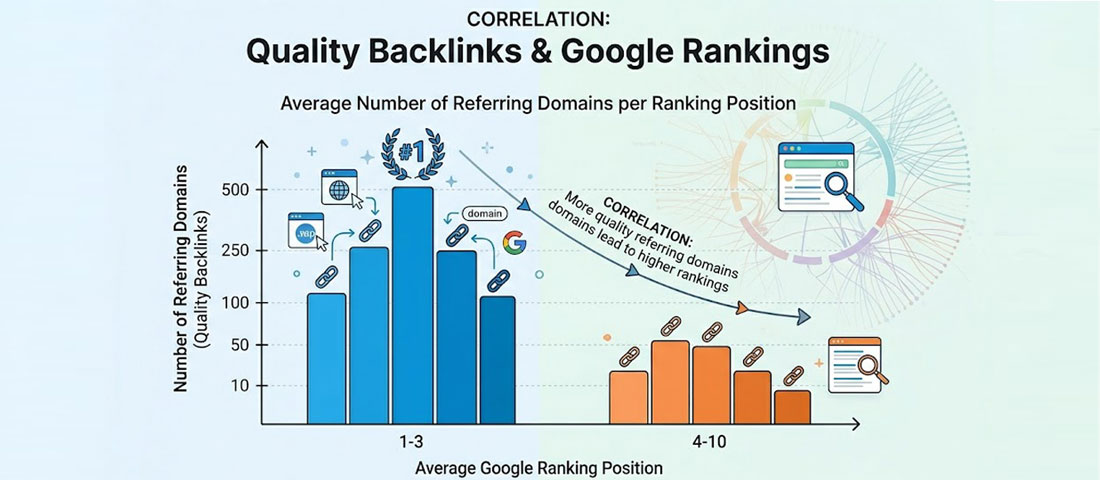
Research consistently shows a strong correlation between the number of high-quality referring domains and Google ranking position — confirming that backlinks remain a primary ranking factor in 2026.
What Makes a Backlink Valuable — Quality Signals Explained
Not all backlinks are equal. Understanding the signals that determine link quality helps you focus your effort on the activities that actually move the needle.
Domain Authority / Domain Rating of the Linking Site
A link from a high-authority website — a major news publication, an established industry journal, a recognised government or educational institution — carries significantly more ranking influence than a link from a low-authority blog. The authority of the linking domain transfers, in part, to your page through the link. This is why a single link from a highly authoritative source (a mention in Forbes, a case study on a major industry publication) can be more valuable than dozens of links from low-authority blogs.
Topical Relevance of the Linking Page
A link from a page that is topically relevant to your content — a web design publication linking to your web design services page — carries more weight than a link from an unrelated domain. Google uses topical context to assess whether a link is a genuine editorial endorsement from an authority in your field. Links from highly authoritative but topically unrelated sources are still valuable, but topically relevant links are the gold standard.
Editorial Nature of the Link
A link that has been editorially placed — where an author chose to link to your content because they genuinely found it valuable, informative, or relevant — is a different signal from a link that was manufactured, paid for, or arranged through a link exchange. Google has become increasingly effective at identifying manufactured links and assigns them dramatically less or zero value. The most valuable links are those you could not have created yourself — where an independent author or editor made the independent decision to reference your content.
Anchor Text
The anchor text — the visible, clickable text of a link — provides contextual information to Google about what the linked page is about. A natural, diverse anchor text profile (a mix of branded anchors, generic anchors like “read more” or “click here,” and occasionally keyword-relevant anchors) is a healthy signal. An anchor text profile that is overwhelmingly keyword-optimised (every link using exact-match keywords as anchor text) is a manipulation signal that can trigger algorithmic penalties.
Link Placement Within the Content
Links embedded within the body text of an article — particularly in relevant context — carry more weight than links placed in footers, sidebars, or link lists. In-content editorial links are the clearest signal of genuine editorial endorsement; navigational and structural links are less meaningful as ranking signals.
The 5 Worst Backlink Strategies to Avoid Completely
Warning: The following practices violate Google’s guidelines. Businesses that use them risk manual penalties (direct action by a Google reviewer that removes rankings) or algorithmic penalties (automatic ranking reductions). Recovery from these penalties can take months or years and requires significant remediation work. No short-term ranking gain is worth the long-term risk.
1. Buying Links
Purchasing links — paying websites to place links back to your site — is the most direct violation of Google’s link scheme guidelines and one of the practices that Google actively investigates and penalises. Despite this, link selling is a significant industry. The appearance of a paid link is often identical to an editorial one, which is why Google has invested heavily in detecting link selling patterns through algorithmic signals (sudden link profile growth, link patterns across known paid networks, anchor text patterns typical of paid campaigns).
Beyond the penalty risk: paid links typically come from low-quality sites operating a link selling model that Google specifically monitors. The links provide limited ranking benefit even before penalty risk is considered.
2. Private Blog Networks (PBNs)
A Private Blog Network is a collection of websites created specifically to link to a target website — manufacturing the appearance of organic editorial links. PBNs were effective in the early 2010s before Google developed the ability to detect network footprints. In 2026, Google’s algorithm is very effective at identifying PBN patterns (hosting similarities, content patterns, domain registration patterns, link network structures). Websites found to be using PBNs typically receive severe ranking penalties.
3. Reciprocal Link Schemes
“I link to you, you link to me” arrangements — particularly at scale — are identified as link schemes in Google’s guidelines. Occasional mutual linking between genuinely related, relevant websites is natural and fine. Systematic reciprocal link arrangements designed to manufacture the appearance of editorial links are detectable and penalisable.
4. Low-Quality Directory and Forum Spam
Mass submitting your website to low-quality directories, blog comment spam, forum signature links, and similar automated link generation tactics adds toxic links to your backlink profile with no ranking benefit. These tactics were borderline effective in 2010. In 2026, they are actively harmful — Google treats large numbers of these low-quality links as a spam signal. If your site has accumulated a large number of these links (from previous agency work or inherited history), they should be disavowed.
5. Content Farms and Paid Guest Post Networks
The practice of paying for “guest posts” on networks of low-quality blogs — where the entire purpose of the blog is to sell links — is a scaled version of link buying. Google has specifically targeted these networks with algorithm updates and manual action teams. Links from sites that publish hundreds of low-quality “guest posts” from dozens of different sites carry little value and significant risk. Genuine guest posting — contributing quality content to relevant, established publications that would have published the article on its merits regardless of the link — is entirely different and remains a legitimate and effective link building strategy.
Proven Off-Page SEO Strategies That Build Genuine Authority
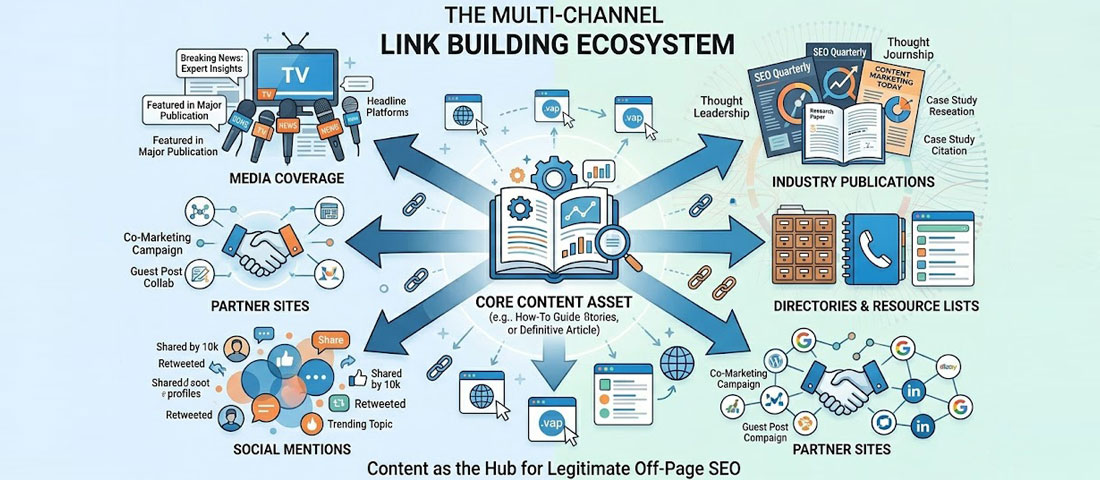
Legitimate off-page SEO draws links and mentions from multiple channels — each contributing to overall domain authority through genuine editorial endorsement.
1. Digital PR — The Gold Standard for High-Authority Links
Digital PR is the practice of creating genuinely newsworthy content — original research, data studies, provocative industry perspectives, compelling statistics — and pitching it to journalists, bloggers, and publications as a media story. When successful, digital PR earns editorial coverage and links from major publications (national newspapers, major industry journals, high-authority news sites) that provide extraordinary link authority.
Effective digital PR content in the web design and marketing context includes: original industry salary surveys, data on adoption of specific technologies, research into consumer behaviour patterns relevant to your industry, or provocative takes on industry trends backed by data. The content must be genuinely newsworthy — not branded self-promotion thinly disguised as news.
2. Genuine Guest Posting on Relevant Industry Publications
Contributing high-quality, genuinely useful articles to established, respected publications in your industry — as a named expert, with content that stands on its editorial merits — earns authoritative links and brand visibility simultaneously. The key distinction from paid guest post networks: the publication must have editorial standards that would reject a poor-quality article, and the content must provide genuine value to their readership independent of the link.
For a web design and digital marketing agency, target publications include: industry-specific marketing blogs (Moz, Search Engine Journal, HubSpot Blog, Neil Patel Blog), business publications (Entrepreneur, Inc, Business Insider), and regional business publications in your target markets (UK-specific business media for UK clients, etc.).
3. Building Linkable Assets
A linkable asset is content so genuinely useful, comprehensive, or data-rich that other websites naturally link to it as a reference. Classic linkable asset types include: original research and surveys with unique data; comprehensive guides that become industry references; free tools and calculators; infographics with original data; and statistics roundup pages that aggregate industry data.
Creating a linkable asset requires more upfront investment than standard blog content — but generates links passively over months and years without ongoing outreach effort. A single well-created industry statistics page can attract hundreds of editorial links over its lifetime.
4. HARO and Journalist Source Requests
Help a Reporter Out (HARO) and its equivalents (Quoted, Terkel, Featured) connect journalists seeking expert quotes and commentary with industry professionals. When your contribution is included in a published article, you typically receive a link and brand mention in a genuine editorial context on a publication you could not have easily pitched directly.
HARO works best when you respond quickly (within a few hours of the query being posted), provide genuinely expert and specific responses (not generic ones that any agency could give), and focus on queries from publications relevant to your target markets. The time investment is modest; the link quality when successful is high.
5. Broken Link Building
Broken link building involves identifying links on authoritative websites that point to 404 (dead) pages, and suggesting your relevant content as a replacement. The website owner receives value (a fixed broken link on their page), and you receive an editorial link. Tools like Ahrefs and Semrush’s backlink analysis features can identify broken outbound links on target domains.
6. Building Unlinked Brand Mentions Into Links
When other websites mention your brand name, products, or key individuals without including a link, you have an opportunity to request that the mention be converted to a link. Use tools like Semrush’s Brand Monitoring or Google Alerts to identify new unlinked brand mentions, then reach out politely to the publisher with a request to add a link. The success rate is modest but the effort is low, and these are among the cleanest possible editorial links.
7. Industry Directories and Established Citation Sources
Legitimate industry directories — Clutch.co for agencies, Google Business Profile, industry-specific association directories — provide both links and citation signals that strengthen your brand entity in Google’s knowledge graph. These are not the low-quality directory spam described in the “worst strategies” section; they are established platforms with genuine traffic and editorial standards. Creating and maintaining accurate, complete profiles on these platforms is a standard component of off-page SEO for any business.
Brand Mentions, Digital PR, and Authority Beyond Links
In 2026, off-page authority signals extend beyond traditional link building. Google’s ability to understand entity mentions — references to your brand, products, or key personnel — even without an accompanying link has grown significantly. The following non-link signals contribute to your website’s off-page authority:
- Unlinked brand mentions on authoritative domains contribute to Google’s entity understanding of your business — even without a link, a mention of your brand name in context on a trusted site adds to the web’s collective understanding of who you are.
- Review signals on Google Business Profile, Clutch, Trustpilot, and industry-specific review platforms contribute to local search authority and brand trust signals that feed into rankings.
- Social signals — while Google has been inconsistent about the direct ranking value of social shares — contribute to content discovery, can generate secondary links from people who find your content through social, and contribute to brand entity signals.
- Business citation consistency — ensuring your business name, address, and phone number (NAP) are accurate and consistent across all major business directories — is a specific local SEO signal that contributes to local search rankings.
How to Audit and Disavow Toxic Backlinks
If your website has accumulated toxic backlinks — from previous black-hat SEO work, spam link injection from a security breach, or links built by a previous agency using problematic methods — these can be actively harming your rankings. Here is how to identify and address them:
-
Export your backlink profile
Download your complete backlink profile from Google Search Console (Links report) and cross-reference with Ahrefs or Semrush for comprehensive coverage. You want a complete picture of every domain linking to your site. -
Identify toxic signals
Review your backlink profile for links from: clearly spammy or irrelevant sites; sites with very low authority scores; sites that are primarily link sellers or directories; foreign language sites with no relevance to your market; links with highly keyword-stuffed anchor text; and links that appeared suddenly in large volumes (suggesting a link scheme). Tools like Semrush’s Backlink Audit tool provide toxicity scores to help prioritise review. -
Attempt outreach removal first
For clearly toxic links where contact information is available, attempt to request removal from the linking site. Google recommends this step before disavowal, though it is often unsuccessful for truly spammy sites. -
Submit a disavow file
Google’s Disavow Tool (in Search Console) allows you to tell Google to ignore specific links or entire domains when assessing your backlink profile. Create a disavow file listing the domains you want Google to ignore and submit it through Search Console. This does not remove the links — it instructs Google not to count them. Use this tool with care — disavowing legitimate links harms your rankings. Only disavow links you are confident are toxic.
Measuring Off-Page SEO Success
Off-page SEO progress is measured through several metrics that should be monitored monthly:
- Referring domains growth: The number of unique domains linking to your site should be growing steadily. Track this in Ahrefs or Semrush. A declining referring domain count indicates more link attrition than growth — a concerning signal.
- Domain Authority / Domain Rating trend: While not a perfect metric, a rising DA/DR trend confirms that your link building is improving your overall domain authority.
- Organic traffic and ranking improvements: The ultimate measure of off-page SEO success. Ranking improvements for competitive terms and organic traffic growth are the business-meaningful outcomes that all off-page investment should be aimed at.
- New high-authority links acquired: Track the specific high-value links earned each month — domain, authority score, anchor text, referring page. These are the output metric for your link building programme.
Frequently Asked Questions About Off-Page SEO and Backlinks
| Do backlinks still matter for SEO in 2026? | Yes — backlinks remain one of the most important ranking factors in 2026. Google has confirmed this repeatedly and research consistently shows a strong correlation between the quality and quantity of referring domains and search ranking positions. What has changed is the nature of what counts as a valuable link: Google has dramatically improved its ability to distinguish high-quality editorial links from manufactured ones, meaning the focus must be on earning genuine, authoritative links rather than building large volumes of low-quality ones. For AI search visibility, the same authority signals that drive traditional ranking also drive AI Overview citations and brand mentions across generative AI platforms. |
| What is the fastest way to build backlinks? | The fastest legitimate methods for building quality backlinks are: HARO (Help a Reporter Out) — responding to journalist queries for expert quotes can produce links on authoritative publications within days of successful placement; broken link building — identifying broken links on authoritative sites and suggesting your content as a replacement; unlinked brand mention outreach — contacting sites that mention your brand without a link and requesting one; and leveraging existing relationships with partners, suppliers, and clients who can feature your business on their website. Faster but illegitimate methods — buying links, link exchanges, PBNs — carry significant penalty risk and are not recommended. |
| How many backlinks do I need to rank on the first page of Google? | There is no universal answer — the number of backlinks needed to rank on the first page depends entirely on your specific target keywords and the competitive landscape for those terms. A highly competitive term like “web design company” might require hundreds of referring domains from authoritative sources. A moderately competitive long-tail term like “web design for physiotherapy practices London” might require only a handful of quality links. The right approach is not to target an arbitrary link number but to analyse the current top-ranking pages for your target keywords (using Ahrefs or Semrush) to understand how many referring domains they have, then build toward comparable or superior authority. |
| What are the worst backlink practices to avoid? | The backlink practices that most reliably result in Google penalties are: buying links from any source; using private blog networks (PBNs) to manufacture editorial links; mass automated directory and forum submissions; reciprocal link exchange schemes at scale; and paying for guest posts on low-quality networks of blogs that exist primarily to sell links. All of these violate Google’s link scheme guidelines. The consequences range from algorithmic ranking reductions to manual penalties that can devastate organic traffic overnight. No short-term ranking benefit from these tactics is worth the long-term recovery cost. |
| How do I know if my backlinks are hurting my rankings? | Signs that your backlink profile may be hurting your rankings include: a sudden drop in organic traffic coinciding with the appearance of a large number of new suspicious links; a manual action notification in Google Search Console citing “unnatural links”; a backlink profile that is heavily concentrated in low-quality directories, spam sites, or foreign language sites unrelated to your market; or links with overwhelmingly keyword-stuffed anchor text suggesting a manufactured link scheme. Audit your backlink profile in Ahrefs or Semrush, use Semrush’s Backlink Audit toxicity analysis to identify problematic links, and consider submitting a disavow file for clearly toxic domains. |
| What is digital PR and how does it help with backlinks? | Digital PR is the practice of creating genuinely newsworthy content — original research, data studies, compelling industry insights — and pitching it to journalists and publications as a media story. When successful, digital PR earns editorial coverage and links from major publications (national newspapers, industry journals, high-authority news sites) that provide extraordinary link authority. Unlike most link building tactics, digital PR produces links from some of the most authoritative sites on the internet — the kind that move domain authority and competitive rankings measurably. It is the highest-ceiling legitimate link building strategy available, and the most effective for building the kind of authority that drives rankings in competitive markets. |
| How do I disavow bad backlinks? | To disavow bad backlinks: first, export your complete backlink profile from Google Search Console and cross-reference with Ahrefs or Semrush; identify toxic links (spammy sources, suspicious anchor text patterns, irrelevant foreign sites); attempt to contact the linking sites to request removal; create a disavow file listing the domains you want Google to ignore (format: “domain:example.com” on each line); and submit the file through Google Search Console’s Disavow Tool. Use the disavow tool with caution — disavowing legitimate links harms your rankings. Only disavow links you are confident are toxic, and consider consulting an SEO professional if you are uncertain about your assessment. |
Want to build genuine off-page authority for your business website?
Neel Networks provides ethical, white-hat link building and off-page SEO services for businesses across the USA, UK, Canada, and Australia. We build genuine editorial links through digital PR, guest posting, and outreach — no shortcuts, no risk, lasting results.