How to Choose the Best eCommerce Platform in 2026: Shopify, WooCommerce & More
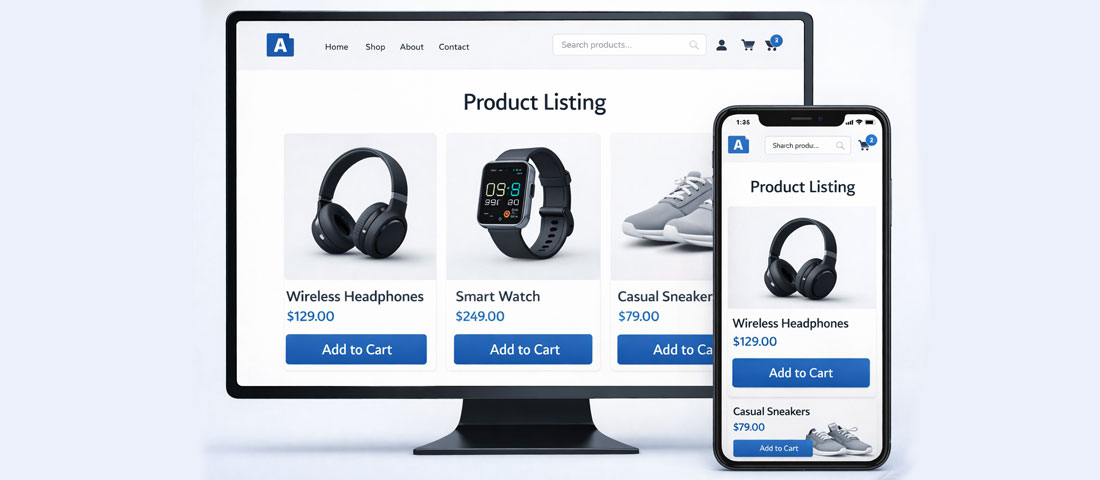
Building an online store in 2026 means choosing from a broader and more capable range of eCommerce platforms than at any previous point. Shopify has matured into a global eCommerce powerhouse. WooCommerce continues to dominate the self-hosted WordPress eCommerce space. BigCommerce, Magento, and Squarespace Commerce each serve specific niches effectively. And AI-powered personalisation, headless commerce architectures, and new payment methods are pushing all platforms to evolve rapidly.
What this guide covers
- 1. What Is an eCommerce Website?
- 2. The Essential Elements Every eCommerce Website Must Have
- 3. The Benefits of Selling Online in 2026
- 4. Types of eCommerce Platforms: Hosted vs Self-Hosted
- 5. Shopify vs WooCommerce: The Definitive Comparison for 2026
- 6. Other eCommerce Platforms Worth Considering
- 7. A Step-by-Step Decision Framework for Choosing Your eCommerce Platform
- 8. What to Prepare Before You Build Your eCommerce Store
- 9. Frequently Asked Questions About eCommerce Platforms
The right platform for your store is not the most popular one — it is the one that best matches your specific product types, your expected order volume, your technical capability, your budget, your integration requirements, and your growth trajectory. This guide covers everything you need to make that decision confidently.
What Is an eCommerce Website?
An eCommerce website is an online store — a website through which businesses sell products or services directly to customers, processing payments electronically. eCommerce has grown from a niche digital experiment in the late 1990s to one of the dominant channels of global retail — with worldwide eCommerce sales exceeding $6 trillion annually and growing every year.
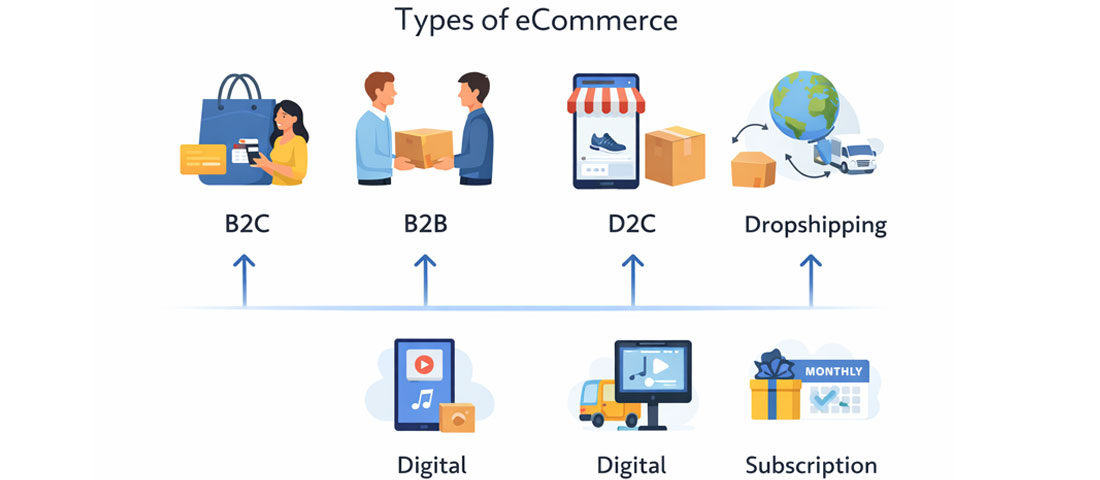
Types of eCommerce Websites
eCommerce takes many forms, and understanding which type applies to your business shapes your platform choice:
- B2C (Business to Consumer): The most common type — a business selling directly to individual customers. Fashion retailers, food brands, electronics stores, and most consumer product brands are B2C eCommerce.
- B2B (Business to Business): Selling products or services to other businesses. Often requires custom pricing, bulk ordering, account-based purchasing, and approval workflows not found in standard consumer eCommerce platforms.
- D2C (Direct to Consumer): Manufacturers or brands selling directly to end consumers, bypassing traditional retail distribution. Growing rapidly as brands seek to own the customer relationship and margin directly.
- Dropshipping: Selling products that are fulfilled directly by a supplier — the retailer holds no inventory. Lower barrier to entry; lower margin; dependent on supplier reliability and speed.
- Digital products: Selling downloadable files, software, courses, music, or other digital goods. Requires platform support for secure digital delivery and licence management.
- Subscription eCommerce: Recurring billing for physical products (subscription boxes) or services. Requires robust subscription billing capabilities not present in all eCommerce platforms.
The Essential Elements Every eCommerce Website Must Have
Regardless of platform, a successful eCommerce website in 2026 requires these non-negotiable elements:
- Product pages that convert. High-quality product images from multiple angles, detailed descriptions, specifications, sizing information where relevant, customer reviews, and a clear, prominent Add to Cart button. Mobile-optimised product pages are essential — over 60% of eCommerce traffic comes from mobile devices.
- Secure, frictionless checkout. Every additional step in the checkout process loses a proportion of customers. The checkout should: support guest checkout (not requiring account creation); offer multiple payment methods (credit/debit cards, PayPal, Apple Pay, Google Pay, Buy Now Pay Later); be clearly secure (HTTPS, trust badges); and complete in as few steps as possible.
- Site search that actually works. Visitors who use site search convert at 2 to 4 times the rate of those who do not — but only if the search returns relevant results. AI-powered site search that understands natural language queries and handles synonyms and misspellings is a meaningful conversion improvement.
- Trust signals throughout. Secure payment badges, clear return and refund policies, visible customer reviews, social proof (customer count, media mentions), and clear contact information all contribute to the trust that converts browsing visitors into paying customers.
- Mobile-first design. Your product pages, category pages, filters, cart, and checkout must all work flawlessly on a smartphone with a touch interface. Mobile checkout abandonment is significantly higher than desktop — because most mobile checkouts are poorly designed.
- Fast load times. eCommerce conversion rates are particularly sensitive to page speed. Product pages that load in under 2 seconds convert significantly better than those taking 4+ seconds. Image optimisation and caching are essential.
- Clear shipping and returns information. Customers want to know delivery times and costs before they add to cart — not discover unexpected shipping fees at checkout (one of the leading causes of cart abandonment). Prominent, clear shipping information removes this barrier.
The Benefits of Selling Online in 2026
For businesses still evaluating whether eCommerce is worth the investment, the case in 2026 is overwhelming:
- 24/7 revenue generation. Your online store takes orders while you sleep, while you are on holiday, and while you are serving other customers. No physical retail space requires this level of always-on availability.
- Global reach at low marginal cost. Selling to a customer in another city or another country through an online store costs almost no more than selling to a local customer. Geographic expansion that would require significant physical investment for a traditional retailer is achievable digitally at minimal cost.
- Data-driven insights. eCommerce platforms generate rich data on customer behaviour, purchase patterns, popular products, abandoned carts, and marketing attribution — enabling evidence-based decisions that physical retail cannot match.
- Reduced overheads compared to physical retail. No commercial rent, no retail staff during quiet periods, no display and merchandising costs. eCommerce margin structures are fundamentally different from physical retail.
- Integration with marketing channels. Social commerce (selling through Instagram, TikTok, Facebook), Google Shopping, email marketing, and influencer partnerships are all more directly measurable and optimisable for online stores than for physical retailers.
Types of eCommerce Platforms: Hosted vs Self-Hosted
eCommerce platforms divide into two fundamental categories: hosted (SaaS) platforms and self-hosted platforms. Understanding this distinction is the first step in the decision process.
Hosted platforms (Shopify, BigCommerce, Squarespace Commerce, Wix eCommerce) manage all hosting, security, software updates, and infrastructure on your behalf. You pay a monthly subscription and get a fully managed eCommerce environment. Lower technical overhead, faster to launch, but less flexibility and higher long-term cost as your business grows.
Self-hosted platforms (WooCommerce on WordPress, Magento/Adobe Commerce) require you to manage your own hosting, handle software updates, and take responsibility for server security and performance. Higher initial technical complexity, but more flexibility, no per-transaction fees, and better long-term cost at scale.
Shopify vs WooCommerce: The Definitive Comparison for 2026
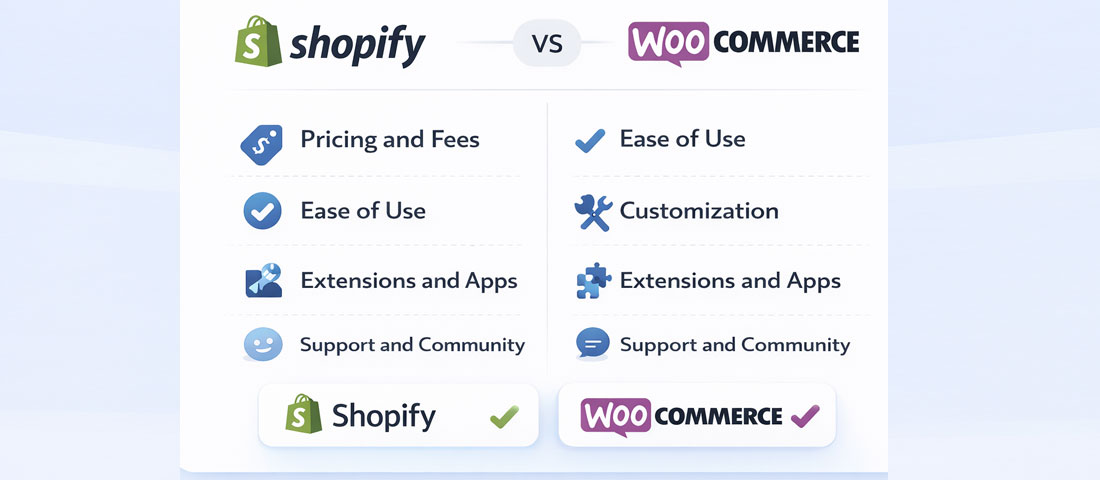
Shopify and WooCommerce are the two dominant eCommerce platforms globally — and the right choice between them depends on your specific requirements, not on which is universally “better.”
Shopify
Shopify is a fully hosted eCommerce platform — you pay a monthly subscription ($29 to $299/month for standard plans; $2,300+/month for Shopify Plus enterprise) and Shopify manages all hosting, security, platform updates, and infrastructure. It is purpose-built for eCommerce with strong out-of-the-box features, an excellent admin interface, a large app store (8,000+ apps), and the best multi-channel selling integration (Instagram, TikTok, Facebook, Google Shopping) of any eCommerce platform.
Shopify is the right choice when:
- You want a fully managed eCommerce environment with minimal technical overhead
- You need strong multi-channel selling (social commerce, marketplaces) from day one
- You are based in a market where Shopify Payments is available (avoiding per-transaction fees on third-party payment processors)
- You are dropshipping or need strong Shopify-native fulfilment integrations
- You are new to eCommerce and want to launch quickly with a proven platform
Shopify limitations to be aware of:
- Transaction fees (0.5 to 2% depending on plan) if you do not use Shopify Payments — significant at scale
- Less content and blogging flexibility than WordPress — not ideal if content marketing is a primary acquisition channel
- Customisation beyond Shopify’s Liquid template system requires developer expertise with a smaller talent pool than WordPress
- Subscription costs grow significantly as you add apps and move to higher tiers
WooCommerce
WooCommerce is a free, open-source eCommerce plugin that runs on WordPress — turning any WordPress website into a fully featured online store. It is self-hosted (you manage your own hosting and WordPress environment) and infinitely extensible through WordPress’s 60,000+ plugin ecosystem. WooCommerce powers approximately 36% of all online stores globally — more than any other platform.
WooCommerce is the right choice when:
- You already have a WordPress website and want to add eCommerce functionality
- Content marketing is a primary customer acquisition strategy — WordPress + WooCommerce delivers better blogging and SEO capabilities than Shopify
- You need deep customisation of the store’s functionality beyond what a hosted platform’s app store can deliver
- You want to avoid per-transaction fees — WooCommerce charges none at the platform level
- You have complex product types, pricing structures, or ordering workflows that exceed Shopify’s out-of-the-box capabilities
WooCommerce limitations to be aware of:
- Requires managing hosting, WordPress, and WooCommerce updates — more technical overhead than Shopify
- Performance requires active optimisation — WooCommerce on poor hosting or with a heavy theme can be slow
- Multi-channel selling (social commerce, marketplaces) requires third-party plugins and more configuration than Shopify’s native integrations
The Shopify vs WooCommerce Decision Summary
| Factor | Choose Shopify | Choose WooCommerce |
|---|---|---|
| Technical management preference | Fully managed, no server responsibility | Happy to manage own hosting and WordPress |
| Primary customer acquisition | Social commerce, paid ads, marketplaces | Content marketing, SEO, blogging |
| Product complexity | Standard products, standard variants | Complex products, custom pricing, B2B |
| Long-term cost at scale | Higher (subscription + transaction fees) | Lower (hosting + no platform transaction fees) |
| Speed to launch | Faster (managed platform) | Slightly longer (more setup required) |
| Design customisation | Good within Liquid/Shopify constraints | Complete (full WordPress flexibility) |
Other eCommerce Platforms Worth Considering
BigCommerce is a strong alternative to Shopify for larger merchants — it offers no transaction fees on any payment processor, stronger B2B features, and more flexibility on pricing rules. Best for mid-market merchants who need more than Shopify’s standard tier but less than a full Magento implementation.
Magento / Adobe Commerce is enterprise eCommerce — powerful, infinitely flexible, and significantly more expensive and technically complex to implement and maintain. Appropriate for large retailers with complex requirements and the development resources to match. Not appropriate for small to medium businesses.
Squarespace Commerce is appropriate for small, visually-focused stores where design quality is the priority and selling volume is modest. Its SEO limitations and transaction fees make it a poor choice for growth-focused eCommerce.
A Step-by-Step Decision Framework for Choosing Your eCommerce Platform
-
Define your product and order characteristics
How many products? Are they physical, digital, or both? Do you have complex variants (size, colour, material combinations)? Do you need subscription billing? Do you have B2B customers with custom pricing? Complex product structures favour WooCommerce or BigCommerce. Simple, standard product catalogues work equally well on any platform. -
Assess your primary customer acquisition strategy
If SEO and content marketing will drive most of your traffic, WooCommerce on WordPress provides better blogging and content management capabilities. If social commerce, paid ads, and marketplace integration are your primary channels, Shopify’s native multi-channel integrations are a genuine advantage. -
Calculate the three-year total cost of ownership
For Shopify, calculate: monthly subscription × 36 + app subscriptions × 36 + transaction fees (estimated as a percentage of projected revenue if not using Shopify Payments). For WooCommerce, calculate: hosting × 36 + essential paid plugins × 36 + development costs for setup and customisation. The comparison often surprises businesses — Shopify’s recurring costs compound significantly, while WooCommerce’s higher setup cost pays off over time. -
Evaluate your technical capability and team
If no one on your team is comfortable managing WordPress, updates, and basic server-level decisions, Shopify’s fully managed environment eliminates technical risk. If you have a developer relationship or technical capability in-house, WooCommerce’s flexibility and cost advantages become more accessible. -
Consider your growth trajectory
Where will your business be in three years? A platform that is right for 100 orders per month may create significant friction at 1,000 orders per month. Evaluate each platform’s capabilities at your projected scale — not just your current one.
What to Prepare Before You Build Your eCommerce Store
The most common cause of eCommerce projects running over time and over budget is starting development before the foundational decisions and assets are ready. Before commissioning a developer or agency to build your store, prepare:
- Product catalogue: All product names, descriptions, prices, variants, SKUs, and specifications in a structured spreadsheet
- Product photography: High-quality product images from multiple angles, on white or consistent background, at sufficient resolution for zoom capability
- Payment processing: Decide on your payment gateway (Stripe, PayPal, Razorpay for India-based stores) and have your merchant account ready
- Shipping strategy: Decide on your shipping zones, carriers, rates, and free shipping threshold before development begins — these affect how the checkout is configured
- Return and refund policy: Documented clearly, ready to add to the store
- Domain name: Your .com or .co.uk or appropriate domain, registered and ready to point to the store
- Brand assets: Logo in vector format, brand colour codes, any brand guidelines that should inform the store’s design
Frequently Asked Questions About eCommerce Platforms
| Which eCommerce platform is best for a small business in 2026? | For most small businesses starting out with eCommerce in 2026, either Shopify or WooCommerce is the right choice — the decision between them depends on your specific needs. Shopify is better if you want a fully managed platform with minimal technical overhead, strong multi-channel selling capabilities, and a proven hosted environment. WooCommerce is better if SEO and content marketing are primary customer acquisition strategies, if you already have a WordPress website, or if you want to avoid per-transaction fees and have more flexibility in customisation. Both platforms are mature, well-supported, and capable of growing with your business. |
| Is Shopify or WooCommerce better for SEO? | WooCommerce on WordPress has a meaningful SEO advantage over Shopify for content-driven eCommerce. WordPress’s blogging and content management capabilities are significantly more flexible than Shopify’s, making it easier to build the content marketing strategy — regular blog posts, comprehensive buying guides, SEO-optimised category pages — that drives organic search traffic. Shopify has improved its SEO capabilities significantly over the years and handles basic on-page SEO well, but its URL structure, blogging platform, and schema markup capabilities are less flexible than WordPress. For stores where organic search is a primary customer acquisition channel, WooCommerce has a genuine advantage. |
| How much does it cost to build an eCommerce website in India? | The cost of building an eCommerce website in India from a professional web design agency like Neel Networks is significantly lower than equivalent work in the USA, UK, or Australia — typically 50 to 70% less for comparable quality. A professional Shopify or WooCommerce store with custom design, product catalogue setup, payment gateway integration, and SEO foundation can typically be built for a fraction of what the same work would cost from a Western agency, without any compromise on quality or deliverables. Contact us for a specific quote based on your store’s requirements. |
| What is the difference between Shopify and WooCommerce? | Shopify is a fully hosted SaaS eCommerce platform — you pay a monthly subscription and Shopify manages all hosting, security, and platform updates. WooCommerce is a free, open-source eCommerce plugin for WordPress — you manage your own hosting and WordPress environment but have complete control and no platform transaction fees. Shopify is easier to set up and requires less technical management. WooCommerce is more flexible, more cost-effective at scale, and better integrated with WordPress’s content management and SEO capabilities. Shopify excels at multi-channel selling and social commerce. WooCommerce excels at content-driven eCommerce and complex customisation. |
| What payment gateways should an Indian eCommerce store use? | For eCommerce stores based in India, the leading payment gateway options are: Razorpay (the most widely used Indian payment gateway, supporting UPI, cards, net banking, and wallets with excellent Shopify and WooCommerce integration); PayU (another strong Indian gateway with comprehensive payment method support); and Stripe (available in India and preferred for stores with significant international customer base). For stores selling primarily to international customers, PayPal remains important as a buyer-trusted option. The right gateway depends on your customer geography, currency requirements, and the payment methods your target audience prefers. |
| How long does it take to build an eCommerce website? | The timeline for building an eCommerce website depends on the scope and complexity of the store. A focused eCommerce store with up to 100 products, standard functionality, and a custom design typically takes 8 to 12 weeks from project kickoff to launch — including discovery, design, development, product upload, payment gateway configuration, testing, and SEO setup. Larger stores with hundreds of products, complex product variants, custom functionality, ERP integrations, or B2B ordering workflows typically take 12 to 20 weeks. The most common cause of timeline extension is delays in product data, photography, and content delivery from the client — having these assets ready before the project begins significantly improves timeline outcomes. |
Ready to build your eCommerce store with the right platform and the right team?
Neel Networks builds custom eCommerce stores on Shopify and WooCommerce for businesses across the USA, UK, Canada, Australia, and India. We help you choose the right platform, design a store that converts, and integrate the tools your business needs to grow.