Top On-Page SEO Factors You Can’t Ignore in 2026

If you want to appear at the top of Google search results in 2026, publishing content alone is no longer enough. Google now evaluates pages based on usefulness, structure, credibility, and user value, not just the presence of keywords.
Because millions of pages are published every day, simply adding more content does not make a website stand out. To earn strong visibility, your pages must clearly demonstrate relevance, quality, and real benefit to users.
Google handles billions of searches every day, and its ranking systems are continuously refined using advanced algorithms and AI. As a result, competition in search results is higher than ever. Websites that perform well are those that are technically sound, clearly organized, and focused on solving user needs — not just targeting keywords.
While you cannot control Google’s algorithm updates, you can control how well your pages are optimized. Strong on-page SEO — including content quality, page structure, internal linking, and user experience — is where websites gain a real competitive advantage.
At Neel Networks, we help brands across the United Kingdom, the United States, Canada, Australia, Germany, France, India, the United Arab Emirates, Singapore, and other global markets build sustainable search visibility through solid on-page SEO practices. Our team supports businesses looking for reliable international SEO services focused on long-term growth rather than short-term tactics.
Let’s break down the most important on-page SEO factors you should focus on in 2026 — explained in a clear and practical way.
What Is On-Page SEO (Really)?
On-page SEO is not about stuffing keywords into paragraphs like people used to do in the past. It is about making each page clear, relevant, and genuinely helpful for both users and search engines.
It focuses on how your content is written, organized, and presented so that search engines can understand it easily and visitors can get value from it quickly.
On-page SEO includes:
- Clear content structure
- Search intent alignment
- Useful and complete
- Proper heading usage
- Internal linking
- Optimized images
- Strong page performance
All of these elements work together to improve how your pages are understood and ranked. Unlike backlinks and other external ranking signals, on-page SEO is fully under your control — and when done correctly, it builds long-term organic growth.
1. Search Intent Matching (Your #1 Priority)
Google does not just look for keywords like it used to. Now Google understands what people are really looking for when they search for something.
When someone searches for something
- “best CRM for small business” — comparison intent
- “SEO agency in London” — commercial intent
- How to start email marketing” — informational intent
Your content must match that purpose exactly. If someone wants a guide, give a complete guide. If they want a comparison, give structured comparisons. Format matters as much as content depth.
If your page does not fully satisfy the search need, it is unlikely to rank well — even if the site is technically strong. This is even more important now because AI-powered search results often highlight pages that give direct, complete answers.
How to get it right:
- Search for your target keyword.
- Study the top 5 results.
- Identify the format (list, guide, comparison, tool, video).
- Create something better, deeper, clearer.
2. E-E-A-T: Prove You’re Credible
Google evaluates content using E-E-A-T — Experience, Expertise, Authoritativeness, and Trustworthiness. These signals help Google decide whether your content deserves visibility, especially for competitive or high-impact topics.
With large volumes of AI-generated content now published online, credibility matters more than ever. Search engines — and users — look for content that reflects real knowledge and first-hand experience, not just generic summaries.
Business owners and decision-makers don’t want surface-level advice. They look for proof, examples, and practical insight they can trust.
How to demonstrate authority:
- Add real author bios with credentials
- Share first-hand case studies.
- Reference credible sources
- Keep your data updated.
- Get mentioned by reputable industry sites.
Trust is becoming a ranking factor — not just a branding factor.
3. Title Tags That Actually Get Clicks
Your title tag is what users see first in search results. It affects both rankings and click-through rate, so it needs to be clear, relevant, and compelling.
In competitive markets like the US, UK, and Australia, ranking isn’t enough — you need clicks.
Best practices for 2026:
- Keep it under 60 characters (prevents truncation)
- Place primary keywords near the start
- Add a hook or benefit
- Include year for freshness (“2026”)
- Avoid keyword stuffing
Example:
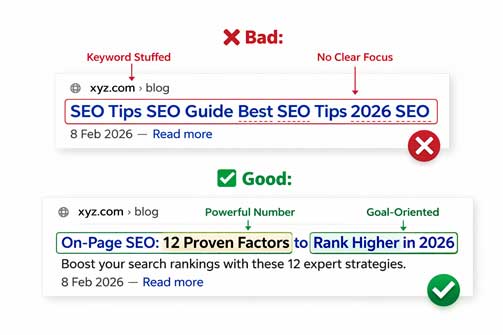
- Bad: “SEO Tips SEO Guide Best SEO Tips 2026 SEO.”
- Good: “On-Page SEO: 12 Proven Factors to Rank Higher in 2026”
4. H1 Tags
The H1 tag is the main headline of your page. It tells both users and search engines what the page is primarily about, so it should be clear, specific, and aligned with your main keyword.
Use only one H1 per page to avoid confusion and keep the topic focus strong.
Best practices
- Use a single H1 tag per page
- Include the primary keyword naturally.
- Make it readable and compelling — not robotic.
- Match it closely with the page title (but don’t duplicate word-for-word if it hurts readability)
A clear H1 improves topic understanding and keeps your page structure clean.
5. Meta Descriptions
A meta description is the short text shown under your page title in Google results. It doesn’t directly improve rankings, but it helps people decide whether to click your link or skip it.
Think of it like a short preview of your page.
Keep it:
- Length: 150-160 characters
- Include primary keyword (gets bolded in results)
- Clear value proposition
- Call-to-action
If your description is clear and useful, more people will click your result — and more clicks mean more traffic.
6. URL Structure
Your page URL is the web address people see in the browser and in search results. It should be simple and easy to read. Clean URLs help both users and search engines understand what the page is about.
If a URL looks messy or too long, people trust it less, and search engines get weaker topic signals.
Keep your URLs simple
- Include your main keyword
- Use hyphens between words (not underscores)
- Keep it short
- Remove extra words like “and”, “the”, “a.”
- Avoid dates if the content is meant to stay useful for years
Example:
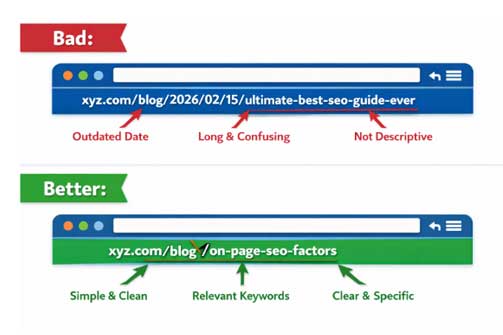
Bad: /blog/2023/03/15/ultimate-best-seo-guide-ever
Better: /blog/on-page-seo-factors
Short, clear URLs are easier to trust and easier to rank.
7. Strategic Keyword Placement
Keywords still matter, but you don’t need to repeat them again and again. Google is smart enough now to understand topic meaning and related terms. Your job is to use keywords naturally, where they make sense.
Place your main keyword in important spots so both readers and search engines quickly understand the page topic.
Where to use your keyword
- In the first paragraph
- In some subheadings (H2/H3)
- In image alt text
- Naturally, inside the content
Don’t force it. Write normally and include related words and phrases around the topic.
Example:
If your keyword is “coffee maker,” you can also mention things like brew temperature, filter type, or grind size. This helps cover the topic fully instead of repeating one phrase.
Natural usage reads better and ranks better.
8. Content Freshness
Content should not be “publish once and forget.” Over time, information becomes outdated, links break, and examples stop being relevant. When that happens, rankings can slowly drop.
Google prefers pages that stay updated and accurate, especially for topics that change often.
Your 2026 maintenance schedule:
- High-priority pages: Review monthly (news, trends, technology)
- Evergreen content: Refresh quarterly
- Cornerstone content: Expand semi-annually
What to update regularly
- Statistics and numbers
- Examples and case studies
- Industry trends
- Old screenshots or tools
- Broken or outdated links
For important pages, review them every few months and improve them where needed. Adding a “Last Updated” date can also build user trust.
Fresh content signals that your page is still useful today — not just when it was first published.
9. Internal Linking Strategy
Internal links are links from one page of your website to another page on the same site. They help users discover more useful content and help search engines understand how your pages are connected.
Good internal linking spreads authority across your site and strengthens important pages.
How to do it properly
- Link to 3–5 related pages from each article
- Use clear, descriptive link text (not “click here”)
- Link to important pages more often
- Keep key pages within a few clicks from the homepage
Example:
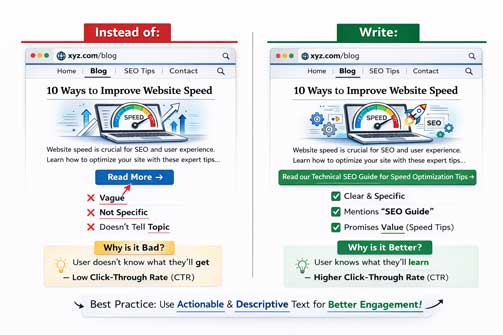
Instead of: Click here for more.
Write: Read our technical SEO guide for speed optimization tips
Clear internal links improve navigation, understanding, and rankings.
10. Image Optimisation
Images make your content more engaging, but if they are not optimized, they can slow your page and hurt user experience. Search engines also use image data to understand your page better.
Optimized images help with page speed, accessibility, and even visibility in image search.
Simple image optimization tips
- Add clear alt text that describes the image
- Keep file sizes small (compress before uploading)
- Use modern formats like WebP when possible
- Use correct image dimensions (not oversized)
- Turn on lazy loading for below-the-fold images
Alt text should describe the image in plain language and include the keyword only if it fits naturally.
Well-optimized images = faster pages + better usability.
11. Schema Markup
Schema markup is a small piece of structured code added to your page that helps search engines understand your content more clearly. It can also make your search results look richer by showing extra details like FAQs, ratings, or product info.
It doesn’t guarantee better rankings, but it can improve how your result appears and increase clicks.
Common schema types to use
- Article — for blog posts
- FAQ — for question–answer sections
- HowTo — for step-by-step guides
- Product — for product pages
- LocalBusiness — for local company details
- Review — for ratings and reviews

You can add schema using plugins or schema tools — no need to code it manually in most CMS platforms.
Schema helps search engines read your page correctly and present it better in results.
12. Core Web Vitals (Performance Matters)
Core Web Vitals are Google’s page experience metrics. They measure how fast your page loads, how quickly it responds, and how stable it looks while loading. These are confirmed ranking factors.
In simple terms: if your page is slow or jumpy, users leave — and rankings suffer.
Table
| Metric | Target | What It Measures |
| LCP (Largest Contentful Paint) | Under 2.5s | How fast main content loads |
| INP (Interaction to Next Paint) | Under 200ms | Interactivity (replaces FID in 2026) |
| CLS (Cumulative Layout Shift) | Under 0.1 | Visual stability |
Note: INP replaced FID in 2024 as the interactivity metric. It measures the entire interaction lifecycle, not just the first input.
Quick wins:
- Compress and lazy-load images
- Enable browser caching
- Minimise JavaScript and CSS
- Use a content delivery network (CDN)
- Choose fast hosting
13. Mobile-First Design
Google mainly uses the mobile version of your site for crawling and ranking. That means your pages must work well on phones — not just on desktop. If your mobile experience is poor, your rankings and conversions can both drop.
What your mobile pages should have
- Responsive design that fits all screen sizes
- Text that is easy to read without zooming
- Buttons and links that are easy to tap
- Fast loading speed on mobile networks
- No intrusive pop-ups blocking content
In major markets, most searches now happen on mobile devices, so mobile usability is no longer optional — it’s essential.
Mobile UX = ranking factor + conversion factor.
Global consideration: In countries like India, the UK, the US, and Canada, most people now search using their phones, with mobile devices making up around 60% to 80% of total search traffic in these major markets.
14. Helpful Content Compliance
Google wants to rank content that truly helps users — not pages written just to target keywords. If your page doesn’t fully answer the reader’s question, it’s less likely to perform well.
How to keep content helpful
- Write for people first, not search engines
- Give complete, clear answers
- Add original insights or examples
- Avoid filler and keyword stuffing
- Share real experience where possible
A good self-check: after reading your page, would someone still need to search again? If yes, improve the content further.
Helpful content builds trust — and trust supports rankings.
15. Optimising for AI Search

Google now shows AI-generated answers and summaries directly in search results. To get picked for these, your content needs to be clear, structured, and straight to the point.
Pages that answer questions quickly and clearly have a better chance of being used in AI results.
How to improve your chances
- Give a clear answer early on the page
- Use question-style headings
- Add short, direct explanations
- Include an FAQ section where relevant
- Keep paragraphs short and focused
Avoid long, vague introductions before the real answer. Clear and well-structured content performs better in both normal search and AI-powered results.
Your On-Page SEO Checklist (Before You Publish)
Use this quick checklist before publishing any page. It helps you catch the most important on-page SEO points in one place.
Content check
- Search intent is clear and fully matched
- The main keyword appears in the first paragraph
- Related terms are used naturally
- Content gives complete and useful answers
- Internal links to relevant pages are added
Page setup check
- Title tag is clear and under ~60 characters
- One H1 tag is used
- Meta description is written and compelling
- Images have proper alt text
- URL is short and keyword-focused
Technical check
- Page loads fast
- Mobile layout works properly
- No broken links
- Images are compressed
- Schema markup added where useful
Run this once before publishing, and you’ll avoid most common on-page SEO mistakes.
Why Do Businesses Choose Neel Networks?
If you want on-page SEO done properly without trial and error, working with experienced professionals can save time and deliver more consistent results.
Neel Networks provides structured, data-driven SEO support for businesses across the globe. Whether companies need scalable international SEO services or consistent and affordable SEO services, the focus remains on long-term rankings built through strong fundamentals — not short-term tricks.
Our on-page SEO services include
- Full website audits
- Keyword research and content planning
- On-page content optimization
- Technical SEO fixes
- Performance tracking and reporting
Ready to climb the rankings? Contact Neel Networks today for a free SEO consultation.
Frequently Asked Questions
Is on-page SEO enough to rank?
On-page SEO builds the foundation. However, competitive keywords also require quality backlinks and authority signals.
How often should I update content?
Review high-performing pages every 3–6 months.
Does schema guarantee rich snippets?
No. Schema makes pages eligible, but Google decides whether to display rich results.
How long does on-page SEO take to show results?
Typically, 4–12 weeks, depending on competition and domain authority.
Conclusion
On-page SEO in 2026 isn’t about gaming the algorithm. It is about building pages that are clear, useful, fast, and trustworthy.
Focus on:
- Clear structure
- Helpful content
- Strong user experience
- Good performance
When you get these basics right, your pages are more likely to rank and stay stable through updates. Create content that truly helps users, organize it well, and keep it updated — that’s the formula that lasts.